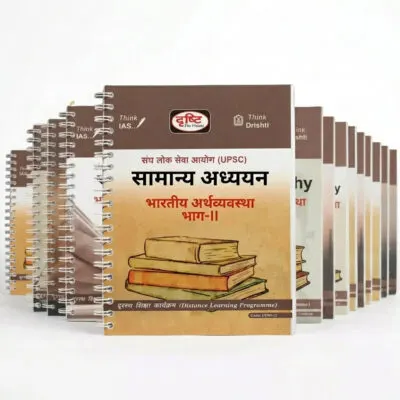
Drishti IAS International Relations Notes 2025-26

1 Booklet | Hindi Medium | UPSC Study Material
Key Highlights:
📘 1 Booklets
📚 International Relations
🎓 Drishti IAS
🏷️ Printed
🇬🇧 Hindi Medium
₹488
🌀 spiral
📘 book-binding
Only 33 sets left
Selling fast (57 sold this week)
5% OFF Use UPSC5% (COD Available)
10% OFF Use UPI10 (UPI Only)
Secure Payment
Fast Delivery
Safe Packaging

About Drishti IAS IR Notes 2025-26

The Drishti IAS IR Notes 2025-26 is a printed UPSC study material set sold by UPSC Store — India’s trusted source for genuine, latest-batch civil services preparation books. This page covers full booklet details, syllabus coverage, pricing, shipping, and frequently asked questions. Useful for UPSC CSE, BPSC, UPPSC, MPPSC, RAS and other state PSC examinations.

Drishti IAS International Relations Notes 2025-26 — 6 Hindi Medium Printed Booklets for UPSC GS Paper II

Related: Drishti IAS notes · International Relations notes

Product Overview

FeatureDetails
Booklets Count6 Individual Printed Booklets — Full GS Paper II International Relations Coverage
LanguageHindi Medium (हिंदी माध्यम) — Naturally Written, Not Translated
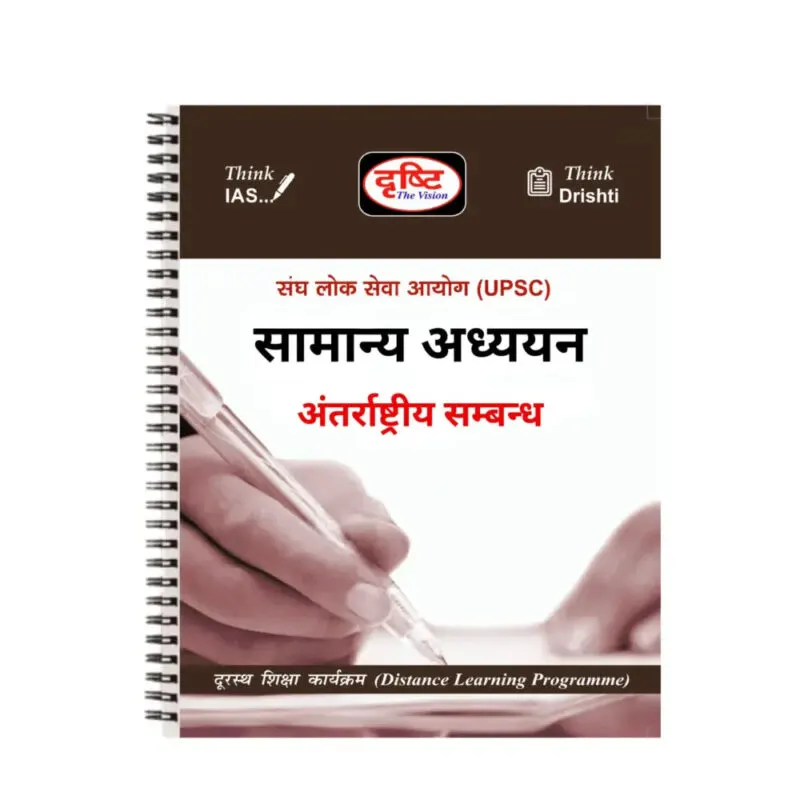
PublisherDrishti IAS (Think IAS | Think Drishti — Distance Learning Programme)
Edition2025-26 — Latest Genuine Batch
ConditionBrand New, Unmarked, Fresh Stock
FormatHigh-Quality Printed Booklets — Spiral or Book Binding
Paper Quality75 GSM Ultra-White — Highlighter Safe, Zero Bleed-Through
ShippingPan India Delivery in 3-5 Business Days — Tracked
Also Useful ForBPSC, UPPSC, MPPSC, RAS and all State PSC Examinations

Complete Booklet Catalog

The Drishti IAS International Relations Notes 2025-26 set covers the entire UPSC GS Paper II अंतर्राष्ट्रीय सम्बन्ध syllabus across 6 well-organized printed booklets, written in naturally flowing Hindi — not mechanically translated from English. This set is specifically designed for Hindi medium UPSC aspirants appearing in UPSC Civil Services Mains and is equally valuable for State PSC examinations like BPSC, UPPSC, MPPSC, and RAS that follow a similar GS pattern.

  • Booklet 1: भारत और उसके पड़ोसी देश (India and Its Neighbours) — भारत-पाकिस्तान संबंध, भारत-चीन संबंध, भारत-नेपाल, भारत-श्रीलंका, भारत-बांग्लादेश, भारत-म्यांमार, भारत-भूटान और भारत-अफगानिस्तान द्विपक्षीय संबंध। सीमा विवाद, व्यापार संबंध, सांस्कृतिक कूटनीति और ऐतिहासिक पृष्ठभूमि सहित UPSC Mains के लिए महत्वपूर्ण सभी पहलू शामिल।
  • Booklet 2: भारत और वैश्विक शक्तियाँ (India and Global Powers) — भारत-अमेरिका संबंध, भारत-रूस संबंध, भारत-यूरोपीय संघ, भारत-जापान, भारत-इजरायल। रणनीतिक साझेदारी, रक्षा सहयोग, परमाणु समझौते, व्यापार और प्रौद्योगिकी सहयोग। UPSC GS Paper II के प्रमुख विषयों पर केंद्रित विश्लेषणात्मक सामग्री।
  • Booklet 3: अंतर्राष्ट्रीय संगठन एवं संस्थाएँ (International Organisations and Institutions) — संयुक्त राष्ट्र और उसकी प्रमुख संस्थाएँ, विश्व व्यापार संगठन, IMF, विश्व बैंक, G-20, G-7, SCO, BRICS, ASEAN, SAARC। प्रत्येक संगठन की संरचना, कार्यप्रणाली, भारत की भूमिका और हालिया विकास।
  • Booklet 4: भारतीय विदेश नीति (Indian Foreign Policy) — भारतीय विदेश नीति के मूल सिद्धांत, पंचशील, गुटनिरपेक्षता से नई-गुटनिरपेक्षता तक, पड़ोसी पहले नीति, एक्ट ईस्ट पॉलिसी, नेबरहुड फर्स्ट, इंडो-पैसिफिक विज़न। भारत की बहुपक्षीय कूटनीति और वैश्विक शासन में भारत की भागीदारी।
  • Booklet 5: वैश्विक मुद्दे एवं चुनौतियाँ (Global Issues and Challenges) — आतंकवाद और उग्रवाद, साइबर सुरक्षा, जलवायु कूटनीति, परमाणु अप्रसार, संयुक्त राष्ट्र सुधार, वैश्विक स्वास्थ्य शासन, खाद्य सुरक्षा और ऊर्जा भू-राजनीति। UPSC Mains GS Paper II के उत्तर लेखन के लिए केस स्टडी सहित।
  • Booklet 6: समसामयिक अंतर्राष्ट्रीय सम्बन्ध (Contemporary International Relations — Current Affairs Integration) — 2024-25 की प्रमुख वैश्विक घटनाएँ, रूस-यूक्रेन संघर्ष और भारत की स्थिति, मध्य-पूर्व संकट, हिंद-प्रशांत क्षेत्र में बदलती शक्ति संरचना, क्वाड, I2U2, IMEC कॉरिडोर, तथा UPSC 2025-26 की दृष्टि से महत्वपूर्ण समसामयिक मुद्दे।

In-Depth Content Breakdown: Booklet by Booklet

Booklet 1: भारत और उसके पड़ोसी देश (India and Its Neighbours)

This booklet covers the most heavily tested segment of UPSC GS Paper II — India’s bilateral relationships with its immediate neighbours. Topics include the historical background of India-Pakistan relations, Line of Control disputes, and peace process timelines. India-China relations are treated with special depth: border disputes including Galwan Valley, Doklam, and the evolving LAC situation. India-Nepal relations, the open border treaty, the revised map controversy, and connectivity projects are explained with clarity that makes Hindi-medium answer writing straightforward and precise for UPSC Mains 2025-26.

The second half of this booklet focuses on India’s maritime neighbourhood — Sri Lanka, Bangladesh, and Maldives — with sections on India’s role in the Sri Lankan economic crisis, the Teesta River water-sharing issue with Bangladesh, and India’s challenge of managing Chinese influence in the Indian Ocean Region. The booklet uses structured comparison tables for quick revision, maps illustrating disputed territories, and answer-framework boxes that directly align with UPSC Mains question patterns, making this an indispensable resource for any Hindi medium aspirant preparing for GS Paper II.

Booklet 2: भारत और वैश्विक शक्तियाँ (India and Global Powers)

India’s relationships with major global powers form a central pillar of UPSC GS Paper II, and this booklet addresses each bilateral relationship with analytical depth. The India-USA section covers the foundational agreements — LEMOA, COMCASA, BECA — alongside the evolution from estrangement to strategic partnership, the civil nuclear deal, and the H1B visa debate. India-Russia relations are examined through the lens of the Ukraine conflict: how India balances its traditional defence partnership with Russia while maintaining ties with the West, oil purchase decisions, and the S-400 issue. All content is written in fluent, natural Hindi.

The India-Japan section explains the special strategic and global partnership, bullet train project, defence cooperation, and the Indo-Pacific convergence. India-Israel relations are covered with focus on defence technology, agricultural cooperation, and the Abraham Accords’ implications for India’s West Asia policy. Each bilateral section concludes with a “UPSC की दृष्टि से” (From UPSC’s Perspective) box highlighting which aspects are most likely to be asked in Mains, previous year question references, and model answer outlines — all in Hindi — making this booklet a buy-worthy addition for 2025-26 aspirants.

Booklet 3: अंतर्राष्ट्रीय संगठन एवं संस्थाएँ (International Organisations and Institutions)

International organisations form the backbone of the UPSC GS Paper II syllabus under the section on “Important International Institutions, agencies and fora — their structure, mandate.” This booklet systematically covers the United Nations system — General Assembly, Security Council (including India’s permanent membership demand), ECOSOC, ICJ, and UN specialised agencies like WHO, UNESCO, and ILO. The IMF and World Bank are explained with their voting structures, SDR allocation, governance reforms, and India’s position on Bretton Woods institutions reform. The content is structured for direct answer writing in Hindi medium UPSC Mains.

Groupings like G-20, G-7, BRICS, and SCO receive dedicated treatment covering their founding history, membership, India’s role, and significance for UPSC. Regional organisations — ASEAN, SAARC, BIMSTEC, and IORA — are covered with India’s engagement, recent summits, and their relevance to India’s neighbourhood and Act East Policy. Each organisation section includes a ready-reference “संरचना एवं कार्य” (Structure and Function) table alongside a “भारत की भूमिका” (India’s Role) summary paragraph, giving Hindi medium aspirants a structured framework for both prelims and mains preparation.

Booklet 4: भारतीय विदेश नीति (Indian Foreign Policy)

Understanding the philosophical and strategic foundations of India’s foreign policy is essential for any UPSC aspirant. This booklet begins with Nehru’s idealism, Panchsheel, and the Non-Aligned Movement, tracing the evolution through Indira Gandhi’s realism, Rajiv Gandhi’s reforms, Vajpayee’s Look East pivot, and Modi-era doctrines. The “Neighbourhood First” policy, Act East Policy, and Indo-Pacific Vision are explained with specific examples, achievements, and critiques. India’s diaspora diplomacy, cultural outreach through ICCR, and soft power projection are covered as distinct sub-topics aligned with UPSC syllabus keywords in Hindi.

The booklet dedicates a full chapter to India’s multilateral diplomacy — how India engages in the UN, WTO, climate negotiations (UNFCCC/COP), and global health forums. India’s stand on Permanent Membership of the UN Security Council, nuclear doctrine, and its position on international law regarding the South China Sea are covered with answer-ready explanations in Hindi. A special section on “भारतीय विदेश नीति की चुनौतियाँ” (Challenges to Indian Foreign Policy) provides balanced critical analysis useful for 250-word UPSC Mains answers, along with model introductions and conclusions in Hindi.

Booklet 5: वैश्विक मुद्दे एवं चुनौतियाँ (Global Issues and Challenges)

This booklet addresses the cross-cutting global challenges that regularly appear in UPSC GS Paper II. Terrorism and counter-terrorism receive thorough coverage: FATF, NSG, global terror financing networks, cross-border terrorism, and India’s position in multilateral forums. Cyber security is treated as a distinct foreign policy domain — Budapest Convention, India’s cyber diplomacy, state-sponsored cyber attacks, and the geopolitics of data sovereignty. Nuclear non-proliferation covers the NPT regime, CTBT, India’s nuclear doctrine, Wassenaar Arrangement, and the geopolitics of the Iran nuclear deal (JCPOA) — all presented in Hindi with conceptual clarity.

Climate diplomacy receives focused attention: Paris Agreement, UNFCCC COP outcomes, India’s NDCs, the Common But Differentiated Responsibilities (CBDR) principle, climate finance debates, and India’s International Solar Alliance initiative. Energy geopolitics — oil price politics, Strait of Hormuz, India’s energy security, and Arctic Council developments — are covered as integrated topics. Each global issue section includes a “भारत का पक्ष” (India’s Position) column alongside a “वैश्विक परिप्रेक्ष्य” (Global Perspective) column, enabling aspirants to write balanced, multi-dimensional UPSC Mains answers entirely in Hindi with confidence.

Booklet 6: समसामयिक अंतर्राष्ट्रीय सम्बन्ध (Contemporary International Relations)

The final booklet in the Drishti IAS International Relations Notes 2025-26 set bridges static syllabus content with current affairs — the combination that UPSC consistently tests. The Russia-Ukraine conflict is covered from its pre-2022 origins through 2024-25 developments, India’s abstentions at the UN, Rupee-Rouble trade, grain corridor implications, and impact on global food and energy prices. The Israel-Hamas conflict, India’s evolving stance, humanitarian law dimensions, and implications for India’s West Asia policy are examined through a UPSC GS Paper II lens with model answer structures provided in Hindi.

This booklet also covers the rise of new groupings reshaping global order: QUAD and its Indo-Pacific security architecture, I2U2 (India-Israel-UAE-USA), the India-Middle East-Europe Economic Corridor (IMEC), and the shifting dynamics within BRICS following its 2024 expansion. China’s Belt and Road Initiative and India’s connectivity alternatives — like the International North-South Transport Corridor (INSTC) — are compared in a structured table. A dedicated “UPSC 2025-26 के लिए महत्वपूर्ण मुद्दे” section lists anticipated exam topics, making this booklet an essential buy for any Hindi medium UPSC aspirant targeting Mains 2025-26.

Physical Construction and Quality Standards

Every booklet in this Drishti IAS International Relations 2025-26 set is manufactured to withstand the rigors of daily UPSC preparation — from repeated revision sessions and margin annotations to travel between coaching centers and libraries across India.

Paper Quality: 75 GSM Anti-Glare White Paper

Each booklet uses 75 GSM ultra-white paper chosen specifically for UPSC study use. The high opacity ensures zero bleed-through when you use multiple highlighter colors or write with gel pens for margin notes — essential for color-coded revision strategies popular among Hindi medium UPSC aspirants. The anti-glare surface reduces eye strain significantly during long study sessions of 6-8 hours, which is typical in the intensive Mains preparation phase. The paper thickness also prevents ink show-through even with dark permanent markers.

Printing Technology: High-Resolution Laser Printing

All six booklets are printed using high-resolution laser printing technology that produces razor-sharp Hindi text — ensuring that complex Devanagari conjunct characters (संयुक्त अक्षर) print clearly without smudging or blurring. Maps showing India’s neighbourhood, geopolitical regions, and trade routes are reproduced with precision that makes geographic details legible. Flowcharts illustrating foreign policy frameworks and organizational structures of international bodies are printed with permanent toner that remains smudge-proof even after extended handling. No ink fading over time.

Binding and Durability

These booklets come in either spiral or book binding depending on print batch — both formats chosen for durability through months of intensive UPSC use. Spiral binding allows the booklet to lie completely flat on a study desk, making it easy to write notes alongside the printed text without fighting the spine. Book binding offers compact storage in a bookshelf alongside other GS materials. Both formats feature a 300 GSM laminated cover that resists moisture, bending, and corner damage during transit and daily handling throughout the preparation cycle.

Key Features and Study Design

These notes are designed specifically for Hindi medium UPSC aspirants who need GS Paper II International Relations material written in natural, fluent Hindi — not translated from English — and structured to produce high-scoring Mains answers.

  • Natural Hindi Writing — Not Translated: Drishti IAS has a distinct advantage in the Hindi medium UPSC market — the content is originally conceived and written in Hindi by subject experts, producing prose that reads naturally and enables Hindi medium aspirants to internalize concepts without the awkwardness of translated text.
  • UPSC Mains Answer Framework Boxes: Each major topic includes structured answer-writing frameworks in Hindi — introduction lines, body structure pointers, and conclusion formats — directly mapped to the 10-mark and 15-mark UPSC Mains question patterns for GS Paper II International Relations.
  • Integrated Current Affairs (2024-25): Static syllabus content is seamlessly integrated with relevant 2024-25 developments — Russia-Ukraine, BRICS expansion, QUAD summits, India-China border updates — eliminating the need for a separate current affairs source for International Relations topics in UPSC preparation.
  • Comparison Tables and Structured Maps: Complex bilateral relationships and multi-country groupings are presented through side-by-side comparison tables, organization charts, and labeled maps that enable quick visual revision and are particularly effective for last-month UPSC Mains revision.
  • Useful for Prelims and Mains Both: While primarily designed for UPSC Mains GS Paper II, the factual content, dates, membership lists, and agreement details are structured to double as prelims revision material — giving aspirants efficient dual-use study material that saves time in the 12-18 month UPSC preparation cycle.

Shipping, Packaging and Delivery

All six booklets of the Drishti IAS International Relations Notes 2025-26 set are dispatched in transit-safe packaging designed to protect printed study material during Pan India delivery. Each set is first individually shrink-wrapped to prevent moisture ingress and surface scuffing. The bundle is then placed inside a double-walled corrugated cardboard box with foam edge protectors at each corner. A rigid backing board prevents the booklets from bending during handling at courier sorting hubs. The package is sealed with tamper-evident tape and labeled with a tracked shipping label before dispatch.

Orders are dispatched within 24 hours of payment confirmation and reach any address across India within 3-5 business days via tracked courier service. You will receive a tracking ID via WhatsApp and email immediately upon dispatch. For any queries about your order, delayed delivery, or missing booklets, contact our team on WhatsApp at +91 70045 49563 — missing or damaged booklets are replaced within 48 hours of complaint. We deliver to all major cities and PIN codes including Delhi, Mumbai, Patna, Lucknow, Jaipur, Bhopal, Hyderabad, Chennai, Kolkata, and all Tier-2 and Tier-3 cities.

Frequently Asked Questions (FAQ)

Q1: Is Drishti IAS International Relations notes enough for UPSC Mains GS Paper II?

A: These 1 Booklet cover the complete UPSC GS Paper II International Relations syllabus — India’s neighbours, global powers, international organisations, foreign policy, global issues, and contemporary developments. For most Hindi medium aspirants, this set combined with regular newspaper reading (The Hindu or Dainik Jagran) provides sufficient preparation for both Prelims and Mains. Supplementing with previous year question practice is recommended for answer-writing improvement.

Q2: What is the paper quality? Can I use a highlighter?

A: These booklets use 75 GSM ultra-white paper chosen for high opacity — multiple highlighter colors and gel pens work without bleed-through to the reverse side, ideal for color-coded revision. The anti-glare surface also reduces eye strain during extended study sessions, and the paper handles both ballpoint and gel pen annotations cleanly without smudging or tearing during normal study use.

Q3: Are Drishti IAS notes available in Hindi medium for International Relations?

A: Yes — this complete 1-booklet set is entirely in Hindi medium (हिंदी माध्यम). The key advantage is that Drishti IAS writes its Hindi content originally in Hindi rather than translating from English, resulting in naturally flowing prose that Hindi medium aspirants find far easier to read, retain, and reproduce in UPSC Mains answer sheets compared to translated material from other institutes.

Q4: How many booklets does the Drishti IAS International Relations notes set have?

A: This set contains exactly 6 printed booklets covering: (1) India and Its Neighbours, (2) India and Global Powers, (3) International Organisations, (4) Indian Foreign Policy, (5) Global Issues and Challenges, and (6) Contemporary International Relations with 2024-25 current affairs integration. Each booklet is separately bound, allowing you to carry only the relevant booklet to coaching classes or revision sessions.

Q5: Is Drishti IAS International Relations notes updated for the 2025-26 syllabus?

A: Yes, this is the genuine 2025-26 batch edition from Drishti IAS’s Distance Learning Programme. The content includes updates up to 2024-25 — covering BRICS 2024 expansion, India-China border resolution developments, QUAD summit outcomes, IMEC corridor, and other recent international events that are relevant for UPSC Civil Services Mains 2025-26. You will receive fresh, unmarked stock directly from the current print batch.

Q6: Which is better for UPSC Hindi medium — Drishti IAS or Vision IAS notes for International Relations?

A: Both are respected sources. Drishti IAS notes are considered stronger for Hindi medium aspirants because the content is originally authored in Hindi, producing more natural and fluent text. Vision IAS Hindi notes are a translation from their English material and may feel slightly stilted in places. If Hindi is your medium of expression in UPSC Mains, Drishti IAS notes typically produce better answer writing fluency and are preferred by many successful Hindi medium candidates.

Q7: Can I buy Drishti IAS International Relations notes online?

A: Yes — you can buy these Drishti IAS International Relations Notes 2025-26 online directly through this store. Place your order here, and the complete 1-booklet printed set will be dispatched from our Mukherjee Nagar, Delhi location within 24 hours. Pan India delivery takes 3-5 business days via tracked courier. You can also reach us on WhatsApp at +91 70045 49563 to confirm availability before placing your order.

Q8: Are these notes sufficient for both UPSC Prelims and Mains International Relations?

A: These booklets are primarily structured for UPSC Mains GS Paper II answer writing, but the factual content — membership of organisations, bilateral agreement dates, foreign policy doctrines, and institutional mandates — is structured to serve as prelims revision material as well. Many aspirants use the organization membership tables and agreement fact-boxes for Prelims MCQ preparation, making this set a dual-use resource that saves both time and money during UPSC preparation.

Q9: Are these notes useful for State PSC exams like BPSC, UPPSC, and MPPSC?

A: Absolutely. These Drishti IAS International Relations Notes are highly relevant for BPSC, UPPSC, MPPSC, RAS, and other State PSC examinations that include General Studies Paper II with an International Relations component. Since these are written in Hindi, they are particularly convenient for aspirants preparing for Hindi-medium State PSC exams. The coverage of India’s foreign policy, neighbourhood relations, and international organisations aligns well with State PSC GS syllabuses.

Q10: What is the Distance Learning Programme (DLP) mentioned on the cover?

A: Drishti IAS’s Distance Learning Programme (DLP) — also identified as “Think IAS | Think Drishti” — is the institute’s correspondence-based study programme that delivers high-quality printed study material to aspirants across India who cannot attend the Delhi coaching center in person. These notes are part of that same DLP curriculum, offering the same content quality that Drishti IAS classroom students receive, now available to buy online for home delivery across India.

Q11: How should I use these 1 Booklet in my UPSC study schedule?

A: Begin with Booklet 4 (Indian Foreign Policy) to establish the conceptual foundation, then study Booklets 1 and 2 for bilateral relationships. Follow with Booklet 3 for international organisations, then Booklet 5 for thematic global issues. Save Booklet 6 (Contemporary International Relations) for the last phase of preparation when you integrate current affairs. Revise all 1 Booklet at least twice before UPSC Mains using the comparison tables and answer-framework boxes provided in each booklet.

Q12: What if a booklet is missing or damaged when I receive my order?

A: Every order is packed with transit-safe packaging including corrugated boxes and corner protectors. However, if any booklet arrives damaged or is missing from your set, simply WhatsApp a photo of the received package to +91 70045 49563 within 48 hours of delivery. Our team will dispatch a replacement booklet within 48 hours of receiving your complaint at no additional cost. Customer satisfaction is our priority, and we ensure every buyer receives a complete, usable set.

Summary

SpecificationValue
Booklets6 Printed Booklets — Complete UPSC GS Paper II International Relations
LanguageHindi Medium (हिंदी माध्यम) — Originally Written in Hindi
PublisherDrishti IAS — Think IAS | Think Drishti (Distance Learning Programme)
Edition2025-26 — Latest Genuine Batch
Paper75 GSM Ultra-White — Highlighter Safe, Zero Bleed-Through
BindingSpiral or Book Binding with 300 GSM Laminated Cover
ConditionBrand New, Unmarked, Fresh Stock
Delivery3-5 Business Days Pan India — Tracked Courier
Also Useful ForBPSC, UPPSC, MPPSC, RAS and all State PSC Examinations
ContactWhatsApp: +91 70045 49563

Sold by UPSC Store — Mukherjee Nagar, Delhi’s trusted source for printed UPSC study material. Buy Drishti IAS International Relations Notes 2025-26 online today and receive your complete 1-booklet Hindi medium set with pan India delivery in 3-5 days.

Reference: UPSC official syllabus

Customer Reviews 220

4.5
Based on 220 reviews
5★
131
4★
65
3★
24
2★
0
1★
0
S
Sameer Verma
23 Apr 2026
✓ Verified

Material bahut structured hai. Delivery time thoda zyada tha but content worth it.

P
Pooja Deshmukh
23 Apr 2026
✓ Verified

Booklets mein kaafi information hai lekin kuch topics zyada detailed hote to aur achcha hota. Fir bhi decent material hai.

K
Kavya Reddy
22 Apr 2026
✓ Verified

Very comprehensive aur well-organized, IR samajhne mein bahut help mila.

M
Manish Tiwari
19 Apr 2026
✓ Verified

Booklets bahut well-organized hain aur samajhne mein easy hai.

P
Priya Sharma
18 Apr 2026
✓ Verified

6 booklets mein sab kuch cover hai. Drishti ka quality hamesha best hota hai.

H
Harsh Mishra
17 Apr 2026
✓ Verified

Ye booklets padhne ke baad confidence badh gaya. Content crystal clear hai.

N
Nikhil Chakraborty
14 Apr 2026
✓ Verified

Drishti ke notes se IR concepts bilkul clear ho gaye hain.

A
Ananya Mishra
02 Apr 2026
✓ Verified

Bilkul mast, sab kuch clear ho gaya padh kar.

🛍️

Aspirants Also Bought

More from the same category

View All

About Drishti IAS International Relations Notes 2025-26

Drishti IAS International Relations Notes 2025-26 is a highly recommended UPSC study material from Drishti IAS, specially designed for International Relations preparation. Available in Hindi medium, this material is crafted to match the exact requirements of the UPSC Civil Services Examination syllabus — covering both Prelims and Mains comprehensively.

Product Details

  • Institute: Drishti IAS
  • Subject: International Relations
  • Medium: Hindi
  • Format: Printed
  • Delivery: Pan-India delivery in 3–5 working days
  • Format: Original printed material, verified authentic

Why Buy from UPSC Store?

  • 100% Genuine Printed Material — Original printed notes, no photocopies or fake copies
  • Fast Delivery — Ships within 24 hours, arrives in 3–5 days pan-India
  • Secure Packaging — Bubble-wrapped and boxed to prevent damage in transit
  • Trusted by 10,000+ Aspirants — India's most reliable UPSC material marketplace
  • WhatsApp Support — Get expert guidance on material selection before ordering

Frequently Asked Questions

Is this product 100% original?

Yes, all products at UPSC Store are 100% genuine printed materials. We do not sell photocopies or fake copies.

How long does delivery take?

Orders are dispatched within 24 hours and delivered across India in 3–5 working days via reputed courier partners.

Can I return the product?

Yes, we accept returns within 7 days if the product is damaged or incorrect. Check our refund policy for details.

Which other study materials should I buy with this?

We recommend pairing this with current affairs notes and a UPSC test series for comprehensive preparation. Browse more in Drishti IAS, General Studies, International Relations, UPSC.