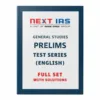



Next IAS General Studies Prelims Test Series 2026-27
About Next IAS GS Prelims Test
The Next IAS GS Prelims Test is a printed UPSC study material set sold by UPSC Store β India’s trusted source for genuine, latest-batch civil services preparation books. This page covers full booklet details, syllabus coverage, pricing, shipping, and frequently asked questions. Useful for UPSC CSE, BPSC, UPPSC, MPPSC, RAS and other state PSC examinations.
Next IAS General Studies Prelims Test Series 2026-27 β 45 English Medium Printed Booklets for UPSC CSE Prelims
Related: Next IAS notes Β· Test series
Product Overview
| Feature | Details |
|---|---|
| Booklets Count | 45 Individual Printed Booklets β Full GS Prelims Test Series with Solutions (GS Paper I + GS Paper II CSAT) |
| Language | English Medium |
| Publisher | Next IAS (A Unit of Made Easy Group) β General Studies Prelims Test Series |
| Edition | 2026-27 β Latest Genuine Batch |
| Condition | Brand New, Unmarked, Fresh Stock |
| Format | High-Quality Printed Booklets β Spiral or Book Binding |
| Paper Quality | 75 GSM Ultra-White β Highlighter Safe, Zero Bleed-Through |
| Shipping | Pan India Delivery in 3-5 Business Days β Tracked |
| Also Useful For | BPSC, UPPSC, MPPSC, RAS and all State PSC Prelims Examinations |
Complete Booklet Catalog
The Next IAS General Studies Prelims Test Series 2026-27 is a 45-booklet printed series built for UPSC CSE aspirants targeting Prelims 2026 and 2027. Each booklet contains a full-length or subject-specific mock test with a separate answer key and detailed explanations booklet, covering every topic tested in GS Paper I and GS Paper II (CSAT) as per the official UPSC Prelims syllabus.
- Booklets 1β2: History of India β Ancient India Test + Solutions β Indus Valley Civilization, Vedic Age, Maurya and Gupta Empires, post-Gupta polities, temple architecture, land revenue systems, bhakti and Sufi movements, trade routes, important dynasties and their administrative structures as per UPSC Prelims GS Paper I requirements.
- Booklets 3β4: History of India β Medieval India Test + Solutions β Delhi Sultanate, Mughal administration, Vijayanagara Empire, Maratha polity, Bhakti saints, Sufi orders, regional kingdoms, architecture of medieval period, socio-economic conditions, and revenue systems β all mapped to UPSC Prelims question patterns.
- Booklets 5β6: Modern Indian History Test + Solutions β British expansion and administrative policies, socio-religious reform movements, the 1857 uprising, Indian National Congress, mass movements (Non-Cooperation, Civil Disobedience, Quit India), partition, princely states integration, and important personalities of the freedom struggle.
- Booklets 7β8: Indian National Movement β In-Depth Test + Solutions β Extremism vs Moderates, revolutionary movements, Gandhi’s leadership, constitutional developments (Morley-Minto, Montague-Chelmsford, Government of India Acts), Round Table Conferences, Ambedkar and Dalit movements, and Subhas Chandra Bose and INA.
- Booklets 9β10: Indian and World Geography β Physical Geography Test + Solutions β Geomorphology, climatology, oceanography, interior of the earth, rock types, weathering, landforms, atmospheric pressure belts, monsoon systems, ocean currents, tides, coral reefs, and world biomes as tested in UPSC Prelims GS Paper I.
- Booklets 11β12: Indian Geography β Economic and Human Geography Test + Solutions β Major soil types, Indian rivers and drainage systems, agricultural patterns, irrigation systems, forest types, wildlife sanctuaries and national parks, mineral distribution, energy resources, population distribution, urbanisation, and transport networks across India.
- Booklets 13β14: World Geography Test + Solutions β Physical geography of continents, major mountain ranges, important rivers and lakes of the world, climate zones, natural vegetation, world agricultural regions, important straits, passes, islands, and geographical phenomena relevant to UPSC Prelims standard questions.
- Booklets 15β16: Indian Polity and Governance Test + Solutions β Constitution of India, Preamble, Fundamental Rights, Directive Principles, Fundamental Duties, Union and State Executives, Parliament, State Legislatures, Judiciary, Constitutional Amendments, Emergency Provisions, local self-government, and important Supreme Court judgments asked in UPSC Prelims.
- Booklets 17β18: Polity β Constitutional Bodies and Governance Test + Solutions β Election Commission, UPSC, CAG, Finance Commission, National Commissions, Attorney General, Advocate General, regulatory bodies, tribunals, cooperative societies, anti-defection law, Schedule 10, Governor’s role, Centre-State relations, and inter-state water disputes.
- Booklets 19β20: Indian Economy β Basics and Macro Test + Solutions β National income concepts, GDP, GNP, NNP, fiscal policy, monetary policy, RBI functions and instruments, inflation indices (CPI, WPI), banking sector, types of budgets, FRBM Act, balance of payments, and key economic indicators tested repeatedly in UPSC CSE Prelims.
- Booklets 21β22: Indian Economy β Planning, Agriculture and Industry Test + Solutions β Five Year Plans, NITI Aayog, Green Revolution, agricultural schemes, MSP, food security, Public Distribution System, important industries, industrial policies, SEZs, FDI norms, Make in India, Start-Up India, and key economic surveys data points.
- Booklets 23β24: General Science β Physics and Chemistry Test + Solutions β Laws of motion, optics, electricity, magnetism, nuclear physics, space technology, periodic table, chemical bonding, acids and bases, polymers, nanomaterials, everyday chemistry applications, and recent scientific developments relevant to UPSC Prelims GS Paper I Science section.
- Booklets 25β26: General Science β Biology and Health Test + Solutions β Cell biology, genetics, human physiology, plant physiology, ecology basics, diseases and pathogens, vaccines, nutrition, biotechnology, CRISPR, GM crops, recent medical developments, health schemes of the Government of India, and science-based UPSC previous year question analysis.
- Booklets 27β28: Environment and Ecology Test + Solutions β Ecosystems, biodiversity, food chains, biogeochemical cycles, climate change, UNFCCC, Paris Agreement, pollution types, environmental legislation, National Parks, Tiger Reserves, UNESCO World Heritage Sites, Ramsar Wetlands, endangered species, and environmental impact assessment.
- Booklets 29β30: Current Affairs β National and International Test + Solutions β Government schemes and policies of the past 12 months, international agreements, summit outcomes, India’s bilateral relations, appointments, awards, sports, defence acquisitions, space missions, and other current events mapped to UPSC Prelims question style for 2026-27 cycle.
- Booklets 31β32: Art, Culture and Heritage Test + Solutions β Indian classical music and dance forms, folk arts, painting schools, architecture styles from ancient to medieval periods, important festivals, UNESCO Intangible Cultural Heritage, famous temples, monasteries and monuments, tribal arts, and cultural geography questions common in UPSC Prelims.
- Booklets 33β34: Science and Technology β Space, Defence and IT Test + Solutions β ISRO missions, DRDO projects, Defence indigenisation, cyber security, artificial intelligence policy, drone regulations, semiconductor policy, 5G rollout, digital India initiatives, and recent technology-based developments tested in UPSC Prelims GS Paper I Science and Technology segment.
- Booklets 35β36: Full-Length Mock Test 1 (GS Paper I) + Solutions β 100-question full-length UPSC Prelims standard mock test covering all GS Paper I topics in a random mixed format identical to the actual UPSC CSE Preliminary Examination pattern, with detailed answer explanations and difficulty-level tagging.
- Booklets 37β38: Full-Length Mock Test 2 (GS Paper I) + Solutions β Second 100-question full-length mock paper with fresh question set covering polity, economy, geography, history, environment, science, and current affairs in UPSC Prelims proportion, designed to simulate exam-day pressure and improve time management and accuracy.
- Booklets 39β40: Full-Length Mock Test 3 (GS Paper I) + Solutions β Third full-length GS Paper I mock with higher-difficulty questions targeting UPSC Prelims 2026-27, including assertion-reason, map-based, and statement-correctness formats that appear frequently in actual UPSC CSE Prelims question papers.
- Booklets 41β42: CSAT β GS Paper II Full Mock Test 1 + Solutions β Full 80-question CSAT mock test covering reading comprehension, logical reasoning, analytical ability, data interpretation, basic numeracy, mental ability, English language comprehension, and decision-making as per the official UPSC CSAT (GS Paper II) pattern.
- Booklets 43β44: CSAT β GS Paper II Full Mock Test 2 + Solutions β Second complete CSAT practice paper with a fresh set of passages, data sets, and reasoning puzzles at UPSC Prelims qualifying standard, with fully worked solutions showing step-by-step methods for calculation-heavy and reasoning-heavy questions.
- Booklet 45: Performance Analysis and Revision Guide β Topic-wise score analysis framework, weak-area identification grids, revision priority charts, important topics frequency analysis from UPSC Prelims 2015β2025, last-minute revision checklists, and a final strategy note for UPSC Prelims 2026-27 examination day.
In-Depth Content Breakdown: Booklet by Booklet
Booklets 1β2: History of India β Ancient India Test + Solutions
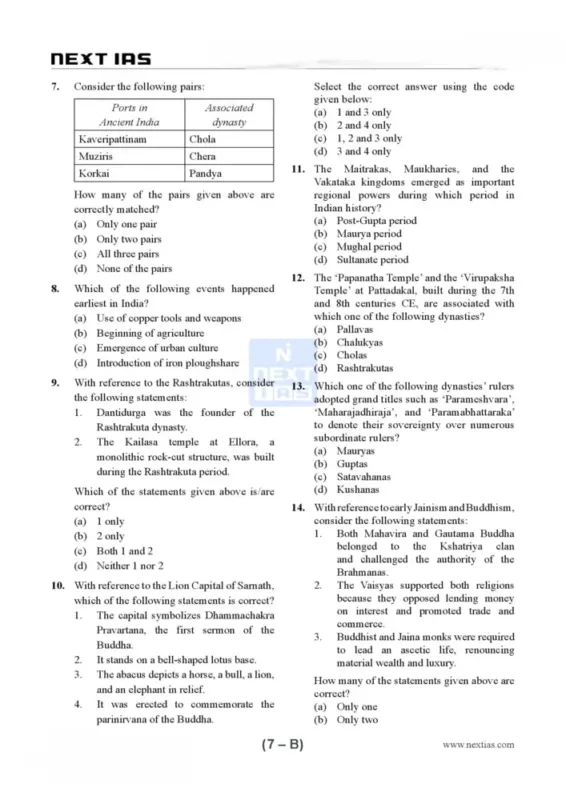
These booklets open the Next IAS Prelims Test Series 2026-27 with a targeted test on Ancient Indian History, one of the most question-dense areas of UPSC Prelims GS Paper I. Topics include the Harappan Civilisation and its town planning, Vedic literature and society, the rise of Magadha, Mauryan administration under Chandragupta and Ashoka, Gupta-era science and culture, and post-Gupta regional powers. Questions are designed to reflect the indirect and application-based style used by UPSC in recent years, moving beyond simple factual recall.
The solutions booklet that accompanies each test is a key feature of the Next IAS format. Every answer comes with a 3-to-5-line explanation tracing the correct logic, plus a note on why the distractors are wrong β a technique that builds elimination skills critical for scoring above the UPSC Prelims cutoff. Diagrams illustrating dynasty timelines and trade route maps are integrated into explanations to make retention easier during the 2026-27 UPSC preparation cycle.
Booklets 3β4: History of India β Medieval India Test + Solutions
Medieval Indian History covers a significant share of UPSC Prelims GS Paper I questions, and these booklets address that demand with precision. The test covers the Delhi Sultanate’s administrative and revenue systems, the Mughal Empire’s political and cultural achievements, the Vijayanagara Empire, Maratha confederacy, Bhakti and Sufi movements with their key figures, and the socio-economic conditions of medieval India. Questions are framed in the statement-based and match-the-following formats that UPSC uses frequently in this segment.
The solution booklet provides context-rich explanations that go beyond textbook facts, connecting medieval events to their long-term implications tested by UPSC. Comparative tables between dynasties, administrative comparison charts between the Mughal and Maratha systems, and important dates compiled in a quick-reference grid make these booklets equally useful for last-minute revision before the UPSC Prelims 2026 and 2027 examinations.
Booklets 5β6: Modern Indian History Test + Solutions
Modern Indian History is a high-yield area for UPSC Prelims, and these booklets deliver a rigorous test of everything from the arrival of European powers to India’s independence in 1947. The test covers British expansion policies, the 1857 revolt and its causes, the formation and evolution of the Indian National Congress, major reform movements (Brahmo Samaj, Arya Samaj, Aligarh Movement), and mass agitations under Gandhi’s leadership. Questions are pitched at the analytical level that separates UPSC qualifiers from non-qualifiers.
Solutions in Booklet 6 are structured to teach aspirants how to approach multi-statement UPSC questions about the same historical event. Answer keys include official NCERT cross-references alongside supplementary sources like Spectrum’s Modern History and Bipin Chandra’s works, helping buyers of this Next IAS 2026-27 test series validate each answer against standard preparation material and build conceptual clarity for the actual UPSC CSE Prelims.
Booklets 7β8: Indian National Movement β In-Depth Test + Solutions
This dedicated test on the Indian National Movement drills deeper into sub-topics often tested as standalone questions in UPSC Prelims: the ideological divide between moderates and extremists, the revolutionary underground movement (Bhagat Singh, Chandrashekhar Azad), constitutional milestones like the Government of India Acts of 1919 and 1935, the Cripps Mission, Cabinet Mission, and the final transfer of power. B.R. Ambedkar’s contributions to the Constituent Assembly and the Dalit question are also covered, reflecting UPSC’s increasing attention to this area.
The solution booklet offers a chronological summary of all major constitutional developments from 1858 to 1947 in tabular format β one of the most revision-friendly features of the Next IAS test series. Answer explanations place each question in its broader historical context, helping aspirants avoid the common mistake of confusing similar-sounding events and acts that regularly appear as traps in UPSC Prelims GS Paper I question papers.
Booklets 9β10: Indian and World Geography β Physical Geography Test + Solutions
Geography occupies a large and predictable share of UPSC Prelims GS Paper I. These booklets test aspirants on the foundational physical geography topics that UPSC returns to every year: interior of the Earth and plate tectonics, types of rocks and rock cycle, weathering and erosion landforms, atmospheric layers and pressure belts, jet streams, monsoon mechanisms, world ocean current systems, El NiΓ±o and La NiΓ±a effects, tides, coral reef formation, and world biome distribution. Questions test both concept clarity and map-reading ability.
What makes these booklets particularly useful for UPSC 2026-27 preparation is the solution booklet’s use of annotated sketch maps β simple black-and-white diagrams of ocean currents, pressure belt positions, and monsoon wind patterns that aspirants can trace and memorise. Physical geography questions in UPSC Prelims often hinge on precise directional or locational knowledge, and these visual aids in the Next IAS solutions bridge the gap between classroom study and examination performance.
Booklets 11β12: Indian Geography β Economic and Human Geography Test + Solutions
Indian economic and human geography is tested through questions on soil distribution, river systems, agricultural zones, forest types, wildlife reserves, and transport networks β all topics that appear in nearly every UPSC Prelims paper. Booklet 11 contains a focused test on these subjects, with questions on major Indian rivers and their tributaries, soil types and their agricultural significance, agro-climatic zones, irrigation methods, and the geography of Indian mineral and energy resources. Questions are designed to the standard of UPSC Prelims difficulty.
The solutions booklet includes state-wise distribution tables for major crops, minerals, and forest types β data that is difficult to retain without structured visual presentation. Important wildlife sanctuaries and national parks are listed with their associated states, biosphere reserves, and Ramsar Wetland status in a compact grid, making Booklet 12 a standalone revision tool for the geography section of UPSC Prelims GS Paper I that buyers can return to repeatedly throughout their 2026-27 preparation schedule.
Booklets 13β14: World Geography Test + Solutions
World geography in UPSC Prelims covers topics from physical features of major continents to economic geography of world regions. Booklet 13 tests aspirants on the location and characteristics of major mountain ranges, rivers, lakes, deserts, straits, gulfs, and islands with geopolitical significance. Climate types across continents, their associated biomes and agricultural patterns, and world mineral and energy resource distribution are also included β all mapped to the level of difficulty UPSC has demonstrated across Prelims papers from 2015 to 2025.
The solutions booklet for world geography is enriched with a comparative table of major world rivers ranked by length, discharge, and basin area, along with a straits and waterways quick-reference sheet covering locations and strategic significance. UPSC Prelims frequently tests world geography through current affairs angles β such as a conflict near a specific sea or a trade dispute affecting a particular strait β and the Next IAS 2026-27 solutions booklet flags these current affairs connections explicitly.
Booklets 15β16: Indian Polity and Governance Test + Solutions
Indian Polity is one of the most scoring subjects in UPSC Prelims and demands both depth and precision. Booklet 15 covers the Constitution of India from its Preamble and historical background through the structure of Fundamental Rights, Directive Principles, Fundamental Duties, the Union Executive and Legislature, State Executive and Legislature, and the three-tier Judiciary. Questions on constitutional amendments, schedules, emergency provisions, and the role of constitutional bodies are all included at UPSC Prelims difficulty level.
The solutions booklet for polity is particularly detailed, given that polity questions in UPSC Prelims often turn on single words in constitutional articles. Each answer explanation cites the relevant article, sub-clause, or constitutional amendment number so aspirants can verify answers directly from M. Laxmikanth’s Indian Polity β the standard reference for UPSC preparation. Important Supreme Court judgments from Kesavananda Bharati to recent constitutional benches are listed with their significance, making Booklet 16 essential for UPSC CSE Prelims scoring.
Booklets 17β18: Polity β Constitutional Bodies and Governance Test + Solutions
Constitutional and statutory bodies are tested with increasing frequency in UPSC Prelims, and this dedicated test booklet addresses every institution from the Election Commission and UPSC to the CAG, Finance Commission, National Human Rights Commission, and regulatory bodies like SEBI, TRAI, and IRDAI. Questions on the Governor’s discretionary powers, Centre-State relations under Article 356, the role of the Vice President, inter-state water disputes mechanisms, and the anti-defection law are all part of this focused test.
The solutions booklet distinguishes between constitutional bodies, statutory bodies, and executive bodies in a clear three-column table β a distinction that UPSC Prelims tests directly. The comparison of quasi-judicial bodies, their parent acts, and their jurisdictions is another reference grid included in Booklet 18. For UPSC 2026-27 aspirants who find governance-related questions tricky because of overlapping mandates of different bodies, this booklet pair is among the most practically useful in the entire 45-booklet Next IAS Prelims test series.
Booklets 19β20: Indian Economy β Basics and Macro Test + Solutions
The economics section of UPSC Prelims GS Paper I covers macroeconomic concepts, monetary and fiscal policy instruments, banking sector operations, and key economic indicators. Booklet 19’s test covers national income accounting, GDP measurement methods, fiscal deficit, revenue deficit, FRBM Act limits, types of taxes, RBI’s monetary tools (repo rate, reverse repo, CRR, SLR, OMOs), inflation measurement through CPI and WPI, and balance of payments concepts that UPSC tests every year without fail.
The solutions booklet for Indian Economy basics uses structured comparison tables β for example, CPI vs WPI components and base years, or fiscal deficit vs primary deficit vs revenue deficit definitions β that eliminate confusion between frequently conflated concepts. The Next IAS 2026-27 economics solutions also flag data points from the latest Union Budget and Economic Survey wherever relevant, ensuring that aspirants buying this printed test series have access to updated economic figures aligned with the UPSC Prelims 2026-27 examination cycle.
Booklets 21β22: Indian Economy β Planning, Agriculture and Industry Test + Solutions
This booklet pair covers the applied side of Indian economics β planning history, agricultural policy, industrial development, and current government economic initiatives. The test includes questions on the transition from Five Year Plans to NITI Aayog’s strategy documents, the Green Revolution and its second generation, MSP determination, PM-KISAN, food security legislation, important industries and their geographic concentration, the industrial policy framework, SEZ regulations, and flagship schemes like PLI and Make in India.
Solutions in Booklet 22 are supplemented by a summary table of all major agricultural and industrial schemes with their launch year, ministry, and key feature β a format specifically designed for the UPSC Prelims question type that asks aspirants to match schemes to their objectives or implementing ministries. The Next IAS Prelims Test Series 2026-27 integrates Economic Survey and Budget highlights into the solutions commentary, making this one of the most current-affairs-linked subject pairs in the full 45-booklet series.
Booklets 23β24: General Science β Physics and Chemistry Test + Solutions
The General Science section of UPSC Prelims GS Paper I draws from physics and chemistry at the Class 9β12 standard but applies concepts to real-world and current affairs contexts. Booklet 23’s test includes questions on Newton’s laws, electromagnetic spectrum and its applications, nuclear fission and fusion, radioactivity, sound and light, basic electrical principles, the periodic table, types of chemical bonds, acids, bases and salts, polymers and plastics, nanomaterials, and the chemistry behind everyday phenomena like soaps, detergents, and food preservation.
Chemistry and physics questions in UPSC Prelims increasingly come with a technology or application angle β for instance, how nuclear reactors work, or which polymer is used in bulletproof vests. The Next IAS 2026-27 solutions booklet for this subject pair explains each answer in terms of the underlying principle and its application, preparing aspirants to handle both direct and applied science questions. A glossary of important scientific terms and their UPSC relevance is included at the end of Booklet 24 as a ready-reference revision tool.
Booklets 25β26: General Science β Biology and Health Test + Solutions
Biology is the richest source of General Science questions in UPSC Prelims, covering topics from cell organelles and their functions to genetics, plant physiology, human body systems, microbiology, and ecology. Booklet 25 tests aspirants on DNA replication, gene expression, chromosomal disorders, types of pathogens (bacteria, virus, fungi, protozoa), major diseases and their vectors, the human immune system, vaccines and their mechanism, nutrition deficiency diseases, and biotechnology applications including CRISPR gene editing and GM crops in India.
Health policy and government health schemes are integrated into the biology test because UPSC frequently bridges science and policy in the same question. The solutions booklet for Biology includes a disease-pathogen-vector-vaccine table covering all major infectious diseases tested in UPSC Prelims historically, a comparison of DNA and RNA, and a summary of all GOI health missions (NHM, Ayushman Bharat, etc.) with their key components. This makes Booklet 26 a bridge between the science section and the governance section of UPSC Prelims GS Paper I.
Booklets 27β28: Environment and Ecology Test + Solutions
Environment and Ecology has emerged as one of the highest-scoring and most dynamic sections of UPSC Prelims GS Paper I, with questions ranging from pure ecology to international environmental law. Booklet 27 tests ecosystem types, food chain and food web dynamics, biogeochemical cycles, primary and secondary succession, biodiversity hotspots, climate change science (greenhouse gases, global warming, sea level rise), the UNFCCC framework, COP agreements and their key outcomes, and India’s climate commitments including the Panchamrit targets submitted at COP26.
Pollution, environmental legislation, and India’s protected area network are covered in depth in the test. The solutions booklet features a complete list of India’s Ramsar Wetland Sites, UNESCO Biosphere Reserves, Tiger Reserves, and Elephant Reserves with their states and special features β formatted as a quick-scan table for last-minute revision before UPSC Prelims 2026. The Next IAS 2026-27 environment solutions booklet also integrates recent Supreme Court and NGT judgments on environmental issues, a topic UPSC has tested in recent Prelims papers.
Booklets 29β30: Current Affairs β National and International Test + Solutions
Current affairs questions constitute a growing share of UPSC Prelims GS Paper I, with some estimates placing the proportion at 20β25% of the total paper. Booklet 29 contains a current affairs mock test covering major government schemes and policy announcements, India’s diplomatic developments, bilateral and multilateral agreements, major international summits, defence deals and indigenisation milestones, space mission achievements (especially ISRO), and appointments to constitutional and statutory bodies β all sourced from the 12-month window most relevant to UPSC Prelims 2026-27.
The solutions booklet for current affairs is structured as a topic-wise summary rather than just isolated answer explanations, giving aspirants a compiled reference of major developments across all GS Paper I subject domains. Sports, cultural events, awards, and important committee reports are covered in the final pages of Booklet 30. The Next IAS Prelims Test Series 2026-27 current affairs booklets are updated to reflect the most recent events, making them a valuable addition to any UPSC aspirant’s study table alongside monthly current affairs magazines.
Booklets 31β32: Art, Culture and Heritage Test + Solutions
Art, Culture, and Heritage questions in UPSC Prelims are among the trickiest because they draw from a wide range of sources β from ancient temple architecture to living tribal traditions. Booklet 31 tests classical dance forms and their origin states, classical music gharanas, folk arts and crafts (Madhubani, Pattachitra, Warli, etc.), painting schools from Mughal miniature to Company School, rock-cut and structural architecture from ancient to medieval periods, and UNESCO Intangible Cultural Heritage elements from India as per the latest list.
The solutions booklet is designed for rapid visual retention β important classical dance forms, instruments, and their associated states are presented in a table format, as are major UNESCO World Heritage Sites in India with their category (cultural, natural, or mixed) and inscription year. The Next IAS 2026-27 art and culture solutions booklet also covers important Geographical Indications (GI tags) granted to Indian handicrafts and products, a topic that has appeared in UPSC Prelims and is expected to feature again in the 2026-27 examination cycle.
Booklets 33β34: Science and Technology β Space, Defence and IT Test + Solutions
Science and Technology is a subject where UPSC Prelims questions are directly linked to current developments in India’s space programme, defence indigenisation, digital governance, and emerging technologies. Booklet 33 tests knowledge of ISRO’s current and recent missions (Chandrayaan, Gaganyaan, Aditya-L1, NISAR), DRDO’s landmark projects, India’s missile programme milestones, defence production policy developments, India’s semiconductor initiative, the drone regulations framework, 5G deployment status, and the regulatory landscape for artificial intelligence and cybersecurity.
The technology solutions booklet is one of the most frequently updated in the Next IAS Prelims series, reflecting the fast-changing nature of this domain. Answer explanations in Booklet 34 provide brief technical context β for example, explaining what a synthetic aperture radar is and why it matters for earth observation satellites β so aspirants understand not just which answer is correct but why. A technology timeline of India’s major milestones in space, nuclear, and defence capability is included as a concluding reference grid.
Booklets 35β36: Full-Length Mock Test 1 (GS Paper I) + Solutions
The first full-length 100-question GS Paper I mock test in the Next IAS Prelims Test Series 2026-27 replicates the actual UPSC Prelims examination format β 100 questions, 2 hours, negative marking of one-third for wrong answers. Questions are drawn from all GS Paper I subject areas in proportions that reflect the historical distribution observed in UPSC Prelims papers from 2015 to 2024. The test is designed to be attempted under timed conditions to build the speed and accuracy essential for UPSC Prelims qualification.
The solutions booklet for Mock Test 1 is the most detailed in the series β every question carries an explanation, a source reference, and a difficulty tag (easy, moderate, or difficult). For questions where multiple statements are evaluated, each statement is individually validated or refuted. The Next IAS 2026-27 mock test solutions also flag which questions were asked in a similar form in recent UPSC Prelims papers, building aspirants’ understanding of recurring patterns and helping them prioritise high-probability topics for final revision.
Booklets 37β38: Full-Length Mock Test 2 (GS Paper I) + Solutions
Mock Test 2 offers a completely fresh 100-question paper with a different distribution of topics compared to Mock Test 1, ensuring that aspirants are tested on areas they may have under-prepared. The difficulty level in this test is calibrated at slightly above the UPSC Prelims 2024 cutoff standard, with more assertion-reason questions, map-based items, and current-affairs-linked GS questions. Time management is a key challenge built into Mock Test 2 β aspirants who can complete it within 1 hour 45 minutes are on track for UPSC Prelims qualification.
Solutions in Booklet 38 are supplemented by a post-test performance review guide. Aspirants are encouraged to categorise each wrong answer into three types: conceptual error, careless mistake, or unknown topic. This error-classification system, provided as a structured worksheet in the solutions booklet, is a hallmark of the Next IAS approach and reflects the institute’s broader coaching methodology as a unit of the Made Easy Group, known for its engineering services examination preparation rigour applied now to UPSC CSE Prelims.
Booklets 39β40: Full-Length Mock Test 3 (GS Paper I) + Solutions
The third full-length mock test is the highest-difficulty paper in the Next IAS Prelims Test Series 2026-27, designed to stretch aspirants beyond their comfort zone and simulate the most demanding UPSC Prelims scenarios. It includes a higher proportion of integrated questions that combine two or more subject areas β for example, a question on the ecology of a specific wetland that simultaneously tests knowledge of biodiversity and India’s international environmental commitments. These cross-domain questions reflect the actual direction UPSC has taken in Prelims paper design since 2020.
The Booklet 40 solutions are structured to show aspirants how to deconstruct complex multi-statement questions using elimination logic when factual recall is incomplete β a test-taking strategy that can be the difference between clearing and missing the UPSC Prelims cutoff. A consolidated topic-frequency analysis comparing Mock Tests 1, 2, and 3 is included in Booklet 40, showing which GS Paper I areas were most tested across the three full-lengths, serving as a data-driven revision priority guide for UPSC 2026-27.
Booklets 41β42: CSAT β GS Paper II Full Mock Test 1 + Solutions
CSAT (Civil Services Aptitude Test), or GS Paper II, is a qualifying paper in UPSC Prelims requiring a minimum score of 33%. Despite being qualifying only, many aspirants lose their UPSC Prelims attempt by underestimating CSAT. Booklet 41 provides a full 80-question CSAT mock test covering reading comprehension passages (English), logical reasoning sequences, analytical ability puzzles, data interpretation (tables, bar charts, pie charts), basic numeracy including percentages, ratios, averages, time-speed-distance, and mental ability tests modelled on UPSC CSAT question patterns.
The Booklet 42 solutions take a step-by-step approach to every numerical and reasoning question β each solution shows the full working method, not just the final answer. For reading comprehension, the solutions explain the inference-making technique and flag common traps in how UPSC phrases comprehension questions to mislead speed-readers. Aspirants who buy this Next IAS 2026-27 CSAT booklet pair alongside the GS Paper I series get a fully rounded UPSC Prelims preparation package in printed format.
Booklets 43β44: CSAT β GS Paper II Full Mock Test 2 + Solutions
The second CSAT mock test in the Next IAS Prelims Test Series 2026-27 raises the difficulty on the data interpretation and logical reasoning components, which are the areas where UPSC CSAT separates stronger performers from borderline qualifiers. Booklet 43 includes longer reading passages, multi-step data interpretation sets, syllogism-based logical reasoning, and decision-making scenarios requiring aspirants to apply ethical and administrative reasoning within a structured choice framework exactly as UPSC presents in GS Paper II.
Booklet 44 solutions include time benchmarks for each question type β suggesting how many seconds to spend on comprehension questions versus numeracy items β helping aspirants develop a time management strategy for the actual UPSC CSAT paper. A CSAT score predictor framework is included in the closing pages: aspirants calculate their expected UPSC CSAT score based on their mock test performance and identify whether focused practice on numeracy, reasoning, or comprehension will yield the fastest improvement before UPSC Prelims 2026-27.
Booklet 45: Performance Analysis and Revision Guide
The final booklet in the Next IAS General Studies Prelims Test Series 2026-27 is a standalone revision and strategy resource rather than a test. It opens with a topic-frequency analysis drawn from UPSC Prelims papers from 2015 to 2025, showing which subjects and sub-topics were asked most often and thus deserve the highest revision priority for UPSC 2026-27. Subject-wise score templates allow aspirants to plot their performance across all 44 preceding booklets and identify their strongest and weakest GS Paper I domains at a glance.
The second half of Booklet 45 contains a series of last-minute revision checklists β one for each major GS Paper I subject β listing the 20 most important concepts, data points, and facts to review in the final 30 days before UPSC Prelims. An examination-day strategy note covering question-attempt sequence, time allocation per section, handling uncertainty with elimination, and guess management within the negative marking framework closes the booklet. This final resource makes Booklet 45 one of the most practically valuable pieces of the entire Next IAS 45-booklet test series.
Physical Construction and Quality Standards
The Next IAS General Studies Prelims Test Series 2026-27 is printed and bound to standards that support intensive daily UPSC preparation β pages that stay flat, ink that does not smudge, and covers that protect booklets through months of repeated use during the 2026-27 preparation cycle.
Paper Quality: 75 GSM Anti-Glare White Paper
Every booklet in this 45-piece Next IAS Prelims series is printed on 75 GSM ultra-white paper chosen for its high opacity. This paper grade ensures that text and diagrams on one side do not show through to the reverse, which matters when aspirants make margin notes and use multiple highlighter colours for subject-wise colour coding. The anti-glare surface reduces eye strain during the long daily study sessions that UPSC preparation demands β typically four to six hours on notes and test practice alone β making this paper specification a genuine study ergonomics decision, not just a production choice.
Printing Technology: High-Resolution Laser Printing
All 45 booklets are produced using high-resolution laser printing technology, which delivers sharper text and cleaner diagram reproduction than inkjet alternatives. Tables, flowcharts, annotated maps, and data grids β which appear throughout the solutions booklets β are printed with crisp lines and consistent tonal density. Laser toner bonds permanently to the paper surface, making the printed pages fully smudge-proof even when booklets are handled repeatedly across months of UPSC revision. Diagrams illustrating ocean current systems, constitutional structures, and ecosystem food chains retain their clarity for the duration of the preparation cycle.
Binding and Durability
Each booklet is available in spiral or book binding format depending on the batch and booklet type. Spiral binding allows the booklet to open completely flat on a desk, which is important when aspirants want to practise writing answers alongside or fill in self-assessment worksheets included in some solutions booklets. Book-bound booklets are more compact and travel-friendly for aspirants preparing in coaching environments like Mukherjee Nagar, Delhi, or in hostel settings. All covers are printed on 300 GSM card stock to prevent folding, moisture absorption, and wear during months of daily UPSC study use.
Key Features and Study Design
The Next IAS Prelims Test Series 2026-27 is designed specifically around how UPSC CSE Prelims questions are framed β favouring concept application, elimination logic, and current affairs integration over simple textbook recall.
- Question-and-Solution Paired Booklet Format: Every test booklet in the 45-piece series has a corresponding dedicated solutions booklet with full explanations β not just answer keys β so aspirants understand every answer deeply rather than just memorising the correct option letter before UPSC Prelims.
- UPSC Pattern Accuracy: Questions across all 45 booklets are modelled on actual UPSC Prelims question structures β multi-statement, assertion-reason, map-based, and chronological ordering types β ensuring that practice with this series directly transfers to performance in the UPSC CSE Prelims examination hall.
- GS Paper I and CSAT Both Covered: The series includes dedicated full-length CSAT mock tests (Booklets 41β44) alongside all GS Paper I subject and full-length tests, making this a complete UPSC Prelims preparation package in a single 45-booklet printed set for 2026-27 aspirants.
- Made Easy Group Academic Standards: As a unit of the Made Easy Group β one of India’s most recognised names in competitive examination preparation β Next IAS brings structured, systematic, and academically rigorous content development to UPSC GS Prelims test series, ensuring question quality and solution accuracy meet national coaching standards.
- Performance Tracking and Strategy Built In: With a dedicated Booklet 45 covering performance analysis, topic frequency data, revision checklists, and examination-day strategy, the Next IAS 2026-27 series goes beyond practice questions to offer aspirants a structured self-improvement framework for achieving and exceeding the UPSC Prelims cutoff score.
Shipping, Packaging and Delivery
All 45 booklets of the Next IAS General Studies Prelims Test Series 2026-27 are packed as a complete set at our Mukherjee Nagar, Delhi fulfilment centre. Each set is individually shrink-wrapped first to prevent page moisture absorption, then packed inside a double-corrugated cardboard box with foam edge protectors at all four corners. The outer box is sealed with reinforced packing tape and labelled with the tracking barcode on all surfaces to ensure scanner visibility at every logistics checkpoint. This packaging standard ensures that even the largest individual booklets arrive with zero page damage, zero spine breakage, and zero cover bending regardless of transit conditions across India.
Orders are dispatched within 24 hours of payment confirmation and reach buyers across India in 3-5 business days via tracked courier. A tracking ID is shared via WhatsApp and email at the time of dispatch. For any queries β including tracking updates, delivery delays, or missing booklets β contact our team directly on WhatsApp at +91 70045 49563. Any missing booklet from the 45-piece set is identified, verified, and replaced within 48 hours of the complaint being raised. We deliver to all pin codes across India including remote locations not served by standard courier partners.
Frequently Asked Questions (FAQ)
A: Yes β the Next IAS General Studies Prelims Test Series 2026-27 is built specifically for aspirants targeting UPSC Prelims 2026 and 2027. Questions are designed to the actual UPSC Prelims difficulty level and pattern, covering GS Paper I and CSAT in 45 booklets with full solutions. As a unit of Made Easy Group, Next IAS brings proven structured pedagogy to UPSC CSE Prelims preparation, making this series a reliable investment for serious 2026-27 aspirants.
A: This set includes 45 individual printed booklets. The set consists of subject-specific tests paired with their solution booklets, three full-length GS Paper I mock tests with solutions, two full-length CSAT (GS Paper II) mock tests with solutions, and a final performance analysis and revision guide booklet. All 45 booklets are shipped together as one complete package in a single tracked delivery.
A: These booklets use 75 GSM ultra-white paper chosen for high opacity β multiple highlighter colours and gel pens work without bleed-through to the reverse side, ideal for colour-coded revision. The anti-glare surface also reduces eye strain during extended UPSC study sessions. Laser-printed text and diagrams are smudge-proof even under heavy use throughout the 2026-27 preparation cycle.
A: The specific product listed here β Next IAS General Studies Prelims Test Series 2026-27 β is the English Medium edition. This is the full set of 45 booklets in English. UPSC Prelims aspirants who prepare in English medium will find all question papers and all solution explanations in clear, exam-standard English throughout the entire 45-booklet series.
A: Next IAS, as a unit of Made Easy Group, brings an engineering-examination-derived rigour to UPSC GS Prelims preparation β strong on structured problem-solving, step-by-step solution methodology, and performance analytics. The 45-booklet format with paired test-and-solution booklets and a dedicated performance analysis booklet (Booklet 45) is a distinguishing feature. Content coverage, question quality, and solution depth are at par with the leading names in UPSC Prelims test series preparation.
A: Yes β the 45-booklet series covers the complete UPSC Prelims GS Paper I syllabus across History (Ancient, Medieval, Modern, National Movement), Geography (Physical, Indian, World), Indian Polity and Governance, Indian Economy, General Science (Physics, Chemistry, Biology), Environment and Ecology, Art and Culture, Science and Technology, and Current Affairs. GS Paper II (CSAT) is also covered through two full-length mock tests. The series is aligned to the official UPSC Prelims syllabus for 2026-27.
A: For aspirants targeting UPSC Prelims 2027, starting with a structured test series in 2026 is strongly advisable β Prelims preparation requires at least 12β18 months of consistent mock testing and revision. The 45-booklet Next IAS series provides subject-wise practice tests for concept building, full-length mocks for exam simulation, CSAT coverage, and a performance analysis system, making it a high-value printed test series for serious UPSC 2026-27 aspirants who prefer studying offline from physical booklets.
A: You can buy the Next IAS General Studies Prelims Test Series 2026-27 β all 45 booklets β directly from this product page. This is a genuine, brand-new, unmarked stock of the current 2026-27 edition. Once you place your order, it is dispatched within 24 hours from Mukherjee Nagar, Delhi, and delivered pan India in 3-5 business days via tracked courier. You can also reach us on WhatsApp at +91 70045 49563 for buying assistance.
A: Each test booklet in this series is paired with a full solutions booklet β not a bare answer key. Every question has a 3-to-5-line explanation validating the correct answer and refuting the distractors. Multi-statement questions have each statement individually evaluated. Solutions include source references, comparison tables, quick-revision grids, and in the case of full-length mocks, a post-test performance worksheet. The quality of solutions is designed to build understanding, not just verify answers.
A: Yes β the Next IAS General Studies Prelims Test Series 2026-27 is also useful for aspirants preparing for State PSC examinations including BPSC, UPPSC, MPPSC, RAS, and other State PSC Prelims, since these examinations share a significant overlap with the UPSC Prelims GS syllabus across History, Geography, Polity, Economy, Science, and Current Affairs. The higher difficulty standard of UPSC-level questions makes this series an effective stretch tool for state-level competitive examination preparation as well.
A: Yes β all 45 booklets of the Next IAS General Studies Prelims Test Series 2026-27 are packed and shipped together as one complete set in a single corrugated box. You will receive a single tracking ID for the entire package. In the rare event that any booklet is missing or damaged on arrival, contact us on WhatsApp at +91 70045 49563 with a photograph and we will replace the affected booklet within 48 hours β at no additional cost to you.
A: Yes β this is the genuine 2026-27 edition of the Next IAS General Studies Prelims Test Series, the latest batch currently available. It is brand new, unmarked, and sourced directly from the current print run. The current affairs, scheme-related questions, and Science and Technology content in the 2026-27 edition reflect developments current to this edition year, making it the most relevant printed test series for aspirants targeting UPSC Prelims 2026 and Prelims 2027.
Summary
| Specification | Value |
|---|---|
| Booklets | 45 Printed Booklets |
| Language | English Medium |
| Paper | 75 GSM Ultra-White |
| Binding | Spiral or Book Binding |
| Delivery | 3-5 Business Days Pan India |
| Also Useful For | BPSC, UPPSC, MPPSC, RAS and all State PSC Prelims |
Sold by UPSC Store β based in Mukherjee Nagar, Delhi, India’s largest UPSC coaching hub. Buy printed test series and study material online with confidence β pan India delivery in 3-5 business days, tracked to your door.
Reference: UPSC official syllabus
Customer Reviews 174
45 booklets mein variety h, GS ke sab topics cover ho gaye.
Bahut shandaar booklets hain aur topics cover bhi comprehensive hain. Best decision to buy this series.
Ek ek booklet mein quality content tha. Next IAS ne sahi kaam kiya hai.
The difficulty level is just right for mains prep bhi helpful.
Next IAS ki materials always reliable hote hain.
Content is really helpful and well-organized. Great investment for prelims preparation.
45 booklets provide excellent coverage of all prelims topics. Printing quality is premium aur booklets are sturdy.
Questions are challenging and well-framed, just like actual UPSC exams. Bilkul satisfied hoon.
Aspirants Also Bought
More from the same category
About Next IAS General Studies Prelims Test Series 2026-27
Next IAS General Studies Prelims Test Series 2026-27 is a highly recommended UPSC study material from Next IAS, specially designed for General Studies & CSAT preparation. Available in English medium, this material is crafted to match the exact requirements of the UPSC Civil Services Examination syllabus β covering both Prelims and Mains comprehensively.
Product Details
- Institute: Next IAS
- Subject: General Studies & CSAT
- Medium: English
- Format: Printed
- Delivery: Pan-India delivery in 3β5 working days
- Format: Original printed material, verified authentic
Why Buy from UPSC Store?
- β 100% Genuine Printed Material β Original printed notes, no photocopies or fake copies
- β Fast Delivery β Ships within 24 hours, arrives in 3β5 days pan-India
- β Secure Packaging β Bubble-wrapped and boxed to prevent damage in transit
- β Trusted by 10,000+ Aspirants β India's most reliable UPSC material marketplace
- β WhatsApp Support β Get expert guidance on material selection before ordering
Frequently Asked Questions
Yes, all products at UPSC Store are 100% genuine printed materials. We do not sell photocopies or fake copies.
Orders are dispatched within 24 hours and delivered across India in 3β5 working days via reputed courier partners.
Yes, we accept returns within 7 days if the product is damaged or incorrect. Check our refund policy for details.
We recommend pairing this with current affairs notes and a UPSC test series for comprehensive preparation. Browse more in CSAT, General Studies, Next IAS, Test Series, UPSC.