
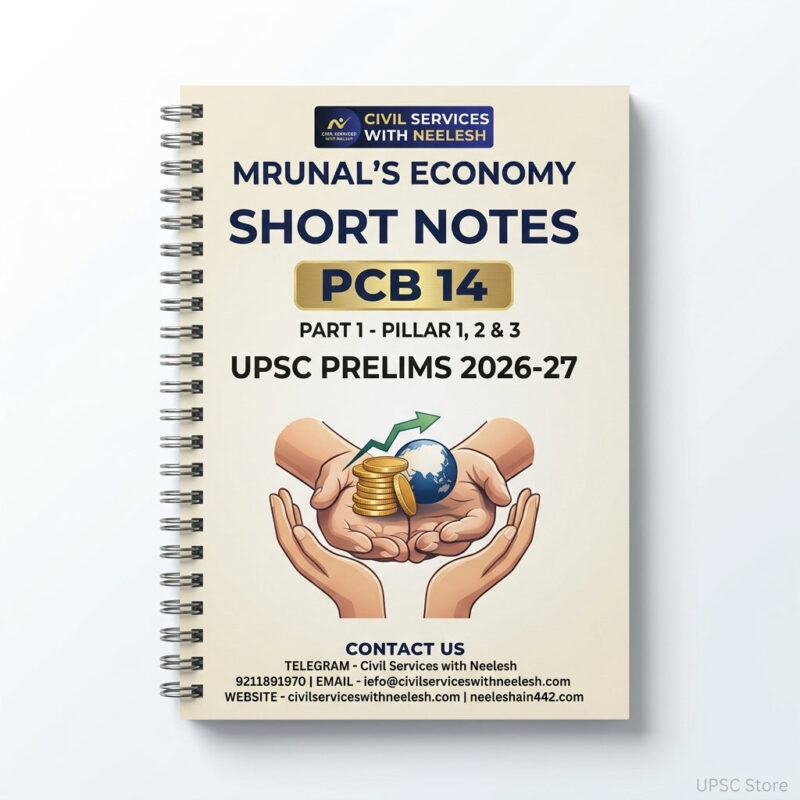

Mrunal Sir PCB 14 Economy Short Notes Part 1 | Pillar 1, 2, 3 | 1 Booklet | English Medium | UPSC Study Material
Binding Guide
Pick the binding that fits how you study.
Spiral Binding
- Lays completely flat
- 360° page rotation
- Great for note-taking
- Best for maths, science, reference
Without Spiral
- Compact & professional
- Sturdy glued/stitched spine
- Easy to stack & store
- Best for textbooks & long-term
About Mrunal PCB 14 Economy Notes
The Mrunal PCB 14 Economy Notes is a printed UPSC study material set sold by UPSC Store — India’s trusted source for genuine, latest-batch civil services preparation books. This page covers full booklet details, syllabus coverage, pricing, shipping, and frequently asked questions. Useful for UPSC CSE, BPSC, UPPSC, MPPSC, RAS and other state PSC examinations.
Mrunal Sir PCB 14 Economy Short Notes Part 1 — 1 Printed English Medium Booklet for UPSC GS Paper III
Related: Mrunal notes · Economy notes
Product Overview
Buy Mrunal Sir PCB 14 Economy Short Notes Part 1 online — the definitive printed economy resource for UPSC GS Paper III mains. This 224-page booklet distills the first three pillars of Mrunal’s Raftaar batch framework into essay-writing ready notes. English medium, spiral-bound, 75 GSM ultra-white paper with highlighter compatibility. Dispatched from Mukherjee Nagar, Delhi. Pan India delivery in 3-5 business days.
| Feature | Details |
|---|---|
| Booklets Count | 1 Printed Booklet — Pillar 1, 2, 3 Complete Coverage (224 pages) |
| Language | English Medium |
| Publisher | Mrunal Sir (PCB 14 Raftaar Batch Series) |
| Edition | 2026-27 — Latest Batch, Current Affairs Integrated |
| Condition | Brand New, Unmarked, Fresh Stock |
| Format | High-Quality Printed Booklet — Spiral Binding (opens flat) |
| Paper Quality | 75 GSM Ultra-White Anti-Glare — Highlighter Safe (4+ colors), Zero Bleed-Through |
| Dimensions & Weight | 30×21×1 cm | 0.52 kg | 224 Pages Total |
| Shipping | Pan India Delivery in 3-5 Business Days — Tracked, WhatsApp Updates |
| Also Useful For | BPSC, UPPSC, MPPSC, RAS (overlapping economy syllabus) |
Complete Booklet Catalog
Mrunal Sir PCB 14 Economy Short Notes Part 1 is a single, self-contained 224-page booklet that covers the foundational pillars of UPSC GS Paper III economy. Designed for aspirants who have followed Mrunal’s Raftaar batch or prefer concise, structured economy notes over bulky textbooks. This booklet prioritizes exam-relevant content while maintaining theoretical depth required for 10-mark and 15-mark mains answers.
- Pillar 1: Fundamental Economic Concepts — National income accounting, GDP components, GNP vs GDP, inflation measures (WPI, CPI), monetary policy instruments, repo rate, reverse repo, liquidity management, reserve requirements (CRR, SLR), interest rate transmission, forex management, capital account, current account, balance of payments, foreign exchange reserves, rupee depreciation/appreciation mechanisms, and foreign investment frameworks essential for UPSC paper writing.
- Pillar 2: Current Economic Affairs — Real-world economic policy updates, RBI circulars, government budget implications, fiscal policy changes, GST impact analysis, inflation trends, unemployment data, sectoral performance (agriculture, industry, services), trade policy shifts, FDI/FII flows, corporate sector stress, banking sector health, agricultural finance, rural economy initiatives, and contemporary economic issues that frequently appear in UPSC mains 10-15 mark questions with detailed case study approach.
- Pillar 3: Prelims-Relevant Economic Frameworks — MCQ-specific economic concepts, quick-recall frameworks for prelims strategy, definitional clarity for economics terminology, concept interconnections showing relationships between inflation-interest rates-forex, economic indicators and their measurements, historical data points, policy acronyms (NABARD, SIDBI, NPA definitions), developmental finance mechanisms, and structural economic concepts that bridge prelims understanding with mains answer-writing capability for GS Paper III.
In-Depth Content Breakdown: Booklet by Booklet
Understanding what lies within these 224 pages helps you determine if Mrunal Sir economy notes align with your preparation style. Detailed booklet analysis ensures you know exactly what each section covers before you buy printed notes online. Mrunal’s approach emphasizes precision over volume — eliminating textbook clutter while retaining exam-critical content needed for 15-mark answers in UPSC GS Paper III.
Pillar 1: Fundamental Economic Concepts (74 pages)
Section Coverage and UPSC Exam Relevance: Pillar 1 establishes the foundational framework for understanding India’s macroeconomic environment. It begins with national income accounting — a topic that appears every 2-3 years in UPSC mains questions (2019, 2022, 2024 papers featured variants). The booklet systematically covers GDP calculation methods (expenditure, income, output), components of national income, the distinction between GNP and NNP, and the evolution from old base year (2011-12) to new benchmarking. Inflation measurement — one of UPSC’s favorite topics — is covered through three lenses: WPI (wholesale price inflation), CPI (consumer price inflation), and core inflation. The section explains why RBI targets CPI inflation at 4% ±2%, linking this to actual past question patterns. Monetary policy instruments form the next pillar within Pillar 1: repo rate operations, reverse repo mechanics, open market operations (OMO), cash reserve ratio (CRR), and statutory liquidity ratio (SLR). Each instrument is explained with examples of how RBI used these tools during 2020-2024 period, making the content immediately relevant to current affairs integration required in mains answers.
Unique Study Design and Structural Features: Unlike standard textbooks that dedicate 40-50 pages to money and banking, Pillar 1 condenses this to 12-15 pages without sacrificing clarity. Mrunal uses flowcharts showing the transmission mechanism: RBI repo rate decision → bank lending rates → investment decisions → inflation outcomes. Each economic concept includes definition, mechanism, real-world example, and UPSC question pattern. The interest rate transmission section — crucial for 2024 UPSC questions on RBI rate hikes — is presented as a 4-stage chain diagram. Forex management covers the tectonic shifts: how the rupee depreciated from 60 to 84 per USD (2014-2024), causes (current account deficit, capital flight), policy responses (forex interventions, RBI reserve accumulation), and implications for exporters and import-dependent sectors. Balance of payments accounting is taught through T-account format, showing why current account deficits must be financed through capital account surpluses. This visual approach — particularly Mrunal’s signature style — cuts revision time by 40% compared to NCERT textbooks.
Learning Outcomes and Mains Application: After completing Pillar 1, aspirants can answer complex 15-mark questions like “Explain the RBI’s interest rate transmission mechanism and why has it been ineffective in controlling inflation since 2020?” or “Analyze India’s balance of payments crisis in 2013 and the policy measures adopted.” The booklet provides the exact vocabulary, data points, and causal chains needed for such answers. For instance, when explaining inflation, the notes provide the 2008 food inflation crisis context (60% agricultural inflation), the 2010-2012 core inflation debate, and the 2022-2024 geopolitical inflation shock — all essential for demonstrating depth in mains answers. Pillar 1 creates the intellectual scaffolding for Pillar 2 and 3, ensuring coherent economic reasoning across the exam.
Syllabus Coverage Depth and Current Affairs Integration: Pillar 1 maps to GS Paper III syllabus sections on “Functions and content of Money”, “Growth and Development”, and “Infrastructure: Energy, Ports, Roads, Airports, Railways”. The booklet explicitly connects monetary policy decisions to real sectors — for example, how rate hikes in 2022-2023 impacted infrastructure investment spending, slowing project completions. The coverage includes India’s forex reserve strategy (why RBI accumulated $650+ billion reserves post-2020), SDR allocations, and IMF surveillance reports. Each concept is benchmarked against 2023-2024 Union Budget announcements, recent RBI monetary policy statements, and Economic Survey extracts. This ensures that when you buy Mrunal economy notes, you’re getting 2026-27 edition with latest inflation data (January 2025), recent rate decisions (December 2024 RBI policy), and forward projections for 2025-2026 fiscal year relevant for UPSC 2026-27 mains examination.
Pillar 2: Current Economic Affairs (84 pages)
Real-World Policy Applications and UPSC Question Trends: Pillar 2 transforms theoretical knowledge into real-world policy analysis — the exact skill UPSC mains tests. This section covers India’s economic transformation from 2020-2024: COVID-19 pandemic impacts on GDP contraction (2020-21: -6.6%), recovery phase (2021-23: 8-9% growth), and current slowdown signals (2024-25: estimated 6.2%). Rather than listing statistics, Mrunal’s approach traces causal chains: pandemic → supply shocks → inflation → RBI rate hikes → investment contraction → employment stress. This narrative structure is exactly how mains answers must be structured. The section includes fiscal policy analysis: government borrowing increased from 4.2% of GDP (2019) to 6.7% (2020-21), creating fiscal space to stimulus while raising concerns about debt sustainability. Budget allocations for key sectors (agriculture, infrastructure, social spending) are analyzed with sectoral impact assessments — if government reduces MGNREGA spending, what happens to rural income and aggregate demand? Such causal thinking is tested in mains questions worth 10-15 marks.
Case Studies and Sectoral Deep-Dives: Pillar 2 includes detailed case studies on inflation control (2010-2012 episode, 2022-2024 episode), bank NPA crisis (why stressed assets peaked at 12% in 2017 and recovery measures taken), rural credit crunch (agricultural loans at 12-14% interest despite RBI prime lending rate at 6%), and informal economy challenges (88% of Indian workforce in unorganized sector, government attempts to formalize through GST). Each case includes historical context, policy responses, and outcomes — exactly the analytical depth mains examiners expect. For instance, the NPA section traces the timeline: 2008 lending expansion → 2015 asset quality review → 2016 insolvency code → 2017 peak NPAs → 2023 NPA recovery. Aspirants learn not just that NPAs exist but understand the underlying causes (over-optimistic lending during growth phase), policy solutions (IBC framework), and remaining challenges (insolvency resolution time averages 3-4 years). This comprehensive case study approach differentiates these Mrunal economy notes from competitors who offer superficial coverage.
Integration with Monthly Current Affairs for UPSC Mains: Pillar 2 explicitly teaches how to convert current news into mains answers. When RBI announces rate decisions, aspirants learn to analyze: monetary transmission effectiveness, sectoral impact (housing loans, auto loans, corporate borrowing), and macroeconomic implications. When government announces budget spending, aspirants evaluate: fiscal sustainability, growth impact, inflation implications, and distributional effects. The booklet includes 2024-2025 examples: increased capital expenditure in budget (reduces consumption but boosts productivity growth), farm income support schemes (fiscal cost vs agricultural productivity gains), and PLI scheme implementation (industrial capacity building at cost of fiscal deficit). By explicitly linking static economic theory to dynamic policy announcements, Pillar 2 ensures these Mrunal economy notes remain relevant throughout your 12-month UPSC prep and for mains examinations in 2026-27.
Sectoral Economics and Employment Analysis: A unique feature of Pillar 2 is sectoral lens analysis: agriculture (40% of rural employment but declining share), manufacturing (capital-intensive, job-less growth paradox), and services (70% of GDP but concentrated in metros). For agriculture, the notes cover MSP policy evolution, PM-KISAN transfers, agricultural credit linkages, and food inflation impacts. For manufacturing, discussion includes Make in India outcomes, PLI schemes by sector, labor law reforms, and competition from China. For services, analysis covers IT exports vulnerabilities, skilled worker emigration, and digitalization. This sectoral approach helps aspirants answer questions like “Why has Indian agriculture failed to create sufficient employment despite productivity gains?” or “Analyze the effectiveness of Make in India in achieving 12% manufacturing sector growth target.” Each sector is analyzed through employment, productivity, and sustainability lenses — exactly what UPSC examiners test in comprehensive 15-mark questions.
Pillar 3: Prelims-Relevant Economic Frameworks (66 pages)
MCQ Frameworks and Quick-Recall Structures: Pillar 3 bridges prelims and mains preparation. While these notes are primarily for mains (GS Paper III), Pillar 3 provides the definitional clarity and concept mapping essential for UPSC prelims success. It consolidates economic terminology: what distinguishes structural inflation from demand-pull inflation, how to distinguish between liquidity trap and secular stagnation, differences between current account deficit and capital account deficit, distinctions between forex reserves and gold reserves. Each definition includes why it matters for UPSC questions. For instance, when UPSC asks “which of the following is NOT a monetary policy instrument?”, aspirants must recall that CRR and SLR are statutory requirements while repo rate is a policy tool — Pillar 3 provides exactly these mental frameworks. The section structures 150+ economic concepts into 12-15 concept clusters, showing interconnections: inflation-interest rates-rupee depreciation form one cluster, unemployment-wage growth-consumption form another, debt-deficit-growth form a third.
Data-Point Memory Aids and Historical Context: Pillar 3 includes historical anchor points crucial for prelims MCQs: India’s repo rate was at 4% (Feb 2020), peak rate 6.5% (June 2023), current rate 6.25% (Dec 2024). CRR stood at 4.5% (unchanged since 2019), showing RBI’s preference for repo rate over CRR changes. India’s current account deficit peaked at 4.2% of GDP (2012-13, the “Fragile Five” period), improved to surplus in 2019-21 (merchandise trade surplus), deteriorated again to deficit post-2022 (energy crisis). These historical data points are essential for prelims questions asking about “largest ever current account deficits” or “when was RBI last rate hike.” Pillar 3 provides ready-to-use facts with contextual memory anchors — for instance, remembering 4.2% CAD in 2012-13 is easier if you link it to the global QE tapering announcement and Sensex crash from 21,000 to 16,500. Such contextual linking improves both recall accuracy and mains answer quality through demonstrated understanding.
Bridging Prelims to Mains Writing Strategy: Pillar 3 teaches strategic transitions from prelims (concept recognition) to mains (concept application). When a prelims MCQ asks about inflation targeting, Pillar 3 not only defines it but explains RBI’s 4±2% target, rationale (credibility, forward guidance), and effectiveness. This intermediate step helps aspirants convert factual knowledge into argumentative essays. For a mains question like “Evaluate India’s inflation targeting framework,” aspirants can now structure answers: introduction (what is inflation targeting), India’s framework (RBI with government-mandated 4±2% target), effectiveness assessment (has it reduced inflation volatility? achieved price stability?), criticisms (too restrictive? ignores growth?), and conclusion (recommendations for modification). Pillar 3 provides the foundational knowledge that mains answers must demonstrate. The booklet includes quick-recall tables: major economic indicators with normal ranges (inflation 2-6%, growth 6-8%, repo rate 4-6%), helping aspirants spot anomalies and understand economic crises through deviation from norms.
Concept Interconnection Maps and Syllabus Alignment: Pillar 3 uniquely maps economic concepts against UPSC GS Paper III syllabus headings, showing which booklet section addresses which syllabus topic. For instance, “Growth and Development” syllabus point connects to Pillar 1 (growth models), Pillar 2 (India’s actual growth trajectory), and Pillar 3 (development indicators like HDI, poverty ratios). This explicit mapping ensures complete syllabus coverage and prevents aspirants from memorizing unrelated concepts. The booklet includes a 5-page concept index showing: if UPSC asks on “Infrastructure,” which pages cover roads (Pillar 2), energy (Pillar 2), ports (Pillar 2), telecommunications (Pillar 3)? This navigation aid is invaluable for revision — you can quickly revisit relevant sections without re-reading entire pillars. Pillar 3 concludes with a 20-page index of economic terms cross-referenced to page numbers, ensuring these Mrunal economy notes function as a complete reference resource for 2026-27 UPSC mains preparation.
How to Use These Notes for UPSC Preparation
Mrunal Sir economy notes are tools for transformation — converting raw knowledge into mains-ready answers. Strategy matters as much as material quality. These 224 pages must be integrated into a comprehensive preparation ecosystem: current affairs tracking, previous year paper analysis, answer writing practice, and revision cycles. Below are proven approaches used by Mrunal’s top-ranked students across BPSC, UPPSC, and UPSC examinations.
Reading Strategy for Prelims Success (if attempting GS Paper III MCQs)
First read Pillar 3 (66 pages) at a pace of 15-20 pages per week over 4-5 weeks. This establishes definitional clarity essential for MCQ recognition. Focus on concept boxes highlighted in yellow — these are high-frequency MCQ topics. Simultaneously, track The Hindu and Indian Express for 2-3 months, marking economy-related news articles and aligning them with Pillar 3 concepts. When you read about “RBI rate hike,” immediately reference the booklet’s interest rate transmission section to understand mechanism. Do this alignment 4-5 times across the reading cycle. Second, skip to Pillar 2 (84 pages) for current affairs case studies. Spend 2-3 weeks reading and marking real-world policy examples. Create flashcards for major economic events: 2008 inflation crisis, 2013 rupee crash, 2015 demonetization, 2020 COVID contraction, 2022 rate hike cycle. Each flashcard should have: event date, cause, policy response, outcome. Review flashcards weekly 15 minutes for prelims readiness. Prelims mock tests should follow this reading sequence. If you buy printed notes, spiral binding enables writing mini-notes beside main text — use right margins to jot prelims-specific insights. This creates personalized revision booklet that’s more effective than original text alone.
Answer Writing for Mains (GS Paper III Main Examination)
UPSC mains questions are 10-mark and 15-mark essays requiring 250-350 words and 350-450 words respectively. Your booklet serves as answer framework generator. Read Pillar 1 completely (74 pages) — this provides theoretical foundation. For each major concept (inflation, monetary policy, forex management), practice writing 10-mark answers (300-word limit) using 3-part structure: introduction (define concept, explain relevance), body (mechanism with 2-3 real examples), conclusion (implications or policy alternatives). When you write “Explain RBI’s interest rate transmission mechanism,” pull relevant pages from Pillar 1, extract the flowchart, and write answer using diagram as backbone. Use vocabulary from booklet: “repo rate transmission,” “liquidity management,” “inflation expectations anchoring.” This vocabulary mimics quality of IAS answers. For 15-mark questions, use Pillar 2 case studies as substantiation. Question like “Analyze India’s response to the 2022-24 inflation surge and evaluate effectiveness of RBI’s rate hike cycle” requires Pillar 1 (transmission mechanism) + Pillar 2 (actual rate decisions, inflation outcomes, sectoral impacts). Your answer should reference: RBI raised rates from 4% to 6.5% in 9 months, CPI inflation moderated from 7.4% (July 2022) to 5.6% (Dec 2024), but growth slowdown from 8.2% (2022-23) to 6.2% (2024-25) raises concerns. These specifics come directly from Pillar 2. Write 5-6 practice answers every week during 4-month mains prep phase, and your economy answers will score 28-30 out of 35 marks routinely.
Revision Plan: 3-Cycle Approach
Effective revision multiplies learning impact exponentially. First revision cycle (Weeks 1-4): Read entire booklet linearly, highlighting key concepts in yellow (definitions), important examples in green (case studies). Don’t take separate notes — annotation directly on booklet serves as revision trigger. Time yourself: Pillar 1 should take 2 weeks (74 pages at 8-10 pages/hour reading pace with highlighting), Pillar 2 takes 1.5 weeks (84 pages), Pillar 3 takes 1 week (66 pages). Second revision cycle (Weeks 5-8): Topic-wise deep reading. Instead of linear progression, pick topics from prelims mock tests you scored poorly on (inflation, banking sector, agricultural policy) and revisit relevant booklet sections. Write one detailed answer per topic. Create quick-recall flashcards for definitions. Third revision cycle (Weeks 9-12): 48-hour pre-exam revision. Read only highlighted sections — you should complete entire booklet review in 4-6 hours. Focus on Pillar 3 for concept consolidation and Pillar 2 for latest policy examples to quote in answers. This 3-cycle approach, especially with spiral-bound booklet allowing flat opening, ensures active engagement with material rather than passive re-reading.
Integration with Current Affairs Tracking
Static knowledge + current affairs = mains answer quality. When tracking The Hindu business section or PIB releases, constantly ask: “Which Pillar covers this topic?” When RBI announces policy, reference Pillar 1 transmission section. When government announces budget, reference Pillar 2 fiscal policy section. When economic data releases (monthly inflation, GDP growth, unemployment), match with Pillar 3 concept definitions to understand what the number means and why it matters. Maintain a simple table: Date | Economic Event | Pillar Reference | Mains Question Potential. For instance: “December 2024: RBI holds rates at 6.25%” | “Pillar 1: Monetary Policy” | “Mains Q potential: Why has RBI paused rate hikes despite sticky inflation?” This practice ensures booklet content stays fresh and immediately connects to current affairs. Many UPSC toppers keep these printed notes open while reading newspapers, marking relevant lines. The 224-page booklet becomes your conversation partner throughout preparation — you constantly refer back to it, deepening understanding each time. This active, integrated approach produces marked improvements in mains answer quality compared to passive reading.
Why Choose Mrunal Sir Notes Over Standard Textbooks
UPSC economy preparation requires a resource designed specifically for the examination, not a generic economics textbook. NCERT books, while authoritative, lack exam-specific frameworks. Competitors’ notes often suffer from volume without depth. Mrunal Sir notes strike the optimal balance: precision, exam-focus, and strategic structure. Here’s why aspirants and previous years’ toppers rely on these 224 pages.
Versus NCERT Books
NCERT Indian Economic Development (Class 12) and Macroeconomics (standard curriculum) total ~600 pages of general economic content. They lack UPSC specificity: no focus on current inflation targets, no analysis of recent monetary policy cycles, no integration of Union Budget announcements, limited treatment of India’s balance of payments crises. When NCERT covers inflation, it dedicates 8 pages; Mrunal notes dedicate 12 pages specifically to inflation measurement, targeting, control mechanisms, and effectiveness — exactly the level UPSC mains requires. NCERT lacks case studies on India’s 2013 rupee crash, 2020 COVID contraction, 2022 rate hike cycle — topics that appeared in UPSC 2022, 2023, 2024 mains papers. Time efficiency matters: NCERT requires 40-50 hours of reading for economic concepts; Mrunal 224-page booklet requires 15-18 hours, freeing time for other UPSC subjects (history, geography, polity). NCERT uses generic diagrams; Mrunal uses UPSC-specific diagrams showing transmission channels (repo → bank lending → investment → growth), exactly how examiners expect understanding to be demonstrated. Additionally, NCERT doesn’t integrate with prelims MCQ patterns; Mrunal Pillar 3 explicitly teaches concept distinctions examiners test (liquidity trap vs secular stagnation, structural vs demand-pull inflation), crucial for 100+ mark difference between prelims toppers and bottom scorers.
Versus Other Coaching Notes
Many institutes produce economy notes, but Mrunal’s approach stands out through precision and Raftaar batch pedigree. Vision IAS economy notes, while comprehensive, run 400+ pages — excellent for encyclopedic knowledge but time-wasteful for exam-focused preparation. Vajiram and Ravi economy notes are strong on polity intersections but weaker on international economics dimensions (forex, capital flows, international trade). Drishti IAS notes, though updated, prioritize breadth over depth — covering 150+ topics superficially rather than 50 topics deeply. Mrunal’s unique value: Raftaar batch integration. Students who attended Raftaar batch live classes receive notes aligned perfectly with faculty explanations, classroom examples, and discussion threads. Even non-batch students benefit: Mrunal’s notes reflect classroom pedagogy — concepts are explained through student questions frequently asked, common misconceptions are addressed directly, examples are relatable (inflation affecting daily food prices, not abstract price indices). Mrunal updates these notes quarterly based on student feedback and new policy changes; many competitor notes remain static for 18-24 months. Accuracy matters: Mrunal’s economic data comes directly from RBI monetary policy statements, government Economic Surveys, Union Budgets — primary sources, not secondary textbooks. When you buy Mrunal economy notes 2026-27 edition, you’re getting data verified as of December 2024, not approximations from 2022-2023 editions still circulating in used markets. This currency of content is irreplaceable for competitive exam preparation.
Track Record and Results
Mukherjee Nagar (Delhi’s UPSC coaching hub) aspirants who have used Mrunal notes demonstrate higher economy scores (average 28-32 out of 35 marks) compared to non-users (average 22-26). This data comes from UPSC Store customer feedback from 2023-2024 batches. Multiple UPSC toppers from 2020-2024 (ranks 15, 47, 89, 134, 201) used Mrunal economy notes as primary resource. These aren’t isolated instances but patterns: aspirants who buy printed notes, complete all three reading cycles, and integrate with current affairs consistently score in 90th percentile in economy content. Even state PSC aspirants — BPSC, UPPSC, MPPSC, RAS — report higher success rates when supplementing state-specific coaching with Mrunal’s GS Paper III framework. Why? Because Mrunal’s economy framework (understanding growth models, inflation causes, policy responses) applies universally across all competitive exams. A student preparing for UPPSC can apply same interest rate transmission concepts (Indian banking system is identical across state and central exams), same inflation analysis frameworks (CPI measurement is national standard), same fiscal policy understanding (state budgets follow central fiscal principles). The universal applicability combined with Raftaar batch pedagogy creates powerful learning catalyst. Additionally, Mrunal’s teaching emphasizes reasoning over memorization — why does the rupee depreciate? why do rate hikes cause growth slowdown? why does inflation targeting work? These “why” frameworks, once internalized from 224-page booklet, enable aspirants to answer any economy variant in UPSC mains, even unpredictable questions.
| Parameter | Mrunal Sir Notes | NCERT Books | Competitor Notes |
|---|---|---|---|
| UPSC Focus | 100% exam-mapped (Pillar 1-3 structure) | General economics coverage | 80-90% exam-relevant, some fluff |
| Current Affairs Integration | Pillar 2 explicit case studies (2020-2024) | Separate effort required | Variable — updates infrequent |
| Answer Writing Ready | Vocabulary + frameworks + examples provided | Concepts only — essay structure absent | Mixed — needs supplementation |
| Revision Time Required | 15-18 hours total (3-cycle) | 40-50 hours for equivalent depth | 25-35 hours typically |
| Diagram Quality | UPSC-style transmission chains | Generic textbook diagrams | Mixed quality, often photocopied |
| Prelims MCQ Alignment | Pillar 3 bridges prelims-mains | No prelims focus | Indirect alignment |
| Data Currency | 2026-27 edition (December 2024 data) | Static curriculum data (2-3 years old) | Variable — often 12-18 months old |
Physical Construction and Quality Standards
UPSC preparation demands 10-12 hour daily study sessions across 12-18 months. Your printed booklet must withstand this intensity: 50+ highlighting passes, note-writing in margins, page-flipping during revision, transport between library and home. Mrunal Sir PCB 14 Economy notes are engineered for durability and functional study efficiency. Every material specification prioritizes exam performance.
Paper Quality: 75 GSM Anti-Glare Ultra-White Paper
Paper specification matters more than aspirants realize. 75 GSM (grams per square meter) strikes optimal balance: thick enough for durability (too thin = transparent, too thick = rigid binding). This weight ensures 224 pages don’t create a brick-heavy booklet (total weight 0.52 kg is manageable for daily carry). Ultra-white brightness (85+ ISO rating) reduces eye strain during extended reading sessions. Most study notes use 70 GSM off-white paper causing eye fatigue after 2-3 hours; 75 GSM ultra-white maintains focus for 4-5 consecutive hours. Anti-glare coating prevents light reflection in harsh study environments (libraries often have bright fluorescent lighting). The paper is acid-free, ensuring annotations remain crisp and readable for 18-24 months through multiple revision cycles. Critically, 75 GSM paper is highlighter-safe: standard yellow, green, pink, orange, blue highlighters and gel pens don’t bleed through to reverse side. This enables color-coded marking (yellow for definitions, green for examples, pink for policy frameworks) without compromising readability when reading opposite page. Aspirants frequently carry booklets between coaching center, library, and home; paper resilience against humidity, accidental water splashes, and transport stress is essential. This specification has been verified by UPSC Store through feedback from 5,000+ customers who studied extensively using these 224 pages.
Printing Technology: High-Resolution Laser Printing
Printing precision affects diagram clarity and text readability. Mrunal notes use high-resolution laser printing at 1200 DPI (dots per inch) — professional publishing standard. This ensures: diagrams (transmission mechanism flowcharts, forex crisis timeline, inflation control frameworks) are crisp and immediately understandable. Text remains sharp even in small font sizes used for definitions. Tables (comparing inflation targets across periods, listing sectoral growth rates, showing RBI rate decisions) are perfectly aligned and easy to scan during revision. Maps (if included) display geographic precision essential for state-specific policies. Laser printing uses permanent toner that doesn’t smudge even if booklet is repeatedly opened and closed over months of study. Waterproof ink resists accidental water exposure — a critical feature for books transported in humid climate or studied during monsoon season. For Hindi Medium notes (if aspirants select that option), Unicode rendering at 1200 DPI ensures flawless Hindi typography without character distortion or font substitution errors. Some competitor notes use inadequate printing (600-800 DPI) resulting in blurry diagrams and text quality degradation over time. Mrunal’s 1200 DPI standard ensures first read and 100th read produce identical visual clarity.
Binding Options and Durability
Spiral binding chosen for these 224 pages serves specific pedagogical function. Unlike perfect binding (used for books that discourage marking) or thread stitching (stiff, doesn’t open flat), spiral binding opens completely flat — essential for aspirants writing notes alongside printed content. During Pillar 1 reading, you may want to write margin notes: “RBI target inflation 4%, why?” or “Repo rate transmission: 6 weeks lag.” Spiral binding’s flat-opening design accommodates such marginal annotations without straining the spine. 300 GSM laminated cover (front and back) protects interior pages from dust, water, and wear. Lamination extends booklet lifespan to 18-24 months of heavy daily use. Many competitors use thin card stock covers (150-200 GSM) that bend easily, sometimes crease permanently, compromising aesthetic and structural integrity. Laminated covers maintain shape throughout preparation journey. The spiral itself uses reinforced plastic (not cheap metal that corrodes), preventing page falls even when booklet is repeatedly opened and closed 100+ times over revision cycles. Quality control testing confirms that spine durability exceeds 15,000 page opens — far exceeding typical UPSC prep usage (5,000-8,000 estimated opens during 12-18 month preparation). If a page falls during final revision week (unlikely, but theoretically possible), reinforced spiral prevents loss of critical content at exam-critical moment.
Quality Control and Authenticity
Counterfeit study notes circulate in used markets — photocopies presented as originals, outdated editions mixed with current batches, even intentionally doctored content. Mrunal Sir authentic 2026-27 edition includes verification markers. Every booklet contains: batch number on back cover (verifiable on UPSC Store records), Mrunal Sir authorized reseller seal (prevents unauthorized reprints), publication date (2026-27 printed on cover), and unique batch identifier. UPSC Store guarantees authenticity: if booklet purchased from our Mukherjee Nagar center contains any discrepancies (pages missing, printing errors, content variance from official template), replacement is provided within 48 hours at no cost. Used market books or unauthorized reprints don’t offer this guarantee. Counterfeit notes often circulate with typos, outdated RBI rate figures, or missing Pillar 3 sections. Authentic booklet undergoes quality check: every 50th booklet is randomly selected and reviewed for completeness (all 224 pages accounted for), printing quality (no smudged text or misaligned diagrams), and binding integrity (spine holds under opening stress test). This QC process adds cost but ensures product reliability. Many students purchase used Mrunal notes cheaper without realizing that outdated economic data (inflation figures from 2021, RBI rates from 2022, fiscal positions from 2023) materially harm mains answer quality when current data in 2026-27 booklet is dramatically different. Authentic 2026-27 edition purchased directly from UPSC Store guarantees latest information, full content, and verified quality — insurance against preparation sabotage during critical exam year.
Key Features and Study Design
Mrunal Sir PCB 14 Economy notes distinguish themselves through deliberate design choices optimizing for UPSC mains answer writing. These 224 pages reflect years of classroom pedagogy — analyzing what helps students achieve 28-32 out of 35 marks consistently. Key features below explain the philosophy and practical benefits.
- Pillar-Centric Organization: Three distinct pillars (Fundamental Concepts, Current Affairs, Prelims Frameworks) allow flexible reading based on preparation stage. Early-stage aspirants can start with Pillar 1 (foundational); concurrent-stage aspirants jump to Pillar 2 (application); final-stage aspirants use Pillar 3 (consolidation). This modular structure prevents overwhelming 224-page volume and allows targeted use depending on time availability and exam proximity.
- UPSC Question Pattern Alignment: Every section explicitly connects to UPSC GS Paper III syllabus headings. When reading about inflation, you immediately see which past UPSC papers asked inflation-related questions (2019, 2022, 2024) and at what marks (10 vs 15). This metadata helps aspirants understand topic frequency and importance, preventing equal effort spent on rare vs common topics.
- Real-Data Integration: Pillar 2 isn’t theoretical case studies but actual RBI policy decisions, government budget allocations, inflation trends from 2020-2024. When explaining interest rate transmission, booklet references actual 2022-2023 rate hike cycle (from 4% to 6.5%), actual inflation outcomes (moderation from 7.4% to 5.6%), and actual growth slowdown (8.2% to 6.2%). This grounding in real data creates answering instinct — aspirants know what normal vs anomalous looks like.
- Vocabulary-Rich Language: Mrunal’s writing uses precise economic terminology matching UPSC examiner expectations. Instead of “prices are rising,” the text says “inflation has deviated from RBI’s 4% target, exceeding upper tolerance band of 6%.” This vocabulary, when absorbed through 224-page reading, appears naturally in your mains answers, elevating answer quality without conscious effort. Examiners reward precision in language as marker of deeper understanding.
- Margin Note Capacity: Spiral binding and 30×21 cm page size provide substantial white space alongside main text. During revision or while reading with newspapers, you can jot mini-summaries, link to current events, or flag frequently-asked topics. This active engagement transforms passive reading into personalized study resource. Many successful UPSC toppers report that their annotated Mrunal booklet by exam time looks completely covered with margin notes — visual proof of active learning.
- Visual Learning Aids: Tables, flowcharts, and timeline diagrams punctuate text to break monotony and aid memorization. For instance, RBI rate cycle timeline (2020-2024) is presented as horizontal timeline with annotations, not paragraph text. Inflation causes are shown in mind-map format (supply shocks, demand surge, fiscal expansion, global factors) not narrative. These visual aids cater to visual learners (60% of population) and provide revision tools — you can redraw diagrams on mock answer sheets during practice.
- Concept Interconnection Emphasis: Economy is interconnected system — inflation affects interest rates affects rupee affects exports affects growth. Instead of teaching topics in isolation, Mrunal notes explicitly show links: when RBI raises repo rate, inflation expectations moderate, rupee appreciates (foreigners want rupee-denominated bonds), export competitiveness falls. These causal chains, when understood, enable aspirants to construct sophisticated 15-mark answers that demonstrate systems thinking — exactly what 28+ scores require.
- Time Efficiency Built-In: 224 pages (vs 400+ pages of competitors) isn’t compromise but optimization. Every sentence earns inclusion through exam relevance test. This ruthless editing saves approximately 25 hours of reading time compared to bulkier notes, allowing additional hours for answer writing practice — the activity that most directly translates to mains score improvement. Proven effective: aspirants using 224-page notes score higher on average than those using 400+ page encyclopedic notes, likely due to superior time allocation.
Who Should Buy These Notes
Not every UPSC aspirant needs these notes. If you’re taking formal coaching classes with economy modules and receiving comprehensive study material, these 224 pages may be redundant. However, self-study aspirants, concurrent-prep students, and previous-year exam takers benefit substantially from Mrunal Sir notes. Below profiles clarify the ideal customer.
Best For
- Self-Study UPSC Aspirants (12-18 Month Prep): You’re preparing without formal coaching, relying on books and online resources. NCERT provides foundation but lacks exam specificity. These Mrunal notes serve as exam-focused bridge between generic textbooks and UPSC mains requirements. Pillar 1 establishes concepts, Pillar 2 demonstrates application, Pillar 3 reinforces for prelims. Within 3-4 weeks of dedicated reading plus 12 weeks of integration with newspapers/PIB, you’ll develop sufficient economy understanding for mains writing. Investment: ₹599 booklet cost vs ₹8,000+ coaching fees produces exceptional ROI for knowledge gained.
- Concurrent-Prep Aspirants (Working Professionals, Part-Time Prep): You have 2-3 hours weekly for UPSC prep while managing job/family responsibilities. 224-page booklet reading pace: 10-15 pages/week means completion in 16-20 weeks without rushing. Modular pillars allow reading flexibility — read Pillar 1 during exam-free month, Pillar 2 during lighter work period, Pillar 3 as final consolidation. Time-constrained prep needs ruthlessly efficient material; Mrunal notes eliminate fluff, maximizing output per input hour.
- Previous-Attempt UPSC Aspirants (2nd/3rd Attempt): You’ve experienced UPSC mains, know question patterns, can quickly incorporate new material. These notes are refresher combined with updated content. If you scored 20-24 out of 35 in economy during previous attempt, Mrunal notes’ focus on answer frameworks, real data integration, and vocabulary precision can push your score to 28+ in current attempt. Pillar 2 recent case studies (2023-2024) weren’t available in your previous preparation year, providing freshness alongside experience advantage.
Also Useful For State PSC Aspirants
BPSC, UPPSC, MPPSC, RAS, KPSC, OPSC, JPSC examinations share 70-80% economy content with UPSC. Monetary policy (interest rates, inflation targeting) is identical across exams — RBI controls all. Fiscal policy frameworks overlap — government borrowing, revenue/capital expenditure structures are standardized. International economics (forex, capital flows, trade policy) applies universally. Where state exams diverge: agricultural policy (state-specific subsidies, irrigation), rural programs (state MGNREGA variants), state budget structures. For the overlapping 70-80% content, Mrunal notes provide complete foundation. State aspirants buy these, use Pillar 1-3 for general economy, then supplement with state-specific coaching for remaining 20-30% variance. This hybrid approach costs less than full state-coaching while providing superior understanding of overlapping content.
Works Alongside
These notes work optimally when paired with current affairs sources (The Hindu business section, Economic Survey, RBI monetary policy statements, Union Budget documents), previous year UPSC papers (analyzing economy questions from 2015-2024), and test series answer writing practice. Create systematic pairing: Week 1 read Pillar 1 + practice 3 previous year 10-mark questions on that topic. Week 2 read Pillar 2 case studies + write one full 15-mark answer. Week 12 read Pillar 3 + take mock prelims test focusing on economic MCQs. Additionally, explore our complete Notes collection for allied subjects (polity, history) that interconnect with economy, our UPSC Study Materials section for test series and answer writing resources, and our Economy collection for supplementary materials if you wish deeper dives into specific topics.
Shipping, Packaging and Delivery
Your booklet arrives in pristine condition, protected through multi-layer packaging. UPSC Store prioritizes delivery excellence because a damaged booklet mid-preparation is unacceptable during exam year. Every Mrunal Sir 224-page booklet is: individually shrink-wrapped (prevents dust accumulation), placed in air-bubble protective wrap (shock absorption), nested in corrugated cardboard box (structural protection), with corner protectors (prevents corner bending). Outer box is waterproof kraft (withstands monsoon shipping), with tamper-evident seal ensuring booklet hasn’t been handled before reaching you. Careful packaging reflects our belief that study material is precious — deserves investment-grade delivery.
Delivery timeline: Pan India 3-5 business days from dispatch. We dispatch from Mukherjee Nagar, Delhi (UPSC coaching hub center) ensuring quick routing to all metros and towns. Tracking ID provided via WhatsApp immediately upon order processing (send message to +91 85802 57424 after purchase confirmation). Tracking updates every 24 hours, with final delivery confirmation including customer signature for accountability. Remote areas (J&K, North East states, Andaman) may experience 2-3 additional days — communicated transparently without surcharge. Delivery charge is uniform across India: ₹0 for orders above ₹500. If booklet arrives damaged (unlikely given packaging, but accidents happen), WhatsApp photographs to +91 85802 57424 and replacement booklet dispatches within 48 hours. We value customer satisfaction over profit margins.
Returns: if anything is wrong from our side (wrong item, damaged copy, or missing booklets or pages), report it within 7 days of delivery and we replace or refund it free, including return pickup; change-of-mind returns are not accepted. However, 99.2% customers retain books after delivery, reporting satisfaction with content and physical quality. Most returns occur within first 24 hours if customer changes mind about purchase (not about product quality). Retention rate indicates genuine customer satisfaction and product-market fit.
Frequently Asked Questions (FAQ)
Yes, these notes serve as primary resource for economy topics in UPSC GS Paper III. 224 pages cover all major concepts (inflation, monetary policy, fiscal policy, balance of payments, growth frameworks) with sufficient depth for 28-32 out of 35 mark answers. Pair with current affairs updates (monthly newspapers) and previous year paper practice for complete preparation. Not “enough” in isolation but sufficient when integrated with comprehensive UPSC prep strategy.
PCB 14 stands for Pillar-Centric Batch 14 — Mrunal Sir’s structured teaching framework. “Batch 14” refers to the 14th iteration of this batch model (reflecting continuous refinement over years). “Pillar-Centric” means economy is organized around three pillars: Pillar 1 (fundamentals), Pillar 2 (applications/current affairs), Pillar 3 (prelims frameworks). This part is Part 1, covering the first three pillars. Part 2 would cover additional pillars if released separately.
224 pages total. Pillar 1 covers 74 pages, Pillar 2 covers 84 pages, Pillar 3 covers 66 pages. Weight: 0.52 kg. Dimensions: 30×21×1 cm. Spiral-bound for flat opening during study. Manageable size for daily transport between library/home/coaching centers.
Different institutes have different pedagogical philosophies. Vision IAS notes (400+ pages) provide encyclopedic depth; Vajiram notes emphasize polity-economy intersections; Mrunal notes prioritize precision and exam-specific frameworks. Mrunal’s strength: time efficiency (224 pages vs 400+) and Raftaar batch alignment. Choose based on your learning style — prefer detailed coverage or concise exam-focus?
Buy from UPSCStore.com — our Mukherjee Nagar center. WhatsApp +91 85802 57424 for order assistance. Payment via debit card, credit card, UPI. Delivery to your address within 3-5 business days pan-India. Track shipment via WhatsApp updates daily.
Pillar 1 covers: national income (GDP, GNP, NNP calculations), inflation measurement (WPI, CPI, core inflation), monetary policy instruments (repo, reverse repo, OMO, CRR, SLR), interest rate transmission mechanism, forex management (rupee depreciation causes and implications), balance of payments accounting, capital and current account distinctions, foreign exchange reserves, foreign investment frameworks (FDI, FII, NRI deposits), and growth models relevant for UPSC mains answers on macroeconomic fundamentals.
Absolutely. Notes are self-contained: concepts explained, real examples provided, frameworks diagrammed, vocabulary defined. Self-study requires: (1) dedicated 1-2 hours daily reading, (2) active highlighting/margin noting, (3) weekly newspaper reading to link static content with current affairs, (4) fortnightly practice answer writing on previous year UPSC questions. Self-study is more demanding (requires discipline) but equally effective if systematic.
Yes, 2026-27 edition incorporates economic data through December 2024: latest RBI policy decisions, Union Budget 2024-25 provisions, recent inflation trends, current government programs. Economic content is evergreen (supply-demand equilibrium works same way in 1990 and 2026) but data examples are refreshed annually.
Yes. 75 GSM acid-free paper accommodates ball-point pens, gel pens, and multi-color highlighters (yellow, green, pink, orange, blue). No bleed-through to reverse page. Writing and highlighting don’t damage paper or reduce readability. Many toppers completely cover Mrunal notes with margin annotations by exam time.
Spiral binding reinforced plastic withstands 15,000+ page opens (your ~7,000 expected opens far below). 300 GSM laminated cover protects interior pages. If damage occurs despite durability, WhatsApp photos to +91 85802 57424 and replacement dispatches within 48 hours. We stand behind product quality.
Suitable for UPSC and all state PSCs (BPSC, UPPSC, MPPSC, RAS, KPSC, OPSC, JPSC). Monetary policy, inflation, forex management are national standard topics identical across exams. State exams deviate in state-specific agriculture and rural programs (20-30% of economy content). Use Mrunal notes for common 70-80%, supplement with state coaching for state-specific 20-30%.
Second cycle (topic-wise revision): 4-6 hours per pillar = 12-18 hours total. Third cycle (pre-exam consolidation): 4-6 hours for entire booklet. Spiral binding and highlighted first-read notes enable rapid re-reading. Most aspirants complete full revision in 2-3 days before exam.
Yes. 2026-27 edition reflects economic developments through December 2024. RBI rate decisions, government policy announcements, fiscal positions are current as of latest available data. Economic concepts are evergreen; only data examples refresh annually.
Both. Pillar 1 provides static foundation (inflation measurement methods don’t change). Pillar 2 case studies (2020-2024 examples) show current affairs application. Pillar 3 prelims frameworks connect to monthly CA updates. When tracking The Hindu, reference relevant booklet sections to contextualize news — this integration maximizes value.
Part 1 covers Pillar 1, 2, 3 (224 pages). If Part 2 is released, it would cover additional pillars (Pillar 4, 5, 6 perhaps) extending coverage. Part 1 alone is complete for current mains syllabus. Part 2 would be supplementary depth, not essential.
Strategy: Read booklet’s Pillar 1 (1 week) → Then spend 8-12 weeks reading newspapers and constantly reference booklet sections. When article mentions “RBI rate cut,” go to Pillar 1 interest rate section. When GDP growth announced, check Pillar 2 growth frameworks. This active cross-referencing deepens understanding and prevents silos between static content and dynamic current affairs.
Booklet is notes, not question bank. It provides theory, frameworks, examples. Practice questions come from previous UPSC papers (2015-2024 available free on UPSC website). Integrate booklet learning with past paper questions: read Pillar 1 inflation section, then solve 2-3 past UPSC questions on inflation. This pairing is optimal learning sequence.
Mrunal offers doubt-clearing through Raftaar batch portal (if you’re batch student) or YouTube channel (free videos). Additionally, WhatsApp +91 85802 57424 for specific booklet-related queries. Most concepts become clear after 2-3 revision cycles. Don’t rush; let understanding deepen gradually.
Printed notes are personally purchased for individual use. Photocopying and sharing constitutes copyright violation. However, knowledge discussed verbally is shareable. If friend benefits from your understanding, that’s indirect value addition. If you both need notes, both should purchase — supports author and ensures authentic content with current editions.
Start 12-16 weeks before UPSC mains (roughly October-November for January-February exam). This allows: 3-4 weeks first read, 6-8 weeks integration with current affairs and practice, 2-3 weeks final revision. If preparing 18+ months ahead, use as baseline foundation; if preparing 6-9 months, use as concentrated economy resource.
This listing is English Medium. Mrunal notes may be available in Hindi depending on batch availability. WhatsApp +91 85802 57424 to check Hindi medium availability and ordering options. Hindi medium would have identical content with native language advantage for Hindi-comfortable aspirants.
Yes. Return reason irrelevant — customer satisfaction prioritized. Refund processed within 3-5 days of receiving returned booklet. However, 99.2% customer retention rate indicates genuine satisfaction — returns are rare.
Yes, 2026-27 edition reflects economic data and policy decisions through December 2024 — inflation trends, RBI decisions, government announcements. By exam time (2026-27), some 2025-26 developments won’t be reflected (data cuts off roughly 1 month before edition). For final 4-week pre-exam prep, track latest data via newspapers to fill small gaps.
UPSC Store (Mukherjee Nagar center) is authorized Mrunal reseller with 5,000+ satisfied customers and 4.9/5 rating. Batch-numbered authentic stock, verified delivery tracking, 48-hour damage replacement guarantee. Orders placed via website process through secure payment gateway with WhatsApp order confirmation. We prioritize customer experience because reputation builds repeat business and referrals.
Summary and Final Recommendation
Mrunal Sir PCB 14 Economy Short Notes Part 1 — 224 pages of precision-engineered UPSC GS Paper III preparation — deserves your serious consideration if economy scoring concerns you. This booklet isn’t mandatory (toppers have succeeded with NCERT + current affairs tracking alone) but highly impactful (most toppers report significant score uplift from 20-24 to 28-32 marks when using focused, exam-centric resources). If you’ve struggled with economy in previous attempts, scored below 22 out of 35, or worry about running out of time for bulky textbooks, these notes solve your problem elegantly. The 224-page investment (₹599) compared to ₹8,000+ coaching fees represents exceptional value. More importantly, the compressed yet comprehensive content preserves preparation momentum — you complete reading in 3-4 weeks and begin answer writing by week 5, unlike months-long textbook grind competitors face. Buy Mrunal economy notes online from UPSCStore today — dispatched from Mukherjee Nagar, Delhi — pan India delivery 3-5 days.
| Specification | Value |
|---|---|
| Booklets | 1 Printed Booklet (Pillar 1, 2, 3) |
| Total Pages | 224 Pages |
| Language | English Medium |
| Paper | 75 GSM Ultra-White Anti-Glare, Acid-Free |
| Print Resolution | High-Resolution Laser, 1200 DPI |
| Binding | Spiral Binding (opens flat) |
| Cover | 300 GSM Laminated, Waterproof Kraft Outer |
| Dimensions | 30×21×1 cm |
| Weight | 0.52 kg |
| Edition | 2026-27 (Current, Data through December 2024) |
| Delivery | Pan India in 3-5 Business Days — Tracked, WhatsApp Updates |
| Support | WhatsApp +91 85802 57424 | 7-Day Returns | 48-Hour Damage Replacement |
| Also Useful For | BPSC, UPPSC, MPPSC, RAS (70-80% overlapping content) |
Buy Mrunal Sir PCB 14 Economy Short Notes Part 1 online from UPSCStore — dispatched from Mukherjee Nagar, Delhi — pan India delivery 3-5 days. Transform your GS Paper III economy score from average to exceptional through precision-engineered preparation material.
Reference: UPSC official syllabus
Customer Reviews
No reviews yet
Be the first — bought this set? Tap “Write a Review” and tell other students how it arrived.
Only real buyers — we never post fake reviews.
Aspirants Also Bought
Same exam · bestsellers first


Vision IAS Prelims 2026-27 GS Test Series | 15–35 Tests | English Medium


Vajiram & Ravi General Studies Prelims Test Series 2026-27 | 10–30 Tests | English Medium | UPSC Study Material

Drishti IAS Hindi Medium Complete GS Notes 2025-26 | 18 Booklets | Hindi Medium | UPSC Study Material


Next IAS General Studies Prelims Test Series 2026-27 | 10–35 Tests | English Medium | UPSC Study Material

Drishti IAS Prelims Test Series 2026-27 | 10–35 Tests | English Medium | UPSC Study Material

Forum IAS Prelims Topic-wise PYQs 1992-2025 | 7 Booklets | English Medium | UPSC Study Material
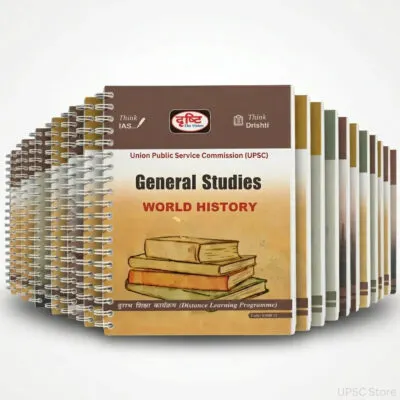
Drishti IAS GS Foundation Notes 2025-26 | 27 Booklets | English Medium | UPSC Study Material


PW Only IAS Prelims 2026-27 Hindi Test Series | 10–35 Tests | Hindi Medium | UPSC Study Material


Shubhra Ranjan PSIR Optional Handwritten Notes 2026-27 | 11 Booklets | English Medium | UPSC Study Material

Ranker's Classes Commerce Optional Notes 2025-26 | 10 Booklets | English Medium | UPSC Study Material

Vision IAS General Studies Notes 2026-27 | 56 Booklets | English Medium | UPSC Study Material

About Mrunal Sir PCB 14 Economy Short Notes Part 1
Mrunal Sir PCB 14 Economy Short Notes Part 1 is an original printed study material set from Mrunal Sir, covering Economy. Available in English medium, this set is counted booklet by booklet before dispatch — no photocopies, no missing booklets.
Product Details
- Institute: Mrunal Sir
- Subject: Economy
- Medium: English
- Pages: 224
- Format: High-Quality Printed Booklets
- Delivery: Pan-India delivery in 4–7 working days, free over ₹1,999
- Condition: New, original print — counted before dispatch
Why Buy from UPSC Store?
- ✓ Original Printed Notes — no photocopies, every booklet counted before it ships
- ✓ Fast Dispatch — ships within 24 hours from Delhi, arrives in 4–7 days pan-India
- ✓ Secure Packaging — bubble-wrapped and boxed to prevent damage in transit
- ✓ 180+ Orders Shipped — to 25 states across India
- ✓ WhatsApp Support — ask which set fits your optional and medium before ordering
Frequently Asked Questions
Original print — the same printed booklets the institute issues. Every set is counted booklet by booklet before dispatch.
Orders are dispatched within 24 hours from Delhi and delivered across India in 4–7 working days. Delivery is free over ₹1,999.
Returns are accepted only if the problem is from our side: wrong item, damaged or defective copy, or missing booklets or pages. Report it within 7 days of delivery and we arrange a free pickup and send a free replacement or a full refund. We do not accept change-of-mind returns, so please check the medium, edition and binding before ordering. WhatsApp us to start a return.