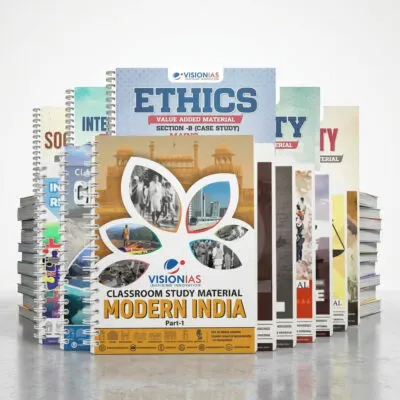


Vision IAS Complete GS Notes 2025-26
About Vision IAS Complete GS Notes
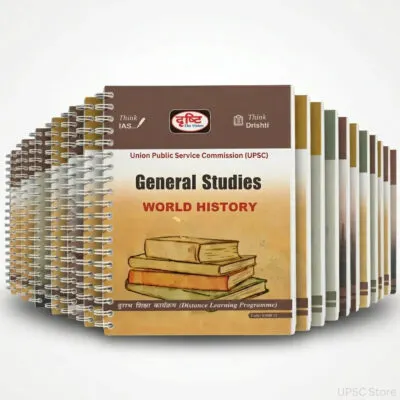
The Vision IAS Complete GS Notes is a printed UPSC study material set sold by UPSC Store — India’s trusted source for genuine, latest-batch civil services preparation books. This page covers full booklet details, syllabus coverage, pricing, shipping, and frequently asked questions. Useful for UPSC CSE, BPSC, UPPSC, MPPSC, RAS and other state PSC examinations.
Vision IAS Complete GS Hindi Medium 2025-26 — 42 Printed Booklets for UPSC Mains & Prelims All GS Papers
Related: Vision IAS notes · UPSC General Studies
Product Overview
| Feature | Details |
|---|---|
| Booklets Count | 42 Individual Printed Booklets — Full UPSC GS Syllabus Coverage Across All Four GS Papers |
| Language | Hindi Medium (हिंदी माध्यम) |
| Publisher | Vision IAS (Classroom Study Material Series — क्लासरूम अध्ययन सामग्री) |
| Edition | 2025-26 — Latest Genuine Batch |
| Condition | Brand New, Unmarked, Fresh Stock |
| Format | High-Quality Printed Booklets — Spiral or Book Binding |
| Paper Quality | 75 GSM Ultra-White — Highlighter Safe, Zero Bleed-Through |
| Shipping | Pan India Delivery in 3-5 Business Days — Tracked |
| Also Useful For | BPSC Hindi Medium, UPPSC Hindi Medium, MPPSC, RAS, and all State PSC Hindi Medium Aspirants |
Complete Booklet Catalog
The Vision IAS Complete GS Hindi Medium 2025-26 set spans all four General Studies papers of the UPSC Civil Services Mains examination, along with Essay and Ethics Case Studies, making it the most thorough Hindi-medium classroom material available for UPSC aspirants. Each booklet isolates one subject or sub-topic so you can study, revise, and carry only what you need for each session.
- Booklet 1: पर्यावरण I (Environment Part 1) — Ecology fundamentals, biodiversity, ecosystems, food chains, energy flow, biogeochemical cycles, biomes, habitat classification, IUCN Red List categories, wildlife protection acts, national parks, wildlife sanctuaries, and conservation strategies aligned with GS Paper III environment sub-theme.
- Booklet 2: पर्यावरण II (Environment Part 2) — Climate change science, greenhouse gases, IPCC reports, Paris Agreement, carbon credits, pollution types (air, water, soil, noise, light), NGT rulings, environmental impact assessment, solid waste management rules, and India’s renewable energy targets for UPSC GS III.
- Booklet 3: पर्यावरण III (Environment Part 3) — International environmental conventions — CITES, Ramsar, Cartagena Protocol, Nagoya Protocol, Basel Convention; global environmental bodies; UN Environment Programme; sustainable development goals and India’s commitments; green economy concepts; environmental jurisprudence and landmark Supreme Court judgments.
- Booklet 4: पर्यावरण IV (Environment Part 4) — Disaster ecology, environmental refugees, recent government schemes on environment, green hydrogen, biofuels, e-waste management, coastal regulation zones, wetland conservation, environmental current affairs integrated with static content for UPSC Prelims and Mains 2025-26.
- Booklet 5: भारतीय समाज I (Indian Society Part 1) — Salient features of Indian society, diversity, caste system and social stratification, tribal communities and their constitutional protections, role of women, gender inequality, female empowerment schemes, SHG movements, demographic trends, urbanisation challenges, and social mobility concepts for GS Paper I.
- Booklet 6: भारतीय समाज II (Indian Society Part 2) — Communalism, regionalism, secularism, globalisation’s social impact, social empowerment, poverty and hunger dimensions, social capital, voluntarism, NGOs, civil society, religious and linguistic diversity, minority rights, and constitutional provisions safeguarding social justice — essential for UPSC GS I and GS II.
- Booklet 7: भारतीय समाज III (Indian Society Part 3) — Population and associated issues, migration patterns, urbanisation problems, slum development, smart cities, juvenile delinquency, child labour, elderly care, disability rights, LGBTQ+ rights framework in India, and contemporary social movements — current affairs integrated with social issues for UPSC Mains preparation.
- Booklet 8: नीतिशास्त्र केस स्टडीज (Ethics Case Studies) — Solved and model case studies for GS Paper IV Ethics section, covering public servant dilemmas, whistleblower scenarios, conflict of interest situations, corruption handling, disaster management ethical decisions, probity in governance, role of civil servants in upholding constitutional values and citizen service delivery.
- Booklet 9: भूगोल I (Geography Part 1) — Physical geography: geomorphology, interior of earth, plate tectonics, rock types, weathering and erosion, landform evolution, rivers and drainage patterns, glacial landforms, coastal landforms, karst topography — complete UPSC GS I physical geography section covered with relevant diagrams and map-based questions.
- Booklet 10: भूगोल II (Geography Part 2) — Climatology and oceanography: atmosphere layers, pressure belts, wind systems, monsoon mechanism, cyclones and anticyclones, jet streams, El Niño and La Niña, ocean currents, tides, marine ecosystems, coral reefs, deep-sea resources — aligns directly with UPSC GS I geography syllabus on climate and environment.
- Booklet 11: भूगोल III (Geography Part 3) — Human geography: world population distribution, migration, urbanisation, agriculture types and regions, Green Revolution, food security, land use patterns, world industries and industrial location theory, transportation and trade routes, globalisation’s geographic impacts — covers GS I human geography and economic geography comprehensively.
- Booklet 12: भूगोल IV (Geography Part 4) — Indian geography: physiographic divisions, drainage system, soils, natural vegetation, agriculture in India, major crops and cropping patterns, irrigation systems, mineral and energy resources, industries and industrial corridors, transport networks, and geographical basis of regional planning — vital for UPSC GS I Indian geography.
- Booklet 13: आधुनिक भारत का इतिहास I (Modern Indian History Part 1) — European advent in India, British conquest, Subsidiary Alliance, Doctrine of Lapse, revolts before 1857, The Great Revolt of 1857 — causes, nature, course and consequences; social and religious reform movements: Brahmo Samaj, Prarthana Samaj, Arya Samaj, Ramakrishna Mission, and their role in national awakening.
- Booklet 14: आधुनिक भारत का इतिहास II (Modern Indian History Part 2) — Rise of Indian nationalism, formation of INC, Moderates and Extremists, Swadeshi Movement, Home Rule League, Gandhian era — Non-Cooperation Movement, Civil Disobedience Movement, Quit India Movement; Revolutionary nationalism; Subhash Chandra Bose and INA; Cabinet Mission, Partition, and Independence — complete UPSC GS I modern history.
- Booklet 15: राज्यव्यवस्था और संविधान I (Polity and Constitution Part 1) — Historical background of Indian Constitution, Constituent Assembly, Preamble, Fundamental Rights in detail — Articles 12 to 35, constitutional remedies, Fundamental Duties, Directive Principles of State Policy, their justiciability and relationship with Fundamental Rights — the bedrock of UPSC GS II polity preparation.
- Booklet 16: राज्यव्यवस्था और संविधान II (Polity and Constitution Part 2) — Union Executive: President, Vice President, Prime Minister, Council of Ministers, Cabinet Committees; Parliament — Lok Sabha and Rajya Sabha, legislative procedure, ordinary and constitutional amendment bills, parliamentary committees, anti-defection law, Budget process — essential GS II polity content for UPSC Mains.
- Booklet 17: राज्यव्यवस्था और संविधान III (Polity and Constitution Part 3) — Judiciary: Supreme Court, High Courts, subordinate courts, judicial review, judicial activism, PIL, constitutional benches, tribunals; State government structure — Governor, Chief Minister, State legislature; Centre-State relations — legislative, administrative and financial relations, Inter-State Council, Zonal Councils — comprehensive UPSC GS II coverage.
- Booklet 18: राज्यव्यवस्था और संविधान IV (Polity and Constitution Part 4) — Local self-government: 73rd and 74th Amendments, Panchayati Raj Institutions, Urban Local Bodies; Emergency provisions; Constitutional bodies — Election Commission, CAG, UPSC, Finance Commission; Statutory bodies — CBI, CVC, Lokpal, NHRC; constitutional amendments — complete list relevant for UPSC GS II examination.
- Booklet 19: राज्यव्यवस्था और संविधान V (Polity and Constitution Part 5) — Governance and accountability: RTI Act, e-governance, digital India, citizens’ charters, social audit; welfare schemes classification; NGOs and civil society role; challenges of governance — corruption, red-tapism, delays; role of media; transparency and accountability mechanisms; federalism issues in India — current affairs linked with polity for UPSC.
- Booklet 20: निबंध (Essay) — Essay writing strategy for UPSC GS Essay Paper, model essays across all major themes — society, polity, economy, international relations, philosophy, science and technology; introduction and conclusion techniques; flow and coherence; language enrichment for Hindi medium writers; previous year essay analysis and emerging topics for 2025-26 UPSC aspirants.
- Booklet 21: नीतिशास्त्र I (Ethics Part 1) — Essence and determinants of ethics, moral philosophy — teleological and deontological theories, utilitarianism, Kantian ethics, virtue ethics; attitude and its influence on behaviour; emotional intelligence — concepts and application in administration; moral intuitions, conscience, civil service values and foundational concepts for UPSC GS IV Ethics.
- Booklet 22: नीतिशास्त्र II (Ethics Part 2) — Contributions of moral thinkers: Indian tradition — Kautilya, Gandhi, Vivekananda, Ambedkar; Western tradition — Aristotle, Plato, Kant, Mill; aptitude and foundational values for civil services; integrity and impartiality; objectivity; dedication to public service; empathy and tolerance; compassion in administration — UPSC GS IV complete thinkers section.
- Booklet 23: नीतिशास्त्र III (Ethics Part 3) — Public/civil service values and ethics in public administration; probity in governance — concept of public service; philosophical basis of governance and integrity; information sharing and transparency; Right to Information; ethical dilemmas in governance; corporate governance; international relations ethics — completes the UPSC GS IV syllabus for Hindi medium aspirants.
- Booklet 24: अंतराष्ट्रीय सम्बन्ध I (International Relations Part 1) — India’s foreign policy — evolution, Panchsheel, NAM, Gujral Doctrine, Neighbourhood First policy; India’s bilateral relations with major powers — USA, Russia, China, Japan, France; strategic partnerships; Look East and Act East policy; India-ASEAN relations; India’s nuclear doctrine and role in global nuclear governance — UPSC GS II IR.
- Booklet 25: अंतराष्ट्रीय सम्बन्ध II (International Relations Part 2) — India’s neighbourhood policy: relations with Pakistan, Bangladesh, Sri Lanka, Nepal, Bhutan, Maldives, Afghanistan; China border issue; SAARC and its limitations; BIMSTEC; regional groupings — SCO, BRICS, G20, G7; multilateral institutions — UN, WTO, IMF, World Bank — India’s role and reform agenda for UPSC GS II.
- Booklet 26: अंतराष्ट्रीय सम्बन्ध III (International Relations Part 3) — Global geopolitics: US-China rivalry, Indo-Pacific, Quad, AUKUS; Russia-Ukraine conflict and global implications; Middle East dynamics and India’s interests; Africa engagement; diaspora and India’s soft power; cyber diplomacy; space diplomacy; vaccine diplomacy; current international affairs for UPSC 2025-26 integrated with static IR framework.
- Booklet 27: अर्थशास्त्र I (Economy Part 1) — Fundamentals of Indian economy: GDP, GNP, NNP, national income accounting; economic growth vs development; five-year plans and NITI Aayog; poverty measurement — Tendulkar Committee, Rangarajan Committee, Multidimensional Poverty Index; inequality indices; human development index; inclusive growth concept — UPSC GS III economy foundation.
- Booklet 28: अर्थशास्त्र II (Economy Part 2) — Monetary policy: RBI functions and tools, repo rate, CRR, SLR, OMOs; banking sector — commercial banks, cooperative banks, NBFCs, RRBs, payment banks; financial markets — money market, capital market, SEBI; inflation measurement and management; NPA crisis and banking reforms; digital payments ecosystem — complete UPSC GS III monetary section.
- Booklet 29: अर्थशास्त्र III (Economy Part 3) — Fiscal policy: Union Budget structure, revenue and capital accounts, fiscal deficit concepts, FRBM Act; taxation — direct and indirect taxes, GST structure and council; government expenditure and subsidies; disinvestment and privatisation; public debt management; fiscal federalism and Finance Commission — essential UPSC GS III fiscal content for Hindi medium.
- Booklet 30: अर्थशास्त्र IV (Economy Part 4) — Agriculture and rural economy: land reforms, Green Revolution, second Green Revolution; agricultural marketing — APMC, e-NAM, FCI; minimum support price and procurement; food security — PDS, NFSA; rural development programmes — MGNREGA, PMGSY, PMKSY; agri-credit and crop insurance — Pradhan Mantri Fasal Bima Yojana — UPSC GS III agriculture complete.
- Booklet 31: अर्थशास्त्र V (Economy Part 5) — Infrastructure: energy sector — coal, oil, gas, renewables; transport — railways, roads, ports, civil aviation; communication — telecom, broadband, digital infrastructure; industrial policy — Make in India, PLI schemes, SEZs, industrial corridors; foreign trade policy; FDI and FII; balance of payments; WTO and India’s trade disputes — UPSC GS III infrastructure and trade.
- Booklet 32: विश्व इतिहास I (World History Part 1) — Renaissance and Reformation; Age of Exploration; Industrial Revolution — causes, phases, social impact; American Revolution; French Revolution — causes, phases, legacy; Napoleon and European reorganisation; 19th century political changes — nationalism, unification of Germany and Italy; colonialism and imperialism — types and impacts — UPSC GS I world history.
- Booklet 33: विश्व इतिहास II (World History Part 2) — World War I — causes, course, Treaty of Versailles; Russian Revolution 1917; Rise of Fascism and Nazism; World War II — causes, major events, Holocaust, atomic bombings; Cold War — origin, phases, proxy wars; UN formation; decolonisation of Asia and Africa; fall of USSR; post-Cold War world order — complete UPSC GS I world history syllabus.
- Booklet 34: कला एवं संस्कृति I (Art and Culture Part 1) — Indian art traditions: Indus Valley art, rock paintings, Mauryan art and architecture, Gupta period art, South Indian temple architecture styles — Nagara and Dravida, cave temples, Buddhist art — Stupa, Chaitya, Vihara; painting traditions — Ajanta, Bagh, Ellora; classical dance forms and their geographic origins for UPSC GS I.
- Booklet 35: कला एवं संस्कृति II (Art and Culture Part 2) — Medieval and modern art: Mughal architecture, provincial styles, Indo-Islamic architecture; folk arts and crafts — GI tagged crafts state-wise; classical music — Hindustani and Carnatic; folk music and theatre; puppetry; Indian cinema; UNESCO Intangible Cultural Heritage listings from India; cultural institutions and their mandates — UPSC GS I art and culture.
- Booklet 36: आपदा प्रबंधन (Disaster Management) — Disaster Management Act 2005; NDMA, NDRF, SDRF structure and functioning; types of disasters — natural and man-made; disaster risk reduction — Sendai Framework; early warning systems; India’s disaster vulnerability; post-disaster reconstruction; community-based disaster management; role of technology in disaster response — complete UPSC GS III disaster management section.
- Booklet 37: सुरक्षा (Security) — Internal security challenges: left-wing extremism, insurgency in Northeast, J&K situation; border management — Line of Control, LAC, international borders; organised crime and narco-terrorism; cyber security threats; critical infrastructure protection; money laundering and terror financing; UAPA, NIA; role of para-military forces — complete UPSC GS III internal security content.
- Booklet 38: सुशासन (Good Governance) — Concept of good governance and its pillars; e-governance initiatives — NeGP, Digital India; government schemes for governance reform; decentralisation and people’s participation; transparency and accountability tools; social audit; citizens’ charter; grievance redressal mechanisms; second ARC recommendations; ethics in public administration — UPSC GS II governance section.
- Booklet 39: विज्ञान और प्रद्योगिकी I (Science and Technology Part 1) — Basics of science relevant to UPSC — physics, chemistry, biology applications; space technology — ISRO missions, satellite types, launch vehicles; defence technology — missiles, DRDO programmes; nuclear technology — reactors, thorium programme; biotechnology — GMOs, CRISPR, stem cells; IT sector — AI, machine learning, blockchain basics — UPSC GS III S&T.
- Booklet 40: विज्ञान और प्रद्योगिकी II (Science and Technology Part 2) — Nanotechnology and its applications; renewable energy technologies; electric vehicles; 5G and telecom revolution; health technology — telemedicine, mRNA vaccines, drug regulation; cybersecurity tools; semiconductor policy; quantum computing; India’s innovation ecosystem — startups, patents; technology and society interface — current affairs integrated for UPSC 2025-26.
- Booklet 41: सामाजिक न्याय (Social Justice) — Constitutional framework for social justice; SC/ST welfare — reservation policy, Scheduled Castes and Scheduled Tribes (Prevention of Atrocities) Act; OBC framework — Mandal Commission, creamy layer; women empowerment — laws, schemes, gender budget; child welfare — POCSO, ICPS; welfare of minorities, disabled, elderly — schemes and legislative protections for UPSC GS II social justice.
- Booklet 42: आजादी के बाद का भारत / प्राचीन इतिहास / मध्यकालीन इतिहास / नीति 80 केस अध्ययन / यूपीएससी पाठ्यक्रम — Post-Independence India: state reorganisation, Nehruvian era policies, Emergency period, economic liberalisation; Ancient Indian History: Indus Valley to Guptas; Medieval Indian History: Delhi Sultanate to Maratha Empire; 80 Ethics Case Studies for rapid revision; and the full official UPSC CSE syllabus for quick reference and study planning.
In-Depth Content Breakdown: Booklet by Booklet
Booklets 1–4: पर्यावरण I–IV (Environment)
These four environment booklets address the entire UPSC GS Paper III environment sub-theme as well as significant portions of GS Paper I (geography overlap) and GS Paper II (international agreements). Environment is one of the most scoring areas in both UPSC Prelims and Mains, and these four volumes ensure nothing is missed. Coverage begins with ecology fundamentals and climbs through climate change, international conventions, and India’s green policy commitments.
What makes these booklets stand out for Hindi medium aspirants is the clear Hindi terminology matched with common English acronyms used in examinations — so IPCC, NDC, CBD, Ramsar, and similar terms are explained in Hindi context without creating confusion during answer writing. Diagrams showing carbon cycles, food webs, and the greenhouse effect are printed at high resolution, supporting visual retention for complex ecological processes.
Booklets 5–7: भारतीय समाज I–III (Indian Society)
Indian Society occupies a dedicated section of UPSC GS Paper I and overlaps with GS Paper II social justice and welfare content. These three booklets cover the full social fabric of India — caste, tribe, gender, religion, language, migration, and urbanisation — all of which are recurring themes in UPSC Mains questions. The material is written to align directly with the UPSC syllabus statement rather than being a broad sociology textbook.
Each social issue is presented with its constitutional foundation, recent government response, and critical analysis — which is the three-layered approach Vision IAS classroom material is known for. Hindi medium UPSC aspirants benefit greatly here because the language uses standard administrative Hindi rather than literary Hindi, making it directly applicable for Mains answer writing in Hindi medium.
Booklet 8: नीतिशास्त्र केस स्टडीज (Ethics Case Studies)
GS Paper IV’s case study section (Section B) is the most anxiety-inducing part for many UPSC aspirants. This dedicated case studies booklet provides model scenarios covering the full range of dilemmas a civil servant might face — from handling political pressure to whistleblowing, from natural disaster response to ethical procurement decisions. Each case study includes a structured answer format that scores well under UPSC marking schemes.
The booklet includes 80 case studies in total across the Ethics Notes series, with this volume focusing on worked examples and answer frameworks. Hindi medium students particularly benefit from model answers written in examination-standard Hindi that demonstrate how to present multiple stakeholder perspectives, identify ethical dimensions, and propose practical solutions — all within the word limits UPSC imposes in GS Paper IV.
Booklets 9–12: भूगोल I–IV (Geography)
Geography accounts for a substantial share of UPSC GS Paper I and also supports environment, disaster management, and agriculture questions in GS Papers III. These four booklets divide geography logically: physical geography (geomorphology, climatology), oceanography, human geography, and Indian geography. The systematic four-volume structure means you can pick up exactly the geography sub-topic you need at any revision stage.
Map-based content is a strength of these booklets — physical maps of India and the world are printed inline with the text so you study location and concept simultaneously. The Indian geography volume is especially useful for UPSC Prelims, where map-spotting questions (passes, rivers, peaks, biosphere reserves) appear every year. All map labels are in both Hindi and standard transliterated English to support answer writing in either convention.
Booklets 13–14: आधुनिक भारत का इतिहास I–II (Modern Indian History)
Modern Indian History is one of the highest-weightage topics in UPSC GS Paper I, and these two booklets cover the entire arc from European arrival to Indian independence. The narrative approach used in Vision IAS classroom material makes chronology easy to follow, while separate analytical sections address the causes-nature-consequences framework that UPSC questions demand. Social and religious reform movements are given dedicated coverage because they appear consistently in both Prelims and Mains.
The Gandhian era chapters are particularly detailed — each mass movement is analysed for its triggers, phases, government response, and impact on the independence struggle. Revolutionary nationalism, the INA, and the events of 1945-47 are covered in a way that enables both objective MCQs (Prelims) and analytical essays (Mains). Hindi medium students will find the language precise and exam-ready throughout both booklets.
Booklets 15–19: राज्यव्यवस्था और संविधान I–V (Polity and Constitution)
Five booklets are dedicated to Polity and Constitution — the largest single-subject allocation in this entire 46-booklet set — reflecting the enormous weight this topic carries in UPSC GS Paper II. Coverage is article-by-article for Fundamental Rights, and institution-by-institution for constitutional and statutory bodies. Every major Supreme Court judgment referenced in the UPSC syllabus is summarised in accessible Hindi.
The governance booklet (Part V) bridges polity theory with current affairs — connecting constitutional provisions to real policy challenges like RTI implementation, e-governance gaps, and federalism strains. This makes the polity series doubly useful: you build conceptual clarity through Parts I–IV and then connect everything to current affairs through Part V, which is precisely the integrated understanding UPSC rewards in Mains answers. Buy this set to get the most current 2025-26 polity content available in Hindi medium.
Booklet 20: निबंध (Essay)
The Essay paper carries 250 marks in UPSC Mains and is often underestimated by first-time aspirants. This booklet addresses essay strategy, structure, and execution specifically for Hindi medium writers who must maintain quality prose under examination time pressure. Model essays cover themes across philosophy, society, economy, governance, and technology — the five broad domains from which UPSC consistently draws essay prompts.
What distinguishes this booklet is its focus on introduction crafting, thematic layering, and conclusion techniques that examiners reward. Previous year analysis shows which angles UPSC favours — this booklet incorporates those patterns into its model essays. Hindi medium aspirants often score lower on Essay simply due to structure issues; this booklet directly addresses that gap with annotated model answers showing paragraph-by-paragraph logic.
Booklets 21–23: नीतिशास्त्र I–III (Ethics)
Three booklets cover the theoretical framework of UPSC GS Paper IV Ethics in full — moral philosophy, contributions of thinkers (both Indian and Western), civil service values, and public administration ethics. GS Paper IV is unique in that it requires both theoretical knowledge and practical application, and the three-booklet structure handles each layer separately. Booklet I builds the foundation, Booklet II addresses thinkers and aptitude, and Booklet III closes with governance ethics and probity.
For Hindi medium aspirants, ethics presents a vocabulary challenge — terms like “deontological”, “teleological”, “utilitarianism”, and “categorical imperative” must be rendered in examination-quality Hindi. These booklets solve this problem by providing standardised Hindi equivalents and demonstrating their use in model answers. The 80 Case Studies booklet (Booklet 8) works as a companion to these three theoretical volumes, completing the full GS Paper IV preparation arc.
Booklets 24–26: अंतराष्ट्रीय सम्बन्ध I–III (International Relations)
International Relations under UPSC GS Paper II requires both static knowledge of India’s foreign policy framework and dynamic awareness of current geopolitical developments. These three booklets handle the static-dynamic integration well — static content on foreign policy doctrines, bilateral relations frameworks, and multilateral institutions is presented alongside current affairs boxes that update the picture for 2025-26.
The third IR booklet is the most current-affairs-heavy, covering the Indo-Pacific framework, Quad dynamics, India-China relations post-Galwan, India’s G20 presidency legacy, and India’s growing engagement with Africa and ASEAN. For Hindi medium aspirants, IR is often challenging because news and analysis is predominantly in English; these booklets translate complex geopolitical analysis into clear, structured Hindi that translates directly into Mains answers.
Booklets 27–31: अर्थशास्त्र I–V (Economy)
Five booklets cover the UPSC GS Paper III economy syllabus — the largest subject allocation after Polity. Economy is consistently one of the toughest sections for Hindi medium aspirants because economic terminology is largely English-origin and news coverage is English-centric. These five booklets systematically build from national income accounting fundamentals through monetary policy, fiscal policy, agriculture, and infrastructure-trade, ensuring nothing in the UPSC economy syllabus is left uncovered.
Each economy booklet includes flowcharts showing policy transmission mechanisms (e.g., how repo rate changes affect inflation), tables comparing schemes and institutions, and current affairs sections updating figures like fiscal deficit targets, GST revenue trends, and FDI inflows. The agricultural economy booklet (Part IV) is particularly strong for UPSC GS III agriculture questions, which require both scheme knowledge and structural understanding of India’s agrarian challenges. Buy these five economy booklets to build the analytical depth UPSC expects.
Booklets 32–33: विश्व इतिहास I–II (World History)
World History under UPSC GS Paper I spans from the Industrial Revolution to the Cold War — a period of roughly 250 years of dramatic global change. These two booklets divide the content at World War I, with Part I covering the 18th–19th century transformations and Part II covering the 20th century conflicts and their aftermath. Each event is analysed through causes-events-consequences, the structure UPSC questions on world history consistently demand.
World History is often treated as a peripheral topic by UPSC aspirants, but it appears in Mains GS I every year and indirectly informs IR and governance questions. The Cold War chapter in Part II is especially well-constructed, connecting ideology, proxy conflicts, and the post-1991 world order in a way that makes both static answers and analytical arguments easy to build. Hindi medium treatment of European and American history requires careful translation — these booklets achieve clarity without sacrificing accuracy.
Booklets 34–35: कला एवं संस्कृति I–II (Art and Culture)
Art and Culture features in UPSC GS Paper I and has growing weightage in Prelims, with GI-tagged crafts, UNESCO listings, and classical art forms appearing regularly as MCQ options. These two booklets cover the full arc from Indus Valley art to contemporary cultural institutions, with architecture, painting, music, dance, and craft traditions all addressed. The division into ancient/medieval (Part I) and medieval/modern (Part II) enables focused revision by historical period.
The GI-tagged products section in Part II is especially valuable for Prelims, where questions on geographical indication products (textiles, crafts, food items) have become more frequent. UNESCO Intangible Cultural Heritage listings from India are tabulated for quick reference. Hindi medium aspirants benefit from cultural terms being presented in their original Sanskrit or regional language forms alongside Hindi explanations, maintaining authenticity while improving accessibility.
Booklet 36: आपदा प्रबंधन (Disaster Management)
Disaster Management is a dedicated sub-theme of UPSC GS Paper III and also appears in essay prompts and case studies. This booklet covers the legal and institutional framework (Disaster Management Act, NDMA, NDRF) and then connects it to India’s disaster profile — floods, cyclones, earthquakes, droughts, and industrial disasters. The Sendai Framework for Disaster Risk Reduction 2015-2030 is covered in alignment with UPSC’s international conventions section.
The booklet includes state-wise disaster vulnerability mapping concepts, which are useful for both Prelims and for answer enrichment in Mains. Community-based disaster management and the role of technology (early warning systems, satellite imagery, mobile alerts) are emerging themes that this 2025-26 edition addresses with updated examples. The compact single-booklet format means disaster management can be revised in one focused study session before the examination.
Booklet 37: सुरक्षा (Security)
Internal Security is a dedicated UPSC GS Paper III topic that many aspirants underestimate. This booklet covers left-wing extremism (LWE), insurgency in Northeast India, the J&K security situation, border management challenges, cyber security, and critical infrastructure protection. Each security challenge is mapped to the relevant constitutional provisions, central agencies, and policy responses — the three layers UPSC expects in security-related answers.
Organised crime, narco-terrorism, money laundering (PMLA), and terror financing have been growing in UPSC question frequency, and this booklet addresses all of them in the 2025-26 updated edition. The role of NSG, CRPF, BSF, SSB, and NIA is explained institutionally, which is important for questions on internal security architecture. Hindi medium treatment of security topics is handled with appropriate seriousness and precision throughout.
Booklet 38: सुशासन (Good Governance)
Good Governance sits at the intersection of UPSC GS Paper II (governance, accountability) and GS Paper IV (ethics in administration). This booklet addresses governance through both structural and values-based lenses — covering digital India initiatives, decentralisation, social audit, citizens’ charters, and the Second Administrative Reforms Commission recommendations that UPSC references frequently. Governance is one of the most question-dense topics in UPSC GS II Mains.
The booklet’s structure moves from theoretical governance concepts to practical implementation challenges, which mirrors how UPSC frames governance questions — asking aspirants to identify structural problems and suggest solutions. E-governance case studies (GSTN, DigiLocker, PFMS, GeM portal) are included with their implementation status, which enriches Mains answers with current, specific examples. This is a high-value booklet for both GS II and GS IV preparation.
Booklets 39–40: विज्ञान और प्रद्योगिकी I–II (Science and Technology)
Science and Technology is one of the fastest-changing sections of the UPSC GS Paper III syllabus, and the two-booklet 2025-26 edition ensures currency. Part I covers foundational science applications — space (ISRO missions like Chandrayaan-3, Aditya-L1), defence technology (DRDO, missiles, submarines), nuclear policy, and biotechnology (GMOs, CRISPR gene editing, biopharmaceuticals). The content is designed for students without a science background, focusing on concepts and implications rather than technical detail.
Part II addresses emerging technologies that have rapidly entered the UPSC question bank — AI and machine learning policy, quantum computing, semiconductor manufacturing, 5G rollout, and cybersecurity. India’s innovation ecosystem (startup policy, IPR framework, technology transfer) is also covered. Both booklets maintain a policy-society interface focus — how does this technology affect governance, economy, and society? — which is exactly the angle UPSC expects in GS III S&T answers.
Booklet 41: सामाजिक न्याय (Social Justice)
Social Justice under UPSC GS Paper II covers welfare schemes, reservation policy, minority rights, gender justice, child welfare, and disability rights — a wide canvas that this single booklet navigates systematically. The constitutional framework for each social justice dimension is laid out first, followed by legislative protections (e.g., SC/ST Atrocities Act, POCSO Act, PWD Act) and current government schemes. This structure helps aspirants write complete, structured answers quickly.
Social justice is an increasingly important topic in UPSC Mains as questions on gender budgeting, transgender rights, disability inclusion in governance, and elderly care policy have grown more frequent. This 2025-46 Booklet incorporates recent Supreme Court judgments and Parliamentary legislation relevant to social justice, ensuring Hindi medium aspirants are not disadvantaged by relying on older materials that miss crucial recent developments.
Booklet 42: आजादी के बाद का भारत / प्राचीन इतिहास / मध्यकालीन इतिहास / नीति 80 केस अध्ययन / यूपीएससी पाठ्यक्रम
The final booklet is a multi-purpose resource that serves several distinct needs. Post-Independence India covers the major political and economic developments from 1947 to the present — state reorganisation, Emergency, economic reforms of 1991, and coalition politics — which is directly relevant for UPSC GS I (post-independence) questions. Ancient and Medieval History sections provide concise revision notes covering major dynasties, administration, culture, and polity — sufficient for the UPSC Prelims and Mains factual recall questions.
The inclusion of 80 Ethics Case Studies in this booklet (building on Booklet 8) gives aspirants a large case study bank to practise with before UPSC GS Paper IV. The UPSC official syllabus is reproduced in full at the end, serving as a self-audit tool — you can map every booklet in the 42-volume set to specific syllabus points to confirm complete coverage before your examination. This reference utility makes Booklet 42 the logical starting and ending point for your 2025-26 UPSC preparation journey.
Physical Construction and Quality Standards
These 46 Booklets are manufactured to withstand the demands of sustained UPSC preparation — daily handling across months of study, annotation, highlighting, and repeated revision cycles. Every component of the physical construction is selected to support long-duration study sessions without fatigue or deterioration.
Paper Quality: 75 GSM Anti-Glare White Paper
Each booklet uses 75 GSM ultra-white, anti-glare paper chosen specifically for UPSC study use. The high opacity ensures that text and diagrams on the reverse side do not show through, even when using multiple marker colours for topic-wise colour coding. Gel pens, ballpoint pens, and standard fluorescent highlighters (yellow, orange, green, pink) all perform without bleed-through. The anti-glare surface significantly reduces eye strain during extended study sessions — critical when working through 46 Booklets over several months of UPSC preparation.
Printing Technology: High-Resolution Laser Printing
All 46 Booklets are produced using high-resolution laser printing technology, delivering crisp, sharp text even at small font sizes used in tables and footnotes. Diagrams — including geography maps, polity flowcharts, economic graphs, and ecology cycles — are printed at sufficient resolution to read all labels clearly without magnification. Laser toner is permanent and smudge-proof, so notes written alongside printed text remain clean even after repeated handling. There is no ink smudging, fading, or quality degradation across the entire 46-booklet set.
Binding and Durability
Booklets are available in spiral or book binding depending on the subject and length. Spiral-bound booklets open completely flat on a study desk, allowing you to write notes in the margin alongside printed content without the spine fighting back — particularly useful for geography maps and polity diagrams. Book-bound volumes use a reinforced perfect-binding technique with a 300 GSM matte laminated cover that resists bending, moisture, and daily bag wear. Both binding types ensure the booklets survive the full duration of your UPSC 2025-26 preparation cycle.
Key Features and Study Design
Vision IAS Hindi Medium 2025-26 GS notes are designed around the specific preparation challenges of Hindi medium UPSC aspirants — from answer-writing language to terminology accuracy to current affairs integration — making them distinct from generic study materials in the market.
- UPSC Syllabus Alignment: Every booklet maps directly to named UPSC GS Paper I, II, III, and IV syllabus points. There is no surplus content that wastes revision time — you study what UPSC asks, structured the way UPSC asks it, which is the single most efficient approach to Mains preparation.
- Hindi Medium Answer-Writing Language: Content is written in clear, administrative Hindi that directly translates into Mains answers. Aspirants preparing in Hindi medium often struggle to find materials that match examination-standard language — these booklets solve that problem by modelling the exact register UPSC expects from Hindi medium candidates.
- Current Affairs Integration for 2025-26: Static content in each booklet is supplemented with current affairs boxes linking recent events, government schemes, Supreme Court judgments, and international developments to the underlying syllabus concepts. This integration is updated to the 2025-26 edition, making the material relevant for the upcoming UPSC examination cycle.
- Subject-Wise Modular Structure: 42 separate booklets mean you carry only what you need to each study session. You can also follow the recommended Vision IAS study sequence — beginning with Polity and History before moving to Economy and Environment — or customise based on your own subject strengths and weaknesses without the rigidity of a single bound volume.
- Diagrams, Maps, and Tables Throughout: Complex processes — economic policy transmission, ecological cycles, constitutional amendment procedures, diplomatic frameworks — are visualised in diagrams and tables that appear inline with the relevant text. This visual support is particularly valuable for Hindi medium students who rely heavily on self-made notes and flowcharts during revision.
Shipping, Packaging and Delivery
Each order of the Vision IAS Complete GS Hindi Medium 2025-26 set is packaged with the care that 42 printed booklets require. Every booklet is individually shrink-wrapped to prevent moisture exposure during transit. The complete set is then packed in a double-walled corrugated cardboard box with foam corner protectors and kraft paper padding filling any void space. Edge reinforcement tape is applied to all box corners. The final parcel is sealed with branded security tape that shows evidence of tampering if the seal is broken in transit, ensuring the booklets arrive in exactly the brand-new, unmarked condition in which they were packed.
Orders are dispatched within 24 hours of payment confirmation and delivered pan India in 3–5 business days via tracked courier. A shipment tracking ID is sent via WhatsApp immediately upon dispatch — you can reach us at +91 70045 49563 for any delivery queries. In the rare event that a booklet is missing or damaged upon delivery, we replace the affected item within 48 hours of your complaint, no questions asked. We ship to all pin codes across India including Tier 2 and Tier 3 cities, J&K, Northeast states, and Andaman and Nicobar Islands.
Frequently Asked Questions (FAQ)
A: This set contains 42 individual printed booklets covering the complete UPSC GS syllabus across all four papers — GS I, GS II, GS III, and GS IV — along with Essay, Ethics Case Studies, and supplementary history and culture content. The 46 Booklets together cover every named topic in the official UPSC Civil Services Mains syllabus as of the 2025-26 edition, making this a single-source purchase for full GS preparation in Hindi medium.
A: Yes. This 46-booklet set covers all four GS Papers — GS Paper I (History, Geography, Society, Art & Culture), GS Paper II (Polity, Governance, IR, Social Justice), GS Paper III (Economy, Environment, S&T, Security, Disaster Management), and GS Paper IV (Ethics, Integrity, Aptitude) — entirely in Hindi medium. The Essay booklet is also included, making this the most complete Hindi-medium GS classroom material set currently available for UPSC 2025-26.
A: Yes. These are genuine 2025-26 edition booklets from Vision IAS’s classroom study material series. The content has been updated to include developments relevant for the UPSC 2025-26 examination cycle — including recent Supreme Court judgments, government scheme updates, international agreements, current geopolitical developments, and new technology topics. You are buying the latest available batch, not old stock from a previous year’s edition.
A: Yes. You can buy this complete Vision IAS Complete GS Hindi Medium 2025-26 set online right here without enrolling in any classroom programme at Vision IAS. This store ships the genuine printed booklets pan India directly to your address. Whether you are self-studying from home, studying in a non-metro city, or supplementing other coaching with Vision IAS materials, this online purchase option gives you full access to the same classroom notes used by Vision IAS students.
A: Vision IAS is among the most widely used classroom note series for UPSC CSE preparation. The Hindi medium edition is specifically designed for UPSC Mains answer writing — content follows the Mains question structure, language is examination-standard administrative Hindi, and current affairs are integrated with static content the way UPSC questions require. Thousands of UPSC Mains qualifiers in Hindi medium have used Vision IAS classroom material as their primary GS resource, which reflects its effectiveness for serious UPSC preparation.
A: These booklets use 75 GSM ultra-white paper chosen for high opacity — multiple highlighter colors and gel pens work without bleed-through to the reverse side, ideal for color-coded revision.
A: Vision IAS, Vajiram & Ravi, and Shankar IAS are the three most widely used classroom note series for UPSC GS preparation. Vision IAS notes are known for current affairs integration, analytical content framing, and IR depth. Vajiram notes are known for polity and ancient history depth. Shankar IAS notes are known for environment. Many successful UPSC aspirants use Vision IAS as the primary base for all four GS papers, supplementing with subject-specific resources where needed. For Hindi medium, Vision IAS is the most systematically prepared option.
A: These booklets are primarily designed for UPSC Mains GS preparation, but they contain all the static content that UPSC Prelims also tests — history, geography, polity, economy, environment, science and technology, and art and culture. Prelims-specific practice (MCQ practice, elimination techniques) is not included, as these are classroom study notes rather than question banks. However, thorough reading of these 46 Booklets builds the static knowledge base required for UPSC Prelims alongside Mains preparation.
A: Yes. Because these booklets cover the complete UPSC GS syllabus in Hindi medium, they are directly applicable for UPPSC (Uttar Pradesh PSC), BPSC (Bihar PSC), MPPSC (Madhya Pradesh PSC), RAS (Rajasthan Administrative Service), and virtually all Hindi-medium State PSC examinations that follow a similar GS pattern. State PSC syllabi are largely subsets of the UPSC GS syllabus, so buying this 46-booklet set serves double duty for aspirants preparing for both UPSC and their respective State PSC simultaneously.
A: Orders are dispatched within 24 hours of payment confirmation. Pan India delivery takes 3–5 business days via tracked courier. You will receive a shipment tracking ID on WhatsApp (+91 70045 49563) immediately upon dispatch. You can use this tracking ID on the courier partner’s website to monitor your shipment in real time. Delivery is available to all Indian pin codes including remote areas, hill stations, Northeast states, and island territories.
A: Every set is quality-checked and counted before packing — however, if you receive a set with a missing or damaged booklet, contact us immediately on WhatsApp at +91 70045 49563 with a photo of the received parcel. We will dispatch the replacement booklet within 48 hours of your complaint at no additional cost. We stand behind the quality and completeness of every order shipped from our store, and your satisfaction is our primary commitment as a UPSC study material provider.
A: This is 100% genuine, brand-new Vision IAS classroom study material — not photocopied, scanned, or reproduced without authorisation. All 46 Booklets are fresh-stock printed editions from the genuine 2025-26 batch. The paper quality, printing resolution, and binding all meet the original production standard. You can verify this on receipt — genuine booklets have consistent print quality, clear black text on white paper, and no signs of photocopy degradation such as grey backgrounds or text shadows. Buy with confidence from our verified store.
Summary
| Specification | Value |
|---|---|
| Booklets | 42 Printed Booklets |
| Language | Hindi Medium (हिंदी माध्यम) |
| Subject Coverage | Complete GS — All Four Papers + Essay + Ethics Case Studies |
| Paper | 75 GSM Ultra-White Anti-Glare |
| Binding | Spiral or Book Binding with 300 GSM Cover |
| Edition | 2025-26 Latest Genuine Batch |
| Condition | Brand New, Unmarked, Fresh Stock |
| Delivery | 3–5 Business Days Pan India — Tracked |
| Also Useful For | BPSC, UPPSC, MPPSC, RAS, and all Hindi Medium State PSC Examinations |
Sourced and dispatched from our store in Mukherjee Nagar, Delhi — India’s most prominent UPSC preparation hub. Order today and receive your complete Vision IAS Hindi Medium 2025-26 GS set with pan India delivery in 3–5 business days.
Reference: UPSC official syllabus
Customer Reviews 135
Top notch!
46 booklets sab kuch cover karte hain aur quality bhi decent hai.
Best purchase for exam prep.
46 booklets sab mil gaye, kahin short nahin padhe aur concept bilkul clear hai.
Content is detailed and well-researched. The Hindi medium makes it relatable and easy to grasp.
46 booklets mein sab kuch hai jo chahiye. Quality aur content dono excellent hain.
Coverage achchi hai but examples aur case studies mein kamiyan hain. Decent for revision.
Each booklet covers topics systematically. Meri padhai ka best source ban gaya!
Aspirants Also Bought
More from the same category
About Vision IAS Complete GS Notes 2025-26
Vision IAS Complete GS Notes 2025-26 is a highly recommended UPSC study material from Vision IAS, specially designed for GS Foundation preparation. Available in Hindi medium, this material is crafted to match the exact requirements of the UPSC Civil Services Examination syllabus — covering both Prelims and Mains comprehensively.
Product Details
- Institute: Vision IAS
- Subject: GS Foundation
- Medium: Hindi
- Format: Printed
- Delivery: Pan-India delivery in 3–5 working days
- Format: Original printed material, verified authentic
Why Buy from UPSC Store?
- ✅ 100% Genuine Printed Material — Original printed notes, no photocopies or fake copies
- ✅ Fast Delivery — Ships within 24 hours, arrives in 3–5 days pan-India
- ✅ Secure Packaging — Bubble-wrapped and boxed to prevent damage in transit
- ✅ Trusted by 10,000+ Aspirants — India's most reliable UPSC material marketplace
- ✅ WhatsApp Support — Get expert guidance on material selection before ordering
Frequently Asked Questions
Yes, all products at UPSC Store are 100% genuine printed materials. We do not sell photocopies or fake copies.
Orders are dispatched within 24 hours and delivered across India in 3–5 working days via reputed courier partners.
Yes, we accept returns within 7 days if the product is damaged or incorrect. Check our refund policy for details.
We recommend pairing this with current affairs notes and a UPSC test series for comprehensive preparation. Browse more in BPSC, Economy, General Studies, Geography, History, UPPSC, UPSC, Vision IAS.