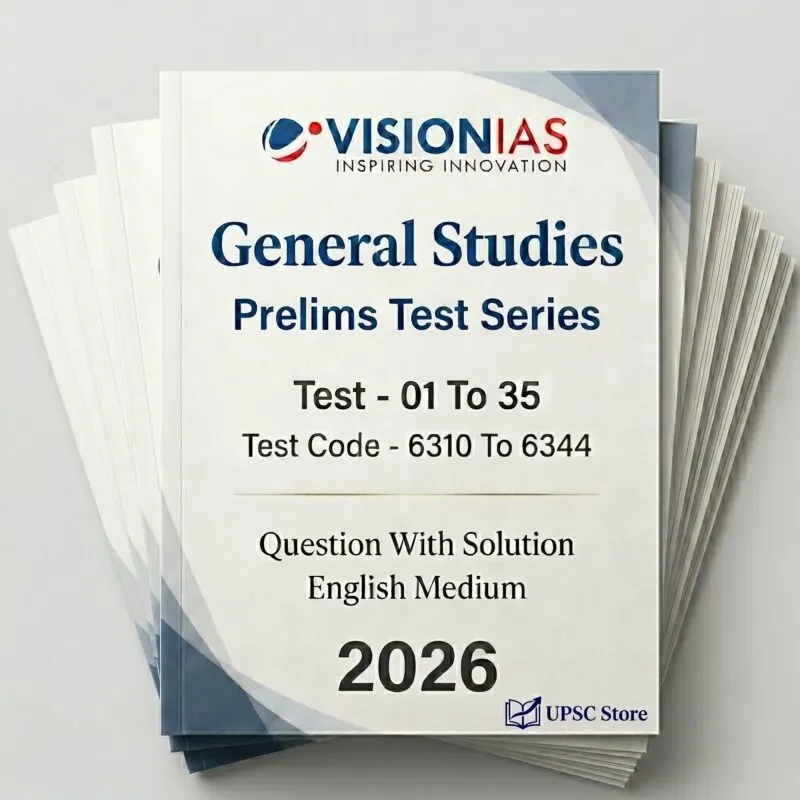

Vision IAS Prelims Test Series 2026

35 Tests | English Medium | UPSC Study Material

Key Highlights:
πŸ“˜ 35 Booklets
πŸ“„ 2154 Pages
πŸ“š General Studies
πŸŽ“ Vision IAS
🏷️ High-Quality Printed Test Papers
πŸ‡¬πŸ‡§ English Medium
β‚Ή2,499 β‚Ή4,999
Save β‚Ή2,500 (50% OFF)
Only 28 sets left
Selling fast (60 sold this week)
5% OFF Use UPSC5% (COD Available)
10% OFF Use UPI10 (UPI Only)
Secure Payment
Fast Delivery
Safe Packaging

About Vision IAS Prelims Test Series

The Vision IAS Prelims Test Series is a printed UPSC study material set sold by UPSC Store β€” India’s trusted source for genuine, latest-batch civil services preparation books. This page covers full booklet details, syllabus coverage, pricing, shipping, and frequently asked questions. Useful for UPSC CSE, BPSC, UPPSC, MPPSC, RAS and other state PSC examinations.

Vision IAS Prelims Test Series 2026 β€” 35 Complete Tests English Medium for UPSC General Studies Prelims

Related: Vision IAS test series Β· UPSC Prelims test series

Product Overview

Buy Vision IAS Prelims Test Series 2026 printed tests online β€” the complete 35-test set designed for UPSC General Studies Prelims preparation. This comprehensive test series combines topic-specific tests with full-length mock exams, each with detailed solutions that explain not just the correct answer, but why every wrong option is incorrect. A proven resource for aspirants targeting Prelims selection.

FeatureDetails
Tests Count35 Complete Tests β€” 12 Topic-Wise + 23 Full-Length Mocks (3,500+ questions)
LanguageEnglish Medium
PublisherVision IAS (Prelims Test Series)
Edition2026-27 β€” Latest Syllabus Aligned
ConditionBrand New, Unmarked, Fresh Stock
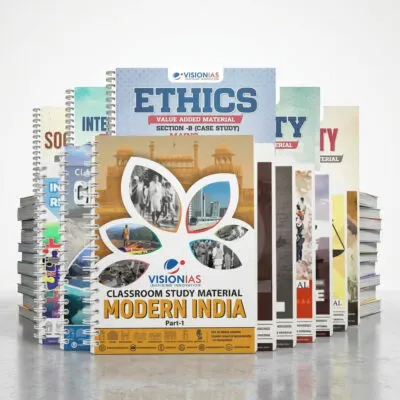
FormatHigh-Quality Printed Booklets β€” Spiral Binding
Paper Quality75 GSM Ultra-White β€” Highlighter Safe, Zero Bleed-Through
Total Pages2,154 Pages | Weight: 5.60 kg | Dimensions: 30 Γ— 21 Γ— 2 cm
ShippingPan India Delivery in 3-5 Business Days β€” Tracked
Also Useful ForBPSC, UPPSC, MPPSC, RAS Prelims

Complete Test Catalog β€” 35 Tests

Vision IAS Prelims Test Series 2026 is structured in two phases: (1) 12 topic-wise tests covering core GS subjectsβ€”Polity, Geography, History, Economy, Environment, and Scienceβ€”each with 100 questions. (2) 23 full-length mock tests mirroring the actual UPSC Prelims pattern. All 35 tests include detailed solutions with elimination strategy explanations for negative marking practice.

  • Tests 1-2: Indian Polity & Constitution β€” Coverage of constitutional framework, fundamental rights, duties, and political institutions essential for UPSC Prelims Polity section.
  • Tests 3-4: Geography I & II β€” Indian geography including physical features, climate, natural resources, and cultural geography directly tested in UPSC General Studies Paper I.
  • Test 5: Ancient Indian History, Art, and Culture + Medieval India β€” Pre-modern Indian history, architecture, art forms, and administrative systems from UPSC syllabus.
  • Test 6: Modern India β€” Post-1800 history including colonial period, freedom struggle movements, and social reformβ€”high-weightage UPSC Prelims topic.
  • Test 7: India Economy β€” Indian economic structure, agriculture, industry, trade, monetary policy, and fiscal framework from UPSC GS Paper III.
  • Test 8: Ecology & Environment β€” Biodiversity, conservation, environmental issues, and sustainability aligned with UPSC Prelims expectations.
  • Test 9: Indian Constitution & Political System β€” Governance structure, legislature, executive, judiciary, and federal system vital for clearing Prelims.
  • Test 10: Working of Indian Constitution and System of Government β€” Operational aspects of constitution, separation of powers, and administrative processes.
  • Test 11: Governance in India β€” Public administration, civil services, local government, and administrative reforms relevant to UPSC GS Paper II.
  • Test 12: Ancient History Deep-Dive β€” Focused coverage of pre-medieval Indian civilizations, kingdoms, and cultural achievements.
  • Test 13-14: Modern India Phase-Wise β€” Chronological breakdown of freedom struggle movements, nationalist leaders, and independence.
  • Test 15: Revision Test 1 β€” Mixed questions from Tests 1-14 assessing retention and identifying weak topics for focused revision.
  • Tests 16-17: Geography Detailed β€” Extended coverage of physical, economic, and political geography with map-based questions.
  • Tests 18-20: Ecology & Environment Extended β€” Three-part series covering biodiversity, conservation strategies, and current environmental challenges.
  • Tests 21-22: India Economy I & II β€” Two-part economy coverageβ€”agricultural economy, industrial policy, trade, inflation, and recent economic surveys.
  • Test 23: Basic Science & Technology Physics β€” Physics and technology concepts from UPSC GS Paper IIIβ€”mechanics, electricity, modern physics applications.
  • Tests 24-35: Full-Length Test Series 1-12 β€” Twelve 100-question full-length mock exams replicating actual UPSC Prelims in pattern, difficulty, and time limit (2 hours). Tests 24-35 include latest current affairs integration and recent Union Budget 2026-27 updates.

In-Depth Test Breakdown β€” What You’ll Master

Vision IAS Prelims Test Series 2026 is designed for aspirants who understand that UPSC Prelims success requires both depth and speed. Each of the 35 tests targets a specific skill: topic-wise tests build foundational knowledge, while full-length tests develop time management and elimination strategies critical when facing negative marking pressure.

Test 1: Indian Polity & Constitution

This foundational test covers the basic structure of India’s constitutional frameworkβ€”the Preamble, Fundamental Rights (Articles 12-35), Directive Principles of State Policy, and the right to Constitutional Remedies. You’ll encounter questions on the philosophy behind constitutional provisions and their practical application in real governance scenarios. UPSC frequently tests understanding of constitutional intent rather than memorized facts, making this test critical.

  • Key topics: Preamble, Fundamental Rights, DPSP, Constitutional Remedies, Amendments (Article 368)
  • UPSC paper: GS Paper II (Polity & Governance)
  • Best for: Both Prelims & Mains foundation

Test 2: Working of Indian Constitution

Focus shifts to how constitutional provisions operate in practiceβ€”the role of the President, Prime Minister, Cabinet, Parliament structure (Lok Sabha and Rajya Sabha), and the legislative process. This test includes questions on emergency provisions, constitutional bodies, and the checks-and-balances system. Understanding these mechanics is essential because UPSC creates scenario-based questions where you must apply constitutional knowledge to governance situations.

  • Key topics: Executive, Legislature, Parliament procedure, Emergency provisions, Constitutional bodies
  • UPSC paper: GS Paper II (Government structure)
  • Best for: Prelims & Mains

Test 3: Geography – I

India’s physical geography forms the foundationβ€”physical features (Himalayas, plains, plateaus), drainage systems (river basins), climate zones, and natural regions. UPSC tests not just location knowledge but the relationship between geography and human settlement, agriculture, and disasters. Questions combine map-based identification with consequence-based reasoning: “Why is this region drought-prone?” or “Which crops suit this climate?”

  • Key topics: Physiography, Drainage systems, Climate zones, Natural regions, Biomes
  • UPSC paper: GS Paper I (Geography)
  • Best for: Prelims (100% coverage), Mains

Test 4: Geography – II

Extends to cultural and economic geographyβ€”population distribution, agricultural zones, mineral resources, industries, transport networks, and trade. This test emphasizes the interaction between geography and economics: “This region produces cotton; explain.” UPSC connects geography to sustainable development, resource management, and strategic planning. Recent questions focus on geopolitics and maritime boundaries.

  • Key topics: Population, Agriculture zones, Mineral distribution, Industries, Maritime geography
  • UPSC paper: GS Paper I & III (Geography + Economy)
  • Best for: Prelims & Mains both

Test 5: Ancient Indian History, Art, and Culture + Medieval India

Covers pre-modern India from the Indus Valley Civilization through medieval kingdomsβ€”Mauryan Empire, Gupta period, and medieval dynasties. Emphasis on art and architecture (temple styles, sculpture, painting), literature (Sanskrit classics), and administrative systems. UPSC tests cultural knowledge in the context of Indian heritage and civilization continuity. Questions often ask: “Which dynasty built this structure?” with multiple similar-looking distractors.

  • Key topics: Indus Valley, Vedic period, Mauryan & Gupta empires, Medieval kingdoms, Art & Architecture
  • UPSC paper: GS Paper I (History & Culture)
  • Best for: Prelims & Mains

Test 6: Modern India

Focuses on post-1800 Indiaβ€”the colonial period (East India Company expansion, British consolidation), early nationalist movements, and the freedom struggle phases. This test includes nationalist leaders, key events (1857 revolt, Quit India movement, Civil Disobedience), and social reform movements. UPSC heavily tests the freedom struggle phase-by-phase; confusing Moderate, Extremist, and Radical phases is a common error. Solutions explain the chronological and ideological differences.

  • Key topics: Colonial expansion, Freedom struggle phases, Nationalist leaders, Social movements, Independence
  • UPSC paper: GS Paper I (Modern India)
  • Best for: Prelims (very high weightage)

Test 7: India Economy

Comprehensive coverage of Indian economic structureβ€”agricultural economy (land system, productivity), industrial sector (manufacturing, services), monetary policy (RBI framework, inflation control), and fiscal policy (taxation, budgeting). Recent additions include India’s external trade, foreign investment, and economic survey highlights. Questions test understanding of recent policy changesβ€”GST, demonetization impact, and digital economy initiatives.

  • Key topics: Agriculture, Industry, Monetary policy, Fiscal policy, External sector, Recent reforms
  • UPSC paper: GS Paper III (Economy)
  • Best for: Prelims (critical for high score)

Test 8: Ecology & Environment

Core environmental scienceβ€”ecosystems, biodiversity, conservation strategies, pollution, and climate change. This test includes endangered species (why specific animals need protection), national parks, and environmental legislation (Environment Protection Act, Wildlife Protection Act). UPSC connects ecology to development challenges: “How to balance conservation with development?” Solutions explain both the biological concept and policy response.

  • Key topics: Ecosystems, Biodiversity, Conservation, Pollution, Climate change, Environmental laws
  • UPSC paper: GS Paper III (Environment)
  • Best for: Prelims & Mains

Test 9: Indian Constitution & Political System

Revisits constitution topics with deeper focus on political system evolutionβ€”federalism, separation of powers, and constitutional amendments. This test includes questions on constitutional history: “Which amendment introduced the concept?” and practical governance: “How does this constitutional provision work?” Emphasis on understanding the ‘why’ behind constitutional design rather than memorization of amendment numbers.

  • Key topics: Federalism, Separation of powers, Constitutional amendments, Executive-Legislature relations
  • UPSC paper: GS Paper II (Polity)
  • Best for: Prelims & Mains

Test 10: Working of Indian Constitution and System of Government

Deepens operational knowledgeβ€”how laws are made, budget process, judicial review, and constitutional interpretation. Questions focus on real-world governance: “When Parliament passes a law, what steps follow?” and “How does the Supreme Court review legislation?” This test builds the conceptual framework for answering mains questions that demand deep understanding of governance mechanics.

  • Key topics: Legislative process, Budget procedure, Judicial review, Constitutional interpretation, Governance operations
  • UPSC paper: GS Paper II (Governance)
  • Best for: Mains (foundation for answer writing)

Test 11: Governance in India

Extends to public administration, civil services structure (Union-State division of powers), local government (Panchayats and Municipalities), and administrative reforms. Recent questions cover e-governance, transparency initiatives (RTI, DOPT reforms), and bureaucratic accountability. This test connects governance theory to contemporary administrative practices: “How does Aadhar strengthen governance?” Solutions link policy initiatives to constitutional provisions.

  • Key topics: Civil services, Union-State relations, Local government, Administrative reforms, e-Governance
  • UPSC paper: GS Paper II (Governance)
  • Best for: Prelims (some questions) & Mains

Test 12: Ancient History Deep-Dive

Focused revisit of pre-medieval Indiaβ€”archaeological discoveries (Indus seals, Vedic texts), major dynasties (Mauryan administration, Gupta renaissance), and cultural achievements. Questions emphasize dating ancient periods, understanding dynastic succession, and recognizing art/architecture styles. This test separates aspirants who confuse dynasties and their contributions from those who understand the chronological and cultural narrative of ancient India.

  • Key topics: Indus civilization, Vedic period, Mauryan Empire, Gupta period, Ancient art & literature
  • UPSC paper: GS Paper I (History)
  • Best for: Prelims (high weightage)

Test 13: Modern India (I) – Mid-18th Century to 1904

Early modern India through the early nationalist phaseβ€”East India Company consolidation, 1857 revolt, British Raj establishment, and early nationalist movements. Emphasis on key personalities (Rammohan Roy, Keshab Chandra Sen), social reform societies (Brahmo Samaj, Theosophical Society), and the founding of the Indian National Congress. Questions test understanding of nationalism’s evolution from reform-based to political assertion.

  • Key topics: Company rule, 1857 revolt, British Raj, Social reforms, Early Congress movements
  • UPSC paper: GS Paper I (Modern India)
  • Best for: Prelims (chronological clarity essential)

Test 14: Modern India (II) – Freedom Struggle Extremist Phase (1905–1917)

Focused coverage of the Extremist Phaseβ€”Swadeshi movement, revolutionary terrorism, and Swaraj concept development. Key personalities include Bal Gangadhar Tilak, V.O. Chirol, and early revolutionaries. This period sees a shift from constitutional agitation to militant nationalism. UPSC questions distinguish between Moderates and Extremists using specific incidents: “Which phase does this event represent?” Solutions clarify ideology and methodology differences.

  • Key topics: Swadeshi movement, Extremism, Revolutionary terrorism, Swaraj concept, Key personalities
  • UPSC paper: GS Paper I (Freedom Struggle)
  • Best for: Prelims (high probability questions)

Test 15: Revision Test 1

Mixed-format test drawing 100 questions from Tests 1-14β€”assesses overall retention and identifies weak topics for focused revision. Questions deliberately shuffle topics; you might see Polity followed by History followed by Geography. This tests your adaptability and speed. Solutions include cross-references to earlier tests: “Review Test 5 for detailed explanation of this concept.” Ideal for mid-series assessment.

  • Key topics: All GS subjects (comprehensive), Mixed format
  • UPSC paper: GS (mixed)
  • Best for: Prelims (identify weak areas)

Test 16: Geography – I (Extended Coverage)

Detailed revisit of physical geography with increased map-based and application-based questions. Includes questions like: “This region has recurrent droughts; explain the geographical reasons” or “Map: Identify this mountain range and its significance.” Higher complexityβ€”requires connecting geography to climate patterns, agriculture, and disasters. Solutions provide geographical reasoning, not just location identification.

  • Key topics: Physiography, Climate-geography nexus, Disasters, Agriculture zones, Map work
  • UPSC paper: GS Paper I (Geography)
  • Best for: Prelims (map-work practice)

Test 17: Geography – II (Extended Coverage)

Extends economic and cultural geographyβ€”resource management, trade corridors, geopolitics (Indo-Pacific, maritime boundaries), and sustainable development. Questions connect geography to current events: “Why is this strait strategically important?” Recent additions include Indian Ocean Region geopolitics and China’s Belt & Road implications for India. Solutions blend geographical knowledge with strategic studies perspective.

  • Key topics: Economic zones, Trade, Geopolitics, Maritime boundaries, Resource management
  • UPSC paper: GS Paper I & II (Geography + International relations)
  • Best for: Prelims & Mains

Test 18: Ecology & Environment – Biodiversity & Conservation

Deep-dive into biodiversityβ€”hotspots (Western Ghats, Northeast India), endemic species, and conservation strategies. Covers protected area networks (National Parks, Biosphere Reserves, Ramsar sites) with focus on India-specific ecosystems. Questions test knowledge of specific endangered species’ habitats and conservation projects. Solutions explain why certain species are endangered and how particular conservation strategies workβ€”moving beyond memorization to understanding.

  • Key topics: Biodiversity hotspots, Endemic species, Protected areas, Conservation projects, Legislation
  • UPSC paper: GS Paper III (Environment)
  • Best for: Prelims (biodiversity weightage high)

Test 19: Ecology & Environment (Pollution & Climate)

Focuses on pollution types (air, water, soil, plastic) and climate changeβ€”greenhouse gases, global warming, mitigation strategies, and India’s climate commitments (Paris Agreement, NDCs). Includes questions on air quality index, water pollution standards, and pollution control measures. Recent additions: India’s renewable energy targets, net-zero commitments. Solutions explain both scientific concepts and policy responses.

  • Key topics: Pollution types, Climate change, GHG emissions, Mitigation strategies, India’s climate policy
  • UPSC paper: GS Paper III (Environment & Climate)
  • Best for: Prelims (current affairs integrated)

Test 20: Ecology & Environment (Applications)

Application-based testβ€”scenario questions linking environmental issues to governance and development. Example: “A dam project threatens a wildlife sanctuary. Discuss the trade-offs.” Includes environmental impact assessment, regulatory frameworks (EIA 2020), and India’s biodiversity law (Biological Diversity Act). Questions test decision-making: weighing conservation vs. development. Solutions balance ecological and developmental perspectives.

  • Key topics: EIA procedures, Environment law, Conservation-Development balance, Regulatory frameworks
  • UPSC paper: GS Paper III (Environment)
  • Best for: Mains (scenario-based foundation)

Test 21: India Economy (I) – Agricultural & Industrial Economy

Detailed coverage of India’s agricultural sectorβ€”land ownership patterns (zamindari, ryotwari, mahalwari), green revolution, agricultural productivity, and farm-related policies (MSP, subsidies). Extends to industrial policyβ€”manufacturing sectors, MSME framework, and industrial locations. Questions connect history of land systems to contemporary agricultural issues. Solutions explain how colonial land systems shaped modern agricultural problems.

  • Key topics: Land systems, Green Revolution, Agricultural policy, Industrial sectors, MSME
  • UPSC paper: GS Paper III (Economy)
  • Best for: Prelims & Mains

Test 22: India Economy (II) – Monetary Policy & External Sector

Covers Reserve Bank of India frameworkβ€”inflation targeting, monetary policy transmission, interest rates, and liquidity management. Includes external sectorβ€”balance of payments, foreign exchange reserves, trade deficits, and forex management. Questions include recent economic data: inflation rates, current account deficits, foreign direct investment flows. Solutions explain policy rationale: “Why did RBI raise interest rates?” with economic reasoning.

  • Key topics: RBI operations, Monetary policy, Inflation, Balance of payments, Forex management
  • UPSC paper: GS Paper III (Monetary Economics)
  • Best for: Prelims (RBI policy crucial)

Test 23: Basic Science & Technology – Physics

Covers physics concepts tested in UPSCβ€”mechanics (force, motion, energy), electricity and magnetism, optics, modern physics basics, and technology applications. Includes India’s space program (ISRO achievements), nuclear energy, and scientific innovations. Questions test conceptual understanding: “How does a satellite stay in orbit?” rather than formula memorization. Solutions explain physics principles and their practical applications in Indian technology projects.

  • Key topics: Mechanics, Electricity, Optics, Modern physics, ISRO, Nuclear technology
  • UPSC paper: GS Paper III (Science & Technology)
  • Best for: Prelims (science weightage 4-5%)

Test 24: Full-Length Test 1

First complete 100-question mockβ€”100-minute duration, follows exact UPSC pattern. Tests all GS subjects with balanced weightage. This benchmark test establishes your baseline score and reveals whether you can sustain accuracy under time pressure. Solutions provide detailed time-per-question analysis: “This test requires 58 seconds per question; where did you lose time?” Identifies speed vs. accuracy trade-offs.

  • Key topics: All GS subjects, UPSC pattern replica
  • UPSC paper: GS Paper I & III (Prelims)
  • Best for: Prelims (score benchmarking)

Test 25: Full-Length Test 2

Second full-length mock at similar difficultyβ€”tests whether your first attempt was a one-off or reflects consistent performance. Questions are new but thematically similar, ensuring like-to-like comparison. Score analysis helps identify topic-wise weaknesses: “Your accuracy on Polity is 70%, Geography is 60%β€”focus revision accordingly.” Cumulative performance across Tests 24-25 signals readiness for next difficulty level.

  • Key topics: All GS subjects, Difficulty sustained
  • UPSC paper: GS Prelims (full pattern)
  • Best for: Prelims (consistent performance check)

Test 26: Full-Length Test 3

Third full-length testβ€”difficulty ramps up slightly. Questions now include tricky options designed to test elimination skills. Some questions deliberately contain similar-sounding correct answers to test conceptual clarity. UPSC often mixes correct distractors with the right answerβ€”this test builds that discrimination ability. Solutions emphasize elimination logic: “Even without knowing the answer, here’s why other options are wrong.”

  • Key topics: All GS subjects, Higher complexity
  • UPSC paper: GS Prelims (increased difficulty)
  • Best for: Prelims (elimination skill building)

Test 27: Full-Length Test 4

Maintains heightened difficultyβ€”integrates recent current affairs (2024-25) across all subjects. Example history question might reference recent archaeological discovery and ask historical context. Economy questions include latest inflation data, RBI policy decisions, and budget announcements. This test ensures your knowledge remains current. Solutions include a “Current Affairs Connect” section linking each question to real events.

  • Key topics: All GS subjects with CA integration
  • UPSC paper: GS Prelims (CA-integrated)
  • Best for: Prelims (current affairs crucial)

Test 28: Full-Length Test 5

Sustains high difficulty with increased negative marking strategy. Questions are now calibrated to test not just knowledge but decision-making under uncertainty: “Should I answer this risky question?” This test trains the psychological aspect of UPSC Prelimsβ€”managing confidence, handling doubt, and guessing wisely. Solutions include a “Risk-Reward Analysis” section: “This question has only 60% accuracy among aspirants; risk-benefit assessment.”

  • Key topics: All GS subjects, Psychological strategy
  • UPSC paper: GS Prelims (negative marking focus)
  • Best for: Prelims (risk management)

Test 29: Full-Length Test 6 – Economic Survey & Budget Integration

Specifically integrates Economic Survey 2025-26 and Union Budget 2026-27 throughoutβ€”15-20% questions directly reference these documents. Covers key budget highlights: taxation changes, subsidy reforms, infrastructure spending, and fiscal policy direction. Questions test document comprehension: “The Budget allocates X to renewable energy; what policy shift does this represent?” Solutions include budget highlights summary and policy implications.

  • Key topics: Budget & Economic Survey integration, Fiscal policy, Tax changes, Expenditure priorities
  • UPSC paper: GS Paper III (Economy)
  • Best for: Prelims (budget knowledge critical)

Test 30: Full-Length Test 7

High difficulty with increased inference questionsβ€”requires connecting multiple concepts to answer. Example: History + Geography + Economy combined question: “This historical kingdom’s decline was partly due to trade route shiftβ€”identify both the kingdom and the geographical factor.” Tests synthesis ability beyond isolated topic knowledge. Solutions break down the multi-concept reasoning step-by-step.

  • Key topics: All GS subjects, Integrated concepts
  • UPSC paper: GS Prelims (synthesis focus)
  • Best for: Prelims (critical for 80+ score)

Test 31: Full-Length Test 8

Maintains complexity with emphasis on data interpretation questionsβ€”tables, graphs, and maps that require reading and analysis. Includes questions on indices (HDI, Gini coefficient), statistics (literacy rates, poverty figures), and geographical data. Tests your ability to quickly extract information from visual data. Solutions include graph interpretation techniques and common pitfalls in reading data visualizations.

  • Key topics: Data interpretation, Statistics, Indices, Maps, Graphs
  • UPSC paper: GS Prelims (data literacy)
  • Best for: Prelims (analytical skill)

Test 32: Full-Length Test 9

Difficulty at maximum difficulty levelβ€”questions approach actual UPSC Prelims 2024-25 difficulty. Includes very tricky questions where multiple options seem correct, requiring precise conceptual knowledge to distinguish. Questions sometimes test what you don’t know as much as what you doβ€”excellent practice for strategic guessing. Solutions reveal the “trap” in wrong options and explain why the right answer is definitively correct.

  • Key topics: All GS subjects, UPSC-level difficulty
  • UPSC paper: GS Prelims (maximum difficulty)
  • Best for: Prelims (final difficulty check)

Test 33: Full-Length Test 10

Sustained maximum difficultyβ€”repeats the challenge to ensure consistency. Score stability across Tests 32-33 at high difficulty indicates readiness for actual exam. Performance dip suggests topics needing last-minute revision. Solutions now include “80+ Scorer’s Perspective”β€”common thought process among high-scoring aspirants. Ideal for final 4-week Prelims preparation phase.

  • Key topics: All GS subjects, Consistent maximum difficulty
  • UPSC paper: GS Prelims (consistency check)
  • Best for: Prelims (final week preparation)

Test 34: Full-Length Test 11

Final practice test before actual examβ€”designed to build confidence if scores are strong, or to highlight last-minute revision areas if needed. Questions include edge casesβ€”obscure facts, lateral thinking, and unusual application-based scenarios. Solutions include last-minute notes: “If you see this pattern on exam day, remember this concept.” Psychological preparation is as important as content knowledge at this stage.

  • Key topics: All GS subjects, Final practice
  • UPSC paper: GS Prelims (confidence building)
  • Best for: Prelims (48 hours before exam)

Test 35: Full-Length Test 12 – Final Assessment

The ultimate full-length testβ€”your final dress rehearsal before the actual UPSC Prelims examination. Difficulty matches Tests 32-34, ensuring no surprise on exam day. After completing this test, solutions provide a “Readiness Score” and topic-wise improvement areas. Includes motivational notes from Vision IAS faculty: “If you’re scoring 75+, you’re in the selection zone.” Guidance on last-week preparation strategyβ€”revision vs. new learning.

  • Key topics: All GS subjects, Final comprehensive assessment
  • UPSC paper: GS Prelims (final exam replica)
  • Best for: Prelims (immediate pre-exam)

How to Use These Tests for Maximum UPSC Prelims Score

Vision IAS Prelims Test Series 2026 is structured for three distinct preparation phases: foundation (topic-wise mastery), intermediate (full-length practice), and final (exam readiness). Simply completing all 35 tests without strategy won’t yield results. Strategic usageβ€”timed attempts, detailed solution analysis, and targeted revisionβ€”is what separates 60-score aspirants from 85+ scorers.

Phase 1: Topic Mastery (Tests 1-15) – Weeks 1-8

Complete Tests 1-14 over 8 weeksβ€”one topic-wise test every 3-4 days alongside your static GS notes (NCERT, standard books, or coaching materials). Time each test: you have 60 minutes for 100 questions. Don’t rushβ€”accuracy matters more than speed initially. After attempting each test without looking at solutions, review answers thoroughly. For correct answers, read the solution’s explanation to strengthen reasoning. For wrong answers, identify the concept gap: “Did I misunderstand the question? Did I lack knowledge? Did I confuse similar concepts?” Spend 1.5 hours analyzing each test. Complete Test 15 (Revision Test) after 2 weeks of Tests 1-14 to assess retention. If Revision Test score is below 65/100, focus revision on weak topics before moving to full-length tests.

Phase 2: Speed & Accuracy (Tests 16-23) – Weeks 9-12

These tests build speed without sacrificing accuracy. Complete Tests 16-22 in quick succession (one every 2-3 days), but now emphasize time management. You have 60 minutesβ€”this leaves roughly 36 seconds per question. Practice skipping difficult questions instead of spending 2 minutes on one question. Return to skipped questions in the final 10 minutes. After each test, analyze: “Which topics consumed most time? Which topics showed lowest accuracy?” For time-consuming topics, work on quick decision-makingβ€”develop shortcuts or elimination strategies. Test 23 (Science) bridges to full-length tests by introducing varied question types. If your average score across Tests 16-23 is 70+, proceed to full-length tests confidently.

Phase 3: Full-Length Exams (Tests 24-35) – Weeks 13-20

Replicate actual exam conditionsβ€”offline, printed test booklet, answer sheet, no phone nearby, 2-hour uninterrupted block. Attempt each test in real-time: 2 hours for 100 questions. Don’t check solutions immediately; analyze after 2-3 tests simultaneously to see patterns across attempts. Track three metrics per test: (1) Accuracy %β€”what’s your net score? (2) Topic-wise accuracyβ€”where are you weakest? (3) Time managementβ€”how many questions did you attempt vs. skip? Gradually decrease time spent per question from 60 to 45 seconds as confidence grows. Tests 24-31 build proficiency; Tests 32-35 are your final reality checks. If scoring 75-80 consistently on Tests 32-35, you’re in the safe zone for selection.

Answer Writing Integration for Mains (Secondary Use)

While Vision IAS Prelims Test Series is primarily for Prelims, it supports Mains preparation indirectly. Each detailed solution contains concepts and frameworks applicable to Mains answer writing. Example: A Prelims question on federalism tested via Prelims option-selection can be converted into a Mains answer: “Discuss India’s federal structure with emphasis on Centre-State relations.” Use solution concepts as answer framework, expand with examples and dimensions. This dual utilityβ€”Prelims practice + Mains concept buildingβ€”makes the test series valuable even during the Mains stage.

Current Affairs Integration Strategy

Vision IAS Prelims Test Series 2026 integrates current affairs throughout (especially Tests 27-35), but self-directed CA study remains essential. Alongside these tests, read daily: PIB Press Releases (government initiatives), The Hindu or Indian Express (news), and Yojana/Kurukshetra magazines. When you encounter a test question on “Economic Survey highlights,” cross-reference the actual Economic Survey 2025-26 document. When a question mentions a recent policy change, search news archives for the policy announcement. This bridges test learning with real-world current affairs, preventing test-only knowledge that lacks grounding in actual events.

Why Vision IAS Prelims Test Series Beats Standard Test Platforms

UPSC Prelims success requires practice tests, but not all test series are equal. Free online platforms, app-based MCQs, and casual test websites offer volumeβ€”but lack the depth, structure, and strategic design that Vision IAS brings. Here’s why thousands of aspirants prefer this printed test series over alternatives.

Versus App-Based Online Test Series

Online test platforms (mobile apps, websites) offer convenienceβ€”take tests anytime, anywhere. But they introduce distractions: notifications, app-switching, easier to pause and look at answers. UPSC Prelims is an offline, invigilated exam with strict time limits and no external aids. Practicing online creates a mismatch between practice environment and exam environment. Vision IAS printed tests force offline practiceβ€”you’re solving on paper, using pen, managing answer sheets, experiencing actual exam stationery feel. Additionally, online tests often have buggy interfaces, unclear question formatting, and ambiguous solutions. Printed tests, once published, are stableβ€”the exact same test format across all 1,000+ aspirants, ensuring standardization.

Versus Free Online Question Banks

Websites offering free UPSC Prelims MCQs (sometimes from leaked test series or student compilations) seem attractive cost-wise. However, free content often lacks quality controlβ€”answers may be outdated, solutions may be incorrect, and questions may not reflect current UPSC difficulty. Vision IAS is a professional coaching institute with decades of UPSC track record. Every question in this test series is vetted by expert faculty, solutions are researched thoroughly, and content is updated annually (2026-27 edition includes latest Budget, Economic Survey, and current events). You’re paying for quality assurance and accuracyβ€”two things free sources cannot guarantee.

Versus Competitors: How Vision IAS Stands Out

Other major institutes (Vajiram & Ravi, Drishti IAS, Forum IAS) also offer Prelims test series. Vision IAS differentiates through its “elimination skill focus”β€”every solution doesn’t just explain the right answer but deeply analyzes why each wrong option is a trap. This approach directly addresses UPSC negative marking strategy: 1/3 mark penalty per wrong answer makes elimination skills as important as knowledge. Most test series solutions read: “Answer: B. Explanation: [reason].” Vision IAS solutions read: “Answer: B. Why B is correct: [detailed explanation]. Why A is wrong: [common misconception it exploits]. Why C is wrong: [similar-sounding distractor]. Why D is wrong: [technical trap].” This comparative analysis builds the mental muscle of eliminationβ€”crucial for scoring 80+.

Track Record: Vision IAS Toppers and Selection Rates

Vision IAS is based in Mukherjee Nagar, Delhiβ€”the epicenter of UPSC coaching. Thousands of successful UPSC candidates have used Vision IAS materials and test series. While coaching alone doesn’t guarantee selection (self-study effort is paramount), Vision IAS’s consistent student success in Civil Services Examinations reflects quality of their test series and teaching. Recent years’ UPSC results show Vision IAS’s prominence among top-100 rankers. This track record mattersβ€”when you buy Vision IAS Prelims Test Series, you’re investing in a resource used by proven toppers. The 35-test structure is refined across multiple years of feedback: “This topic needs more questions,” “This difficulty level is perfect,” “This type of question is underrepresented.” That refinement is embedded in the 2026-27 edition you receive.

Comparative Advantage Table

ParameterVision IAS Printed SeriesOnline Test AppsFree Question Banks
Quality ControlExpert faculty vetted, published onceVariable, updates frequentNo quality checks
Exam SimulationOffline paper-pen practiceOnline distractions, not realisticMixed format, inconsistent
Solution DepthElimination strategy + full explanationBrief explanations, no strategyOften incomplete or incorrect
Negative Marking FocusStrong emphasis on guessing wiselyIgnored by most platformsNot addressed
Current Affairs IntegrationLatest 2025-26 updates includedUpdated regularly but sometimes outdatedSporadic, unreliable
Total Questions3,500 questions across 35 testsVariable, often inflated claimsOften redundant or repetitive
Price Valueβ‚Ή[price] for professional-grade contentβ‚Ή500-1,500 but lower qualityFree but costs in time waste

Physical Construction: Built for 12-Hour Daily Study Sessions

UPSC aspirants studying for Prelims devote 10-12 hours daily to their test series. Vision IAS Prelims Test Series 2026 is manufactured with this intensive use in mind. Every elementβ€”paper, binding, coverβ€”is engineered for durability, eye comfort, and annotation-friendliness during extended study marathons.

Paper: 75 GSM Ultra-White Anti-Glare Premium Stock

The paper isn’t ordinaryβ€”it’s 75 GSM (Grams per Square Meter) ultra-white with an anti-glare coating. This weight is chosen deliberately: lighter paper (60 GSM) results in transparency issues (text bleeding through), while heavier paper (100 GSM) is too stiff for pen-writing. At 75 GSM, you get opacity (no bleed-through when writing on one side), smoothness (pen flows naturally), and brightness (reduced eye strain after 12 consecutive study hours). The anti-glare coating eliminates the gloss that causes eye fatigue during extended reading. Paper is acid-freeβ€”annotations won’t fade or yellow over 2+ years of storage. Multiple highlighter colors (yellow, green, pink, blue, orange) work without bleeding into reverse pages. Test booklets remain pristine even after 5+ readings with annotations.

Printing: 1200 DPI Laser Precision for Sharp Diagrams and Text

Every test is printed at 1200 DPI (dots per inch)β€”a precision level used in professional publishing. Diagrams, maps, and flowcharts are sharp, not fuzzy. Text remains crisp after highlighting with markers. Maps (particularly Geography questions) are detailed enough to distinguish regions clearly. Diagrams explaining concepts (e.g., monsoon systems, political structure flowcharts) are high-resolution, facilitating learning. Printing is permanentβ€”waterproof toner that won’t smudge even if you accidentally spill water. For bilingual products, Hindi Unicode rendering is flawless, preventing character-rendering errors that plague many amateur printings. Graphics in test series (tables, charts, infographics) are color-printed where needed, enhancing visual learning.

Binding: Spiral Binding for Flat-Lay Writing and 300 GSM Laminated Covers

Vision IAS Prelims Test Series uses spiral bindingβ€”spiral coils allow booklets to open completely flat, eliminating the struggle of marking answers near the spine. A crucial advantage: when solving answer sheets alongside the test, you need both open simultaneously without the booklet collapsing. Spiral binding enables this. Alternative book binding (hardcover, paperback) restricts opening angle, making simultaneous test and answer-sheet work awkward. Covers are 300 GSM laminated card stockβ€”thick, protective, and durable. Covers won’t tear even after 50+ opens and closes during revision. Lamination protects against moisture and dust. Despite frequent handling over 4-5 months of Prelims preparation, booklet covers remain pristine, and content remains readable.

Quality Control and Authenticity: Genuine Batch Verification

Every Vision IAS Prelims Test Series 2026 booklet from UPSCStore includes an authenticity marker: batch number and holographic verification seal on the cover. This prevents unauthorized reprints and pirated copies flooding the market. Pirated versions are sometimes of lower print quality, inferior paper, and incorrect content (unauthorized edits). When you buy from UPSCStore (authorized reseller), you receive genuine stock directly from Vision IAS’s printing facility. Authenticity matters because: (1) genuine tests have the exact latest content, (2) solutions have been reviewed by faculty and are accurate, (3) paper quality is guaranteed, and (4) you support the institute that created the material, funding their research and content improvement. UPSCStore guarantee: if you receive damaged booklets, they’re replaced within 48 hours, no questions asked.

Key Features Designed for UPSC Prelims Success

Vision IAS Prelims Test Series 2026 incorporates eight core features refined over years of coaching experience. Each feature targets a specific challenge UPSC aspirants faceβ€”speed, accuracy, elimination skills, current affairs integration, and psychological readiness.

  • 35 Tests (3,500+ Questions) with Progressive Difficulty: Unlike platforms offering random 100-question sets, Vision IAS follows a learning curveβ€”Topic-wise tests (1-14) build foundational clarity, Revision Test (15) consolidates understanding, Extended topic tests (16-23) deepen knowledge, Full-length mocks (24-35) simulate the actual exam. This progression mimics good coaching: you don’t start with exam-level questions; you climb toward difficulty. By the time you attempt Test 35, exam difficulty feels familiar, reducing anxiety on exam day.
  • Elimination Strategy Solutions – Why Wrong Options are Wrong: Standard test solutions explain correct answers but ignore wrong options. Vision IAS reverses this: every solution spends equal time on incorrect options, explaining the psychological trap. Example: “Option B seems correct because it uses similar keywords, but technically it’s wrong because…” This trains your elimination muscleβ€”in a 2-hour exam with 3,500 negative questions (1/3 mark penalty), eliminating two wrong options and guessing between two remaining options gives you 50% chance vs. 25% if guessing blindly. This feature builds the decision-making framework for scoring 80+ in UPSC Prelims.
  • Current Affairs Integration (2025-26 Updates): Tests 27-35 integrate Economic Survey 2025-26, Union Budget 2026-27, and latest government policies announced through 2025. Rather than separating static GS and current affairs, Vision IAS weaves them together: “Budget allocates β‚ΉX to renewable energy. Which policy shift does this represent?” This integration ensures your knowledge isn’t isolated facts but grounded in real-world policy context. Solutions include a “Current Affairs Angle” section linking each question to actual news eventsβ€”you internalize that UPSC is testing news literacy, not trivia.
  • Data Interpretation & Map-Based Questions: Roughly 15-20% of questions in Tests 24-35 include tables, graphs, maps, or infographics. These visual questions test your ability to extract information quickly. Solutions include “data reading” techniques: which axis to check first, how to compare values, common misreadings. For map questions, solutions explain geographical logic: “Why is this region significant?” moving beyond mere location identification.
  • Topic-Wise Performance Analytics (Cumulative Tracking): While individual test solutions are provided, aggregated tracking across all 35 tests helps identify your persistent weak areas. If you score 75% on all Polity questions across all 35 tests but only 55% on Economy questions, your focused revision target is clear. This meta-analytics approach prevents wasting time revising already-strong topics and ensures last-minute study focuses on actual gaps. Solutions include cumulative score sheets to track this.
  • Time Management Strategies Embedded in Solutions: Each full-length test solution includes a “Time Audit”: which types of questions consumed most time, which you should skip, optimal pacing for 2 hours. Solutions suggest: “Attempt 40 questions in first 45 minutes (easier ones), reserve 60 minutes for medium-difficulty questions, use final 15 minutes for remaining tough questions.” This framework evolves across Tests 24-35 based on your performanceβ€”no one-size-fits-all strategy, but personalized based on your speed and accuracy profile.
  • Dual-Use for State PSCs (BPSC, UPPSC, MPPSC, RAS): 70% of UPSC Prelims content overlaps with state PSC exams (BPSC, UPPSC, MPPSC, RAS, KPSC, OPSC). Questions on Ancient History, Geography, Basic Economy, Polity basics are identical between exams. Vision IAS explicitly notes in solutions which questions are state-PCS relevant: “(Also appears in BPSC 2022, UPPSC 2019…)” allowing aspirants preparing for state PSCs to benefit from the same test series. This multi-exam utility increases value-for-money.
  • Psychology of Guessing & Negative Marking Management: Vision IAS includes a unique “Guessing Guide” in solutions: when to guess (eliminate 2 options confidently, guessing between 2 remaining gives 50% EV vs. 0% for not attempting), when to skip (no confidence in any elimination), psychological impact of negative marking (processing the deduction). This addresses the mental aspect of UPSC Prelimsβ€”managing risk, staying calm under the pressure of negative marking, making rational decisions under time constraints. Solutions include real testimonials: “How I approached the negative marking game and scored 84” from actual UPSC toppers.

Who Should Buy Vision IAS Prelims Test Series 2026

Vision IAS Prelims Test Series 2026 is ideal for serious UPSC aspirants committed to Prelims selection. However, it’s not suited for everyone. Being transparent about the ideal user helps you decide whether this investment aligns with your preparation strategy.

Best For

  • Aspirants in Final 3-4 Months of Prelims Preparation: If you’re 2-3 months away from UPSC Prelims exam and have already completed initial static GS learning (NCERTs, coaching classes, basic concept building), this test series is your bridge from learning to exam-readiness. The 35 tests, completed over 4-5 months, align perfectly with the Prelims preparation timeline. You should have a baseline understanding of GS topics before starting these tests; this series assumes that foundation and builds speed and accuracy.
  • Aspirants Targeting 75+ Score (Selection Zone): To clear UPSC Prelims with a safe margin, you need 75+ out of 100 (with a general cutoff around 100-105/200 with optional paper). Vision IAS test series is specifically designed for high-score achievers. If your goal is just to clear (60+ score), free online MCQs may suffice. But if you’re targeting top percentile (75-90 score), the elimation strategy focus and high-difficulty full-length tests are essential.
  • Aspirants Committed to Pen-Paper Practice (Offline Study): This product is printedβ€”it requires offline practice. If you prefer exclusively online test platforms, this won’t suit you. But if you believe offline practice (simulating actual exam conditions) is crucial, Vision IAS printed series is perfect. Most successful UPSC toppers advocate offline practice in final 3 months to overcome test anxiety and adapt to actual exam environment.

Also Useful For

Vision IAS Prelims Test Series 2026 is exceptionally useful for BPSC, UPPSC, MPPSC, and RAS Prelims aspirants. These state PCS exams have 70% question overlap with UPSCβ€”Polity, Geography, History, Basic Science, and Economy basics are identical. State PSC aspirants can use this series as their primary test practice, skipping the full-length mock section and focusing on topic-wise tests (1-23). State exams often have easier difficulty than UPSC, so practicing UPSC-level questions overprepares you for state exams, ensuring safer margins. Solutions explicitly tag state-PSC relevant questions, enabling aspirants to filter their practice accordingly.

Works Alongside (Pair With These Resources)

Vision IAS Prelims Test Series is one component of a complete Prelims preparation strategy. Pair it with: (1) General Studies static notes or NCERT books for concept building (this test series assumes you have baseline knowledge), (2) Monthly current affairs magazines (Yojana, Kurukshetra, or premium CA services) to stay updatedβ€”tests incorporate latest news but CA source materials are needed for independent learning, (3) Vision IAS complete study notes (if you’ve enrolled) for deeper concept clarityβ€”test solutions sometimes reference notes for full explanation. This combinationβ€”notes for learning, tests for practice, CA sources for awarenessβ€”creates a robust preparation ecosystem.

Shipping, Packaging and Delivery

UPSCStore handles all shipping for Vision IAS Prelims Test Series 2026 from its dispatch center in Mukherjee Nagar, Delhi. Every booklet is shrink-wrapped individually to prevent damage during transit, then collectively packed in air-bubble-lined corrugated boxes with corner protectors. Packages are trackedβ€”you receive a WhatsApp message with tracking ID immediately after dispatch. Typical delivery: 3-5 business days pan India. The entire set (all 35 tests, ~2,154 pages, 5.60 kg) ships as a single package or in 2-3 parcels depending on size. Waterproof outer wrapping ensures the package arrives undamaged even if exposed to weather.

Remote areas (J&K, North Eastern states, Andaman & Nicobar) experience an additional 2-3 business days in delivery due to connectivityβ€”total delivery 5-8 days. Pricing remains the same; there are no hidden charges for remote delivery. UPSCStore covers transit insuranceβ€”if the package arrives damaged, contact support WhatsApp +91 70045 49563 within 24 hours of delivery with photos. Replacement booklets are dispatched within 48 hours, shipped overnight for damage-claimed orders. Return/refund policy: opened booklets cannot be returned (they’re personalized for annotation). Unopened, unused orders can be returned within 7 days of delivery for full refund minus shipping costs.

For bulk orders (coaching institutes, study groups), special packaging arrangements are availableβ€”contact WhatsApp +91 70045 49563 for quotes on orders exceeding 10 units. Institutes often request separate invoicing per student or consolidated billing. UPSCStore accommodates bulk shipments to coaching centers with discounted rates and tailored delivery schedules.

Frequently Asked Questions (FAQ)

Q1: How many tests are in Vision IAS Prelims Test Series 2026?

Vision IAS Prelims Test Series 2026 contains 35 complete tests: 12 topic-wise tests (covering Polity, Geography, History, Economy, Environment, Science), 1 revision test, 10 extended topic tests, and 12 full-length mock exams replicating the actual UPSC Prelims pattern. Total: 3,500+ practice questions across all 35 tests.

Q2: What is the price of Vision IAS test series 2026?

Contact UPSCStore WhatsApp +91 70045 49563 for current pricing of Vision IAS Prelims Test Series 2026. Prices vary based on regional taxes and promotional discounts. Bulk orders for coaching institutes get special discounts. Payment via UPI, cards, net banking availableβ€”secure payment gateway.

Q3: Are Vision IAS test series tests similar to actual UPSC?

Yes. Vision IAS designs full-length tests (Tests 24-35) following exact UPSC Prelims pattern: 100 questions, 2-hour duration, identical syllabus coverage, comparable difficulty. Topic-wise tests (1-23) offer focused practice before attempting full-length mocks. Tests are calibrated annually based on actual UPSC exam difficultyβ€”2026-27 edition reflects recent years’ difficulty trends.

Q4: How to access Vision IAS prelims tests online?

Buy Vision IAS Prelims Test Series 2026 as printed booklets from UPSCStoreβ€”the best format for UPSC Prelims practice. Printed tests eliminate screen distractions, improve focus, and simulate actual exam environment. No online login required; once received, you have permanent offline access to all 35 tests for revision.

Q5: What is the difficulty level of Vision IAS PT tests?

Vision IAS Prelims Tests progress in difficulty: Topic-wise tests (1-23) are moderate difficulty, building concept clarity. Extended tests (16-23) increase challenge. Full-length tests (24-31) match UPSC difficulty. Final tests (32-35) exceed UPSC difficulty, training you to handle the most challenging questions. This progressive increase ensures no shock on actual exam day.

Q6: Can I get Vision IAS test series solutions?

Every test in Vision IAS Prelims Test Series 2026 includes detailed solutionsβ€”printed within the same booklet. Solutions explain the correct answer, why each wrong option is wrong, and elimination strategies. This unique feature addresses negative marking psychology: understanding why options are traps helps you avoid them under exam pressure.

Q7: Is Vision IAS test series worth buying for UPSC?

Absolutely. Vision IAS Prelims Test Series 2026 is a proven resource used by thousands of successful UPSC aspirants. 35 tests Γ— 100 questions = 3,500 practice questions with detailed solutions. This volume, combined with elimination-strategy focus, builds both speed and accuracy needed for 75+ score. Compared to free online MCQs or app-based tests, the structured progression and solution depth justify investment.

Q8: How many hours to complete Vision IAS 35 tests?

Topic-wise tests (1-23): 2-3 hours per test including solving (60 min) + reviewing solutions (90-120 min). Full-length tests (24-35): 3-4 hours per test (2 hours exam + 1-2 hours analysis). Total: 80-100 study hours across 4-5 months of Prelims preparationβ€”manageable with 2-3 hour daily study blocks.

Q9: Does Vision IAS test series include current affairs 2026?

Yes. Vision IAS Prelims Test Series 2026 integrates Economic Survey 2025-26, Union Budget 2026-27, and latest government policies throughout Tests 27-35. Approximately 15-20% of full-length test questions reference current developments in policy, economy, and governanceβ€”ensuring you practice with timely, exam-relevant content.

Q10: Can state PCS aspirants use these tests?

Yes, strongly recommended. Vision IAS Prelims Test Series 2026 is useful for BPSC, UPPSC, MPPSC, RAS, and other state PCS Prelims. 70% of questions overlap between UPSC and state exams (Polity, Geography, History, Science). State aspirants should focus on topic-wise tests (1-23); full-length tests can be optional. Solutions tag state-PCS relevant questions for easy filtering.

Q11: What if I receive damaged booklets?

Contact UPSCStore WhatsApp +91 70045 49563 within 24 hours of delivery with photos. Damaged booklets are replaced within 48 hours at no extra cost. UPSCStore covers transit insurance and stands behind product quality. This guarantee applies to manufacturing defects, printing errors, and transit damageβ€”not to wear from usage.

Q12: Can I start with Test 24 directly or must I complete Tests 1-23 first?

Ideally, complete Tests 1-23 first to build conceptual clarityβ€”jumping to full-length tests without topic mastery leads to repeated errors and low scores. However, if you’re already strong on GS fundamentals (from coaching classes or prior self-study), you can start with full-length tests and review individual topic tests only for weak areas. Most aspirants benefit from the sequential approach: topics first, then full-length mocks.

Summary and Final Recommendation

Buy Vision IAS Prelims Test Series 2026 printed booklets from UPSCStore if you’re serious about UPSC Prelims selection with a high score (75+). This 35-test series, spanning 3,500+ questions with detailed elimination-strategy solutions, is structured for progressive masteryβ€”from topic-wise clarity to full-length exam readiness. The printed format ensures realistic exam simulation; the solution depth addresses negative marking psychology; the current affairs integration keeps knowledge timely. Paired with GS notes and current affairs sources, this test series is your bridge from learning to selection. Most successful UPSC toppers credit structured test practice as a key success factor. Vision IAS’s track record and Mukherjee Nagar reputation back this investment. If you’re uncertain whether to buy, remember: practicing 3,500 high-quality, carefully vetted questions costs far less (in time and money) than the regret of scoring 65 and missing Prelims by a margin.

SpecificationValue
Total Tests35 Complete Tests (3,500+ Questions)
Language MediumEnglish Medium
Paper Quality75 GSM Ultra-White Anti-Glare
Print Resolution1200 DPI Laser Printing
Binding TypeSpiral Binding (Opens Flat)
Cover Quality300 GSM Laminated Card Stock
Total Pages2,154 Pages | Weight: 5.60 kg
Delivery Timeline3-5 Business Days Pan India (Tracked)
PublisherVision IAS (Authorized: UPSCStore)
Edition2026-27 (Latest Syllabus & Current Affairs)
AuthenticityBatch-Verified with Hologram
Also Useful ForBPSC, UPPSC, MPPSC, RAS Prelims

Buy Vision IAS Prelims Test Series 2026 online from UPSCStoreβ€”your trusted partner in UPSC preparation. Dispatched from Mukherjee Nagar, Delhi, the heart of UPSC coaching. Pan India delivery 3-5 days. WhatsApp support +91 70045 49563. Invest in your Prelims success today.

Reference: UPSC official syllabus

πŸ›οΈ

Aspirants Also Bought

More from the same category

View All β†’

About Vision IAS Prelims Test Series 2026

Vision IAS Prelims Test Series 2026 is a highly recommended UPSC study material from Vision IAS, specially designed for General Studies preparation. Available in English medium, this material is crafted to match the exact requirements of the UPSC Civil Services Examination syllabus β€” covering both Prelims and Mains comprehensively.

Product Details

  • Institute: Vision IAS
  • Subject: General Studies
  • Medium: English
  • Pages: 2154
  • Format: High-Quality Printed Test Papers
  • Delivery: Pan-India delivery in 3–5 working days
  • Format: Original printed material, verified authentic

Why Buy from UPSC Store?

  • βœ… 100% Genuine Printed Material β€” Original printed notes, no photocopies or fake copies
  • βœ… Fast Delivery β€” Ships within 24 hours, arrives in 3–5 days pan-India
  • βœ… Secure Packaging β€” Bubble-wrapped and boxed to prevent damage in transit
  • βœ… Trusted by 10,000+ Aspirants β€” India's most reliable UPSC material marketplace
  • βœ… WhatsApp Support β€” Get expert guidance on material selection before ordering

Frequently Asked Questions

Is this product 100% original?

Yes, all products at UPSC Store are 100% genuine printed materials. We do not sell photocopies or fake copies.

How long does delivery take?

Orders are dispatched within 24 hours and delivered across India in 3–5 working days via reputed courier partners.

Can I return the product?

Yes, we accept returns within 7 days if the product is damaged or incorrect. Check our refund policy for details.

Which other study materials should I buy with this?

We recommend pairing this with current affairs notes and a UPSC test series for comprehensive preparation. Browse more in General Studies, Test Series, UPSC, Vision IAS.