
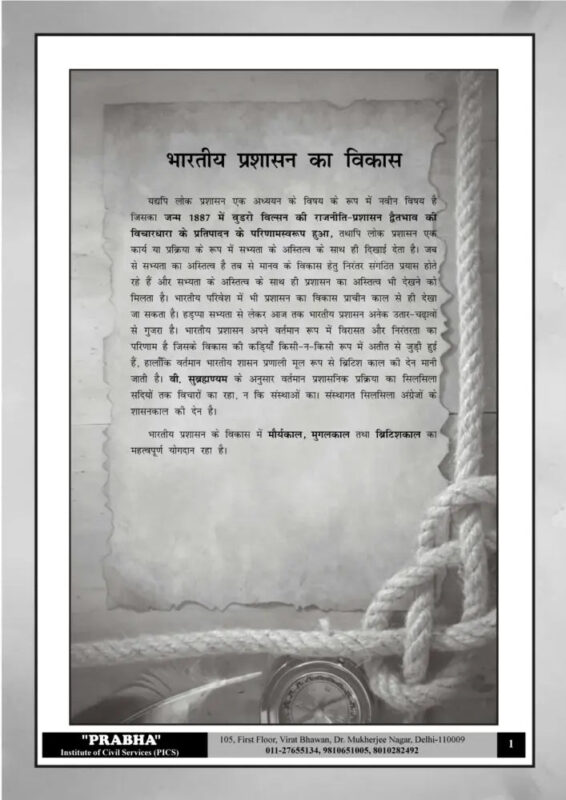
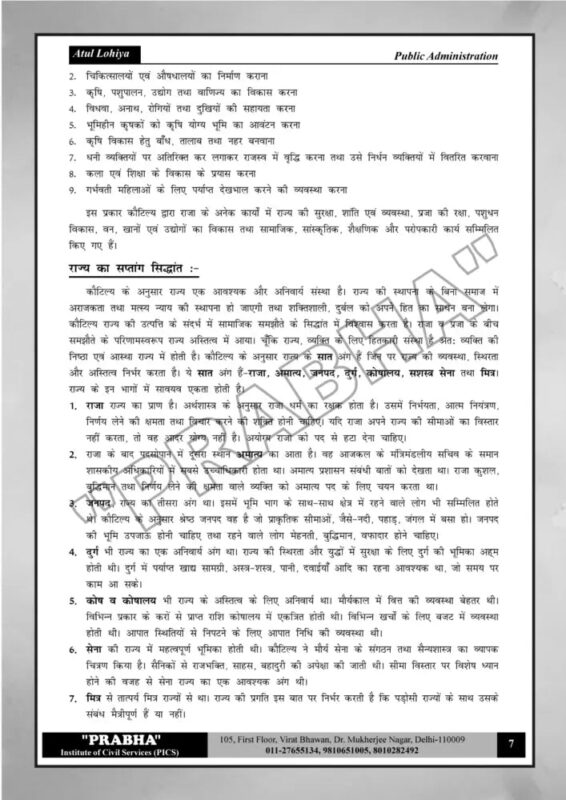


Atul Lohiya Public Administration Notes 2025-26
About Atul Lohiya Public Administration Notes
The Atul Lohiya Public Administration Notes is a printed UPSC study material set sold by UPSC Store — India’s trusted source for genuine, latest-batch civil services preparation books. This page covers full booklet details, syllabus coverage, pricing, shipping, and frequently asked questions. Useful for UPSC CSE, BPSC, UPPSC, MPPSC, RAS and other state PSC examinations.
Atul Lohiya Public Administration Notes 2025-26 — 10 Hindi Medium Printed Booklets for UPSC Optional Paper I & II
Related: Public Administration · Optional subjects
Product Overview
| Feature | Details |
|---|---|
| Booklets Count | 10 Individual Printed Booklets — Complete UPSC Public Administration Optional Paper I & II Coverage |
| Language | Hindi Medium (हिंदी माध्यम) |
| Publisher | Prabha Institute of Civil Services — PICS (Dr. Atul Lohiya Series) |
| Edition | 2025-26 — Latest Genuine Batch |
| Condition | Brand New, Unmarked, Fresh Stock |
| Format | High-Quality Printed Booklets — Spiral or Book Binding |
| Paper Quality | 75 GSM Ultra-White — Highlighter Safe, Zero Bleed-Through |
| Shipping | Pan India Delivery in 4-7 business days — Tracked |
| Also Useful For | BPSC, UPPSC, MPPSC, RAS and all State PSC Public Administration Optional |
Complete Booklet Catalog
These 10 printed Hindi-medium booklets by Dr. Atul Lohiya of Prabha Institute of Civil Services (PICS) cover the entire UPSC Public Administration optional syllabus across Paper I and Paper II. Designed for Hindi-medium aspirants who want structured, faculty-curated notes for the 500-mark optional subject, this set is one of the most sought-after resources for UPSC Mains 2025-26 preparation.
- Booklet 1: प्रशासनिक सिद्धान्त — प्रारम्भिक अवधारणाएँ (Administrative Theory — Foundational Concepts) — Covers introduction to public administration, evolution of the discipline, scope and significance, distinction from private administration, public administration as a science and art debate, Woodrow Wilson’s essay and its relevance to modern UPSC syllabus, and key theoretical frameworks tested in Paper I.
- Booklet 2: वैज्ञानिक प्रबन्धन एवं शास्त्रीय सिद्धान्त (Scientific Management and Classical Theory) — Taylor’s scientific management, Fayol’s principles of administration, POSDCORB by Luther Gulick, bureaucratic model of Max Weber, formal organisation theory, span of control, unity of command, and their critical examination from UPSC optional examination perspective.
- Booklet 3: मानवीय सम्बन्ध एवं व्यावहारिक उपागम (Human Relations and Behavioural Approach) — Elton Mayo’s Hawthorne experiments, Abraham Maslow’s hierarchy of needs, McGregor’s Theory X and Y, Herzberg’s motivation-hygiene theory, Simon’s decision-making model, bounded rationality, Chester Barnard’s cooperative system, and organisational behaviour concepts for UPSC Paper I.
- Booklet 4: संगठन संरचना एवं प्रशासनिक व्यवहार (Organisational Structure and Administrative Behaviour) — Line and staff organisations, departmental organisations, public corporations, autonomous bodies, regulatory agencies, committee system, coordination and control mechanisms, delegation of authority, centralisation versus decentralisation debate with Indian administrative examples.
- Booklet 5: जवाबदेही एवं नियंत्रण (Accountability and Control) — Legislative control over executive, parliamentary committees, question hour, CAG and its constitutional role, judicial control through writs, citizen’s charter, RTI Act 2005, Lokpal and Lokayukta, administrative tribunals, ombudsman concept, and accountability frameworks relevant to UPSC Public Administration optional.
- Booklet 6: भारतीय प्रशासन — संवैधानिक ढाँचा (Indian Administration — Constitutional Framework) — Constitutional provisions for administration, President and Council of Ministers, Prime Minister’s role, Cabinet Secretariat, Cabinet committees, Parliamentary system, federal features, Governor’s role, state administration structure, Union-State administrative relations, and constitutional bodies for Paper II.
- Booklet 7: जिला प्रशासन एवं स्थानीय स्वशासन (District Administration and Local Self-Government) — Collector and district administration, role of DM in development, 73rd and 74th Constitutional Amendments, Panchayati Raj Institutions, urban local bodies, devolution of powers, decentralised planning, parallel bodies, capacity building issues, and grassroots governance for UPSC Paper II.
- Booklet 8: विकास प्रशासन एवं नीति-निर्माण (Development Administration and Policy Making) — Concept of development administration, planning commission to NITI Aayog transition, five-year plans legacy, policy cycle and formulation process, implementation challenges, public policy analysis frameworks, welfare state concepts, participatory development, and socio-economic administration themes for UPSC Mains.
- Booklet 9: कार्मिक प्रशासन एवं लोक सेवाएँ (Personnel Administration and Public Services) — Recruitment, training, promotion and service conditions, UPSC and SPSC roles, all-India services, central services, lateral entry debate, performance appraisal systems, conduct and discipline, service rules, administrative ethics, whistle-blower protection, and civil services reforms relevant to UPSC optional Paper II.
- Booklet 10: वित्तीय प्रशासन एवं वित्तीय प्रबंध (Financial Administration and Financial Management) — Budget: concepts and types, budget cycle in India, Finance Ministry role, Comptroller and Auditor General, parliamentary financial committees (PAC, Estimates Committee), zero-based budgeting, performance budgeting, outcome budgeting, fiscal federalism, Finance Commission, FRBM Act, and treasury management systems for UPSC Paper I & II.
In-Depth Content Breakdown: Booklet by Booklet
Booklet 1: प्रशासनिक सिद्धान्त — प्रारम्भिक अवधारणाएँ
This opening booklet lays the conceptual foundation for UPSC Public Administration optional Paper I. It covers the meaning, scope, and significance of public administration as a discipline, tracing its evolution from Woodrow Wilson’s 1887 essay to contemporary governance frameworks. The booklet addresses the politics-administration dichotomy debate, the status of public administration as a science versus art, and its relationship with allied social sciences. Dr. Atul Lohiya presents these foundational concepts through clear Hindi-medium explanations that make the material accessible for aspirants approaching this optional subject for the first time.
The booklet includes concept maps tracing theoretical evolution, comparative tables distinguishing public administration from business administration, and margin notes highlighting frequently tested UPSC Mains questions from previous years. Key thinkers such as L.D. White, W.F. Willoughby, and Dwight Waldo are covered with their contributions summarised in easy-to-revise formats. The Hindi explanations of technical English terminology are particularly valuable for aspirants who prefer Hindi as their medium of expression in the UPSC Mains examination.
Booklet 2: वैज्ञानिक प्रबन्धन एवं शास्त्रीय सिद्धान्त
This booklet is devoted to the classical school of administrative theory, which forms a significant portion of UPSC Public Administration Paper I. It opens with Frederick Winslow Taylor’s principles of scientific management, examining time-motion studies and their administrative implications. Henri Fayol’s fourteen principles of management are presented in tabular format for quick revision. Luther Gulick’s POSDCORB framework — Planning, Organising, Staffing, Directing, Coordinating, Reporting, and Budgeting — is explained in depth with application to Indian administrative contexts that UPSC examiners frequently expect.
Max Weber’s ideal-type bureaucracy receives dedicated treatment in this booklet, with characteristics of legal-rational authority, hierarchy, written rules, and impersonality explained through Indian civil service parallels. Critical perspectives on Weber, including Merton’s concept of bureaucratic dysfunction, goal displacement, and trained incapacity, are included. The booklet uses flowcharts and comparison tables between Weber’s model and Indian bureaucracy, making it an ideal resource for aspirants preparing structured answers for UPSC optional Paper I on organisational theory topics.
Booklet 3: मानवीय सम्बन्ध एवं व्यावहारिक उपागम
The human relations and behavioural approach booklet is among the most important for UPSC Public Administration optional, as motivation theories and decision-making models are frequently examined. It covers Elton Mayo’s Hawthorne Studies in detail, explaining the four phases of the experiment and their implications for worker productivity and informal organisation. Abraham Maslow’s hierarchy of needs is presented with a pyramid diagram and administrative applications. McGregor’s contrasting Theory X and Theory Y assumptions about workers provide a strong framework for discussing modern public management reforms in UPSC answers.
Herbert Simon’s bounded rationality and decision-making model receives extensive treatment, including his critique of the classical decision-maker as an “administrative man” versus the “economic man.” Chester Barnard’s acceptance theory of authority and the concept of the cooperative system are explained with Indian administrative examples. Herzberg’s two-factor theory — motivators versus hygiene factors — is covered with application to civil service motivation and administrative reforms. The booklet includes previous year UPSC questions mapped to each theory, allowing aspirants to understand the examination pattern and frame appropriately structured answers.
Booklet 4: संगठन संरचना एवं प्रशासनिक व्यवहार
Organisational structure forms the backbone of UPSC Public Administration Paper I, and this booklet provides a structured analysis of the various forms of public organisations in India. Line organisations, line and staff structures, and functional organisations are explained with diagrams applicable to Indian ministries and departments. The booklet covers departmental undertakings, public sector corporations, and autonomous regulatory bodies with constitutional and statutory bases. The committee system in Indian administration — standing committees, ad hoc committees, advisory committees — is detailed with real-world examples from Indian governance.
The booklet devotes significant attention to the principles of coordination — as a process and as a structural mechanism — and the methods through which coordination is achieved in large-scale public organisations. Centralisation versus decentralisation is examined as both an administrative principle and a practical governance challenge, with the Indian federal experience as the reference point. Delegation of authority, span of control debates between Urwick and Simon, and unity of command principles are covered with critical analysis relevant to UPSC Mains answer writing for Public Administration optional.
Booklet 5: जवाबदेही एवं नियंत्रण
Accountability in public administration is a high-weightage theme across both UPSC Public Administration papers and this booklet provides thorough coverage of all accountability mechanisms in the Indian system. Legislative accountability is explained through parliamentary tools — question hour, zero hour, adjournment motion, no-confidence motion — and the role of parliamentary standing committees in departmental oversight. The Comptroller and Auditor General’s constitutional position under Article 148 is detailed with types of audit and their significance for financial accountability in UPSC examination context.
The booklet covers citizen-facing accountability tools including the Right to Information Act 2005, citizens’ charters, social audits, and grievance redressal mechanisms. The Lokpal and Lokayuktas Act 2013 is analysed with comparative notes on the ombudsman concept across different countries. Administrative tribunals under Article 323A and 323B are covered with the CAT’s jurisdiction and landmark cases. Judicial accountability through writs — mandamus, certiorari, prohibition, quo warranto, and habeas corpus — is explained with Indian case examples, making this booklet highly relevant for UPSC Mains answer writing.
Booklet 6: भारतीय प्रशासन — संवैधानिक ढाँचा
This booklet transitions to UPSC Public Administration Paper II, covering the constitutional architecture of Indian administration. The President’s constitutional position, discretionary powers, and relationship with the Council of Ministers is explained with relevant constitutional articles and landmark Supreme Court judgments. The role of the Prime Minister as head of government and the Cabinet’s collective responsibility principle receive detailed treatment. The Cabinet Secretariat’s coordinating function and the Prime Minister’s Office’s growing significance are analysed with administrative reform committee recommendations.
Union-State administrative relations under Articles 256, 257, and 365 are explained along with the Governor’s discretionary role, appointment controversies, and Supreme Court guidelines from Constituent Assembly debates to contemporary controversies. The booklet includes the structure of state administration — Council of Ministers, Chief Secretary, secretariat organisation — with comparisons to Union-level structures. Federal features versus unitary tendencies in Indian administration are critically examined, drawing on the Sarkaria Commission and Punchhi Commission recommendations that UPSC examiners regularly ask about in the optional examination.
Booklet 7: जिला प्रशासन एवं स्थानीय स्वशासन
The district administration booklet is essential for UPSC Public Administration Paper II, covering the Collector’s multifaceted role in revenue administration, law and order, development coordination, and disaster management. The historical evolution of the district collector from British revenue collector to modern development administrator is traced. Sub-divisional administration, tehsildar functions, and the revenue hierarchy are explained. The booklet also addresses the relationship between the collector and elected representatives, and the tensions between bureaucratic and political authority at the district level in India’s democratic setup.
The 73rd and 74th Constitutional Amendments receive detailed treatment — the three-tier Panchayati Raj structure, mandatory devolution of functions, functionaries and funds, reservation provisions, State Finance Commissions, and District Planning Committees. Urban local bodies — municipalities, municipal corporations, and their elected structure — are covered under the 74th Amendment. The booklet examines challenges in decentralisation including parallel bodies, inadequate devolution, and capacity deficits. NITI Aayog’s Aspirational Districts programme and its administrative implications are included as a contemporary governance dimension relevant to recent UPSC Mains questions.
Booklet 8: विकास प्रशासन एवं नीति-निर्माण
Development administration as a sub-field of public administration receives focused treatment in this booklet, covering its origins in post-colonial state-building and its evolution through successive planning phases in India. The transition from Planning Commission to NITI Aayog is analysed with administrative and policy implications. Public policy as a concept — types, formulation stages, implementation, evaluation, and termination — is covered using the policy cycle framework. Key policy analysis models including the incremental model, mixed scanning, and rational-comprehensive model are explained with Indian policy examples tested in UPSC optional examinations.
The booklet addresses welfare state concepts, poverty alleviation administration, and the administrative challenges of implementing flagship schemes such as MGNREGS, PM Awas Yojana, and PMGSY. Participatory development, civil society’s role in policy implementation, and bottom-up versus top-down implementation models are discussed. The role of NITI Aayog in cooperative federalism, SDG monitoring, and policy innovation is covered as a contemporary dimension. Dr. Atul Lohiya’s structured notes connect development administration theory to current Indian policy debates, which is the format most rewarded in UPSC Public Administration optional answers.
Booklet 9: कार्मिक प्रशासन एवं लोक सेवाएँ
Personnel administration is a critical component of UPSC Public Administration Paper II and this booklet covers the entire civil services architecture in India. The recruitment process through UPSC, the constitutional position of the Union Public Service Commission under Articles 315-323, and the role of State Public Service Commissions are detailed. All-India Services — IAS, IPS, IFoS — their recruitment, training at LBSNAA, and deputation mechanisms between Union and states are explained. The lateral entry experiment into Indian bureaucracy, its rationale, controversies, and status under administrative reforms, is covered as a contemporary theme for UPSC optional.
The booklet covers training administration — induction training, in-service training, National Centre for Good Governance — and the performance appraisal system including the Annual Confidential Report and the reformed APAR system. Service rules, conduct rules, disciplinary proceedings, and the Appeals system are explained with the CCS (CCA) Rules framework. Administrative ethics — values in public service, codes of conduct, conflict of interest, integrity pledge — and whistle-blower protection under the Whistle Blowers Protection Act 2014 are included. Civil services reforms recommended by the 2nd Administrative Reforms Commission are mapped to UPSC syllabus points.
Booklet 10: वित्तीय प्रशासन एवं वित्तीय प्रबंध
Financial administration is the subject highlighted on the cover of this PICS UPSC notes set and this booklet provides the most detailed treatment of the topic among all Public Administration optional resources available in Hindi medium. The Indian budget — its constitutional basis under Articles 112-117, the budget cycle from preparation to enactment, the role of Finance Ministry and its divisions, budget documents (Annual Financial Statement, Demand for Grants, Finance Bill) — is covered with precision. Types of budgets — performance budget, programme budget, zero-based budgeting, outcome-based budgeting — are compared with Indian experience and reform committee findings.
The booklet covers parliamentary financial control through the three major committees — Public Accounts Committee, Estimates Committee, and Committee on Public Undertakings — with their composition, functions, and limitations. The Comptroller and Auditor General’s role in financial accountability, types of audit (compliance, performance, propriety), and the significance of CAG reports in parliamentary oversight are analysed in depth. Fiscal federalism — Finance Commission’s role under Article 280, vertical and horizontal devolution, grants-in-aid, state fiscal autonomy — is covered with 15th Finance Commission recommendations. The FRBM Act’s fiscal discipline framework, treasury single account concept, and public financial management reforms complete this booklet’s treatment of वित्तीय प्रशासन for UPSC.
Physical Construction and Quality Standards
Every booklet in this Atul Lohiya PICS Public Administration set is manufactured to withstand daily UPSC preparation cycles — repeated reading, underlining, margin annotation, and revision over months of intensive study for the optional subject that carries 500 marks in UPSC Mains.
Paper Quality: 75 GSM Anti-Glare White Paper
The 75 GSM ultra-white paper selected for these Public Administration booklets provides the ideal opacity for printed Hindi-medium content. Text and diagrams printed on one side do not bleed through to the reverse, enabling aspirants to use multiple highlighter colours for colour-coded revision of Public Administration topics across Paper I and Paper II. The anti-glare surface significantly reduces eye fatigue during long study sessions of 6-8 hours that UPSC optional preparation typically demands. The paper weight ensures pages lie flat without curling, maintaining clean margins for hand-written notes alongside Dr. Atul Lohiya’s printed text.
Printing Technology: High-Resolution Laser Printing
All ten booklets are printed using high-resolution laser printing technology that delivers crisp Hindi text reproduction, clear flowcharts of administrative processes, sharp organisational diagrams, and legible tables comparing administrative theories and constitutional provisions. Laser toner is permanently fused to the paper surface, ensuring that the printed content remains smudge-proof even with extensive handling across a year of UPSC preparation. The print quality is particularly important for Hindi-medium aspirants where precise Devanagari character rendering — including maatras, half-consonants, and conjunct characters in administrative terminology — is critical for correct understanding of technical concepts in Public Administration optional notes.
Binding and Durability
These PICS Atul Lohiya Public Administration booklets are available in either spiral binding or book binding format. Spiral-bound booklets open completely flat on a study desk, allowing aspirants to write notes alongside the printed text without the spine pressing against pages — a major advantage during intensive UPSC optional revision. The 300 GSM laminated cover provides protection against moisture and daily wear. Book-bound editions offer a more compact storage format ideal for carrying in a bag between library sessions and coaching classes. Both binding formats use reinforced spine construction that withstands the repeated opening and closing typical of a UPSC optional booklet used over a full preparation year.
Key Features and Study Design
These 12 Booklets by Dr. Atul Lohiya of PICS are designed specifically for Hindi-medium UPSC aspirants who need structured, syllabus-mapped notes for Public Administration optional — a subject that contributes 500 marks and can be the decisive factor in Mains success.
- Complete Syllabus Coverage in Hindi: All topics of UPSC Public Administration optional Paper I and Paper II are covered in Hindi medium — from classical administrative theory and organisational behaviour through to Indian administration, district governance, personnel administration, and वित्तीय प्रशासन — eliminating the need for multiple scattered sources.
- Faculty-Curated Content by Dr. Atul Lohiya: Dr. Atul Lohiya’s reputation as a Public Administration faculty at PICS makes these notes a trusted resource for Hindi-medium UPSC aspirants nationwide. The content reflects years of teaching the optional subject, with emphasis on UPSC examiner expectations, answer-writing patterns, and frequently tested conceptual areas across both papers.
- वित्तीय प्रशासन Special Coverage: The dedicated Booklet 10 on financial administration and financial management is one of the strongest features of this set — covering budget types, parliamentary financial control, CAG audit functions, fiscal federalism, Finance Commission, and FRBM Act in greater depth than most competing Public Administration optional notes available in Hindi medium.
- UPSC-Mapped Structure with Previous Year Questions: Each booklet is structured along UPSC Public Administration syllabus headings, with references to previous year questions mapped to relevant topics. This allows aspirants to directly connect the notes content to the examination pattern, building answer-writing confidence and identifying high-priority areas within the 500-mark optional subject.
- Fresh 2025-26 Edition — Updated Content: This is the latest 2025-26 edition from Prabha Institute of Civil Services, incorporating recent administrative developments — NITI Aayog policy updates, 15th Finance Commission implementation, lateral entry debate, RTI amendments, and Lokpal operationalisation — ensuring that aspirants are not studying outdated content in a subject where contemporary examples improve answer quality significantly in UPSC Mains evaluation.
Shipping, Packaging and Delivery
All 12 Booklets of the Atul Lohiya Public Administration PICS set are packed with care for safe transit to every corner of India. Each booklet is individually shrink-wrapped to protect against moisture and surface abrasion during shipping. The complete set is then placed in a rigid corrugated cardboard box with corner edge protectors to prevent bending during courier handling. The outer box is sealed with tamper-proof tape and labelled with fragile indicators to ensure courier staff handle the package with appropriate care. Brand new, unmarked stock is dispatched directly — no returned or display copies are ever sent.
Orders are dispatched within 24 hours of payment confirmation and delivered pan India within 4-7 business days via tracked courier services. A tracking ID is shared via WhatsApp and email upon dispatch so aspirants can monitor their shipment in real time. For any queries regarding your order, missing booklets, or delivery issues, contact the store on WhatsApp at +91 70045 49563 — any missing booklet from the 10-piece set will be replaced or refunded within 48 hours of confirmed delivery reporting. Bulk orders for coaching institutes and study groups across BPSC, UPPSC, MPPSC, and RAS preparation centres are also accepted with priority dispatch.
Frequently Asked Questions (FAQ)
A: Yes — Dr. Atul Lohiya’s PICS Public Administration notes are among the most respected Hindi-medium optional resources for UPSC. The 12-booklet set covers the entire Paper I and Paper II syllabus in structured Hindi, with previous year question mapping and answer-writing orientation built into the content. Aspirants who prefer Hindi as their medium of expression in UPSC Mains find these notes particularly effective because the technical administrative terminology is explained accurately in Hindi rather than transliterated from English sources.
A: The 2025-26 edition includes exactly 10 individual printed booklets covering UPSC Public Administration optional Paper I and Paper II. Each booklet addresses a distinct segment of the syllabus — from foundational administrative theory and classical management approaches through to Indian constitutional administration, district governance, personnel administration, and the dedicated वित्तीय प्रशासन booklet on financial administration and financial management. All 12 Booklets are dispatched together as a complete set in a single tracked shipment.
A: Prabha Institute of Civil Services (PICS) is a well-established name in UPSC optional subject preparation, particularly for Hindi-medium aspirants. Dr. Atul Lohiya’s Public Administration notes from PICS have been used by thousands of UPSC aspirants across multiple batches. The 2025-26 edition is updated with current administrative developments. These are genuine, faculty-published printed notes — not photocopied compilations — making them a reliable investment for the 500-mark UPSC optional subject.
A: Yes, the complete 12-booklet set covers both UPSC Public Administration Paper I and Paper II. Booklets 1 through 5 primarily address Paper I topics — administrative theory, classical and behavioural approaches, organisational structure, and accountability mechanisms. Booklets 6 through 10 cover Paper II — constitutional framework of Indian administration, district administration, development administration, personnel administration, and financial administration. The coverage is mapped to the official UPSC Public Administration optional syllabus as issued by the UPSC examination notification.
A: Yes, these are exclusively Hindi-medium printed notes prepared by Dr. Atul Lohiya of PICS specifically for Hindi-medium UPSC aspirants. The entire content — theory explanations, administrative examples, constitutional provisions, policy analysis, and वित्तीय प्रशासन coverage — is written in Hindi. This is the 2025-26 latest edition, making it current for UPSC Mains 2025 and 2026 examination cycles. Hindi-medium aspirants can buy these notes online and have them delivered anywhere in India within 4-7 business days.
A: The dedicated वित्तीय प्रशासन booklet (Booklet 10) covers the Indian budget cycle and its constitutional basis, types of budgets (zero-based, performance, outcome), the Finance Ministry’s role in budget preparation, parliamentary financial committees (Public Accounts Committee, Estimates Committee, Committee on Public Undertakings), the CAG’s audit functions, fiscal federalism and Finance Commission under Article 280, 15th Finance Commission recommendations, the FRBM Act’s fiscal discipline framework, and public financial management reform initiatives — providing complete coverage of financial administration for UPSC optional.
A: Dr. Atul Lohiya’s PICS notes stand out for their faculty-direct authorship, structured Hindi-medium presentation, and the dedicated वित्तीय प्रशासन booklet which many competing sets treat as a minor appendix. The 12-booklet structure allows topic-specific revision without carrying the entire set, which is a practical advantage during UPSC Mains preparation. The 2025-26 edition includes contemporary administrative developments not found in older editions of competing notes. For aspirants who want printed, buy-ready notes rather than PDFs, this set is the most convenient option available online.
A: Yes, beginners can use these notes for UPSC Public Administration self-study in Hindi medium. The booklets begin with foundational concepts in Booklet 1 and build progressively through theory, Indian administration, and specialised topics. Dr. Atul Lohiya’s teaching-oriented approach means the language is accessible without assuming prior knowledge of administrative theory. Beginners are advised to read the booklets in sequence — Booklets 1 to 5 for Paper I and 6 to 10 for Paper II — before moving to previous year question practice and answer-writing preparation for UPSC Mains optional.
A: These booklets use 75 GSM ultra-white paper chosen for high opacity — multiple highlighter colours and gel pens work without bleed-through to the reverse side, ideal for colour-coded revision. The anti-glare surface reduces eye fatigue during extended study sessions. The paper weight ensures that pages remain flat during extended use and do not develop dog-ear folds easily, maintaining the readability of Dr. Atul Lohiya’s printed Hindi content across the full UPSC optional preparation period.
A: Yes — while these notes are designed for UPSC Public Administration optional, they are equally valuable for state PSC examinations that include Public Administration as an optional subject. UPPSC, BPSC, MPPSC, and RAS all have Public Administration optional syllabi that overlap substantially with UPSC — particularly on Indian administration, district administration, personnel administration, and financial administration topics. Hindi-medium aspirants preparing for state PSC exams in UP, Bihar, Madhya Pradesh, and Rajasthan will find the entire 12-booklet set highly relevant to their preparation.
A: You can buy the Atul Lohiya Public Administration PICS notes online directly through this store by clicking the Add to Cart or Buy Now button. After payment confirmation, the complete 12-booklet set is dispatched within 24 hours in secure corrugated packaging. Delivery takes 4-7 business days pan India via tracked courier. Your tracking ID will be shared on WhatsApp at +91 70045 49563. For bulk orders for coaching institutes or study groups preparing for UPSC or state PSC examinations, contact the store on WhatsApp for pricing and priority dispatch arrangements.
A: This is the genuine latest 2025-26 edition of Dr. Atul Lohiya’s Public Administration notes from Prabha Institute of Civil Services (PICS). Only fresh stock from the current batch is dispatched — no old editions, repackaged copies, or second-hand booklets are sold. The 2025-26 edition incorporates updated content on administrative developments including NITI Aayog policy frameworks, 15th Finance Commission implementation, Lokpal operationalisation, and recent civil services reforms, ensuring that your UPSC optional preparation is based on the most current material available in Hindi medium.
Summary
| Specification | Value |
|---|---|
| Booklets | 10 Printed Booklets — Paper I & II Complete |
| Language | Hindi Medium (हिंदी माध्यम) |
| Faculty | Dr. Atul Lohiya, PICS (Prabha Institute of Civil Services) |
| Edition | 2025-26 Latest |
| Paper | 75 GSM Ultra-White, Highlighter Safe |
| Binding | Spiral or Book Binding, 300 GSM Cover |
| Delivery | 4-7 business days Pan India — Tracked |
| Also Useful For | BPSC, UPPSC, MPPSC, RAS and all State PSC Public Administration Optional |
Sourced and dispatched from our UPSC store in Mukherjee Nagar, Delhi — India’s foremost UPSC preparation hub. Buy Atul Lohiya Public Administration PICS notes online today and receive the complete 12-booklet Hindi-medium set at your doorstep anywhere in India with pan India delivery in 4-7 days.
Reference: Civil Services Examination
Customer Reviews 261
10 booklets bilkul sahi condition mein aye, quality maintain hai.
10 booklets mein sab topics comprehensively cover hai. Hindi medium ke students ke liye lifesaver.
Sach mein ye notes padhne se mera confidence boost ho gaya.
Notes bahut detailed hain aur Hindi mein samajh mein aata hai easily.
Recommend karunga sab logon ko.
Bilkul recommend karunga sabko, bahut detailed aur organized notes hain.
Isse better notes nahi dekhe. Hindi medium mein perfect explanation.
High quality material, packaging bhi intact tha delivery mein.
Aspirants Also Bought
More from the same category
About Atul Lohiya Public Administration Notes 2025-26
Atul Lohiya Public Administration Notes 2025-26 is a highly recommended UPSC study material from Atul Lohiya, specially designed for Public Administration preparation. Available in Hindi medium, this material is crafted to match the exact requirements of the UPSC Civil Services Examination syllabus — covering both Prelims and Mains comprehensively.
Product Details
- Institute: Atul Lohiya
- Subject: Public Administration
- Medium: Hindi
- Format: Printed
- Delivery: Pan-India delivery in 4–7 working days
- Format: Original printed material, verified authentic
Why Buy from UPSC Store?
- ✅ 100% Genuine Printed Material — Original printed notes, no photocopies or fake copies
- ✅ Fast Delivery — Ships within 24 hours, arrives in 4–7 days pan-India
- ✅ Secure Packaging — Bubble-wrapped and boxed to prevent damage in transit
- ✅ Trusted by 10,000+ Aspirants — India's most reliable UPSC material marketplace
- ✅ WhatsApp Support — Get expert guidance on material selection before ordering
Frequently Asked Questions
Yes, all products at UPSC Store are 100% genuine printed materials. We do not sell photocopies or fake copies.
Orders are dispatched within 24 hours and delivered across India in 4–7 working days via reputed courier partners.
Yes, we accept returns within 7 days if the product is damaged or incorrect. Check our refund policy for details.
We recommend pairing this with current affairs notes and a UPSC test series for comprehensive preparation. Browse more in Optional, Public Administration, UPSC.