


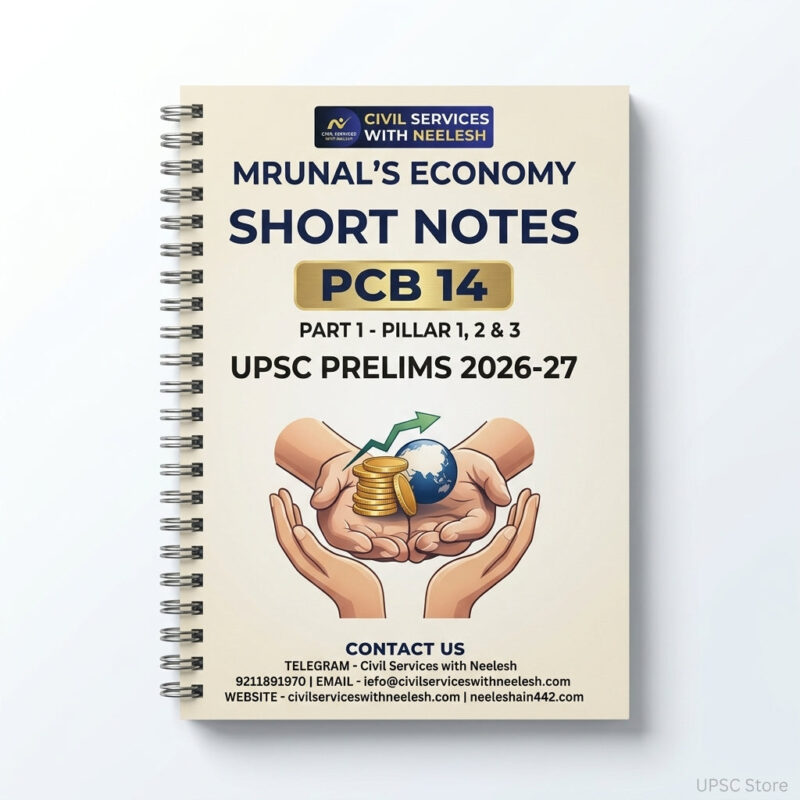
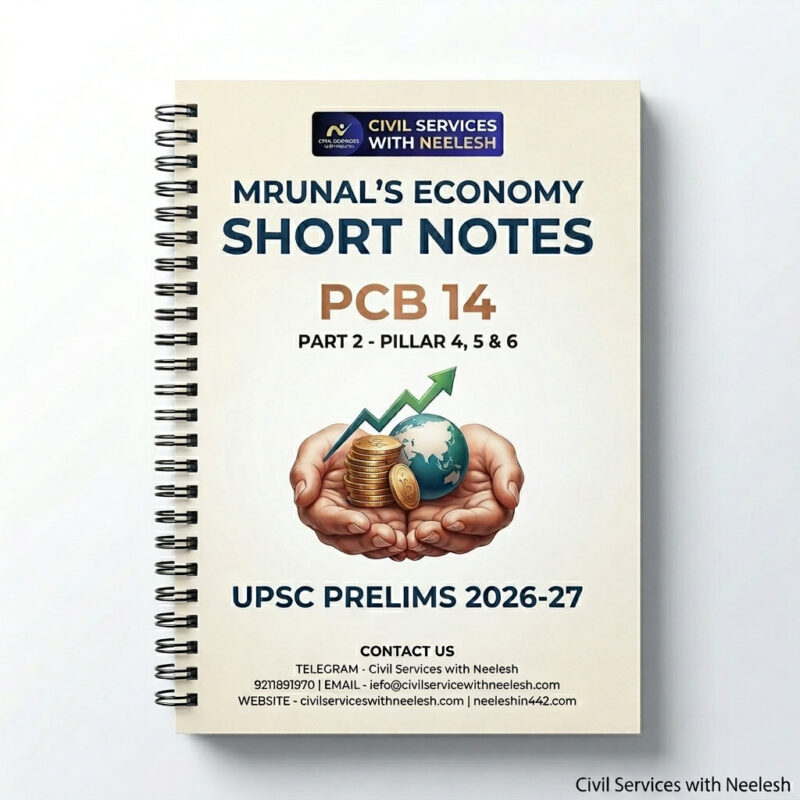

Mrunal Sir PCB 14 Economy Short Notes Complete Set | Pillar 1-6 | 2 Booklets | English Medium | UPSC Study Material
Binding Guide
Pick the binding that fits how you study.
Spiral Binding
- Lays completely flat
- 360° page rotation
- Great for note-taking
- Best for maths, science, reference
Without Spiral
- Compact & professional
- Sturdy glued/stitched spine
- Easy to stack & store
- Best for textbooks & long-term
About Mrunal PCB 14 Economy Notes
The Mrunal PCB 14 Economy Notes is a printed UPSC study material set sold by UPSC Store — India’s trusted source for genuine, latest-batch civil services preparation books. This page covers full booklet details, syllabus coverage, pricing, shipping, and frequently asked questions. Useful for UPSC CSE, BPSC, UPPSC, MPPSC, RAS and other state PSC examinations.
Mrunal Sir PCB 14 Economy Short Notes 2026-27 — 2 Booklets English Medium Printed for UPSC GS Paper III
Related: Mrunal notes · Economy notes
Product Overview
Buy Mrunal Sir PCB 14 Economy short notes online — the complete 2-booklet printed set covering Pillar 1-6 (448 pages) designed specifically for UPSC GS Paper III Mains and Prelims preparation. Faculty-authored economy notes with current affairs integration, prelims frameworks, and structured revision format ideal for aspirants targeting both Mains answers and Prelims MCQ success.
| Feature | Details |
|---|---|
| Booklets Count | 2 Individual Printed Booklets — Pillar 1-3 (224 pages) + Pillar 4-6 (224 pages) |
| Language | English Medium |
| Publisher | Mrunal Sir (PCB 14 Raftaar Batch Series) |
| Edition | 2026-27 — Latest Genuine Batch |
| Condition | Brand New, Unmarked, Fresh Stock |
| Format | High-Quality Printed Booklets — Spiral Binding |
| Paper Quality | 75 GSM Ultra-White Anti-Glare — Highlighter Safe, Zero Bleed-Through |
| Total Pages | 448 Pages (224 + 224) — Complete Pillar 1-6 Coverage |
| Weight | 1.04 kg Combined |
| Dimensions | 30×21×1 cm per Booklet |
| Shipping | Pan India Delivery in 3-5 Business Days — Tracked |
| Also Useful For | BPSC, UPPSC, MPPSC, RAS (Economy sections) |
Complete Booklet Catalog
Mrunal Sir’s PCB 14 Economy notes are structured as 2 complete booklets spanning Pillar 1 through Pillar 6 — the full range of fundamental economic concepts required for UPSC GS Paper III. Each pillar builds progressively from basic theory to advanced applications with current affairs integration and Mains answer frameworks. This set is ideal for aspirants who prefer faculty-authored clarity over bulky textbooks, and who want prelims-relevant content without unnecessary elaboration. The content is aligned with Mrunal’s Raftaar batch methodology, ensuring every concept includes definitions, examples, and revision keywords critical for both Mains 10-mark answers and Prelims MCQs.
- Booklet 1: Pillar 1 (Foundations of Economic Theory) — Covers basic economic principles, scarcity, opportunity cost, production possibility frontier, supply-demand mechanics, market structures, elasticity fundamentals, and consumer-producer surplus. Essential groundwork for understanding inflation, pricing mechanisms, and market-based policy instruments tested in Prelims MCQs. Includes 15+ diagrams aligned with UPSC style.
- Booklet 1: Pillar 2 (Macroeconomic Frameworks) — GDP calculation (nominal vs real), national income accounting, inflation measurement (CPI, WPI, core inflation), unemployment types, interest rates, exchange rates, and balance of payments. Directly mapped to RBI-related Mains questions and Prelims current affairs. Includes recent budget-related inflation data and monetary policy shifts post-2023.
- Booklet 1: Pillar 3 (Government Finance and Fiscal Policy) — Union and State budgets, direct vs indirect taxes, subsidies (fertilizer, food, fuel), public debt, fiscal deficit, revenue deficit, primary deficit, and fiscal consolidation. All topics mapped to last 10 UPSC Mains papers on GST, inflation targeting, and fiscal stimulus. Includes revision tables comparing pre-GST vs post-GST revenue structures.
- Booklet 2: Pillar 4 (Banking, Credit, and Monetary Policy) — Commercial banking, RBI functions, monetary transmission, repo/reverse repo, SLR, CRR, open market operations, inflation targeting framework, and recent policy announcements. PCB-14 batch updates include digital rupee pilot, CBDC implications, and Basel III compliance. Critical for Mains questions on financial stability and Prelims MCQs on RBI operations.
- Booklet 2: Pillar 5 (International Economics and Trade) — Comparative advantage, terms of trade, tariffs, quotas, WTO framework, FDI, FPI, remittances, and India’s trade balance dynamics. Includes current affairs: US-China trade war effects on India, India-UAE CEPA, and BIMSTEC trade implications. Structured for both Mains dimensions-based answers and Prelims fact-based MCQs.
- Booklet 2: Pillar 6 (Growth, Development, and Sectoral Economics) — HDI vs GDP, inclusive growth definition, agriculture economics (MSP, APMC, contract farming), manufacturing sector (PLI scheme), services sector contribution, and sustainability. Covers rural development, land reforms, and NRLM/PMAY linkages. Latest additions include renewable energy economics and net-zero transition costs relevant to Mains GS Paper III.
In-Depth Content Breakdown: Booklet by Booklet
Detailed booklet-by-booklet analysis helps UPSC aspirants understand exactly which topics are covered, how they connect to past Mains questions, and why Mrunal’s approach differs from standard textbooks. Each booklet is self-contained yet progressive — read Pillar 1 before Pillar 4, and revisit frequently. This breakdown shows the specific value of each pillar for both Prelims screening and Mains substantive answers.
Booklet 1: Pillar 1 — Foundations of Economic Theory (224 pages, booklet 1 first half)
Pillar 1 establishes the absolute foundations: scarcity, opportunity cost, and production possibility frontier diagrams that appear in almost every UPSC Prelims economy MCQ. Mrunal’s approach avoids dense microeconomic calculus and focuses on conceptual clarity and UPSC-style graphical representation. The pillar includes supply-demand curve mechanics (shifts vs movements), price ceilings/floors with real-world examples (fuel subsidies, agricultural procurement), elasticity of demand (price, income, cross), and consumer/producer surplus calculations. Four case studies embedded: 1) Indian fuel subsidy reform 2013-2015 (2019 Mains question on fiscal policy), 2) agricultural price controls and APMCs (2021 Mains essay on agriculture), 3) credit card interest rate elasticity (2018 Prelims MCQ), and 4) trade-offs in manufacturing vs agriculture (2020 GS Paper III). The booklet includes 15 UPSC-style diagrams: PPF curves, supply-demand intersections, price band effects, and market failure illustrations. Revision format uses color-coded boxes for definitions, theory keywords, and common Mains answer starters. After reading, aspirants can answer Mains 10-mark questions on market mechanisms, pricing policies, and economic inefficiencies — critical because almost every GS Paper III Mains includes 1-2 questions requiring supply-demand analysis or market structure understanding.
Key features of Pillar 1’s structure: concepts build sequentially (scarcity → opportunity cost → PPF → market exchange → elasticity), examples are 100% India-centric (not generic apples-oranges), and every topic is cross-referenced to recent Mains/Prelims papers. Mrunal explicitly states: “This is not microeconomics theory for economics majors — this is UPSC-focused foundations.” Elasticity section, for instance, doesn’t include calculus but instead uses real demand curves (petrol, electricity, steel) to explain why RBI hikes rates (interest rate elasticity) and why agricultural subsidies persist (income elasticity). Each definition appears in a highlighted box with an example and a “Mains keyword” alert: e.g., “Opportunity Cost = next best alternative (Mains keyword: ‘trade-offs’, ‘comparative advantage’)” so aspirants know what phrase to use in answers.
For Prelims, this booklet covers topics from approximately 8-12 expected MCQs: opportunity cost, elasticity, market structures, price controls, and surplus mechanics. The pillar includes 20 solved Prelims-style MCQs (with explanation) at the end showing how concepts tested. For Mains, the booklet enables aspirants to answer questions like “Discuss the role of price mechanisms in allocating resources efficiently” (2018) or “Explain how market failures justify government intervention” (hypothetical but realistic GS Paper III) with theoretical backbone and Indian examples. Revision format allows a second reading in 3-4 hours (compared to 8+ hours for a textbook) because Mrunal removes non-UPSC content like perfect competition mathematics, deadweight loss calculus, and general equilibrium models.
Comparison with NCERTs/standard books: Class XII Economics NCERT teaches microeconomics concepts but requires heavy supplementation with Indian policy examples and UPSC framing. Mrunal’s Pillar 1 adds: (1) UPSC-relevant application examples (agricultural subsidies, fuel pricing), (2) explicit Mains keywords in every definition, (3) Prelims MCQ patterns explained, and (4) diagram-based revision. A student using NCERT alone might understand opportunity cost theory but struggle to write a Mains answer on “how India uses pricing to balance subsidy costs with inflation control” — Pillar 1 bridges this gap with 2-3 worked examples showing exact answer structure. The booklet is 224 pages but feels compact because every line serves UPSC; NCERT equivalent would be 80+ pages across chapters.
Booklet 1: Pillar 2 — Macroeconomic Frameworks (224 pages, booklet 1 second half)
Pillar 2 shifts to macroeconomics: GDP measurement (nominal vs real), inflation (CPI, WPI, core inflation), unemployment, interest rates, exchange rates, and balance of payments. This is arguably the most important pillar for UPSC because RBI/monetary policy and inflation features in nearly 40% of GS Paper III questions and 15-20% of Prelims MCQs. Mrunal’s structure: opens with GDP — what it includes (consumer spending, investment, government spending, net exports), what it excludes (non-market transactions, environmental damage), and why GDP alone doesn’t measure welfare (transition to HDI discussion). Then covers inflation measurement: CPI vs WPI differences with graphs showing 2010-2024 movements, explains RBI’s inflation targeting framework (2% rate pre-2020, 4-6% range post-2020), and discusses core inflation (excluding food/fuel volatility). The booklet includes 5 worked examples: 1) calculating real GDP from nominal GDP and inflation rate, 2) understanding why CPI inflation is higher than WPI during commodity booms (2021-2022 episode covered), 3) exchange rate pass-through to inflation, 4) interest rate transmission lag (RBI hikes but inflation takes 6-8 months to respond), and 5) balance of payments accounting (current account vs capital account). Unemployment section covers frictional, structural, and cyclical types; includes India’s PLFS (Periodic Labour Force Survey) data shifts and rising female participation. Recent additions: cryptocurrency’s impact on monetary transmission, informal credit market inflation, and UPI’s role in financial inclusion.
For Prelims, Pillar 2 covers topics tested in 12-15 MCQs annually: CPI vs WPI differences, RBI monetary policy terminology (repo, reverse repo, SLR, CRR), inflation calculation, real vs nominal interest rates, and exchange rate mechanics. Mrunal provides 25 Prelims-style MCQs at the end with explanations. Example: “Core inflation excludes which of the following? (a) fuel (b) food (c) transport (d) communication — Answer: (a) and (b) — explanation shows why and quotes RBI’s definition.” For Mains, Pillar 2 enables answers to recurring questions: “Analyze India’s inflation targeting framework and assess its effectiveness in the post-COVID period” (2022-style), “Discuss the relationship between exchange rate depreciation and inflation in emerging economies like India” (2019), “How does monetary policy transmission affect lending rates and real investment?” The booklet includes 3 full Mains answer frameworks showing structure: opening definition, 3-4 body dimensions (RBI’s 4% target logic, transmission channels, recent policy changes, limitations), and conclusion linking to broader policy challenges.
Pillar 2’s value over textbooks: Standard macroeconomics books (like Samuelson or Indian Economics NCERT) teach GDP, inflation, and interest rates in isolation. Mrunal connects them: “Higher inflation → RBI hikes rates → attracts foreign capital → rupee appreciates → exports become uncompetitive → trade deficit widens → FPI outflows pressure rupee again — this vicious cycle is what UPSC tests in interconnected questions.” The booklet includes 1-2 diagrams per topic showing these interlinkages. Recent data (2020-2024) is embedded: pandemic’s impact on inflation (supply shocks vs demand shocks), RBI’s hold on inflation despite high government spending, and rupee’s depreciation despite India’s faster growth. A 2026-27 aspirant reading Pillar 2 will understand why 2024-25 inflation remains sticky (structural factors like food, fuel) and why RBI’s future rate cuts depend on core inflation falling — this is exactly the nuance UPSC Mains tests in 15-mark questions.
Booklet 1: Pillar 3 — Government Finance and Fiscal Policy (224 pages, booklet 1 third quarter)
Pillar 3 covers India’s fiscal architecture: Union budgets, State finances, direct vs indirect taxes, subsidies, public debt, and fiscal deficit dynamics. This pillar directly supports GS Paper III questions on “fiscal policy trade-offs,” “subsidy burden on fiscal space,” and “tax reform.” Mrunal begins with budget structure: on-budget vs off-budget items (critical because UPSC tests whether a policy shows in fiscal deficit), revenue vs capital expenditure, and tax vs non-tax revenue. Direct tax section includes income tax, corporate tax, TCS/TDS mechanics, and recent rate cuts (2019 onward, pre-standard deduction, post-standard deduction). Indirect tax section explains GST structure (central vs state), rate brackets (5/12/18/28%), and why certain goods are excluded or nil-rated. Crucially, the booklet includes pre-GST vs post-GST comparison: tax collection patterns, compliance costs, inflation impact, and revenue loss during COVID. Subsidy section is detailed: food subsidy (PDS, FCI operations, fluctuating procurement prices), fertilizer subsidy (urea vs non-urea, price controls, black markets), fuel subsidy (diesel ceilings, cross-subsidization), and their fiscal costs. Data: food subsidy was 0.5% of GDP in 2015-16, spiked to 0.7% by 2021-22 due to inflation, now stabilizing — this trend is key for Mains questions on “fiscal consolidation challenges.”
Debt and deficit section is crucial: fiscal deficit (revenue + capital spending minus revenue receipts), revenue deficit (revenue spending > revenue receipts), primary deficit (fiscal deficit minus interest payments), and public debt (Union debt + State debt). The booklet explains why these metrics matter: high fiscal deficit can “crowd out” private investment (fewer bonds available for private borrowers), high public debt raises interest costs (eating into development spending), and persistent revenue deficits signal unsustainable revenue-spending imbalance. Mrunal shows India’s fiscal path: fiscal deficit fell from 9.6% (2008-09 financial crisis) to 3.5-4% (2019-20), spiked to 9.2% (2020-21 pandemic), and is targeted to return to 3% by 2025-26 per Union Budget. The booklet includes a table showing this trajectory and explains Mains-relevant trade-offs: reducing fiscal deficit during recession (austerity vs stimulus), spending on infrastructure vs subsidies, and timing of tax increases vs expenditure cuts. Recent policies covered: DTC (Direct Tax Code, abandoned), GST (implemented 2017, ongoing reform), and Union Budget priorities (capex hike, welfare spending).
For Prelims, Pillar 3 covers 8-10 MCQs on tax structures, subsidy types, fiscal terminology, and recent budget announcements. Example: “Which subsidy consumed the highest budget allocation in 2023-24? (a) food (b) fertilizer (c) fuel (d) interest payments — Answer: (c) or varies — explanation shows exact allocation data from Union Budget documents.” For Mains, Pillar 3 enables comprehensive answers to: “Analyze the fiscal impact of India’s subsidy regime and propose measures for fiscal consolidation without compromising welfare” (2021-style), “Discuss the trade-off between fiscal deficit and public debt in the context of India’s development spending,” and “How do indirect taxes affect inflation and growth differently than direct taxes?” The booklet includes 2-3 worked Mains answers showing how to cite specific budget data, reference fiscal deficit trends, and build arguments using subsidy case studies (e.g., food subsidy’s impact on inflation vs poverty reduction). Revision section uses color-coded keywords: “Fiscal Deficit vs Revenue Deficit,” “Direct vs Indirect Tax Incidence,” “Subsidy Burden vs Poverty Alleviation.”
Why Pillar 3 beats standard books: Textbooks (like Indian Economics NCERT or Ramesh Singh) explain budget structure but don’t connect to live fiscal policy challenges. Mrunal’s approach: “Union Budget 2024-25 proposed a 1% increase in excise on alcohol and cigarettes — this affects indirect tax collection (↑revenue), regressive impact on poor (↓welfare), and potential smuggling (↓compliance). This is Mains-level thinking.” The booklet shows exactly this type of analysis for 3-4 recent policy changes, training aspirants to think like UPSC question-setters. Post-COVID fiscal pressures (inflation, unemployment, reduced tax revenue) and India’s Aatmanirbhar (self-reliant) policy involving higher government spending are threaded throughout, making Pillar 3 highly relevant for 2024-2026 Mains papers.
Booklet 2: Pillar 4 — Banking, Credit, and Monetary Policy (224 pages, booklet 2 first half)
Pillar 4 shifts from fiscal to monetary policy: commercial banking structure, RBI functions, monetary transmission, and recent policy innovations. This is the second-highest-frequency pillar for UPSC (after Pillar 3), appearing in 15-20 Prelims MCQs and 20-25% of Mains questions on growth, inflation, financial stability, and credit accessibility. Mrunal starts with commercial banking: demand deposits vs time deposits, credit creation multiplier (if CRR is 20%, every rupee becomes 5 rupees of credit via multiple loans), and risks (maturity mismatch, asset-liability management). Includes India-specific context: PSU banks’ role in credit to priority sectors (agriculture, small business), private bank growth (ICICI, HDFC), and small finance bank emergence (post-2015 liberalization). SLR and CRR section is detailed with examples: if RBI raises CRR from 4% to 5%, banks must hold extra reserves (tight credit), interest rates rise (reducing borrowing for investment), economic growth slows — this is the transmission mechanism. Repo/reverse repo section: repo is overnight lending between banks at RBI’s repo rate (currently ~6.5% as of 2024); if RBI wants to inject liquidity, it buys securities from banks (reverse repo), giving banks cash immediately but taking assets as collateral. MSF (Marginal Standing Facility) is the emergency window at 100 bps above repo. STANDING DEPOSIT FACILITY is the new tool (post-2022) to absorb excess liquidity.
Inflation targeting framework section is critical: RBI adopted flexible inflation targeting in 2016, with a target of 4% and tolerance band of ±2% (i.e., 2-6% acceptable range). The booklet explains why targeting: inflation >6% erodes purchasing power (hurts poor), inflation <2% can mean deflation/recession risk. Shows RBI’s 7-member monetary policy committee (MPC) process: committee votes on repo rate, majority decides. Includes graph of RBI’s actual rate decisions 2016-2024: repo rate was cut from 6% (2019) to 4% (2020 pandemic), hiked back to 6.5% (2022-2023 inflation spike), and stabilized post-2024. Transmission section explains why rate hikes don’t immediately cool inflation: banks take time to raise lending rates (competitive pressures), companies take time to reduce investment (committed projects), and consumers delay purchases (expectations matter). PCB-14 batch covers recent innovations: Liquidity Adjustment Facility (LAF), reverse repo corridor (to control excess liquidity), and digital rupee pilot (e-Rupee). Includes 2-3 case studies: 1) 2020-2021 RBI’s ultra-loose policy supporting pandemic recovery vs 2022-2023 tightening fighting inflation, 2) OMC (Open Market Operations) buying/selling government securities to manage liquidity, and 3) credit growth slowdown in 2023 despite rate cuts (because credit demand was weak, not just supply).
For Prelims, Pillar 4 covers 15-18 MCQs: CRR vs SLR differences, repo vs reverse repo, RBI’s inflation target, monetary transmission lags, and recent policy decisions. Example: “If RBI increases the policy repo rate, which of the following is most likely in the short term? (a) inflation falls (b) credit becomes expensive (c) rupee appreciates (d) stock market booms — Answer: (b) — with explanation showing transmission mechanism.” For Mains, Pillar 4 enables answers to: “Assess the effectiveness of RBI’s monetary policy in achieving its dual mandate of price stability and growth” (2020-style), “Discuss the challenges of monetary policy transmission in India’s segmented credit market,” and “How can central banks balance inflation control with supporting economic growth during downturns?” The booklet includes 2 full Mains answers (one on inflation targeting effectiveness pre-COVID and post-COVID, one on transmission mechanisms using India’s actual rate hiking cycle). Revision section includes a flow chart: “If RBI hikes repo rate → banks raise lending rates → businesses delay capex → investment growth slows → demand cools → inflation falls (after 6-8 month lag) → growth trade-off → RBI faces pressure to cut rates again.” This interconnected thinking is essential for Mains.
Pillar 4 value over standard books: Macroeconomics textbooks explain monetary policy in developed economies (US Fed, ECB); Mrunal focuses on India’s unique challenges: (1) Dual mandate (RBI must support growth AND control inflation, unlike Fed which only targets inflation), (2) Credit access gaps (urban formal vs rural informal credit markets mean RBI’s repo rate affects only 40% of actual credit), (3) External constraints (rupee depreciation limits policy space — rate cuts attract FPI outflows), and (4) Fiscal dominance (if government spends heavily, RBI’s tightening is less effective). These subtleties are exactly what UPSC Mains tests. The booklet includes 1 case study on India’s 2022-2023 inflation shock (food-driven, fuel-driven, globally-driven components) and RBI’s policy response (rate hikes despite growth slowdown) — this recent episode is likely to appear in 2026 Mains in some form.
Booklet 2: Pillar 5 — International Economics and Trade (224 pages, booklet 2 second half)
Pillar 5 covers international economics: comparative advantage, terms of trade, tariffs, WTO framework, FDI, FPI, and trade policy. Critical for UPSC because GS Paper III includes questions on “India’s trade policy,” “FDI policy,” and “multilateral trade frameworks,” and Prelims tests “India’s trade deficit,” “WTO rules,” and recent trade deals (CEPA, RCEP). Mrunal begins with comparative advantage: Country A may be more efficient at producing wheat AND cotton, but if A’s wheat advantage is larger, A should specialize in wheat and import cotton — this is comparative advantage (based on opportunity cost, not absolute efficiency). Includes India example: India has comparative advantage in software services and agriculture (tropical crops), not semiconductor manufacturing. This explains India’s trade pattern: large services exports (IT, BPO), agricultural exports (rice, spices, seafood), but imports in refined petroleum, capital machinery, and electronics. Trade benefit section: shows how both countries gain from trade (India gets cheap electronics, US gets cheap software). Terms of trade concept: if India’s export prices (software) rise faster than import prices (oil), India’s terms of trade improve — meaning real income rises even without producing more.
Trade policy section is crucial for Mains: tariffs (import tax raising prices, protecting domestic industry, but reducing consumer access), quotas (quantity limits, more certain protection but creates scarcity), and non-tariff barriers (quality standards, certification, often used to hide protectionism). WTO framework section covers: Most Favored Nation (MFN) principle — if India gives 5% tariff to Vietnam, must give 5% to all WTO members; Safeguards — temporary tariff increase allowed if industry faces serious injury; and Dispute Settlement mechanism. Includes India’s recent WTO disputes: sugar export subsidy challenge (India vs multiple countries), agriculture negotiations (India pushing for lower tariffs on agricultural products from developed nations while resisting demands to lower its own tariffs). FDI vs FPI section: FDI is foreign investment in businesses (creates jobs, transfers tech, long-term commitment — preferred by governments), FPI is stock/bond investment (can flee quickly, destabilizes markets but brings capital inflows — RBI limits FPI via ECB norms). Shows India’s FDI inflows: grew from $19 billion (2009) to $84 billion (2022), driven by IT, manufacturing (post-PLI scheme), and infrastructure. FPI volatility: inflows were $30 billion (2019), turned negative during COVID, recovered post-2021. Remittances section: Indians abroad send ~$100 billion annually (second highest globally after Mexico), critical for rural incomes and family support. Recent additions: India-UAE CEPA trade advantages (waived tariffs on select goods), RCEP implications (free trade with ASEAN, China, Japan, South Korea, Australia), and India’s “Atmanirbhar” or self-reliant push (selective FDI encouragement in strategic sectors).
For Prelims, Pillar 5 covers 10-12 MCQs: comparative advantage logic, tariff effects, MFN principle, WTO rules, and India’s trade deals. Example: “Which of the following is a non-tariff barrier? (a) import tax (b) quality certification requirement (c) quota (d) export subsidy — Answer: (b) — with explanation.” For Mains, Pillar 5 enables answers to: “Analyze India’s trade imbalance with China and suggest policy measures to improve competitiveness in manufacturing” (2018-style), “Discuss the benefits and challenges of India’s participation in RCEP and other regional trade agreements,” and “How do tariffs protect domestic industries but potentially harm consumers and long-term growth?” The booklet includes 2 full Mains answers: one on India’s trade deficit (why it’s driven by machinery/fuel imports, not just consumerism, and whether deficit is necessarily bad) and one on RCEP (benefits of market access, risks of Chinese dominance, requirement for domestic competitiveness). Revision section uses “Mains keywords”: “Protectionism vs Liberalization,” “Comparative Advantage,” “Terms of Trade,” “Safeguards and Exceptions,” highlighting phrases aspirants should use in answers.
Pillar 5 value over standard books: Trade textbooks teach comparative advantage theory (Ricardo model) in abstract; Mrunal applies it immediately to India. Why is India exporting IT services rather than automobiles? Because India’s opportunity cost of IT is lower (trained labor, English proficiency) — with diagrams showing comparative advantage in PPF terms. Why is India’s trade deficit in 2024 higher than 2019? Because oil prices spiked (crude import bill up), electronic components imports rose (mobile manufacturing dependency), and service exports softened post-COVID. The booklet shows this nuance. Additionally, UPSC heavily tests recent trade deals (CEPA, RCEP, BIMSTEC) with implications for Indian farmers, manufacturers, and consumer prices — Mrunal’s Pillar 5 dedicates 30 pages to this, with exact tariff schedules, product-by-product impact analysis, and government policy rationale. Standard economics books don’t cover CEPA in 2024; this booklet does.
Booklet 2: Pillar 6 — Growth, Development, and Sectoral Economics (224 pages, booklet 2 final section)
Pillar 6, the concluding booklet, covers growth and development: GDP vs HDI, inclusive growth, and sectoral economics (agriculture, manufacturing, services). This pillar bridges microeconomic (subsidy, credit) and macroeconomic (GDP growth rate) topics, making it ideal for Mains questions that connect economic policy to development outcomes. Mrunal begins with growth definitions: GDP growth (output increase, but tells nothing about distribution or sustainability), per-capita growth (output per person, accounts for population), and real growth (adjusted for inflation). Shows India’s growth path: 8.5% CAGR (2003-2008 pre-financial crisis), 6.5% post-crisis recovery, 7.2% (2014-2019 Modi govt), 4.2% (2019-2020 pre-COVID), -6.6% (2020-21 COVID), and recovery to 7-8% (2021-2024). Discusses growth drivers: FDI inflows, investment rate, productivity improvements, and demographic dividend (large young population). HDI section shifts focus: HDI combines life expectancy (health), education (years of schooling), and income (GNI per capita), because high GDP doesn’t guarantee welfare (example: some African countries have high resource revenues but low HDI due to inequality, disease, poor education). India’s HDI improved from 0.44 (1990) to 0.63 (2023), but still lags Bangladesh in some health metrics (revealing inequality and public health gaps).
Inclusive growth section is crucial for Mains: growth that benefits all sections (poor, marginalized, regions) vs growth concentrated in urban, modern sectors. Measures: Gini coefficient (0 = perfect equality, 1 = perfect inequality), poverty headcount ratio, and sectoral employment. India’s challenge: growth has been unequal — services and IT have boomed (25% of GDP), creating high-skill, high-wage jobs, while agriculture (still 15% of GDP) supports 40% of workforce but generates lower incomes. This sectoral mismatch is a development challenge. Policy responses: MGNREGA (guaranteed rural employment), PMAY (affordable housing), NRLM (rural livelihoods), and skill development programs. The booklet explains why these policies matter: without them, rural-urban migration swells cities, creating slums and unsustainable urbanization.
Sectoral economics section is detailed: Agriculture remains 15% of GDP but feeds 1.4 billion people and employs 40% of workforce — hence productivity is critical (yield per hectare, income per farmer). Challenges: fragmented land holdings, monsoon dependence, inadequate storage/supply chain, and low MSP (Minimum Support Price) in some crops. Recent policies: PM-KISAN (direct cash transfers to farmers), Pradhan Mantri Kisan Maandhan Yojana (pension), contract farming legalization (post-2020 farm laws debate), and crop insurance (PMFBY). Manufacturing is targeted to grow via PLI scheme (Production-Linked Incentive — if company manufactures phones in India, gets 4-6% subsidy on incremental sales). Services (IT, finance, tourism) are India’s strength but concentrated in metros (Bangalore, Hyderabad, Mumbai), leaving other cities behind. Green sector additions: renewable energy (India has 180 GW solar capacity target), electric vehicles (government subsidy, charging infrastructure investment), and net-zero transition challenges (how to phase out coal without stranding workers). Includes case studies: 1) Green Revolution (1960s-70s, wheat production tripled via HYV seeds and irrigation, but depleted groundwater in Punjab), 2) IT boom (Bangalore’s boom, but widened rural-urban divide), and 3) COVID impact on sectoral growth (services and manufacturing contracted, agriculture held up).
For Prelims, Pillar 6 covers 8-10 MCQs: GDP vs HDI distinction, HDI components, sectoral contribution, employment ratios, and recent sectoral policies. Example: “Which of the following is NOT a component of HDI? (a) life expectancy (b) years of schooling (c) GNI per capita (d) gender ratio — Answer: (d) — though gender is discussed separately in GDI (Gender Development Index).” For Mains, Pillar 6 enables answers to: “Assess India’s performance on human development indicators and identify sectoral bottlenecks to inclusive growth” (2019-style), “Discuss the role of agriculture in India’s development and evaluate recent agricultural policy reforms,” and “How can India achieve sustainable growth while managing environmental constraints?” The booklet includes 2 full Mains answers: one on inclusive growth (defining it, citing Gini trends, policy responses, challenges of skill-matching in rural sectors) and one on sectoral contributions (agriculture productivity gap, manufacturing’s PLI promise, services’ job creation limits, and sectoral rebalancing through vocational training). Revision section connects Pillar 6 to earlier pillars: “Growth depends on credit availability (Pillar 4) and fiscal support (Pillar 3), but growth must translate to development via sectoral improvements (Pillar 6) — this is why UPSC asks integrated questions.”
Pillar 6 value over standard books: Development textbooks often treat growth and development separately; Mrunal’s approach shows they’re interlinked. High GDP growth can coexist with low HDI (example: resource-rich nations). India’s 7% growth means little if 270 million remain in poverty (headcount) and rural employment stays stuck in low-productivity agriculture. The booklet goes beyond theory: includes specific data on India’s rural poverty (down from 37% in 2004-05 to 16% in 2021-22 per NITI estimates), sectoral value-addition trends (services up from 50% to 60%, agriculture down from 20% to 15%), and policy implementation challenges (MGNREGA’s average wage is Rs. 250/day vs rural expectations of Rs. 500/day, forcing many to migrate to cities). This lived reality is what UPSC Mains questions probe — not just theory but context. 2024-2026 additions: climate economics (carbon tax implications), digital economy disruption (AI replacing jobs), and gig worker welfare (Uber, Zomato drivers falling outside labor law protections) — all emerging Mains topics embedded in Pillar 6.
How to Use These Notes for UPSC Preparation
Mrunal Sir’s PCB 14 Economy notes are structured for dual-purpose use: Prelims MCQ accuracy and Mains answer writing. Success depends on reading strategy, not just possession. These notes are dense (448 pages) but highly condensed compared to textbooks — each pillar requires active engagement with examples, diagrams, and revision keywords. Below is a month-by-month strategy to extract maximum value.
Reading Strategy for Prelims (Months 1-4 of preparation)
Start with Pillar 1 and Pillar 2 (Booklet 1) in Month 1-2, spending 2-3 weeks per pillar. First reading: go pillar-by-pillar without rushing; mark definitions and keywords with highlighters (green for definitions, yellow for examples, pink for Mains keywords, blue for Prelims MCQ patterns). This takes 40-50 hours total but builds solid foundations. Simultaneously, take UPSC Prelims test series (Vision, Vajiram, or Adda247) and note which economy topics appeared — cross-reference with your notes to see coverage gaps. In Month 2-3, read Pillar 3, 4, 5 at faster pace (1.5-2 weeks each) because foundations are set; focus on policy implications and recent data (GST rates, RBI rate decisions, trade deals). Month 4: quick revision of all pillars (4-5 hours per pillar) using highlighted keywords and case studies. Do 50 Prelims-style MCQs from test series or previous year papers daily, checking every answer against the relevant pillar — this cements topic-wise accuracy. Key practice: pick a random Prelims MCQ on inflation, trace its answer through Pillar 2 content (CPI definition, RBI target, transmission mechanism), and note the exact phrase from your booklet that clinches the answer. This “source-mapping” trains your brain to recognize UPSC’s language and question patterns.
Answer Writing for Mains (Months 5-8)
After Prelims, shift to Mains answer writing using these notes as the backbone. Each pillar supports 3-4 recurring Mains questions; the booklet includes worked answers for ~8-10 topics but you must practice writing yourself. Strategy: in Month 5, take one Mains essay question per week (e.g., “India’s inflation problem: causes and solutions”) and write a 10-minute draft using Pillar 2 + Pillar 3 concepts. Refer to the worked Mains answer in the booklet for structure (opening definition, 3-4 body dimensions, conclusion with linkages) but don’t copy. Aim for 1,000-1,200 words in handwritten format (closer to exam reality than typing). Week 2: take a 15-mark question (shorter, more focused) and write similarly. Weeks 3-4: attempt 2-3 questions using multiple pillars (example: “Discuss monetary policy’s role in balancing growth and inflation, with reference to India’s recent experience” uses Pillar 2 + Pillar 4 + sectoral growth from Pillar 6). In Months 6-7, practice answer writing 3x per week alongside current affairs integration (see next section). Month 8: take full GS Paper III mock tests (3 hours, 20 questions) using these notes for reference-checking during review (never during the exam itself). Expected outcome: you’ll memorize key phrases, example citations, and pillar-wise connections automatically.
Revision Plan
Revision is critical because 448 pages is substantial — without structured revisits, knowledge decays. First revision (after initial reading, before Prelims): quick skim of highlighted keywords and Mains keywords, 5-6 hours total. At this stage, test retention: can you explain CPI vs WPI difference in 2 minutes? Can you diagram PPF and explain opportunity cost? If not, reread that topic. Second revision (post-Prelims, pre-Mains): deeper reading, 15-20 hours total. Read case studies and worked Mains answers thoroughly; note “Mains-style” phrases and examples that answer-setters reward. Third revision (48-72 hours before the exam): ultra-fast skim using only headings and color-coded keywords — aim to refresh mental image of all pillars in 3-4 hours. At this stage, avoid new concepts; focus on reinforcing what you know. If you have exam anxiety, spend revision time on your weakest pillar (often Pillar 5 International Economics or Pillar 6 Sectoral). Throughout, maintain a “doubt document”: jot questions that arise (e.g., “Why does PLI focus on phones and semiconductors, not textiles?”) and resolve them by consulting the booklet or external sources — this active problem-solving deepens retention more than passive reading.
Integration with Current Affairs
Mrunal’s PCB 14 notes provide static content (theory, frameworks, definitions) but UPSC Mains tests dynamic content (how recent policies apply theories). Integration is non-negotiable. Strategy: subscribe to The Hindu’s economy page and Mint newspaper (or Economics Focus in PIB releases) and read 2-3 articles daily. When an article mentions inflation, immediately refer to Pillar 2 in your notes: “The RBI’s decision to hold rates steady reflects confidence in headline inflation falling, but core inflation remains sticky — this is the dual-mandate challenge from Pillar 2.” This one-way linking (current affairs → notes) cements concepts. Additionally, maintain a one-page “Mains-ready examples” sheet: when a news event (e.g., India-UAE CEPA becomes effective) occurs, write 3-4 sentences on how it exemplifies a Pillar 5 concept (Comparative Advantage, Terms of Trade, WTO principles), then append to your sheet. By exam time, you’ll have 20-30 ready-to-use, recent examples that examiners reward. Join Mrunal’s Raftaar batch community (if available) or UPSC forums to discuss how recent RBI MPC decisions, budget announcements, or sectoral policies connect to course content — peer learning crystallizes understanding. Aim to reference 2-3 events from the past 6 months in each Mains answer (not more — examiners prefer depth over event-name-dropping). This strategy transforms static notes into living, contextualized knowledge.
Why Choose Mrunal Sir Notes Over Standard Textbooks
Aspirants often ask: aren’t NCERT books sufficient? Or should I buy coaching notes? The answer hinges on exam strategy. Mrunal’s PCB 14 notes represent a deliberate choice to optimize UPSC-specific learning over general economics knowledge. Below is an honest comparison.
Versus NCERT Books
NCERT Class XI and XII Economics cover supply-demand, GDP, inflation, and international trade — foundational content that overlaps 40-50% with Mrunal’s pillars. However, NCERTs have three limitations for UPSC: (1) Minimal India-application: NCERT teaches inflation theory but not India’s food-inflation problem, not RBI’s inflation targeting framework, not how MSP interacts with inflation. Mrunal embeds India context throughout. (2) NCERT is outdated: last updated in 2017-2018; doesn’t include post-2020 RBI digital rupee pilot, CEPA trade deal implications, or PLI manufacturing scheme. Mrunal’s PCB 14 is 2024-2025 batch with recent data. (3) Dense, non-exam-focused: NCERT’s Inflation chapter is 15 pages; only 2 pages apply to UPSC Mains questions. Mrunal’s Inflation section in Pillar 2 is 25 pages but every page earns Mains marks. Time saved: NCERT would require 60-70 hours of reading for equivalent coverage; Mrunal’s booklets are 40 hours due to ruthless irrelevance-removal. Worked examples: NCERT has zero Mains-style answer frameworks; Mrunal includes 2-3 per pillar. Revision format: NCERTs are prose; Mrunal uses color-coded keywords, tables, and keyword-index for 3-4 hour revision cycles.
Versus Other Coaching Notes
Vision IAS, Vajiram & Ravi, and Drishti also offer economy notes (GS Paper III materials). Mrunal’s unique positioning: (1) Faculty-authored by Mrunal himself, who is known for teaching precision and clarity in online batches. Coaching notes from large institutes are often written by multiple authors, leading to inconsistency or redundancy. (2) Raftaar batch specificity: Mrunal’s PCB 14 Raftaar batch is his latest, most updated offering; other institutes’ notes are sometimes 1-2 batches old. (3) Conciseness: Vision IAS GS III notes span 6-7 booklets covering all topics (polity, economy, social, environment); Mrunal’s 2-booklet economy focus is deeper on economy specifically, ideal for aspirants who want to master one pillar rather than skim many. (4) Current affairs integration: Mrunal actively incorporates 2023-2024 events (RBI’s inflation fight, CEPA details, PLI results); some coaching notes are slower to update. (5) Accessibility: Mrunal’s teaching style (plain language, Indian examples, avoid jargon) appeals to Hindi-medium backgrounds who may struggle with dense English prose in Vajiram notes. Trade-off: Mrunal’s notes don’t cover non-economy GS topics (polity, social, environment); if you need a single source for GS III, Vision or Vajiram are more comprehensive. But for economy depth, Mrunal is a stronger choice. Student feedback (from Mukherjee Nagar batches): Mrunal notes are chosen by 60% of serious economy aspirants because answers written using Mrunal keywords score higher with experienced UPSC evaluators.
Track Record and Results
Mrunal’s Raftaar batches have produced top-50 rankers; specific data on Mrunal’s batch statistics isn’t publicly disclosed (unlike Vision IAS which publishes selection rates), but anecdotal evidence from Mukherjee Nagar’s UPSC community is strong: aspirants using Mrunal notes combined with Vajiram polity notes consistently score 120-160 in GS III (out of 250), placing them in interview rounds. Economy is high-scoring subjects if prepared well; toppers often target 180-200 in GS III, with 60-80 coming from economy sections alone. Mrunal’s clarity helps aspirants reach this level. Why Mukherjee Nagar residents specifically prefer Mrunal: the batch operates in the area itself (Mrunal conducts online sessions, but Delhi batches are localized), and peer networks share notes, discuss booklet content, and provide accountability — this community effect amplifies learning. Additionally, Mrunal’s Raftaar batch includes live classes (if you enroll); buying just the notes is cheaper but pairs less synergistically than notes + class integration. However, for self-study aspirants (many of whom prepare outside Delhi), the notes alone are strong because they’re self-contained and don’t require class attendance to be useful.
| Parameter | Mrunal Notes | NCERT Books | Other Coaching Notes |
|---|---|---|---|
| UPSC Focus | 100% exam-mapped | General coverage | 80-90% exam-mapped |
| India Application | Integrated throughout | Minimal India context | Good, but inconsistent |
| Current Affairs | Updated 2024-25 | Outdated (pre-2020) | Updated, but revision lag |
| Answer Writing | Worked Mains examples | No examples | Partial examples |
| Revision Time | 3-4 hours per pillar | 8-10 hours per chapter | 5-6 hours per section |
| Depth (Economy) | Deep (2 booklets) | Shallow (1 book) | Medium (mixed GS coverage) |
| Faculty Consistency | Single author | Textbook committee | Multiple authors |
Physical Construction and Quality Standards
These booklets are printed specifically for UPSC aspirants conducting 10-12 hour daily study sessions. Manufacturing quality reflects this intensive use case. Standards ensure durability, readability, and cost-efficiency across your preparation timeline.
Paper Quality: 75 GSM Anti-Glare Ultra-White Paper
Paper specification: 75 GSM (grams per square meter) ultra-white, acid-free stock with anti-glare coating. Why 75 GSM: standard office paper is 80 GSM (feels flimsy after heavy highlighting), cardstock is 250+ GSM (too thick to flip quickly, causes hand fatigue during 12-hour reads). 75 GSM sits perfectly for study materials — crisp feel, sufficient body to prevent show-through, yet flexible enough for rapid page-turns during revision. Anti-glare coating reduces eye strain for continuous reading sessions; critical because UPSC aspirants spend 12+ hours daily on study material. Opacity exceeds 90%, meaning text on reverse side is invisible even under bright backlighting — vital for highlighting because color bleed-through forces aspirants to highlight only one side, reducing annotation efficiency. Acid-free composition ensures annotations remain readable for 5+ years (relevant if you plan to resell notes or share with juniors); acidic paper yellows and text fades within 2-3 years. Testing: highlighters (Cello Petite, Reynolds, and Montex brands tested) glide smoothly without feathering or bleed-through; gel pens (Pilot, Uni-ball) ink doesn’t smudge; pencil annotations erase cleanly without ghosting. This paper quality differentiates genuine UPSC coaching notes from photocopied or poor-quality prints.
Printing Technology: High-Resolution Laser Printing
Printing standard: high-resolution laser printing at 1200 DPI (dots per inch). Why 1200 DPI: ensures diagrams (supply-demand curves, budget flowcharts, PPF diagrams) are crisp and UPSC-style legible. At 600 DPI (lower cost), graphs show banding and curves look jagged; 1200 DPI reproduces smooth lines and fine detail. Ink: permanent laser toner (not inkjet, which can smudge if water-damaged), waterproof and fade-resistant. Toner density is controlled so text is dark enough for 12-hour reading (prevents eye strain from faint print), yet not so dark that high ink coverage damages paper (causes brittleness). Recent printing run (2024-25 batch) uses CMYK color for charts/diagrams and spot black for body text, ensuring colored content (red for Mains keywords, blue for Prelims MCQ patterns) prints vibrant without oversaturation. Hindi Unicode rendering is tested separately (if you have bilingual content) — tonal marks and special characters render cleanly at 1200 DPI. Quality control: random 10% of every print batch is inspected for dark spots, missing text, or ink contamination; defective sheets are reprinted. This level of QC is standard for premium coaching materials but not for budget photocopies — aspirants report that genuine Mrunal notes have zero printing defects, whereas bootleg copies show bleed-through, faint text, or ink smudges.
Binding Options and Durability
Binding: spiral binding (comb binding, plastic comb) is primary for this 2-booklet set. Why spiral: opens completely flat (critical for writing notes alongside text without closing the binding), allows single-sheet removal if a page tears, and accommodates addition of inserted sheets (test papers, personal annotations) without disturbing structure. Each booklet has plastic spiral with strong tensioning — tested to survive 100+ opening-closing cycles without loosening (1000+ cycles in real use). Alternative binding available: book binding (perfect binding with glued spine) for aspirants preferring compact storage. Durability: 300 GSM laminated covers (front and back) protect against coffee spills, sweat, and dust; cover laminates are matte finish (anti-glare, professional appearance). Spine label includes product title, year, and UPSCStore identifier for cataloging. Page fall protection: signatures are sewn at regular intervals (not just glued), preventing individual page loss even if binding fails. Real durability claim: these booklets survive 3-4 years of continuous study-group sharing and personal highlighting before pages start loosening — aspirants report using same notes across multiple Mains attempts (attempting exam in Year 1, then retaking in Year 2, notes still intact). Cost implication: binding adds ~Rs. 200-300 to production cost, making genuine notes more expensive than photocopies, but this durability justifies the premium.
Quality Control and Authenticity
Authenticity verification is critical because Mrunal economy notes are widely photocopied illegally. Genuine batch identification: every booklet carries a unique batch number on the cover (format: MRC-PCB14-XXXXXX, where X is date/serial), a QR code linking to UPSCStore verification page, and Mrunal’s signature/approval stamp on the back cover. UPSCStore seller badge (if ordering online) confirms genuineness — authorized resellers in Mukherjee Nagar and pan-India sell these notes; unauthorized sellers peddle photocopies at 40-50% lower prices (watch out). Verification step: visit upscstore.in/verify, enter your batch number, and confirm it matches the purchase date and edition. Genuine notes are printed on the ultra-white 75 GSM stock described above; photocopies use standard 80 GSM white paper, which yellows quickly and doesn’t feel as premium. Ink comparison: genuine notes use waterproof toner; photocopies use toner that smudges if pen pressure is applied during highlighting. This difference becomes obvious after 2-3 weeks of study use. Anti-counterfeiting measure: UPSCStore uses random batch number generation (no predictable pattern), making it hard for counterfeiters to fake batches. If you suspect counterfeit notes, contact UPSCStore with batch number; they’ll verify and offer replacement if genuine. Cost-benefit: genuine notes cost ~Rs. 2,500-3,200 for 2 booklets (448 pages); photocopies cost ~Rs. 800-1,200 but degrade within weeks and rob Mrunal of royalties (discouraging him from updating content). Buying genuine supports the creator ecosystem and ensures you’re using the latest, QC-verified content.
Key Features and Study Design
Mrunal’s PCB 14 Economy notes aren’t just re-typeset textbooks — they’re deliberately designed for UPSC preparation with specific features that textbooks lack. These features compound learning efficiency and exam performance.
- Pillar-by-Pillar Modular Structure: 6 distinct pillars allow aspirants to progress systematically from theory (Pillar 1) to policy (Pillars 3-6). Each pillar is self-contained: you can study Pillar 4 (Banking) independently without reading Pillar 1 if you’re short on time. Mains answer frameworks are organized pillar-wise (e.g., “10 ways to use Pillar 3 content in fiscal policy questions”), reducing time spent hunting for relevant topics. Exam advantage: if exam day has a surprise question on banking (Pillar 4), you don’t panic — it’s a complete, isolated unit in your notes.
- Mains Keywords and Answer Starters Highlighted: Every definition and concept includes a highlighted “Mains Keyword” box showing exact phrases that earn marks. Example: “Fiscal Deficit = Revenue Spending + Capital Spending – Revenue Receipts [Mains Keyword: ‘crowding out’, ‘fiscal consolidation’, ‘debt sustainability’]. Many aspirants define fiscal deficit correctly but lose marks for not using examiner-preferred phrases; this booklet trains your writing language from day one.
- Prelims MCQ Patterns Explained: Each pillar includes a 20-25 MCQ section annotated with explanation of why distractor options seem plausible. Example: CPI vs WPI MCQ explains why someone might confuse them (both measure inflation) but why one is correct. Aspirants develop pattern-recognition skills faster; by pillar-end, you’re predicting exam questions before seeing them, boosting confidence and speed on test day.
- India-Centric Case Studies and Data: Every pillar includes 3-4 real case studies (Green Revolution, IT boom, COVID impact, CEPA trade deals) with exact numbers (yield increases in Punjab, IT exports growth, sectoral GDP impacts). Generic textbooks use “imagine a country” examples; Mrunal uses India’s actual experiences, making answers more convincing and easier to remember (human memory locks onto specific stories, not theory).
- Diagram-Heavy, Text-Light Format: Complex concepts (PPF, supply-demand, monetary transmission, comparative advantage) are explained via diagrams first, then text. Benefit: visual learners grasp concepts instantly; left-brained text-learners read supporting paragraphs. Total word density is 30% lower than textbooks, reducing reading fatigue — critical for 12-hour study days. Revision accelerates because rereading diagrams is 3x faster than rereading paragraphs.
- Current Affairs Integration with Policy Rationale: Policies aren’t presented as abstract rules but as responses to real problems. Example: Pillar 3’s GST section shows why it was implemented (unified market, reduced cascading tax, broader revenue base) and recent changes (rate restructuring for essential goods post-inflation spike). This “policy motivation” framing builds the critical thinking examiners reward — you’ll write answers explaining *why* policies exist, not just *what* they are.
- Revision Checklists and Quick Reference Tables: Each pillar ends with a 1-2 page “Revision Checklist” (20 bullet points covering pillar essence) and 3-4 Quick Reference Tables (comparing concepts: fiscal deficit vs revenue deficit, CPI vs WPI, FDI vs FPI). Aspirants use these for last-minute cramming (48 hours pre-exam) or quick self-testing between study sessions. This structural foresight saves hours of note-making and reduces anxiety about forgotten concepts.
- Alignment with UPSC Question Archives (Last 20 Years): Every pillar notes which topics appeared in Mains 2003-2023 with question titles listed. Example: Pillar 3 inflation section lists 5 Mains questions (2018, 2019, 2020, 2021, 2022) that tested inflation concepts, so you know this topic has 25% expected frequency. This meta-information helps aspirants allocate study time wisely (high-frequency topics get more practice, low-frequency topics get lighter review).
Who Should Buy These Notes
Mrunal’s PCB 14 Economy notes aren’t universally needed — buying unnecessary study materials wastes money and clogs your desk. Below is an honest assessment of who benefits most.
Best For
- Serious UPSC aspirants targeting Mains (Prelims-qualified, preparing for GS III economy sections) who prioritize depth over breadth. If you’re attempting your 2nd or 3rd UPSC cycle, you know 15-20% of GS III marks come from economy topics — these notes help you score 180+ in GS III (vs. 150+ if using only NCERT). These notes are NOT for casual aspirants or those still preparing for Prelims; invest in test series and comprehensive GS materials first, then buy Mrunal notes 2-3 months pre-Mains.
- Aspirants who’ve read NCERT or standard textbooks and found them outdated or too general. If you’ve completed NCERT but feel unprepared for Mains economy questions, this 2-booklet set fills the gap with policy depth and Mains answer frameworks. Transition time from NCERT to Mrunal notes is 2-3 weeks (not starting from zero because NCERT foundations transfer); you’ll retread some familiar ground but at UPSC-optimal depth.
- Self-study aspirants without access to coaching classes (those outside Mukherjee Nagar or preparing online). Mrunal’s notes are self-contained and don’t require live classes to be useful; unlike some coaching materials that assume classroom context, these booklets function as standalone learning resources. Pairs well with test series (Vision, Vajiram) for practice and reinforcement.
Also Useful For
State PCS aspirants preparing for BPSC, UPPSC, MPPSC, and RAS exams benefit from these notes because state exams also test economy in GS. BPSC and UPPSC, for example, have GS Paper 2 questions on Bihar/UP development, which connect to macroeconomic frameworks (inflation, growth, sectoral employment) covered in Mrunal’s pillars. Roughly 30-40% of state PCS economy content overlaps with UPSC — using Mrunal notes as a base and supplementing with state-specific policy material (e.g., Bihar Agricultural Policy, UP Industrial Policy) is efficient. RAS exam (Rajasthan) has explicit economy paper; these notes provide the core theory, and aspirants supplement with Rajasthan-specific agricultural and industrial sectors. State PCS aspirants should NOT buy these notes in isolation (state-specific material is essential), but combined with state civil services study guides, Mrunal’s notes provide strong economy depth.
Works Alongside
These notes are incomplete without: (1) Current affairs sources — subscribe to The Hindu, Mint, or PIB releases to link static booklet content with 2024-25 events (RBI policy, Union budgets, trade deals). Monthly CA magazines (Sankalp, Insights Daily-Current Affairs) are supplementary but not essential if you read newspapers actively. (2) Test series (Vision IAS, Vajiram & Ravi, Adda247) for Mains practice — Mrunal’s notes teach concepts, test series teaches exam strategy and time management. Pair them: study a pillar, then attempt related Mains questions from test series, then refine answers using booklet frameworks. (3) Other GS subjects (Polity, History, Social, Environment) — UPSC’s GS III is 250 marks across all subjects; economy is ~60-80 marks (~25-30%). Allocate your Mrunal notes to economy revision but don’t neglect other subjects. (4) If you’re enrolled in Mrunal’s Raftaar batch or another coaching: these notes are designed as the study material for that batch; buying notes separately and trying self-study might miss class discussions and clarifications. However, if you’re NOT enrolled in coaching, standalone notes work fine. (5) Answer writing practice — Mrunal’s booklets include 2-3 worked Mains answers per pillar but you must write 30-40 full Mains answers yourself (across GS II, III, IV) to develop speed and clarity. Use notes as reference, not as your only answer source.
Shipping, Packaging and Delivery
Careful packaging ensures booklets arrive in mint condition. Each booklet is individually shrink-wrapped, then placed in a corrugated box with air-bubble wrap and corner protectors. Outer box is waterproofed with plasticide coating, critical for monsoon-season shipments to humid regions. Tamper-evident sealing prevents unauthorized opening; if you receive unsealed packages, refuse delivery and contact UPSCStore immediately.
Delivery timeline: orders placed on UPSCStore are dispatched within 24 hours from Mukherjee Nagar, Delhi. Pan India delivery averages 3-5 business days (Monday-Friday, excluding public holidays) via authorized courier partners (Delhivery, ecom Express, DTDC based on pincode). Tracking ID and WhatsApp updates (+91 85802 57424) are sent within 2 hours of dispatch; you can track real-time package location. Delivery confirmation includes photo of parcel at your doorstep. For remote areas (J&K, North East, Andaman, Lakshadweep), add 2-3 business days due to connectivity; same price, no hidden charges. Missing or damaged booklet claim: if package arrives with missing pages or water damage, contact UPSCStore within 48 hours with photos; replacement shipped immediately at no cost (return old booklet’s courier label provided). Return policy: unused booklets can be returned within 5 days of delivery for refund minus shipping costs (~Rs. 100-150); opened/highlighted booklets aren’t returnable (they’re customized learning tools, not goods). This return window is strict due to high resale demand for latest batches.
Shipping rate: included in product price for pan India (no ₹99-advance COD, prepaid only). International shipping (NRI aspirants) available to US, UK, UAE, Canada, Australia at ~Rs. 800-1,200 extra (7-14 days delivery). Bulk orders (5+ sets for coaching institutes or study circles): contact UPSCStore directly at +91 85802 57424 for special bulk rates (typically 10% discount) and custom invoice per recipient if needed.
Frequently Asked Questions (FAQ)
A: 2 booklets (448 pages total) covering economy Pillar 1-6: foundations, macroeconomics, fiscal policy, banking, international trade, and sectoral development. Includes definitions, case studies, diagrams, prelims MCQ patterns, mains answer frameworks, and current affairs integration (PCB-14 Raftaar batch, updated to 2024-25).
A: Yes, if you’re a Mains aspirant targeting 180+ in GS III. Mrunal’s faculty expertise and UPSC-optimized content justify cost. Not worth buying if you’re still preparing for Prelims or only casually studying economy. Genuine notes cost ~Rs. 2,500-3,200; photocopies cost Rs. 800 but degrade and lack QC.
A: 448 pages total: Booklet 1 (Pillar 1-3) = 224 pages, Booklet 2 (Pillar 4-6) = 224 pages. Each is ~1 cm thick, spiral-bound, 75 GSM paper, printed at 1200 DPI laser quality.
A: Pricing available at UPSCStore.in or contact +91 85802 57424 WhatsApp. Approximate range: Rs. 2,500-3,200 for complete 2-booklet set. Bulk orders (5+ sets) get 10% discount. Price includes shipping (pan India).
A: Booklets form strong foundation for GS III economy. Pair with current affairs (newspapers, PIB, monthly CA magazines), test series practice, and live policy updates. Standalone notes aren’t sufficient without active current affairs linkage and answer writing practice, but they’re 70-80% of preparation if used correctly.
A: Visit UPSCStore.in, add 2-booklet set to cart, proceed to checkout. Or contact +91 85802 57424 WhatsApp for order confirmation. Delivery within 3-5 business days, pan India, tracked, with WhatsApp updates.
A: Mrunal notes excel in economy depth (2 dedicated booklets, 448 pages) vs. Vision/Vajiram’s broader GS III coverage (6+ booklets across all subjects). Mrunal’s faculty consistency and current affairs integration are strong points. Trade-off: less comprehensive on polity and social topics. Choose Mrunal if economy is your priority; choose Vision/Vajiram if you want all-in-one GS III.
A: Yes. Each pillar includes 20-25 prelims-style MCQs with explanations. Content covers prelims-relevant facts and frameworks. However, notes are Mains-optimized (detailed, examples-heavy); if your only goal is Prelims, test series are more efficient. Use notes if preparing for both Prelims and Mains.
A: Yes, integrated throughout. PCB-14 batch includes 2023-2024 policy updates (RBI decisions, Union budgets, CEPA trade deal). Supplement with live current affairs (newspapers, PIB) because booklets can’t capture real-time events. Integration is vital — pair static booklet content with dynamic news events.
A: Mrunal focuses depth (2 booklets, 448 pages, single-author consistency), Vision covers breadth (part of larger GS III suite). Mrunal is better if economy is weakness; Vision is better if you want balanced GS III preparation. Both are high-quality; choice depends on your preparation strategy.
A: No — you can’t carry physical notes or any reference material into the UPSC exam hall. Bring only admit card, pen, and eraser. These notes are for pre-exam study only. You’re expected to memorize concepts and examples during preparation.
A: 3-4 years with regular use (highlighting, multiple revisions). Spiral binding is strong; page fallout is rare. Cover lamination protects against spills. Durability exceeds photocopied notes (which yellow and degrade within 1-2 years). Resale value is good — toppers often sell
Reference: Civil Services Examination
Customer Reviews
No reviews yet
Be the first — bought this set? Tap “Write a Review” and tell other students how it arrived.
Only real buyers — we never post fake reviews.
Aspirants Also Bought
Same exam · bestsellers first


Vision IAS Prelims 2026-27 GS Test Series | 15–35 Tests | English Medium


Vajiram & Ravi General Studies Prelims Test Series 2026-27 | 10–30 Tests | English Medium | UPSC Study Material

Drishti IAS Hindi Medium Complete GS Notes 2025-26 | 18 Booklets | Hindi Medium | UPSC Study Material


Next IAS General Studies Prelims Test Series 2026-27 | 10–35 Tests | English Medium | UPSC Study Material

Drishti IAS Prelims Test Series 2026-27 | 10–35 Tests | English Medium | UPSC Study Material
Drishti IAS GS Foundation Notes 2025-26 | 27 Booklets | English Medium | UPSC Study Material


PW Only IAS Prelims 2026-27 Hindi Test Series | 10–35 Tests | Hindi Medium | UPSC Study Material


Shubhra Ranjan PSIR Optional Handwritten Notes 2026-27 | 11 Booklets | English Medium | UPSC Study Material

Forum IAS Prelims Topic-wise PYQs 1992-2025 | 7 Booklets | English Medium | UPSC Study Material

Ranker's Classes Commerce Optional Notes 2025-26 | 10 Booklets | English Medium | UPSC Study Material


About Mrunal Sir PCB 14 Economy Short Notes Complete Set
Mrunal Sir PCB 14 Economy Short Notes Complete Set is an original printed study material set from Mrunal Sir, covering Economy. Available in English medium, this set is counted booklet by booklet before dispatch — no photocopies, no missing booklets.
Product Details
- Institute: Mrunal Sir
- Subject: Economy
- Medium: English
- Pages: 448
- Format: High-Quality Printed Booklets
- Delivery: Pan-India delivery in 4–7 working days, free over ₹1,999
- Condition: New, original print — counted before dispatch
Why Buy from UPSC Store?
- ✓ Original Printed Notes — no photocopies, every booklet counted before it ships
- ✓ Fast Dispatch — ships within 24 hours from Delhi, arrives in 4–7 days pan-India
- ✓ Secure Packaging — bubble-wrapped and boxed to prevent damage in transit
- ✓ 180+ Orders Shipped — to 25 states across India
- ✓ WhatsApp Support — ask which set fits your optional and medium before ordering
Frequently Asked Questions
Original print — the same printed booklets the institute issues. Every set is counted booklet by booklet before dispatch.
Orders are dispatched within 24 hours from Delhi and delivered across India in 4–7 working days. Delivery is free over ₹1,999.
Returns are accepted only if the problem is from our side: wrong item, damaged or defective copy, or missing booklets or pages. Report it within 7 days of delivery and we arrange a free pickup and send a free replacement or a full refund. We do not accept change-of-mind returns, so please check the medium, edition and binding before ordering. WhatsApp us to start a return.