IMS Mathematics Optional Notes 2025-26

20 Booklets | English Medium | UPSC Study Material

Key Highlights:
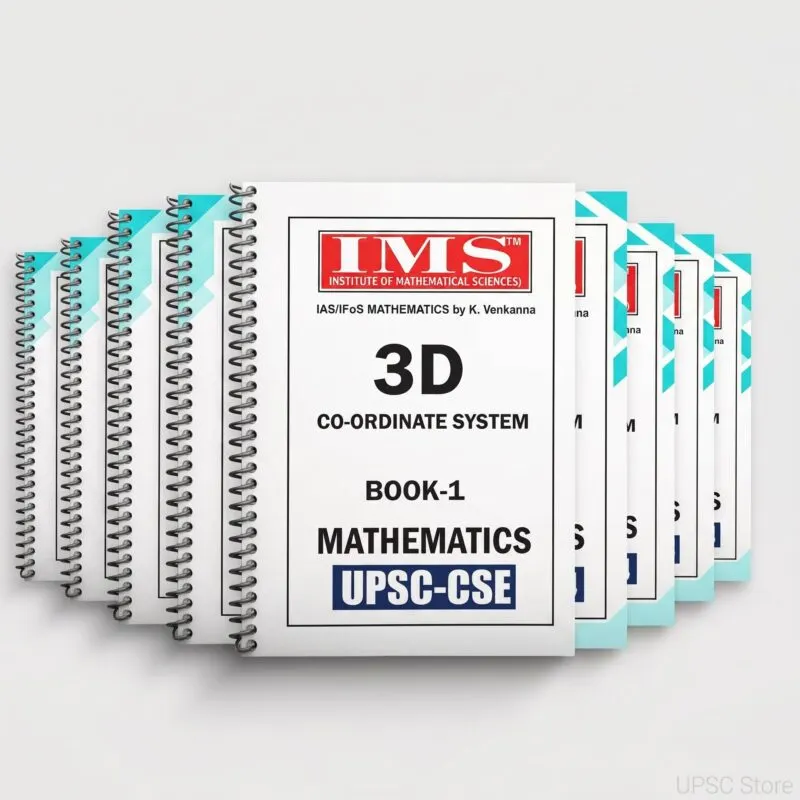
πŸ“˜ 20 Booklets
πŸ“š Mathematics Optional
πŸŽ“ IMS (Institute of Mathematical Sciences)
🏷️ Printed
πŸ‡¬πŸ‡§ English Medium
β‚Ή4,799
πŸŒ€ spiral βœ“
πŸ“˜ book-binding βœ“
Only 14 sets left
Selling fast (58 sold this week)
5% OFF Use UPSC5% (COD Available)
10% OFF Use UPI10 (UPI Only)
Secure Payment
Fast Delivery
Safe Packaging

About IMS Mathematics Optional Notes 2025-26

The IMS Mathematics Optional Notes 2025-26 is a printed UPSC study material set sold by UPSC Store β€” India’s trusted source for genuine, latest-batch civil services preparation books. This page covers full booklet details, syllabus coverage, pricing, shipping, and frequently asked questions. Useful for UPSC CSE, BPSC, UPPSC, MPPSC, RAS and other state PSC examinations.

IMS Mathematics Optional Notes 2025-26 by K. Venkanna β€” 20 English Medium Printed Booklets for UPSC Mains Optional Subject

Related: IMS notes Β· Mathematics optional

Product Overview

FeatureDetails
Booklets Count20 Individual Printed Booklets β€” Full UPSC Mathematics Optional Syllabus (Paper I + Paper II)
LanguageEnglish Medium
PublisherIMS β€” Institute of Mathematical Sciences (K. Venkanna Series)
Edition2025-26 β€” Latest Genuine Batch
ConditionBrand New, Unmarked, Fresh Stock
FormatHigh-Quality Printed Booklets β€” Spiral or Book Binding
Paper Quality75 GSM Ultra-White β€” Highlighter Safe, Zero Bleed-Through
ShippingPan India Delivery in 3-5 Business Days β€” Tracked
Also Useful ForBPSC, UPPSC, MPPSC, RAS, and all State PSC Mathematics Optional candidates

Complete Booklet Catalog

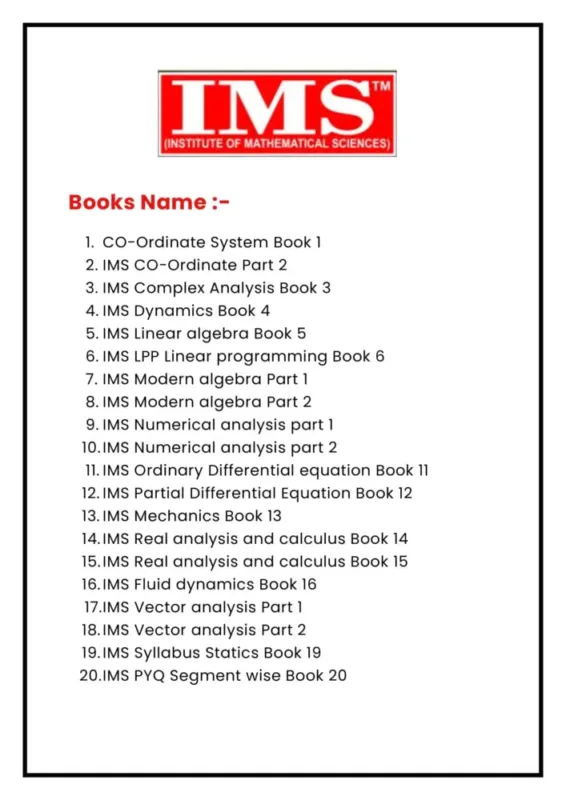
This 15-booklet set by K. Venkanna at IMS covers every topic in the UPSC Mathematics Optional syllabus β€” Paper I and Paper II β€” with topic-wise organisation ideal for both first-time learners and revision-stage aspirants. Each booklet targets a specific area of the syllabus, making it easy to pick up, study, and put down without losing context across subjects.

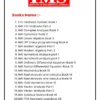
  • Booklet 1: 3D Co-Ordinate System β€” Three-dimensional geometry including direction cosines and direction ratios, equations of lines and planes in 3D space, shortest distance between skew lines, sphere, cone, cylinder, conicoids, central conicoids, and their reduction to standard forms. Fundamental for both UPSC CSE and IFoS Mathematics optional Paper I.
  • Booklet 2: Linear Algebra β€” Vector Spaces β€” Vector spaces over real and complex fields, subspaces, basis and dimension, linear transformations, rank-nullity theorem, matrix representation of linear transformations, change of basis, eigenvalues and eigenvectors, Cayley-Hamilton theorem, and canonical forms including Jordan and rational canonical forms.
  • Booklet 3: Linear Algebra β€” Matrices β€” Types of matrices, determinants, matrix operations, inverse of a matrix, systems of linear equations, consistency using rank conditions, Hermitian, skew-Hermitian and unitary matrices, orthogonal transformations, quadratic forms, reduction to canonical form using orthogonal transformations.
  • Booklet 4: Calculus β€” Differential Calculus β€” Limits and continuity, differentiability, mean value theorems (Rolle, Lagrange, Cauchy), Taylor and Maclaurin series, partial derivatives, total differentials, Jacobians, maxima and minima of functions of two or more variables, Lagrange multipliers method, and envelopes and evolutes.
  • Booklet 5: Calculus β€” Integral Calculus β€” Definite and indefinite integrals, techniques of integration, improper integrals, Beta and Gamma functions, double and triple integrals with change of order of integration, change of variables in multiple integrals, applications to area, volume and surface area, line integrals and surface integrals.
  • Booklet 6: Analytic Geometry β€” 2D β€” Cartesian and polar coordinates in two dimensions, shift of origin and rotation of axes, second-degree equations in two variables, classification of conics, tangents and normals to conics, chord of contact, pole and polar, conjugate diameters, asymptotes, pair of straight lines, and angle bisectors.
  • Booklet 7: Ordinary Differential Equations β€” First-order ODEs (variable separable, homogeneous, exact, integrating factor), Bernoulli equations, linear differential equations with constant coefficients, method of undetermined coefficients, method of variation of parameters, Cauchy-Euler equations, systems of ODEs, power series solutions, Frobenius method.
  • Booklet 8: Vector Analysis β€” Scalar and vector fields, gradient, divergence and curl and their physical interpretations, vector identities, line integrals, surface integrals and volume integrals, Green’s theorem, Stokes’ theorem and Gauss divergence theorem with proofs and applications to UPSC-level problems.
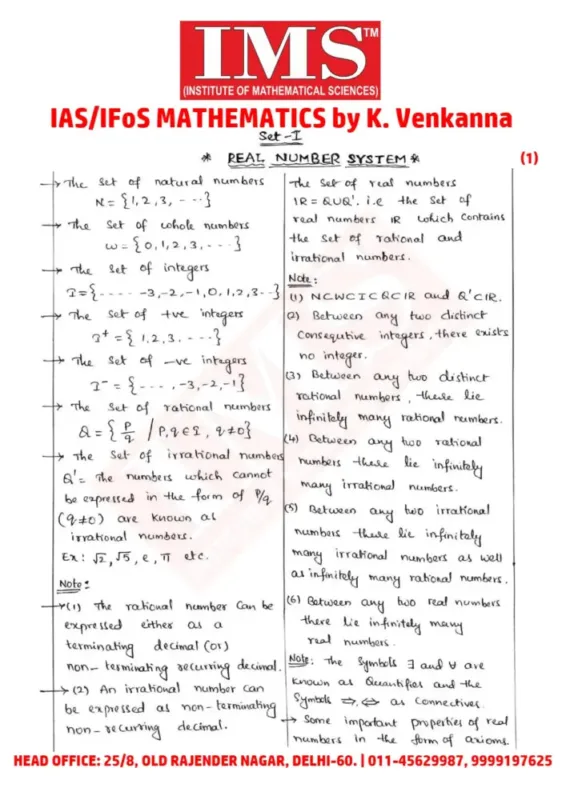
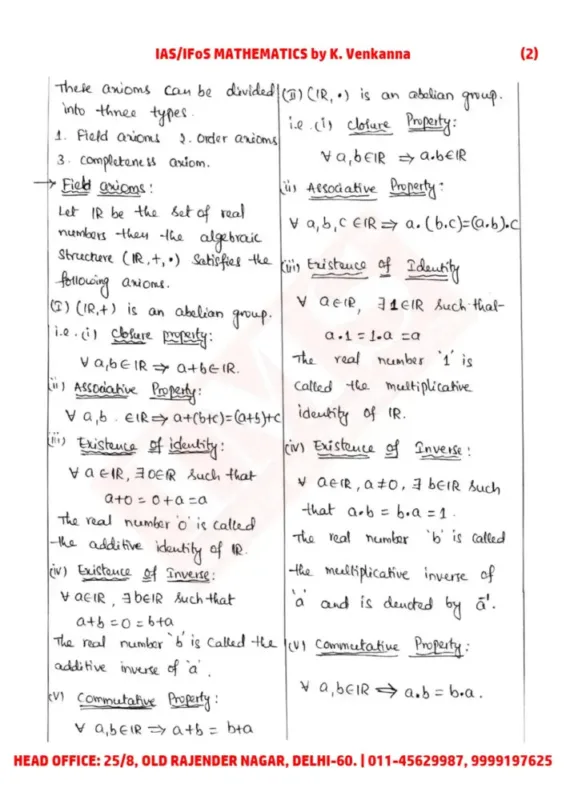
  • Booklet 9: Real Analysis β€” Sequences and Series β€” Real number system, supremum and infimum, sequences and their convergence, Cauchy sequences, series of real numbers, tests of convergence (comparison, ratio, root, Leibniz), absolute and conditional convergence, power series and radius of convergence, uniform convergence of sequences and series.
  • Booklet 10: Real Analysis β€” Functions and Metric Spaces β€” Continuity and uniform continuity on metric spaces, connectedness, compactness and completeness of metric spaces, Riemann integration, Riemann-Stieltjes integral, functions of bounded variation, improper Riemann integrals, and introduction to Lebesgue measure and integration.
  • Booklet 11: Complex Analysis β€” Analytic functions, Cauchy-Riemann equations, harmonic functions, complex integration, Cauchy’s theorem and Cauchy’s integral formula, power series representation, Taylor and Laurent series, classification of singularities, residue theorem, contour integration techniques, evaluation of real integrals using residues.
  • Booklet 12: Abstract Algebra β€” Groups β€” Groups, subgroups, cyclic groups, cosets, Lagrange’s theorem, normal subgroups, quotient groups, homomorphisms and isomorphisms, first, second and third isomorphism theorems, permutation groups, Cayley’s theorem, Sylow’s theorems and their applications to group structure.
  • Booklet 13: Abstract Algebra β€” Rings and Fields β€” Rings, integral domains, fields, ideals, quotient rings, ring homomorphisms, polynomial rings, irreducibility criteria, unique factorization domains, principal ideal domains, Euclidean domains, field extensions, algebraic elements, finite fields, and Galois theory fundamentals.
  • Booklet 14: Linear Programming β€” Formulation of linear programming problems, graphical method, simplex method, Big-M method, two-phase method, duality in linear programming, dual simplex method, sensitivity analysis, transportation problems, assignment problems, and integer programming basics relevant to UPSC Mathematics optional Paper II.
  • Booklet 15: Partial Differential Equations β€” Formation of PDEs, first-order PDEs (Lagrange and Charpit methods), Cauchy’s problem for first-order PDEs, second-order PDEs with constant and variable coefficients, classification into elliptic, parabolic and hyperbolic types, heat equation, wave equation, Laplace equation and their solutions.
  • Booklet 16: Numerical Analysis and Computer Programming β€” Numerical methods for solving algebraic and transcendental equations, interpolation (Newton forward and backward, Lagrange), numerical differentiation and integration, numerical solution of ODEs (Euler, Runge-Kutta methods), basics of computer programming relevant to UPSC IFoS Mathematics optional.
  • Booklet 17: Mechanics β€” Statics β€” Forces in a plane, resultant of coplanar forces, equilibrium of rigid bodies, moments and couples, friction (laws and applications), centre of gravity and centroid of plane figures and solids, virtual work principle, and applications of statics relevant to UPSC Mathematics optional and IFoS exam.
  • Booklet 18: Mechanics β€” Dynamics β€” Kinematics of a particle, Newton’s laws of motion, work, energy and power, conservation of energy and momentum, motion under central forces, Kepler’s laws, motion of a rigid body, moments of inertia, theorems of parallel and perpendicular axes, motion in two dimensions.
  • Booklet 19: Fluid Dynamics β€” Equation of continuity, Euler’s equations of motion, Bernoulli’s equation, irrotational motion, velocity potential, stream function, sources and sinks, doublets, method of images, vortex motion, Navier-Stokes equations and their applications, relevant to UPSC IFoS Mathematics optional Paper II.
  • Booklet 20: Statistics and Probability β€” Probability theory, random variables, probability distributions (Binomial, Poisson, Normal, Exponential), moments and moment generating functions, sampling theory, estimation (point and interval), testing of hypotheses, chi-square test, t-test, F-test, correlation and regression, and applications in UPSC Mains context.

In-Depth Content Breakdown: Booklet by Booklet

Booklet 1: 3D Co-Ordinate System

The foundation booklet of this IMS Mathematics optional series, Book 1 addresses the full three-dimensional geometry component of UPSC Paper I. Covered topics include direction cosines, direction ratios, the equation of a line and plane in three-dimensional Cartesian space, angle between intersecting planes, distance of a point from a plane, and the shortest distance between skew lines. These concepts appear directly in UPSC Mains Mathematics optional questions year after year and form the geometric backbone of later analytical topics.

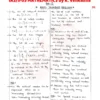
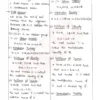
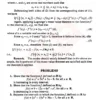
K. Venkanna’s teaching approach, reflected in this printed material, uses step-by-step derivations with fully worked UPSC-standard problems after every major concept. Diagrams showing 3D planes, intercepts, and surface cross-sections are printed with laser clarity. The booklet also covers sphere, cone, cylinder, paraboloid, ellipsoid, and hyperboloid with standard form derivations and parametric representations β€” directly mapped to UPSC CSE and IFoS Mathematics optional syllabi. An ideal starting point for candidates building their optional from scratch.

Booklet 2: Linear Algebra β€” Vector Spaces

Linear Algebra is one of the highest-scoring areas in UPSC Mathematics optional Paper I, and this booklet addresses its abstract foundations with exceptional clarity. Topics include vector spaces over real and complex fields, linear dependence and independence, spanning sets, basis and dimension theorems, linear transformations and their matrix representations, range and kernel, and the rank-nullity theorem. Every theorem is stated precisely, followed by a proof and then a worked example at UPSC Mains answer-writing level.

The second half of the booklet covers eigenvalues, eigenvectors, characteristic polynomials, the Cayley-Hamilton theorem, diagonalisation conditions, and canonical forms including Jordan canonical form. Abstract concepts are grounded through numerical examples that mirror actual UPSC previous year question patterns. Tables comparing properties of different types of transformations and matrices make this an excellent quick-revision resource. Aspirants who buy this booklet gain one of the clearest printed treatments of linear algebra available for UPSC preparation in English medium.

Booklet 3: Linear Algebra β€” Matrices

Building directly on the vector spaces booklet, this module covers the computational and structural aspects of matrices as tested in UPSC Mathematics optional. Topics include matrix algebra, determinants with properties and Sarrus rule, adjugate and inverse matrices, systems of linear equations and consistency conditions using rank, row echelon and reduced row echelon forms, and the theory behind Gaussian elimination. Special matrix types β€” symmetric, skew-symmetric, Hermitian, skew-Hermitian, orthogonal and unitary β€” are covered with proofs of their key properties.

Quadratic forms receive particular attention since they are a consistent UPSC Mains question area. The booklet covers positive definiteness, signature, index, reduction to canonical form using congruent transformations and orthogonal transformations, and Sylvester’s law of inertia. UPSC-pattern practice problems follow each section, and answer frameworks suitable for 15-mark Mains questions are modelled throughout. This is essential material for anyone wanting to buy a complete printed Mathematics optional set for 2025-26.

Booklet 4: Calculus β€” Differential Calculus

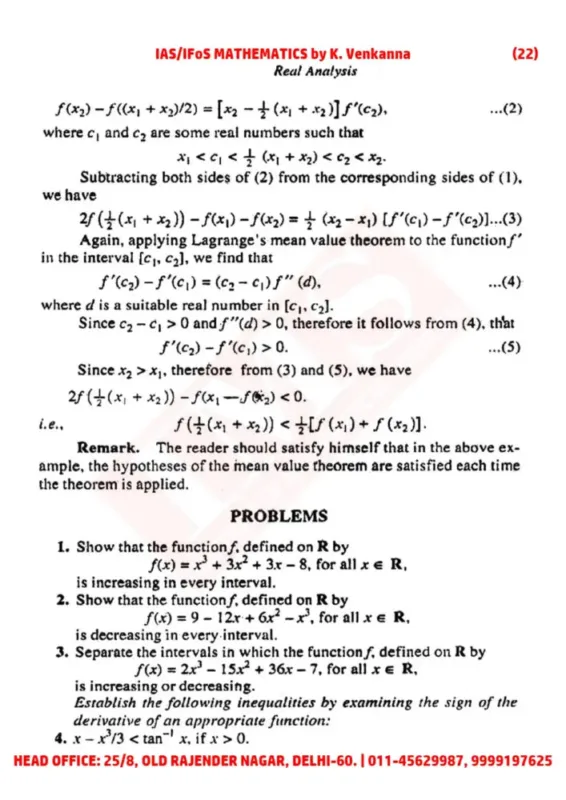
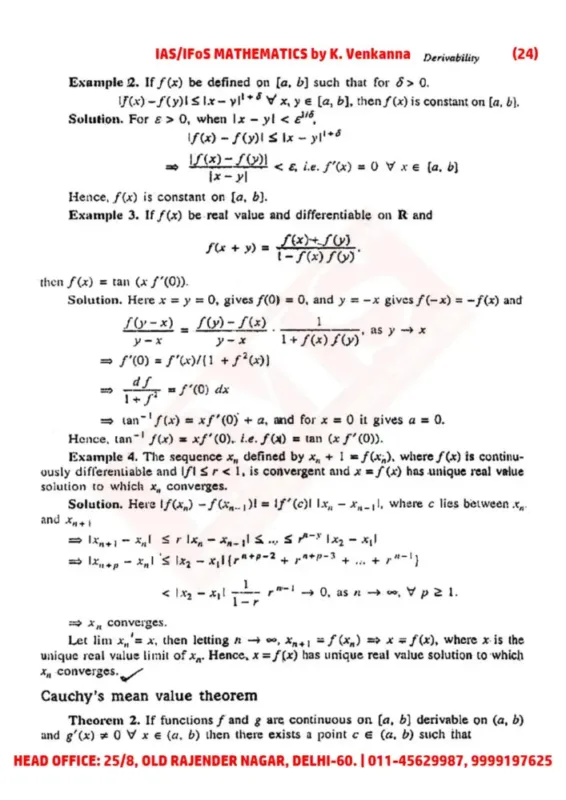
Differential calculus forms the analytical core of UPSC Mathematics optional Paper I, and this booklet covers it with the rigour expected at Mains level. From epsilon-delta definitions of limits through continuity and uniform continuity, differentiability, Rolle’s theorem, Lagrange’s mean value theorem, and Cauchy’s mean value theorem β€” every result is proved and then applied. Taylor’s series and Maclaurin’s series with remainder forms are covered with convergence analysis, followed by indeterminate forms and L’HΓ΄pital’s rule.

Multivariable calculus topics β€” partial derivatives, higher-order partial derivatives, Euler’s theorem on homogeneous functions, total differentials, and Jacobians β€” are covered in the second half. Maxima and minima of functions of two variables using the second derivative test and Lagrange’s method of undetermined multipliers are illustrated through exam-style problems. Envelopes, evolutes, and asymptotes round out the booklet. Candidates who buy these printed IMS notes save months of cross-referencing multiple textbooks for these scattered topics.

Booklet 5: Calculus β€” Integral Calculus

Integral calculus at the UPSC Mathematics optional level demands both computational accuracy and theoretical understanding, and this booklet addresses both. Standard techniques β€” substitution, integration by parts, partial fractions, trigonometric substitutions β€” are covered alongside reduction formulae. Definite integrals with properties, improper integrals with convergence tests, and Beta-Gamma functions with their interrelation are thoroughly treated with multiple worked examples graded in difficulty from basic to UPSC Mains standard.

Double and triple integrals are introduced with Fubini’s theorem and then practiced through change of order of integration and change of variables using Jacobians. Applications to area between curves, volume of solids of revolution, surface area, and arc length are illustrated with geometry-linked diagrams that aid visualisation. Line integrals evaluated as single integrals along parameterised curves, and surface integrals using projection methods, prepare aspirants directly for the Vector Analysis booklet that follows in the IMS Mathematics optional series.

Booklet 6: Analytic Geometry β€” 2D

Two-dimensional analytic geometry is a direct scoring opportunity in UPSC Mathematics optional Paper I, and this booklet equips aspirants with both classical and coordinate geometry techniques. The transformation of axes β€” translation, rotation, and their combinations β€” is covered first, followed by second-degree equations and their classification into circle, parabola, ellipse, and hyperbola using discriminant conditions. Standard forms and their properties, including focus-directrix definitions and eccentricity, are thoroughly derived and tabulated for quick revision.

The booklet then moves into projective and advanced properties: tangents and normals, chord of contact, pole and polar with respect to conics, conjugate diameters, asymptotes of hyperbola, rectangular hyperbola, and pair of straight lines. Angle between lines given by a homogeneous second-degree equation and condition for perpendicularity and parallelism are worked through with exam-style answers. This booklet is especially valuable for IFoS Mathematics optional candidates where 2D geometry questions carry direct marks. Every section has UPSC previous year pattern problems with model solutions.

Booklet 7: Ordinary Differential Equations

ODEs constitute one of the most directly applicable and consistently examined topics in UPSC Mathematics optional Paper I, and this booklet provides a treatment that matches the depth required. First-order equations are covered through variable separable, homogeneous substitution, exact equations with integrating factor techniques, Bernoulli equations, and Clairaut’s equations. Geometric applications β€” orthogonal trajectories and isogonal trajectories β€” are covered with worked diagrams. Each method is illustrated with three to five progressively complex problems.

Higher-order linear differential equations with constant coefficients are covered using the complementary function and particular integral approach, including all standard rules for exponential, polynomial, trigonometric, and product forcing functions. Variation of parameters and the Cauchy-Euler equation receive dedicated treatment. Series solutions around ordinary and regular singular points using the Frobenius method, along with Legendre polynomials and Bessel functions as special solutions, are introduced as required by the UPSC syllabus. This booklet alone covers an entire sub-section of the optional paper worth 40-60 marks.

Booklet 8: Vector Analysis

Vector analysis bridges the gap between multivariable calculus and the physical applications tested in UPSC Mathematics optional Paper I. This booklet opens with scalar and vector fields, gradient of a scalar field and its geometric interpretation as the direction of steepest ascent, divergence of a vector field as a measure of source density, and curl as a measure of rotation. Vector identities are listed, proved, and applied in the context of irrotational and solenoidal fields β€” concepts that also appear in Fluid Dynamics in Paper II.

The three major integral theorems β€” Green’s theorem in the plane, Stokes’ theorem relating line and surface integrals, and Gauss’s divergence theorem relating surface and volume integrals β€” are each stated, proved rigorously, and then applied to UPSC-pattern problems. The booklet includes diagrams of surfaces, bounded regions, and oriented curves to build geometric intuition. Physical interpretations relevant to Mechanics and Fluid Dynamics are noted where appropriate. Candidates who buy this printed booklet avoid the fragmented treatment found in standard reference textbooks.

Booklet 9: Real Analysis β€” Sequences and Series

Real Analysis is often considered the most rigorous component of UPSC Mathematics optional Paper II, and this booklet builds the foundations carefully. It opens with the structure of real numbers β€” completeness axiom, supremum and infimum, Archimedean property, and density of rationals β€” before moving into sequences, convergence definitions with epsilon-N proofs, monotone convergence theorem, Cauchy criterion, and subsequences. The booklet uses a definition-theorem-proof-example structure that mirrors the expected answer format in UPSC Mains.

Series of real numbers are covered with all standard convergence tests: comparison test, limit comparison test, ratio test (D’Alembert), root test (Cauchy), integral test, and Leibniz alternating series test with error bounds. Absolute and conditional convergence are distinguished with counterexamples. Power series β€” radius of convergence, interval of convergence, term-by-term differentiation and integration β€” conclude the booklet. Uniform convergence of sequences and series with Weierstrass M-test is treated as a precursor to the analysis of functions covered in Booklet 10. This is essential printed material for UPSC aspirants targeting Real Analysis marks.

Booklet 10: Real Analysis β€” Functions and Metric Spaces

Building on Booklet 9, this module moves into the topology and measure-theoretic aspects of real analysis tested at UPSC level. Metric spaces are introduced with examples, open and closed sets, interior and boundary points, completeness (Cauchy sequences in metric spaces), compactness (sequential and covering definitions), and connectedness. Continuous functions on compact and connected metric spaces with their preservation properties are proved and illustrated. Uniform continuity and the distinction between pointwise and uniform convergence of function sequences are treated with precision.

The Riemann integral is constructed via upper and lower Darboux sums, with the Riemann condition for integrability, integrability of continuous and monotone functions, and the fundamental theorem of calculus. Riemann-Stieltjes integration extends this framework with applications. Functions of bounded variation are covered with Jordan’s decomposition theorem. The booklet closes with an accessible introduction to Lebesgue measure, measurable sets, and the Lebesgue integral in comparison to the Riemann integral β€” a topic appearing in recent UPSC optional papers. A must-buy booklet for aspirants targeting 40+ marks in Paper II Real Analysis.

Booklet 11: Complex Analysis

Complex Analysis is a high-yield area of UPSC Mathematics optional Paper II, consistently delivering direct questions that reward structured answers. This booklet begins with the algebra and geometry of complex numbers, moves into analytic functions, Cauchy-Riemann equations in Cartesian and polar forms, and harmonic functions with harmonic conjugates. Conformal mappings and MΓΆbius transformations are introduced with diagrams showing how regions in the complex plane are mapped under standard functions like exponential, logarithm, and trigonometric functions.

Complex integration is developed from parametric curve integrals through Cauchy’s theorem (for simply and multiply connected regions), Cauchy’s integral formula, and higher-derivative formulae. Taylor and Laurent series with annular convergence, classification of isolated singularities β€” removable, poles, and essential β€” and the residue theorem with its computation techniques are covered in depth. Contour integration techniques for evaluating real integrals β€” rational functions over the real line, trigonometric integrals, and integrals involving branch cuts β€” are illustrated with step-by-step worked problems matching UPSC Mains question styles exactly.

Booklet 12: Abstract Algebra β€” Groups

Group Theory is a conceptually demanding but ultimately scoring component of UPSC Mathematics optional Paper II, and this booklet makes it accessible without sacrificing mathematical rigour. Groups are introduced from scratch β€” binary operations, closure, associativity, identity, and inverse β€” followed by abelian groups, finite and infinite groups, and order of a group and its elements. Subgroups, cyclic subgroups generated by an element, and the full classification of cyclic groups are proved with examples drawn from integers, modular arithmetic, and matrix groups.

Cosets and Lagrange’s theorem lead into normal subgroups, quotient groups, and the first, second, and third isomorphism theorems β€” all proved and illustrated. Permutation groups (symmetric group S_n, alternating group A_n), even and odd permutations, and Cayley’s theorem that every group is isomorphic to a permutation group are covered. The Sylow theorems β€” first, second, and third β€” with applications to determining group structure for small orders round out the booklet. UPSC previous year questions on group theory are solved in full at the end of each chapter.

Booklet 13: Abstract Algebra β€” Rings and Fields

Continuing from Group Theory, this booklet develops the theory of rings, integral domains, and fields as required for UPSC Mathematics optional Paper II. Rings are defined with examples including Z, Q, polynomial rings, and matrix rings. Properties of rings, subrings, ring homomorphisms, and the correspondence between ideals and quotient rings are developed systematically. Maximal and prime ideals are characterised with examples, and the relationship between them and field and integral domain structures is established through theorems with full proofs.

Polynomial rings receive detailed attention β€” division algorithm, irreducibility tests (Eisenstein criterion, reduction modulo p), unique factorisation in polynomial rings over fields, and relationship between roots and factors. The hierarchy of ring structures β€” Euclidean domains, principal ideal domains, and unique factorisation domains β€” is presented with examples and counter-examples at each level. Field extensions, algebraic and transcendental elements, degree of extension, splitting fields, and finite fields GF(p^n) are introduced at the level required by the UPSC Mathematics optional syllabus. This is a buy-worthy booklet for aspirants tackling algebra questions.

Booklet 14: Linear Programming

Linear Programming forms a self-contained scoring section of UPSC Mathematics optional Paper II and this booklet covers every method tested in the exam. LPP formulation from word problems, solution by graphical method for two-variable problems, standard form and canonical form transformations, the simplex algorithm with pivot selection rules, Big-M method and two-phase simplex for artificial variables are all developed with fully worked numerical examples. The booklet also covers degenerate cases, unboundedness, and infeasibility detection during the simplex process.

Duality theory β€” formation of the dual problem, weak and strong duality theorems, complementary slackness conditions, and economic interpretation of dual variables β€” is given UPSC-answer-level treatment. The dual simplex method, post-optimality sensitivity analysis for objective function coefficients and right-hand-side constants, and parametric programming are covered. Transportation problems (NWCM, LCM, VAM for initial BFS; MODI method for optimality) and the assignment problem (Hungarian method) are worked through with tabular step-by-step solutions matching UPSC Mains marking expectations exactly.

Booklet 15: Partial Differential Equations

Partial Differential Equations represent a direct link between UPSC Mathematics optional theory and physical applications, making them a high-mark section in Paper II. This booklet opens with formation of PDEs by elimination of arbitrary functions and constants, first-order PDEs, and the geometric interpretation of solutions as surfaces. Lagrange’s method for first-order linear PDEs, Charpit’s method for non-linear first-order PDEs, and the Cauchy problem for first-order equations are all treated with worked examples at UPSC standard.

Second-order PDEs are classified into elliptic (Laplace equation), parabolic (heat equation), and hyperbolic (wave equation) types using the discriminant of the principal part. Canonical forms for each type are derived and the method of characteristics is applied to hyperbolic equations. Solutions of the heat equation and wave equation using separation of variables and Fourier series expansions are worked through completely, including boundary and initial condition applications. The Laplace equation in rectangular, polar, and spherical coordinates with potential theory applications closes the booklet β€” directly relevant to both UPSC CSE and IFoS Mathematics optional Paper II.

Booklet 16: Numerical Analysis and Computer Programming

Numerical Analysis in UPSC Mathematics optional Paper II tests both the underlying theory of numerical methods and their step-by-step application. This booklet covers root-finding methods β€” bisection, secant, Newton-Raphson, and their convergence order analysis β€” followed by interpolation theory: finite differences (forward, backward, central), Newton’s interpolation formulae, Lagrange’s interpolation, and divided differences with Newton’s divided difference formula. Numerical differentiation using difference operators and Richardson extrapolation is treated with error bounds.

Numerical integration covers the trapezoidal rule, Simpson’s one-third and three-eighth rules, Weddle’s rule, and Gaussian quadrature, each with error formulae. Numerical solution of ODEs uses Euler’s method, modified Euler’s method, and the classic fourth-order Runge-Kutta method, with worked examples tracking truncation and round-off errors. The computer programming component introduces basic algorithms, flowcharts, and programming logic relevant to UPSC IFoS Mathematics optional requirements. All numerical worked examples carry five-digit precision matching the level of accuracy expected in UPSC Mains answers.

Booklet 17: Mechanics β€” Statics

Statics forms the first half of the Mechanics component of UPSC Mathematics optional Paper II and this booklet covers it with a balance of theory and problem-solving. Forces in a plane β€” resultant by parallelogram and triangle of forces, Lami’s theorem, resolution of forces along and perpendicular to an inclined plane β€” are introduced and applied. Moments and couples with their resultant, conditions of equilibrium for concurrent and non-concurrent coplanar force systems, and analytical and graphical methods for determining equilibrium are all covered with diagrams and worked problems.

Friction receives a full treatment: laws of dry friction, angle of friction, cone of friction, equilibrium on a rough inclined plane, and applications to wedges, ladders, and belt friction. Centre of gravity and centroid calculations for standard plane figures and composite solids are tabulated and derived. The principle of virtual work β€” statement, proof, and applications to pin-jointed frameworks β€” closes the statics section. Detailed diagrams accompany every problem type, and model UPSC Mains answers of 200-250 words length are provided for representative questions from previous years.

Booklet 18: Mechanics β€” Dynamics

Dynamics extends Mechanics into the study of motion, and this booklet covers kinematics and kinetics at the depth required for UPSC Mathematics optional Paper II. Rectilinear motion, velocity and acceleration in Cartesian and polar coordinates, projectile motion with and without air resistance, and circular motion with normal and tangential acceleration components are treated analytically. Newton’s laws are applied to produce and solve equations of motion for particles under various force systems including constant, variable, and resisting forces.

Work-energy theorem, impulse-momentum theorem, conservation of energy and linear momentum, coefficient of restitution in direct and oblique impacts, and motion under central forces are all given dedicated worked examples. Kepler’s laws of planetary motion are derived from the central force equation. Rigid body dynamics covers moment of inertia by direct integration and via parallel and perpendicular axes theorems, moment of inertia of standard bodies, angular momentum, torque, and equations of motion for rotating rigid bodies. Two-dimensional problems in rigid body mechanics are solved using both energy and force-moment approaches.

Booklet 19: Fluid Dynamics

Fluid Dynamics appears in UPSC Mathematics optional Paper II and IFoS Mathematics optional and this booklet addresses it at the analytical level required. Kinematics of fluid flow β€” velocity field, streamlines, pathlines, streaklines, steady and unsteady flow, rotational and irrotational flow β€” is introduced first. The equation of continuity in Cartesian and cylindrical coordinates is derived from first principles. Euler’s equations of motion for an inviscid fluid in both differential and integral form are derived, followed by Bernoulli’s equation and its applications to flow measurement devices.

Irrotational motion is analysed through the velocity potential function and stream function, with the Cauchy-Riemann equations providing the link to complex analysis from Booklet 11. Sources, sinks, doublets, and uniform flow are combined using the principle of superposition to model flows around obstacles. Vortex motion and circulation with Kelvin’s circulation theorem are covered. Viscous flow is introduced through the Navier-Stokes equations with exact solutions for Poiseuille flow and Couette flow, completing the fluid dynamics syllabus for both UPSC CSE and IFoS Mathematics optional candidates.

Booklet 20: Statistics and Probability

Probability and Statistics form the final examined component of UPSC Mathematics optional Paper II, and this booklet provides a rigorous yet accessible treatment. Probability theory is built from axiomatic foundations β€” sample spaces, events, probability measure, conditional probability, Bayes’ theorem, and independence. Discrete and continuous random variables, probability mass functions and probability density functions, cumulative distribution functions, and expectation and variance with their properties are covered before introducing standard distributions: Binomial, Poisson, Geometric, Hypergeometric, Uniform, Normal, Exponential, and Gamma.

Moment generating functions and their use in identifying distributions and deriving moments are worked through for each standard distribution. Sampling distributions β€” chi-square, Student’s t, and Snedecor’s F β€” are introduced with their genesis from normal samples. Point estimation (method of moments, MLE), interval estimation, and hypothesis testing theory (Type I and Type II errors, level of significance, power of a test) are covered with standard test procedures. Correlation and regression analysis β€” product moment coefficient, Spearman’s rank correlation, simple linear regression, and least squares estimation β€” close the booklet and the full 15-booklet IMS Mathematics optional series.

Physical Construction and Quality Standards

Every booklet in the IMS Mathematics optional 2025-26 set is manufactured to withstand the intensive, multi-session use that UPSC preparation demands β€” from first reading through multiple rounds of revision over a 12 to 18-month preparation cycle.

Paper Quality: 75 GSM Anti-Glare White Paper

The 75 GSM ultra-white paper used across all 15 Booklets is selected for its high opacity, which prevents text on the reverse side from showing through during reading or highlighting. Multiple highlighter colours β€” yellow, green, orange, pink β€” and gel pen annotations do not bleed to the back of the page, allowing students to colour-code revision notes without damaging content on the other side. The anti-glare finish reduces eye strain during 6 to 8 hour study sessions typical of intensive UPSC optional preparation, making it noticeably more comfortable than standard photocopy-grade paper used by competing materials in the market.

Printing Technology: High-Resolution Laser Printing

All 15 Booklets are printed using high-resolution laser technology, which delivers sharp, clearly defined mathematical symbols, equations, matrices, integrals, and geometric diagrams at a level of clarity that is critical for a subject like Mathematics optional. Fractions, subscripts, superscripts, Greek letters, and multi-line equations are rendered without pixellation or blurring even at small font sizes. The permanent toner used in laser printing is smudge-proof and moisture-resistant, ensuring that diagrams of 3D surfaces, flow lines, geometric constructions, and complex plane mappings remain legible throughout the preparation period without fading or smearing under heavy handling.

Binding and Durability

The booklets are available in spiral binding or book binding depending on stock. Spiral-bound booklets open completely flat on a desk, allowing students to write margin notes directly alongside printed content without the book springing back β€” a significant advantage during active problem-solving sessions. Book-bound editions have a 300 GSM laminated cover that protects the interior pages through months of daily use in coaching centres, libraries, and at-home study desks. Both binding styles use reinforced spine attachment so individual pages do not detach under the stress of repeated opening at the same spread over many revision rounds.

Key Features and Study Design

These IMS Mathematics optional notes are structured around the specific demands of UPSC Mains β€” where optional subject preparation must achieve both speed and precision under exam conditions β€” and reflect K. Venkanna’s decades of experience teaching Mathematics optional at IMS Delhi.

  • Complete UPSC Syllabus Coverage in 20 Modules: All 15 Booklets together cover every single topic in both UPSC Mathematics optional Paper I and Paper II as specified in the official UPSC syllabus notification, leaving no gap that would require a supplementary textbook during preparation.
  • Topic-Wise Modular Design for Targeted Preparation: Because each booklet covers a single topic area, aspirants can pick up Paper I Booklet 7 (ODEs) for a focused session without carrying all 15 Booklets, making library and coaching centre study far more practical than using a thick omnibus textbook.
  • Theorem-Proof-Problem Structure in Every Chapter: Each chapter follows a rigorous sequence of formal statement, full proof, worked example at UPSC difficulty, and then practice problems graded from moderate to Mains-level difficulty β€” training both mathematical thinking and answer-writing simultaneously.
  • Previous Year UPSC Question Integration: Relevant UPSC and IFoS Mathematics optional previous year questions are integrated at the close of major topics with model answers written at the length and format expected in UPSC Mains β€” giving aspirants a benchmark for their own answer writing quality before the exam.
  • Faculty-Level Insight from K. Venkanna, IMS: The content reflects the teaching judgement of K. Venkanna, one of India’s most recognised Mathematics optional faculty members, in identifying which proofs, which problem types, and which conceptual links between topics most directly produce marks in the UPSC optional paper β€” insight that generic textbooks cannot replicate.

Shipping, Packaging and Delivery

All 15 Booklets in this IMS Mathematics optional 2025-26 set are shipped together as a single consolidated order. Before dispatch, each booklet is individually wrapped in protective shrink-wrap to prevent surface abrasion. The complete set is then packed in a rigid corrugated cardboard box with foam edge protectors at all six faces to absorb transit impact. A moisture-resistant inner liner prevents water or humidity damage during last-mile delivery in all weather conditions. The outer box is sealed with reinforced packing tape and labelled with fragile-handling instructions to reduce the probability of damage during courier sorting and transit.

Orders are dispatched within 1-2 business days of payment confirmation and reach customers across India within 3-5 business days via tracked courier. A tracking ID is sent by WhatsApp and email on the day of dispatch. For any query about your order β€” including delayed delivery, missing booklets, or damaged copies β€” contact the store directly on WhatsApp at +91 70045 49563. Any missing or damaged booklet from your set will be replaced and re-dispatched within 48 hours of the issue being reported, at no additional cost to the buyer.

Frequently Asked Questions (FAQ)

Q1: Is IMS Mathematics optional notes good for UPSC preparation?

A: Yes. IMS (Institute of Mathematical Sciences) and K. Venkanna have a long-standing reputation for Mathematics optional coaching in Delhi’s Mukherjee Nagar corridor. These notes are used by successful UPSC Mains candidates each year. The content follows a theorem-proof-problem format designed specifically for the UPSC exam β€” not for undergraduate exams β€” which makes the approach significantly more targeted than standard university textbooks. Aspirants from across India buy these printed notes to access faculty-level content without attending offline classes in Delhi.

Q2: How many booklets are included in IMS Mathematics optional notes 2025-26?

A: The 2025-26 edition contains 20 printed booklets covering the full UPSC Mathematics optional syllabus across Paper I and Paper II. Each booklet is dedicated to a specific topic area β€” from 3D Co-Ordinate System (Booklet 1) through Linear Algebra, Calculus, Differential Equations, Real and Complex Analysis, Abstract Algebra, Linear Programming, PDEs, Numerical Analysis, Mechanics, Fluid Dynamics, and Statistics. All 15 Booklets are shipped together in a single package, tracked pan India.

Q3: Are IMS Mathematics optional notes available in English medium?

A: Yes. This 15-booklet set is entirely in English medium, as Mathematics optional at UPSC is predominantly answered in English by most aspirants. All theorems, proofs, worked examples, and practice problems are written in English. The mathematical notation follows standard international conventions. There is no Hindi medium version of this specific IMS K. Venkanna Mathematics optional series β€” making this English medium set the standard product for aspirants who write their UPSC optional paper in English.

Q4: What topics are covered in IMS Mathematics optional UPSC notes?

A: The 15-booklet set covers every topic prescribed in the UPSC Mathematics optional syllabus. Paper I topics include Linear Algebra, Calculus, Analytic Geometry (2D and 3D), Ordinary Differential Equations, Dynamics and Statics, and Vector Analysis. Paper II topics include Algebra (Groups, Rings, Fields), Real Analysis, Complex Analysis, Linear Programming, Partial Differential Equations, Numerical Analysis and Computer Programming, Mechanics, Fluid Dynamics, and Statistics and Probability. No supplementary textbook is required alongside this set for syllabus coverage.

Q5: How do IMS Mathematics optional notes compare to other institutes?

A: IMS K. Venkanna notes are widely regarded among UPSC Mathematics optional aspirants for their mathematical rigour and UPSC-specific answer framing, particularly in areas like Real Analysis, Complex Analysis, and Abstract Algebra where generic coaching notes often lack depth. Compared to other available printed materials, these booklets provide full proofs rather than just statements, integrate UPSC previous year questions at topic endings, and maintain consistent quality across all 15 Booklets. For aspirants who buy printed Mathematics optional material, IMS remains one of the most frequently recommended choices.

Q6: Can I buy IMS Mathematics optional notes without joining coaching?

A: Absolutely. This store sells the complete 15-booklet set as printed material for direct delivery to your address anywhere in India. You do not need to enrol in any classroom program or online course to buy these notes. Many UPSC aspirants based outside Delhi β€” including those in Tier 2 and Tier 3 cities β€” rely on buying high-quality printed notes like this set for self-study preparation. The booklets are self-contained with worked examples and practice problems, making independent study fully viable with these notes.

Q7: Are IMS Mathematics optional notes updated for UPSC 2025-26 syllabus?

A: Yes. This is the 2025-26 edition, freshly printed and dispatched from current stock. The UPSC Mathematics optional syllabus has been stable for several years, and these notes are aligned with the current official UPSC syllabus for Mathematics optional Paper I and Paper II as well as IFoS Mathematics optional. Content updates by K. Venkanna at IMS are incorporated into each new session’s batch, and the 2025-26 edition reflects those latest revisions, making it the appropriate material for candidates appearing in UPSC Mains 2025 or 2026.

Q8: What is the paper quality? Can I use a highlighter?

A: These booklets use 75 GSM ultra-white paper chosen for high opacity β€” multiple highlighter colors and gel pens work without bleed-through to the reverse side, ideal for color-coded revision. The anti-glare surface also reduces eye fatigue during extended daily study sessions of 6 to 8 hours that UPSC Mathematics optional preparation typically demands. Mathematical equations, matrix arrays, integral expressions, and geometric diagrams remain clearly legible even after repeated highlighting passes over the same content during revision cycles.

Q9: How long will delivery take after I place my order?

A: Orders are dispatched within 1-2 business days of payment confirmation. Pan India delivery is completed within 3-5 business days from dispatch. A tracking ID is sent via WhatsApp and email on the day of dispatch so you can monitor the courier progress in real time. For remote locations in the Northeast, Jammu and Kashmir, Ladakh, and Andaman and Nicobar Islands, delivery may take up to 7 business days. Contact the store on WhatsApp at +91 70045 49563 for specific queries about your delivery timeline before or after purchase.

Q10: Is this the complete set for both UPSC Mathematics optional Paper I and Paper II?

A: Yes. The 15-booklet set is designed to cover the full Mathematics optional syllabus across both Paper I and Paper II as tested in UPSC Civil Services Mains and IFoS Mains. Booklets 1 through approximately 9 address Paper I topics (Geometry, Linear Algebra, Calculus, ODEs, Vector Analysis), while Booklets 10 through 20 address Paper II topics (Real Analysis, Complex Analysis, Algebra, LP, PDEs, Numerical Analysis, Mechanics, Fluid Dynamics, Statistics). The exact Paper I and Paper II split is noted on each booklet’s cover for easy reference.

Q11: Are these notes useful for IFoS (Indian Forest Service) Mathematics optional as well?

A: Yes. IFoS Mathematics optional paper has significant overlap with UPSC CSE Mathematics optional syllabus, particularly in Linear Algebra, Calculus, Differential Equations, Mechanics, Fluid Dynamics, and Statistics. K. Venkanna’s IMS notes explicitly reference IFoS relevance in applicable booklets. Aspirants preparing for both UPSC CSE and IFoS simultaneously β€” a common strategy since both exams share the preliminary stage β€” will find this 15-booklet set valuable for covering both optional papers without requiring separate study material purchases for each exam.

Q12: What should I do if a booklet is missing or damaged after delivery?

A: Immediately contact the store on WhatsApp at +91 70045 49563 with a photograph of the package and its contents. Any missing booklet or booklet damaged in transit will be identified, repacked, and re-dispatched within 48 hours of your report being received and verified, at no additional charge. The store maintains fresh stock of all 15 Booklets to enable rapid replacement fulfilment. All packages are tracked, so the courier status can also be jointly reviewed to resolve delivery discrepancies quickly.

Summary

SpecificationValue
Booklets20 Printed Booklets
LanguageEnglish Medium
FacultyK. Venkanna β€” IMS (Institute of Mathematical Sciences)
Edition2025-26 Latest Batch
Paper75 GSM Ultra-White
BindingSpiral or Book Binding
Delivery3-5 Business Days Pan India
Also Useful ForBPSC, UPPSC, MPPSC, RAS and all State PSC Mathematics Optional

Sold by UPSC Store, Mukherjee Nagar, Delhi β€” India’s trusted source for printed UPSC optional subject notes. Buy online and receive your complete IMS Mathematics optional 2025-26 set with pan India delivery in 3-5 days.

Reference: UPSC official syllabus

Customer Reviews 114

4.5
Based on 114 reviews
5β˜…
68
4β˜…
34
3β˜…
12
2β˜…
0
1β˜…
0
A
Arjun Nambiar
25 Apr 2026
βœ“ Verified

Notes are comprehensive aur preparation ke liye bilkul perfect.

M
Megha Singh
21 Apr 2026
βœ“ Verified

Padhte padhte samajh aa jata hai sab kuch. Recommended to all math optional students.

R
Rohit Gupta
13 Apr 2026
βœ“ Verified

Impressed with the content and printing quality overall.

A
Aditya Mishra
10 Apr 2026
βœ“ Verified

Best study material for maths optional. Content badiya hai!

M
Mohit Kapoor
08 Apr 2026
βœ“ Verified

Bohot helpful notes, maths optional clear ho raha hai.

N
Neha Gupta
06 Apr 2026
βœ“ Verified

Sab concepts clearly explain hai. Bohat helpful for UPSC prep.

N
Nikhil Yadav
05 Apr 2026
βœ“ Verified

Notes detailed hain aur helpful bhi. Bas packaging thoda improve ho sakta tha.

S
Sanjay Verma
31 Mar 2026
βœ“ Verified

IMS ne accha kaam kiya hai notes banate hue.

About IMS Mathematics Optional Notes 2025-26

IMS Mathematics Optional Notes 2025-26 is a highly recommended UPSC study material from IMS (Institute of Mathematical Sciences), specially designed for Mathematics Optional preparation. Available in English medium, this material is crafted to match the exact requirements of the UPSC Civil Services Examination syllabus β€” covering both Prelims and Mains comprehensively.

Product Details

  • Institute: IMS (Institute of Mathematical Sciences)
  • Subject: Mathematics Optional
  • Medium: English
  • Format: Printed
  • Delivery: Pan-India delivery in 3–5 working days
  • Format: Original printed material, verified authentic

Why Buy from UPSC Store?

  • βœ… 100% Genuine Printed Material β€” Original printed notes, no photocopies or fake copies
  • βœ… Fast Delivery β€” Ships within 24 hours, arrives in 3–5 days pan-India
  • βœ… Secure Packaging β€” Bubble-wrapped and boxed to prevent damage in transit
  • βœ… Trusted by 10,000+ Aspirants β€” India's most reliable UPSC material marketplace
  • βœ… WhatsApp Support β€” Get expert guidance on material selection before ordering

Frequently Asked Questions

Is this product 100% original?

Yes, all products at UPSC Store are 100% genuine printed materials. We do not sell photocopies or fake copies.

How long does delivery take?

Orders are dispatched within 24 hours and delivered across India in 3–5 working days via reputed courier partners.

Can I return the product?

Yes, we accept returns within 7 days if the product is damaged or incorrect. Check our refund policy for details.

Which other study materials should I buy with this?

We recommend pairing this with current affairs notes and a UPSC test series for comprehensive preparation. Browse more in Mathematics, Optional, UPSC.