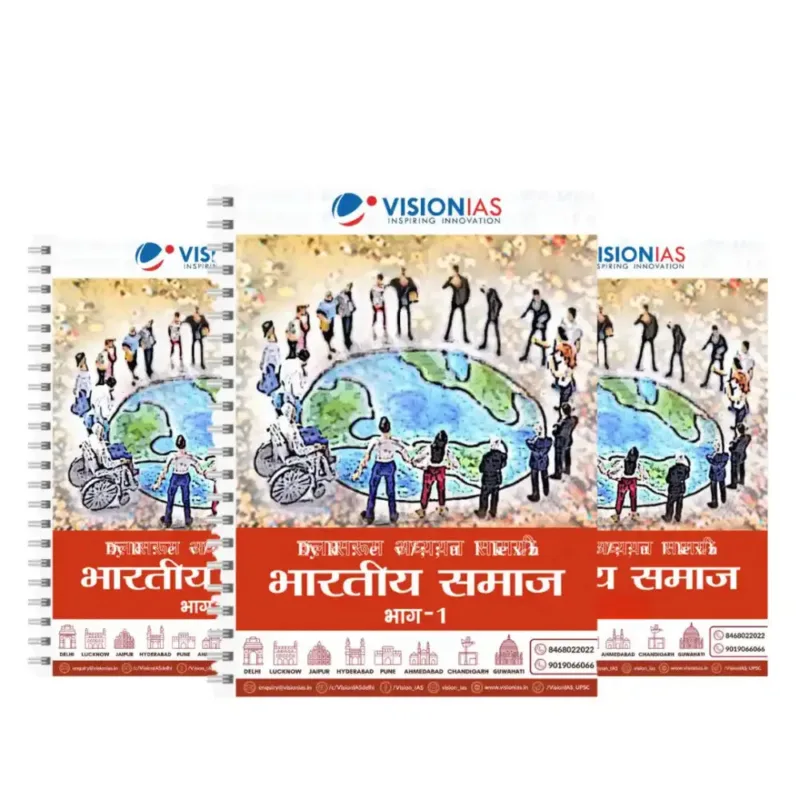

Vision IAS Indian Society Hindi Medium Notes

3 Booklets | UPSC Study Material
Key Highlights:
📘 3 Booklets
📚 Indian Society
🎓 Vision IAS
🏷️ Printed
🇬🇧 Hindi Medium
₹848
🌀 spiral
📘 book-binding
Only 15 sets left
Selling fast (93 sold this week)
5% OFF Use UPSC5% (COD Available)
10% OFF Use UPI10 (UPI Only)
Secure Payment
Fast Delivery
Safe Packaging

About Vision IAS Indian Society Hindi

The Vision IAS Indian Society Hindi is a printed UPSC study material set sold by UPSC Store — India’s trusted source for genuine, latest-batch civil services preparation books. This page covers full booklet details, syllabus coverage, pricing, shipping, and frequently asked questions. Useful for UPSC CSE, BPSC, UPPSC, MPPSC, RAS and other state PSC examinations.

Vision IAS Society Notes – Hindi GS | Comprehensive General Studies Material for UPSC Civil Services Examination

Related: Vision IAS Hindi notes · Social Justice material

Product FeatureDetails
Booklets Count5 Dedicated Modules (Comprehensive Set)
LanguageHindi (Standard Academic Hindi for UPSC)
PublisherVision IAS Publication Division
ConditionBrand New (Freshly Printed & Quality Checked)
FormatPhysical Printed Booklets (Soft Copy Not Included)

Complete Booklet Catalog

The Vision IAS Society (Indian Society) Hindi GS set is meticulously organized into five distinct booklets, each covering a specific pillar of the UPSC General Studies Paper I syllabus. Below is the inventory of the physical materials included in this package:

  • Booklet 1: भारतीय समाज की मुख्य विशेषताएँ एवं भारत की विविधता (Salient Features of Indian Society and Diversity of India)
  • Booklet 2: महिलाओं की भूमिका और महिला संगठन; जनसंख्या एवं संबद्ध मुद्दे (Role of Women and Women’s Organizations; Population and Associated Issues)
  • Booklet 3: गरीबी और विकासात्मक मुद्दे; शहरीकरण, उनकी समस्याएँ और समाधान (Poverty and Developmental Issues; Urbanization, their Problems and Remedies)
  • Booklet 4: भारतीय समाज पर भूमंडलीकरण के प्रभाव एवं सामाजिक सशक्तिकरण (Effects of Globalization on Indian Society and Social Empowerment)
  • Booklet 5: संप्रदायवाद, क्षेत्रवाद एवं धर्मनिरपेक्षता (Communalism, Regionalism, and Secularism)

Deep Dive: Internal Content of Booklet 1 – Indian Social Structure & Diversity

The first booklet in this Vision IAS Hindi GS series serves as the foundational text for understanding the sociological fabric of India. Physically, this booklet is approximately 80 to 100 pages of high-density information. The internal layout begins with a “Syllabus Mapping” page that correlates every chapter to previous year UPSC Mains questions (2013-present).

Chapter-wise Breakdown:

  • The Concept of Society: The booklet opens with a technical definition of ‘Society’ and ‘Community’, using academic Hindi terminology. It provides a tabular comparison between traditional and modern societies.
  • Salient Features of Indian Society: This section is structured using bulleted points. It discusses the “Multi-layered Identity” of Indians. The printing quality ensures that the sub-headers are in a bold, darker typeface for easy scanning.
  • Caste System: A significant portion of this booklet is dedicated to the evolution of the caste system. It includes complex flowcharts showing the transition from the Varna system to the Jati system. Specific terminology like “Sanskritization” (संस्कृतिकरण) and “Westernization” (पश्चिमीकरण) are defined in dedicated gray boxes for quick reference.
  • Linguistic and Religious Diversity: The booklet contains a demographic map of India (printed in high-contrast grayscale) illustrating the linguistic zones and religious distributions based on the 2011 Census.

The “Drishti/Vision Special” feature in this booklet is the “Quick Revision Mind Map” located at the end of the Diversity chapter, which summarizes the challenges to Indian unity on a single A4 spread.

Deep Dive: Internal Content of Booklet 2 – Women, Population, and Social Dynamics

This booklet focuses on the dynamic issues of gender and demographics. The physical layout utilizes wide margins, specifically designed for students to add their own current affairs updates next to the static content.

Detailed Indices:

  • Women’s Movements: The booklet tracks the history of women’s organizations from the pre-independence era to contemporary digital movements. It includes a chronological timeline of major legislations affecting women, printed in a clean, legible table.
  • Self-Help Groups (SHGs): There is an extensive 15-page section on the role of SHGs in rural empowerment. It uses case studies (presented in boxed formats) of successful SHGs like Kudumbashree.
  • Population Trends: This section is heavy on data visualization. You will find bar graphs and pie charts representing the “Demographic Dividend”, age-sex pyramids, and fertility rate trends across different Indian states. The ink used is anti-smudge, ensuring that the dense statistical data remains sharp even under highlighter use.
  • Old Age Issues: A unique chapter on the “Greying of India”, discussing the physical and social challenges faced by the elderly.

Deep Dive: Internal Content of Booklet 3 – Poverty, Development, and Urbanization

Booklet 3 is perhaps the most data-intensive module in the set. It bridges the gap between Sociology and Economics. The paper quality here remains consistent at 75 GSM, ensuring that the detailed maps of urban clusters do not bleed through to the reverse side.

Internal Content Highlights:

  • Poverty Dimensions: Instead of generic definitions, the booklet provides technical criteria used by the Rangarajan and Tendulkar Committees. These are presented in a comparative table format.
  • Developmental Issues: This chapter covers the “Rural-Urban Divide”. It uses high-resolution diagrams to explain the “Vicious Cycle of Poverty”.
  • Urbanization Challenges: This section contains detailed architectural and social breakdowns of issues like Slums (मलिन बस्तियाँ), Traffic Congestion, and Solid Waste Management. The booklet includes a special section on “Smart Cities Mission” with a breakdown of its core components.
  • Remedial Measures: Every problem discussed is followed by a “Way Forward” (आगे की राह) section, which is a hallmark of Vision IAS notes, providing students with ready-made concluding remarks for their Mains answers.

Deep Dive: Internal Content of Booklet 4 – Globalization & Social Empowerment

This booklet is updated to reflect the post-pandemic social order. It examines how international trends affect local Indian traditions. The internal text is printed in a font size that balances readability with information density, roughly equivalent to 11-point Times New Roman but in a clear Hindi typeface.

Key Chapters and Features:

  • Impact of Globalization: This is divided into “Impact on Food”, “Impact on Family Structure”, “Impact on Language”, and “Impact on Vulnerable Sections”. Each sub-topic uses a “Pros vs. Cons” table layout.
  • Social Empowerment: The booklet focuses on the empowerment of SCs, STs, OBCs, and Minorities. It lists constitutional provisions (Articles 14, 15, 16, etc.) in a highlighted sidebar for easy memorization.
  • Vulnerable Sections: Dedicated chapters for the disabled (Divyangjan) and the LGBTQ+ community (in the context of recent legal changes). These pages include summaries of landmark Supreme Court judgments.

Deep Dive: Internal Content of Booklet 5 – Social Ideologies

The final booklet handles sensitive and complex topics like Communalism and Secularism. The writing style is neutral and academic, adhering to the requirements of the UPSC. The physical binding of this booklet is reinforced to withstand frequent flipping during revision.

  • Regionalism: This chapter includes a map of India highlighting areas with significant regional movements (e.g., Bodoland, Gorkhaland). It discusses the “Sons of the Soil” theory in great detail.
  • Communalism: The booklet categorizes the causes of communalism into historical, political, economic, and social factors using a “Tree Diagram” format.
  • Secularism: A sophisticated comparison between the “Western Concept of Secularism” and the “Indian Concept of Secularism” is provided in a two-column layout. This is a high-yield area for UPSC Mains and the booklet provides 5-6 model arguments for each side.

Physical Quality and Technical Specifications

Vision IAS Society Notes are known not just for their content, but for their durability as study tools. When you purchase this GS Society Hindi set, you are investing in a product designed for the rigorous multi-year study cycle of a UPSC aspirant.

1. Paper Grade and Texture

The booklets are printed on premium 75 GSM Maplitho paper. This is a significant upgrade from standard photocopy paper. The “GSM” (Grams per Square Meter) ensures that the paper has a substantial weight. The texture is slightly matte, which is intentional. Glossy paper causes glare under study lamps, leading to eye strain. These notes are “anti-glare”, allowing for long hours of reading without discomfort. Furthermore, the paper is high-opacity; you can use fluorescent highlighters (Yellow, Pink, Green) to mark key phrases without the ink seeping through to the information on the next page.

2. Printing Technology and Ink Clarity

The notes are produced using High-Definition Laser Printing. Unlike inkjet printing, which can blur if a drop of water touches the page, laser printing bonds the toner to the paper fibers. The Hindi characters are crisp and clear, with no “bleeding” or “feathering” at the edges of the letters. This is crucial for the Hindi script (Devanagari), where small matras (diacritics) must be clearly legible to avoid misinterpretation of technical terms.

3. Binding and Ergonomics

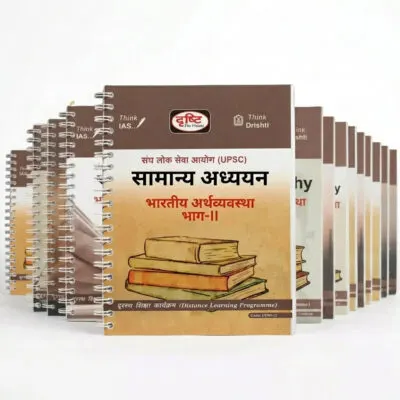
The set is typically Spiral Bound or Soft-Bound with reinforced spines. The spiral binding is of industrial grade, meaning the plastic or metal coils do not warp or snag on other books in your bag. A major advantage of the spiral format is the “Lay-Flat” capability. You can fold the booklet back on itself or lay it perfectly flat on a desk, which is essential when you are transcribing notes into your primary register. The covers are made of 250-300 GSM cardstock, often with a laminated finish to protect against dust and minor moisture.

4. Margin Architecture

Each page is designed with a Standard 1.5-inch margin on the outer edge. This is a deliberate “Vision Special” design choice. UPSC aspirants are encouraged to practice “Active Reading” where they write keywords, date of current affairs, or cross-references in the margins. The internal gutters (the space near the binding) are wide enough so that no text is lost in the fold, ensuring that every word is readable without prying the book open forcefully.

5. Visual Hierarchy

The internal formatting uses a hierarchical structure:

  • Level 1 Headers: Large, Bold, All-caps equivalent in Hindi.
  • Level 2 Headers: Bold and Underlined.
  • Level 3 Headers: Italicized or Bulleted.
  • Information Boxes: Used for “Did You Know?”, “Case Studies”, or “Definition of Terms”.

This visual hierarchy makes the physical product a “self-guiding” document, helping the brain categorize information during the first reading.


Content Strategy: How to Use These Physical Booklets

The product is structured to follow a “Linear Learning Path”. The sequence of the three booklets is not random; it is designed to build the student’s conceptual depth. Booklet 1 introduces the *what* (features of society), while Booklets 4 and 5 deal with the *why* and the *impact* (globalization and communalism). The physical layout encourages this progression, with each booklet ending in a “Practice Question” set that mimics the UPSC Mains answer sheet, including the specific word-limit lines.

Inside the booklets, you will also find “Previous Year Questions” (PYQs) integrated at the end of relevant chapters. For example, after the chapter on “Regionalism” in Booklet 5, you will find the 2020 and 2021 questions on the same topic, allowing you to immediately test the efficacy of the notes you just read. This integration of the question bank within the study material eliminates the need to carry separate PYQ books.


Frequently Asked Questions (FAQ)

1. Are these notes the latest edition for the current UPSC cycle?
Yes, these are the latest printed versions of the Vision IAS Society notes in Hindi. They include the most recent updates on social schemes, census data interpretations, and contemporary social movements like the digital empowerment of rural women.

2. What is the total page count of the entire 5-booklet set?
The complete set comprises approximately 450 to 500 pages. This varies slightly based on the specific print run, but the content remains comprehensive for the GS Paper I Society section.

3. Is the Hindi used in these notes “Shuddh Hindi” (Pure) or “Hinglish”?
The notes use “Standard Academic Hindi” as required by the UPSC. While the primary language is Hindi, technical terms (like ‘Globalization’ or ‘Secularism’) are often provided in English in brackets alongside the Hindi translation to ensure the student understands the global context.

4. Can I use highlighters on this paper?
Absolutely. The 75 GSM Maplitho paper is specifically chosen for UPSC aspirants who use heavy highlighting. The ink will not bleed through to the other side under normal usage.

5. Are these notes sufficient for the UPSC Society syllabus, or do I need NCERTs?
These notes are designed to be “NCERT-Plus”. They cover everything in the Class 11 and 12 Sociology NCERTs and add the advanced analysis and current affairs integration required for the Mains examination. Most students find these sufficient as their primary source.

6. How are the booklets protected during shipping?
The booklets are shrink-wrapped to prevent moisture damage and then placed in a corrugated cardboard box or a heavy-duty bubble mailer to ensure the corners and the spiral binding remain intact during transit.

7. Do these notes cover Social Justice (GS Paper II) as well?
These notes focus primarily on “Indian Society” for GS Paper I. While there is some overlap with Social Justice (like empowerment and poverty), the specific governance and legislative aspects of Social Justice are usually covered in a separate Vision IAS GS II module.

8. Is there any color printing inside the booklets?
To keep the notes affordable and focused on high-contrast reading, the internal content is printed in high-quality Black & White (Grayscale). This is ideal for photocopying and ensures that diagrams and maps are clear without the distraction of unnecessary colors.

9. How do I verify the authenticity of these Vision IAS notes?
Authentic Vision IAS materials feature their characteristic clean layout, specific font choices, and the “Vision IAS” branding on the header/footer of every page. The paper quality of genuine notes is significantly higher than local pirated copies.

10. Are there practice questions included in the booklets?
Yes, every major chapter ends with a set of “Self-Assessment Questions” and previous year UPSC Mains questions to help you practice answer writing in the Hindi medium.

11. Is the font size comfortable for middle-aged aspirants or those with eye strain?
The font size is standard for educational materials (approx. 11pt). It is balanced to provide maximum information while remaining legible. The high contrast between the white paper and dark black ink significantly helps in readability.

12. Does the set include the “Value Addition” material?
Yes, the 5-booklet structure integrates value-addition topics like case studies and committee reports directly into the relevant chapters, rather than keeping them as a separate supplement.


End of Product Description. This set is the gold standard for Hindi medium UPSC aspirants focusing on the Society segment of the General Studies curriculum.

Frequently Asked Questions

How many booklets are in this set?

The set contains 5 dedicated modules covering Indian Society for UPSC GS Paper I.

Is the content in standard Hindi?

Yes, the booklets use standard academic Hindi suited to UPSC aspirants.

Are these original Vision IAS booklets?

Yes, the booklets are freshly printed and quality-checked Vision IAS originals.

Is soft copy included?

No, only the physical printed booklets are included; soft copy is not provided.

Is COD available?

Yes, COD is supported across India.

How long does pan-India delivery take?

Most pin codes receive delivery in 3-5 business days with tracking.

Reference: UPSC official syllabus

Customer Reviews 85

4.5
Based on 85 reviews
5★
51
4★
25
3★
9
2★
0
1★
0
N
Nikhil Joshi
23 Apr 2026
✓ Verified

Paper quality achhi hai.

R
Rajesh Kumar Sharma
21 Apr 2026
✓ Verified

Bahut accha notes hai, samajh mein aata hai. Recommend karunga sabko.

N
Neha Patel
21 Apr 2026
✓ Verified

Bohot helpful notes hain yaar, Indian Society ka sab kuch cover hai.

V
Vikram Singh
20 Apr 2026
✓ Verified

Basics clear ho jayengi isse. Lekin advanced topics ke liye aur coaching zaruri padega.

R
Rajesh Kumar
20 Apr 2026
✓ Verified

Bahut achche notes hain, samajhne mein aasan hai. Highly recommended for UPSC aspirants.

P
Pooja Singh
20 Apr 2026
✓ Verified

Indian society ke topics ko itna clearly explain kiya hai, really impressed.

S
Suresh Rao
19 Apr 2026
✓ Verified

Mera exam prep mein bahut help hua. Quality notes for serious students.

A
Amar Singh Yadav
17 Apr 2026
✓ Verified

Sabkuch clear ho gaya inn notes se. Hindi medium ka best option hai yeh.

🛍️

Aspirants Also Bought

More from the same category

View All

About Vision IAS Indian Society Hindi Medium Notes

Vision IAS Indian Society Hindi Medium Notes is a highly recommended UPSC study material from Vision IAS, specially designed for Indian Society preparation. Available in Hindi medium, this material is crafted to match the exact requirements of the UPSC Civil Services Examination syllabus — covering both Prelims and Mains comprehensively.

Product Details

  • Institute: Vision IAS
  • Subject: Indian Society
  • Medium: Hindi
  • Format: Printed
  • Delivery: Pan-India delivery in 3–5 working days
  • Format: Original printed material, verified authentic

Why Buy from UPSC Store?

  • 100% Genuine Printed Material — Original printed notes, no photocopies or fake copies
  • Fast Delivery — Ships within 24 hours, arrives in 3–5 days pan-India
  • Secure Packaging — Bubble-wrapped and boxed to prevent damage in transit
  • Trusted by 10,000+ Aspirants — India's most reliable UPSC material marketplace
  • WhatsApp Support — Get expert guidance on material selection before ordering

Frequently Asked Questions

Is this product 100% original?

Yes, all products at UPSC Store are 100% genuine printed materials. We do not sell photocopies or fake copies.

How long does delivery take?

Orders are dispatched within 24 hours and delivered across India in 3–5 working days via reputed courier partners.

Can I return the product?

Yes, we accept returns within 7 days if the product is damaged or incorrect. Check our refund policy for details.

Which other study materials should I buy with this?

We recommend pairing this with current affairs notes and a UPSC test series for comprehensive preparation. Browse more in General Studies, Social Justice, UPSC, Vision IAS.