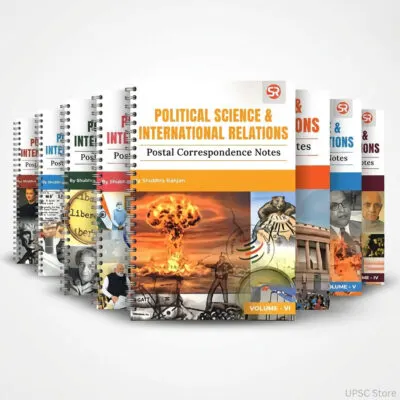
Drishti IAS PSIR Notes 2025-26

6 Booklets | English Medium | UPSC Study Material

Key Highlights:
πŸ“˜ 6 Booklets
πŸ“š Political Science & International Relations
πŸŽ“ Drishti IAS
🏷️ Printed
πŸ‡¬πŸ‡§ English Medium
β‚Ή1,325
πŸ“˜ book-binding βœ“
πŸŒ€ spiral βœ“
Only 31 sets left
Selling fast (77 sold this week)
5% OFF Use UPSC5% (COD Available)
10% OFF Use UPI10 (UPI Only)
Secure Payment
Fast Delivery
Safe Packaging

About Drishti IAS PSIR Notes 2025-26

The Drishti IAS PSIR Notes 2025-26 is a printed UPSC study material set sold by UPSC Store β€” India’s trusted source for genuine, latest-batch civil services preparation books. This page covers full booklet details, syllabus coverage, pricing, shipping, and frequently asked questions. Useful for UPSC CSE, BPSC, UPPSC, MPPSC, RAS and other state PSC examinations.

Drishti IAS PSIR Notes 2025-26 β€” 6 English Medium Printed Booklets for UPSC Optional Subject

Related: Drishti IAS notes Β· PSIR optional

Buy Drishti IAS PSIR printed notes online β€” the complete 2025-26 set of 6 booklets covering Political Science and International Relations for UPSC Civil Services Examination optional preparation. These expert-authored booklets deliver structured coverage of all major PSIR topics, from political theory and comparative politics to international relations frameworks and contemporary geopolitical issues. Whether you’re starting your UPSC optional journey or refining your subject expertise, Drishti IAS PSIR notes provide the scholarly depth and strategic focus required to score high marks in Mains examination.

Product Overview

FeatureDetails
Booklets Count6 Individual Printed Booklets β€” Complete PSIR Optional Syllabus Coverage
LanguageEnglish Medium
PublisherDrishti IAS (PSIR Optional Series)
Edition2025-26 β€” Latest Genuine Batch
ConditionBrand New, Unmarked, Fresh Stock
FormatHigh-Quality Printed Booklets β€” Spiral or Book Binding
Paper Quality75 GSM Ultra-White β€” Highlighter Safe, Zero Bleed-Through
ShippingPan India Delivery in 3-5 Business Days β€” Tracked
Also Useful ForBPSC, UPPSC, MPPSC, RAS, KPSC, JPSC, OPSC and All State PSC Examinations

Complete Booklet Catalog

The Drishti IAS PSIR Notes 2025-26 set comprises six comprehensive booklets meticulously designed for UPSC aspirants choosing Political Science and International Relations as their optional subject. These booklets systematically cover foundational concepts, advanced theories, Indian political systems, comparative governance frameworks, and contemporary geopolitical analysis essential for Mains examination success.

Each booklet is authored by subject specialists at Drishti IAS who understand the UPSC question pattern and the depth required to secure high marks in optional subject papers.

  • Booklet 1: Introduction to Political Science β€” Fundamental definitions and key concepts of political science; major schools of political thought including classical, medieval, and modern perspectives; scope and methods of political inquiry; relationship between political science and other disciplines; basic terminology for UPSC answer writing; introduction to core PSIR optional themes and their examination relevance.
  • Booklet 2: Comparative Politics and Political Systems β€” Comparative analysis of democratic, authoritarian, and hybrid political systems; institutional structures across nations; governance models and constitutional frameworks; electoral systems and political representation mechanisms; political behavior and socialization patterns; case studies from USA, UK, France, Germany, and China for UPSC Mains comparison questions.
  • Booklet 3: International Relations Theories and Concepts β€” Core IR theories including realism, liberalism, constructivism, and critical approaches; concepts of sovereignty, power, and national interest; balance of power and international security frameworks; international law and institutions; the role of the UN system; regional organizations and their functioning; directly aligned with UPSC IR paper requirements.
  • Booklet 4: Indian Government, Constitution, and Politics β€” Detailed analysis of Indian constitutional framework and federalism; executive, legislative, and judicial structures; inter-governmental relations and center-state dynamics; political parties, electoral processes, and coalition politics; Indian political culture and traditions; contemporary challenges in Indian governance; essential for UPSC GS and optional integration.
  • Booklet 5: Political Thought and Ideologies β€” Classical political thinkers from Plato to Mill; modern and contemporary political philosophers; major ideologies including liberalism, socialism, conservatism, feminism, and nationalism; impact of ideology on policy and governance; application of political thought to contemporary issues; strong UPSC ethics and governance angles included.
  • Booklet 6: International Relations in Contemporary Context β€” Current global issues including climate change, terrorism, migration, and humanitarian concerns; geopolitical conflicts and regional tensions; emerging powers and international relations shifts; India’s foreign policy and strategic partnerships; multilateralism and global governance challenges; updated for 2025-26 examination cycle.

In-Depth Content Breakdown: Booklet by Booklet

Booklet 1: Introduction to Political Science

This foundational booklet establishes the core concepts and terminology essential for understanding Political Science and International Relations. The booklet defines political science as a social science concerned with the study of power, governance, and political behavior across different systems and societies. It covers the evolution of political science as a discipline, its methodologies including empirical analysis and theoretical frameworks, and the major schools of political thought from ancient to contemporary periods. The booklet explains why understanding foundational concepts is crucial for UPSC Mains, where answer writers must demonstrate deep comprehension rather than surface-level knowledge. Special emphasis is given to the relationship between political science and allied disciplines like philosophy, economics, and sociology, helping students contextualize PSIR within broader social sciences.

The unique strength of this booklet lies in its strategic presentation for examination purposes. Rather than mere academic definitions, each concept is presented with examination relevance and application potential. The booklet includes practice scenarios and question patterns that have appeared in UPSC Mains, allowing students to understand how theoretical knowledge is tested. Visual flowcharts map the relationship between different schools of thought, and comparative tables highlight distinctions between key concepts. The booklet emphasizes that Political Science is not just about memorizing definitions but developing analytical frameworks to evaluate political phenomena critically β€” exactly what UPSC examiners assess in optional papers.

Booklet 2: Comparative Politics and Political Systems

Comparative Politics is a critical component of the PSIR optional syllabus, and this booklet provides comprehensive analysis of different political systems and governance structures across the globe. The booklet examines democratic systems in detail, including parliamentary democracies (UK, India), presidential systems (USA), and mixed systems (France). It analyzes authoritarian and semi-authoritarian regimes, exploring how power is concentrated, distributed, or shared. The booklet covers constitutional frameworks, separation of powers doctrines, and institutional relationships that define how nations govern themselves. For UPSC aspirants, this booklet is invaluable because comparative questions frequently appear in Mains papers, requiring students to contrast Indian systems with other nations. The booklet includes recent constitutional amendments and governance reforms globally, ensuring content is current for 2025-26 examinations.

What distinguishes this booklet for UPSC preparation is its focus on answering comparative questions effectively. Each political system is analyzed through consistent frameworks covering institutions, processes, and outcomes, enabling students to draw meaningful comparisons. The booklet includes case studies of political transitions, elections, and governance challenges in different countries, with specific application to how these examples strengthen UPSC answers. Detailed sections on political behavior, party systems, and electoral mechanisms provide concrete examples for illustration. Tables and organizational charts visually represent complex institutional structures, making them easier to recall during examinations. The booklet also addresses how comparative analysis helps understand contemporary India better, strengthening the bridge between optional and GS papers.

Booklet 3: International Relations Theories and Concepts

This booklet presents the theoretical foundations of International Relations, essential for answering PSIR Mains questions with scholarly rigor. The booklet comprehensively covers major IR theories: realism (including classical and neo-realism) and its emphasis on power politics and national interest; liberalism and its focus on institutions, interdependence, and cooperation; constructivism and its exploration of how ideas and identities shape international politics; and critical approaches including Marxism and postcolonial perspectives. For UPSC candidates, mastering these theoretical frameworks is crucial because examination questions often require analyzing international phenomena through specific theoretical lenses. The booklet demonstrates how different theories would interpret the same international event, developing critical thinking skills essential for scoring high marks. Contemporary applications include analyzing India’s foreign policy, regional conflicts, and global governance issues through theoretical frameworks.

The pedagogical approach of this booklet strengthens understanding through practical application. Rather than presenting theories as abstract concepts, each theory is illustrated with real-world examples from international relations: realism through great power competition and balance of power dynamics; liberalism through multilateral institutions like the UN and regional organizations; constructivism through the social construction of identity and interest in international politics. The booklet includes sections on sovereignty, power, national interest, and security dilemma β€” fundamental concepts that unite most IR theories. Special attention is given to non-state actors, transnational issues like terrorism and climate change, and how traditional IR theories adapt to analyze these challenges. Diagrams illustrate theoretical frameworks and relationships, and practice questions guide students in applying theories to analyze contemporary international issues for UPSC examinations.

Booklet 4: Indian Government, Constitution, and Politics

This booklet focuses on Indian political systems, constitutional framework, and governmental structures β€” areas where PSIR optional and UPSC GS papers overlap significantly. The booklet provides comprehensive analysis of the Indian Constitution, covering the Preamble, fundamental rights, directive principles, and constitutional amendments through 2024. It examines the executive structure at central and state levels, the bicameral legislature and its functions, and the independent judiciary including the Supreme Court and High Courts. The booklet analyzes federalism in India, exploring center-state relations, concurrent and residual powers, and recent developments in inter-governmental coordination. For UPSC aspirants, this content is critical because constitutional provisions and governmental functions appear across multiple papers, and mastery demonstrates comprehensive understanding. The booklet includes recent Supreme Court judgments on constitutional interpretation and governance, ensuring contemporary relevance for 2025-26 examinations.

The unique value of this booklet for UPSC preparation lies in its analytical depth beyond factual description. It examines how Indian constitutional structures function in practice, including challenges like coalition politics, electoral dynamics, and implementation gaps. The booklet analyzes Indian political culture, traditions of consensus and accommodation, and debates around federalism and autonomy. Detailed sections on Indian political parties β€” their ideologies, support bases, and evolution β€” provide context for understanding electoral outcomes and political dynamics. The booklet addresses contemporary political issues including institutional conflicts, electoral reforms, and governance challenges, all with examination-relevant analysis. Tables comparing Indian federal structure with other federal systems strengthen comparative understanding. Case studies of recent political developments and constitutional controversies prepare students to handle contemporary context questions in UPSC Mains examination.

Booklet 5: Political Thought and Ideologies

Political thought forms the intellectual foundation of PSIR optional preparation, and this booklet systematically covers major political philosophers and ideologies from ancient to contemporary periods. The booklet examines classical thinkers including Plato, Aristotle, Hobbes, Locke, and Rousseau, explaining their core contributions to political philosophy and their enduring influence on modern governance. It covers modern thinkers like Mill, Marx, and Tocqueville, analyzing their perspectives on democracy, socialism, and civil society. The booklet explores major ideologies including liberalism with its emphasis on individual rights and limited government; conservatism and its critique of rapid change; socialism and marxism addressing inequality; feminism and its analysis of gender and power; and nationalism as a force in world politics. For UPSC examinations, understanding political thought is essential because many contemporary policy debates reflect underlying philosophical differences, and excellent answers demonstrate awareness of these intellectual foundations. The booklet links political thought to Indian context, showing how different ideologies influence Indian politics and governance debates.

What makes this booklet invaluable for UPSC preparation is its emphasis on applying political thought to contemporary analysis. Rather than presenting philosophers as historical figures, the booklet demonstrates how their ideas remain relevant to current challenges: Locke’s ideas on consent and limited government in understanding democratic governance; Mill’s liberalism in debates on individual freedom versus collective welfare; Marx’s analysis of inequality in understanding development and social conflict; feminist thought in analyzing gender in politics and governance. The booklet includes sections on Indian political thinkers including Rammohan Roy, Keshab Chandra Sen, and modern thinkers like B.R. Ambedkar, strengthening connection to Indian constitutional and political development. Practice questions encourage students to apply political theories to contemporary policy issues, developing the analytical writing style required for UPSC Mains. Visual summaries of major ideologies and their key proponents aid retention and recall during examinations.

Booklet 6: International Relations in Contemporary Context

This concluding booklet transitions from theoretical and historical foundations to contemporary international relations and geopolitical analysis crucial for 2025-26 UPSC examinations. The booklet covers emerging global issues including climate change and environmental security; terrorism and transnational security threats; migration and refugee crises; humanitarian intervention and responsibility to protect; and global governance challenges. It analyzes contemporary geopolitical conflicts and regional tensions, including US-China competition, Russia-Ukraine tensions, Middle East dynamics, and South Asian security issues. The booklet examines India’s foreign policy, its strategic partnerships with major powers, regional engagements in SAARC and beyond, and India’s positions on global issues. India’s role in emerging forums like BRICS, Shanghai Cooperation Organization, and Quad is analyzed for its geopolitical significance. Updated content reflects developments through 2024-25, ensuring students engage with recent international events relevant for UPSC examinations, where current affairs mastery is essential for scoring well.

The practical utility of this booklet for UPSC Mains preparation is exceptional because it directly addresses the contemporary context questions that increasingly dominate optional papers. The booklet analyzes how traditional IR concepts apply to modern challenges: realism in understanding power competition between great powers; liberalism in analyzing multilateral institutions’ effectiveness in addressing global issues; constructivism in understanding identity politics and regional conflicts. Case studies of contemporary international crises and Indian responses provide concrete material for examination answers. The booklet includes sections on climate diplomacy, where India’s position as a developing nation shapes its international relations; technology and cybersecurity in modern international politics; and global economic governance during transition. Analytical frameworks help students evaluate contemporary issues systematically rather than relying on news headlines. Special emphasis on India-specific content ensures integration with general studies preparation, as optional and GS papers increasingly overlap on foreign policy and international issues relevant to India’s development and strategic interests.

Physical Construction and Quality Standards

Drishti IAS PSIR Notes are manufactured to the highest standards expected by serious UPSC aspirants who will study these materials intensively for months. The physical quality reflects that these booklets are designed for active study β€” highlighting, annotating, cross-referencing β€” rather than passive reading. Every component from paper selection through binding has been chosen to withstand the rigorous use typical of UPSC preparation while maintaining clarity and readability even after extensive revision cycles.

Paper Quality: 75 GSM Anti-Glare White Paper

These booklets use premium 75 GSM ultra-white paper specifically selected for UPSC study material standards. The 75 GSM weight provides optimal opacity, preventing text and diagrams from showing through to the reverse side β€” a critical feature when using highlighters and gel pens during revision. The ultra-white finish reduces eye strain during extended study sessions, a consideration important for aspirants studying 10-12 hours daily. The paper surface has a slight anti-glare coating that minimizes reflection under bright study lights while maintaining crisp visibility of printed content. The opacity rating ensures that even thick highlighter marks don’t compromise text clarity, and the paper accepts multiple colored highlights without degradation. This paper quality specifically supports the color-coding study methodology many UPSC aspirants employ, where different colors indicate different concept categories.

Printing Technology: High-Resolution Laser Printing

Drishti IAS uses high-resolution laser printing technology delivering crisp text and diagrams throughout every booklet. The laser printing process ensures permanent toner bonding, preventing smudging or fading even after repeated page-turning and highlighting during revision phases. Diagrams, flowcharts, and tables are rendered with precision, maintaining clarity essential for visual learning of complex concepts. Maps and comparative charts are printed at resolutions enabling fine details to remain legible. The printing technology produces uniform ink density throughout, ensuring no pages are lighter or darker than others β€” important for consistent readability across extended study material. The laser printing creates sharp edges on text characters, supporting easy reading and reducing eye fatigue compared to lower-quality printing. Color diagrams, where included, reproduce accurately from the original designs, providing the visual support intended by Drishti IAS content developers.

Binding and Durability

These booklets are available in spiral binding or book binding options, each engineered for intensive UPSC study. Spiral binding allows booklets to open completely flat, creating an optimal writing surface for making marginal notes alongside printed text β€” a study methodology preferred by many successful aspirants. The spiral mechanism uses durable metal coils that withstand repeated opening and closing without loosening or damage. Book binding provides a more compact option for aspirants preferring portable study materials, with 300 GSM cardstock covers protecting inner pages from wear. Both binding options utilize adhesives and techniques ensuring pages remain securely attached even after months of regular use. The cover stock for book-bound editions is acid-free and treated for durability, resisting creasing and damage from being carried in bags or stored on shelves. Whether spiral or bound, these booklets are engineered to maintain integrity throughout the intensive preparation phase, supporting consistent study experience from first reading through final revision cycles before examinations.

Key Features and Study Design

Drishti IAS PSIR Notes are engineered specifically for UPSC Mains preparation, incorporating pedagogical features that research shows enhance learning, retention, and examination performance for optional subject candidates.

  • Structured Progression of Complexity: Booklets are sequenced to build knowledge systematically, starting with foundational concepts and progressing to advanced analysis. Early booklets establish vocabulary and conceptual frameworks required to understand later material, supporting cumulative learning essential for mastering complex subjects like International Relations and Political Theory.
  • Examination-Aligned Content Selection: Rather than encyclopedic coverage, Drishti IAS has curated content specifically addressing UPSC Mains question patterns for PSIR optional. Historical examples, case studies, and analytical frameworks included are those most frequently appearing in recent papers or most likely to appear in evolving examination patterns, maximizing return on study time.
  • Visual Learning Support with Diagrams and Flowcharts: Complex concepts in Political Science and International Relations are supported by carefully designed diagrams, theoretical flowcharts, and organizational charts. These visuals translate abstract concepts into memorable visual forms, supporting multiple learning styles and aiding retention of intricate relationships between ideas for accurate examination recall.
  • Practice Questions Aligned to UPSC Format: Each booklet includes practice questions reflecting actual UPSC Mains format and question types. Questions range from conceptual understanding to analytical application, allowing students to assess their readiness and practice writing examination-style answers with the guidance of source material available during practice sessions.
  • Integration of Indian Context and Global Analysis: Content balances theoretical knowledge with Indian examples, ensuring Optional Subject preparation naturally integrates with General Studies preparation. Indian foreign policy, constitutional debates, and political developments are analyzed within global frameworks, creating synergy between optional and GS papers that successful candidates leverage.

Shipping, Packaging and Delivery

Drishti IAS PSIR Notes are packaged with care ensuring arrival in perfect condition. All booklets are shrink-wrapped as a protective unit and placed in a corrugated shipping box with internal padding. Edge protectors are positioned around booklet stacks preventing damage from box compression during transit. The packaging design is slim and lightweight, keeping shipping costs reasonable while providing full protection. For pan-India delivery, these precautions ensure booklets arrive unmarked and undamaged, meeting the “Brand New” condition standard expected for premium study materials.

Delivery across India is completed in 3-5 business days from order confirmation, with tracking ID provided for monitoring shipment status. Orders ship from Delhi, allowing most major cities to receive within this timeline. If a booklet arrives damaged or is missing from the shipment, WhatsApp +91 70045 49563 and we’ll replace it within 48 hours at no additional charge β€” our commitment to your uninterrupted preparation. Tracking updates are sent via SMS and email, and customers can contact our support team for delivery queries. For convenience, we accept multiple payment methods and provide invoice details for all orders, supporting both personal purchases and bulk institutional buying.

Frequently Asked Questions (FAQ)

Q1: Are Drishti IAS PSIR notes enough for complete UPSC optional preparation?

These Drishti IAS booklets provide comprehensive coverage of the PSIR optional syllabus, serving as your primary reference material. However, UPSC preparation typically combines multiple resources: these notes as structured foundation, supplementary reading from recommended texts for deeper understanding of specific philosophers or theorists, current affairs updates from reliable sources for contemporary international relations, and practice with previous years’ papers to understand evolving question patterns. The six-booklet set covers all syllabus areas, but your overall preparation strength depends on supplementing with practice, current affairs, and answering previous papers under examination conditions.

Q2: How many booklets are included in Drishti PSIR notes 2025-26?

This set includes 6 individual printed booklets, each focusing on a distinct PSIR area: Introduction to Political Science, Comparative Politics, International Relations Theories, Indian Government and Politics, Political Thought and Ideologies, and International Relations in Contemporary Context. The six-booklet structure enables focused study of each area while maintaining manageable material volume for intensive revision. All six booklets together form the complete PSIR optional content set for 2025-26 UPSC examinations.

Q3: What specific topics are covered in Drishti PSIR notes 2025-26?

The six-booklet set covers all major PSIR optional areas: foundational concepts and history of political science; comparative analysis of political systems including democracies, authoritarian regimes, and constitutional frameworks across USA, UK, France, Germany, China; International Relations theories (realism, liberalism, constructivism, critical approaches) and core concepts like sovereignty and national interest; Indian constitutional structure, federalism, political parties, and governance; political thought from classical thinkers (Plato, Aristotle, Locke, Rousseau) through modern philosophers (Mill, Marx) and Indian thinkers (Ambedkar); contemporary global issues including terrorism, climate change, migration, and India’s foreign policy and strategic partnerships.

Q4: Are these PSIR notes available in English medium?

Yes, this entire 6-booklet set is in English medium, designed for aspirants preparing in English for the UPSC Civil Services Examination. The English language used is clear and accessible while maintaining academic rigor appropriate for optional subject preparation. Drishti IAS also publishes PSIR notes in Hindi medium for Hindi-medium aspirants, but this particular set is exclusively English medium. If you need Hindi-medium PSIR materials, please inquire about our Hindi medium offerings.

Q5: How do Drishti IAS PSIR notes compare to other institute study materials?

Drishti IAS is recognized for high-quality, examination-focused content creation backed by experienced educators and subject experts. These PSIR notes reflect Drishti’s pedagogical approach: structured progression from foundational concepts to advanced analysis, examination-aligned content selection based on UPSC question patterns, integration of Indian context with global analysis, and inclusion of contemporary developments. Quality differences between institutes lie in content curation, explanation clarity, and examination relevance. Drishti IAS PSIR notes emphasize analytical frameworks over mere information delivery, supporting the critical thinking required for scoring well in optional papers. For direct comparison, review sample content from competing materials, but most successful PSIR candidates have found Drishti materials comprehensive and examination-focused.

Q6: Can I download these PSIR notes as a PDF instead of buying printed booklets?

We offer printed booklets only β€” not PDF downloads. This policy ensures quality control and supports the original content creators. Printed materials offer distinct advantages for UPSC preparation: the tactile experience of highlighting and annotating strengthens memory retention; physical materials prevent distraction from digital devices; and printed study supports the deep focus required for complex subjects like Political Science. If you require digital access, some aspirants photograph their printed notes for mobile reference during commute time, combining printed primary study with digital convenience. We recommend printed materials for serious optional subject preparation.

Q7: What is the current price of Drishti IAS PSIR notes 6 booklets for 2025-26?

Current pricing for the complete 6-booklet Drishti IAS PSIR Notes 2025-26 set is available on our product page at UPSC Store Mukherjee Nagar. Prices may vary based on bulk purchases or any ongoing promotions. We recommend checking our website for the latest pricing or WhatsApp +91 70045 49563 for current rates and any available discounts. Payment is accepted through multiple methods, and all orders include GST where applicable. Shipping is included in the quoted price for most regions, with 3-5 day pan-India delivery.

Q8: How can I use Drishti PSIR study material for GS Paper 2 preparation?

While PSIR is optional subject material covering depth not required for GS, the two fields overlap significantly. GS Paper 2 includes Constitution, Governance, and International Relations sections where PSIR knowledge strengthens answers substantially. Use Drishti PSIR booklets to deepen understanding of constitutional provisions, governmental functions, and international relations concepts tested in GS. The Booklet 4 on Indian Government directly supports GS Paper 2 Indian Polity sections, and Booklet 3 on IR theories and Booklet 6 on contemporary international relations support GS questions on foreign policy and global issues. Many successful candidates study optional materials alongside GS preparation, using the depth from optional to write superior GS answers on overlapping topics. However, remember that GS requires broader coverage across multiple areas, while PSIR allows depth in these subjects.

Q9: What is the paper quality? Can I use a highlighter on these booklets?

These booklets use 75 GSM ultra-white paper specifically chosen for student highlighting and annotation. The 75 GSM weight provides high opacity, preventing text from bleeding through to the reverse side even with thick highlighter marks. Multiple highlighter colors β€” yellow, green, pink, blue β€” work effectively without compromising text clarity on either side. Gel pens and ballpoint pens also write smoothly on the paper surface. The ultra-white finish and anti-glare coating minimize eye strain during extended study sessions, important for aspirants studying 10-12 hours daily. We recommend avoiding permanent markers, which can bleed through, but standard highlighters and study pens perform excellently on this paper quality.

Q10: How should I structure my study using these 6 booklets over my preparation timeline?

A recommended approach is reading the booklets in order over 4-6 weeks for initial coverage, spending about one week per booklet initially. Booklet 1 provides foundational concepts essential for understanding later material, so read it carefully. Booklets 2-5 can be studied in sequence as they build logically on earlier concepts. Booklet 6 should be revisited regularly as you prepare, updating your understanding with new international developments. After initial reading, dedicate 8-12 weeks to deepening understanding by re-reading sections, making detailed notes, and attempting practice questions. Then allocate 4-6 weeks for revision, focusing on challenging sections and integrating with current affairs. Throughout preparation, answer previous years’ PSIR papers (available separately) to practice examination writing. This structure ensures you’re not just reading passively but actively learning and practicing the examination-writing skills required for high performance.

Q11: Are these 2025-26 edition notes current enough for exams in 2026?

The 2025-26 edition reflects syllabus interpretation and content emphasis as of 2025, making it current for the 2026 UPSC examination cycle. However, UPSC examination questions frequently test very recent developments in international relations and politics. While these booklets provide authoritative core content and analytical frameworks, you must supplement them with current affairs updates from reliable sources covering international events from mid-2025 through early 2026. Subscribe to current affairs publications, follow reliable news sources for geopolitical developments, and integrate recent developments into your answer-writing practice. The booklets establish your knowledge foundation; current affairs keep you updated on the contemporary context that will be tested.

Q12: What is the binding option, and which should I choose?

These booklets are available in both spiral binding and book binding. Spiral binding allows the booklets to open completely flat, creating an ideal writing surface for making marginal notes alongside printed text β€” preferred by aspirants who annotate heavily during study. Spiral-bound materials lie flat on a desk, enabling comfortable reading and writing simultaneously. Book binding is more compact for carrying between locations and storing on shelves, preferred by aspirants who prefer portable study materials. Both options use durable materials engineered for intensive study use. Choose based on your study preference: if you study primarily at a desk and annotate extensively, spiral binding is optimal; if you study in multiple locations and prefer compact, portable materials, book binding suits you better. Either option maintains full content integrity and durability throughout your preparation.

Summary

SpecificationValue
InstituteDrishti IAS
SubjectPolitical Science and International Relations (PSIR)
Edition2025-26
Booklets6 Printed Booklets
LanguageEnglish Medium
Paper75 GSM Ultra-White, Highlighter Safe
BindingSpiral or Book Binding
Delivery3-5 Business Days Pan India
ConditionBrand New, Unmarked, Fresh Stock
Also Useful ForBPSC, UPPSC, MPPSC, RAS, KPSC, JPSC, OPSC and All State PSC Examinations

Drishti IAS PSIR Notes 2025-26 are available exclusively at UPSC Store, Mukherjee Nagar, Delhi β€” your one-stop destination for authentic, premium UPSC study materials. Order your 6-booklet set today and begin structured preparation for the Civil Services Examination optional subject. Contact us at +91 70045 49563 via WhatsApp for order confirmation and delivery details. Pan India delivery guaranteed in 3-5 days.

Reference: Civil Services Examination

Customer Reviews 270

4.5
Based on 270 reviews
5β˜…
162
4β˜…
80
3β˜…
28
2β˜…
0
1β˜…
0
V
Vikram Singh
24 Apr 2026
βœ“ Verified

Notes bahut detailed hain aur easy to understand bhi.

A
Arjun Sharma
22 Apr 2026
βœ“ Verified

Bilkul mast notes, bahot detailed aur organized hai. Drishti ke notes se PSIR clear hone wala.

H
Harish Malhotra
21 Apr 2026
βœ“ Verified

Material quality achhi hai aur content bhi solid.

K
Kavya Prabhu
17 Apr 2026
βœ“ Verified

Quality fantastic, packaging bhi secure tha. On time delivery!

R
Rohan Mishra
17 Apr 2026
βœ“ Verified

Quality bagus hai aur content relevant. Bohot madan aa raha hai padh ke.

M
Meera Singh
17 Apr 2026
βœ“ Verified

Notes bilkul perfect hain, 8 booklets mein sab kuch cover hai. Printing quality bhi premium hai.

P
Priya Sharma
14 Apr 2026
βœ“ Verified

Quality is excellent aur content covers syllabus nicely. Highly recommended for serious UPSC aspirants.

A
Anjali Verma
14 Apr 2026
βœ“ Verified

8 booklets mein sab kuch detailed way mein hai. Perfect for UPSC prep.

About Drishti IAS PSIR Notes 2025-26

Drishti IAS PSIR Notes 2025-26 is a highly recommended UPSC study material from Drishti IAS, specially designed for Political Science & International Relations preparation. Available in English medium, this material is crafted to match the exact requirements of the UPSC Civil Services Examination syllabus β€” covering both Prelims and Mains comprehensively.

Product Details

  • Institute: Drishti IAS
  • Subject: Political Science & International Relations
  • Medium: English
  • Format: Printed
  • Delivery: Pan-India delivery in 3–5 working days
  • Format: Original printed material, verified authentic

Why Buy from UPSC Store?

  • βœ… 100% Genuine Printed Material β€” Original printed notes, no photocopies or fake copies
  • βœ… Fast Delivery β€” Ships within 24 hours, arrives in 3–5 days pan-India
  • βœ… Secure Packaging β€” Bubble-wrapped and boxed to prevent damage in transit
  • βœ… Trusted by 10,000+ Aspirants β€” India's most reliable UPSC material marketplace
  • βœ… WhatsApp Support β€” Get expert guidance on material selection before ordering

Frequently Asked Questions

Is this product 100% original?

Yes, all products at UPSC Store are 100% genuine printed materials. We do not sell photocopies or fake copies.

How long does delivery take?

Orders are dispatched within 24 hours and delivered across India in 3–5 working days via reputed courier partners.

Can I return the product?

Yes, we accept returns within 7 days if the product is damaged or incorrect. Check our refund policy for details.

Which other study materials should I buy with this?

We recommend pairing this with current affairs notes and a UPSC test series for comprehensive preparation. Browse more in Drishti IAS, Optional, Political Science, UPSC.