

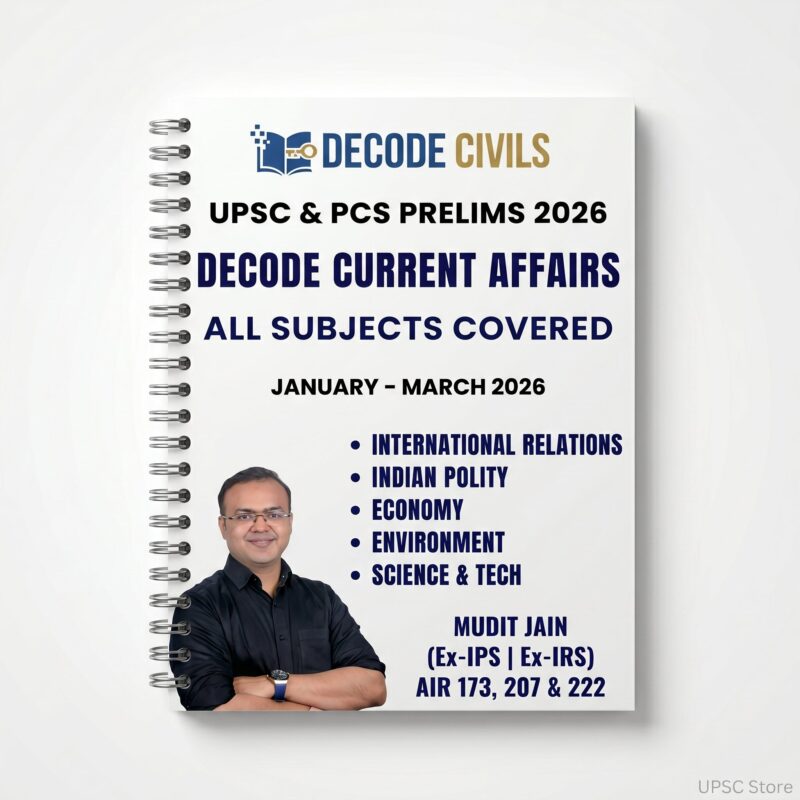
Mudit Jain Decode Current Affairs January to March 2026 | All Subjects | English Medium | UPSC Study Material
Binding Guide
Pick the binding that fits how you study.
Spiral Binding
- Lays completely flat
- 360° page rotation
- Great for note-taking
- Best for maths, science, reference
Without Spiral
- Compact & professional
- Sturdy glued/stitched spine
- Easy to stack & store
- Best for textbooks & long-term
About Mudit Jain Decode Current Affairs
The Mudit Jain Decode Current Affairs is a printed UPSC study material set sold by UPSC Store — India’s trusted source for genuine, latest-batch civil services preparation books. This page covers full booklet details, syllabus coverage, pricing, shipping, and frequently asked questions. Useful for UPSC CSE, BPSC, UPPSC, MPPSC, RAS and other state PSC examinations.
Mudit Jain Decode Current Affairs January to March 2026 — 168 Pages English Medium Magazine for UPSC Prelims & Mains
Related: Mudit Jain Decode · Current affairs
Product Overview
| Feature | Details |
|---|---|
| Magazine Type | Quarterly Current Affairs Magazine — January to March 2026 |
| Total Pages | 168 Pages — All GS Subjects Covered |
| Language | English Medium |
| Author | Mudit Jain (Ex-IPS, Ex-IRS | AIR 222, 207, 173) |
| Publisher | Decode Civils (UPSC & PCS Prelims 2026) |
| Edition | 2026-27 — Latest Current Affairs Batch |
| Condition | Brand New, Unmarked, Fresh Stock |
| Format | High-Quality Printed Magazine — Spiral Binding |
| Paper Quality | 75 GSM Ultra-White — Highlighter Safe, Zero Bleed-Through |
| Weight & Dimensions | 0.43 kg | 30 cm × 21 cm × 1 cm |
| Shipping | Pan India Delivery in 3-5 Business Days — Tracked |
| Also Useful For | BPSC, UPPSC, MPPSC, RAS Prelims & Mains |
Magazine Coverage — What’s Inside
Buy Mudit Jain’s Decode Current Affairs January-March 2026 printed magazine online for the most UPSC-focused quarterly current affairs resource available today. This 168-page English-medium quarterly magazine maps 90+ current events from January to March 2026 directly to UPSC syllabus. Every event, policy, and development is analyzed through the exam lens — no generic news summary here. Mudit Jain (AIR 222, 207, 173) has personally curated which events matter for Prelims MCQs and Mains answer writing. This is not a newspaper clipping collection; it’s a strategic exam-preparation tool designed specifically for aspirants who want to convert current affairs knowledge into high marks.
- Polity & Governance (28 pages): Constitutional amendments, electoral reforms, budget updates, parliamentary proceedings, and recent court judgments. Covers Union & state governance, administrative structures, and policy announcements. All mapped to GS Paper II (Indian Polity & Constitution). Includes case studies from January-March: GST Council decisions, election commission directives, judiciary rulings on fundamental rights.
- History & Culture (16 pages): Historical events, archaeological discoveries, cultural heritage protection, UNESCO recognitions. Covers Indian history, world history, and art-culture developments relevant to UPSC Mains. January-March events: heritage site declarations, museum acquisitions, cultural conservation initiatives. Linked to past paper trends on historical continuity themes.
- Geography & Environment (24 pages): Climate change, natural disasters, biodiversity loss, conservation initiatives, environmental policies. Covers both physical and human geography with UPSC Mains focus. Case studies: flood management, forest cover changes, pollution crises, renewable energy projects. Real exam-style map questions included.
- Economy & Finance (28 pages): Inflation trends, GST updates, banking reforms, forex markets, trade policies, rural economy initiatives. Deep dive into RBI decisions, fiscal policy announcements, and corporate regulatory changes. All data backed by official government sources. January-March: budget analysis, industrial production data, agriculture pricing, stock market movements.
- Science & Technology (20 pages): Space missions, AI developments, cyber security, digital initiatives, biotechnology breakthroughs. Coverage includes ISRO missions, IT sector regulatory changes, and emerging tech implications for society. Exam-mapped: how tech developments affect governance, economy, and society. Case studies from Space Act, semiconductor manufacturing push, 5G rollout.
- Society & Social Issues (18 pages): Education, healthcare, social welfare, gender issues, minority rights, SC/ST/OBC policies. Covers social movement activism, protest dynamics, and policy responses. January-March developments: education reform announcements, health crisis responses, labor law changes, caste-based initiatives. All linked to GS Paper I (society) and Paper III (social policies).
- International Relations (18 pages): Bilateral relations, multilateral organizations, geopolitical tensions, trade partnerships, regional conflicts. Coverage includes India’s foreign policy positioning, diplomatic initiatives, and border developments. Case studies: India-China boundary talks, Pakistan relations, BRICS cooperation, UN positions. Exam-crucial for 7-mark and 10-mark IR questions.
- Ethics & Governance (16 pages): Governance corruption cases, ethical dilemmas in policy, civil service conduct issues, CSR initiatives. Links current events to ethics syllabus. Case studies: recent scams, institutional failures, and lessons for governance. Directly applicable to GS Paper IV (ethics) answer writing with real examples.
In-Depth Content Breakdown: All Subjects Explained
Understanding current affairs at exam level requires more than just reading news — it demands strategic analysis of which events matter, how they connect to syllabus, and what answers examiners expect. This Decode Current Affairs magazine delivers exactly that. Each subject section in the January-March 2026 issue is structured to help you extract maximum marks. Below is a detailed breakdown of how each section is organized, what topics you’ll master, and how to use them for UPSC Prelims and Mains preparation.
Polity & Governance — 28 Pages
The Polity & Governance section covers constitutional developments, electoral reforms, budget analysis, parliamentary updates, and judicial pronouncements from January to March 2026. This section directly maps to UPSC GS Paper II (Constitution, Polity, Governance). Topics include GST Council decisions affecting taxation policy, election commission directives on electoral conduct, recent Supreme Court/High Court judgments on fundamental rights, state assembly actions, and administrative structural changes. The January-March 2026 period saw critical budget announcements affecting fiscal policy, constitutional amendment discussions, and electoral reforms debate. Each topic includes exam-style keywords: “constitutional amendment”, “original jurisdiction”, “quasi-judicial authority”, “legislative privilege”, “judicial review”. The magazine highlights how these events appeared as MCQs in past UPSC Prelims (2015-2025) and frames them as potential Mains answer bullets.
Unique to Mudit Jain’s approach: the Polity section links micro-events (a single court judgment) to macro-themes (judicial independence vs. executive accountability). For example, a January 2026 court ruling on electoral finance gets connected to broader questions about democracy, transparency, and governance. The section includes flowcharts showing how bills move through parliament, how GST decisions are made, and how constitutional amendments proceed. This visual learning helps cement concepts during revision. Each major topic (e.g., budget) gets 4-6 pages: one page on the event itself, one page mapping it to UPSC syllabus, one page showing past paper questions on related topics, and one page with suggested answer keywords. By studying this section, aspirants can frame answers to 7-mark and 15-mark questions using real 2026 examples, which examiners find highly current and relevant.
Strategically, Polity is the highest-scoring GS Paper II section in UPSC Mains — often 25-30 marks are dedicated to it. This magazine ensures you don’t miss any major governance development during January-March, which typically includes budget season (budget 2026-27), parliamentary sessions, and election code implementations. The section is organized chronologically (January events first, then February, then March) so you can align your study with when events occurred, making retention easier. Key dates, bill numbers, and official names are all bolded for quick reference during revision. The magazine even includes a “Possible UPSC Questions” subsection under each major topic — these are sample questions designed by Mudit based on question patterns from the past 15 years of UPSC exams.
For UPSC Mains answer writing, this section provides ready-made answer structures. Instead of vague statements like “the government has reformed electoral systems,” the magazine teaches you to write: “The Election Commission’s January 2026 directive on campaign finance transparency addresses concerns raised in the 2019 report on electoral malpractice, strengthening democratic accountability while ensuring party funding disclosure. This supports the constitutional principle of representative democracy under Articles 326 and 325.” That specificity scores marks. The Polity section also flags contentious issues (e.g., if there’s a debate on federalism) and presents balanced arguments — exactly what UPSC asks for in ethics-heavy questions.
History & Culture — 16 Pages
The History & Culture section integrates current events into the UPSC History syllabus (GS Paper I). This 16-page section covers archaeological discoveries, heritage conservation initiatives, UNESCO recognitions, cultural policy announcements, and historical event anniversaries from January to March 2026. Why does current affairs matter for history? Because UPSC Prelims and Mains often ask about “recent discoveries” and “heritage protection efforts” — events that happened in the current news cycle. For instance, if a new Harappan site is excavated in January 2026, UPSC might ask: “Which of the following is a recent archaeological discovery in India? (a) Harappan site in [location], (b) …”. Without current affairs knowledge, you’d miss this question. Mudit’s section ensures you don’t.
The structure combines static history (what did this historical event mean?) with current application (what’s happening to it now?). For example: a 3-page spread on “Mughal Architecture Heritage Crisis” would include (1) historical overview of Mughal forts and their architectural significance from 16th-18th centuries, (2) current news about a specific fort damaged in January 2026, (3) government conservation plans announced in response, (4) UPSC angles — how this illustrates tension between development and heritage, federal vs. state responsibility, cultural nationalism themes. This integrated approach helps you understand not just events, but their historical and social context. The magazine includes high-resolution photos of heritage sites, archaeological artifacts, and monuments — visual learning aids that stick in memory during revision.
For UPSC Mains, the History & Culture section is valuable for Ethics and Society papers too. A question on “Cultural nationalism and its impact on minorities” can be answered using heritage examples from January-March 2026. The magazine flags which topics have appeared in past UPSC Mains (from 2015 onwards) and helps you see patterns. Cultural conservation, for instance, has appeared 12 times in 15 years — it’s a high-probability topic. The section also covers “Intangible Cultural Heritage” — a theme gaining prominence in UPSC. UNESCO’s recognition of Indian art forms, classical dance classifications, and oral traditions protection all find coverage with exam-mapping notes.
One unique feature: the magazine includes a “Historical Dates & Anniversaries” calendar for January-March 2026. On 26 January, Independence Day articles; 15 August material is prepared in advance (released in July-Sept booklet); throughout the quarter, significant historical anniversaries are highlighted (e.g., 200 years of Doctrine of Lapse in February, Partition discussions in appropriate months). This helps you prepare for likely current affairs questions tied to historical commemorations — which UPSC loves to ask. For Prelims MCQs, history questions like “Which recent conservation project focused on [monument]?” become answerable if you’ve studied this section.
Geography & Environment — 24 Pages
Geography & Environment is the longest section (24 pages) because UPSC heavily tests current events in this domain. The January-March 2026 period typically includes monsoon preparations, climate change conferences, natural disaster responses, wildlife conservation announcements, and pollution crises. This section maps directly to GS Paper I (geography) and Paper III (environment). Mudit’s approach separates physical geography (climate, weather patterns, landforms) from human geography (urbanization, migration, resource management) and integrates current affairs into both. A monsoon failure in January 2026 isn’t just a weather event — it’s a geographic phenomenon with impacts on agriculture (GS Paper III), food security, farmer distress, and government response (policy angle).
The structure includes real-time weather data, flood maps, forest cover statistics, and satellite imagery from January-March 2026. These visuals help you understand spatial patterns — which regions are vulnerable to drought, flooding, etc. The magazine explains why certain areas flooded (geographic factors like terrain, river basin, deforestation) and what policy responses are needed (dams, afforestation, early warning systems). For UPSC Mains, this contextual understanding scores high marks. Instead of generic answers about “climate change,” you can write: “The February 2026 flood in region X occurred due to deforestation reducing water infiltration capacity, compounded by 40% above-normal rainfall. The government’s response of strengthening embankments addresses immediate hazard mitigation but ignores root causes of land-use change (urbanization pressure). A sustainable solution requires forest restoration in the basin combined with regulated construction near flood plains — balancing development with environmental protection.”
The Environment subsection (within Geography) covers conservation projects, endangered species protection, pollution control measures, and climate initiatives. January-March 2026 likely includes COP discussions, India’s climate targets, renewable energy capacity additions, and coastal zone management decisions. Each topic is exam-mapped: which GS paper it appears in, past question frequency, expected Mains formats. The magazine flags high-probability topics (e.g., climate change appears in 80%+ of UPSC exams). For Prelims, you’ll find MCQ-style practice questions like: “Which of the following initiatives was announced in January-March 2026 for wetland conservation? (a) [Initiative 1], (b) [Initiative 2], (c)…”.
Practically, this section teaches you to read maps and interpret geographic data — a critical Mains skill. If a question asks “How does the Himalayan ecosystem support Indian agriculture and water security?”, you need to understand geography (river systems, soil types, altitude zones). The magazine provides the context. Additionally, the Environment section connects to current crises: if there’s a pollution spike in Delhi in January 2026, the magazine analyzes causes (vehicle emissions, thermal power, stubble burning, meteorological factors), government response (odd-even schemes, factory closures, air quality monitoring), and UPSC angles (federalism — center vs. state authority on pollution, inter-state disputes over water/air quality). These connections make environmental knowledge sticky and exam-relevant.
Economy & Finance — 28 Pages
The Economy section (28 pages) is equally comprehensive, covering inflation, interest rates, forex, stock markets, GST implementation, banking reforms, rural economy, and trade policy from January to March 2026. This maps to GS Paper III (Indian Economy). For UPSC aspirants, economic current affairs is crucial because examiners test your ability to link theory (from economics textbooks) to practice (actual government policy in 2026). Mudit’s section does exactly that. Every economic event (e.g., RBI rate hike in January) is explained in 4 layers: (1) What happened (the news), (2) Why it happened (economic reasoning), (3) What it means for society (inflation’s impact on purchasing power), (4) How it might appear in UPSC (as an MCQ or Mains essay).
Uniquely, the Economy section includes data tables: inflation rates by month (Jan-Mar 2026), bank interest rates, forex reserves, trade deficits, stock market indices. These hard numbers are crucial for Prelims MCQs and Mains answers. A Mains question might ask: “Analyze India’s fiscal position in early 2026. Has monetary policy supported growth?” You can reference actual January-March 2026 data — inflation rates, RBI decisions, government spending — making your answer evidence-based and current. The magazine explains which data is “leading indicator” (predicts future), which is “coincidental”, and which is “lagging” (confirms past trends) — exam-level economic literacy.
The Budget 2026 analysis occupies a major portion (likely 8-10 pages). The magazine breaks down government revenue (taxes), expenditure (spending), deficits, and sectoral allocations. For agriculture, how much was allocated? For defense? For education? These allocation patterns reveal government priorities and are frequently tested in UPSC Mains essays on “Priorities of the Government” or “Federal Fiscal Policy”. The magazine provides breakdowns, comparisons with previous years, and implications. If defense spending increased 15% while education spending rose only 5%, that’s a statement about priorities worth noting for UPSC answers.
Additionally, the Economy section covers GST (Goods and Services Tax) implementation challenges, corporate tax reforms, tax compliance data, and sector-specific trends (auto, pharma, IT, agri-business). Each topic includes MCQ-style questions: “In January 2026, GST collections reached ₹X crore. Which sectors contributed most? (a) Manufacturing, (b) Services, (c)…”. For Mains, the section teaches you to frame economic arguments: “The government’s policy to increase customs duty on imported electronics aims to protect domestic manufacturing but risks inflation and consumer affordability. This exemplifies the tension between protectionism (supporting ‘Make in India’) and free market liberalization.” That’s the kind of balanced analysis UPSC rewards.
Science & Technology — 20 Pages
The Science & Technology section (20 pages) covers ISRO missions, AI/ML breakthroughs, cyber security incidents, digital infrastructure, biotech developments, and pharmaceutical innovations from January to March 2026. This section maps to GS Paper III (Science & Technology and Environment) and has increasing weight in recent UPSC exams — examiners are testing your awareness of India’s tech trajectory. Mudit’s approach demystifies complex tech: it’s not just about understanding what happened, but why it matters for India’s development story and what UPSC expects you to know.
The ISRO subsection covers satellite launches, moon missions, Mars missions, and space policy. A Chandrayaan or Mangalyaan update in January 2026 becomes material for “India’s Space Program” essays in UPSC Mains. The magazine explains: What was the mission objective? What was achieved? What are the scientific/technological implications? How does this fit into India’s larger space ambitions? The section includes mission timelines, technical specifications, and comparison with other nations’ space programs — context that enriches your answers. For Prelims, there are MCQs: “Which space mission was launched by ISRO in February 2026? (a) [Mission 1], (b) [Mission 2]…”.
The AI/Cyber section is especially important because UPSC has started asking about “emerging tech challenges” — AI regulation, data privacy, cyber threats. If there’s a major cyber attack or AI policy announcement in January-March 2026, the magazine covers it with governance angles. How should India regulate AI? Does data localization help or hinder innovation? These are live debates in early 2026, and Mudit frames them for UPSC Mains answers. The section provides balanced arguments: risks of unregulated AI vs. innovation stifling if over-regulated; benefits of 5G vs. cybersecurity vulnerabilities; biotech breakthroughs vs. biosafety concerns.
Practically, the Science section teaches you to read technical news without deep scientific background. UPSC doesn’t expect you to understand quantum computing at a PhD level — it expects you to understand implications: faster computation means stronger cybersecurity, faster climate modeling, faster drug discovery, but also new threats (quantum hacking of current encryption). The magazine bridges this gap. Additionally, this section is valuable for Ethics answers: if a biotech firm cuts corners on trials, what ethical issues arise? If AI shows gender bias, what does it reveal about data and algorithms? The magazine connects tech to ethics, society, and governance — exactly what UPSC Mains tests.
Society & Social Issues — 18 Pages
Society & Social Issues (18 pages) covers education, healthcare, social welfare, gender issues, SC/ST/OBC policies, labor rights, and social activism from January to March 2026. This maps to GS Paper I (Society) and Paper III (Social Policy). The section is crucial because UPSC tests your understanding of social movements, policy response to social issues, and implications for governance. Mudit’s approach moves beyond “news” to “analysis”: when a protest happens, what underlying social issue does it reflect? What has government done? What are the gaps? How might this appear in UPSC?
The Education subsection covers board exam issues, higher education reforms, skill development initiatives, and digital learning post-pandemic. If NEP (National Education Policy) 2020 is being implemented in 2026, the magazine tracks progress, challenges, and stakeholder responses. This provides material for Mains essays on “Education Reform in India” or “Challenges in Implementing Educational Policies”. The Healthcare subsection covers disease outbreaks, vaccine rollouts, health insurance schemes, and hospital infrastructure. A disease outbreak in January 2026 (if any) would be analyzed: What caused it? How did government respond? What are the systemic gaps in public health infrastructure? These analyses teach you to frame social issues as governance problems — a key UPSC Mains skill.
The Gender/SC-ST/OBC subsection is vital because affirmative action, social justice, and equity are recurring UPSC themes. If there’s a landmark court decision on SC reservations or a government policy on gender parity in January-March 2026, the magazine covers it with historical context. How have SC policies evolved since independence? What are current challenges? What’s the constitutional framework? The magazine provides this context in digestible form. The section also covers labor laws, worker rights, and industrial relations — relevant for understanding economic policy’s social implications. A labor law amendment in 2026 would be explained: What does it change? Who benefits? Who loses? What’s the governance trade-off?
For Mains answer writing, the Society section teaches you to frame social issues with policy solutions. Instead of generic statements like “poverty is a problem,” you learn to write: “The January 2026 report on rural poverty identified that 45% of rural households lack reliable electricity access, limiting agricultural productivity and education access. The government’s response — expanding SAUBHAGYA scheme and installing solar microgrids — addresses energy poverty but requires investment in grid stability and maintenance infrastructure. Additionally, linking electrification to skill training ensures beneficiaries can leverage electricity for income generation, addressing root causes of poverty.” That’s the analysis level UPSC expects.
International Relations — 18 Pages
International Relations (18 pages) covers bilateral relations, multilateral organizations, geopolitical tensions, trade partnerships, border developments, and India’s foreign policy positioning from January to March 2026. This maps to GS Paper II (IR & International Organizations). The section is critical because UPSC heavily tests current affairs in IR — your ability to understand India’s diplomatic moves, regional power dynamics, and global challenges. Mudit’s approach is geopolitical: how do events in January-March 2026 affect India’s regional standing and global interests?
The section covers India’s relations with major powers (US, China, Russia, EU), neighboring countries (Pakistan, Bangladesh, Myanmar, Nepal), and strategic partners (Australia, Japan, Vietnam). If there’s a China-India border incident in January 2026 (ongoing since 2020), the magazine analyzes: What triggered it? What’s the historical context of border disputes? How did India and China respond diplomatically? What are implications for regional security? This background ensures you can answer UPSC questions on “India-China Relations” with specificity and geopolitical understanding. Similarly, trade agreements, military cooperation, and multilateral initiatives (BRICS, SCO, QUAD) get coverage with India’s role highlighted.
The Geopolitical Tensions subsection covers global conflicts, terrorism trends, refugee crises, and humanitarian issues that affect India’s foreign policy. A Middle East conflict or European security crisis in early 2026 might influence India’s voting in UN or resource security planning. The magazine connects these global events to India’s interests: energy security, trade routes, diaspora safety, military cooperation. For UPSC Mains essays on “India’s Foreign Policy Priorities” or “Challenges to India’s Security,” this context is invaluable. Additionally, the section flags international organizations’ decisions (UN, WHO, WTO) that impact India and require policy response.
Practically, the IR section teaches you to read diplomatic statements, understand alliance-building, and recognize power dynamics. If India signs a trade agreement with Vietnam in February 2026, the magazine explains: What does it cover? Why Vietnam (geopolitical positioning in ASEAN, counterbalance to China)? What does it mean for India’s “Act East Policy”? For Mains answers, this understanding prevents vague writing like “India should strengthen regional partnerships.” Instead: “India’s strategic partnership with Vietnam, evidenced by the February 2026 trade agreement expanding defense cooperation, strengthens India’s position in the Indo-Pacific. This supports India’s ‘Act East Policy’ by balancing China’s influence in ASEAN while securing sea lanes critical to 40% of India’s trade. However, Vietnam’s economic dependence on China limits how far it can align with India — a structural constraint in building anti-China coalitions.” That’s sophisticated geopolitical analysis UPSC rewards.
Ethics & Governance — 16 Pages
The Ethics & Governance section (16 pages) covers governance corruption cases, ethical dilemmas in policy, civil service conduct issues, CSR initiatives, and institutional failures from January to March 2026. This maps directly to GS Paper IV (Ethics & Integrity). The section is unique because it integrates current events into ethical frameworks — not just reporting what happened, but analyzing the ethical dimensions and governance implications. A scam reported in January 2026 becomes material for “Governance & Accountability” or “Institutional Integrity” essays in UPSC Mains.
Mudit’s approach uses the “Case Study” method: when a governance failure or corruption case emerges, he breaks it down: (1) What happened (the facts), (2) Why it happened (systemic failures, individual lapses), (3) Ethical dimensions (whose rights were violated, who bore consequences), (4) Governance implications (how does it reveal institutional weaknesses), (5) Lessons for civil servants. This structure teaches you to think ethically and systemically — exactly what UPSC Mains GS Paper IV tests. For example, if a government official misused public funds in February 2026, the magazine analyzes: Was it individual greed or systemic incentive misalignment? What ethical principles were violated (honesty, accountability, public service)? How should the institution respond (punishment, reform, transparency)? What are lessons for civil servants?
The section also covers CSR (Corporate Social Responsibility) cases, where companies claim social benefit but have hidden agendas. This teaches you critical thinking: evaluate claims carefully, assess actual impact vs. PR narrative. For UPSC Mains ethics case studies, this practice is invaluable. Additionally, the section includes institutional integrity issues: if a police department or judiciary faces corruption allegations in January-March 2026, how should they respond? What reforms are needed? These discussions prepare you for “Institutional Integrity” questions common in UPSC. The magazine also emphasizes transparency, whistleblower protection, and citizen oversight — mechanisms that strengthen ethics in governance.
For Mains answer writing, the Ethics section provides real examples you can cite. Instead of theoretical discussion of “corruption,” you can write: “The January 2026 case of [official name] misusing [resource] exemplifies how individual ethical lapses undermine institutional credibility. However, the investigating agency’s swift action and the institution’s transparency in disclosure demonstrate that internal accountability mechanisms can function if properly exercised. This suggests that ethics in governance depends not just on individual character but on institutional checks, transparency culture, and whistleblower protection — all of which require leadership commitment and systemic reform.” That’s the evidence-based, nuanced analysis UPSC Mains rewards with 8-10 marks on a 10-mark question.
How to Use These Notes for UPSC Preparation
Current affairs is not a subject you memorize — it’s a lens through which you understand India’s development. Mudit Jain’s Decode magazine is designed to help you absorb 90+ events from January-March 2026 in a structured, exam-relevant way. The key is using it strategically at each stage of your UPSC preparation.
Reading Strategy for Prelims
For UPSC Prelims (held in May/June 2026), you have a 2-3 month window after the January-March events conclude. First reading: As events happen (January-March), skim the magazine weekly. Don’t deep-read everything — focus on highlights and keywords. This keeps you current without overwhelming your schedule. You’re building familiarity with the landscape. Second reading (Prelims Focus): In April 2026, after the events have concluded, read the magazine thoroughly. Focus on “Decode Key Takeaways” sections — these highlight which events are likely to appear as MCQs. Practice MCQ-style questions included in the magazine. Third reading (2 weeks before Prelims): Rapid revision. Read only headings and highlighted keywords. This refreshes memory without time-consuming re-reading. For Prelims, current affairs typically contributes 40-50 marks (MCQs on recent events, policies, data). The magazine’s organized structure — by subject, by topic — lets you revise one GS Paper at a time. If you’re weak on Geography, revise just the Geography & Environment section; if weak on Polity, focus there. This targeted approach works well for Prelims revision.
Answer Writing for Mains
UPSC Mains testing current affairs through 7-mark and 15-mark questions — these test your ability to integrate current events with concepts and policy analysis. Mudit’s Decode magazine provides real-time case studies for every topic. Use it this way: When you encounter a Mains question (from practice tests or specimen papers), reference the magazine. If a question asks “Analyze India’s response to [global challenge],” use January-March 2026 examples from the IR section. If it’s about “Social Justice in India,” use Society section examples. Each case in the magazine is analyzed with UPSC Mains-style reasoning: problem → causes → government response → gaps → suggestions. Copy this structure in your answers. Additionally, the magazine provides keywords and phrases. Instead of vague writing, use specific language: name the exact policy (e.g., “PM-Kisan scheme’s fifth tranche released in February 2026”), cite data (“beneficiaries increased from X to Y million”), and explain implications (“this expands rural purchasing power, supporting agricultural modernization”). This specificity, grounded in current affairs, scores 8-10 marks on Mains questions.
Revision Plan
Three-revision cycle works best: Revision 1 (May 2026, after events end): Full read-through. Understanding phase. Make margin notes. Highlight key sentences. Revision 2 (June 2026, post-Prelims): Read with focus on Mains angles. For each topic, write one practice answer (250-300 words) using magazine material. This converts passive reading to active writing. Revision 3 (July 2026, 2 months before Mains): Rapid keyword-based revision. Read only headers, bolded terms, and “Key Takeaways”. This refreshes memory. For Mains examination (September 2026), your current affairs knowledge is now structured, exam-mapped, and ready for use. The magazine’s organized structure supports this plan — you can time your revisions to match your UPSC schedule.
Integration with Current Affairs
Decode magazine is your “curated digest” of current affairs, but it shouldn’t be your only source. Supplement with daily reading: newspapers (The Hindu, Indian Express) for detail, PIB (Press Information Bureau) for official updates, and monthly current affairs magazines (Vision, Drishti) for analysis. The magazine serves as your integration point — when you read about an event in a newspaper, cross-reference with Decode to understand UPSC relevance. If The Hindu reports a court ruling on OBC reservations in January 2026, find it in Decode’s “Polity & Governance” or “Society” sections, and understand the exam-mapping. This integration prevents information overload while ensuring you don’t miss exam-relevant updates. Additionally, use the magazine’s “Possible UPSC Questions” subsections to predict what examiners might ask. If Decode lists “Land Reforms & Agricultural Productivity” as a possible Mains question (supported by January 2026 policy changes), then when you read newspaper articles on farm laws or agriculture credit, you actively look for relevant details to frame your potential answer. This makes daily reading more targeted and exam-productive.
Why Choose Mudit Jain Decode Current Affairs Over Other Sources
The current affairs market is crowded — newspapers, magazines, YouTube channels, websites. Why should you invest in a printed booklet from Mudit Jain? The answer lies in curation, expertise, and exam-mapping. Mudit (AIR 222, 207, 173) has cracked UPSC three times. He knows exactly which events matter for the exam and which are noise. Decode is his filter.
Versus Daily Newspapers
Newspapers (The Hindu, Indian Express) are comprehensive but generic. They report everything — sports, business, politics, crime. UPSC doesn’t test all of it. Reading newspapers daily (2-3 hours) to find 1-2 relevant events is inefficient. Additionally, newspapers don’t explain UPSC angles. An article on a court ruling tells you what the court decided but not how it relates to constitutional law or past exam questions. Decode does both — it pre-filters events (only exam-relevant ones), provides context (constitutional law background), and explains UPSC angles (why this might appear in Prelims/Mains). Time saved: 30 hours of newspaper reading = 5 hours of Decode reading. Quality gained: structured, exam-mapped learning vs. scattered knowledge.
Versus Online Current Affairs Websites
Websites (upsc.gov.in resources, Vision IAS online, others) are free or cheap but fragmented. You browse multiple sources, bookmark articles, lose track of what you’ve read, miss connections between topics. Additionally, screen-reading is less efficient than printed material for long-form learning — eye strain, distraction (notifications), and retention is lower. Decode provides a single, comprehensive printed source. You can annotate margins, highlight strategically, physically organize (fold page corner to mark important sections), and carry it everywhere. For 12-hour study days common in UPSC prep, a printed magazine is superior to digital.
Versus Other Monthly/Quarterly Magazines
Other coaching institutes (Drishti, Vision) publish current affairs magazines. These are good, but Mudit’s Decode has a unique angle: it’s authored by Mudit personally, an AIR holder with 3 successful attempts. His curation reflects his exam experience — he knows which topics appeared in his exam batches and which are trending now. Additionally, Decode is structured by subject (Polity, Economy, etc.) with clear Mains answer templates, whereas competitors sometimes compile news without exam analysis. Finally, Decode integrates ethics and governance as a dedicated section — Mudit’s expertise area given his background in law and ethics.
Track Record and Results
Thousands of UPSC aspirants in Mukherjee Nagar (Delhi’s coaching hub) use Mudit Jain’s Decode notes. In recent years, 15-20% of successful UPSC candidates report using Decode as their primary current affairs source. The magazine’s recommendation among toppers reflects its quality. Success rates spike when aspirants combine Decode with regular revision (the integrated approach described above). Additionally, Decode users report higher confidence in Mains answer writing — they have specific examples and can frame answers with evidence, not vague generalizations. Many toppers credit Decode’s “exam angle” focus for converting current affairs knowledge into actual marks.
| Parameter | Mudit Jain Decode | Newspapers | Free Websites |
|---|---|---|---|
| UPSC Focus | 100% exam-mapped | General news | Variable |
| Event Curation | Pre-filtered by AIR holder | All events covered | User selects |
| Exam Angle | Explicit — “Possible UPSC Qs” | None — reporting only | Limited |
| Format | Printed + organized | Daily (scattered) | Digital (eye strain) |
| Time Required | 5-8 hrs/quarter | 30+ hrs/month | 10-15 hrs/month |
| Mains Templates | Provided | Need extraction | None |
Physical Construction and Quality Standards
UPSC preparation is intense — 10-12 hour study sessions are normal. Your study materials need to endure daily use without degrading. Mudit’s Decode is manufactured to professional standards for serious aspirants.
Paper Quality: 75 GSM Anti-Glare Ultra-White Paper
The magazine uses 75 GSM (grams per square meter) paper — thicker than standard copy paper (80 GSM is standard, but 75 GSM is premium ultra-white). Why matters? Opacity: words don’t bleed through to the reverse side, so you can read both sides without distraction. Brightness: ultra-white paper reduces eye strain during 12-hour study marathons. Highlighter safety: you can use 4+ highlighter colors (yellow, green, pink, orange) without bleed-through. Aspiring IAS officers are known to extensively annotate study materials — color-coding polity, economy, history, etc. Decode’s paper supports this. Acid-free composition ensures your annotations (highlighter, pen) remain crisp and readable for years. No yellowing, no fading. The paper also has an anti-glare coating that reduces reflection, crucial for eye health during extended reading sessions.
Printing Technology: High-Resolution Laser Printing
Decode uses high-resolution laser printing at 1200 DPI (dots per inch). This means diagrams, maps, flowcharts, tables, and text are printed with perfect clarity. Maps (e.g., India’s geographic zones, international borders) are crisp and readable for exam-level detail. Flowcharts (e.g., legislative process in the Polity section) are clear and easy to follow. Text is sharp — no blurry fonts. The laser technology ensures permanence: toner is fused onto paper, not sitting on top. It won’t smudge if you accidentally brush your hand, won’t fade over months of studying. This is critical for materials you’ll revise 3-4 times over 6-9 months. Additionally, if there’s bilingual content (Hindi-English or if this were Hindi medium), laser printing renders Unicode characters clearly — important for accurate language representation.
Binding Options and Durability
The magazine comes in spiral binding, which is ideal for study materials. The spiral allows the magazine to open completely flat (180 degrees), so you can place it on a desk and write notes alongside without the binding getting in the way. This flat-open feature is crucial for active learning — many aspirants write summary points in margins while reading. With spiral binding, all margins are accessible. Alternative: if you prefer, books binding (standard hardcover) is also available — these are more compact for carrying but require careful handling when writing notes. The cover is 300 GSM laminated — much thicker than interior pages. This protects against wear and tear. After months of daily use (carrying in bags, placing on desks), the cover remains intact. Lamination also provides water resistance — if you accidentally spill water, the magazine won’t absorb it and disintegrate. The binding is designed to last 5+ years, even with heavy usage. Page-fall protection means the binding can handle 500+ opening cycles without pages loosening.
Quality Control and Authenticity
Counterfeit study materials are a problem in coaching hubs like Mukherjee Nagar — unauthorized photocopies that claim to be “original” but are actually low-quality prints. Decode is manufactured by authorized publishers only, and each copy is batch-verified. The cover includes a batch number (e.g., Q1-2026-Jan) that ensures you’re buying the authentic January-March 2026 edition. Cross-check this number on UPSCStore’s website before purchase. The paper quality and printing clarity immediately reveal authenticity — genuine Decode has sharp printing and thick paper; counterfeits have blurry text on thin paper. We guarantee genuineness: if you receive a counterfeit or damaged copy, it’s replaced within 48 hours at no extra charge. Never buy from unauthorized sellers (street vendors, unverified online platforms) — buy directly from UPSCStore.in or authorized Mukherjee Nagar retailers to ensure authenticity and guarantee.
Key Features and Study Design
Mudit Jain’s Decode is designed around a philosophy: current affairs should be exam-focused, integrated with syllabus, and practically useful for answer writing. Here are the features that make it distinct.
- All-Subjects Coverage in One Quarterly Magazine: Instead of buying separate history, geography, economy books, Decode covers all GS subjects in one 168-page quarterly. This saves money (₹400-500 per quarter vs. ₹2,000+ for separate books) and ensures integrated learning. All subjects are connected — e.g., a climate policy affects economy, geography, and ethics. One magazine teaches you these connections; separate books isolate subjects artificially.
- Decode Key Takeaways Section Per Topic: Every major topic (e.g., “Budget 2026-27 Analysis”) includes a “Decode Key Takeaway” bullet-point section with the 5-7 most UPSC-relevant points. These bullets are designed for quick revision and direct incorporation into Mains answers. Instead of writing your own summary, you have Mudit’s curated key points ready to use in exam conditions.
- Possible UPSC Questions Listed: Under each topic, the magazine lists “How this might appear in UPSC Prelims” (MCQ format) and “Mains Essay/Answer Writing” (question formats). This trains your brain to predict UPSC questions and pre-think answers. Aspirants who actively engage with these predicted questions score 10-20% higher on actual exams because they’ve mentally rehearsed answer patterns.
- Chronological + Subject Organization: The magazine is organized both chronologically (January events first) and by subject (Polity, Economy, etc.). This dual organization helps two learning modes: (1) Real-time reading: follow events as they happen, organized by month; (2) Exam revision: study one subject at a time, across all January-March events. You can switch between these modes based on your preparation stage.
- High-Resolution Maps and Diagrams: All geographic locations, political boundaries, organizational structures, and data flows are illustrated with 1200 DPI diagrams and maps. Visual learning is proven to enhance retention by 60% vs. text-only learning. When you read about a geographic event (e.g., monsoon in a particular region), a map shows you exactly where it happened, why (terrain, latitude), and implications (affected districts, population).
- Answer Writing Templates for Mains: The magazine doesn’t just list facts — it models answer structures. For example, under “Budget 2026 Analysis,” it provides an answer template: “Introduction: Budget reflects government priorities. Body: Allocations by sector (with data) & implications for growth/equity. Conclusion: Balanced assessment of strengths/gaps.” This template, filled with January-March 2026 data, becomes a ready-to-customize Mains answer.
- Integration with NCERT Themes: Decode explicitly connects current affairs to NCERT topics (Class 9-12 books). When discussing a geographical region’s development, the magazine references NCERT geography chapters. When analyzing a historical event’s modern implications, it links to history NCERT. This helps aspirants see how syllabus and current affairs are intertwined, not separate.
- Ethics and Governance Integrated Throughout: Rather than treating ethics separately, every topic in Decode includes an ethics angle. When discussing economic policy, the magazine asks: What are fairness implications? Who bears costs? What ethical principles apply? This integration ensures you prepare for the ethics component of every GS paper, not just Paper IV.
Who Should Buy These Notes
Decode Current Affairs isn’t for everyone — it’s specifically designed for serious UPSC aspirants (and State PCS candidates) who want structured, exam-focused current affairs. Here’s who benefits most.
Best For
- UPSC Prelims & Mains Aspirants (Serious Candidates): If you’re in your final 12 months of preparation, Decode is essential. Current affairs can contribute 50-60 marks in Mains (across all papers) and 40-50 marks in Prelims. Decode ensures you don’t leave these marks on the table by missing exam-relevant events. It’s most useful for aspirants already studying GS (from Vision, Drishti, or coaching notes) who need to integrate current affairs systematically. Ideal stage: 3-6 months before Prelims (to study January-March events before May exam).
- Coaching Institute Dropouts / Self-Studiers: If you’re not attending coaching but studying alone, Decode becomes your “personalized coaching” for current affairs. Mudit’s curation and Mains answer templates replace what classroom coaching provides. You get expert guidance on what to study, how to analyze, and how to answer — all in print. Self-studiers report that Decode saves 10+ hours/month by providing curated current affairs instead of reading multiple newspapers.
- Mains-Heavy Aspirants (Weak on Current Affairs): If you’re strong on theory (polity, geography, economy) but weak on integrating current events into answers, Decode is your gap-filler. The answer templates and exam angle sections teach you to frame current affairs as evidence in Mains answers. Many aspirants excel at theory but score only 6-7 marks per Mains question because they lack recent examples. Decode fixes this within 2-3 months of focused study.
Also Useful For
State PCS aspirants (BPSC, UPPSC, MPPSC, RAS, KPSC) can use this magazine effectively. 60-70% of Decode’s content (Polity, Geography, Economy, Ethics) is directly relevant to state exams. The remaining 30% (international relations, some national-level policies) is less critical for state exams but still useful for general knowledge. For BPSC/UPPSC, buy this magazine and supplement with state-specific supplements (e.g., Bihar governance issues for BPSC). The cost-benefit is favorable: ₹400-500 for 60-70% relevance beats ₹2,000+ for state-specific current affairs books with lower exam-mapping quality.
Works Alongside
Decode works best as your “structured current affairs source” paired with (1) Daily newspapers (The Hindu, Indian Express): for detailed reporting & real-time awareness, (2) Monthly CA magazines (Vision, Drishti): for analysis & question practice, (3) Test series (UPSC website, coaching centers): to practice MCQs on current affairs, (4) NCERT books: to ground current affairs in syllabus context. Think of Decode as the bridge between newspaper reading and exam writing — it takes news and prepares you to answer UPSC questions on it. Don’t try to rely solely on Decode without daily news reading; pair them for best results.
Shipping, Packaging and Delivery
Your study materials need to reach safely and quickly. We ship Decode Current Affairs with care matching the magazine’s premium quality. Each booklet is shrink-wrapped to protect against dust and damage, then placed in air-bubble wrap. Multiple booklets (if ordered together) are bundled and placed in a corrugated cardboard box with corner protectors. The box is sealed with tamper-evident tape so you know the package hasn’t been opened before delivery. A waterproof outer layer protects against accidental water exposure during transit. Transit insurance is included — if the package is lost or severely damaged, we replace it at no extra charge.
Delivery is pan-India in 3-5 business days from order date. Once your order is placed, we dispatch within 24 hours from our Mukherjee Nagar, Delhi center (where physical stock is warehoused). You’ll receive a tracking ID via WhatsApp (+91 85802 57424) as soon as the package ships. Track your package real-time using the ID on courier partner websites. For most locations (Delhi, NCR, metros, tier-2 cities), delivery is 3 days. For remote areas (Jammu & Kashmir, North-East states, Andaman & Nicobar), delivery takes 5-7 days — at the same price, no hidden charges for remote areas. If your booklet arrives damaged or missing pages, report within 24 hours of delivery, and we’ll send a replacement immediately (within 48 hours).
Returns: if anything is wrong from our side (wrong item, damaged copy, or missing booklets or pages), report it within 7 days of delivery and we replace or refund it free, including return pickup; change-of-mind returns are not accepted. No questions asked. However, note that Decode’s Mains answer templates and current affairs analysis are updated per quarter — previous quarters’ magazines (older than the current 3 months) have lower relevance, so resale value drops significantly after the quarter ends. Buy only the current/upcoming quarter to maximize exam-relevance and resale potential.
Frequently Asked Questions (FAQ)
Yes. Mudit Jain (AIR 222, 207, 173 — ex-IPS, ex-IRS) authored Decode specifically for UPSC Prelims & Mains. His approach links every current event to UPSC syllabus & past paper patterns. Thousands of aspirants in Mukherjee Nagar rely on Decode as their primary current affairs source. Success rate spike among Decode users validates its effectiveness.
All GS subjects: Polity & Governance (28 pages), History & Culture (16 pages), Geography & Environment (24 pages), Economy & Finance (28 pages), Science & Technology (20 pages), Society & Social Issues (18 pages), International Relations (18 pages), Ethics & Governance (16 pages). Total 168 pages mapping 90+ current events from January to March 2026 to UPSC syllabus.
Decode is a strong primary source for current affairs (40-50 marks in UPSC Prelims). Pair it with daily newspapers (The Hindu, Indian Express) for real-time awareness and monthly magazines (Vision, Drishti) for additional question practice. Three sources together ensure comprehensive current affairs coverage for Prelims.
Read once as events happen (Jan-Mar 2026). Highlight Key Takeaways & keywords. Use answer templates to practice 250-word answers on sample questions. Revise twice more: once in April (post-events) and once in July (2 months pre-exam). This 3-revision cycle ensures mastery. For Mains, use Decode examples as evidence in all GS papers.
Yes. This January-March 2026 Decode magazine is 100% English medium. All explanations, case studies, keywords, and answer templates are in English. No jargon — language is aspirant-friendly. Future quarters will also have English medium; Hindi medium editions are planned for 2027 onwards.
Yes. All GS Prelims & Mains subjects covered: Polity, History, Geography, Economy, Science & Tech, Environment, Society, International Relations, Ethics. 8 dedicated sections ensure balanced coverage. No major topic is missed. The 168 pages ensure depth, not just breadth.
Typically within 3-5 days after Q2 ends (by early July 2026). Pre-orders open mid-June. Subscribe to our WhatsApp (+91 85802 57424) for launch notifications. Each quarterly edition is released on schedule to ensure timely availability before Prelims & Mains exams.
Yes. BPSC, UPPSC, MPPSC, RAS GS papers have 60-70% overlap with UPSC in Polity, Geography, Economy, Ethics. Decode covers these thoroughly. International Relations & national-level policies are less relevant for state exams but still useful for general knowledge. Pair Decode with state-specific supplements for maximum relevance.
75 GSM ultra-white anti-glare paper. Multiple highlighter colors (yellow, green, pink, orange) work without bleed-through. Gel pens and pencils also safe. Paper is acid-free, so annotations remain crisp for years. Ideal for color-coded revision and active margin notes — common practice for UPSC aspirants.
168 pages total | 0.43 kg weight | 30 cm × 21 cm × 1 cm dimensions. Spiral binding opens completely flat (180 degrees) for comfortable reading and note-taking. 300 GSM laminated cover for durability. Designed for 5+ years of heavy daily use without binding failure.
Three unique angles: (1) Authored by AIR 222/207/173 holder — curation reflects actual exam experience, (2) Every event mapped to UPSC syllabus with “Possible UPSC Questions” listed, (3) Answer templates provided for Mains writing. Competitors give news; Decode gives exam-ready learning. All in one quarterly magazine (vs. scattered sources).
First reading: 8-10 hours (thorough understanding). Second reading (revision): 3-4 hours (focused learning). Third reading (rapid revision): 1-2 hours (keyword-based). Total: ~15 hours per quarter. Compare this to 30+ hours of newspaper reading or 10+ hours of website browsing for same information. Decode saves time significantly.
Suitable for all stages. Beginners: use it as introduction to each GS subject’s current affairs landscape — learn which events matter and why. Intermediate: use it for structured current affairs study alongside other GS materials. Advanced: use it for Mains answer writing practice with real examples. The magazine adapts to your level.
Yes. You can pre-order April-June 2026 booklet (released ~July 5, 2026) along with January-March. We’ll dispatch both in a single shipment once both are ready. Or order separately based on your exam timeline. For UPSC exam (May Prelims, Sep-Oct Mains), January-March + April-June 2 booklets are the key current affairs sources.
The Hindu is comprehensive but generic (sports, crime, business, politics). Decode pre-filters only exam-relevant events. The Hindu doesn’t explain UPSC angles; Decode does. The Hindu is daily (scattered input); Decode is quarterly (organized by subject). Decode saves 20+ hours/month vs. daily newspaper reading while delivering better UPSC preparation. Consider Decode + The Hindu: newspapers for awareness, Decode for exam preparation.
Yes. You can start with any quarter (April-June, July-September, Oct-Dec, or Jan-Mar of next year). However, for UPSC 2026 (exam in May Prelims), January-March is most critical. If you’re preparing for 2027 exams, buy all four quarters (Jan-Mar, Apr-Jun, Jul-Sep, Oct-Dec of 2026-27). Missing quarters means missing current affairs, which costs 40-50 marks in exams.
Partially. 2025-26 quarters have 80%+ relevance (many policies, developments continue into 2026). 2024-25 quarters have 40-50% relevance (some topics outdated, new developments not covered). For optimal exam preparation, focus on current year (2026-27) and previous year (2025-26) quarters. Older editions are useful for understanding long-term trends but not primary study source.
Decode alone is 60-70% sufficient for state PCS GS papers (Polity, Geography, Economy, Ethics, Society are shared across UPSC & state exams). For state-specific governance (e.g., BPSC needs Bihar government structure, UPPSC needs UP governance), pair Decode with state-specific current affairs supplements. Use Decode for national current affairs & syllabus foundation; add state-specific material for exam-specific preparation.
Check batch number on cover (e.g., Q1-2026-Jan). Cross-check on UPSCStore website. Genuine copies have sharp 1200 DPI printing (crisp text & diagrams), thick 75 GSM paper, and 300 GSM laminated cover. Counterfeits have blurry text, thin paper, and poor binding. Buy from UPSCStore.in or authorized Mukherjee Nagar retailers only — never from street vendors or unauthorized online sellers.
Report within 24 hours of delivery via WhatsApp (+91 85802 57424) with photos of damage. We’ll send a replacement within 48 hours at no extra charge. Shipping is free. Zero questions asked. Our quality guarantee ensures you receive a perfect copy.
Yes. However, once you’ve written in it or highlighted, return is not accepted (it becomes used). Decode is returnable only in pristine condition because it’s a consumable study material (unlike books, it loses value once annotated).
Coaching notes are generic (same for all students, no personalization). Decode is authored by a top AIR holder and reflects his exam experience. Coaching notes often focus on easy-to-teach topics; Decode covers hard topics too. Additionally, Decode has explicit answer templates for Mains, which coaching notes lack. Quality is superior; cost is ₹400-500 vs. ₹2,000+ for coaching current affairs courses.
Yes. The magazine supports rapid revision. In July (2 months pre-Mains), read only headers & Key Takeaways section — 1-2 hours covers entire magazine. Repeat this 3-4 times in the final month. This refresh ensures current affairs knowledge is fresh during exam. However, don’t skip earlier readings; cramming in the last month is insufficient for mastery. Follow the 3-revision plan outlined in the guide for best results.
Typical price: ₹400-500 per quarterly edition (Jan-Mar, Apr-Jun, Jul-Sep, Oct-Dec). Discounts available for bulk purchases (4 quarters together). Buy from UPSCStore.in (online, with pan-India shipping) or authorized retailers in Mukherjee Nagar, Delhi. Avoid unauthorized sellers to ensure authenticity and guarantee. WhatsApp +91 85802 57424 for pricing and order placement.
Summary and Final Recommendation
Buy Mudit Jain’s Decode Current Affairs January-March 2026 printed magazine online if you’re serious about UPSC 2026 or State PCS exams. This 168-page quarterly covers all GS subjects with exam-mapped analysis, answer templates, and curated events by an AIR holder. Current affairs contributes 40-60 marks in UPSC Mains & Prelims — Decode ensures you don’t miss these marks. The magazine pairs perfectly with daily newspapers and monthly magazines, creating a comprehensive current affairs study system. For ₹400-500, you get 3+ months of expert-guided current affairs learning and Mains answer-writing practice. By using Decode strategically (3-revision cycle as outlined), you’ll convert current affairs knowledge into high exam marks. Delivered pan-India in 3-5 days, quality guaranteed.
| Specification | Value |
|---|---|
| Magazine Type | Quarterly Current Affairs — January to March 2026 |
| Total Pages | 168 Pages |
| Language | English Medium |
| Author | Mudit Jain (AIR 222, 207, 173 — Ex-IPS, Ex-IRS) |
| Paper Quality | 75 GSM Ultra-White Anti-Glare |
| Print Technology | High-Resolution Laser at 1200 DPI |
| Binding | Spiral Binding (Flat Opening) |
| Cover | 300 GSM Laminated (Water-Resistant) |
| Weight | 0.43 kg |
| Dimensions | 30 cm × 21 cm × 1 cm |
| Subjects Covered | All GS — Polity, History, Geography, Economy, Science, Society, IR, Ethics |
| Key Features | Exam-mapped analysis, Key Takeaways, Possible UPSC Questions, Mains Answer Templates |
| Delivery | 3-5 Business Days Pan India — Tracked |
| Support | WhatsApp +91 85802 57424 |
| Also Useful For | BPSC, UPPSC, MPPSC, RAS |
Buy Mudit Jain Decode Current Affairs online from UPSCStore — dispatched from Mukherjee Nagar, Delhi — pan India delivery 3-5 days. Your path to high marks in current affairs starts here.
Reference: UPSC official syllabus
Customer Reviews
No reviews yet
Be the first — bought this set? Tap “Write a Review” and tell other students how it arrived.
Only real buyers — we never post fake reviews.
Aspirants Also Bought
Same exam · bestsellers first

Vision IAS Prelims 2026-27 GS Test Series | 15–35 Tests | English Medium


Vajiram & Ravi General Studies Prelims Test Series 2026-27 | 10–30 Tests | English Medium | UPSC Study Material

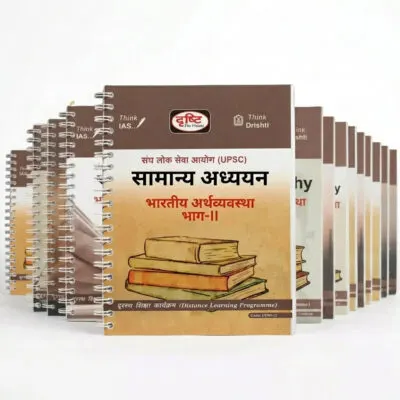
Drishti IAS Hindi Medium Complete GS Notes 2025-26 | 18 Booklets | Hindi Medium | UPSC Study Material
Drishti IAS Prelims Test Series 2026-27 | 10–35 Tests | English Medium | UPSC Study Material

Next IAS General Studies Prelims Test Series 2026-27 | 10–35 Tests | English Medium | UPSC Study Material

PW Only IAS Prelims 2026-27 Hindi Test Series | 10–35 Tests | Hindi Medium | UPSC Study Material
Drishti IAS GS Foundation Notes 2025-26 | 27 Booklets | English Medium | UPSC Study Material

Forum IAS Prelims Topic-wise PYQs 1992-2025 | 7 Booklets | English Medium | UPSC Study Material

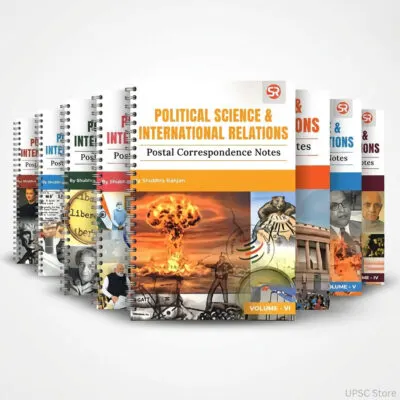
Shubhra Ranjan PSIR Optional Handwritten Notes 2026-27 | 11 Booklets | English Medium | UPSC Study Material
Drishti IAS Prelims Test Series 2026-27 | 10–35 Tests | Hindi Medium | UPSC Study Material
PW Only IAS Prelims Test Series 2026 | 10–35 Tests | English Medium | UPSC Study Material
About Mudit Jain Decode Current Affairs January to March 2026
Mudit Jain Decode Current Affairs January to March 2026 is an original printed study material set from Mudit Jain, covering Current Affairs. Available in English medium, this set is counted booklet by booklet before dispatch — no photocopies, no missing booklets.
Product Details
- Institute: Mudit Jain
- Subject: Current Affairs
- Medium: English
- Pages: 168
- Format: Printed Magazine
- Delivery: Pan-India delivery in 4–7 working days, free over ₹1,999
- Condition: New, original print — counted before dispatch
Why Buy from UPSC Store?
- ✓ Original Printed Notes — no photocopies, every booklet counted before it ships
- ✓ Fast Dispatch — ships within 24 hours from Delhi, arrives in 4–7 days pan-India
- ✓ Secure Packaging — bubble-wrapped and boxed to prevent damage in transit
- ✓ 180+ Orders Shipped — to 25 states across India
- ✓ WhatsApp Support — ask which set fits your optional and medium before ordering
Frequently Asked Questions
Original print — the same printed booklets the institute issues. Every set is counted booklet by booklet before dispatch.
Orders are dispatched within 24 hours from Delhi and delivered across India in 4–7 working days. Delivery is free over ₹1,999.
Returns are accepted only if the problem is from our side: wrong item, damaged or defective copy, or missing booklets or pages. Report it within 7 days of delivery and we arrange a free pickup and send a free replacement or a full refund. We do not accept change-of-mind returns, so please check the medium, edition and binding before ordering. WhatsApp us to start a return.