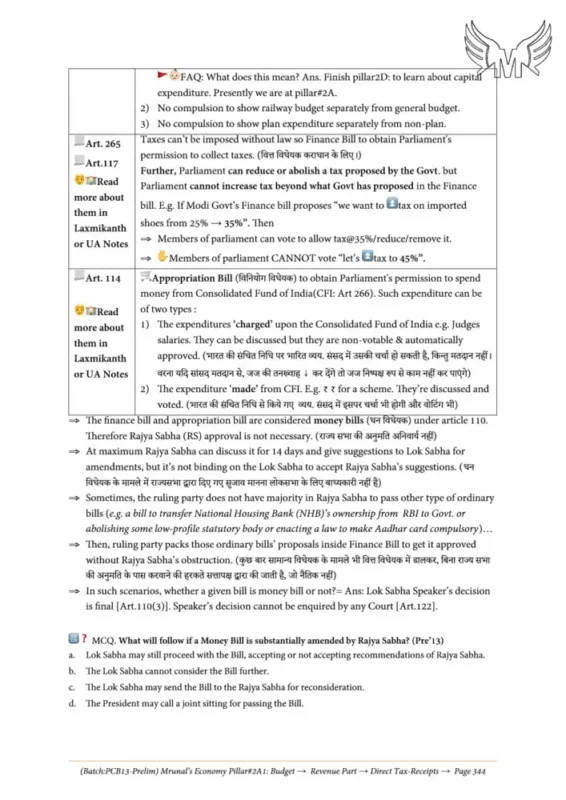
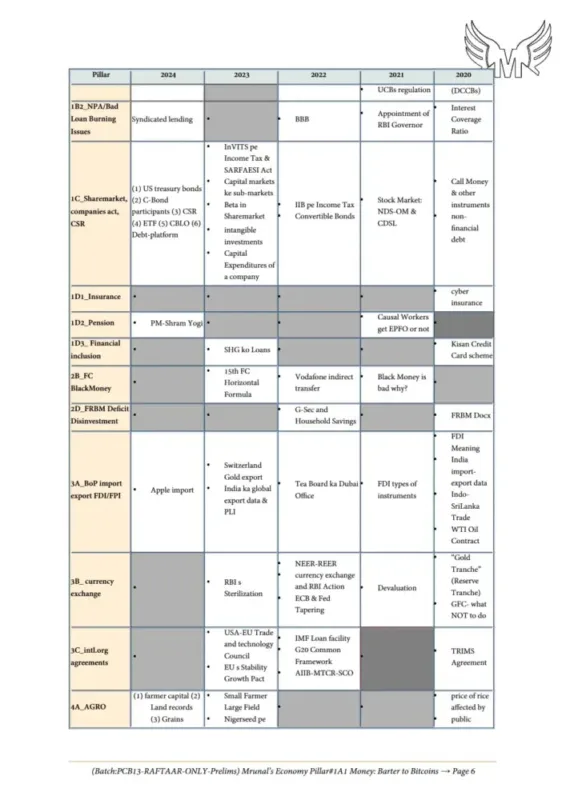
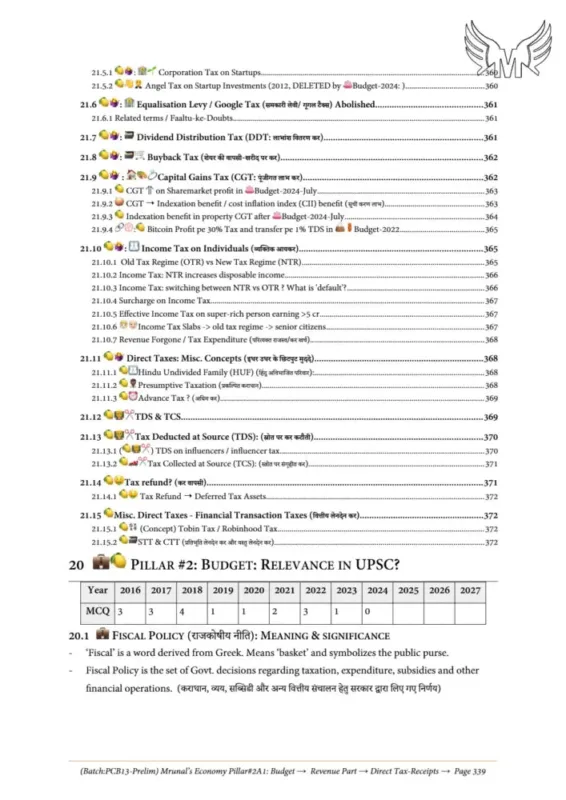
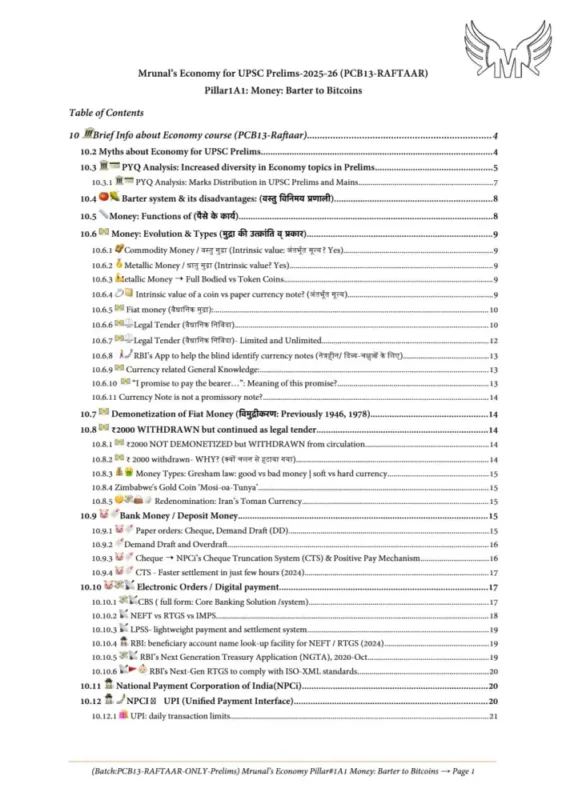



Mrunal Economics Optional Notes 2026-27
About Mrunal Economics Optional Notes 2026-27
The Mrunal Economics Optional Notes 2026-27 is a printed UPSC study material set sold by UPSC Store β India’s trusted source for genuine, latest-batch civil services preparation books. This page covers full booklet details, syllabus coverage, pricing, shipping, and frequently asked questions. Useful for UPSC CSE, BPSC, UPPSC, MPPSC, RAS and other state PSC examinations.
Mrunal Economics Optional Notes 2026-27 β 12 English Medium Printed Booklets for UPSC Mains Economics Optional
Related: Mrunal notes Β· Economics optional
Product Overview
| Feature | Details |
|---|---|
| Booklets Count | 4 Individual Printed Booklets β Full Economics Optional Syllabus Coverage (Paper I + Paper II) |
| Language | English Medium |
| Publisher | Mrunal (Economy Optional Series) |
| Edition | 2026-27 β Latest Genuine Batch |
| Condition | Brand New, Unmarked, Fresh Stock |
| Format | High-Quality Printed Booklets β Spiral or Book Binding |
| Paper Quality | 75 GSM Ultra-White β Highlighter Safe, Zero Bleed-Through |
| Shipping | Pan India Delivery in 3-5 Business Days β Tracked |
| Also Useful For | BPSC, UPPSC, MPPSC, RAS and all State PSC Economics Optional candidates |
Complete Booklet Catalog
This 4-booklet set by Mrunal covers the complete UPSC Economics Optional syllabus across both Paper I and Paper II, structured for aspirants who want focused, exam-oriented notes rather than dense academic textbooks. Each booklet is designed to map directly to UPSC Mains answer-writing, with topic sequencing that mirrors the official syllabus order for easy navigation during revision.
- Booklet 1: Advanced Microeconomics β Consumer Theory and Demand β Covers utility theory, indifference curves, revealed preference theory, consumer surplus, demand elasticities, Engel curves, Slutsky equation, substitution and income effects. Includes worked numerical examples, graphical analysis, and important UPSC-relevant derivations for Paper I microeconomics section.
- Booklet 2: Advanced Microeconomics β Production, Costs and Market Structures β Production functions (Cobb-Douglas, CES, Leontief), returns to scale, isoquants, cost curves, break-even analysis, perfect competition, monopoly, monopolistic competition, oligopoly models (Cournot, Bertrand, Stackelberg), game theory basics, and price discrimination strategies.
- Booklet 3: Macroeconomic Theory β National Income and Classical Models β National income accounting, circular flow, GDP measurement methods, classical macroeconomics, Say’s Law, quantity theory of money, Classical dichotomy, neutrality of money, Pigou effect, and the foundations of modern macro needed for UPSC Economics Optional Paper I.
- Booklet 4: Macroeconomic Theory β Keynesian Framework and IS-LM β Keynesian consumption function, multiplier theory, accelerator principle, IS curve derivation, LM curve derivation, money market equilibrium, IS-LM model, fiscal and monetary policy effectiveness, liquidity trap, crowding-out effect, and Hicks-Hansen synthesis for UPSC Mains.
- Booklet 5: Money, Banking and Financial Markets β Functions and supply of money, money multiplier, credit creation, RBI monetary policy tools (repo, CRR, SLR, OMO), inflation theories (demand-pull, cost-push, structural), Philips curve, stagflation, theories of interest rates, bond pricing, and financial market instruments relevant to UPSC Economics Optional.
- Booklet 6: International Trade Theory β Absolute and comparative advantage, Heckscher-Ohlin theorem, Stolper-Samuelson theorem, Rybczynski theorem, terms of trade, trade policy tools (tariffs, quotas, subsidies), WTO framework, balance of payments, current and capital accounts, and exchange rate determination β essential for UPSC Economics Optional Paper I.
- Booklet 7: Growth and Development Economics β Classical and Keynesian growth models, Harrod-Domar, Solow growth model, endogenous growth theory, Lewis dual-sector model, Rostow’s stages, Myrdal’s circular causation, balanced vs. unbalanced growth, poverty measurement (Head Count Index, Sen Index), inequality (Gini coefficient, Lorenz curve), and Human Development Index.
- Booklet 8: Indian Economy β Planning, Agriculture and Rural Development β Five-Year Plans, NITI Aayog, planning models (Mahalanobis, Gadgil), agricultural productivity, Green Revolution, land reforms, agricultural credit, MSP policy, food security, PDS, rural employment schemes (MGNREGS), cooperative movement, and India’s rural development programmes for UPSC Economics Optional Paper II.
- Booklet 9: Indian Economy β Industry, Infrastructure and Trade Policy β Industrial policy evolution (1948 to present), role of public sector, disinvestment, SEZs, Make in India, MSME sector, infrastructure development (roads, power, telecom), FDI policy, India’s foreign trade trends, export-import policy, trade deficits, and WTO disputes involving India.
- Booklet 10: Indian Economy β Money, Finance and Banking Sector β RBI functions and monetary policy, NBFC regulation, banking sector reforms, NPA crisis, IBC 2016, financial inclusion (Jan Dhan, PM Mudra), capital markets (SEBI), government securities market, fiscal policy, Union Budget components, FRBM Act, fiscal deficit trends, and debt management in India.
- Booklet 11: Indian Economy β Social Sector, Poverty and Human Development β Poverty estimation in India (Tendulkar, Rangarajan Committees), poverty alleviation programmes, social security schemes, education and health sector performance, SDGs and India’s progress, demographic dividend, women’s economic empowerment, nutrition indices, India’s ranking in global human development reports.
- Booklet 12: Current Economic Issues, Data Interpretation and Answer Writing β Recent policy developments, Union Budget analysis, Economic Survey highlights, important economic data tables, practice questions with model answers, essay-format answers for optional Paper II, tips for 20-mark and 10-mark economics answers, and UPSC Economics Optional previous year question analysis.
In-Depth Content Breakdown: Booklet by Booklet
Booklet 1: Advanced Microeconomics β Consumer Theory and Demand
Booklet 1 forms the foundation of UPSC Economics Optional Paper I by covering consumer behaviour theory in depth. Topics span cardinal and ordinal utility, budget constraints, indifference curve analysis, and the derivation of individual demand curves. The Slutsky equation, which separates substitution and income effects, is explained with algebraic steps alongside diagrams β a favourite in UPSC Mains for 20-mark questions. Revealed preference theory (Samuelson), compensating variation, and equivalent variation are included with their standard UPSC question formats.
The booklet uses a two-column layout alternating between concept explanation and graphical illustration, making abstract demand theory visually accessible. Consumer surplus, producer surplus, and deadweight loss are presented with labelled diagrams ideal for direct reproduction in answer sheets. Elasticity concepts β price, income, and cross-elasticity β are covered with ready-to-use formulas and real-world examples. Engel curve derivations for normal, inferior, and Giffen goods are explained alongside common UPSC question patterns to help aspirants write precise, marks-maximising answers.
Booklet 2: Advanced Microeconomics β Production, Costs and Market Structures
This booklet addresses production theory and market structure β both heavily tested in UPSC Economics Optional Paper I. Production functions including Cobb-Douglas and CES are derived and compared, with isoquant and isocost analysis explained step by step. Short-run and long-run cost curves are differentiated clearly, with the envelope theorem explained accessibly for exam purposes. Perfect competition equilibrium, shut-down condition, and long-run supply curves are standard 10-mark and 20-mark UPSC answer topics covered here in full.
Market structure analysis spans monopoly (including natural monopoly and price discrimination β first, second, and third degree), monopolistic competition and the Chamberlin model, and oligopoly theories including Cournot, Bertrand, and Stackelberg duopoly models. Game theory basics β dominant strategy, Nash equilibrium, prisoner’s dilemma β are presented in tabular matrix format. Each market structure section ends with a comparison table for quick UPSC revision, and model 20-mark answer outlines are provided for the most frequently asked market structure questions.
Booklet 3: Macroeconomic Theory β National Income and Classical Models
Booklet 3 opens UPSC Economics Optional macroeconomic theory by establishing national income accounting methods β expenditure approach, income approach, and value-added approach β with India-specific numerical examples. The circular flow model is presented for two-, three-, and four-sector economies. Classical macroeconomics, including Say’s Law, flexible wages and prices, and full employment equilibrium, is explained with its theoretical context. The Classical Quantity Theory of Money (Fisher and Cambridge versions) is covered alongside the Classical dichotomy and neutrality of money.
Special attention is given to the Pigou wealth effect and classical real balance effect β topics that frequently appear in UPSC Mains as part of the Keynes vs. Classical debate. The booklet uses side-by-side comparison tables contrasting classical and Keynesian assumptions, which are highly effective for revision. GDP deflator vs. CPI distinctions, nominal vs. real GDP, and national income aggregates (NNP, GNP, NI, PI, DPI) are presented with standard definitional tables for quick recall during UPSC Mains answer writing.
Booklet 4: Macroeconomic Theory β Keynesian Framework and IS-LM
The Keynesian framework is perhaps the single most-tested area in UPSC Economics Optional Paper I, and Booklet 4 gives it full treatment. Consumption function derivation, MPC, MPS, and the multiplier formula are explained with worked numerical problems. The accelerator principle, interaction of multiplier and accelerator, and investment theory (Keynes’ MEC) are covered alongside the paradox of thrift. The IS curve is derived algebraically and graphically from the goods market, and the LM curve is similarly derived from the money market, building to the complete IS-LM diagram.
Policy analysis using IS-LM forms a major section β fiscal expansion (shifting IS), monetary expansion (shifting LM), crowding-out effect, liquidity trap (horizontal LM), and classical range (vertical LM) are all diagrammed and explained for direct UPSC answer use. The Hicks-Hansen synthesis is presented as a bridging section between classical and Keynesian economics. Model 20-mark answers for common IS-LM UPSC questions are embedded within the booklet, with suggested diagram placements and paragraph structures to help aspirants write well-organised, high-scoring responses.
Booklet 5: Money, Banking and Financial Markets
Booklet 5 addresses money and banking β tested both in UPSC Economics Optional Paper I (theory) and Paper II (Indian banking system). Topics include functions of money, measures of money supply (M0 to M4), credit creation by commercial banks, and the money multiplier mechanism. RBI instruments β repo rate, reverse repo, CRR, SLR, open market operations, and LAF β are detailed with their transmission mechanisms. Inflation theories are presented systematically: demand-pull (Keynes), cost-push, structural inflation (applicable to India), and the monetarist view.
The Phillips curve β original, expectations-augmented (Friedman-Phelps), and long-run vertical versions β is presented with labelled diagrams. Stagflation of the 1970s and its implications are explained as a UPSC case study. Interest rate theories (classical loanable funds, Keynesian liquidity preference, Hicks synthesis) are compared in a tabular format. The booklet closes with financial market instruments β government bonds, T-bills, commercial paper, call money market β and SEBI’s regulatory role, bridging theory with current Indian financial market realities important for UPSC Economics Optional Paper II answers.
Booklet 6: International Trade Theory
International trade theory constitutes a significant portion of UPSC Economics Optional Paper I and Booklet 6 covers it thoroughly. Starting from Adam Smith’s absolute advantage and Ricardo’s comparative advantage, the booklet builds to the Heckscher-Ohlin (H-O) theorem, including the factor price equalisation theorem, Stolper-Samuelson theorem, and Rybczynski theorem β all frequently tested in UPSC Mains. The Leontief Paradox and its interpretations are covered as a critical discussion point.
Trade policy instruments β tariffs (specific, ad valorem, compound), import quotas, export subsidies, anti-dumping duties, and non-tariff barriers β are analysed using partial equilibrium welfare diagrams showing consumer surplus, producer surplus, government revenue, and deadweight loss effects. The WTO framework, GATT principles, and India’s trade disputes are covered for Paper II relevance. Balance of payments accounting, current account vs. capital account, exchange rate systems (fixed, floating, managed float), and PPP theory round out this booklet with both theoretical rigour and real-world UPSC answer applicability.
Booklet 7: Growth and Development Economics
Booklet 7 bridges classical economics with development economics β a topic area that spans both UPSC Economics Optional papers and overlaps with GS Paper III. Harrod-Domar growth model, its assumptions, warranted and natural growth rates, and knife-edge instability are explained clearly. Solow’s neo-classical growth model is detailed with the golden rule of capital accumulation, steady-state analysis, and convergence hypothesis β a heavily tested 20-mark topic. Endogenous growth models (Romer, Lucas) are introduced with their policy implications for developing economies.
Development economics models β Lewis dual-sector model (transfer of surplus labour), Rostow’s five stages of growth, Myrdal’s circular and cumulative causation, Hirschman’s unbalanced growth, and Nurkse’s balanced growth theory β are each explained with diagrams and critical evaluations. Poverty measurement using Head Count Ratio, Poverty Gap, and Sen’s P-alpha index is presented with solved calculations. Inequality measures (Gini coefficient, Lorenz curve construction) are explained step by step. Human Development Index components and India’s performance data make this booklet essential for both theoretical and applied UPSC Economics Optional questions.
Booklet 8: Indian Economy β Planning, Agriculture and Rural Development
Booklet 8 opens UPSC Economics Optional Paper II content with India’s planning history and agricultural economy. The evolution from Five-Year Plans under the Planning Commission to NITI Aayog’s role is charted with key policy shifts. Planning models β Mahalanobis two-sector model and its critique, Gadgil formula for plan transfers β are explained for their exam relevance. Agricultural sector analysis covers productivity growth, Green Revolution impact (HYV seeds, fertiliser use, irrigation expansion), regional disparities, and the second Green Revolution debate.
Land reform legislation β zamindari abolition, tenancy reforms, land ceiling laws β is covered alongside their implementation gaps and outcomes. Agricultural credit institutions (NABARD, cooperative credit, Kisan Credit Card), MSP mechanism and its fiscal implications, and food security architecture (National Food Security Act, PDS, buffer stock policy) are detailed. Rural development programmes β MGNREGS, PMAY-G, PMGSY, PM-KISAN β are covered with their objectives, funding, and UPSC-relevant evaluation points. This booklet directly supports 10-mark and 20-mark questions on India’s agricultural and rural economy in UPSC Mains Paper II.
Booklet 9: Indian Economy β Industry, Infrastructure and Trade Policy
India’s industrial policy evolution from the 1948 Industrial Policy Resolution through the 1991 liberalisation reforms to the current Make in India initiative is narrated chronologically, with policy objectives and outcomes analysed at each stage. The role of public sector enterprises, disinvestment policy, and strategic disinvestment debates are covered for UPSC answer writing. Special Economic Zones, their benefits and controversies, and MSME sector challenges (credit access, technology, formalisation post-GST) are detailed with current data.
Infrastructure development β National Highway construction, power sector reforms (Electricity Act 2003, UDAY scheme, renewable energy targets), digital infrastructure (BharatNet, Digital India), and railway modernisation β is covered as both policy narrative and answer material. India’s foreign trade policy, export competitiveness, trade deficit trends, and major WTO disputes (TRIPS, agricultural subsidies, solar panel cases) are explained with data tables. This booklet ensures that UPSC Economics Optional Paper II candidates have well-rounded, data-backed content for industrial and trade policy questions.
Booklet 10: Indian Economy β Money, Finance and Banking Sector
This booklet covers the Indian financial system in depth, beginning with RBI’s structure, functions, and monetary policy framework. The move to inflation targeting (CPI-based, Monetary Policy Committee), transmission mechanism, and challenges of monetary policy in India are explained with current context. Banking sector reforms β nationalisation, Narasimham Committee recommendations, Basel norms, PCA framework β are covered alongside the NPA crisis, its causes, and policy responses including the Insolvency and Bankruptcy Code 2016 and NARCL (Bad Bank).
Financial inclusion initiatives β Pradhan Mantri Jan Dhan Yojana, PM Mudra Yojana, Atal Pension Yojana, PM Suraksha Bima β are detailed with coverage data. Capital markets, SEBI regulation, and mutual fund growth are covered briefly for completeness. Fiscal policy components β revenue receipts vs. capital receipts, Plan vs. Non-Plan (pre-2017), revenue deficit, fiscal deficit, primary deficit, effective revenue deficit β are explained with Union Budget terminology. FRBM Act targets, fiscal consolidation roadmap, and India’s debt management challenges round out this booklet for comprehensive UPSC Economics Optional Paper II preparation.
Booklet 11: Indian Economy β Social Sector, Poverty and Human Development
Poverty measurement in India is a recurring UPSC Economics Optional topic, and Booklet 11 covers it with committee-wise detail: Planning Commission methodology, Lakdawala Committee, Tendulkar Committee (2009), and Rangarajan Committee (2014) approaches are compared in a structured table. Major poverty alleviation programmes β NRLM (Aajeevika), PMAY-U, National Social Assistance Programme β are covered with objectives and beneficiary data. Multidimensional Poverty Index methodology and India’s recent MPI progress are included.
Education sector analysis covers Right to Education Act, National Education Policy 2020 key provisions, gross and net enrolment ratios, learning outcomes data, and education expenditure as a percentage of GDP. Health sector coverage includes National Health Mission, Ayushman Bharat (PM-JAY), health infrastructure gaps, infant and maternal mortality trends, and India’s Sustainable Development Goal (SDG-3) performance. Women’s economic empowerment β labour force participation rates, gender pay gap, SHG movement impact β is covered alongside India’s ranking in global indices (HDI, GII, GHI) for data-rich UPSC answer writing.
Booklet 12: Current Economic Issues, Data Interpretation and Answer Writing
Booklet 12 is the strategic capstone of the Mrunal Economics Optional 2026-27 series. It covers recent Union Budget highlights, Economic Survey key themes, and important policy announcements relevant to the UPSC Economics Optional exam. Critical economic data β GDP growth rates, inflation indices, fiscal deficit numbers, trade balance figures, FDI inflow trends, and sector-wise growth data β are compiled in revision-ready tables. This makes it an indispensable reference for both Paper I analytical questions and Paper II applied questions.
The answer-writing section is a standout feature of this booklet. Model answers for 20-mark essay-type questions and 10-mark short-note questions are provided with paragraph structure guidance, relevant diagram suggestions, and data citation tips. Previous year UPSC Economics Optional question papers are analysed topic-wise, with frequency tables showing which areas have been most tested. This analytical breakdown helps aspirants prioritise revision and allocate time effectively. Tips for scoring in economics optional β how to structure theoretical answers, when to use diagrams, how to cite data β make this booklet a practical guide for UPSC Mains answer writing.
Physical Construction and Quality Standards
These Mrunal Economics Optional printed notes are manufactured to withstand the intensive daily use that UPSC preparation demands β covering months of reading, annotation, and revision without degrading in quality. Every component, from paper to binding, is chosen with the serious UPSC aspirant in mind.
Paper Quality: 75 GSM Anti-Glare White Paper
Each booklet uses 75 GSM ultra-white paper selected specifically for high opacity and low glare under both natural and artificial light. This paper weight ensures that text and diagrams on the reverse side do not show through, maintaining readability across dense economics content pages. Multiple highlighter colours β yellow, green, blue, pink β can be used simultaneously without any bleed-through to the reverse side, making colour-coded revision of economics topics practical and clean. The anti-glare surface reduces eye strain significantly during the extended three-to-five-hour study sessions typical of UPSC Economics Optional preparation, protecting long-term reading comfort throughout the preparation year.
Printing Technology: High-Resolution Laser Printing
All 4 Booklets are printed using high-resolution laser printing technology, ensuring that economics diagrams β IS-LM curves, production possibility frontiers, indifference curve maps, Lorenz curves, and supply-demand graphs β are rendered with sharp, precise lines that remain clear even at small sizes. Laser toner is permanent and smudge-proof; pages can be turned rapidly without smearing. Dense tabular data β national income accounting tables, monetary policy instrument comparisons, poverty measurement committee comparisons β prints with uniform ink density across all cells. Flowcharts mapping policy transmission mechanisms and economic models are crisp and fully legible, supporting effective visual learning for UPSC Economics Optional content.
Binding and Durability
Booklets are available in spiral binding or book binding based on stock. Spiral-bound booklets open completely flat on a desk, allowing aspirants to write notes in margins alongside economics diagrams and formulae without the spine obstruction typical of perfect-bound books β particularly useful when working through mathematical derivations alongside Mrunal’s explanation. Book-bound editions feature a compact, stackable format ideal for organised storage of all 12 economics booklets on a shelf or in a bag. All editions feature a 300 GSM thick laminated cover that resists moisture, bending, and corner damage through months of repeated handling during intensive UPSC Economics Optional revision cycles.
Key Features and Study Design
These Mrunal Economics Optional 2026-27 printed notes are structured specifically for UPSC Mains answer writing β not passive reading. Every design choice, from topic sequencing to diagram placement, is made to maximise exam performance across the 500-mark Economics Optional paper.
- UPSC Syllabus-Mapped Structure: Every booklet topic is sequenced to match the official UPSC Economics Optional syllabus for Paper I and Paper II, making it easy to track coverage, identify gaps, and complete targeted revision in the weeks before UPSC Mains without wasting time reordering content.
- Diagrams and Graphs Integrated: Economics is a diagram-heavy optional subject. Each relevant concept β IS-LM, Solow growth model, indifference curves, Lorenz curve, Phillips curve β is accompanied by a clearly labelled diagram that aspirants can study, understand, and reproduce in UPSC Mains answer sheets for higher marks.
- Model Answers and Answer Frameworks: Booklet 12 and selected earlier booklets include model answer outlines for 10-mark and 20-mark UPSC questions, showing how to structure introductions, body paragraphs, diagram placement, and conclusion points to write complete, examiner-friendly economics optional answers efficiently.
- Current Data Tables for Paper II: India-specific economic data β GDP, inflation, fiscal deficit, trade balance, poverty ratios, HDI rankings β is compiled in revision-ready tables throughout the Paper II booklets, enabling aspirants to cite accurate figures in UPSC Mains answers and demonstrate command of current economic developments.
- Mathematical Derivations Made Accessible: Key mathematical derivations β Slutsky equation, multiplier formula, Solow steady-state, H-O theorem proof β are presented step-by-step with each algebraic step explained in plain language, making quantitative economics approachable for aspirants without strong mathematics backgrounds preparing for UPSC Economics Optional.
Shipping, Packaging and Delivery
All 12 Mrunal Economics Optional booklets are individually shrink-wrapped before being placed together in a rigid double-wall corrugated cardboard box sized precisely for the set. Foam corner protectors and bubble-wrap internal padding ensure that no booklet experiences cover bending, page dampness, or spine damage during the transit journey from our Mukherjee Nagar, Delhi dispatch centre to your delivery address anywhere in India. The outer box is additionally sealed with reinforced adhesive tape rated for courier transit, preventing accidental opening. Every order is photographed before dispatch as quality proof, so you receive the same brand-new, unmarked condition product that left our warehouse.
Orders are dispatched within 24 hours of payment confirmation and delivered across India within 3-5 business days via tracked courier partners. A tracking ID is sent to your registered email and WhatsApp number upon dispatch so you can monitor your Mrunal Economics Optional notes package in real time. For any delivery query, missing booklet, or damage report, WhatsApp us directly at +91 70045 49563 β replacement booklets are dispatched within 48 hours of a confirmed damage or shortage report, at no additional cost to the buyer.
Frequently Asked Questions (FAQ)
A: These 12 printed booklets cover the complete UPSC Economics Optional syllabus for both Paper I and Paper II. For most aspirants, Mrunal’s notes form a strong primary resource. You may supplement with standard references like Salvatore’s Microeconomics or Dornbusch’s Macroeconomics for deeper theoretical clarity on specific 20-mark topics, but the notes alone cover all exam-relevant content in a condensed, answer-writing-ready format.
A: This product includes exactly 12 individual printed booklets covering the complete UPSC Economics Optional syllabus. The set is divided across microeconomics, macroeconomics, international trade, growth economics, and Indian economy topics β spanning both Paper I and Paper II of the UPSC Mains Economics Optional subject. All 4 Booklets are dispatched together as a single tracked shipment.
A: The listed price on this page is the complete, all-inclusive price for all 4 Booklets β no hidden charges. Shipping is included for pan India delivery. There are no separate handling fees or packaging charges. The price shown is exactly what you pay at checkout. For bulk orders (for coaching centres or study groups), WhatsApp us at +91 70045 49563 for applicable bulk pricing.
A: Mrunal is widely regarded among UPSC aspirants as one of the most structured faculty choices for Economics Optional, known for breaking down complex macroeconomic and microeconomic theory into exam-applicable content. The notes focus on UPSC answer-writing patterns, include model answers, and cover both theoretical Paper I and applied Paper II content. Many UPSC rank-holders from recent years have used Mrunal’s economics content as their primary optional resource.
A: This specific product β Mrunal Economics Optional Notes 2026-27 with 4 Booklets β is available in English medium. Economics Optional is predominantly chosen by English-medium aspirants given the nature of economics textbooks and terminology. If you require Hindi-medium economics optional notes, please WhatsApp us at +91 70045 49563 to check current availability of Hindi-medium editions from our store.
A: The 4 Booklets cover: consumer theory and demand, production and market structures, national income and classical models, Keynesian framework and IS-LM, money and banking, international trade theory, growth and development economics, Indian planning and agriculture, Indian industry and infrastructure, Indian financial and fiscal system, social sector and poverty measurement, and a final booklet on current economic issues with model answers and previous year UPSC question analysis.
A: Standard economics textbooks (Salvatore, Mankiw, Dornbusch) are written for academic understanding and are often 600-900 pages each. Mrunal’s notes are structured specifically for UPSC Mains answer writing β topics are sequenced by syllabus, diagrams are pre-labelled for reproduction in answer sheets, model answers are provided, and current data tables are integrated. This saves aspirants hundreds of hours of summarisation and makes active UPSC revision significantly more efficient than reading from academic textbooks alone.
A: Yes. These are the genuine 2026-27 edition printed notes, updated with current Union Budget analysis, Economic Survey themes, revised poverty and HDI data, recent RBI monetary policy developments, and current trade policy changes. The Indian economy booklets (Booklets 8-12) are particularly updated to reflect recent policy changes, scheme revisions, and new economic data, ensuring your UPSC Economics Optional preparation is current and exam-relevant for the 2026-27 cycle.
A: These booklets use 75 GSM ultra-white paper chosen for high opacity β multiple highlighter colors and gel pens work without bleed-through to the reverse side, ideal for color-coded revision. You can use yellow, green, blue, and pink highlighters simultaneously across dense economics notes pages without any ink showing through. The paper surface is also smooth enough for fine-tip pens for margin annotations alongside diagrams and derivations.
A: Yes. While these notes are structured for UPSC Economics Optional, the content is equally useful for State PSC economics optional papers including BPSC, UPPSC, MPPSC, RAS, and other state-level civil services examinations that include economics as an optional subject. The Indian economy booklets are especially relevant for state PSC Paper II equivalents, and the theory booklets provide the microeconomics and macroeconomics foundation required across all state-level economics optional syllabi.
A: You can safely buy these Mrunal Economics Optional printed notes directly from this product page using standard online payment methods. Our store is based in Mukherjee Nagar, Delhi β the hub of UPSC coaching in India β and has dispatched thousands of orders pan India. Every order is tracked and photographed before dispatch. If you prefer to buy via WhatsApp before placing the online order, contact us at +91 70045 49563 and we will assist with the purchase process.
A: If any of the 4 Booklets is missing from your delivered package or arrives with printing damage or binding defects, WhatsApp us at +91 70045 49563 with a photograph of the received package and the specific booklet issue. We will dispatch a replacement booklet within 48 hours of confirming the complaint, at no additional cost. Our packaging is designed to prevent transit damage, but we stand fully behind every order with a replacement guarantee for the buyer’s peace of mind.
Summary
| Specification | Value |
|---|---|
| Booklets | 4 Printed Booklets |
| Language | English Medium |
| Subject | Economics Optional (Paper I + Paper II) |
| Edition | 2026-27 Latest Batch |
| Paper | 75 GSM Ultra-White |
| Binding | Spiral or Book Binding |
| Cover | 300 GSM Laminated |
| Delivery | 3-5 Business Days Pan India |
| Also Useful For | BPSC, UPPSC, MPPSC, RAS and all State PSC Economics Optional |
Dispatched from our store in Mukherjee Nagar, Delhi β India’s UPSC coaching hub. Buy Mrunal Economics Optional Notes 2026-27 online today and receive your complete 4-booklet set with pan India delivery in 3-5 days.
Reference: UPSC official syllabus
Customer Reviews 176
Mrunal's notes are crystal clear and cover everything.
Content bahut comprehensive hai aur samajh mein aata hai easily.
Mrunal sir's notes are always reliable. Delivery was fast and packaging was decent.
Jo clarity chahiye tha wo mil gaya. Economics ab itna difficult nahi lag raha!
These notes saved my preparation time completely. Totally recommend!
4 booklets mein sab kuch cover hai. Padhne ke liye perfect.
Mast notes, delivery fast.
Economics optional ke liye sabse badhiya notes yeh hain.
Aspirants Also Bought
More from the same category
About Mrunal Economics Optional Notes 2026-27
Mrunal Economics Optional Notes 2026-27 is a highly recommended UPSC study material from Mrunal-Patel, specially designed for Economics Optional preparation. Available in English medium, this material is crafted to match the exact requirements of the UPSC Civil Services Examination syllabus β covering both Prelims and Mains comprehensively.
Product Details
- Institute: Mrunal-Patel
- Subject: Economics Optional
- Medium: English
- Format: Printed
- Delivery: Pan-India delivery in 3β5 working days
- Format: Original printed material, verified authentic
Why Buy from UPSC Store?
- β 100% Genuine Printed Material β Original printed notes, no photocopies or fake copies
- β Fast Delivery β Ships within 24 hours, arrives in 3β5 days pan-India
- β Secure Packaging β Bubble-wrapped and boxed to prevent damage in transit
- β Trusted by 10,000+ Aspirants β India's most reliable UPSC material marketplace
- β WhatsApp Support β Get expert guidance on material selection before ordering
Frequently Asked Questions
Yes, all products at UPSC Store are 100% genuine printed materials. We do not sell photocopies or fake copies.
Orders are dispatched within 24 hours and delivered across India in 3β5 working days via reputed courier partners.
Yes, we accept returns within 7 days if the product is damaged or incorrect. Check our refund policy for details.
We recommend pairing this with current affairs notes and a UPSC test series for comprehensive preparation. Browse more in Economy, Mrunal, Optional, UPSC.