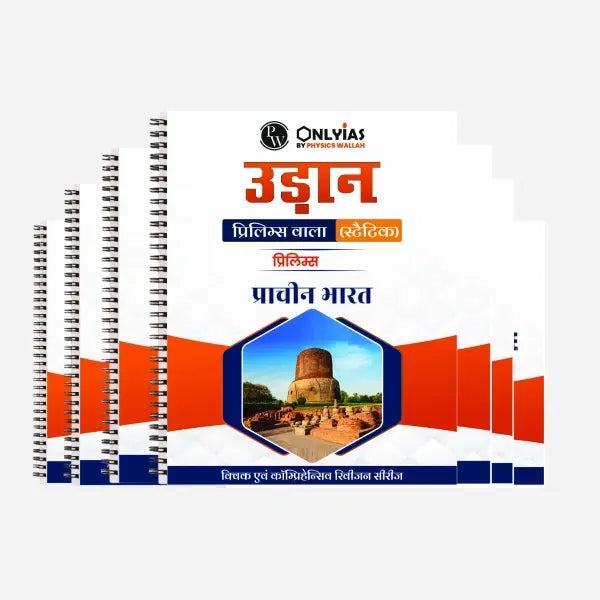
PW Udaan Prelims GS Notes 2025-26

11 Booklets | Hindi Medium | UPSC Study Material
Key Highlights:
📘 11 Booklets
📚 Prelims GS
🎓 Physics Wallah (PW)
🏷️ Printed
🇬🇧 Hindi Medium
₹1,735
🌀 spiral
📘 book-binding
Only 29 sets left
Selling fast (93 sold this week)
5% OFF Use UPSC5% (COD Available)
10% OFF Use UPI10 (UPI Only)
Secure Payment
Fast Delivery
Safe Packaging

About PW Udaan Prelims GS Hindi

The PW Udaan Prelims GS Hindi is a printed UPSC study material set sold by UPSC Store — India’s trusted source for genuine, latest-batch civil services preparation books. This page covers full booklet details, syllabus coverage, pricing, shipping, and frequently asked questions. Useful for UPSC CSE, BPSC, UPPSC, MPPSC, RAS and other state PSC examinations.

PW Udaan Prelims GS Notes 2025-26 — 16 Hindi Medium Printed Booklets for UPSC GS Paper I Prelims

Related: PW Only IAS notes · General Studies notes

Product Overview

FeatureDetails
Booklets Count16 Individual Printed Booklets — Full GS Prelims Static Coverage
LanguageHindi Medium (हिंदी माध्यम)
PublisherOnly IAS by Physics Wallah (उड़ान प्रिलिम्स — स्टैटिक एवं कॉम्प्रिहेंसिव रिवीजन सीरीज)
Edition2025-26 — Latest Genuine Batch
ConditionBrand New, Unmarked, Fresh Stock
FormatHigh-Quality Printed Booklets — Spiral or Book Binding
Paper Quality75 GSM Ultra-White — Highlighter Safe, Zero Bleed-Through
ShippingPan India Delivery in 3-5 Business Days — Tracked
Also Useful ForBPSC, UPPSC, MPPSC, RAS and all State PSC Prelims

Complete Booklet Catalog

The PW Udaan Prelims GS Notes 2025-26 Hindi Medium set spans 16 printed booklets covering the entire UPSC Prelims GS Paper I static syllabus — from Ancient India and Medieval History to Indian Polity, Economy, Environment, and Current Affairs integration. This set is designed specifically for Hindi medium UPSC aspirants who want a structured, point-based, and revision-ready study resource built by the Only IAS team at Physics Wallah.

  • Booklet 1: प्राचीन भारत (Ancient India) — Indus Valley Civilisation, Vedic Age, Mahajanapadas, Maurya Empire, post-Mauryan kingdoms, Gupta period, religious movements including Buddhism and Jainism, art and architecture of ancient India, and important ancient dynasties with UPSC Prelims MCQ focus.
  • Booklet 2: मध्यकालीन भारत (Medieval India) — Delhi Sultanate, Vijayanagara Empire, Bhakti and Sufi movements, Mughal administration, Maratha Empire, regional kingdoms, medieval art and architecture, trade routes, and socio-religious reforms with previous year question mapping.
  • Booklet 3: आधुनिक भारत (Modern India) — British East India Company expansion, Governor-Generals and Viceroys, revolt of 1857, Indian National Congress, nationalist movements, partition of Bengal, Non-Cooperation, Civil Disobedience, Quit India movement, and important personalities of the freedom struggle.
  • Booklet 4: विश्व इतिहास (World History) — Renaissance and Reformation, American and French Revolutions, Industrial Revolution, World War I and II, Russian Revolution, decolonisation movements, Cold War era, United Nations formation, and their relevance to UPSC Prelims GS Paper I syllabus.
  • Booklet 5: भारतीय राजव्यवस्था (Indian Polity — Part I) — Constitution of India: Preamble, Fundamental Rights, Directive Principles, Fundamental Duties, Union Executive, Parliament structure and functions, President and Prime Minister roles, emergency provisions, and constitutional amendments relevant to UPSC Prelims.
  • Booklet 6: भारतीय राजव्यवस्था (Indian Polity — Part II) — State governments, Governor’s role, State Legislature, judiciary including Supreme Court and High Courts, local self-government (Panchayati Raj and Urban Local Bodies), constitutional bodies, statutory bodies, and tribunals for UPSC Prelims preparation.
  • Booklet 7: भारतीय अर्थव्यवस्था (Indian Economy — Part I) — National income concepts, GDP and GNP, planning in India, poverty and unemployment, agriculture sector, Green Revolution, land reforms, food security, public distribution system, and economic survey highlights relevant for UPSC Prelims GS Paper I.
  • Booklet 8: भारतीय अर्थव्यवस्था (Indian Economy — Part II) — Banking system, RBI functions, monetary policy, fiscal policy, budget concepts, taxation (GST, direct taxes), inflation, capital markets, foreign trade and balance of payments, international economic organisations like IMF, World Bank for UPSC Prelims.
  • Booklet 9: भारत एवं विश्व का भूगोल — भौतिक (Physical Geography) — Lithosphere, atmosphere, hydrosphere, geomorphology, climatology, oceanography, natural disasters, soil types, rock systems, tectonic plates, Himalayan and Peninsular rivers, Indian climate and monsoon mechanisms for UPSC Prelims Paper I.
  • Booklet 10: भारत एवं विश्व का भूगोल — मानव (Human Geography) — Population distribution and growth, urbanisation, migration, agricultural geography, industrial geography, transport and communication networks, world resources and their distribution, economic geography concepts tested in UPSC Prelims GS Paper I.
  • Booklet 11: पर्यावरण एवं पारिस्थितिकी (Environment and Ecology) — Ecosystem types, biodiversity hotspots, national parks and sanctuaries, climate change, environmental treaties (Paris Agreement, CBD, CITES, Ramsar), pollution types, environmental acts and bodies, biosphere reserves, coral reefs, and wetlands for UPSC Prelims.
  • Booklet 12: विज्ञान एवं प्रौद्योगिकी (Science and Technology) — Space technology (ISRO missions), defence technology, nuclear technology, biotechnology, nanotechnology, artificial intelligence basics, IT Act, cyber security, health technology, and government science schemes tested in recent UPSC Prelims papers.
  • Booklet 13: भारतीय कला एवं संस्कृति (Indian Art and Culture) — Classical dance forms, music traditions, folk arts, painting schools, sculpture, temple architecture styles, languages and literature, festivals, UNESCO intangible heritage of India, and cultural organisations relevant to UPSC Prelims GS Paper I.
  • Booklet 14: सामाजिक विकास एवं मुद्दे (Social Development and Issues) — Education policy (NEP 2020), health indicators, women empowerment schemes, child welfare, poverty alleviation programmes, SC/ST welfare, social justice acts, human development index, and government social sector flagship schemes for UPSC Prelims.
  • Booklet 15: अंतर्राष्ट्रीय संबंध एवं संगठन (International Relations and Organisations) — India’s foreign policy, bilateral relations with key nations, regional groupings (SAARC, ASEAN, SCO, BRICS, G20), United Nations system, international treaties and conventions, and India’s position on global issues for UPSC Prelims GS Paper I.
  • Booklet 16: करंट अफेयर्स इंटीग्रेशन एवं रिवीजन (Current Affairs Integration and Revision) — Static-current linkage notes, previous year UPSC Prelims question analysis, topic-wise MCQ practice pointers, important government schemes 2024-25, quick-revision tables, and last-mile preparation tips for UPSC Prelims 2025-26.

In-Depth Content Breakdown: Booklet by Booklet

Booklet 1: प्राचीन भारत (Ancient India)

Ancient India is among the most consistently tested areas in UPSC Prelims GS Paper I, with 3 to 5 questions appearing almost every year. This booklet by Only IAS covers the Indus Valley Civilisation in detail — town planning, trade, script mysteries — before moving to the Vedic Period, Early and Later Vedic distinctions, Mahajanapadas, rise of Jainism and Buddhism, the Mauryan Empire under Chandragupta and Ashoka, and the Gupta Age. The notes are structured with UPSC Prelims MCQ patterns in mind, highlighting frequently tested facts with clear point-based formatting in Hindi.

The Ancient India booklet stands apart for its integrated coverage of art, architecture, and religion alongside political history — a combination UPSC Prelims questions frequently exploit. Stupa architecture, cave paintings (Ajanta, Ellora), Chaityas, Viharas, Gandhara and Mathura schools of sculpture are explained with visual cues and comparison tables. Post-Mauryan dynasties (Sunga, Kanva, Satavahana, Kushana) and the Sangam Age of South India are covered with the depth the UPSC Prelims syllabus demands. Buy this set to get one of the best Hindi medium treatments of Ancient India available in printed form.

Booklet 2: मध्यकालीन भारत (Medieval India)

Medieval India in UPSC Prelims focuses heavily on administrative systems, cultural syncretism, and socio-religious movements — all areas where Hindi medium aspirants often lack quality printed resources. This booklet covers the Delhi Sultanate across all five dynasties with administrative, revenue, and military organisation details. The Vijayanagara and Bahmani kingdoms, Mughal administration under Akbar through Aurangzeb, the Maratha polity under Shivaji and the Peshwas, and regional kingdoms are treated with factual precision essential for UPSC Prelims objective questions.

The Bhakti and Sufi movements receive dedicated coverage — saint-wise doctrines, regional spread, and their social reform dimensions — as UPSC Prelims has repeatedly asked questions on these topics. Medieval architecture (Qutb Minar, Humayun’s Tomb, Fatehpur Sikri, Mughal paintings) is covered with timeline charts. Trade and economic conditions under medieval rulers, foreign travellers’ accounts (Ibn Battuta, Bernier, Tavernier), and their observations provide additional UPSC Prelims preparation depth. The Hindi language treatment makes complex administrative terminology more accessible for हिंदी माध्यम aspirants.

Booklet 3: आधुनिक भारत (Modern India)

Modern Indian History carries significant weight in UPSC Prelims — typically 5 to 8 questions — making this booklet one of the most critical in the PW Udaan set. The booklet begins with the arrival of European trading companies, traces British territorial expansion through the Carnatic Wars, Battle of Plassey, and Subsidiary Alliance, and covers the administrative and economic policies of major Governor-Generals and Viceroys. The Revolt of 1857 — causes, events, and consequences — receives detailed treatment with factual tables for quick revision before UPSC Prelims.

The Indian national movement from the formation of the Indian National Congress in 1885 through Independence in 1947 is covered chronologically and thematically. Non-Cooperation Movement, Civil Disobedience Movement, Quit India Movement, and the role of major leaders (Gandhi, Nehru, Bose, Ambedkar, Tilak, Gokhale, Savarkar) are explained in structured Hindi medium notes. Revolutionary movements, peasant and tribal uprisings, press and education policies under British rule, and constitutional developments (Government of India Acts 1919, 1935) are also included — all directly relevant to UPSC Prelims GS Paper I.

Booklet 4: विश्व इतिहास (World History)

World History is part of the UPSC Prelims GS Paper I syllabus and is frequently overlooked by aspirants using fragmented resources. This booklet covers the Renaissance, Reformation, Enlightenment, and their impact on global political thought. The American War of Independence, French Revolution, and the rise of nationalism in Europe are explained with cause-effect clarity. The Industrial Revolution’s social and economic transformations, imperialism and colonialism, and the First and Second World Wars are covered with key dates and outcomes essential for UPSC Prelims MCQs.

Post-World War II events — formation of the United Nations, Cold War dynamics, Korean and Vietnam Wars, Cuban Missile Crisis, decolonisation of Asia and Africa, Non-Aligned Movement — are covered with India’s role clearly highlighted. The Russian Revolution of 1917 and its ideological impact on global politics receives separate treatment. The booklet uses timelines, comparative tables, and cause-effect diagrams to make World History revision efficient for UPSC Prelims. Hindi medium aspirants who find English-language world history sources difficult will particularly benefit from buying this printed booklet.

Booklet 5: भारतीय राजव्यवस्था — Part I (Indian Polity Part I)

Indian Polity is the highest-scoring and most predictable section of UPSC Prelims GS Paper I, with 8 to 12 questions appearing consistently. Part I of the Polity booklet covers the making of the Indian Constitution — Constituent Assembly debates, sources of constitutional provisions, and the Preamble with all its keywords and their legal interpretations. Fundamental Rights (Articles 12 to 35), their exceptions, judicial interpretations, and recent Supreme Court judgments are covered with precision. Directive Principles and Fundamental Duties with their UPSC Prelims relevance are included in point-based Hindi notes.

The Union Executive — President, Vice President, Prime Minister, Council of Ministers, Cabinet — is covered with constitutional articles, powers, and UPSC Prelims MCQ-oriented facts. Parliament (Lok Sabha and Rajya Sabha), legislative procedures, types of bills, joint sessions, and Speaker’s role are explained with article references. Emergency provisions (Articles 352, 356, 360) — their proclamation, effects, and revocation — are treated with comparison tables. Constitutional amendments procedure under Article 368 and major amendments are listed for rapid UPSC Prelims revision. Buy this booklet for the most structured Hindi medium Polity coverage available.

Booklet 6: भारतीय राजव्यवस्था — Part II (Indian Polity Part II)

Polity Part II extends coverage to State governments — Governor’s role and discretionary powers, State Legislature structure, and Centre-State relations including legislative, administrative, and financial relations under Articles 245 to 300. The Indian Judiciary section covers Supreme Court, High Courts, subordinate courts, judicial review, PIL, and recent landmark judgments tested in UPSC Prelims. Constitutional and statutory bodies — Election Commission, CAG, UPSC, Finance Commission, NITI Aayog — are covered with their composition, powers, and functions.

Local self-government receives detailed treatment — 73rd and 74th Constitutional Amendments, Panchayati Raj institutions, Urban Local Bodies, their structure and finances — as UPSC Prelims regularly asks questions from this area. Tribunals, regulatory bodies, and quasi-judicial bodies are listed with their parent legislation. The booklet also covers Schedule-wise analysis of all 12 Schedules of the Constitution with key facts. Anti-defection law, coalition dynamics, and recent constitutional issues are incorporated with a UPSC Prelims MCQ lens, making this booklet essential for Hindi medium GS Paper I preparation in the 2025-26 cycle.

Booklet 7: भारतीय अर्थव्यवस्था — Part I (Indian Economy Part I)

Economy Part I in the PW Udaan Hindi medium set covers the foundational macro-economic concepts tested in UPSC Prelims — national income accounting (GDP, GNP, NNP, NDP), measurement methods, and India’s GDP composition. Economic planning in India — five-year plans, NITI Aayog’s role, and development strategy evolution — is covered factually for UPSC Prelims. Agriculture sector receives in-depth treatment: irrigation types, cropping patterns, Green Revolution, seed and fertiliser policy, MSP mechanism, and food security programmes including the National Food Security Act.

Poverty estimation in India — Planning Commission methods, Tendulkar Committee, Rangarajan Committee, and SECC data — are explained with poverty line numbers and UPSC Prelims-relevant statistics. Unemployment types, rural employment schemes (MGNREGS), and urban livelihoods missions are covered. Land reform legislations, consolidation of holdings, and cooperative farming are included as per UPSC GS Paper I syllabus. Agricultural trade, export-import policy for farm produce, and the Agricultural Marketing reforms under APMC are also covered, giving Hindi medium aspirants a complete economy foundation to buy into their preparation.

Booklet 8: भारतीय अर्थव्यवस्था — Part II (Indian Economy Part II)

Economy Part II covers the financial system and monetary framework tested in UPSC Prelims — RBI structure, functions, monetary policy tools (CRR, SLR, Repo Rate, Reverse Repo), and recent monetary policy committee decisions. The banking system — commercial banks, cooperative banks, NBFCs, payment banks, small finance banks — is covered with regulatory framework details. Fiscal policy, Union Budget structure, types of deficits (fiscal, revenue, primary), FRBM Act, and government borrowing are explained with clear Hindi medium definitions for UPSC Prelims.

GST structure — CGST, SGST, IGST, HSN codes, GST Council — is covered with constitutional basis (101st Amendment). Direct tax system, income tax basics, and corporate tax are included for UPSC Prelims completeness. Capital markets — SEBI, stock exchanges, mutual funds, bonds — and external sector topics — balance of payments, current account deficit, FDI and FPI, foreign exchange reserves — are explained. International institutions (IMF, World Bank Group, WTO, ADB) and India’s engagement with them are covered in point format. This booklet is essential for anyone who wants to buy a complete Hindi medium Economy resource for UPSC Prelims 2025-26.

Booklet 9: भारत एवं विश्व भूगोल — भौतिक (Physical Geography)

Physical Geography consistently contributes 5 to 8 questions in UPSC Prelims GS Paper I, making this booklet a high-return investment. The booklet covers geomorphology — internal and external forces, rock types, soil formation, weathering and erosion processes — and geophysical phenomena like earthquakes and volcanoes with their global distribution. Climatology covers global wind systems, Coriolis force, air masses, fronts, jet streams, El Niño and La Niña, Indian monsoon mechanism, and climate classification (Koppen system) in structured Hindi notes.

Oceanography — ocean currents (warm and cold), tides, ocean floor features, marine resources, and ENSO — is covered with UPSC Prelims MCQ patterns in mind. Indian physical geography receives dedicated sub-sections: Himalayan ranges and passes, Indo-Gangetic Plains, Peninsular Plateau, Coastal Plains, Islands, Drainage systems (Himalayan vs Peninsular rivers), and natural vegetation zones. Soil types of India — Alluvial, Black, Red, Laterite, Desert, Mountain soils — with their distribution and agricultural significance are covered in tabular form. Hindi medium aspirants will find this printed booklet far more accessible than English textbooks for UPSC Prelims revision.

Booklet 10: भारत एवं विश्व भूगोल — मानव (Human Geography)

Human Geography covers population geography — global and Indian population distribution, density, growth trends, demographic dividend, census 2011 data, and migration patterns — all of which appear in UPSC Prelims. Agricultural geography covers world agricultural types (plantation, Mediterranean, shifting cultivation, mixed farming), major crops and their producing regions globally and in India, and revolution-based agricultural developments (White Revolution, Blue Revolution, Yellow Revolution). The booklet uses distribution maps described in text for Hindi medium aspirants to visualise data.

Industrial geography covers major industries — iron and steel, textiles, petrochemical, automobile — and their location factors globally and in India. Transport geography (railways, roadways, waterways, airways) includes India’s national highway network, inland waterways, and major ports. World resources — energy resources (coal, petroleum, natural gas, renewable energy), mineral resources, and their geopolitical implications — are covered. Urbanisation trends, smart cities, and human settlement patterns round off this booklet. UPSC Prelims aspirants seeking quality Hindi medium Geography notes will find this among the best printed resources to buy in 2025-26.

Booklet 11: पर्यावरण एवं पारिस्थितिकी (Environment and Ecology)

Environment and Ecology has become one of the highest-scoring sections in UPSC Prelims, with 8 to 12 questions in recent years. This booklet covers ecosystem structure (producers, consumers, decomposers), food chains and webs, energy flow, biogeochemical cycles (Carbon, Nitrogen, Phosphorus, Water cycles), and ecological pyramids. Biodiversity — levels, threats, hotspots (India’s four hotspots), endemic species, IUCN Red List categories, and India’s biodiversity legislation — is covered with factual precision required for UPSC Prelims MCQs.

Protected Area Network — Wildlife Sanctuaries, National Parks, Biosphere Reserves, Tiger Reserves, Elephant Corridors — is listed with locations and UPSC Prelims-relevant facts. International environmental treaties receive dedicated coverage: UNFCCC and Paris Agreement (NDCs, carbon credits), Convention on Biological Diversity, CITES, Ramsar Convention (Indian Ramsar sites), Montreal Protocol, Basel Convention, and Stockholm Convention. Pollution types — air, water, soil, noise, e-waste, plastic — and relevant legislation (Environment Protection Act, Forest Conservation Act, Wildlife Protection Act) are covered in detail. This Environment booklet is a must-buy for every Hindi medium UPSC Prelims aspirant in the 2025-26 cycle.

Booklet 12: विज्ञान एवं प्रौद्योगिकी (Science and Technology)

Science and Technology is among the fastest-evolving sections in UPSC Prelims, requiring updated notes tied to current developments — exactly what the 2025-26 edition of this PW Udaan booklet provides. Space technology receives thorough treatment: ISRO’s mission history, recent launches (Chandrayaan, Gaganyaan, PSLV, GSLV), international space organisations (NASA, ESA, SpaceX context), and satellite applications in communication, navigation (NavIC), and remote sensing. Defence technology covers missile systems (Agni, Prithvi, BrahMos, DRDO projects), and nuclear doctrine basics.

Biotechnology — GM crops, stem cell research, gene editing (CRISPR), cloning, biofuels — is covered with UPSC Prelims MCQ orientation. Health technology topics include vaccine development, mRNA vaccines, drug regulatory framework (CDSCO), and India’s pharmaceutical sector. Nanotechnology, 5G, artificial intelligence, blockchain, and quantum computing basics are included as emerging technology topics frequently appearing in UPSC Prelims. Cyber security, IT Act provisions, and government digital initiatives (DigiLocker, Digital India, UPI) complete the booklet. Hindi medium aspirants who find English science resources difficult will particularly benefit from buying this printed Science and Technology booklet.

Booklet 13: भारतीय कला एवं संस्कृति (Indian Art and Culture)

Indian Art and Culture contributes 4 to 6 questions in UPSC Prelims GS Paper I — a section where point-based, well-organised Hindi medium notes give aspirants a decisive advantage. This booklet covers classical dance forms (Bharatanatyam, Kathak, Kuchipudi, Odissi, Manipuri, Mohiniyattam, Sattriya) with their origin states, gharanas, and exponents. Classical music traditions — Hindustani and Carnatic systems, ragas, instruments — and folk music and dance forms state-wise are listed with UPSC Prelims examination focus.

Indian painting schools — Mughal, Rajput, Pahari, Madhubani, Warli, Pattachitra — and sculpture traditions from ancient to medieval India are covered with key characteristics. Temple architecture styles — Nagara, Dravida, Vesara — with examples and their distinctive features are explained with comparison tables useful for UPSC Prelims. UNESCO Intangible Cultural Heritage of India, Geographical Indication (GI) tags for handicrafts, and major cultural institutions (Sangeet Natak Akademi, Lalit Kala Akademi, Sahitya Akademi) are included. Classical languages, major literary works, and Indian languages listed in the Eighth Schedule complete this booklet.

Booklet 14: सामाजिक विकास एवं मुद्दे (Social Development and Issues)

Social issues and government schemes form an increasingly important part of UPSC Prelims GS Paper I, especially given the integration of current affairs with static syllabus. This booklet covers education policy — Right to Education Act, National Education Policy 2020 (NEP 2020) highlights, Samagra Shiksha, higher education bodies (UGC, AICTE) — and health policy — National Health Mission, Ayushman Bharat, ASHA workers, and health indicators (MMR, IMR, TFR). Human Development Index and India’s HDI ranking trends are included.

Women’s empowerment schemes (Beti Bachao Beti Padhao, Sukanya Samriddhi, Mahila Shakti Kendra), child welfare (ICDS, POSHAN Abhiyan, child labour acts), and SC/ST welfare legislation (Scheduled Castes and Scheduled Tribes (Prevention of Atrocities) Act, PCR Act) are covered. Poverty alleviation flagship schemes — PM Awaas Yojana, PMGSY, MGNREGS, Ujjwala Yojana, Jan Dhan Yojana — are listed with launch year, objective, and UPSC Prelims relevance. Social justice commissions and minority welfare bodies complete this booklet, making it a high-value addition to the complete PW Udaan 11-booklet set.

Booklet 15: अंतर्राष्ट्रीय संबंध एवं संगठन (International Relations and Organisations)

International Relations features in UPSC Prelims through questions on India’s bilateral relationships, regional groupings, and India’s stand in multilateral forums — all covered in this dedicated booklet. India’s foreign policy — Panchsheel principles, Non-Aligned Movement, Neighbourhood First policy, Act East Policy, and recent diplomatic developments with neighbours (Pakistan, China, Nepal, Bangladesh, Sri Lanka) — is treated with factual clarity. India-USA, India-Russia, India-EU, and India-Africa relations are covered with key agreements and strategic dimensions.

Regional and global organisations receive systematic coverage: SAARC (structure, summits, limitations), ASEAN and India-ASEAN relations, SCO (Shanghai Cooperation Organisation), BRICS and its expansion, G20 India Presidency highlights, Commonwealth, and IBSA are explained with membership and objectives. United Nations system — General Assembly, Security Council (P5 + India’s permanent membership campaign), ECOSOC, ICJ, and key UN agencies (UNDP, UNICEF, WHO, FAO, WFP) — is covered in structured tables. International treaties and India’s ratification status complete this booklet for UPSC Prelims 2025-26 aspirants studying in Hindi medium.

Booklet 16: करंट अफेयर्स इंटीग्रेशन एवं रिवीजन (Current Affairs Integration and Revision)

The final booklet in the PW Udaan Prelims 2025-26 Hindi medium set serves as a bridge between static GS content and current affairs — the integration that separates high scorers from average performers in UPSC Prelims. It covers important government schemes and policies launched or significantly updated in 2024-25, mapping them to the relevant static GS topics in the preceding booklets. Previous year UPSC Prelims questions (topic-wise) are referenced with answer pointers, helping aspirants understand the exact format and depth of questions asked.

The booklet includes quick-revision summary tables for all major topics — polity articles, geography facts, economy data points, environment treaties — making it the ideal last-week revision companion before UPSC Prelims. Important appointments, India’s international rankings (Global Hunger Index, Ease of Doing Business, Press Freedom Index), and recent developments in science, technology, and foreign policy are consolidated here. Topic-wise MCQ practice pointers and frequently tested fact lists give Hindi medium aspirants a structured path to maximise scores in UPSC Prelims GS Paper I. Buy the complete 11-booklet PW Udaan set to access this integration booklet in its full printed form.

Physical Construction and Quality Standards

Every booklet in the PW Udaan Prelims GS Notes 2025-26 Hindi Medium set is manufactured to withstand the intensive daily use of a serious UPSC Prelims aspirant — multiple readings, heavy annotation, and months of constant handling from the start of preparation through the final revision days before the exam.

Paper Quality: 75 GSM Anti-Glare White Paper

The 75 GSM ultra-white paper used across all 11 Booklets is selected for its high opacity, ensuring zero show-through from the reverse side even when multiple highlighter colours are applied. UPSC aspirants who colour-code their revision — different colours for polity, economy, and environment facts — can do so freely without worrying about ink bleeding. The anti-glare surface reduces eye strain significantly during long study sessions of 6 to 8 hours, which are standard in intensive UPSC Prelims preparation. The paper is gel pen and ballpoint pen friendly throughout.

Printing Technology: High-Resolution Laser Printing

All 11 Booklets are printed using high-resolution laser printing technology, producing crisp, sharp text even for the complex Devanagari script used throughout these Hindi medium notes. Diagrams, flow charts, tables, and maps are rendered with laser precision — fine lines in geography maps and small text in comparison tables remain perfectly legible. The permanent toner bonding means pages are completely smudge-proof even when wet fingers turn pages rapidly during revision. Font sizes are optimised for comfortable reading without magnification, respecting the eye health of aspirants studying for extended hours daily.

Binding and Durability

The PW Udaan booklets are available in spiral or book binding formats, each offering specific advantages for UPSC Prelims preparation. Spiral-bound booklets open completely flat on any study surface, allowing aspirants to write margin notes alongside printed content without the book curling shut — essential for active annotation. Book-bound versions offer compact storage and a clean professional look preferred by some aspirants. Both formats use 300 GSM laminated covers that resist daily wear, moisture, and the mechanical stress of being picked up and put down dozens of times daily during intensive UPSC preparation cycles.

Key Features and Study Design

The PW Udaan Prelims GS Notes 2025-26 set is purpose-built for Hindi medium UPSC Prelims aspirants who need structured, point-based, exam-oriented static notes that integrate seamlessly with daily current affairs practice and require minimal supplementation from other sources.

  • हिंदी माध्यम में सम्पूर्ण कवरेज (Complete Hindi Medium Coverage): All 11 Booklets are written entirely in Hindi, using precise Devanagari terminology that matches UPSC’s own Hindi medium question paper language — eliminating the translation gap that English-medium adapted notes create for Hindi medium aspirants.
  • Prelims MCQ-Oriented Structure: Every topic is structured around the way UPSC Prelims frames objective questions — important facts are presented as standalone bullet points, comparison tables highlight frequently tested distinctions, and MCQ traps (common wrong answer options) are flagged with study notes throughout all 11 Booklets.
  • Static-Current Integration: The 2025-26 edition incorporates current affairs linkages within static topic chapters — for example, recent biodiversity discoveries within the Ecology booklet, new space missions within the Science booklet — so aspirants do not need to maintain a separate current affairs register for UPSC Prelims.
  • Previous Year Question Mapping: High-frequency UPSC Prelims topics are marked with PYQ indicators showing how many times a topic has been tested. This helps aspirants prioritise their revision during the final weeks before UPSC Prelims and allocate study time efficiently across all 11 Booklets.
  • Quick Revision Architecture: Each booklet ends with summary tables and important facts lists designed for rapid revision in the 48-72 hours before UPSC Prelims. This layered structure — detailed notes for first reading, summary tables for second reading, quick facts for final revision — makes the 11-booklet set self-sufficient for the complete UPSC Prelims preparation cycle.

Shipping, Packaging and Delivery

All 11 Booklets of the PW Udaan Prelims GS Notes 2025-26 Hindi Medium set are individually shrink-wrapped before being placed together in a heavy-duty corrugated cardboard box. Foam edge protectors and bubble wrap padding are used to secure every booklet within the outer box, preventing corner damage and spine bending during transit. The outer box is sealed with tamper-proof tape and clearly labelled with the order details. This transit-safe packaging ensures that aspirants receive their complete 11-booklet set in the same brand-new, unmarked condition that left our Mukherjee Nagar dispatch centre — regardless of whether the delivery destination is a metro city or a remote district.

Orders are dispatched within 1 business day of payment confirmation and delivered Pan India within 3 to 5 business days via tracked courier partners. A tracking ID is shared via WhatsApp and email immediately upon dispatch, so aspirants can monitor their order in real time. For any queries — including missing booklets, damaged covers, or delivery delays — contact our support team directly on WhatsApp at +91 70045 49563. Any missing or damaged booklet reported within 48 hours of delivery is replaced at no additional cost. Buy with complete confidence — your 11-booklet PW Udaan set is fully protected from checkout to delivery.

Frequently Asked Questions (FAQ)

Q1: Is PW Udaan notes good for UPSC Prelims Hindi medium aspirants?

A: Yes — the PW Udaan Prelims GS Notes 2025-26 set is specifically developed by Only IAS (Physics Wallah’s IAS division) for Hindi medium UPSC aspirants. The language uses authentic Devanagari UPSC terminology, the structure is MCQ-oriented, and all 11 Booklets together cover the complete GS Paper I Prelims static syllabus. Thousands of Hindi medium UPSC aspirants across India use this series as their primary printed study resource, and it compares favourably with any competing Hindi medium UPSC Prelims material available in the market for the 2025-26 cycle.

Q2: How many booklets are included in PW Udaan Prelims GS Notes 2025-26?

A: This set includes exactly 16 printed booklets covering the full GS Paper I UPSC Prelims static syllabus. The subjects covered across these 11 Booklets are: Ancient India, Medieval India, Modern India, World History, Indian Polity (Part I and II), Indian Economy (Part I and II), Physical Geography, Human Geography, Environment and Ecology, Science and Technology, Indian Art and Culture, Social Issues and Development, International Relations and Organisations, and a Current Affairs Integration and Revision booklet. All 11 Booklets are dispatched together as a single shipment in one sealed package.

Q3: What topics are covered in PW Udaan प्राचीन भारत booklet?

A: The Ancient India (प्राचीन भारत) booklet covers Indus Valley Civilisation, Vedic Period (Early and Later Vedic), rise of Jainism and Buddhism, the 16 Mahajanapadas, Mauryan Empire (Chandragupta, Bindusara, Ashoka), post-Mauryan dynasties (Sunga, Kanva, Kushana, Satavahana), Gupta Age, Sangam Age, and ancient art and architecture schools (Gandhara, Mathura, Amaravati). Temple architecture, cave paintings, stupa construction, and major inscriptions are also included with UPSC Prelims MCQ-oriented point formatting throughout the booklet.

Q4: What is the price of Only IAS Udaan Prelims notes 2025-26?

A: The price of the complete PW Udaan Prelims GS Notes 2025-26 Hindi Medium set (11 Booklets) is displayed on the product page. Our store offers competitive pricing with no hidden charges — the listed price includes all 11 Booklets and Pan India tracked delivery within 3 to 5 business days. Compared to buying individual subject notes from multiple publishers, this 11-booklet set offers significant value for Hindi medium UPSC Prelims aspirants. Check the current price on the product page and buy online for the fastest delivery to your address.

Q5: Are Physics Wallah Udaan notes enough for UPSC Prelims preparation?

A: The 11-booklet PW Udaan set covers the complete UPSC Prelims GS Paper I static syllabus and is sufficient as the primary study resource for most Hindi medium aspirants. However, for maximum results, UPSC toppers recommend supplementing these static notes with a daily current affairs source (newspaper or monthly current affairs magazine) and regular MCQ practice from previous year UPSC Prelims question papers. The Udaan set’s built-in current affairs integration booklet (Booklet 16) helps bridge the static-current gap, making supplementation relatively minimal compared to other printed notes series.

Q6: Is PW Udaan available in both Hindi and English medium?

A: Yes — Only IAS by Physics Wallah publishes the Udaan Prelims GS Notes series in both Hindi medium and English medium editions. The product listed here is specifically the Hindi Medium (हिंदी माध्यम) edition for 2025-26. If you are an English medium UPSC aspirant, please check the separate English medium listing in our store. Both editions cover the same syllabus and booklet structure, but the language, terminology, and examples in the Hindi medium edition are specifically tailored for aspirants who study and write their UPSC Prelims in Hindi.

Q7: How is PW Udaan different from other UPSC Hindi medium study material?

A: PW Udaan distinguishes itself from competing UPSC Hindi medium printed notes through three key differences: first, MCQ-oriented point structure designed specifically for objective UPSC Prelims — not adapted from Mains answer writing material; second, current affairs integration within static topic chapters, reducing the need for additional resources; and third, the 11-booklet division by subject allows aspirants to carry only the relevant booklet during travel or focus sessions, unlike bulky single-volume notes. The Only IAS team’s UPSC faculty expertise is reflected in the depth and accuracy of coverage across all GS subjects.

Q8: Can I use PW Udaan notes for UPSC Mains preparation as well?

A: The PW Udaan Prelims GS Notes 2025-26 set is primarily designed and structured for UPSC Prelims GS Paper I — point-based, fact-heavy, and MCQ-oriented. While the factual content covered is also relevant to UPSC Mains GS Papers, the presentation format (bullet points, tables, quick-fact lists) is not optimised for answer writing. For UPSC Mains, Only IAS publishes a separate Mains-specific notes series. That said, many aspirants use the Udaan Prelims set to build a strong factual foundation before transitioning to Mains answer writing practice, making it a valuable first-phase study resource.

Q9: What is the paper quality? Can I use a highlighter?

A: These booklets use 75 GSM ultra-white paper chosen for high opacity — multiple highlighter colors and gel pens work without bleed-through to the reverse side, ideal for color-coded revision. The anti-glare coating reduces eye fatigue during extended study sessions, and the paper surface is optimised for both ballpoint and gel pen annotations. UPSC aspirants who use a multi-colour revision system — assigning different colours to polity, economy, history, and geography facts — can apply this method freely across all 11 Booklets without any paper quality concerns.

Q10: Are these the latest 2025-26 edition booklets or old stock?

A: All 11 Booklets in this set are genuine 2025-26 edition — the latest batch produced by Only IAS Physics Wallah for the current UPSC Prelims preparation cycle. We source directly from authorised distributors and maintain strict first-in-first-out stock management, ensuring aspirants always receive the most current edition. The 2025-26 edition incorporates updated current affairs integration, revised polity and economy data points, and the latest environment treaties and science developments through the 2024-25 period. Buying old or outdated UPSC Prelims notes is a common preparation mistake — this listing guarantees genuine current-edition stock only.

Q11: Can I use PW Udaan Hindi medium notes for State PSC exams?

A: Yes — the PW Udaan Prelims GS Notes 2025-26 Hindi Medium set is highly useful for State PSC Prelims preparation alongside UPSC. The GS syllabus of BPSC, UPPSC, MPPSC, RAS, and most other State PSCs overlaps significantly with UPSC GS Paper I, covering History, Polity, Economy, Geography, Environment, and Science and Technology. Hindi medium State PSC aspirants from Uttar Pradesh, Bihar, Madhya Pradesh, Rajasthan, and other Hindi-belt states will find these 11 Booklets equally effective for their State PSC Prelims preparation, making this a multi-exam value purchase.

Q12: What should I do if a booklet is missing or damaged upon delivery?

A: If any booklet from the 11-booklet PW Udaan set is missing or arrives damaged, contact our customer support team immediately on WhatsApp at +91 70045 49563 with a photograph of the received package and its contents. We guarantee replacement of any missing or damaged booklet within 48 hours of your complaint — at zero additional cost to you. All orders are shipped in tamper-proof corrugated packaging with individual bubble wrap protection, so damage during transit is rare; however, our replacement commitment ensures that every aspirant who buys from our store receives the complete, undamaged 11-booklet set they paid for.

Summary

SpecificationValue
Booklets16 Printed Booklets — Full GS Prelims Static Coverage
LanguageHindi Medium (हिंदी माध्यम)
PublisherOnly IAS by Physics Wallah — PW Udaan Prelims Series
Edition2025-26 Latest Genuine Batch
Paper75 GSM Ultra-White, Highlighter Safe
BindingSpiral or Book Binding, 300 GSM Cover
Delivery3-5 Business Days Pan India — Tracked
Also Useful ForBPSC, UPPSC, MPPSC, RAS and all State PSC Prelims
SupportWhatsApp +91 70045 49563 — 48-hour Replacement Guarantee

Sold by your trusted UPSC study material store in Mukherjee Nagar, Delhi — where aspirants have bought their UPSC Prelims printed notes for years. Order the complete PW Udaan Prelims GS Notes 2025-26 Hindi Medium set today and receive all 11 Booklets with Pan India delivery in 3-5 days.

Reference: Civil Services Examination

Customer Reviews 380

4.5
Based on 380 reviews
5★
227
4★
113
3★
40
2★
0
1★
0
A
Aman Singh
24 Apr 2026
✓ Verified

Padhne se lagta hai ki bilkul professional coaches ne likha hai.

A
Aisha Khan
23 Apr 2026
✓ Verified

Notes clear aur comprehensive hain, packaging mein koi damage nahi tha. Bilkul satisfied hoon.

R
Riya Nair
23 Apr 2026
✓ Verified

11 booklets mein sab topics cover ho gaye hain, Hindi mein samajhna bhi easy tha.

R
Rajesh Kumar
23 Apr 2026
✓ Verified

Bahut acche notes hain, coverage bilkul sahi hai. Padhne mein aasan language use ki gayi hai.

R
Rohan Kulkarni
22 Apr 2026
✓ Verified

Amazing.

S
Shreya Nair
21 Apr 2026
✓ Verified

Hindi mein detailed notes mill gaye jo padh lena tha, PW ne badiya kaam kiya.

R
Rohan Desai
16 Apr 2026
✓ Verified

Bilkul sahi purchase tha, padhai mein kaafi madadgar sabit hua.

P
Priya Verma
12 Apr 2026
✓ Verified

Bahut helpful booklets hain.

🛍️

Aspirants Also Bought

More from the same category

View All

About PW Udaan Prelims GS Notes 2025-26

PW Udaan Prelims GS Notes 2025-26 is a highly recommended UPSC study material from Physics Wallah (PW), specially designed for Prelims GS preparation. Available in Hindi medium, this material is crafted to match the exact requirements of the UPSC Civil Services Examination syllabus — covering both Prelims and Mains comprehensively.

Product Details

  • Institute: Physics Wallah (PW)
  • Subject: Prelims GS
  • Medium: Hindi
  • Format: Printed
  • Delivery: Pan-India delivery in 3–5 working days
  • Format: Original printed material, verified authentic

Why Buy from UPSC Store?

  • 100% Genuine Printed Material — Original printed notes, no photocopies or fake copies
  • Fast Delivery — Ships within 24 hours, arrives in 3–5 days pan-India
  • Secure Packaging — Bubble-wrapped and boxed to prevent damage in transit
  • Trusted by 10,000+ Aspirants — India's most reliable UPSC material marketplace
  • WhatsApp Support — Get expert guidance on material selection before ordering

Frequently Asked Questions

Is this product 100% original?

Yes, all products at UPSC Store are 100% genuine printed materials. We do not sell photocopies or fake copies.

How long does delivery take?

Orders are dispatched within 24 hours and delivered across India in 3–5 working days via reputed courier partners.

Can I return the product?

Yes, we accept returns within 7 days if the product is damaged or incorrect. Check our refund policy for details.

Which other study materials should I buy with this?

We recommend pairing this with current affairs notes and a UPSC test series for comprehensive preparation. Browse more in General Studies, PW Only IAS, UPSC.