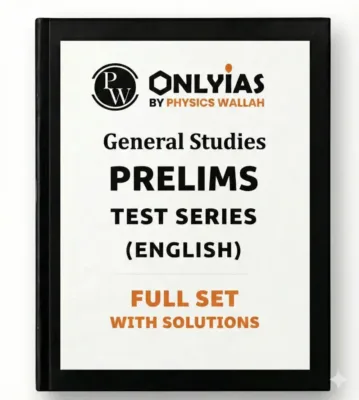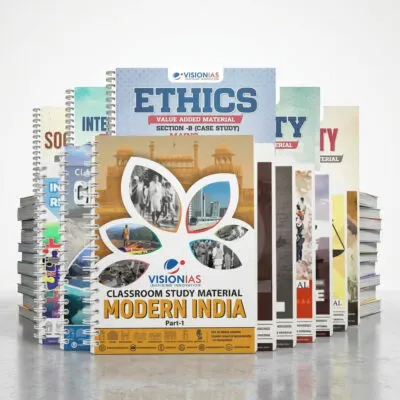
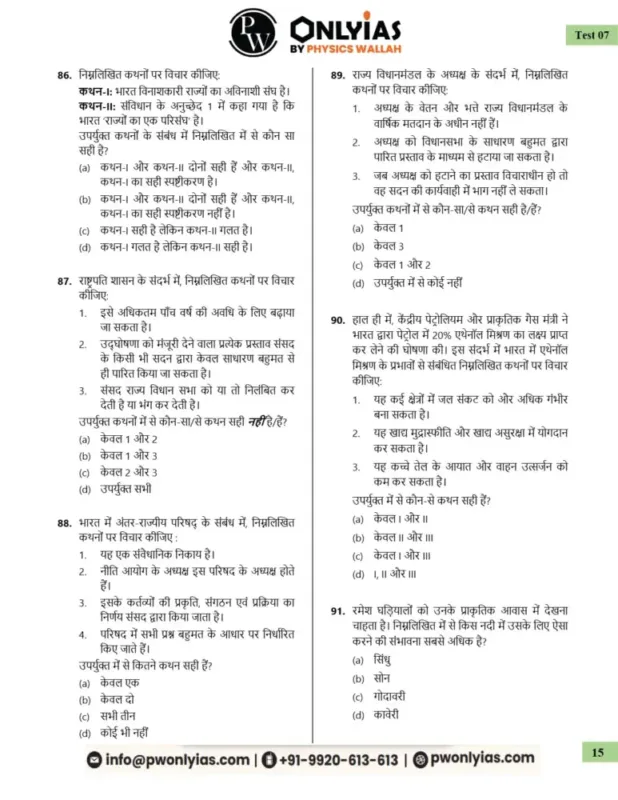

PW Only IAS Prelims 2026-27 Hindi Test Series

35 Booklets | Hindi Medium | UPSC Study Material
Key Highlights:
πŸ“˜ 35 Booklets
πŸ“š IAS Prelims
πŸŽ“ PW Only IAS
🏷️ Printed
πŸ‡¬πŸ‡§ Hindi Medium
β‚Ή899
πŸ“¦ 10-tests-set βœ“
πŸ“¦ 15-tests-set βœ“
πŸ“¦ 20-tests-set βœ“
πŸ“¦ 25-tests-set βœ“
πŸ“¦ 30-tests-set βœ“
πŸ“¦ 35-tests-set βœ“
Only 12 sets left
Selling fast (76 sold this week)
5% OFF Use UPSC5% (COD Available)
10% OFF Use UPI10 (UPI Only)
Secure Payment
Fast Delivery
Safe Packaging

About PW Only IAS Prelims Hindi

The PW Only IAS Prelims Hindi is a printed UPSC study material set sold by UPSC Store β€” India’s trusted source for genuine, latest-batch civil services preparation books. This page covers full booklet details, syllabus coverage, pricing, shipping, and frequently asked questions. Useful for UPSC CSE, BPSC, UPPSC, MPPSC, RAS and other state PSC examinations.

PW Only IAS Prelims 2026-27 Hindi Test Series | 35 Booklets | Hindi Medium | UPSC Study Material

Related: PW Only IAS notes Β· Hindi test series

The PW Only IAS Prelims 2026-27 Hindi Test Series is a comprehensive, meticulously designed examination preparation package crafted exclusively for Hindi medium aspirants who are seriously targeting the UPSC Civil Services Preliminary Examination in 2026 and 2027. This all-inclusive test series comes in a set of 32 premium booklets, each thoughtfully structured to cover every dimension of the UPSC Prelims syllabus with depth, accuracy, and pedagogical precision. Whether you are a first-time aspirant or a repeat candidate looking to sharpen your preparation, this Hindi medium test series offers the perfect blend of conceptual clarity, practice, and performance analysis.

Developed by the nation’s leading UPSC educators and content specialists at Physics Wallah’s Only IAS division, this test series represents years of research into UPSC question patterns, examiner tendencies, and the evolving nature of the Civil Services Examination. Every booklet is packed with high-quality questions, detailed explanations, and strategic insights that are aligned with the latest UPSC syllabus and examination trends. For Hindi medium students who often struggle to find quality study material at par with English medium counterparts, this series is a game-changer that levels the playing field completely.


About the Test Series

The PW Only IAS Prelims Hindi Test Series 2026-27 is not merely a collection of question papers β€” it is a complete self-contained preparation ecosystem. The series has been designed to simulate the actual UPSC Prelims examination environment, giving candidates repeated exposure to the kind of multi-dimensional, application-based questions that UPSC is known for setting. With 35 Booklets covering both General Studies Paper I and CSAT Paper II, this series provides structured, topic-wise as well as full-length mock tests that are indispensable for a serious aspirant.

The content has been rigorously vetted by experienced UPSC mentors who have years of teaching experience and have personally guided hundreds of successful IAS, IPS, and IFS officers. The language used throughout the booklets is clear, precise, and idiomatic Hindi that is easy to comprehend, making it ideal for students from Hindi-speaking states such as Uttar Pradesh, Bihar, Madhya Pradesh, Rajasthan, Jharkhand, Chhattisgarh, and Uttarakhand. The series bridges the long-standing gap in quality Hindi medium UPSC preparation material.


Complete List of 35 Booklets

Booklet 1: Indian History – Ancient Period

This booklet covers the entire ancient history of India from the Indus Valley Civilization to the early medieval period. Questions are framed around archaeological findings, cultural practices, religious movements, administrative systems, and socio-economic conditions of ancient India. Special attention is given to UPSC’s favorite topics such as Buddhism, Jainism, Mauryan Empire, Gupta period, and temple architecture.

The booklet includes carefully curated multiple-choice questions that test not just rote learning but the candidate’s ability to analyze historical context and draw inferences. Each question is followed by a detailed explanation in Hindi that clarifies the concept, provides additional background, and points out common misconceptions. This makes the booklet equally useful for both learning and revision purposes, ensuring that aspirants develop a deep, exam-ready understanding of ancient Indian history.

Booklet 2: Indian History – Medieval Period

The medieval history booklet spans the Delhi Sultanate, Vijayanagara Empire, Mughal Empire, Bhakti and Sufi movements, Maratha rise, and the regional kingdoms that shaped India’s pre-colonial past. Questions are designed to test understanding of political, cultural, economic, and architectural developments of the period. UPSC-style questions with trap options have been intentionally included to sharpen analytical thinking.

Special emphasis has been placed on the socio-religious reform movements of the medieval period, which UPSC repeatedly tests in various forms. The explanations provided for each question not only justify the correct answer but also explain why the other options are incorrect, a pedagogical approach that dramatically improves the candidate’s ability to eliminate wrong choices under examination pressure. This booklet will help aspirants build a nuanced, well-rounded understanding of medieval Indian history.

Booklet 3: Indian History – Modern Period

Modern Indian history from the advent of European powers to India’s independence is comprehensively covered in this booklet. Key topics include the British East India Company’s rise, various uprisings and revolts, social reform movements, the Indian National Congress, the freedom struggle, constitutional developments, and partition. Questions mirror the pattern seen in recent UPSC Prelims papers.

This booklet pays particular attention to the personalities, events, and ideologies of the freedom struggle β€” an area UPSC has consistently tested with increasing sophistication. From Bal Gangadhar Tilak to Mahatma Gandhi, from the Non-Cooperation Movement to the Quit India Movement, every landmark event is covered with precision. Aspirants will find the explanations especially helpful in understanding the cause-effect relationships that define this complex historical period.

Booklet 4: Indian Art and Culture

Art and Culture is one of the most scoring yet underestimated sections of UPSC Prelims. This booklet covers classical dance forms, music traditions, theatre, painting schools, architecture styles, literary traditions, festivals, UNESCO heritage sites, and intangible cultural heritage of India. Questions are framed to test both factual knowledge and conceptual understanding of India’s rich cultural landscape.

The booklet includes special sections on tribal art, folk traditions, and contemporary cultural institutions that have gained increasing importance in recent UPSC papers. The explanations are enriched with visual descriptions and contextual information that help candidates retain information more effectively. Aspirants preparing in Hindi medium will particularly benefit from the culturally resonant language used throughout, which makes complex cultural concepts easy to internalize and recall.

Booklet 5: Indian Geography – Physical Geography

Physical geography of India is covered comprehensively in this booklet, encompassing the Himalayas, peninsular plateau, river systems, coastal plains, islands, climate patterns, soil types, and natural vegetation. Questions are designed to test the candidate’s understanding of geographical processes and their implications on India’s environment, economy, and society.

Map-based conceptual questions are a highlight of this booklet, helping aspirants develop spatial awareness that is crucial for UPSC Prelims. The explanations include comparative analysis of geographical features, helping candidates understand how different physical elements interact with each other. This systems-level understanding is exactly what UPSC expects, and this booklet ensures that Hindi medium aspirants are well-equipped to handle even the most complex geography questions with confidence.

Booklet 6: Indian Geography – Human and Economic Geography

This booklet addresses population distribution, demographic trends, urbanization, agricultural patterns, industrial development, transport networks, trade, and regional development disparities across India. Questions integrate data from census reports, economic surveys, and government policy documents to simulate the data-heavy questions that UPSC often includes in the Prelims examination.

The booklet also covers important government schemes related to agriculture, rural development, and urban planning β€” areas where geography and polity intersect, and where UPSC often sets interdisciplinary questions. Detailed explanations help aspirants understand how human activity reshapes geographical landscapes and what the policy implications are. This holistic approach ensures aspirants are prepared for the increasingly application-oriented nature of UPSC geography questions.

Booklet 7: World Geography

World geography including continents, ocean systems, major mountain ranges, climate zones, international rivers, economic blocs, and geopolitical regions is covered in this booklet. Questions are crafted to test the candidate’s global geographical awareness, which is essential for both Prelims and the current affairs-heavy nature of modern UPSC examinations.

Special sections on recent geopolitical developments, newly recognized territories, disputed regions, and international waterways make this booklet exceptionally relevant for the 2026-27 examination cycle. The explanations connect geographical facts to their economic and strategic significance, giving aspirants a multi-dimensional understanding of world geography. Hindi medium students will find this booklet particularly valuable as quality world geography material in Hindi has historically been scarce.

Booklet 8: Indian Polity – Constitutional Framework

The constitutional framework of India β€” including the Preamble, Fundamental Rights, Directive Principles, Fundamental Duties, federal structure, separation of powers, and constitutional amendments β€” forms the core of this booklet. UPSC-standard questions test both the textual provisions of the Constitution and their judicial interpretation over decades of landmark Supreme Court judgments.

This booklet is indispensable for understanding the philosophical and structural foundations of Indian democracy. Explanations draw heavily from the Constituent Assembly debates, providing historical context that enriches the candidate’s understanding beyond mere textbook knowledge. For Hindi medium aspirants, this booklet provides a clear, accessible entry point into constitutional law β€” one of the most intellectually demanding yet rewarding areas of UPSC preparation.

Booklet 9: Indian Polity – Governance and Institutions

Parliament, Executive, Judiciary, Constitutional Bodies, Statutory Bodies, Regulatory Authorities, and local governance institutions are meticulously covered in this booklet. Questions test knowledge of their composition, powers, functions, and recent controversies that have made headlines and attracted UPSC’s attention in recent examination cycles.

The booklet includes a special section on recent judicial pronouncements, parliamentary developments, and new institutional mechanisms introduced by the government. These contemporary additions to the traditional syllabus are areas where many aspirants lose marks, and this booklet specifically addresses that gap. Detailed, analytically rich explanations help aspirants understand not just what these institutions do but why they exist and how they interact within India’s constitutional ecosystem.

Booklet 10: Indian Economy – Basic Concepts and Macroeconomics

Fundamental economic concepts including GDP, GNP, inflation, monetary policy, fiscal policy, balance of payments, exchange rates, and national income accounting are covered with UPSC-specific framing. Questions are designed to test both definitional clarity and the ability to apply economic concepts to real-world Indian scenarios.

The explanations in this booklet are presented in a step-by-step manner that makes complex economic theories accessible to aspirants without a formal economics background. Mnemonics, comparison tables, and conceptual maps embedded in explanations help aspirants retain information under examination stress. The booklet is particularly valuable for Hindi medium students who often find economic terminology challenging β€” here, every concept is explained in clear, relatable Hindi.

Booklet 11: Indian Economy – Sectors, Planning, and Development

Agriculture, industry, services sector, five-year plans, NITI Aayog initiatives, poverty alleviation programs, infrastructure development, and inclusive growth strategies are comprehensively addressed in this booklet. Questions connect economic data with policy interventions to test the candidate’s understanding of India’s development journey.

Recent economic surveys, budget highlights, and government flagship programs are integrated into the question bank, making this booklet relevant and contemporary. The explanations provide economic reasoning behind government policies, helping aspirants understand the ‘why’ behind policy decisions β€” a skill that distinguishes high-scoring candidates from average performers. This booklet ensures that aspirants can handle even the most current and data-heavy economy questions in UPSC Prelims with analytical confidence.

Booklet 12: Environment and Ecology – Basics

Ecosystem concepts, food chains, nutrient cycles, biodiversity hotspots, ecological services, conservation strategies, and environmental legislation form the foundation of this booklet. Questions are framed around NCERT concepts as well as advanced material from scientific reports and international environmental agreements that UPSC frequently references.

This booklet provides a strong conceptual foundation that is essential before moving to current environmental affairs. The explanations demystify complex ecological relationships and help aspirants understand how human activity impacts natural systems. Special attention is given to India’s unique biodiversity β€” from the Western Ghats to the Northeast β€” which UPSC has increasingly tested in recent years. Hindi medium aspirants will find the scientific terminology explained in accessible, exam-friendly language.

Booklet 13: Environment and Ecology – Current Affairs and International Agreements

Climate change negotiations, COP summits, biodiversity conventions, pollution control laws, environmental impact assessment, protected area networks, and recent environmental controversies are covered in this booklet. Questions reflect the dynamic and current-affairs-heavy nature of this UPSC topic that changes significantly every year.

This booklet is updated to include the most recent international environmental developments relevant to the 2026-27 examination cycle, including new commitments under Paris Agreement, UNCBD protocols, and India’s national action plans. The explanations connect international frameworks to domestic environmental governance, giving aspirants a holistic understanding that is essential for scoring high in this section. Regular practice with these questions will make aspirants confident in tackling even surprising environmental questions in the actual examination.

Booklet 14: Science and Technology – Physics and Space

Principles of physics as tested by UPSC, space technology developments, ISRO missions, satellite applications, space policy, and recent advances in aerospace technology form the core of this booklet. Questions range from basic scientific principles to cutting-edge technological applications that have current affairs significance.

The booklet is designed to bridge the gap between theoretical science and its practical applications, which is exactly how UPSC frames science and technology questions. Each explanation provides the scientific principle, its technological application, and its strategic or economic significance for India. This three-dimensional approach to science questions is what makes this booklet unique and highly effective for UPSC preparation in the Hindi medium.

Booklet 15: Science and Technology – Biology, Biotechnology, and Health

Genetics, biotechnology applications, pharmaceutical developments, public health programs, disease prevention strategies, medical technology, and health policy are comprehensively covered in this booklet. Questions are framed to test both basic biological knowledge and awareness of contemporary biotechnological advancements that have policy implications for India.

Special emphasis is placed on India’s health missions, vaccination programs, biosafety regulations, and emerging technologies like CRISPR, mRNA vaccines, and telemedicine β€” all of which UPSC has shown increasing interest in. The explanations make complex biological and biotechnological concepts accessible without oversimplifying them, striking the perfect balance for UPSC preparation. Hindi medium aspirants will find this booklet particularly beneficial as science material in Hindi of this quality is rarely available commercially.

Booklet 16: Science and Technology – Information Technology and Emerging Tech

Artificial intelligence, machine learning, blockchain, cybersecurity, digital governance, internet regulation, semiconductor technology, and emerging digital technologies are addressed in this forward-looking booklet. Questions reflect UPSC’s growing interest in technology policy and digital transformation of governance.

The booklet covers India’s digital initiatives including Digital India, UPI, DigiLocker, Aadhaar ecosystem, and India’s evolving data protection framework. Explanations ground technical concepts in policy reality, helping aspirants understand the governance implications of technological change. As technology becomes increasingly important in UPSC examinations, this booklet provides Hindi medium aspirants with the contemporary technological awareness that is essential for scoring high in this dynamic section.

Booklet 17: Current Affairs – Part 1

This booklet covers current affairs from the first half of the examination cycle, including national political developments, economic policy changes, significant judicial pronouncements, international relations updates, and major social developments. Questions are framed to test current awareness integrated with static knowledge, mirroring UPSC’s preferred question format.

The current affairs questions in this booklet are carefully curated from reliable sources including The Hindu, Indian Express, PIB, and government reports. Each question is tagged with its source and relevance, helping aspirants identify the most important developments to track. The explanations provide necessary background context, ensuring that aspirants understand not just the event but its historical context and future implications β€” a depth of understanding that UPSC rewards in its marking.

Booklet 18: Current Affairs – Part 2

Continuing the current affairs coverage, this booklet addresses developments from the second half of the cycle including budget announcements, international summits, environmental events, scientific achievements, and sports and cultural milestones of national significance. Questions mirror the integration of static and dynamic knowledge that defines modern UPSC Prelims.

This booklet includes a comprehensive summary section that helps aspirants review the most examination-worthy current events in a concise format, ideal for last-minute revision. The explanations connect current developments to their syllabus relevance, helping aspirants understand which topics deserve deeper study. For Hindi medium aspirants who may have limited access to quality current affairs analysis in Hindi, this booklet is an invaluable resource for staying updated and examination-ready.

Booklet 19: International Relations

India’s foreign policy, bilateral relations with major countries, regional organizations, multilateral forums, border disputes, maritime strategy, and India’s role in global governance are comprehensively covered. Questions are designed to test both factual knowledge and the ability to analyze India’s strategic interests in a complex multipolar world.

The booklet covers India’s relationships with its immediate neighbors under the Neighborhood First Policy, as well as India’s expanding partnerships with major powers like the USA, Russia, China, France, and Japan. Regional groupings such as SAARC, ASEAN, SCO, BRICS, Quad, and G20 are addressed with the depth that UPSC expects. Explanations provide geopolitical context that transforms factual recall into strategic understanding β€” a critical upgrade for Prelims performance.

Booklet 20: Social Issues and Government Schemes

Poverty, inequality, social justice, caste discrimination, gender issues, minority rights, tribal rights, education access, healthcare equity, and the flagship government schemes designed to address these challenges are covered comprehensively. Questions integrate policy knowledge with social science concepts to test the candidate’s understanding of India’s development challenges.

This booklet is especially valuable as UPSC increasingly tests candidates on the design, implementation challenges, and outcomes of government welfare programs. Schemes like PM Awas Yojana, Ayushman Bharat, PM Kisan, Beti Bachao Beti Padhao, Swachh Bharat Mission, and many others are covered with the detail required to answer UPSC-level questions. Hindi medium aspirants serving communities directly impacted by these schemes will find the material particularly resonant and easy to retain.

Booklet 21: Agriculture and Rural Development

Agricultural policies, crop patterns, irrigation systems, agricultural finance, cooperative movement, rural livelihood programs, land reforms, and the transformation of Indian agriculture through technology are covered in this booklet. Questions are crafted around government agricultural policies, budget allocations, and emerging challenges like climate change impact on agriculture.

This booklet pays special attention to agricultural marketing reforms, minimum support price debates, farmer income doubling initiatives, and organic farming promotion β€” topics that have been highly relevant in recent UPSC examinations. The explanations draw connections between agricultural science, economic policy, and social impact, giving aspirants the multi-sectoral understanding required to answer sophisticated UPSC questions on this critical national issue.

Booklet 22: Disaster Management and Internal Security

Natural disaster management, man-made disasters, NDMA framework, disaster risk reduction, internal security threats including Naxalism, terrorism, border security, coastal security, and cybersecurity challenges form the core of this important booklet. Questions test the candidate’s knowledge of both institutional mechanisms and strategic concepts.

The booklet covers India’s disaster management legislation, the role of various agencies in disaster response, and India’s international commitments under the Sendai Framework for Disaster Risk Reduction. Internal security questions cover the constitutional provisions related to emergency powers, the role of central and state security forces, and recent internal security developments. This booklet ensures Hindi medium aspirants are well-prepared for a section that is increasingly significant in UPSC Prelims.

Booklet 23: Ethics and Integrity (GS Paper IV Concepts for Prelims)

While primarily a Mains subject, ethics concepts appear in Prelims through questions on public service values, constitutional morality, and governance integrity. This booklet covers foundational ethics concepts, moral philosophy schools, codes of conduct, and their application in public administration to ensure aspirants are prepared for any ethics-related Prelims questions.

The booklet also serves as an excellent introduction to the Mains GS Paper IV syllabus, giving aspirants an early foundation that will pay dividends in the Mains examination. Questions are framed around real-world dilemmas in governance, public service delivery, and policy-making, making the abstract concepts of ethics tangible and examination-relevant. Hindi medium aspirants preparing for a complete UPSC journey will find this booklet particularly valuable for its dual utility.

Booklet 24: Economic Survey and Budget Highlights

Key themes, data points, policy recommendations, and economic analysis from the most recent Economic Survey and Union Budget are distilled into UPSC-ready questions in this booklet. This is one of the most important resources for aspirants as UPSC consistently derives questions directly from these authoritative government documents.

The booklet presents Economic Survey themes and Budget highlights in a question-answer format that makes even complex economic data easy to retain and recall. Explanations provide the economic reasoning behind budgetary allocations and survey recommendations, helping aspirants understand the data rather than merely memorizing it. For Hindi medium aspirants who find these English-language primary documents challenging to read in full, this booklet serves as an invaluable, accessible summary in their preferred language.

Booklet 25: Science in News and Technology Current Affairs

Recent scientific discoveries, technological breakthroughs, ISRO and DRDO developments, medical research milestones, and innovation policy updates that have appeared in news during the examination cycle are covered in this booklet. UPSC frequently uses news-based science questions that require both scientific knowledge and current awareness.

This booklet is updated to include the latest scientific developments relevant to the 2026-27 examination and includes explanations that clearly connect scientific news to the underlying concepts tested by UPSC. From quantum computing to gene editing, from indigenous defense technology to renewable energy innovations, this booklet ensures that Hindi medium aspirants are not left behind in this rapidly evolving section of the UPSC examination.

Booklet 26: Full-Length Mock Test 1

The first full-length mock test simulates the actual UPSC Prelims Paper I (General Studies) environment with 100 questions across all syllabus domains, designed to replicate the difficulty level, question style, and topic distribution of recent UPSC Prelims papers. Time management under examination conditions is a key skill developed through this mock test.

Detailed performance analysis sections after the mock test help aspirants identify their strong areas, weak sections, and time allocation patterns. The explanations for every question are comprehensive, ensuring that the mock test serves not just as practice but as a learning tool. Performance benchmarks are provided to help aspirants understand where they stand relative to the expected cutoff, giving them a realistic assessment of their preparedness for the actual examination.

Booklet 27: Full-Length Mock Test 2

The second full-length mock test introduces increased difficulty in certain sections to push aspirants beyond their comfort zone and simulate the kind of challenging questions UPSC sets to differentiate high performers. This mock test focuses particularly on integrated, multi-concept questions that require synthesis of knowledge from multiple syllabus areas.

Aspirants who perform this mock test under strict examination conditions β€” including time limits and no reference to study material β€” will develop the mental resilience and examination temperament essential for UPSC success. The detailed explanations that follow each question serve as a targeted revision tool, helping aspirants reinforce learning precisely in the areas where they made errors, which is the most efficient use of preparation time at the advanced stage.

Booklet 28: Full-Length Mock Test 3

The third mock test is calibrated to match the expected difficulty and pattern of the upcoming UPSC Prelims, incorporating the latest question design trends observed in recent examination papers. Special attention is given to current affairs integration, which has become increasingly significant in UPSC’s question-setting approach.

This mock test also includes a section on answer elimination strategies and time management techniques in the explanation booklet, helping aspirants refine their test-taking approach. Statistical analysis of previous UPSC Prelims papers informs the design of this mock test, ensuring that the topic weightage accurately reflects what aspirants are likely to encounter in the actual examination. This makes Mock Test 3 one of the most valuable practice tools in the entire series.

Booklet 29: Full-Length Mock Test 4

Mock Test 4 presents a comprehensive full-length simulation with special emphasis on static GS topics that form the backbone of UPSC Prelims β€” history, geography, polity, and economy. This test is specifically designed for aspirants who want to consolidate their static knowledge while also testing their current affairs awareness in an integrated format.

The accompanying explanation booklet for Mock Test 4 includes a unique ‘Common Mistakes Analysis’ section that catalogues the most frequently made errors by UPSC aspirants in each topic area, helping candidates avoid these costly mistakes in the actual examination. Performance tracking sheets are provided to help aspirants monitor their improvement across all four mock tests, providing a quantitative measure of preparation progress over time.

Booklet 30: CSAT (Paper II) Practice Tests

The CSAT booklet provides comprehensive practice for UPSC Prelims Paper II, covering comprehension passages, logical reasoning, analytical ability, basic numeracy, data interpretation, and decision-making questions. All questions are presented in Hindi, addressing the specific needs of Hindi medium aspirants who must clear the CSAT qualifying threshold.

The comprehension passages in this booklet include texts on social, economic, scientific, and governance topics that mirror the style of passages UPSC selects for the actual examination. Logical reasoning and analytical ability questions are graded by difficulty to help aspirants build their skills progressively. Time management tips and shortcut methods for numerical problems are embedded in the explanations, helping aspirants maximize their CSAT performance within the strict 2-hour time limit.

Booklet 31: Previous Year Questions Analysis (2019-2024)

Six years of UPSC Prelims previous year questions are compiled, analyzed, and explained with detailed solutions in this invaluable booklet. Questions are organized by topic and difficulty level, providing aspirants with a clear picture of UPSC’s historical question patterns, recurring themes, and evolving examination philosophy across the six-year period.

The booklet includes a trend analysis section that identifies which topics have increased in weightage, which concepts UPSC repeatedly tests from different angles, and which new areas have entered the examination in recent years. This pattern recognition is invaluable for strategic preparation. Understanding past papers at this analytical depth β€” rather than merely solving them β€” is one of the most powerful preparation techniques available to UPSC aspirants, and this booklet facilitates exactly that level of engagement.

Booklet 32: Rapid Revision Compendium

The final booklet in the series is a comprehensive rapid revision compendium containing high-density notes, important facts, key data points, constitutional provisions, economic indicators, geographical facts, and current affairs summaries across all UPSC Prelims topics. This booklet is designed for the crucial final weeks before the examination when systematic revision is the priority.

Structured as a quick-reference guide with tables, infographics in text form, bullet points, and memory aids, this compendium helps aspirants consolidate months of preparation into a format that can be reviewed repeatedly in the days leading up to the examination. Important facts are highlighted, common confusions are clarified, and last-minute updates on current affairs are incorporated. For Hindi medium aspirants, this final booklet is the perfect companion to carry confidence into the UPSC Prelims examination hall.


Physical Quality of the Booklets

Paper Quality

The PW Only IAS Hindi Test Series booklets are printed on premium 70 GSM white offset paper that provides excellent ink retention, prevents bleed-through, and ensures comfortable reading even under artificial light conditions. The paper is bright white with appropriate opacity, reducing eye strain during long study sessions. The surface texture is optimized for both reading and writing, as aspirants often annotate practice materials. The paper’s resistance to tearing and moisture ensures that these booklets remain in excellent condition throughout months of intensive use, maintaining their quality from the first study session to the final revision before the examination.

Binding Quality

All 35 Booklets feature robust perfect binding with high-quality EVA adhesive that ensures pages do not come loose even with heavy daily use. The spine of each booklet is reinforced to withstand repeated opening and closing across months of preparation. The binding allows booklets to lie flat when open, enabling comfortable study without the need to hold the booklet open against spring tension β€” a small but significant ergonomic feature for aspirants who spend hours studying each day. The binding quality ensures each booklet maintains its structural integrity for the complete duration of the UPSC preparation cycle and beyond.

Cover Design and Durability

The covers of the booklets are made from thick 300 GSM art card with a matte lamination finish that provides both aesthetic appeal and exceptional durability. The matte finish eliminates glare and gives the booklets a premium, professional look while being resistant to scratches, fingerprints, and moisture. Each booklet’s cover clearly displays the booklet number, topic, and subject area in bold, readable typography, making it easy to identify specific booklets at a glance from a stack. The cover design follows a consistent color-coding system that corresponds to different subject areas, further simplifying organization of the complete 35-Booklet set.

Print Quality

The text throughout all 35 Booklets is printed using high-resolution offset printing technology that produces crisp, clear characters even in the smallest font sizes. The ink quality ensures consistent darkness across the entire print run with no fading, smudging, or variation in print density that might make reading difficult. The Hindi Devanagari script is rendered with particular care, ensuring that all diacritical marks, matras, and conjunct consonants are clearly legible β€” a critical quality consideration for Hindi medium material where typographical ambiguity can create genuine confusion. Charts, tables, and diagrams are printed with precision, making all information easily readable and visually organized.

Font and Typography

A carefully selected Hindi Devanagari typeface with excellent legibility at standard reading distances has been used throughout the booklets. The font size is maintained at a comfortable 11-12 point for body text with clear hierarchical differentiation between headings, subheadings, questions, options, and explanations. Adequate line spacing ensures comfortable reading without cramping, while consistent typographic standards across all 35 Booklets provide a unified reading experience. Question numbers, option labels, and section markers are typographically distinct, helping aspirants navigate the booklets quickly during timed practice sessions without wasting precious examination preparation time.

Packaging

The complete set of 35 Booklets is delivered in a specially designed, durable corrugated box with foam padding inserts that protect the booklets during transit. The packaging is designed to prevent any bending, moisture damage, or surface scratches that might otherwise affect the booklets during shipping across various climatic conditions in India. The box is appropriately sized to hold all 35 Booklets snugly without excessive movement that could cause damage. Each set is shrink-wrapped before boxing for additional protection. The packaging also includes a packing slip with complete contents verification, allowing the recipient to immediately confirm that all 35 Booklets have been delivered in perfect condition.


Frequently Asked Questions (FAQ)

Q1: Is this test series suitable for first-time UPSC aspirants?

Yes, absolutely. The PW Only IAS Prelims Hindi Test Series 2026-27 is designed to serve aspirants at all levels of preparation. First-time candidates will benefit enormously from the topic-wise booklets that build knowledge systematically, while the detailed explanations accompanying each question serve as mini-study notes. The progressive difficulty structure β€” from topic-wise tests to full

Frequently Asked Questions

How many tests does the Hindi series include?

The 35 Booklets set contains both sectional and full length GS and CSAT tests in Hindi.

Are detailed solutions included?

Yes, each test comes with detailed Hindi explanations.

Is this useful for state PSC exams?

Yes, BPSC, UPPSC and MPPSC Hindi medium aspirants benefit from these tests.

Is COD available?

Yes, COD is available on most Indian PIN codes.

What is the latest batch?

This is the 2026-27 PW Only IAS Hindi Prelims Test Series batch.

What is the binding type?

Booklets come in spiral or book binding on 75 GSM paper.

Reference: UPSC official syllabus

Customer Reviews 269

4.5
Based on 269 reviews
5β˜…
160
4β˜…
79
3β˜…
30
2β˜…
0
1β˜…
0
R
Rahul Verma
25 Apr 2026
βœ“ Verified

Mast booklets, bilkul real exam jaise.

A
Aditya Rao
25 Apr 2026
βœ“ Verified

Mast product hai. Booklets properly organized hain aur questions bhi quality ke hain.

A
Aditya Jain
23 Apr 2026
βœ“ Verified

Nothing special but nothing bad either. Regular test series material.

R
Rohan Desai
23 Apr 2026
βœ“ Verified

Questions relevant hain aur booklets ka printing quality premium hai. Paisa bilkul waste nahi hua.

S
Sneha Nair
23 Apr 2026
βœ“ Verified

Hindi test series dhundh raha tha, ye mil gaya. Kaafi detailed solutions bhi the.

K
Kavya Iyer
23 Apr 2026
βœ“ Verified

Quality of printing and content both superb.

S
Shreya Chatterjee
23 Apr 2026
βœ“ Verified

Study material kafi detailed aur organized hai, mere scores improve ho rahe hain.

S
Sneha Iyer
22 Apr 2026
βœ“ Verified

Good quality aur comprehensive content. Perfect for 2026-27 preparation.

πŸ›οΈ

Aspirants Also Bought

More from the same category

View All β†’

About PW Only IAS Prelims 2026-27 Hindi Test Series

PW Only IAS Prelims 2026-27 Hindi Test Series is a highly recommended UPSC study material from PW Only IAS, specially designed for IAS Prelims preparation. Available in Hindi medium, this material is crafted to match the exact requirements of the UPSC Civil Services Examination syllabus β€” covering both Prelims and Mains comprehensively.

Product Details

  • Institute: PW Only IAS
  • Subject: IAS Prelims
  • Medium: Hindi
  • Format: Printed
  • Delivery: Pan-India delivery in 3–5 working days
  • Format: Original printed material, verified authentic

Why Buy from UPSC Store?

  • βœ… 100% Genuine Printed Material β€” Original printed notes, no photocopies or fake copies
  • βœ… Fast Delivery β€” Ships within 24 hours, arrives in 3–5 days pan-India
  • βœ… Secure Packaging β€” Bubble-wrapped and boxed to prevent damage in transit
  • βœ… Trusted by 10,000+ Aspirants β€” India's most reliable UPSC material marketplace
  • βœ… WhatsApp Support β€” Get expert guidance on material selection before ordering

Frequently Asked Questions

Is this product 100% original?

Yes, all products at UPSC Store are 100% genuine printed materials. We do not sell photocopies or fake copies.

How long does delivery take?

Orders are dispatched within 24 hours and delivered across India in 3–5 working days via reputed courier partners.

Can I return the product?

Yes, we accept returns within 7 days if the product is damaged or incorrect. Check our refund policy for details.

Which other study materials should I buy with this?

We recommend pairing this with current affairs notes and a UPSC test series for comprehensive preparation. Browse more in General Studies, PW Only IAS, Test Series, UPSC.