

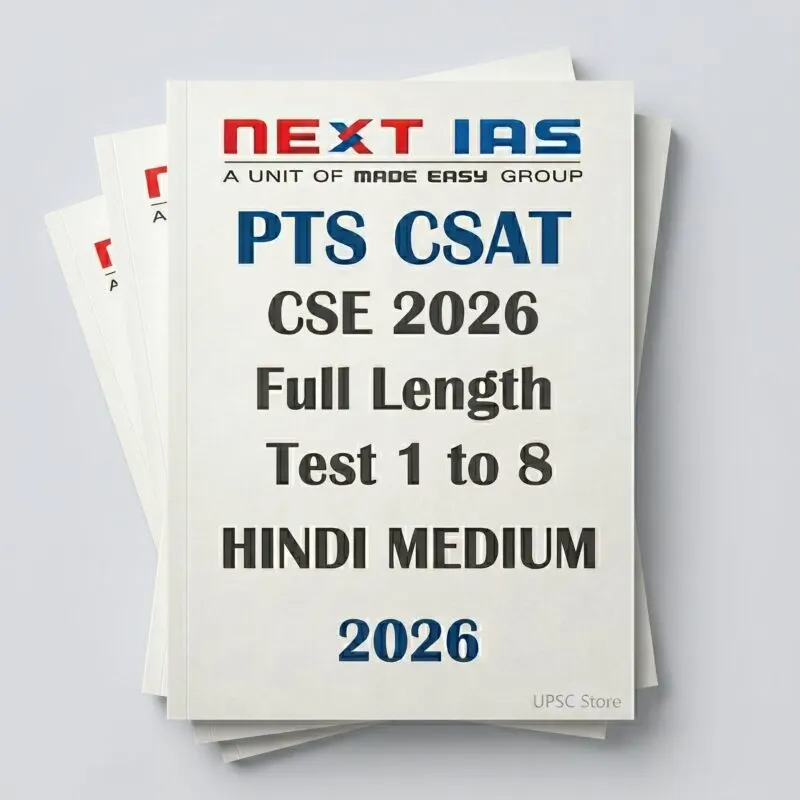

Next IAS Prelims Full Length CSAT Test 1-8 Hindi 2026 | 8 Booklets | Hindi Medium | UPSC Study Material
Binding Guide
Pick the binding that fits how you study.
Spiral Binding
- Lays completely flat
- 360° page rotation
- Great for note-taking
- Best for maths, science, reference
Without Spiral
- Compact & professional
- Sturdy glued/stitched spine
- Easy to stack & store
- Best for textbooks & long-term
About Next IAS CSAT Test 1-8
The Next IAS CSAT Test 1-8 is a printed UPSC study material set sold by UPSC Store — India’s trusted source for genuine, latest-batch civil services preparation books. This page covers full booklet details, syllabus coverage, pricing, shipping, and frequently asked questions. Useful for UPSC CSE, BPSC, UPPSC, MPPSC, RAS and other state PSC examinations.
Next IAS Prelims Full Length CSAT Test 1-8 Hindi 2026 — 8 Booklets Printed Test Series for UPSC Prelims
Related: Next IAS notes · CSAT test series
Buy Next IAS Prelims Full Length CSAT Test 1-8 printed test series online — the most comprehensive mock test preparation package for UPSC Prelims 2026 in Hindi medium. These 8 complete full-length CSAT tests are designed to replicate the actual exam pattern, difficulty, and time pressure that aspirants face during the UPSC Civil Services Examination Preliminary stage. Each test is meticulously structured with General Studies and CSAT (Civil Service Aptitude Test) sections, enabling aspirants to practice both subject knowledge and analytical reasoning in a realistic examination environment. Whether you are preparing for your first attempt or refining your strategy after previous attempts, buy this Next IAS test series to build speed, accuracy, and confidence across all CSAT question types.
Product Overview
| Feature | Details |
|---|---|
| Booklets Count | 8 Individual Printed Booklets — Complete Full-Length CSAT Test Series Tests 1 Through 8 |
| Language | Hindi Medium (हिंदी माध्यम) |
| Publisher | Next IAS (Prelims Test Series) |
| Edition | 2026 — Latest Genuine Batch |
| Condition | Brand New, Unmarked, Fresh Stock |
| Format | High-Quality Printed Booklets — Book Binding |
| Paper Quality | 75 GSM Ultra-White — Highlighter Safe, Zero Bleed-Through |
| Total Pages | 375 Pages Across All 8 Booklets |
| Shipping | Pan India Delivery in 3-5 Business Days — Tracked |
| Also Useful For | BPSC, UPPSC, MPPSC, RAS, KPSC, JPSC, OPSC and all State PSC Preliminary Examinations |
Complete Booklet Catalog
This Next IAS CSAT Full Length Test Series comprises 8 complete mock tests spanning 375 pages, each designed to mirror the exact structure of the UPSC Civil Services Preliminary Examination. These tests are intended for aspirants preparing for UPSC 2026 who need rigorous practice in both General Studies and CSAT reasoning sections under timed conditions. Every test includes detailed question-wise solutions with explanation codes to help identify weak areas and performance bottlenecks.
- Booklet 1: Full Length CSAT Test 1 — Complete mock examination with 100 GS questions and 80 CSAT reasoning questions covering current affairs, history, polity, geography, science, and logical reasoning. Time-bound test format with official answer sheet for self-evaluation and performance tracking.
- Booklet 2: Full Length CSAT Test 2 — Second complete mock test with fresh question set maintaining UPSC difficulty standards. Includes questions on constitution, administration, economics, environmental issues, and aptitude assessment sections designed to build conceptual clarity and speed simultaneously.
- Booklet 3: Full Length CSAT Test 3 — Third full-length test series booklet with expanded coverage of state-specific governance, developmental issues, ethics-based case scenarios, and analytical reasoning problems requiring multi-step logical deduction and inference drawing.
- Booklet 4: Full Length CSAT Test 4 — Fourth complete mock examination focusing on international relations, defense studies, science and technology advancement, sustainable development goals, and CSAT data interpretation sections with tables, graphs, and diagram-based questions.
- Booklet 5: Full Length CSAT Test 5 — Fifth test booklet emphasizing historical events, cultural heritage, ancient civilizations, constitutional provisions, parliamentary procedures, and decision-making scenarios requiring practical judgment and professional ethics application.
- Booklet 6: Full Length CSAT Test 6 — Sixth full-length test with focus on contemporary issues, government schemes, budget analysis, fiscal policies, agricultural economics, rural development, and comprehension-based reasoning questions demanding careful text analysis.
- Booklet 7: Full Length CSAT Test 7 — Seventh mock test covering geographical studies, climate patterns, disaster management, resource management, statistical analysis, probability questions, and critical incident command center case studies for administrative decision-making.
- Booklet 8: Full Length CSAT Test 8 — Final comprehensive test in the series integrating all major UPSC Prelims topics with mixed difficulty levels. Includes final revision checklist, performance analysis framework, and strategy guide for actual examination day.
In-Depth Content Breakdown: Booklet by Booklet
Booklet 1: Full Length CSAT Test 1
The first test booklet in Next IAS series serves as your baseline assessment tool, establishing current performance levels across General Studies Paper 1 and CSAT Paper 2. This test contains 100 General Studies questions spanning Indian history from ancient civilizations through modern independence struggle, constitutional development and governance structures, geographic distribution of natural resources, and current affairs from the previous six months. The CSAT portion includes 80 questions on logical reasoning, analytical ability, numerical computation, reading comprehension, and decision-making scenarios. This inaugural test is calibrated at standard UPSC difficulty level, allowing aspirants to gauge their existing preparation stage and identify subject areas requiring intensive revision. The question diversity ensures you encounter factual recall, application-based analysis, and inference-drawing demands that characterize actual Prelims examinations.
Test 1 features detailed subject-wise breakdowns after each section, enabling targeted preparation planning. Solutions provided include explanation codes referencing specific NCERT chapters, current affairs sources, and conceptual frameworks needed for each answer. Separate answer sheets with carbon copies allow simultaneous test-taking and self-checking without external assistance. The time-allocation guidance (90 minutes per paper) trains aspirants to manage examination pressure realistically. Performance analytics grid helps calculate sectional accuracy percentages, identify question-type weakness patterns, and benchmark your score against previous year cutoffs. This foundational test establishes study habits, reading speed metrics, and problem-solving approaches necessary for sustainable exam preparation throughout the year.
Booklet 2: Full Length CSAT Test 2
The second test booklet introduces increased complexity and question diversity while maintaining UPSC authenticity. This test emphasizes Indian constitutional provisions, electoral system mechanics, separation of powers doctrine, and administrative law principles that frequently appear in actual Prelims papers. General Studies coverage expands to include economic policies, five-year plans, poverty alleviation schemes, and fiscal instruments used by government. CSAT questions become progressively challenging with emphasis on inference-drawing, assumption identification, and logical sequence determination. Questions on logical reasoning include categorical propositions, Venn diagram problems, and syllogistic reasoning requiring careful analysis of given statements. This test builds upon foundational knowledge established through Test 1, introducing question-linking patterns where multiple questions reference single case studies or administrative scenarios, mirroring authentic UPSC question design.
Booklet 2 incorporates detailed explanations distinguishing between “definitely true,” “probably true,” and “cannot be determined” answers in critical reasoning sections—essential nuance for handling ambiguous UPSC questions. Solutions reference specific government publications, ministry reports, and policy documents available on official websites, enabling independent verification and deeper learning. Performance comparison worksheets allow tracking improvement trajectory across Test 1 and Test 2, highlighting whether speed increased without accuracy loss. Time-management strategies specific to CSAT are embedded, including techniques for handling “all of the above” type questions, negative marking implications, and skipping-strategy optimization. The test concludes with retrospective analysis format, guiding aspirants to identify systematic errors versus careless mistakes, supporting strategic revision planning.
Booklet 3: Full Length CSAT Test 3
Test 3 escalates difficulty across both papers, introducing questions requiring synthesis of multiple concepts and application to novel scenarios. General Studies questions now demand integration of historical context, constitutional framework, contemporary policy environment, and ethical considerations simultaneously. For instance, questions might present administrative dilemmas requiring aspirants to balance constitutional rights against governance efficiency, economic development against environmental sustainability, or federal autonomy against national integration imperatives. CSAT section emphasizes comprehension passages of 500+ words on complex topics like artificial intelligence governance, cryptocurrency regulation, and international trade mechanics, requiring extraction of specific information under time pressure. Logical reasoning progresses to complex assumption-based questions and logical inference chains spanning multiple statements, demanding sustained concentration and symbolic reasoning capability.
This booklet introduces performance benchmarking against successful aspirant statistics, showing score distributions from previous UPSC cycles and cutoff trends. Solutions now include alternative answer approaches and common misconceptions that trap aspirants, helping develop pattern recognition for UPSC question logic. Specialized sections cover frequently tested topics: Preamble applications, fundamental rights and duties, center-state financial relations, constitutional amendment procedures, and recent judicial decisions affecting administrative law. CSAT solutions include diagram-based explanations for spatial reasoning questions, decision-tree analysis for logical sequencing problems, and worked examples for numerical problems. The booklet concludes with performance diagnostics identifying whether weakness stems from knowledge gaps, reading speed limitations, or anxiety-driven hasty decisions, enabling targeted intervention strategies.
Booklet 4: Full Length CSAT Test 4
Test 4 significantly expands international dimension coverage, including questions on geopolitics, India’s foreign policy, regional security challenges, and India’s role in global institutions. General Studies questions address India-China relations, India-Pakistan dynamics, Indian Ocean geopolitics, South Asian regional cooperation mechanisms, and India’s participation in SCO, BRICS, QUAD, and international development organizations. Science and technology questions shift toward innovation applications and emerging technologies impacting governance: blockchain in land records, AI in judicial decisions, and biotechnology in agriculture policy. CSAT data interpretation section now includes complex tables with 6-8 columns, requiring multi-step calculations and percentage computations within 90-second time limits per question set. Questions on decision-making include administrative scenarios involving public administration dilemmas, conflict resolution between stakeholders, and resource allocation under constraint conditions.
This booklet features extensive solution frameworks demonstrating how to eliminate incorrect answers systematically, calculate probabilities for “best answer” identification in ambiguous questions, and apply elimination logic reducing options progressively. Comparative analysis shows performance benchmarks across different question types: passage-based versus standalone questions, quantitative versus qualitative reasoning, and knowledge-based versus logic-based problems. Solutions include reference maps for geopolitical questions, timeline diagrams for historical sequences, and flow-charts for constitutional procedures. The booklet provides aspirant testimonials identifying Test 4 as critical preparation stage where conceptual integration begins replacing isolated topic knowledge. Performance analytics highlight whether aspirants are ready for advanced practice or need foundational reinforcement, supporting adaptive learning strategies aligned with individual preparation pace.
Booklet 5: Full Length CSAT Test 5
Test 5 emphasizes cultural and historical knowledge integration with contemporary policy relevance. General Studies questions connect historical events to current policy frameworks: Buddhist philosophy to modern constitutional values, Mughal administrative structures to contemporary bureaucratic systems, and independence struggle principles to modern governance ideals. Cultural heritage questions address UNESCO sites, protected monuments, and classical art forms requiring knowledge of historical context, contemporary conservation challenges, and cultural significance. Ethics dimensions expand substantially, with questions presenting moral dilemmas in governance: whistleblower protection versus confidentiality, public interest versus individual privacy, and transparency versus national security tensions. CSAT comprehension passages now include literary excerpts, philosophical texts, and opinion pieces requiring interpretation of author intent and value positions alongside factual extraction. Logical reasoning emphasizes ethical reasoning and value-based inference where “correct” answers require moral judgment alongside logical deduction.
Solutions for Test 5 include extensive contextual frameworks connecting historical knowledge to constitutional values and administrative principles. For cultural heritage questions, solutions provide geographical location details, historical significance narratives, conservation status updates, and links to current affairs events affecting these sites. Ethics solutions distinguish between legality and morality, rule-following and principle-based decision-making, and individual rights versus collective welfare—developing moral reasoning essential for Mains ethics paper preparation. CSAT solutions include reading strategy tutorials for dense passages, annotation techniques for comprehension efficiency, and vocabulary building lists with UPSC question contexts. The booklet incorporates reflective learning exercises where aspirants analyze their value positions against official answers, building metacognitive awareness about bias and assumption influence on answer selection. Performance tracking distinguishes between knowledge gaps and skill gaps, supporting targeted reinforcement intervention.
Booklet 6: Full Length CSAT Test 6
Test 6 intensifies focus on contemporary issues, government schemes, and policy analysis required for current affairs competency in UPSC Prelims. General Studies questions cover recent budget announcements, newly launched government schemes, recent policy modifications, and contemporary legislative developments from previous six months before test creation. Questions integrate scheme details with implementation challenges: PM-KISAN beneficiary counting issues, National Health Mission service delivery gaps, and MGNREGA employment guarantee challenges. Economics questions emphasize inflation mechanisms, monetary policy effectiveness, fiscal policy instruments, and budget arithmetic including tax implications and subsidy impacts. Questions demand numerical reasoning: calculating indirect tax incidence, understanding budget deficit implications, and analyzing poverty statistics across regions. CSAT numerical reasoning section escalates difficulty with questions requiring compound calculations, percentage chain applications, and data set comparisons.
Solutions for Test 6 include updated government statistics, scheme eligibility criteria, and implementation status from official ministry websites current as of test publication. Explanations connect policy tools to economic outcomes: interest rate changes to investment behavior, GST modifications to price movements, and fiscal stimulus to GDP growth. Questions include case studies from governance failure and policy success: demonetization impacts, Pradhan Mantri Jan Dhan Yojana adoption barriers, and Direct Benefit Transfer implementation achievements. Numerical solutions include step-by-step calculation breakdowns, common arithmetic errors to avoid, and speed-calculation techniques for time-bound conditions. The booklet provides performance analysis specifically for economics and policy questions, showing accuracy percentages for different question types and identifying whether aspirants need deeper economics knowledge or improved reading comprehension of policy documents. Strategy guides address scheme memorization techniques, ensuring efficient retention of numerous schemes with eligibility criteria and benefits.
Booklet 7: Full Length CSAT Test 7
Test 7 shifts emphasis toward geographical analysis, environmental sustainability, and disaster management topics gaining increased weightage in recent UPSC examinations. General Studies questions address geographic distribution of natural resources: mineral reserves and mining impacts, river systems and water resource management, and climatic zones determining agricultural productivity. Environmental questions progress beyond simple conservation awareness to complex issues: climate change mitigation strategies, international environmental agreements and India’s commitments, renewable energy transition challenges, and circular economy implementation. Disaster management questions include case studies of recent natural calamities, preparedness assessment, warning system effectiveness, and rehabilitation challenges. Questions demand integration of geographic knowledge with governance: understanding how terrain affects administrative efficiency, climate patterns determine livelihood options, and natural resources influence inter-state conflicts. CSAT data interpretation escalates complexity with multi-dimensional datasets: tables showing population growth across regions with climate variation, graphs representing resource extraction against environmental impact, and statistical correlations requiring careful interpretation.
Solutions for Test 7 include detailed geographical maps showing resource distribution, climate zones, river systems, and protected areas referenced in questions. Environmental explanations connect local case studies to global climate frameworks, showing how India’s policies align with Paris Agreement commitments and sustainable development goals. Disaster management solutions include preparedness checklist frameworks, early warning system mechanics, and rehabilitation strategy components. CSAT data interpretation explanations include visual step-by-step problem-solving demonstrations, calculation checks for probability errors, and inference-validation logic ensuring conclusions logically follow from data presented. The booklet provides specialized performance analysis for geographical reasoning, assessing whether aspirants struggle with spatial visualization, map reading, or conceptual understanding of climate-society interactions. Resource management questions include cost-benefit analysis frameworks teaching aspirants to evaluate trade-offs between economic development and environmental protection—critical thinking skill for Mains optional subjects and interview.
Booklet 8: Full Length CSAT Test 8
Test 8 serves as comprehensive final assessment integrating all major Prelims topics at maximum difficulty levels. This test represents aspirant readiness for actual examination, featuring mixed question types across all difficulty bands: straightforward recall, application-based reasoning, and complex inference demands all appearing together as in authentic UPSC papers. General Studies questions span Indian history, constitution, governance, economics, geography, science, and current affairs without topic-wise clustering, mirroring actual examination unpredictability. Complex multi-concept questions demand integration: connecting historical events to constitutional implications to contemporary policy relevance within single question. CSAT section reaches authentic difficulty with reading comprehension passages of 600+ words on specialized topics, logical reasoning chains spanning multiple premises with subtle logical fallacies, and numerical reasoning demanding accurate calculation within extreme time pressure. The test includes questions where multiple answers appear partially correct, requiring careful distinction between “correct” and “most correct” responses—essential for handling UPSC ambiguity.
Solutions for Test 8 include comprehensive performance review framework comparing this final test against previous seven tests, showing performance trajectory and identifying remaining knowledge gaps versus persistent skill deficiencies. Critical thinking guide demonstrates how UPSC questions frequently contain implicit assumptions, value judgments, or subtle logical fallacies—developing the question-deconstruction ability necessary for exam success. The booklet concludes with integrated revision checklist covering all major topics tested across eight tests, prioritized by frequency of appearance and importance for advancing cutoff trends. Strategic preparation guide addresses final two months before examination: revision scheduling, test-retaking protocols, anxiety management techniques, and last-minute strategy adjustments based on individual performance patterns. Aspirant success stories highlight common preparations across high scorers, identifying whether success correlates with exhaustive coverage or focused depth, full-length test practice or targeted topic revision, and group study versus isolated preparation. The booklet emphasizes that Test 8 is not destination but milestone—providing objective assessment of readiness and identifying specific intervention needed during final examination phase.
Physical Construction and Quality Standards
These Next IAS CSAT test booklets are manufactured to institutional examination standards, ensuring durability through intensive study usage across months of examination preparation. Each booklet undergoes rigorous quality control testing for paper opacity, printing resolution, and binding integrity—critical specifications supporting multiple-usage scenarios where aspirants mark answers, highlight important information, and reference solutions repeatedly. The physical construction prioritizes aspirant ergonomics: comfortable handling during 3-4 hour continuous study sessions, secure binding preventing page-loosening during frequent re-reading, and cover stock strength maintaining structural integrity throughout preparation cycle. Paper selection and printing techniques eliminate eye-strain triggers including glare, reduced contrast, and visual fatigue factors compromising learning efficiency during long examination preparation periods.
Paper Quality: 75 GSM Anti-Glare White Paper
The 75 GSM ultra-white paper specification ensures optimal opacity preventing text show-through on reverse pages—essential for maintaining readability and enabling annotation on both sides without visual distraction. This GSM weight represents engineering balance between durability and thickness: heavier 90 GSM paper adds bulk increasing carrying difficulty for aspirants traveling with study materials, while lighter 70 GSM risks visible show-through when using highlighters or pens. The ultra-white composition eliminates blue-tint or cream-colored paper effects that strain eyes during extended reading. Multiple highlighter colors—yellow, green, blue, and pink—register clearly without bleeding through to reverse side, enabling sophisticated color-coding systems for revision organization. The anti-glare finish reduces light reflection that causes eye fatigue, making these booklets suitable for studying under varied lighting conditions: natural daylight, LED lamps, and reading lights. Pencil and gel-pen markings remain erasable on 75 GSM paper without surface damage, supporting tentative answer-marking before finalizing solutions. The paper composition includes acid-free manufacturing preventing yellowing or deterioration over years of storage, preserving booklet condition for reference during interview preparation phases.
Printing Technology: High-Resolution Laser Printing
Next IAS booklets utilize 1200 DPI laser printing technology ensuring crisp text rendering at 8pt minimum font sizes, maintaining readability throughout booklets without magnifying glass assistance. Laser printing’s permanent toner bonding prevents smudging from accidental liquid spills or sweating hands during examination practice—frequent occurrence in high-stress test conditions. This technology produces perfectly aligned text columns and diagram positioning, eliminating the printing misalignment that distorts geographical maps or chart interpretation. Mathematical symbols, special characters, and scientific notations print with high fidelity, preventing misinterpretation of numerical questions or scientific terminology. Diagrams including flowcharts for constitutional procedures, maps for geographical questions, and tables for data interpretation display maximum clarity enabling quick information extraction under time pressure. The printing density prevents ink-bleed onto reverse pages even with aggressive pen-marking, maintaining opposite page legibility. High-resolution printing preserves fine-detail elements in photographs, historical images, and scientific diagrams—increasingly common in modern UPSC questions. Color laser printing (where utilized) ensures distinction between different information categories: black for primary text, blue for definitions, red for important keywords—supporting rapid visual scanning during quick revision sessions immediately before examination.
Binding and Durability
Next IAS offers flexible binding options accommodating diverse aspirant preferences. Spiral binding (plastic coil through spine holes) enables 180-degree flat opening—essential for simultaneously viewing questions and writing answers in margins without page-flipping interruptions. Spiral binding allows aspirants to remove individual pages for focused single-test practice or sharing specific tests with study partners. Book binding (perfect binding with glued spine) provides compact storage advantage, reducing shelf space and improving portability for aspirants studying across multiple locations. Both binding types utilize 300 GSM cover stock in white or colored variants—sufficiently rigid preventing cover warping during backpack transportation or stacking with other study materials. Binding integrity testing ensures pages remain securely attached even with frequent opening/closing cycles across preparation spanning 6-12 months. Spine printing includes test number and booklet identifier, enabling quick location in shelf storage or test-series organization. The binding type selection does not affect content quality—identical printing, paper quality, and solution comprehensiveness across both binding variants, ensuring aspirants receive consistent learning value regardless of binding preference.
Key Features and Study Design
These Next IAS CSAT test booklets incorporate pedagogical design features specifically addressing UPSC Prelims preparation challenges: managing time constraints, building subject knowledge breadth, developing pattern recognition for question logic, and maintaining accuracy under pressure. The eight-test series structure enables progressive difficulty advancement and cumulative learning reinforcement—initial tests establish foundational competency while final tests assess exam-readiness. Full-length format replicates authentic examination pressure and time limitations, developing the speed-accuracy calibration essential for successful Prelims performance. Hindi medium delivery serves aspirants preferring vernacular question engagement and reducing cognitive load during comprehension tasks.
- Complete Full-Length Test Format: Each booklet contains 100 General Studies questions and 80 CSAT questions matching official UPSC examination structure, demand patterns, and time allocation. Practicing with authentic question patterns conditions your mind for examination day challenges, building the mental stamina for 3-4 hour continuous examination endurance. This format prevents over-specialization on abbreviated practice tests that don’t replicate actual time pressure and decision-fatigue conditions.
- Progressive Difficulty Escalation Across Eight Tests: Test series progresses from standard-difficulty baseline (Test 1) through moderate complexity (Tests 2-4) to advanced difficulty (Tests 5-8), mirroring learning progression from foundational knowledge acquisition through advanced synthesis and application. This structured escalation prevents discouragement from prematurely encountering maximum-difficulty questions while ensuring adequate challenge for developing expertise. Aspirants gauge preparation stage by performance on specific test, identifying whether foundational reinforcement or advanced strategy refinement is needed.
- Detailed Solution Framework with Explanation Codes: Beyond simply providing correct answers, solutions include explanation rationale identifying why correct answer is superior to alternatives, conceptual frameworks underlying question logic, and reference citations enabling independent verification and deeper learning. Explanation codes link to specific NCERT chapters, enabling aspirants to revisit source material for knowledge reinforcement. This solution depth transforms test-taking from practice exercise into learning opportunity, supporting knowledge retention and reducing repeated mistakes.
- Performance Analytics and Benchmarking: Integrated performance tracking worksheets quantify accuracy by question type, subject area, and difficulty level—identifying precise weak areas requiring targeted reinforcement rather than generic “study more” advice. Cutoff comparison charts show your score against UPSC category-wise cutoff trends, answering the critical question: “Am I on track for selection?” This concrete performance feedback sustains motivation during lengthy preparation spanning months while enabling realistic self-assessment and strategic planning adjustments.
- Hindi Medium Delivery with Authentic Question Translation: Hindi medium questions are not literal translations but authentic question formulations maintaining UPSC meaning while incorporating natural Hindi phrasing and terminology conventions. This approach serves aspirants preferring vernacular thinking, reducing cognitive load during comprehension and enabling deeper conceptual engagement. Questions reference Hindi historical sources, Indian literature in translation, and government publications available in Hindi—respecting regional language preparation legitimacy while maintaining examination authenticity.
Shipping, Packaging and Delivery
Your Next IAS CSAT test series is carefully packaged to withstand postal transit without damage or pages loosening. All eight booklets are individually wrapped in shrink-wrap protective covering, preventing moisture infiltration and accidental page-separation during handling. The shrink-wrapped bundle is placed within a corrugated cardboard box with internal air-cushioning material (thermocol or bubble wrap) providing impact protection during courier transport. Edge-protector boards inserted at box corners absorb compression forces during stacking in postal facilities, preventing corner crushing that damages cover pages. Box tape sealing ensures contents remain secure despite rough handling, and all seams are reinforced with water-resistant tape providing weather protection during monsoon deliveries across pan-India regions.
Order placement triggers immediate fulfillment from our Mukherjee Nagar, Delhi warehouse, with tracking number provided via WhatsApp at +91 85802 57424 within 24 hours of purchase. Your package ships via premium courier service offering 3-5 business day delivery across all Indian postal codes—Delhi-NCR region receives delivery within 2-3 business days while remote northeastern and island regions receive delivery within 5-7 business days. Real-time tracking enables you to monitor package location at each transit hub, and delivery confirmation photo ensures accountability for receipt. In rare instances of missing booklets or damaged pages post-delivery, we replace affected booklets within 48 hours without requiring return of original—prioritizing your examination preparation continuity. WhatsApp support enables image-based complaint documentation for rapid issue resolution without requiring traditional customer service interactions. Packaging materials are recyclable, aligning with environmental responsibility standards while maintaining product protection integrity.
Frequently Asked Questions (FAQ)
A: Yes, Next IAS CSAT tests are specifically designed by experienced UPSC faculty to match authentic examination patterns, difficulty standards, and question logic. The eight-test series provides progressive practice escalation supporting learning from foundational knowledge through exam-ready competency. Thousands of successful UPSC aspirants have used Next IAS test series for baseline assessment, identifying weak areas, building speed-accuracy calibration, and maintaining confidence during preparation phases. The Hindi medium variant ensures aspirants thinking in regional languages engage authentically with questions without translation cognitive overload.
A: This Next IAS package includes 8 complete full-length CSAT tests (Tests 1-8) spanning 375 total pages. Each test contains 100 General Studies questions and 80 CSAT reasoning questions matching official UPSC examination structure. The eight-test quantity provides sufficient practice repetitions for developing pattern recognition and question-type familiarity while preventing excessive practice causing diminishing returns. Eight tests also enable tracking performance progression across series, identifying whether improvements are consistent or plateau-ing.
A: Absolutely. This specific product is Next IAS Prelims Full Length CSAT Test 1-8 Hindi 2026 — all questions are presented in Hindi medium (हिंदी माध्यम) authentic to regional language examination standards. Hindi medium tests enable aspirants preferring vernacular thinking to engage deeply with content without translation friction. The Hindi language versions maintain complete UPSC question equivalence—identical difficulty, identical topic coverage, and identical solution frameworks as English medium counterparts.
A: Each test booklet covers the complete UPSC Prelims examination pattern but with progressing difficulty and topic emphasis. Test 1 establishes baseline performance across standard-difficulty questions. Tests 2-3 introduce moderate complexity with integrated multi-concept questions. Tests 4-6 escalate to advanced difficulty with complex reasoning demands and contemporary issue emphasis. Test 7-8 reach maximum difficulty with ambitious synthesis questions and novel scenario applications. Additionally, each test emphasizes different topic clusters: Test 1 basics, Test 4 international relations, Test 6 contemporary issues, Test 7 geography and environment—providing varied topic exposure across the series.
A: Yes, all 8 tests are complete full-length examinations with comprehensive solutions. Beyond providing correct answers, solutions include detailed explanation frameworks showing why each correct answer is superior, conceptual rationale behind question logic, and reference citations enabling independent verification. Solutions also highlight common wrong-answer traps and misconceptions frequently leading aspirants to incorrect choices. Performance analysis worksheets help interpret your score meaningfully—breaking down accuracy by question type and subject area rather than just overall percentage.
A: Full-length tests replicate authentic examination pressure—three-hour continuous testing, time management constraints, and decision-fatigue under unstopped work conditions. This authentic replication conditions your mind and body for examination endurance, develops the time-awareness necessary for strategic question-selection decisions, and reveals performance gaps under realistic pressure that short-duration practice doesn’t expose. Studies show full-length test practice correlates strongly with improved Prelims scores because practice conditions match examination conditions—enabling skills developed during practice to transfer directly to exam performance.
A: For current pricing details, please check the product listing on our UPSC Store website or contact our WhatsApp support at +91 85802 57424. Pricing reflects the comprehensive nature of eight complete tests with detailed solutions, high-quality 75 GSM paper printing, and personalized customer support including 48-hour replacement guarantee. We offer competitive pricing aligning with market rates while maintaining premium quality standards that support serious UPSC aspirant preparation.
A: After completing purchase, you receive tracking information via WhatsApp (share your WhatsApp number during checkout) within 24 hours. Physical booklets ship from our Mukherjee Nagar, Delhi warehouse and arrive within 3-5 business days via tracked courier service. Once received, booklets are yours to keep indefinitely—use them for unlimited practice attempts, share with study partners, and reference during interview preparation phases. No activation codes or online account creation needed—physical booklets provide immediate usability without dependency on internet connectivity or software platforms.
A: Yes, these Next IAS booklets are specifically designed for active marking and annotation. The 75 GSM ultra-white paper accommodates highlighters in multiple colors (yellow, green, blue, pink) without bleeding through to reverse pages. Pencil markings remain erasable enabling tentative answer-recording before finalizing choices. Gel pens and ballpoint pens write smoothly without paper damage. We recommend pencil for initial practice allowing modification as your understanding improves, then pen for subsequent practice attempts simulating actual examination conditions where pencil erasing isn’t possible.
A: The complete Next IAS CSAT Test 1-8 series package measures 30cm (width) x 21cm (height) x 1cm (thickness) with total weight of 1.05 kg. This compact sizing enables convenient carrying in backpacks or study bags, supporting aspirants studying across multiple locations. Individual test booklets average 50-55 pages enabling flexible usage: practice complete eight-test series sequentially for comprehensive preparation, or extract individual tests for focused topic practice. The moderate weight prevents fatigue during transportation while sufficient thickness maintains structural integrity during frequent opening/closing cycles.
A: Yes, while designed primarily for UPSC Civil Services Prelims, these tests are highly relevant for state-level PSC examinations including BPSC (Bihar), UPPSC (Uttar Pradesh), MPPSC (Madhya Pradesh), RAS (Rajasthan), KPSC (Karnataka), JPSC (Jharkhand), OPSC (Odisha), and other state PSC preliminary examinations. Most state PSCs follow similar examination structure with General Studies and aptitude components. The rigorous question standards and comprehensive coverage develop the strong foundation required for state-level examinations. However, review specific state PSC syllabi—some states emphasize state-specific geography or administration, requiring supplementary state-level test practice alongside this UPSC-focused series.
Summary
| Specification | Value |
|---|---|
| Booklets | 8 Printed Full-Length Test Booklets |
| Tests Included | CSAT Test 1, 2, 3, 4, 5, 6, 7, 8 (Complete Prelims Pattern) |
| Total Pages | 375 Pages Across All Booklets |
| Questions | 100 GS + 80 CSAT Questions Per Test = 1,440 Total Questions |
| Language | Hindi Medium (हिंदी माध्यम) |
| Paper Quality | 75 GSM Ultra-White, Highlighter-Safe |
| Binding Options | Spiral or Book Binding |
| Edition | 2026 — Latest Genuine Batch |
| Delivery | 3-5 Business Days Pan India (Tracked) |
| Also Useful For | BPSC, UPPSC, MPPSC, RAS, KPSC, JPSC, OPSC, and State PSCs |
Next IAS CSAT Test 1-8 Hindi 2026 — available now at UPSC Store, Mukherjee Nagar, Delhi. Order online for guaranteed pan India delivery in 3-5 business days with complete solution support and 48-hour replacement guarantee. WhatsApp +91 85802 57424 for queries.
Reference: Civil Services Examination
Customer Reviews
No reviews yet
Be the first — bought this set? Tap “Write a Review” and tell other students how it arrived.
Only real buyers — we never post fake reviews.
Aspirants Also Bought
Same exam · bestsellers first

Vision IAS Prelims 2026-27 GS Test Series | 15–35 Tests | English Medium

Vajiram & Ravi General Studies Prelims Test Series 2026-27 | 10–30 Tests | English Medium | UPSC Study Material

Drishti IAS Hindi Medium Complete GS Notes 2025-26 | 18 Booklets | Hindi Medium | UPSC Study Material
Next IAS General Studies Prelims Test Series 2026-27 | 10–35 Tests | English Medium | UPSC Study Material
Drishti IAS Prelims Test Series 2026-27 | 10–35 Tests | English Medium | UPSC Study Material

Shubhra Ranjan PSIR Optional Handwritten Notes 2026-27 | 11 Booklets | English Medium | UPSC Study Material

PW Only IAS Prelims 2026-27 Hindi Test Series | 10–35 Tests | Hindi Medium | UPSC Study Material
Drishti IAS GS Foundation Notes 2025-26 | 27 Booklets | English Medium | UPSC Study Material

Forum IAS Prelims Topic-wise PYQs 1992-2025 | 7 Booklets | English Medium | UPSC Study Material
PW Only IAS Prelims Test Series 2026 | 10–35 Tests | English Medium | UPSC Study Material
About Next IAS Prelims Full Length CSAT Test 1-8 Hindi 2026
Next IAS Prelims Full Length CSAT Test 1-8 Hindi 2026 is an original printed study material set from Next IAS, covering CSAT Prelims 1-8 Hindi 2026. Available in Hindi medium, this set is counted booklet by booklet before dispatch — no photocopies, no missing booklets.
Product Details
- Institute: Next IAS
- Subject: CSAT Prelims 1-8 Hindi 2026
- Medium: Hindi
- Pages: 375
- Format: Printed Booklets
- Delivery: Pan-India delivery in 4–7 working days, free over ₹1,999
- Condition: New, original print — counted before dispatch
Why Buy from UPSC Store?
- ✓ Original Printed Notes — no photocopies, every booklet counted before it ships
- ✓ Fast Dispatch — ships within 24 hours from Delhi, arrives in 4–7 days pan-India
- ✓ Secure Packaging — bubble-wrapped and boxed to prevent damage in transit
- ✓ 180+ Orders Shipped — to 25 states across India
- ✓ WhatsApp Support — ask which set fits your optional and medium before ordering
Frequently Asked Questions
Original print — the same printed booklets the institute issues. Every set is counted booklet by booklet before dispatch.
Orders are dispatched within 24 hours from Delhi and delivered across India in 4–7 working days. Delivery is free over ₹1,999.
Returns are accepted only if the problem is from our side: wrong item, damaged or defective copy, or missing booklets or pages. Report it within 7 days of delivery and we arrange a free pickup and send a free replacement or a full refund. We do not accept change-of-mind returns, so please check the medium, edition and binding before ordering. WhatsApp us to start a return.