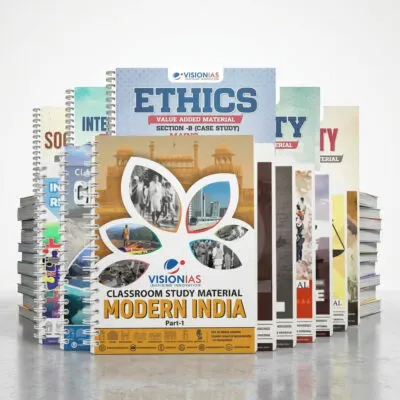
Vision IAS Prelims 2026-27 GS Test Series
About Vision IAS Prelims 2026-27 GS
The Vision IAS Prelims 2026-27 GS is a printed UPSC study material set sold by UPSC Store — India’s trusted source for genuine, latest-batch civil services preparation books. This page covers full booklet details, syllabus coverage, pricing, shipping, and frequently asked questions. Useful for UPSC CSE, BPSC, UPPSC, MPPSC, RAS and other state PSC examinations.
Vision IAS Prelims Test Series 2026: The Ultimate Comprehensive GS Question Bank & Explanatory Resource (English Medium)
Related: Vision IAS test series · UPSC test series
Product Overview
| Feature | Specifications |
|---|---|
| Booklets Count | 35 High-Density Printed Booklets (Subject-Wise + Full Length) |
| Language | English Medium (Academic Standard) |
| Publisher | Vision IAS Publication (Latest 2026 Edition) |
| Condition | Brand New, Laser Printed, Fresh Stock |
| Format | Physical Printed Softcopy / Spiral Bound Comprehensive Volumes |
| Paper Quality | 75 GSM Ultra-White Executive Grade Paper |
Complete Booklet Catalog: The 35-Volume Blueprint
This package is not merely a collection of questions; it is a meticulously indexed library of 35 individual booklets. Each booklet is partitioned into two distinct halves: the Question Segment and the Exhaustive Solution Segment. Below is the inventory of the specific booklets included in the 2026 Series:
- Booklet 1-4: Indian Polity & Governance (Fundamental Rights, DPSP, Parliament, Judiciary, Constitutional Bodies, and Local Self-Government).
- Booklet 5-8: History of India & Indian National Movement (Ancient India, Medieval India, Modern India, and Indian Art & Culture).
- Booklet 9-12: Physical and Indian Geography (Geomorphology, Climatology, Oceanography, Resources, and Detailed Mapping).
- Booklet 13-16: Indian Economy (Macroeconomics, Budget 2025-26, Economic Survey, Banking, Inflation, and External Sector).
- Booklet 17-20: Science & Technology and Environment (Space Tech, Bio-Tech, Ecology, Biodiversity, Climate Change, and International Conventions).
- Booklet 21-28: Monthly Current Affairs Focused Tests (Dedicated tests for each month ranging from June 2025 to April 2026).
- Booklet 29-35: Comprehensive Full-Length Tests (FLTs) (Simulated UPSC environment covering the entire GS syllabus in a randomized format).
Deep Dive: Anatomy of the Question & Explanation Booklets
The Vision IAS Prelims Test Series 2026 is engineered with a specific internal architecture designed to facilitate rapid information retrieval and long-term retention. Unlike standard mock tests, these booklets serve as “Self-Study Revision Modules.”
1. The Internal Indexing System
Every booklet opens with a detailed “Syllabus Micro-Detaling Index.” This page lists the specific chapters from NCERTs and Standard Reference Books (like Laxmikanth or Nitin Singhania) that were used to frame the questions. This allows the aspirant to map their performance directly back to their source material. If you fail a question on ‘Temple Architecture,’ the index precisely points you to the ‘Art and Culture’ booklet’s relevant section.
2. High-Fidelity Schematic Diagrams
Within the explanation sections of the Geography and Science & Technology booklets, you will find high-resolution, monochrome schematic diagrams. For instance, the Geomorphology booklet includes cross-sectional views of tectonic plate boundaries, while the Science booklets feature detailed illustrations of CRISPR-Cas9 mechanisms and satellite launch vehicle stages. These are printed with high-contrast ink to ensure that even the smallest labels are legible under reading lamps.
3. The “Vision Special” Comparative Tables
A hallmark of these physical booklets is the inclusion of “Comparative Matrices.” In the History booklets, for example, there are tables comparing the Bhakti and Sufi movements, or the different land revenue systems under British rule (Zamindari vs. Ryotwari vs. Mahalwari). These tables are formatted with bold headers and shaded rows to prevent visual fatigue during long study sessions.
Physical Product Quality and Durability Standards
We understand that a UPSC aspirant spends 10-12 hours daily with these materials. Consequently, the physical build quality of the Vision IAS 2026 Test Series has been upgraded to industrial standards.
Premium 75 GSM Paper Stock
The booklets utilize 75 GSM (Grams per Square Meter) paper. This is significantly thicker than the standard 50-60 GSM paper used in local photocopies. The benefit of this high-density paper is twofold: first, it provides an “opaque” reading experience where text from the reverse side does not bleed through; second, it is highly receptive to highlighters. You can use neon inks and ink pens without worrying about smudging or soaking through to the next page.
Anti-Glare Ink and Typeface
The printing process employs a matte-finish black toner. This reduces the glare from overhead study lamps, which is a leading cause of eye strain among students. The font used is a customized 11-point serif typeface for the main text and a 9-point sans-serif typeface for the “Extra Info” boxes, ensuring a hierarchical flow of information that the brain can process more efficiently.
Reinforced Binding and Cover Page
Each of the 35 Booklets is bound using a heavy-duty stapling mechanism or high-quality spiral binding (depending on the specific bundle version), reinforced with a 200 GSM cardstock cover. The covers are color-coded by subject—Polity booklets feature a specific header color, while Economy features another—allowing for easy identification on a crowded bookshelf.
Subject-Specific Internal Content Breakdown
The Polity Series (Booklets 1-4)
The internal content of the Polity booklets focuses heavily on recent Supreme Court judgments and Constitutional Amendments. Every explanation for a Polity question includes a “Background” box, a “Current Context” box, and a “Related Articles” list. This triple-layered explanation ensures that the static and dynamic portions of the syllabus are fused. The booklets include detailed flowcharts of the Legislative Process in Parliament and the hierarchy of the Indian Judicial System.
The History & Culture Series (Booklets 5-8)
In these booklets, the internal content is structured chronologically. The Modern History sections are particularly dense, featuring “Timeline Strips” at the bottom of the explanation pages. These strips help you visualize the sequence of events from the 1857 Revolt to the 1947 Independence Act. The Art and Culture booklet contains hand-drawn sketches of stupas, pillars, and various dance mudras, which are essential for visual learners.
The Economy Series (Booklets 13-16)
Given the volatile nature of the Indian Economy, these booklets are updated with the 2025-26 fiscal data. The content includes “Trend Analysis” graphs for GDP growth, Fiscal Deficit, and Inflation over the last five years. The explanations don’t just give the answer; they explain the “Why.” For instance, if a question is about Repo Rate, the booklet provides a step-by-step logic chain of how a rate change affects market liquidity and consumer demand.
Environment and Science & Technology (Booklets 17-20)
The Environment booklets are packed with “Species Profiles” (IUCN status, habitat, and threats) for every animal or plant mentioned in the questions. The Science & Technology booklets feature a “Glossary of Terms” at the end of the explanation section, defining complex jargon like ‘Quantum Entanglement,’ ‘Non-Fungible Tokens (NFTs),’ and ‘Solid-State Batteries’ in simple, layman’s English.
The Vision IAS Proprietary “Performance Tracking” Page
A unique feature of the 2026 physical edition is the “Diagnostic Sheet” attached to the back of every question paper booklet. This sheet is not just an OMR; it is a grid where the student can categorize their mistakes into three types:
- Conceptual Error: You didn’t understand the topic.
- Factual Error: You forgot a date or name.
- Silly Mistake: You misread “Correct” as “Incorrect.”
This physical tracking system allows the aspirant to identify patterns in their performance across all 35 tests, a feature that is often lost in digital PDF formats.
Detailed Structure of an Explanation Page
To understand the “density” of these booklets, one must look at the layout of a single explanation page. A typical page in the Vision IAS Prelims 2026 Series is divided into four zones:
- The Correct Answer Zone: A bolded declaration of the correct option (A, B, C, or D).
- The “Elimination Logic” Zone: This is a revolutionary feature. It explains why the other three options are wrong. This teaches the student the “Art of Elimination,” which is crucial for the UPSC Prelims.
- The Core Concept Zone: A 200-300 word deep dive into the primary topic of the question.
- The “Extra Edge” Zone: A shaded box containing “Fodder Material.” This includes trivia, related news, or “Do You Know?” facts that are highly probable to be asked in the actual examination.
Packaging and Shipping Quality
Because these are 35 thick booklets, the total weight of the package is substantial (approximately 6-8 kg). We ensure that the product is shipped in a “Three-Layer Protection” format:
- Layer 1: Moisture-proof plastic wrapping for each subject bundle.
- Layer 2: Bubble-wrap cushioning to prevent corner damage (bent edges) during transit.
- Layer 3: A corrugated five-ply cardboard box, sealed with industrial-grade adhesive tape.
This ensures that the “New” condition of the booklets is preserved from our warehouse to your study table, regardless of the weather conditions or distance.
Comparison: Physical Booklets vs. Digital PDFs
While digital copies are available, the 2026 Vision IAS Physical Test Series offers advantages that no screen can replicate:
- Tactile Memory: Studies show that physical interaction with paper enhances memory retention and “spatial mapping” of information.
- Annotation Space: The margins of these booklets are intentionally kept 1-inch wide. This allows you to write your own notes, cross-references, and mnemonics directly next to the explanations.
- Zero Distraction: Physical booklets eliminate the temptation of notification pings, allowing for the deep focus required for a 2-hour simulated test.
- Realistic Simulation: The UPSC Prelims is an offline, pen-and-paper exam. Practicing on the same 75 GSM paper with an OMR sheet prepares your motor skills for the actual D-day.
Internal Data Visualization
The 2026 edition has introduced “Subject Weightage Heatmaps.” At the beginning of the Geography booklet, for example, there is a heatmap showing which areas (like Indian Drainage Systems vs. World Climate Types) have been most frequently targeted by UPSC over the last 10 years. This internal content helps you prioritize which questions in the booklet deserve a second or third reading.
Furthermore, the Science & Technology booklets contain “IPR and Patent” charts, summarizing India’s position on various international treaties. These are not found in standard textbooks but are meticulously curated within these test series booklets.
The Revision Strategy for the 35 Booklets
The internal structure of these booklets supports a “Three-Pass Revision” strategy:
- First Pass (Testing): Solve the question paper under timed conditions. Use the OMR provided at the end of the booklet.
- Second Pass (Analysis): Read the explanation for every question—even the ones you got right. Use a yellow highlighter for new facts and a red pen for corrections.
- Third Pass (Pre-Exam): Only read the highlighted portions and the “Extra Edge” shaded boxes in the explanation section. The paper quality ensures your highlighters won’t fade even after 12 months.
Why the 2026 Edition is Different
The 2026 edition of the Vision IAS Prelims Test Series has been re-indexed to include “Statement-Based Questions” and “Pairing Questions” (e.g., How many pairs are correctly matched?) which have become the new standard in the UPSC 2023, 2024, and 2025 papers. The booklets have been redesigned to move away from simple one-liners to these complex, multi-layered question formats. The “Explanation Density” has increased by 15% compared to the 2025 edition to cover these new nuances.
Frequently Asked Questions (FAQ)
1. Are these booklets the original Vision IAS study material or just photocopies?
These are high-quality, laser-printed booklets sourced directly to reflect the latest 2026 curriculum. They feature clear, crisp text and high-resolution diagrams, ensuring an “original-like” reading experience that is far superior to standard low-grade photocopies.
2. Does the set include the CSAT (Aptitude) tests as well?
This specific product listing is for the General Studies (GS) Paper 1 Series, consisting of 35 Booklets. CSAT booklets are usually sold as a separate add-on or a different bundle. Please check your selection before checkout.
3. What is the ink quality? Will it smudge if I use a highlighter?
The booklets are printed using dry-toner laser technology. Unlike inkjet printing, this ink is fused into the paper fibers. You can use any standard highlighter (liquid or gel) immediately after printing without any fear of smudging the text.
4. How current is the “Current Affairs” content in the 2026 series?
The 2026 series is designed to be released in a phased manner. The booklets included in this package cover current affairs from June 2025 up to the latest possible date before the 2026 Prelims, ensuring that you have the most up-to-date information on government schemes and international summits.
5. Is the binding strong enough to last for a full year of preparation?
Yes. Each booklet is individually bound with heavy-duty staples and a reinforced spine. For the thicker Full-Length Test booklets, we utilize a high-tensile spiral binding that allows the book to lay completely flat on your desk without the pages tearing out.
6. Are the solutions provided in the same booklet or a separate one?
For convenience and to save space, each of the 35 Booklets contains the Question Paper followed immediately by the Detailed Solutions. This “Integrated Format” is preferred by students as it eliminates the need to carry two separate books for a single test.
7. Is the language of the explanations easy to understand for beginners?
The language is “Academic English”—it is professional and aligned with the UPSC standard. While it is sophisticated, the booklets include “Concept Boxes” that break down complex terms, making them accessible to both veteran aspirants and beginners.
8. What happens if I receive a booklet with missing pages or printing errors?
We have a strict Quality Control (QC) process. However, if a manufacturing defect occurs, we offer a “Hassle-Free Replacement Policy.” Just provide a photo of the defect, and we will ship the replacement booklet at no extra cost.
9. How does the “Mapping” section in the Geography booklets look?
The mapping sections feature high-contrast grayscale maps with clear labeling. They cover National Parks, River Systems, and International Conflict Zones (like the Middle East or Red Sea). The print quality ensures that the latitudinal and longitudinal nuances are visible.
10. Can I use these booklets for other state PSC exams?
While specifically designed for the UPSC Prelims 2026, the depth of the 35 Booklets makes them highly valuable for State Services (like UPPSC, BPSC, or MPSC) as the GS syllabus largely overlaps with the UPSC standard.
11. Are there any blank pages for note-taking?
Yes, every booklet includes 2-3 blank “Notes” pages at the end of the solution section. These are provided specifically for students to consolidate their learning from that particular test into a single page of “Last-Minute Revision” points.
12. How is the 2026 version “Future-Proofed”?
The 2026 series anticipates the evolving nature of the UPSC by including more “Applied Science” and “International Relations” questions that focus on India’s emerging role in the global supply chain and green hydrogen economy, topics expected to be high-priority in 2026.
Frequently Asked Questions
How is this 35-booklet series structured?
It includes a mix of subject-wise tests and full-length mocks aligned with the UPSC Prelims pattern for the 2026-27 cycle.
Is the medium English?
Yes, English medium edition by Vision IAS Publication.
What paper quality is used?
75 GSM ultra-white executive grade paper, laser printed, with spiral binding for easy use.
Are explanatory notes included?
Yes. Booklets contain detailed explanations and reference notes for each question.
Is COD available?
Yes, COD is available across most pin codes. Free shipping above Rs.1999.
How long does shipping take?
Pan-India tracked delivery takes 4-7 business days from dispatch.
Reference: Civil Services Examination
Customer Reviews 77
Bilkul sahi choice tha yeh material khareedna. Questions type aur difficulty sab kuch realistic hain UPSC ke liye.
Booklets are well-structured and cover most important topics. Quality print kaafi acha hai.
Packing bhi mast tha aur material quality ek dum premium.
Booklets mein relevant questions hai. Quality acceptable hai mujhe.
Booklets bahut well-structured hain, topics ke hisaab se organized.
Test series ke through apne weak areas identify kar sakte ho.
Recommended
Top-notch content and printing quality. Worth every penny.
Aspirants Also Bought
More from the same category
About Vision IAS Prelims 2026-27 GS Test Series
Vision IAS Prelims 2026-27 GS Test Series is a highly recommended UPSC study material from Vision IAS, specially designed for GS preparation. Available in English medium, this material is crafted to match the exact requirements of the UPSC Civil Services Examination syllabus — covering both Prelims and Mains comprehensively.
Product Details
- Institute: Vision IAS
- Subject: GS
- Medium: English
- Format: Printed
- Delivery: Pan-India delivery in 4–7 working days
- Format: Original printed material, verified authentic
Why Buy from UPSC Store?
- ✅ 100% Genuine Printed Material — Original printed notes, no photocopies or fake copies
- ✅ Fast Delivery — Ships within 24 hours, arrives in 4–7 days pan-India
- ✅ Secure Packaging — Bubble-wrapped and boxed to prevent damage in transit
- ✅ Trusted by 10,000+ Aspirants — India's most reliable UPSC material marketplace
- ✅ WhatsApp Support — Get expert guidance on material selection before ordering
Frequently Asked Questions
Yes, all products at UPSC Store are 100% genuine printed materials. We do not sell photocopies or fake copies.
Orders are dispatched within 24 hours and delivered across India in 4–7 working days via reputed courier partners.
Yes, we accept returns within 7 days if the product is damaged or incorrect. Check our refund policy for details.
We recommend pairing this with current affairs notes and a UPSC test series for comprehensive preparation. Browse more in Test Series, UPSC, Vision IAS.