
Vision IAS General Studies Notes 2026-27

56 Booklets | English Medium | UPSC Study Material

Key Highlights:
πŸ“˜ 56 Booklets
πŸ“š General Studies
πŸŽ“ Vision IAS
🏷️ Printed
πŸ‡¬πŸ‡§ English Medium
β‚Ή6,599
πŸŒ€ spiral βœ“
πŸ“˜ book-binding βœ“
Only 13 sets left
Selling fast (92 sold this week)
5% OFF Use UPSC5% (COD Available)
10% OFF Use UPI10 (UPI Only)
Secure Payment
Fast Delivery
Safe Packaging

About Vision IAS GS Notes 2026-27

The Vision IAS GS Notes 2026-27 is a printed UPSC study material set sold by UPSC Store β€” India’s trusted source for genuine, latest-batch civil services preparation books. This page covers full booklet details, syllabus coverage, pricing, shipping, and frequently asked questions. Useful for UPSC CSE, BPSC, UPPSC, MPPSC, RAS and other state PSC examinations.

Vision IAS General Studies 2026-27 β€” 56 English Medium Printed Booklets for UPSC GS Paper I, II, III and IV

Related: Vision IAS bundle Β· General Studies notes

Product Overview

FeatureDetails
Booklets Count56 Individual Printed Booklets β€” Full GS Paper I, II, III and IV Coverage Including Essay and Ethics Case Studies
LanguageEnglish Medium
PublisherVision IAS (Classroom Study Material Series)
Edition2026-27 β€” Latest Genuine Batch
ConditionBrand New, Unmarked, Fresh Stock
FormatHigh-Quality Printed Booklets β€” Spiral or Book Binding
Paper Quality75 GSM Ultra-White β€” Highlighter Safe, Zero Bleed-Through
ShippingPan India Delivery in 3-5 Business Days β€” Tracked
Also Useful ForBPSC, UPPSC, MPPSC, RAS and All State PSC Examinations

Complete Booklet Catalog

This 56-booklet set from Vision IAS covers every subject on the UPSC Civil Services Mains syllabus β€” from Ancient History and Art & Culture to Ethics Case Studies and Essay writing. It is designed for serious UPSC aspirants preparing for GS Paper I, GS Paper II, GS Paper III and GS Paper IV, as well as the Essay paper.

  • Booklet 1: Ancient History β€” Prehistoric India, Indus Valley Civilisation, Vedic Age, Mahajanapadas, Mauryan and Post-Mauryan periods, Gupta Empire, art and architecture of ancient India, trade and economy, social and religious movements including Buddhism and Jainism as covered in UPSC GS Paper I.
  • Booklet 2: Medieval History β€” Delhi Sultanate, Vijayanagara Empire, Mughal Empire, Bhakti and Sufi movements, regional kingdoms, administration and economy of medieval India, architecture, art and culture from 700 CE to 1750 CE as per UPSC GS Paper I syllabus.
  • Booklet 3: Modern Indian History Part I β€” Advent of Europeans, British expansion and consolidation, economic impact of colonial rule, early resistance movements, social reform movements, Revolt of 1857 β€” causes, nature and consequences as required for UPSC GS Paper I.
  • Booklet 4: Modern Indian History Part II β€” Rise of Indian National Congress, Moderates and Extremists, Partition of Bengal, Swadeshi Movement, Home Rule Movement, Gandhi’s entry into Indian politics, Non-Cooperation Movement and Khilafat Movement for UPSC GS Paper I.
  • Booklet 5: Modern Indian History Part III β€” Civil Disobedience Movement, Round Table Conferences, Government of India Acts, Quit India Movement, INA and Subhas Chandra Bose, partition and independence β€” critical topics for UPSC GS Paper I Modern History section.
  • Booklet 6: Post-Independence Indian History β€” Integration of princely states, reorganisation of states, Nehruvian era foreign policy, Green Revolution, Emergency period, economic liberalisation 1991, coalition politics and major social movements in post-1947 India for UPSC GS Paper I.
  • Booklet 7: Art and Culture β€” Indian architecture from ancient to medieval, sculpture, painting traditions (Ajanta, Mughal, Rajput, Pahari), classical dance forms, music, theatre, puppetry, fairs and festivals, UNESCO intangible heritage β€” complete UPSC GS Paper I Art and Culture coverage.
  • Booklet 8: World History Part I β€” French Revolution, American War of Independence, Industrial Revolution, colonialism and imperialism, unification of Germany and Italy, World War I β€” causes, events and consequences as outlined in the UPSC GS Paper I World History syllabus.
  • Booklet 9: World History Part II β€” Russian Revolution, rise of fascism and Nazism, World War II, Cold War, decolonisation, formation of UN, non-alignment movement and post-Cold War world order as required for UPSC Mains GS Paper I.
  • Booklet 10: Society Part I β€” Salient features of Indian society, diversity and unity, caste system, tribal communities, women and women’s organisations, population and urbanisation trends, globalisation’s effect on Indian society for UPSC GS Paper I sociology component.
  • Booklet 11: Society Part II β€” Social empowerment, communalism, regionalism, secularism, issues of poverty and hunger, social capital, role of civil society, inclusive growth and social justice dimensions as covered in UPSC GS Paper I and GS Paper II.
  • Booklet 12: Geography Part I β€” Physical geography: geomorphology, landforms, earthquakes, volcanism, weathering and erosion; climatology: atmospheric circulation, monsoons, climate change basics; oceanography: ocean currents, tides and marine resources for UPSC GS Paper I.
  • Booklet 13: Geography Part II β€” Indian physical geography: physiographic divisions, drainage system, rivers, soils, natural vegetation, wildlife; economic geography basics including agriculture geography and mineral distribution for UPSC GS Paper I.
  • Booklet 14: Geography Part III β€” Human geography: population distribution, migration, urbanisation, human development index; resource geography: land, water, forest; energy resources β€” renewable and non-renewable as per UPSC GS Paper I and GS Paper III syllabus overlap.
  • Booklet 15: Geography Part IV β€” Economic geography: industries, industrial location, transport and communication networks; agricultural geography: cropping patterns, irrigation, food security; regional planning and development geography for UPSC GS Paper I and III.
  • Booklet 16: Geography Part V β€” Mapping skills, important geographical locations in news, geopolitics of resources, Arctic and Antarctic significance, ocean geopolitics, India’s geographical advantage in Indian Ocean Region for UPSC Mains GS Paper I and Prelims.
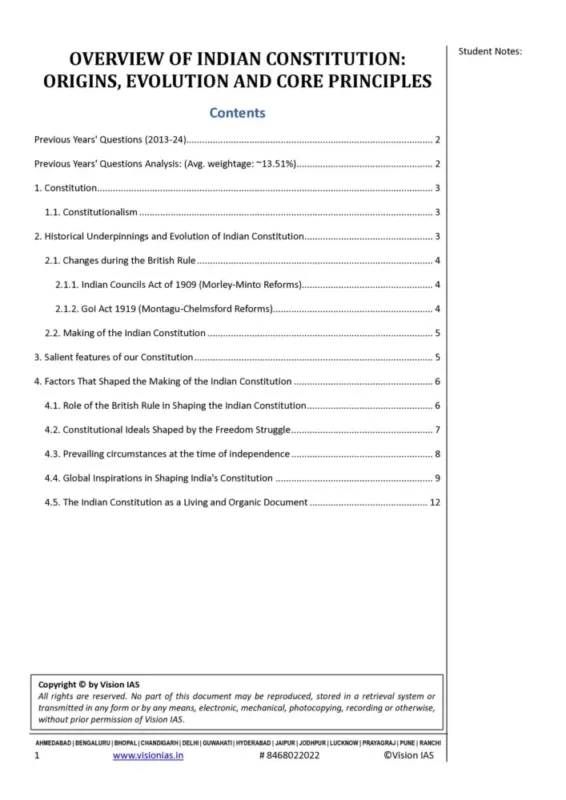
  • Booklet 17: Polity and Constitution Part I β€” Historical background of Indian Constitution, Constituent Assembly debates, Preamble, Union and its territory, citizenship, Fundamental Rights Articles 12–35 with judicial interpretations and landmark Supreme Court cases for UPSC GS Paper II.
  • Booklet 18: Polity and Constitution Part II β€” Directive Principles of State Policy, Fundamental Duties, Constitutional amendments, Parliamentary system, President, Vice-President, Prime Minister, Council of Ministers β€” powers, functions and constitutional provisions for UPSC GS Paper II.
  • Booklet 19: Polity and Constitution Part III β€” Parliament β€” Lok Sabha and Rajya Sabha, legislative procedures, budget process, parliamentary committees, Supreme Court and High Courts, judicial review, PIL and judicial activism for UPSC GS Paper II.
  • Booklet 20: Polity and Constitution Part IV β€” Federal structure, Centre-State relations, Inter-State Council, Finance Commission, Governor’s role, State Legislature, Emergency provisions and their implications, constitutional bodies like CAG, UPSC, Election Commission for GS Paper II.
  • Booklet 21: Polity and Constitution Part V β€” Local self-government: 73rd and 74th Amendments, Panchayati Raj institutions, urban local bodies; statutory bodies, regulatory authorities, tribunals; Non-Constitutional bodies and their roles for UPSC GS Paper II.
  • Booklet 22: Polity and Constitution Part VI β€” Representation of People Act, electoral reforms, anti-defection law, money bill vs ordinary bill controversy, comparative constitutionalism β€” UK, USA, French systems; Constitutional morality and recent debates for UPSC GS Paper II.
  • Booklet 23: Governance Part I β€” Good governance concepts, e-governance, digital India, Right to Information Act, Citizens’ Charter, grievance redressal mechanisms, role of civil services in a democracy, administrative reforms as per UPSC GS Paper II Governance section.
  • Booklet 24: Governance Part II (implied from catalog) β€” Government policies and interventions for development in various sectors, welfare schemes for vulnerable sections, issues of development and management of social sector, health and education policy analysis for UPSC GS Paper II.
  • Booklet 25: Social Justice β€” Welfare schemes for SC, ST, OBC, women, children, differently-abled persons; issues relating to poverty, hunger, malnutrition; government mechanisms and bodies for protection of vulnerable sections; social sector initiatives for UPSC GS Paper II.
  • Booklet 26: International Relations Part I β€” India’s foreign policy evolution, Non-Alignment Movement, India-Pakistan relations, India-China relations, India-USA strategic partnership, India-Russia ties, SAARC, BIMSTEC and neighbourhood first policy for UPSC GS Paper II.
  • Booklet 27: International Relations Part II β€” India’s bilateral ties with major powers, multilateral institutions β€” UN, WTO, IMF, World Bank, G20, BRICS, SCO; India and the Global South; diaspora policy; Indian Ocean diplomacy for UPSC GS Paper II International Relations.
  • Booklet 28: Economics Part I β€” Indian economy basics, national income concepts, GDP, GNP, NNP, economic planning in India, NITI Aayog, economic survey insights, poverty and unemployment concepts, inclusive growth for UPSC GS Paper III Economics.
  • Booklet 29: Economics Part II β€” Agriculture: issues of food security, PDS, agricultural subsidies, MSP, farm laws, irrigation, land reforms, crop insurance schemes; allied sectors like animal husbandry, fisheries and their contribution to rural economy for UPSC GS Paper III.
  • Booklet 30: Economics Part III β€” Industry and infrastructure: industrial policy, Make in India, PLI schemes, MSME sector, public sector enterprises, infrastructure development β€” roads, ports, railways, airports, urban infrastructure for UPSC GS Paper III.
  • Booklet 31: Economics Part IV β€” Monetary policy, fiscal policy, Union Budget analysis, taxation system β€” GST, direct and indirect taxes, banking sector reforms, RBI functions, financial inclusion, capital markets for UPSC GS Paper III Economics.
  • Booklet 32: Economics Part V β€” External sector: India’s balance of payments, foreign trade policy, FDI and FPI, WTO and India, currency management, forex reserves, export promotion schemes, trade agreements and their impact on Indian economy for UPSC GS Paper III.
  • Booklet 33: Environment Part I β€” Biodiversity: conservation, hotspots, protected areas, IUCN Red List, CITES, CBD; ecosystem services; ecological concepts; environmental laws in India β€” Environment Protection Act, Forest Rights Act, Coastal Regulation Zone for UPSC GS Paper III.
  • Booklet 34: Environment Part II β€” Climate change: UNFCCC, Paris Agreement, NDCs, India’s climate commitments; pollution β€” air, water, soil, noise, plastic; solid waste management; National Green Tribunal; environmental impact assessment for UPSC GS Paper III.
  • Booklet 35: Environment Part III β€” International environmental conventions and agreements; sustainable development goals; renewable energy transition; green economy concepts; desertification, land degradation, glacial retreat and their implications for India’s environment policy for UPSC GS Paper III.
  • Booklet 36: Science and Technology Part I β€” Space technology: ISRO missions, satellite navigation, remote sensing; nuclear technology: civil nuclear programme, India’s three-stage nuclear plan; defence technology: DRDO projects, missile systems, indigenisation for UPSC GS Paper III.
  • Booklet 37: Science and Technology Part II β€” Biotechnology: GM crops, gene editing, CRISPR; IT and cyber security; artificial intelligence and machine learning basics; nanotechnology; 5G and semiconductor policy; intellectual property rights and their role in technology development for UPSC GS Paper III.
  • Booklet 38: Security Part I β€” Internal security challenges: left-wing extremism, insurgency in Northeast India, Jammu and Kashmir situation; role of external state and non-state actors in creating internal security challenges; linkages between organised crime and terrorism for UPSC GS Paper III.
  • Booklet 39: Security Part II β€” Cyber security, border management, coastal security, money laundering, drug trafficking; various security forces, their mandates; disaster and emergency management interface with national security; NDMA guidelines for UPSC GS Paper III Security.
  • Booklet 40: Disaster Management β€” Disaster types: natural and man-made; NDMA, SDMA, NDRF structure and functioning; Sendai Framework; disaster risk reduction; early warning systems; post-disaster management; resilience building; case studies of major Indian disasters for UPSC GS Paper III.
  • Booklet 41: Ethics Part I (Ethics I) β€” Foundations of ethics; moral philosophy: consequentialism, deontology, virtue ethics; attitude and its influence on behaviour; emotional intelligence and its application in public administration; moral thinkers β€” Gandhi, Ambedkar, Tagore for UPSC GS Paper IV.
  • Booklet 42: Ethics Part II (Ethics II) β€” Civil service values and ethics in public administration: integrity, impartiality, non-partisanship, objectivity, dedication to public service; codes of ethics and codes of conduct; citizen’s charter and accountability mechanisms for UPSC GS Paper IV.
  • Booklet 43: Ethics Part III (Ethics III) β€” Probity in governance: concept of public service; philosophical basis of governance; information sharing and transparency; Right to Information Act; codes of ethics; work culture; quality of service delivery; utilisation of public funds for UPSC GS Paper IV.
  • Booklet 44: Ethics Part IV (Ethics IV) β€” International relations and ethics; corporate governance; ethical concerns and dilemmas in government and private institutions; laws, rules, regulations and conscience as sources of ethical guidance; accountability and ethical governance for UPSC GS Paper IV.
  • Booklet 45: Ethics Value Added Material Section-B (Case Studies Q&A) β€” Solved and model case study questions on administrative ethics, officer dilemmas in field postings, conflicts between orders and conscience, disaster situations requiring ethical decisions, whistleblower scenarios for UPSC GS Paper IV Section B practice.
  • Booklet 46: Essay β€” Essay writing strategy for UPSC; structure and approach; topic analysis across Philosophy, Socio-cultural, Science, Economics and Governance domains; sample outlines; value addition techniques; introduction and conclusion writing; do’s and don’ts for UPSC Essay paper.
  • Booklet 47: UPSC Syllabus Book β€” Complete official UPSC syllabus for Prelims and Mains with subject-wise mapping to Vision IAS booklets, topic prioritisation guide, previous year question trends by subject, quick reference for revision planning across all GS papers.
  • Booklets 48–56: Value Added Materials and Supplementary Modules β€” Additional value-added booklets covering current affairs integration, maps and diagrams revision sheets, important government schemes, quick-revision fact sheets, previous year question analysis topic-wise and other supplementary content to complete UPSC GS preparation.

In-Depth Content Breakdown: Booklet by Booklet

Booklet 1: Ancient History

This booklet covers the complete Ancient History syllabus for UPSC GS Paper I, starting from prehistoric cultures and the Indus Valley Civilisation through the Vedic Age, Janapadas, Mauryan Empire and Gupta period. Each section is structured around UPSC-relevant themes: polity, economy, religion, art and social life. Questions from the UPSC Mains frequently test not just facts but analytical connections β€” for example, how Mauryan administration influenced later Indian polity β€” and this booklet is built to answer exactly those demands.

What sets this booklet apart is the integration of art and architecture themes alongside political history, so you are not studying them in isolation. The booklet uses timelines, comparative tables of dynasties, and structured notes on religious movements like Buddhism and Jainism that allow fast revision before Mains. Diagrams of architectural styles β€” Stupa, Chaitya, Vihara β€” are clearly labelled. The content is written in a way that trains you to write 150-word and 250-word answers directly in UPSC Mains format.

Booklet 2: Medieval History

Medieval History is a high-yield topic for UPSC GS Paper I, covering the period from approximately 700 CE to 1750 CE. This booklet takes you through the Delhi Sultanate’s administrative innovations, the Mughal consolidation under Akbar, regional kingdoms like Vijayanagara and the Marathas, and the Bhakti-Sufi synthesis that shaped Indian cultural identity. The content is structured to help you write comparative answers β€” Mughal vs Maratha administration, for example β€” which UPSC Mains regularly demands.

The booklet includes detailed notes on medieval architecture β€” Indo-Islamic style evolution from the Qutb Minar to the Taj Mahal β€” along with notes on trade networks, revenue systems like Todar Mal’s zabti, and the role of women in medieval society. Cultural developments including classical music evolution under Mughals and the emergence of Hindustani and Carnatic traditions are also covered, making this booklet useful for both Art and Culture and Medieval History UPSC questions.

Booklet 3: Modern Indian History Part I

Modern Indian History Part I picks up with the arrival of Europeans in India and traces British expansion through the Doctrine of Lapse, Subsidiary Alliance and other methods of territorial consolidation. The economic drain theory, de-industrialisation of Indian textile industry and commercialisation of agriculture are explained with data and analysis that UPSC expects in answers. The 1857 Revolt is treated in depth β€” its causes, the role of different social groups, British response and its legacy in reshaping colonial policy.

This booklet is particularly strong on the social reform movements that parallel political developments β€” Raja Ram Mohan Roy, Brahmo Samaj, Prarthana Samaj, Arya Samaj and the reformers of Bengal, Maharashtra and the South. These topics appear in both UPSC Prelims and Mains consistently, and Vision IAS has structured the notes to connect individual reformers to the broader transformation of Indian society, which helps aspirants write holistic, high-scoring Mains answers.

Booklet 4: Modern Indian History Part II

This booklet covers the period from the formation of the Indian National Congress in 1885 through the Non-Cooperation and Khilafat Movements of 1920-22. The Moderate-Extremist divide, the significance of the Lucknow Pact, Montagu-Chelmsford reforms and the Rowlatt Act are analysed not just as events but as turning points that shaped India’s freedom struggle. Gandhi’s transformation from a South Africa activist to the dominant force in Indian politics is traced with care for nuance that UPSC Mains rewards.

The booklet uses structured flowcharts to show the cause-and-effect chain in major movements, which is exactly what UPSC Mains answer writing demands. Important documents like the Congress resolutions, government Acts and their implications are tabulated for quick comparison. The section on the Khilafat Movement and Hindu-Muslim unity during this period is treated with historical sensitivity, and the factors leading to the eventual failure of the Non-Cooperation Movement are analysed in a way that directly maps to 15-mark Mains questions.

Booklet 5: Modern Indian History Part III

The Civil Disobedience Movement, the Salt March, the Round Table Conferences and the Government of India Act 1935 are the centrepieces of this booklet. The complex politics of the 1930s β€” Congress ministries, League’s Pakistan demand, Cripps Mission and Cabinet Mission β€” are explained with clear chronological structure. The Quit India Movement of 1942 is covered in detail, including regional variations in its intensity and the role of underground networks, which is a favourite area for UPSC analytical questions.

The final sections cover the INA trials, Subhas Chandra Bose’s strategy, the role of World War II in accelerating Indian independence, the Cabinet Mission plan and its failure, and the partition and its immediate aftermath. Vision IAS has been careful to present multiple historiographical perspectives on partition β€” communal, administrative and economic causes β€” which prepares aspirants to write balanced, multi-dimensional Mains answers that earn full marks from UPSC evaluators.

Booklet 6: Post-Independence Indian History

Post-Independence history is a growing area of UPSC questions and this booklet gives it the attention it deserves. Sardar Patel’s integration of 562 princely states, the States Reorganisation Act 1956, the Nehru era’s foreign policy of non-alignment, the Green Revolution and White Revolution, the Emergency of 1975-77 and the Janata interlude are covered with analytical depth. The 1991 liberalisation under Narasimha Rao and Manmohan Singh is explained in its economic and political context.

The booklet also covers major social movements of independent India β€” women’s movement, dalit movement, environmental movements like Chipko β€” and their constitutional and political consequences. Coalition politics from the 1990s onward, the role of regional parties, growth of identity politics, and India’s emergence as a major economy are treated in a way that connects history to the contemporary governance questions that appear in UPSC GS Paper II and GS Paper III.

Booklets 7: Art and Culture

Art and Culture is one of the highest-scoring yet most neglected topics in UPSC GS Paper I. This booklet covers the full syllabus β€” temple architecture styles (Nagara, Dravida, Vesara), cave architecture, sculpture traditions, Indus Valley art, Buddhist and Jain art, Mughal and Rajput miniature painting, classical dance forms (Bharatanatyam, Kathak, Odissi, Kuchipudi, Manipuri, Kathakali, Sattriya, Mohiniyattam), Hindustani and Carnatic music, theatre traditions and puppetry from across India.

The booklet uses photographs and detailed diagrams to distinguish architectural styles β€” a recurring requirement in UPSC Prelims. Fairs, festivals and their regional significance are tabulated for quick recall. UNESCO Intangible Cultural Heritage listings from India are listed and contextualised. The content is written for both Prelims MCQs and Mains descriptive answers, with boxes highlighting “UPSC frequently asked” topics β€” making it a very efficient resource for candidates short on time.

Booklets 8–9: World History Parts I and II

World History accounts for a significant portion of UPSC GS Paper I and is often studied inadequately. These two booklets cover the complete UPSC World History syllabus β€” French Revolution, Industrial Revolution, American Revolution, colonialism and imperialism, World Wars, Russian Revolution, rise of fascism, Cold War, decolonisation and the UN system. Each event is analysed for causes, events, consequences and global significance, which is the framework UPSC expects in answers.

Vision IAS has structured these booklets to draw connections between world events and Indian history β€” how the Great Depression affected Indian nationalism, how World War II accelerated Indian independence, how the Cold War shaped Non-Alignment. These connections are what separate high-scoring answers from average ones in UPSC Mains. Maps showing territorial changes after the World Wars, tables comparing the League of Nations and the United Nations, and timelines of decolonisation movements make these booklets highly revision-friendly.

Booklets 10–11: Society Parts I and II

The Society booklets address the sociology component of UPSC GS Paper I β€” salient features of Indian society, diversity and unity, the caste system’s historical evolution and contemporary relevance, tribal communities and their constitutional protections, women’s issues, population dynamics and urbanisation. The treatment is academic yet accessible, using sociological concepts without overwhelming the aspirant with jargon, and always tying back to UPSC question patterns.

Social justice dimensions β€” reservation policy, SC/ST Atrocities Act, women’s reservation, rights of the differently-abled β€” are covered in the second Society booklet with both constitutional provisions and current policy context. The impact of globalisation on Indian cultural identity, the role of civil society and social capital in development, and communalism, regionalism and secularism as contemporary challenges are analysed with the nuance that UPSC GS Paper I and GS Paper II both demand.

Booklets 12–16: Geography Parts I to V

Five Geography booklets provide one of the most thorough geography treatments available in any UPSC printed notes set. The series moves systematically from physical geography (geomorphology, climatology, oceanography), to Indian geography (physiographic divisions, river systems, soils, forests), to human geography (population, migration, urbanisation), to economic geography (agriculture, industry, resources) and finally to applied geography (mapping, current geographical issues, geopolitics). This sequencing mirrors the UPSC syllabus structure exactly.

Each Geography booklet is rich in maps β€” both outline maps with filled geographic features and diagrammatic explanations of processes like monsoon formation, ocean current circulation and rock cycle. Tables comparing soil types, forest types and crop zones make revision fast and reliable. The fifth Geography booklet’s focus on mapping skills and locations in news is particularly valuable for UPSC Prelims where map-based questions regularly appear. All five booklets together give a UPSC aspirant a complete, connected understanding of Indian and world geography.

Booklets 17–22: Polity and Constitution Parts I to VI

Six dedicated Polity and Constitution booklets make this one of the most thoroughly covered subjects in the Vision IAS 2026-27 package. The series progresses from constitutional history and foundational concepts, through Fundamental Rights, DPSP and Fundamental Duties, to Parliament, judiciary, federalism, local government and electoral reforms. Each constitutional Article is explained with its plain-language meaning, historical background, landmark Supreme Court judgments and current UPSC relevance β€” a structure that works for both Prelims and Mains.

Comparative constitutionalism β€” how India’s constitution differs from the UK, USA and France β€” is covered in the final Polity booklet, which is a high-scoring niche area in UPSC GS Paper II. The anti-defection law, money bill controversy, President’s discretionary powers and the debate over judicial appointments are treated with the kind of analytical depth that 15-mark UPSC answers demand. Constitutional bodies, statutory bodies and quasi-judicial bodies are neatly tabulated for quick comparison, which is an enormous time-saver during revision.

Booklets 23–25: Governance and Social Justice

The Governance booklets cover UPSC GS Paper II’s governance section β€” e-governance, RTI Act, Citizens’ Charters, grievance redressal, role of civil services, administrative reforms commissions and their recommendations, and the interface between technology and public service delivery. Good governance indicators β€” transparency, accountability, participation, responsiveness β€” are discussed with Indian and international examples that work as ready-made answer material for UPSC Mains.

Social Justice, covered in its dedicated booklet, maps government welfare schemes to the vulnerable populations they serve β€” schemes for women, children, elderly, minorities, SC/ST, OBC and persons with disabilities. The booklet uses tables to list scheme names, their implementing ministries and key provisions, making it a quick-reference tool before UPSC Mains. Issues of hunger, malnutrition and food security are linked to both welfare programmes and economic analysis, bridging GS Paper II and GS Paper III topics.

Booklets 26–27: International Relations Parts I and II

India’s foreign policy is one of the most dynamic sections of UPSC GS Paper II, and these two booklets keep pace with it. IR Part I covers bilateral relationships β€” India-Pakistan, India-China, India-USA, India-Russia and neighbourhood diplomacy β€” with historical background, current status and strategic implications. The Non-Alignment Movement’s origins, evolution and continued relevance are explained alongside India’s more recent multi-alignment approach in global affairs.

IR Part II covers multilateral institutions and India’s role in them β€” UN Security Council reform, WTO dispute resolution, IMF voting rights, G20 presidencies, BRICS expansion, SCO dynamics and India’s position in the Global South. India’s ocean diplomacy, the strategic importance of the Indian Ocean Region, Indo-Pacific frameworks and QUAD are covered with the geopolitical analysis that UPSC Mains expects. Colour-coded maps of India’s diplomatic engagements and agreement timelines add significant value for answer enrichment.

Booklets 28–32: Economics Parts I to V

Five Economics booklets cover the entire UPSC GS Paper III Economics syllabus in a logical sequence. Starting from foundational macroeconomic concepts β€” national income, GDP measurement, economic planning β€” the series moves through agriculture, industry, infrastructure, monetary and fiscal policy, and finally the external sector. Each booklet uses data from recent Economic Surveys and Union Budgets, ensuring that answers can be backed with current statistics, which UPSC evaluators expect from high-scoring answers.

The Agriculture booklet is particularly strong on farm sector issues β€” MSP, PM-KISAN, crop insurance under PMFBY, irrigation coverage, land fragmentation and technology adoption challenges β€” that have featured in multiple UPSC Mains questions. The Fiscal Policy booklet covers Union Budget analysis frameworks, GST structure, direct tax reforms and debt management β€” essential for GS Paper III’s Economy section. The External Sector booklet covers India’s trade policy, FDI trends, WTO obligations and currency management with a clarity that makes complex topics accessible.

Booklets 33–35: Environment Parts I to III

Environment is one of the fastest-changing sections of the UPSC syllabus, with new conventions, new court judgments and new policy initiatives constantly entering the picture. These three booklets are updated for 2026-27 with the latest developments in climate negotiations, India’s National Action Plan on Climate Change, biodiversity targets under Kunming-Montreal framework, pollution control norms and environmental governance. The Environment Part I booklet’s treatment of biodiversity β€” hotspots, protected areas, species conservation programmes β€” is among the most detailed in any printed notes available online.

Climate Change, covered in Environment Part II, explains the science, the international negotiations (UNFCCC, COP summits, Paris Agreement mechanisms) and India’s domestic climate commitments including updated NDCs. The third Environment booklet connects global sustainability frameworks β€” SDGs, Sendai Framework, Aichi Targets β€” to India’s policy responses, which is a high-value area for UPSC GS Paper III. Questions on environment from the last five years of UPSC Mains are mapped to relevant sections within these booklets, making targeted revision efficient.

Booklets 36–37: Science and Technology Parts I and II

Science and Technology is one of the highest-variability subjects in UPSC β€” questions can range from ISRO missions to gene editing to cybersecurity in a single paper. Vision IAS S&T Part I covers space technology with ISRO’s mission history, current and upcoming missions, satellite applications and India’s commercial space sector opening. Nuclear technology β€” the three-stage programme, civil nuclear deals, nuclear doctrine β€” and defence technology including missile programmes, indigenisation under Atmanirbhar Bharat defence policy are covered in analytical depth.

S&T Part II covers emerging technologies β€” artificial intelligence, machine learning, blockchain, 5G infrastructure, semiconductor policy, biotechnology including CRISPR gene editing and GM crop regulation, and cybersecurity frameworks. Each technology is explained from first principles before moving to its UPSC-relevant policy and governance dimensions. The booklet connects technology to society, economy and security β€” which is exactly the multi-dimensional analysis UPSC expects in 15-mark S&T answers for GS Paper III.

Booklets 38–40: Security Parts I–II and Disaster Management

Internal security and disaster management together form a crucial part of UPSC GS Paper III. The two Security booklets cover left-wing extremism’s geography, causes and government response strategy; Northeast insurgencies and the peace process; the Jammu and Kashmir situation and its constitutional dimensions; and the role of external state and non-state actors. Money laundering, drug trafficking, human trafficking and their links to terrorism financing are covered with the investigative depth that UPSC analytical questions demand.

The Disaster Management booklet covers the NDMA framework, SDMA structures, NDRF deployment protocols, the Sendai Framework 2015-2030 for Disaster Risk Reduction and India’s implementation progress. Case studies of major Indian disasters β€” Uttarakhand floods, Cyclone Fani, Chennai floods, Bhuj earthquake β€” are analysed to extract lessons for policy and governance, which is a standard UPSC Mains question type. Early warning systems, community resilience building and the economics of disaster preparedness vs response are covered with clear policy recommendations that work directly as answer points.

Booklets 41–44: Ethics Parts I to IV

Four dedicated Ethics booklets make Vision IAS one of the most thorough providers of GS Paper IV content. Ethics Part I covers the philosophical foundations β€” consequentialism, deontology, virtue ethics, care ethics β€” along with the concepts of attitude, aptitude and foundational values for civil service. Emotional intelligence is covered with examples from administrative contexts. Major ethical thinkers β€” Gandhi, Ambedkar, Tagore, Kautilya, Aristotle, Kant β€” are profiled with their key ideas mapped to UPSC question patterns.

Ethics Parts II, III and IV cover public administration ethics, civil service conduct rules, probity in governance, transparency mechanisms, codes of conduct, and the philosophical basis for public service accountability. International ethics β€” India’s role in global governance, corporate social responsibility, environmental ethics β€” is treated in Ethics Part IV. Each booklet uses structured answer frameworks for 10-mark and 20-mark Ethics questions, and the progression from theoretical foundations to applied governance ethics gives aspirants a complete GS Paper IV toolkit.

Booklet 45: Ethics Value Added Material β€” Case Studies

Section B of UPSC GS Paper IV (Case Studies) is often the deciding section for final rank, and this dedicated booklet is one of the most valuable in the entire 56-booklet set. It contains solved and model case study questions covering a wide range of administrative scenarios β€” officers facing political pressure, whistleblower dilemmas, natural disaster response requiring quick ethical decisions, conflicts between legal orders and personal conscience, and corruption in public service situations. Each case study is followed by a structured answer framework.

The booklet teaches the method of identifying ethical issues in a case β€” stakeholders, values in conflict, possible courses of action and their consequences β€” which UPSC evaluators look for. Common mistakes in case study answers β€” being preachy, ignoring practical constraints, neglecting legal frameworks β€” are specifically flagged and corrected. High-scoring model answers are annotated to show exactly where marks are earned, making this booklet a practical answer-writing workshop for UPSC GS Paper IV Section B.

Booklet 46: Essay

The UPSC Essay paper is worth 250 marks β€” equivalent to a full GS paper β€” yet many aspirants under-prepare for it. This booklet covers the complete essay writing strategy: how to interpret essay topics, how to build a thesis, how to structure introduction-body-conclusion, how to maintain philosophical depth while being grounded in policy and data. Topic categories β€” Philosophical, Socio-cultural, Science and Technology, Economic Development, Governance β€” are each treated with their own approach template.

The booklet provides sample topic outlines across all categories along with lists of quotations, data points and examples for common essay themes. Common weaknesses in UPSC essays β€” circular arguments, narrative-only writing without analysis, ignoring multiple perspectives β€” are specifically addressed. The booklet also covers value-addition techniques: using data from Economic Survey, quoting constitutional provisions, referencing international comparisons and embedding current affairs naturally β€” all of which lift an essay from average to top-decile in UPSC evaluation.

Booklet 47: UPSC Syllabus Book and Supplementary Modules

This booklet serves as the navigation guide for the entire 56-booklet Vision IAS package. The complete UPSC Civil Services Mains syllabus β€” GS Paper I through IV, Essay, and Prelims β€” is printed with each topic mapped to the relevant Vision IAS booklet number and section. Previous year question (PYQ) trend analysis by topic is included, showing which themes have appeared repeatedly in UPSC Mains over the last decade β€” essential information for prioritising study time.

The supplementary booklets (48–56) extend the package with value-added content: government schemes reference sheets, maps and diagrams for quick revision, current affairs integration guides showing how to connect recent events to static GS topics, and previous year question papers with topical mapping. These modules are designed for the final two months of UPSC preparation when connecting static knowledge to current affairs and refining answer writing are the primary tasks β€” making them as valuable as any subject booklet in the set.

Physical Construction and Quality Standards

Every booklet in the Vision IAS 2026-27 56-booklet set is manufactured to standards that support daily, intensive UPSC study use over a preparation cycle of 12 to 18 months β€” from the paper grade to the binding method and cover thickness.

Paper Quality: 75 GSM Anti-Glare White Paper

Each of the 56 booklets uses 75 GSM ultra-white paper selected specifically for UPSC study use. The high opacity means text printed on one side is completely invisible from the reverse, so even when you annotate heavily in pen or marker, bleed-through is eliminated. The anti-glare surface reduces eye strain during the 8–12 hour study sessions that UPSC preparation demands. Multiple highlighter colours β€” yellow, pink, green, blue β€” and gel pens work cleanly on this paper without feathering or spreading, making colour-coded revision systems practical and reliable.

Printing Technology: High-Resolution Laser Printing

All 56 booklets are printed using high-resolution laser technology that delivers sharp, consistent text at every font size β€” from body text to footnotes and table entries. Diagrams of geological formations, political maps, flowcharts of constitutional processes, and labelled architectural drawings are all rendered with the clarity that allows you to read fine detail without straining. Laser toner is permanently fused to the paper β€” it does not smudge when pages rub together during transport, and it does not fade with extended exposure to light, ensuring that your notes remain readable throughout your entire preparation cycle.

Binding and Durability

Depending on the specific booklet, binding is either spiral or book binding β€” both chosen to maximise durability and usability. Spiral-bound booklets open completely flat on a desk, allowing you to write notes alongside the printed content without the pages curling or the binding breaking. Book-bound booklets offer compact storage and a clean stacking format for a set this large. Every booklet has a 300 GSM laminated cover β€” thick enough to protect the interior pages through months of daily handling, backpack transport and field study conditions that are common in UPSC preparation.

Key Features and Study Design

These 56 booklets are structured around how UPSC evaluators actually award marks β€” analytical framing, multi-dimensional coverage, answer-ready language and systematic subject sequencing that builds knowledge progressively across GS Paper I through IV.

  • Complete Syllabus Coverage in One Package: All subjects of UPSC GS Paper I, II, III and IV β€” History, Geography, Polity, Economics, Environment, S&T, Security, Ethics and Essay β€” are covered in a single 56-booklet set, eliminating the need to source material from multiple publishers or coaching institutes.
  • Answer-Oriented Writing Style: Content is written in a structured format that mirrors UPSC Mains answer requirements β€” topic sentences, supporting points with examples, and concluding analytical statements. This means notes double as answer frameworks, reducing the time needed to convert knowledge into exam-ready responses.
  • Visual Learning Aids β€” Maps, Diagrams, Tables: Flowcharts, political maps, comparison tables and labelled diagrams are integrated throughout all 56 booklets. These visual elements are particularly valuable for Geography, Polity and Science topics where conceptual relationships are best understood graphically.
  • 2026-27 Edition β€” Updated Content: The edition is updated to include recent constitutional amendments, new government schemes, latest environmental agreements, current ISRO missions and recent Supreme Court judgments. Studying outdated material is one of the most common UPSC preparation mistakes, and buying the 2026-27 edition prevents this directly.
  • Ethics Case Studies β€” Dedicated Booklet: A fully separate booklet for Ethics GS Paper IV Section B case studies provides solved model answers with annotation, answer frameworks for different scenario types, and technique guidance β€” a level of depth in case study preparation that most single-volume study materials cannot match.

Shipping, Packaging and Delivery

Each order of the Vision IAS General Studies 2026-27 56-booklet set is packaged with care to ensure all 56 booklets arrive in brand-new, unmarked condition. The complete set is first shrink-wrapped together to keep booklets aligned and protected from moisture. This shrink-wrapped bundle is then placed in a double-walled corrugated cardboard box with foam edge protectors on all corners. The box is sealed with high-strength tape and labelled with your address on a waterproof label. This packaging system has been tested for the physical stresses of courier transit across all Indian states β€” from Ladakh to the Andaman Islands β€” and keeps every booklet in perfect condition on arrival.

Delivery takes 3-5 business days across India with full tracking available from dispatch. A tracking ID is sent to your registered mobile number and email immediately upon dispatch. For any queries about your order β€” including delayed delivery, missing booklets or damaged items β€” reach us on WhatsApp at +91 70045 49563. If any booklet in your set is found to be missing or damaged on arrival, we replace it within 48 hours of you reporting the issue, at no additional cost. We ship pan India from our Mukherjee Nagar, Delhi location, which means the notes you receive are the same freshly-printed stock used by Delhi’s top UPSC coaching belt students.

Frequently Asked Questions (FAQ)

Q1: Is Vision IAS study material enough for UPSC preparation?

A: Vision IAS printed notes are among the most trusted GS study materials for UPSC and have been used by numerous top-ranked candidates over the years. For GS Paper I through IV and Essay, this 56-booklet set provides complete syllabus coverage. You will still need to supplement with a current affairs source, NCERT readings for foundation-building in certain subjects, and regular answer writing practice β€” but as a core study resource, this set is sufficient for Mains GS preparation.

Q2: How many booklets are included in Vision IAS GS complete package 2026-27?

A: The Vision IAS General Studies complete package for 2026-27 includes 56 printed booklets covering the full UPSC Mains GS syllabus. These include subject booklets for Ancient, Medieval and Modern History, Geography (56 Booklets), Polity and Constitution (56 Booklets), Economics (56 Booklets), Environment (56 Booklets), Science and Technology (56 Booklets), Security (56 Booklets), International Relations (56 Booklets), Ethics (56 Booklets plus case studies), Disaster Management, Essay, Art and Culture, Society, Governance, Social Justice, a UPSC Syllabus Book, and supplementary value-added material booklets.

Q3: What is the paper quality of these booklets? Can I use a highlighter?

A: These booklets use 75 GSM ultra-white paper chosen for high opacity β€” multiple highlighter colours and gel pens work without bleed-through to the reverse side, ideal for colour-coded revision. The anti-glare surface also reduces eye fatigue during long study sessions, which makes a real difference during intensive UPSC preparation periods when daily study hours are at their highest.

Q4: Is Vision IAS 2026-27 study material updated with the latest UPSC syllabus changes?

A: Yes. The 2026-27 edition is updated to reflect the current UPSC Mains syllabus, recent constitutional amendments, new government schemes launched up to the edition cutoff, latest environmental conventions and their outcomes, new Supreme Court judgments on constitutional matters, recent ISRO missions and emerging technology policy. Buying the 2026-27 edition ensures you are not studying outdated material β€” a critical advantage when UPSC questions frequently reference recent developments.

Q5: What topics are covered in Vision IAS GS Paper I, II, III and IV booklets?

A: GS Paper I topics covered include Ancient, Medieval and Modern History, Post-Independence India, Art and Culture, World History, Society and Geography. GS Paper II covers Polity and Constitution, Governance, Social Justice and International Relations. GS Paper III covers Economics, Environment, Science and Technology, Security and Disaster Management. GS Paper IV covers Ethics in four booklets plus a dedicated Ethics Case Studies booklet. Essay preparation is also included in a standalone booklet.

Q6: Should I buy Vision IAS printed notes or rely on PDFs for UPSC preparation?

A: Printed notes are significantly better for active UPSC preparation than PDFs for several well-documented reasons. Screen reading reduces retention compared to reading from paper. Printed booklets allow you to annotate directly β€” underlining, margin notes, sticky tabs β€” which builds memory encoding that passive screen reading does not. You can lay multiple booklets open simultaneously for cross-referencing. There are no device battery, screen glare or distraction issues. Most top UPSC rankers use printed study material as their primary resource for exactly these reasons.

Q7: How is Vision IAS study material different from Vajiram and Forum IAS material?

A: Vision IAS, Vajiram and Forum IAS are all respected UPSC coaching institutes with strong printed notes. Vision IAS notes are particularly known for their analytical writing style that directly mirrors UPSC Mains answer format, their strong Ethics coverage (four booklets plus case studies), and their detailed Geography and International Relations treatment. The 56-booklet count in this set is among the largest complete GS packages available, ensuring no topic is condensed to the point of losing analytical depth. The choice between institutes ultimately depends on the style that best matches your answer writing approach.

Q8: Are these Vision IAS booklets useful for State PSC exams like BPSC, UPPSC and MPPSC?

A: Yes. The Vision IAS 2026-27 GS material is directly useful for BPSC, UPPSC, MPPSC, RAS and most State PSC examinations, as their GS syllabuses largely overlap with UPSC GS Paper I, II, III and IV. History, Geography, Polity, Economics, Environment and Current Affairs content is applicable across all State PSC exams. The Ethics booklets are directly relevant for State PSC ethics papers. Candidates preparing for State PSCs as primary targets will also find this material well-suited for their preparation.

Q9: How long will delivery take and how will the booklets be packaged?

A: Delivery takes 3-5 business days pan India from our Mukherjee Nagar, Delhi dispatch point. All 56 booklets are shrink-wrapped together, placed inside a double-walled corrugated cardboard box with foam edge protectors, and sealed with waterproof labelling. You receive a tracking ID on your registered mobile and email immediately upon dispatch. If any booklet arrives damaged or is missing, contact us on WhatsApp at +91 70045 49563 and we will replace it within 48 hours at no charge.

Q10: Can I buy individual booklets from the 56-booklet set rather than the complete package?

A: The Vision IAS GS 2026-27 56-booklet set is listed as a complete package on our store. For queries about purchasing specific individual booklets β€” for example, only the Ethics or only the Geography series β€” please contact us on WhatsApp at +91 70045 49563. Our team can check current stock availability for individual booklets and advise on pricing. However, buying the complete set is significantly more cost-effective than sourcing booklets individually, and the interconnected nature of the material means the full set provides the most value.

Q11: Are these booklets brand new and original Vision IAS prints?

A: Yes. Every booklet in this set is brand new, unmarked and sourced as genuine Vision IAS classroom study material. We do not sell used, photocopied or scanned-and-reprinted material. All stock is fresh from the 2026-27 print run. The booklets are stored in climate-controlled conditions at our Mukherjee Nagar, Delhi warehouse to ensure pages are not yellowed or warped before they reach you. If you ever receive a booklet that appears to have been previously used or is not in perfect condition, we replace it immediately.

Q12: What is the best way to use this 56-booklet set for UPSC Mains preparation?

A: Start with the UPSC Syllabus Booklet (Booklet 47) to map your preparation plan β€” it shows you exactly which booklet covers which syllabus topic and which topics have appeared most frequently in past UPSC Mains questions. Read subject booklets in the recommended sequence, making margin notes and creating personal summary sheets. Use the Ethics Case Study booklet for regular practice from the beginning, not only at the end. Integrate current affairs into your reading of each booklet. In the final two months, use the supplementary value-added booklets for revision and current affairs integration before your UPSC Mains examination.

Summary

SpecificationValue
Booklets56 Printed Booklets
LanguageEnglish Medium
Edition2026-27 Latest Batch
Paper75 GSM Ultra-White, Anti-Glare, Highlighter Safe
BindingSpiral or Book Binding, 300 GSM Cover
ConditionBrand New, Unmarked, Genuine Vision IAS Print
Delivery3-5 Business Days Pan India, Tracked
SupportWhatsApp +91 70045 49563
Also Useful ForBPSC, UPPSC, MPPSC, RAS and All State PSC Exams

Dispatched from our store in Mukherjee Nagar, Delhi β€” India’s foremost UPSC preparation hub. Buy Vision IAS General Studies printed notes 2026-27 online today and receive all 56 booklets at your door anywhere in India with pan India delivery in 3-5 days.

Reference: Civil Services Examination

Customer Reviews 75

4.5
Based on 75 reviews
5β˜…
45
4β˜…
22
3β˜…
8
2β˜…
0
1β˜…
0
V
Vikram Patel
23 Apr 2026
βœ“ Verified

Best study material for GS preparation. Worth every penny!

A
Anjali Mishra
21 Apr 2026
βœ“ Verified

Notes ka content mast hai! Packaging bhi safe tha, everything arrived in good condition.

P
Pooja Singh
20 Apr 2026
βœ“ Verified

Bilkul satisfied hoon, notes comprehensive aur easy to understand hain.

N
Neha Chopra
20 Apr 2026
βœ“ Verified

56 booklets mein sab topics covered hain. Quality consistent across all books.

P
Pooja Sharma
17 Apr 2026
βœ“ Verified

Covers most basics well but advanced concepts thoda light the. Good for beginners.

N
Neha Gupta
16 Apr 2026
βœ“ Verified

Ye notes literally game changer hain mere prep ke liye. Sab kuch cover ho gaya.

A
Arjun Singh Patel
15 Apr 2026
βœ“ Verified

Bohot helpful for clearing GS concepts. Detailed explanations mil rahe hain.

M
Mohan Verma
15 Apr 2026
βœ“ Verified

Notes helpful hai par kahin kahin same topics repeat ho rahe hain. Still decent for prep.

πŸ›οΈ

Aspirants Also Bought

More from the same category

View All β†’

About Vision IAS General Studies Notes 2026-27

Vision IAS General Studies Notes 2026-27 is a highly recommended UPSC study material from Vision IAS, specially designed for General Studies preparation. Available in English medium, this material is crafted to match the exact requirements of the UPSC Civil Services Examination syllabus β€” covering both Prelims and Mains comprehensively.

Product Details

  • Institute: Vision IAS
  • Subject: General Studies
  • Medium: English
  • Format: Printed
  • Delivery: Pan-India delivery in 3–5 working days
  • Format: Original printed material, verified authentic

Why Buy from UPSC Store?

  • βœ… 100% Genuine Printed Material β€” Original printed notes, no photocopies or fake copies
  • βœ… Fast Delivery β€” Ships within 24 hours, arrives in 3–5 days pan-India
  • βœ… Secure Packaging β€” Bubble-wrapped and boxed to prevent damage in transit
  • βœ… Trusted by 10,000+ Aspirants β€” India's most reliable UPSC material marketplace
  • βœ… WhatsApp Support β€” Get expert guidance on material selection before ordering

Frequently Asked Questions

Is this product 100% original?

Yes, all products at UPSC Store are 100% genuine printed materials. We do not sell photocopies or fake copies.

How long does delivery take?

Orders are dispatched within 24 hours and delivered across India in 3–5 working days via reputed courier partners.

Can I return the product?

Yes, we accept returns within 7 days if the product is damaged or incorrect. Check our refund policy for details.

Which other study materials should I buy with this?

We recommend pairing this with current affairs notes and a UPSC test series for comprehensive preparation. Browse more in General Studies, UPSC, Vision IAS.