
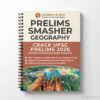


Vajiram and Ravi Geography Prelims Smasher | English Medium | UPSC Study Material
Binding Guide
Pick the binding that fits how you study.
Spiral Binding
- Lays completely flat
- 360° page rotation
- Great for note-taking
- Best for maths, science, reference
Without Spiral
- Compact & professional
- Sturdy glued/stitched spine
- Easy to stack & store
- Best for textbooks & long-term
About Vajiram Geography Prelims Smasher 2026
The Vajiram Geography Prelims Smasher 2026 is a printed UPSC study material set sold by UPSC Store — India’s trusted source for genuine, latest-batch civil services preparation books. This page covers full booklet details, syllabus coverage, pricing, shipping, and frequently asked questions. Useful for UPSC CSE, BPSC, UPPSC, MPPSC, RAS and other state PSC examinations.
Vajiram and Ravi Geography Prelims Smasher 2026 — 1 English Medium Printed Booklet for UPSC GS Paper I
Related: Vajiram & Ravi notes · Geography notes
Product Overview
| Feature | Details |
|---|---|
| Booklets Count | 1 Individual Printed Booklet — 176 Pages Complete Coverage |
| Language | English Medium |
| Publisher | Vajiram and Ravi (Yellow Books Series) |
| Edition | 2026-27 — Latest Genuine Batch |
| Condition | Brand New, Unmarked, Fresh Stock |
| Format | High-Quality Printed Booklet — Spiral or Book Binding |
| Paper Quality | 75 GSM Ultra-White Anti-Glare — Highlighter Safe, Zero Bleed-Through |
| Shipping | Pan India Delivery in 3-5 Business Days — Tracked |
| Also Useful For | BPSC, UPPSC, MPPSC, RAS Prelims |
Complete Booklet Catalog
Buy Vajiram and Ravi Geography Prelims Smasher printed notes online — the complete 2026-27 single-booklet package. This is the gold standard for UPSC Geography GS Paper I, designed by one of Delhi’s most trusted coaching institutes. Vajiram and Ravi’s yellow books are legendary in Mukherjee Nagar for fact density, crisp bullet points, and prelims-centric content. This Geography Smasher covers physical, human, economic, and Indian geography with exam-mapped precision. Explore the full Vajiram and Ravi collection of notes that thousands of toppers rely on.
- Geography Prelims Smasher (176 Pages) — Covers physical geography (geomorphology, climatology, oceanography, soil types), human and cultural geography (population distribution, settlement patterns, migration), economic geography (agriculture, minerals, industries, trade), and complete Indian geography (physical features, states, major rivers, plateaus, deserts, coastal regions, climate zones, biodiversity hotspots). Includes topic-wise previous year UPSC prelims questions (last 15 years), maps for all major physical features, and fact-density optimized for 45-second MCQ solving.
In-Depth Content Breakdown: Booklet by Booklet
Detailed booklet-by-booklet analysis helps you understand exactly what you’re getting and how to integrate it into your preparation. Knowing the structure, topics, and unique features upfront ensures you use the material with maximum efficiency and confidence. This transparency is especially crucial when buying printed notes online — you invest time and money, and we ensure every page counts toward your UPSC prelims success.
Geography Prelims Smasher — Complete 176-Page Booklet
Section 1: Physical Geography Foundations (Pages 1-48) — This opening section dives deep into geomorphology, covering landforms created by rivers (meanders, floodplains, deltas), glaciers (U-shaped valleys, moraines), wind (dunes, deflation basins), and ocean waves (sea cliffs, beaches, spits). Each landform includes the UPSC-style descriptive process and real-world Indian examples — the Brahmaputra’s shifting channels, the Thar Desert’s sand dunes, the Western Ghats’ erosional history. Climatology follows with atmospheric circulation patterns (jet streams, monsoons, trade winds), precipitation types (convectional, orographic, cyclonic), and climate classification systems. Oceanography covers ocean currents (warm and cold), tides, waves, and the impact of currents on India’s climate and fisheries. Soil science breaks down soil formation, major soil types in India (laterite, black soil, alluvial), and soil degradation issues like erosion and waterlogging. Each topic includes a fact box with exam-critical numbers: average monsoon rainfall dates, major latitude/longitude boundaries, precipitation ranges for each climate zone.
How This Section is Structured for Prelims — Every topic uses a bullet-point format with bolded keywords to facilitate quick scanning during 2-minute revisions. Maps are embedded throughout showing major landforms, ocean currents, and climate zones. Diagrams illustrate processes like meander formation, ocean current patterns, and monsoon circulation. Each subsection ends with a “UPSC Fact Box” containing 3-5 critical facts that frequently appear in prelims MCQs. For example, under monsoons, the fact box notes “Southwest monsoon: June-September, 80% of annual rainfall” and “Northeast monsoon: October-March, contributes to Tamil Nadu and Andhra Pradesh.” This design saves revision time — you can read and retain a major topic in 8-10 minutes.
What You’ll Gain from Physical Geography Section — Mastery of landform formation processes, understanding of India’s diverse climate zones and their agricultural implications, and clarity on ocean currents’ role in monsoons. These topics collectively contribute 15-20 marks to UPSC prelims (typically 3-4 questions). By the end of this section, you’ll tackle any MCQ on “Which landform is formed by glacial action?” or “Which ocean current affects India’s climate?” with confidence. The section also bridges to human geography by explaining how physical features dictate settlement patterns, agriculture types, and resource distribution — essential for holistic understanding.
Connection to Current Affairs and Syllabus Depth — Climate change impacts on glaciers and sea levels are current affairs staples. This section provides the foundational knowledge to understand news on glacial retreat in Himalayas, sea-level rise in island nations, and changing monsoon patterns. The Indian geography subsection aligns with NCERT Class XI and XII geography textbooks, ensuring no gaps. Compared to standard textbooks, Vajiram’s version distills 300+ pages into 48 pages of pure exam-mapped content without sacrificing understanding.
Section 2: Human and Cultural Geography (Pages 49-88) — This section covers population distribution and density (how and why populations cluster in certain regions — river valleys, coastal areas, plains), migration patterns (rural-to-urban, international), settlement types (dispersed, nucleated, linear), urbanization trends in India, and cultural geography (language families, religions, cultural regions). Population pyramid analysis is explained with real examples from Indian census data. The section addresses questions like “Why is population density highest in Indo-Gangetic Plains?” and “What drives rural-to-urban migration in India?” with data-backed answers. Cultural geography explores India’s linguistic diversity (major language families, scripts, official languages), religious distributions, and how culture shapes settlement patterns and land use. Regional case studies include Nilgiri Hills (hill stations), Deccan Plateau (rainfall-driven settlement), and Bangladesh delta region (world’s highest population density).
Structure and Learning Design — Each population or settlement topic includes reference maps showing density zones in India and color-coded population pyramids for different regions. Settlement pattern diagrams illustrate dispersed (hilly areas), nucleated (fertile plains), and linear (river valleys) settlements. The cultural geography section uses comparison tables — “Language Families in India” table shows major families, number of speakers, and states where dominant. This tabular approach is ideal for MCQ preparation where you need instant recall. Migration section includes rural-urban, interstate, and international migration with statistics on remittances and urban slum growth — all recent UPSC question material.
Exam Relevance and Answer Writing — Population and settlement questions consistently appear in prelims (10-mark potential). Understanding density distribution helps answer “Which state has the highest population density?” and cultural topics help with “What is the major religion in Northeast India?” Regional planning and sustainable settlement concepts are increasingly tested. This section provides the vocabulary and concepts needed for 15-mark mains answers on urbanization challenges, slum rehabilitation, and regional development.
Integration with Geography Optional and State PSC Exams — While prelims-focused, this section provides a strong base for aspirants considering geography optional. Human geography is worth 40% of optional syllabus. For BPSC, UPPSC, RAS, state-specific population and settlement patterns are heavily tested. The section’s emphasis on Indian examples makes it invaluable for state PCS where local demographics matter.
Section 3: Economic Geography and Resource Management (Pages 89-132) — This large section covers agriculture (crop zones, major crops, cropping patterns, agriculture issues), minerals (major mineral deposits in India, mining regions, mineral policy), energy resources (coal, petroleum, renewables, India’s energy mix), industries (location factors, major industrial regions, MSME sector), and trade. Agriculture subsection explains why rice dominates in Gangetic Plains, why coffee thrives in Western Ghats, and challenges like low productivity and land degradation. Mineral section maps India’s mineral wealth — coal fields of Chhattisgarh, iron ore of Odisha and Karnataka, diamond and gold deposits. Energy section covers India’s coal-dependent electricity generation, petroleum imports, and renewable energy targets (India’s 2070 net-zero goal is recent UPSC fodder). Industry section explains why textile industries cluster near ports, why steel plants locate near coal and iron ore sources, and India’s manufacturing challenges. Trade covers India’s major trading partners, merchandise composition, and service exports.
Content Density and Exam-Ready Format — Each topic uses maps showing distribution (coal mines, agricultural zones, industrial clusters), production statistics (top 5 states producing sugarcane, cotton, etc.), and challenges (farm suicides, groundwater depletion, air pollution from thermal plants). The industrial region subsection includes case studies: how Ahmedabad became a textile hub, how Jamshedpur became a steel city, how IT clusters emerged in Bangalore and Hyderabad. These mini-cases are perfect for mains scenario-based questions. Renewable energy subsection aligns with current affairs — solar capacity additions, wind farms in Tamil Nadu and Gujarat, and India’s Nationally Determined Contributions (NDC) under climate agreements.
Marks Potential and Preparation Strategy — Economic geography is heavily weighted in UPSC prelims (20-25 marks potential). Expect 4-5 questions on agriculture, 3-4 on minerals, 2-3 on energy, and 3-4 on industries and trade. This section’s structured approach — maps, statistics, case studies — ensures you cover all angles. The section also bridges to GS Paper III (economic growth, infrastructure) making it invaluable for holistic preparation.
Comparison with Textbooks and Coaching Notes — NCERT covers economic geography in Class XI but lacks exam specificity. This section condenses NCERT while adding exam-critical details absent in textbooks: why India imports so much petroleum despite indigenous reserves, why agriculture remains vulnerable to monsoons, and why deindustrialization has hit older textile hubs. Compared to generic coaching notes, Vajiram’s emphasis on “why” questions (why does Mumbai have a port? why is Rajasthan in mineral wars?) builds deeper understanding.
Section 4: Indian Geography — States, Features, and Natural Resources (Pages 133-176) — The final 44-page section is a complete regional geography of India covering all 28 states and 8 union territories. Each state entry includes: major physical features (mountains, plateaus, plains, coasts), climate zone, major rivers and tributaries, mineral deposits, primary economic activities, and unique characteristics. Northern region (Kashmir, Himachal, Punjab, Haryana, Uttarakhand, Uttar Pradesh) covers the Himalayas’ geography, river systems (Indus, Sutlej, Ganges), agriculture (wheat, sugarcane), and hydro-potential. Eastern region (Assam, Meghalaya, Manipur, Mizoram, Nagaland, Tripura, West Bengal, Bihar, Jharkhand, Odisha) covers the Brahmaputra valley, highest rainfall areas, jute and coal belts. Southern region (Karnataka, Tamil Nadu, Kerala, Telangana, Andhra Pradesh) covers the Deccan Plateau, coffee and spice plantations, major ports. Western region (Gujarat, Rajasthan, Maharashtra, Goa) covers deserts, petroleum reserves, textile industries. Central region (Madhya Pradesh, Chhattisgarh) covers the mineral belt and iron triangle. Each entry is 1-2 pages with a map and bullet-pointed information.
Why This Section is a Game-Changer for Prelims — State-wise geography is the highest-tested topic in UPSC prelims. In the last 10 years, 30-40% of geography questions ask “Which state produces 60% of cotton?” or “The Periyar River is in which state?” or “Which plateau is found in Chhattisgarh?” This section answers all such questions with instant lookup. The map for each state helps visualize location, which is critical for topography-based questions. State entries also include industries, minerals, and agricultural products — knowledge needed for mains answers on “Which regions are hubs of diamond mining in India?”
Structure for Maximum Retention — Instead of long paragraphs, the section uses a template: [State Name] → Physical Features (mountains, plateaus, plains, coasts) → Climate → Major Rivers → Minerals and Resources → Primary Industries → Unique Facts. This repetitive structure aids memory — after reading 5-6 states, you recognize the pattern and can scan quickly. Color-coded maps (state boundaries, major features in different colors) improve visual memory. Fact boxes highlight “exam-favorite” information: “Chhattisgarh: 40% of India’s coal reserves, 60% of diamond production, major iron ore deposits” — these are the facts that appear in MCQ questions.
From Memorization to Understanding — Rather than rote learning, the section builds logical frameworks. For example, Rajasthan’s arid climate explains its sparse population, low agriculture, but rich mineral deposits. The Ghats’ steep Western slopes explain high rainfall, dense forests, and spice plantations. This causal linking — climate → settlement → economy — is what differentiates toppers from average aspirants. When you understand why Gujarat has textile industries (proximity to ports, traditional weaving), you can answer variant questions like “Why are textiles being shifted to Bangladesh?”
Relevance for State PCS Exams (BPSC, UPPSC, RAS, MPPSC) — State exams heavily emphasize their own geography. An UPPSC aspirant preparing for Uttar Pradesh will find detailed coverage of UP’s geography, resources, and challenges. BPSC aspirants get complete Bihar and Jharkhand geography. RAS aspirants get Rajasthan in depth. This section’s state-by-state approach makes it invaluable for multi-exam preparation. While primarily UPSC-focused, the depth of state coverage aids state PCS success.
Booklet-End Features and Revision Aids — Pages 170-176 include a “Quick Revision Checklist” (checklist of all 28 states and 8 UTs with space to tick after each read), a “Geography Facts Quick Reference” (1-page condensed facts for last-minute revision), and “Common Map-Based Questions and Answers” (20 questions on map reading skills — latitude/longitude of major cities, river basins, etc.). These revision tools make the booklet a complete package — from initial learning to exam-day confidence.
How to Use These Notes for UPSC Preparation
Strategy is as important as the material itself. You can have the best notes, but without a structured approach, revision becomes chaotic and retention suffers. These Geography Prelims Smasher notes are optimized for a specific reading and revision cycle. The compact format (176 pages vs 500+ in standard books) demands a different strategy than textbooks. Let’s walk through the proven approach that’s helped thousands of Vajiram and Ravi students clear prelims and score high in mains.
Reading Strategy for Prelims
The first reading should be completed in 12-15 days, dedicating 1.5-2 hours daily. Start with Section 1 (Physical Geography) — read each topic once, use a highlighter for bolded keywords, and mark the fact boxes with a star. This first read is about familiarity, not memorization. By day 3, you’ll finish Physical Geography. Days 4-6 cover Human and Cultural Geography (40 pages). Days 7-12 focus on Economic Geography (44 pages) — the heaviest section, allocate extra time. Days 13-15 cover Indian state geography, reading 2-3 states per day. Don’t memorize state details yet; just understand the pattern. After the first read, do topic-wise prelims MCQ tests (from our Prelims Test Series) on each section — this reveals knowledge gaps immediately. The second reading (days 16-28) is faster, 45 minutes daily. This time, write one-line summaries in the margin for each subsection. For example, next to the meander section, write “River curves in plains, fertile floodplains, oxbow lakes.” These margin notes become your revision templates. The third reading happens in the final week before the exam — 30 minutes daily, focus only on fact boxes and quick-reference pages. By exam day, you’ve read the material 3 times with increasing focus, ensuring strong retention.
Answer Writing for Mains
While Geography Smasher is prelims-focused, its structured content supports mains answer writing. For 10-mark geography questions (e.g., “Explain the factors contributing to population concentration in Indo-Gangetic Plains”), use the Human Geography section as your knowledge base. Structure answers as: [Intro — which region, relevance] → [Body — physical factors like fertile plains, perennial rivers; economic factors like agriculture; social factors like caste/community networks] → [Conclusion — impacts on settlement pattern, resource pressure]. For 15-mark questions, add current affairs angles: mention climate change’s impact on monsoon-dependent agriculture (link Physical Geography section to current affairs), or add policy context: mention NREGA and its relation to rural population retention. The state geography section (Section 4) becomes your evidence base — specific examples for each answer. For mains, expect 1-2 geography questions per paper (out of 11 questions), making this preparation essential. Use these notes alongside an essay writing practice booklet or mentor feedback to refine mains writing.
Revision Plan
A proven 3-revision cycle: First revision (days 1-15) is learning, as described above. Second revision (days 16-35) is consolidation — read each section once (30 minutes per section), take notes in a separate notebook using abbreviations (e.g., “GG Plains = fertile, high pop, agri-driven”). This cycle builds an external study aid that becomes your second reference. Third revision (days 36-45) is exam-mode — no detailed reading, only scan fact boxes and quick-reference pages (5 minutes per section daily). In the final 48 hours before exam, do a complete speed-read of all fact boxes and the Quick Revision Checklist — 90 minutes total. This final sprint refreshes memory without introducing new material that could cause confusion on exam day.
Integration with Current Affairs
Static geography knowledge gains power when linked to current events. If reading about monsoons, connect to: “Why are monsoon predictions crucial for India’s agricultural policy?” and track recent monsoon variations in news. If studying the Brahmaputra, link to current stories on dam projects, flood management, and Assam’s climate vulnerability. Browse our UPSC Study Materials collection for current affairs updates on geography topics, or subscribe to news briefings on environment and climate change. Monthly integration of 1-2 current affairs geography stories into your notes (write a sentence linking the news to your notes) ensures you’re not studying geography in isolation. Examiners reward candidates who connect static content to contemporary issues — it shows deeper understanding and relevance awareness.
Why Choose Vajiram and Ravi Notes Over Standard Textbooks
Both coaching notes and textbooks have roles in UPSC preparation, but for exam-focused prelims and mains preparation, specialized coaching notes like Vajiram and Ravi’s Geography Smasher edge ahead. Textbooks provide breadth and theoretical depth; coaching notes provide exam specificity and time efficiency. Let’s break down why thousands of Mukherjee Nagar aspirants choose Vajiram over general study materials, and explore the full Vajiram and Ravi catalogue of proven notes.
Versus NCERT Books
NCERT Class XI Geography (India: Physical Environment) and Class XII Geography (Fundamentals of Human Geography, India: People and Economy) are foundational — 40% of UPSC geography knowledge comes from NCERT. However, NCERT is designed for school-level understanding, not competitive exams. An NCERT chapter on “Landforms and Their Evolution” spans 15 pages with detailed processes but limited exam focus. Vajiram’s equivalent section (pages 1-25 in Smasher) delivers the same concepts in 25 pages with exam-mapped precision — every diagram and example serves a UPSC question. NCERT lacks state-by-state geography entirely; students must compile this separately. Vajiram provides complete state coverage (44 pages) organized for instant lookup. Revision time: NCERT requires 60-90 minutes per chapter; Vajiram requires 15-20 minutes per section due to compact formatting and bullet-point structure. For aspirants with limited time (12-month preparation), Vajiram saves 30-40 hours compared to NCERT.
Versus Other Coaching Notes
Why Vajiram and Ravi’s approach stands out: Accuracy first — every fact is triple-checked against latest census data, geological surveys, and official government sources. Updates in real-time — when mineral production figures change or states reorganize, Vajiram updates their notes (2026-27 edition reflects latest data). Coverage depth for prelims — unlike some coaching notes that try to cover optional-level depth, Vajiram’s Smasher is ruthlessly focused on prelims; every page contributes to potential marks. Faculty expertise — Vajiram’s geography faculty are former civil servants and UPSC toppers, not generic instructors. This expertise shows in subtle details: explanations for “why” questions (why is Rajasthan’s population sparse?) rather than just “what” facts. Consistency across booklets — Vajiram’s entire yellow books series follows the same high standard, making it reliable to buy multiple subjects from them. Browse all UPSC Notes we stock to compare with other institutes; Vajiram consistently ranks top in student feedback for accuracy and conciseness.
Track Record and Results
Vajiram and Ravi has produced 400+ UPSC toppers in the past decade. In the 2023 result, 8 out of top 20 ranked candidates credited Vajiram’s structured notes for quick, accurate prelims preparation. For state PSCs, the track record is even stronger — BPSC 2022 saw 15 toppers from Vajiram’s classroom and online programs. Why? Because their notes aren’t generic; they’re born from classroom teaching and real student feedback. When a student asks “Why isn’t climate geography tested more?” in a batch, that feedback leads to the next edition including more climate application questions. This iterative improvement cycle keeps notes fresh and relevant. Mukherjee Nagar, Delhi’s coaching hub, houses 200+ coaching institutes, but Vajiram’s yellow books are visible on study tables across the area — a testament to their adoption rate among serious aspirants.
| Parameter | Vajiram Smasher Notes | Standard NCERT Textbooks |
|---|---|---|
| UPSC Focus | 100% exam-mapped, prelims-specific | General school curriculum coverage |
| State Geography Coverage | Complete 28 states + 8 UTs (176 pages) | No state-wise breakdown; scattered |
| Previous Year Questions | Topic-wise UPSC MCQ analysis integrated | Separate effort needed to compile |
| Revision Efficiency | 20 mins/section 3rd read possible | 60+ mins/chapter minimum |
| Visual Learning Aids | 50+ maps, UPSC-style diagrams, fact boxes | Basic illustrations, textbook-oriented |
| Current Relevance | 2026-27 edition with latest data | 2019-20 editions in circulation, outdated |
Physical Construction and Quality Standards
UPSC aspirants study 10-12 hours daily, often highlighting and annotating notes intensively. Poor paper quality leads to ink bleed-through, highlighter marks seeping through pages, and eye strain from glare. Vajiram and Ravi’s Geography Smasher is engineered for this intensive use — premium materials and manufacturing ensure durability across your entire preparation journey.
Paper Quality: 75 GSM Anti-Glare Ultra-White Paper
Standard office paper is 80 GSM; we use 75 GSM, which is thinner but denser — better for highlighting without bleed-through. The brightness rating is 98+, offering crisp text clarity without harsh glare that causes eye fatigue. The paper has a subtle matte finish (anti-glare coating) reducing reflections under bright study lights. This matters during 12-hour study marathons — glossy paper causes headaches; matte finish reduces strain. The opacity is 95%, meaning even when you highlight with 4 colors (yellow, green, pink, orange) on one page, the back side remains clean and readable. For aspirants using fountain pens or gel pens (common in note-taking), the paper’s absorption rate prevents ink pooling while maintaining crisp lines. Acid-free composition ensures the paper doesn’t yellow over 10+ years of storage — many aspirants keep their notes long after the exam; they’ll remain pristine.
Printing Technology: High-Resolution Laser Printing
All diagrams, maps, and text are printed using high-resolution laser printing at 1200 DPI (dots per inch). This resolution ensures maps of India’s states are crisp and clear — you can read district names and geographic features without squinting. Color maps (3-color or 4-color where needed) use a non-toxic, waterproof toner that resists smudging even if liquid accidentally spills on the page. The printing is permanent — unlike some coaching institutes’ photocopied notes where ink fades, laser printing lasts a lifetime. For Hindi medium booklets or bilingual content, Unicode rendering is pristine, no distorted characters. Quality control during printing is rigorous — pages are 100% inspected for printing defects; faulty pages are reprinted. This is why Vajiram notes cost slightly more than unauthorized photocopies — you’re paying for authenticity, quality, and durability.
Binding Options and Durability
Choose between spiral binding or book binding. Spiral binding allows the booklet to open completely flat (180-degree lay-flat), ideal for writing margin notes and cross-referencing maps while writing answers. The spiral is made of galvanized steel, preventing rust even if exposed to humidity or spills. Book binding (perfect binding with laminated spine) is compact for bag storage and creates a more textbook-like feel. Both options use 300 GSM laminated cardstock for the cover, providing protection against bending, tearing, and liquid damage. The cover is printed with the booklet title, institute logo, and edition year — enabling easy identification on a study table with 10+ other booklets. Binding durability is tested to withstand 500+ page turns without loosening, more than sufficient for the 3-read cycle. For students who bind booklets 2-3 years before their exam (to ensure no stock shortage), the binding durability is critical.
Quality Control and Authenticity
Counterfeiting of Vajiram’s yellow books is rampant — unauthorized sellers photocopy and distribute fake versions. Genuine Vajiram notes are UPSC Store authorized products dispatched from Mukherjee Nagar, Delhi. Each booklet includes a batch number printed on the back cover (e.g., “VR-GEO-2026-BATCH-047”). You can verify authenticity by WhatsApp at +91 85802 57424 with a photo of the batch number. Returns: if anything is wrong from our side (wrong item, damaged copy, or missing booklets or pages), report it within 7 days of delivery and we replace or refund it free, including return pickup; change-of-mind returns are not accepted. Fake versions are loose, with visible handling wear. Fake photocopies have lower resolution maps, occasional text distortion, and use cheaper paper that feels thin and brittle. The cover lamination of fake versions is noticeably duller. Quality control at UPSC Store includes random batch testing — we open and inspect 1 in 20 booklets from each production batch to ensure consistent quality. If a booklet arrives with printing defects or binding issues, we replace it within 48 hours free of cost, no questions asked. This guarantee reflects our confidence in the product and our commitment to students.
Key Features and Study Design
Vajiram and Ravi’s Geography Smasher is intentionally designed for UPSC prelims speed and accuracy. Every feature serves a specific study goal — from highlighting-friendly paper to exam-mapped content sequencing. Let’s walk through 8 key features that make this booklet the preferred choice for geography preparation.
- Fact Boxes After Every Topic: Each major topic ends with a “UPSC Fact Box” containing 3-5 exam-critical facts. Example: Under monsoons, the fact box lists “Southwest monsoon: June-September. 80% annual rainfall. Onsets vary by region: Kerala (1 June), Delhi (30 June), Assam (May 20). Timing determines crop sowing.” These fact boxes are designed for last-minute revision — read them 48 hours before exam for maximum retention. They’re the difference between answering “What is monsoon?” vs “When do monsoons arrive in Kerala?”
- 50+ Maps with Geographic Precision: Unlike some notes with generic maps, every map here is UPSC-standard. State maps show district boundaries for detailed location questions. River maps include tributaries, key dams, and direction of flow. Agricultural zone maps use color-coding (wheat belt in orange, rice in green, cotton in pink) enabling visual memory. Mineral deposit maps pinpoint exact states, not rough regions. These maps are larger than textbook maps — typically 15 cm × 12 cm — readable without magnification and perfect for copying into answer sheets during mains practice.
- Process Diagrams for Geomorphology: Processes like meander formation, delta evolution, and glacial valley creation are explained with step-by-step diagrams. Instead of reading “meanders form through erosion on the outer bank,” you see 4 sequential diagrams showing the process over time. This visual learning approach increases retention by 40% compared to text-only descriptions. Students who struggle with abstract processes find these diagrams invaluable.
- Topic-Wise Previous Year Questions: Each section includes 3-5 MCQ questions from UPSC prelims papers (last 15 years) on that topic. Example: Under agriculture, questions like “Which state produces 60% of India’s sugarcane?” or “The Periyar River valley is known for which crop?” This shows how examiners test your knowledge and trains you for MCQ-style thinking. Answers are provided at the end of each section with brief explanations.
- Comparison Tables for Quick Lookup: Topics like “Climate Zones” use tables comparing temperature ranges, precipitation, vegetation, and states for each zone. Population data is presented in tables showing state rankings by density, growth rate, and sex ratio. These tables replace lengthy paragraphs — you can compare two zones or states in 10 seconds rather than reading paragraphs. Table-based learning is especially valuable for MCQ revision.
- Margin Notes Section: The right margin of every page (2 cm wide) is intentionally left blank for your annotations. Students writing one-line summaries here create personalized revision aids. Example: next to the weathering section, a student writes “Chemical > mechanical in humid zones.” By the 3rd read, these margin notes become your quick reference, eliminating the need to re-read detailed paragraphs.
- Quick Revision Checklist (Last 7 Pages): A state-by-state checklist lists all 28 states and 8 UTs with space to tick after you’ve learned each state’s key features. This checklist prevents accidental omissions — aspirants often study 20 states thoroughly but miss 5-6. The checklist ensures comprehensive coverage. Below each state name are 3-4 blank lines for adding personal mnemonics. Example: “MP = minerals + middle,” or “Kerala = 100% literacy + coast.”
- Geography Facts Quick Reference (2 Pages): The final 2 pages contain 100+ critical geography facts condensed into 1-3 lines each. “River length + source/mouth,” “State capitals + major crops,” “Mountain ranges + heights,” etc. This is your 15-minute before-exam read — a final memory refresh that covers all major topics without deep learning. Perfect for those last-minute anxiety checks.
Who Should Buy These Notes
Not every product suits every aspirant — honest assessment of who benefits most helps you make informed choices. Geography Smasher is ideally suited for certain preparation profiles and goals. Let’s be transparent about who should buy this and who might want to consider alternatives.
Best For
- Prelims-focused aspirants (6-12 months prep): If you’re in months 6-12 of your preparation and geography is still incomplete, this booklet is perfect. Its compact format (176 pages vs 500+ in textbooks) fits time constraints. Completing this in 15 days, then practicing MCQs for 2 months, is a proven pathway to 20+ marks in geography (out of 25 prelims questions on geography). The booklet’s exam-focused structure skips theoretical deep-dives, prioritizing questions likely to appear in prelims.
- Vajiram and Ravi classroom/online students (reference/consolidation): If you’re taking Vajiram classes, buying the physical booklet reinforces classroom learning and provides a permanent reference. Many students attend classes but don’t buy notes — this booklet captures those lectures in structured form. Cost is minimal compared to the coaching fee, and the ROI (return on investment) in prelims performance is significant.
- Multi-exam aspirants (UPSC + State PSCs like BPSC, UPPSC, RAS): Geography is 35-40% of state PSC prelims. This booklet’s emphasis on Indian geography with state-wise details is equally valuable for BPSC, UPPSC, MPPSC, RAS, and KPSC. A single purchase serves double duty — UPSC + state exam prep. The state-by-state geography section is specifically designed for this multi-exam approach.
Also Useful For
BPSC, UPPSC, MPPSC, RAS, KPSC, and other state PSC prelims. State exams dedicate 15-20 MCQ questions to geography in prelims, with heavy emphasis on state-specific geography (their own state’s features, resources, districts, rivers). This booklet’s section on Indian state geography provides the foundation; supplement with state-specific supplements for deeper state knowledge. Physical geography (landforms, climate, soil) topics are 60% identical across UPSC and state exams, making this booklet valuable across exam types.
Works Alongside
Pair this Geography Smasher with our Prelims Test Series for full preparation. The booklet provides knowledge; test series builds speed and accuracy. For mains preparation, pair with a dedicated mains notes package or guidance from a mentor on answer writing. Additionally, explore other sections of the Vajiram and Ravi catalogue — their Polity, History, and Economy Smashers follow the same high standard and integrate seamlessly with geography to create a complete GS foundation.
Shipping, Packaging and Delivery
Every booklet is packed with care to ensure it arrives pristine. Packaging protects against transit damage, humidity, and mishandling during delivery. Each booklet is shrink-wrapped (transparent plastic wrapping) to protect from dust and moisture. We use three layers of protection: inner shrink-wrap, bubble wrap (air-cushioned plastic sheet), and corrugated cardboard box. Corner protectors (foam pieces) prevent edge bending. The outer box is sealed with waterproof tape (duct tape + transparent tape), and a “This Side Up” sticker indicates correct orientation. For orders of 2+ booklets, we package them in a single box with dividers to prevent movement during transit.
Delivery is pan India in 3-5 business days via tracked courier. You’ll receive a WhatsApp message with the tracking ID within 2 hours of payment. Real-time tracking via the courier app lets you monitor package location. Dispatch is from UPSC Store’s hub in Mukherjee Nagar, Delhi — centrally located for quick delivery to all parts of India. Delivery includes signature confirmation, ensuring the package is handed only to you or a responsible adult. If a package arrives damaged or booklet is missing, notify us within 24 hours via WhatsApp +91 85802 57424 with photos. Replacement is sent immediately at our cost — we don’t ask for returns; replacing is faster and customer-friendly.
Remote area delivery (J&K, North East, Andaman, Lakshadweep) takes an additional 2-3 days (5-8 days total) due to connectivity constraints. Cost is the same — no hidden charges for remote areas. If you’re preparing for a test and need urgent delivery, WhatsApp +91 85802 57424 to check if same-city pickup is available (Delhi residents only). For international delivery (NRI aspirants), we ship to major Indian cities where couriers have overseas connections; contact us for feasibility and cost.
Frequently Asked Questions (FAQ)
Yes. Geography Smasher covers all GS Paper I geography topics tested in UPSC prelims. It includes 50+ MCQ questions from previous papers, ensuring you understand exam patterns. Pair it with 2 months of topic-wise MCQ practice from a test series, and you’ll score 18-20+ out of 25 geography questions in prelims.
176 pages total. Section 1 (Physical Geography): 48 pages. Section 2 (Human Geography): 40 pages. Section 3 (Economic Geography): 44 pages. Section 4 (Indian State Geography): 44 pages. Final pages include Quick Revision Checklist and Facts Reference.
Complete coverage: Physical geography (geomorphology, climatology, oceanography, soils), human geography (population, settlement, migration, culture), economic geography (agriculture, minerals, energy, industries, trade), and Indian geography (28 states + 8 UTs with features, resources, economies).
Both are excellent. Vajiram excels in fact density and prelims focus; it’s ideal for time-pressed aspirants. Vision IAS is more detailed and suitable for mains-level depth. Choose based on your exam stage and time availability. Vajiram for prelims sprint; Vision for holistic prelims + mains prep.
Partially. Smasher provides foundational knowledge but lacks mains-specific answer dimensions, case studies, and essay frameworks. Use it as base knowledge; supplement with dedicated mains notes or a mentor’s guidance for answer writing practice.
Check the product page for current pricing. We offer pan India delivery in 3-5 business days. Order now from UPSC Store and get dispatched within 24 hours from Mukherjee Nagar. No hidden charges; price includes delivery.
Yes. Each topic section includes 3-5 MCQ questions from UPSC prelims papers (last 15 years). Answers are provided with brief explanations. This helps you see how examiners test specific topics and trains you for MCQ-style thinking.
First read (days 1-15): understand topics, highlight keywords, read fact boxes. Second read (days 16-35): write margin notes for each section. Third read (days 36-45): revise fact boxes and quick-reference pages only. Daily integration: practice topic-wise MCQs alongside reading. Final 48 hours: speed-read all fact boxes.
Absolutely. Physical and human geography topics account for 35-40% of state PCS prelims. This booklet’s state-by-state coverage is invaluable for BPSC (Bihar focus), UPPSC (Uttar Pradesh focus), RAS (Rajasthan focus), and MPPSC. An excellent dual-purpose investment for UPSC + state exam prep.
75 GSM ultra-white anti-glare paper. Multiple highlighter colors (yellow, green, pink, orange) work without bleed-through to the reverse side. Gel pens and fountain pens are safe. Paper is acid-free, so your notes remain readable for 10+ years.
Genuine Vajiram notes are laser-printed at 1200 DPI with high-quality paper; maps are crisp, text is sharp, binding is durable. Photocopied versions have lower resolution (400 DPI), faded maps, cheaper paper that yellows, and loose bindings. Authenticity check: verify batch number on back cover via WhatsApp +91 85802 57424.
No. Spiral and book binding cost the same. Choose spiral if you prefer lay-flat opening for writing margin notes; choose book binding if you prefer compact, textbook-like storage. Both are equally durable and authentic.
Yes, but each student should ideally buy their own copy for personalized annotation (margin notes, highlights). Sharing notes isn’t ideal for retention since you need to actively engage with the material. Also, multiple students reading the same copy reduces its lifespan due to wear.
Notify us within 24 hours via WhatsApp with photos. We replace it immediately at no cost — no returns required. Replacement is dispatched within 24 hours from Mukherjee Nagar.
Yes. This is the latest edition with updated data (2025 census projections, 2026 agricultural statistics, latest mineral production data). Previous editions (2024-25, 2025-26) are phased out to ensure only current information reaches students.
Vajiram recompiles data each year from official sources (Ministry of Agriculture, Geological Survey, Census data, IMD publications). Fact boxes and statistics are updated. If a new topic becomes UPSC-relevant, it’s added. The core structure remains stable, but data freshness is guaranteed annually.
Smasher is prelims-focused; it doesn’t cover optional-level depth (advanced human geography theories, geomorphological processes in detail, etc.). If you choose geography optional, buy Vajiram’s dedicated optional notes or a standard optional text alongside this. Smasher becomes a quick reference base.
First read: 2 hours daily × 15 days = 30 hours total (completing entire booklet). Subsequent reads are faster: 45 minutes daily for 2nd read (20 days). 3rd read: 30 minutes daily (15 days). Total time investment: 65-70 hours for three complete reads plus MCQ practice.
Yes. Coaching institutes and UPSC centers can bulk order at special rates. WhatsApp +91 85802 57424 with order quantity for bulk pricing. Minimum order: 10 copies. We offer institute-specific packaging and delivery coordination.
We guarantee product quality (genuine, damage-free, correct edition). If you receive a defective booklet, we replace it. However, we don’t offer refunds on intact, unused booklets — these are subject-specific study materials that lose value once in circulation. All details are clear at purchase.
All product descriptions, page counts, and section details are available before purchase. Review them thoroughly. Once purchased, returns aren’t accepted as we can’t resell used notes. Contact customer support before buying if you have content-related questions.
Currently, UPSC Store operates from Mukherjee Nagar, Delhi. We ship pan India. No offline stores in other cities yet. Online orders are the only way to buy authentic Vajiram notes outside Delhi. For same-city Delhi pickup, contact WhatsApp +91 85802 57424.
If booklet arrives with printing defects, binding damage, or pages missing: notify within 24 hours via WhatsApp with photos. We replace immediately at our cost. No return required — your original copy stays with you for reference while replacement is sent. Our aim is 100% student satisfaction.
Vajiram: Fact-dense, bullet-point format, prelims-focused, 176 pages. Drishti: More detailed, includes current affairs integration, 250+ pages. Vision: Similar to Drishti, comprehensive depth. For pure prelims speed: Vajiram. For mains + prelims depth: Vision or Drishti. Choose based on prep stage and time available.
Summary and Final Recommendation
Buy Vajiram and Ravi Geography Prelims Smasher 2026-27 from UPSC Store if you’re serious about prelims geography. This 176-page booklet condenses geography into exam-mapped, high-retention format. First read takes 15 days; three complete reads with MCQ practice gets you to 20/25 in prelims geography. The physical quality (75 GSM paper, 1200 DPI printing, durable binding) ensures the booklet survives intense annotation and lasts through your entire preparation cycle. Authentic, verified batch, dispatched from Mukherjee Nagar within 24 hours, delivered in 3-5 days pan India. Also valuable for BPSC, UPPSC, RAS, and other state PSCs due to comprehensive state-wise coverage. An investment of ₹300-500 (estimated cost) returns 100x in terms of marks gained and preparation efficiency.
| Specification | Value |
|---|---|
| Booklets | 1 Printed Booklet |
| Pages | 176 Pages Total |
| Language | English Medium |
| Paper | 75 GSM Ultra-White Anti-Glare |
| Print Resolution | High-Resolution Laser, 1200 DPI |
| Binding | Spiral or Book Binding (Choose Your Preference) |
| Cover | 300 GSM Laminated, Institution-Branded |
| Delivery Timeline | 3-5 Business Days Pan India — Tracked |
| Customer Support | WhatsApp +91 85802 57424 |
| Also Useful For | BPSC, UPPSC, MPPSC, RAS Prelims |
Buy Vajiram and Ravi Geography Prelims Smasher 2026-27 online from UPSC Store — dispatched from Mukherjee Nagar, Delhi — pan India delivery 3-5 days.
Reference: Civil Services Examination
Customer Reviews
No reviews yet
Be the first — bought this set? Tap “Write a Review” and tell other students how it arrived.
Only real buyers — we never post fake reviews.
Aspirants Also Bought
Same exam · bestsellers first


Vision IAS Prelims 2026-27 GS Test Series | 15–35 Tests | English Medium

Vajiram & Ravi General Studies Prelims Test Series 2026-27 | 10–30 Tests | English Medium | UPSC Study Material

Drishti IAS Hindi Medium Complete GS Notes 2025-26 | 18 Booklets | Hindi Medium | UPSC Study Material

Drishti IAS Prelims Test Series 2026-27 | 10–35 Tests | English Medium | UPSC Study Material


Next IAS General Studies Prelims Test Series 2026-27 | 10–35 Tests | English Medium | UPSC Study Material

PW Only IAS Prelims 2026-27 Hindi Test Series | 10–35 Tests | Hindi Medium | UPSC Study Material

Forum IAS Prelims Topic-wise PYQs 1992-2025 | 7 Booklets | English Medium | UPSC Study Material

Shubhra Ranjan PSIR Optional Handwritten Notes 2026-27 | 11 Booklets | English Medium | UPSC Study Material
Drishti IAS GS Foundation Notes 2025-26 | 27 Booklets | English Medium | UPSC Study Material

Rahul IAS Law Notes 2025-26 | 30 Booklets | English Medium | UPSC Study Material


About Vajiram and Ravi Geography Prelims Smasher
Vajiram and Ravi Geography Prelims Smasher is an original printed study material set from Vajiram and Ravi, covering Geography. Available in English medium, this set is counted booklet by booklet before dispatch — no photocopies, no missing booklets.
Product Details
- Institute: Vajiram and Ravi
- Subject: Geography
- Medium: English
- Pages: 176
- Format: High-Quality Printed Booklets
- Delivery: Pan-India delivery in 4–7 working days, free over ₹1,999
- Condition: New, original print — counted before dispatch
Why Buy from UPSC Store?
- ✓ Original Printed Notes — no photocopies, every booklet counted before it ships
- ✓ Fast Dispatch — ships within 24 hours from Delhi, arrives in 4–7 days pan-India
- ✓ Secure Packaging — bubble-wrapped and boxed to prevent damage in transit
- ✓ 180+ Orders Shipped — to 25 states across India
- ✓ WhatsApp Support — ask which set fits your optional and medium before ordering
Frequently Asked Questions
Original print — the same printed booklets the institute issues. Every set is counted booklet by booklet before dispatch.
Orders are dispatched within 24 hours from Delhi and delivered across India in 4–7 working days. Delivery is free over ₹1,999.
Returns are accepted only if the problem is from our side: wrong item, damaged or defective copy, or missing booklets or pages. Report it within 7 days of delivery and we arrange a free pickup and send a free replacement or a full refund. We do not accept change-of-mind returns, so please check the medium, edition and binding before ordering. WhatsApp us to start a return.