Rajesh Mishra PSIR Notes 2025-26

Political Science | 5 Booklets | English Medium | UPSC Study Material

Key Highlights:
πŸ“˜ 5 Booklets
πŸ“š Political Science & International Relations
πŸŽ“ Rajesh Mishra
🏷️ Printed
πŸ‡¬πŸ‡§ Hindi/English Medium
β‚Ή1,264
πŸŒ€ spiral βœ“
πŸ“˜ book-binding βœ“
Only 28 sets left
Selling fast (69 sold this week)
5% OFF Use UPSC5% (COD Available)
10% OFF Use UPI10 (UPI Only)
Secure Payment
Fast Delivery
Safe Packaging

About Rajesh Mishra PSIR Notes 2025-26

The Rajesh Mishra PSIR Notes 2025-26 is a printed UPSC study material set sold by UPSC Store β€” India’s trusted source for genuine, latest-batch civil services preparation books. This page covers full booklet details, syllabus coverage, pricing, shipping, and frequently asked questions. Useful for UPSC CSE, BPSC, UPPSC, MPPSC, RAS and other state PSC examinations.

Rajesh Mishra Saraswati IAS PSIR Notes 2025-26 β€” 8 English Medium Printed Booklets for UPSC Political Science Optional

Related: Rajesh Mishra PSIR notes Β· Political Science optional

Product Overview

FeatureDetails
Booklets Count8 Individual Printed Booklets β€” Full PSIR Syllabus, Paper 1 and Paper 2
LanguageEnglish Medium
PublisherSaraswati IAS (Rajesh Mishra PSIR Series)
Edition2025-26 β€” Latest Genuine Batch
ConditionBrand New, Unmarked, Fresh Stock
FormatHigh-Quality Printed Booklets β€” Spiral or Book Binding
Paper Quality75 GSM Ultra-White β€” Highlighter Safe, Zero Bleed-Through
ShippingPan India Delivery in 3-5 Business Days β€” Tracked
Also Useful ForBPSC, UPPSC, MPPSC, RAS and all State PSC examinations with Political Science optional

Complete Booklet Catalog

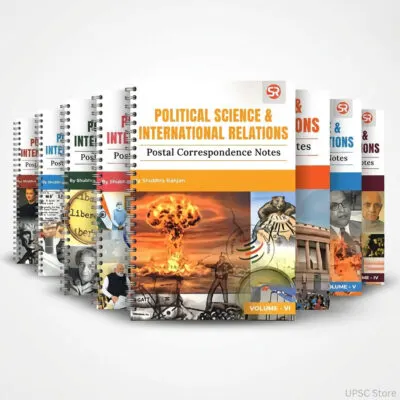
This 5-booklet set by Rajesh Mishra from Saraswati IAS covers the entire UPSC Political Science and International Relations (PSIR) optional syllabus across both Paper 1 and Paper 2. Designed for serious UPSC aspirants targeting the optional paper, it provides structured, exam-ready printed notes from one of the most recognised PSIR faculty in Delhi.

  • Booklet 1: Political Theory β€” Core Concepts and Foundations β€” Covers political theory fundamentals including liberty, equality, justice, rights, power, authority, and legitimacy. Includes Western and Indian perspectives on key concepts, thinker-wise analysis, and structured notes on sovereignty and the state. Essential for PSIR Paper 1 Section A of the UPSC optional syllabus.
  • Booklet 2: Indian Government and Politics β€” Covers the Indian constitutional framework, federalism, centre-state relations, political parties, electoral system, pressure groups, and coalition politics. Includes analysis of post-independence political developments, regional parties, and governance challenges relevant to UPSC PSIR Paper 2.
  • Booklet 3: Comparative Politics and Political Analysis β€” Addresses comparative political systems, approaches to comparative politics, political development, political modernisation, political culture and socialisation, and theories of the state. Structured for UPSC PSIR Paper 1 Section B with thinker-wise and concept-wise breakdown.
  • Booklet 4: Western Political Thought β€” Ancient to Modern β€” Covers major Western political thinkers from Plato and Aristotle through Machiavelli, Hobbes, Locke, Rousseau, Hegel, Marx, Gramsci, and Hannah Arendt. Includes quote-based revision tools and key arguments mapped to the UPSC PSIR optional exam pattern.
  • Booklet 5: Indian Political Thought β€” Covers classical Indian political thought including Kautilya’s Arthashastra, and modern Indian thinkers: Gandhi, Nehru, Ambedkar, Lohia, JP Narayan, and M.N. Roy. Structured for both conceptual clarity and answer-writing application in the UPSC PSIR Paper 2 optional exam.
  • Booklet 6: International Relations β€” Theories and Concepts β€” Covers IR theories including realism, liberalism, neo-realism, constructivism, and post-colonialism. Also includes levels of analysis, national interest, foreign policy, power transition theory, and Cold War history. Core content for PSIR Paper 2 international relations section.
  • Booklet 7: International Organisations and Global Issues β€” Covers the United Nations system, WTO, IMF, World Bank, regional organisations (EU, ASEAN, SAARC), arms control treaties, climate change negotiations, nuclear non-proliferation, terrorism, and humanitarian intervention. Mapped to UPSC PSIR Paper 2 and current affairs integration.
  • Booklet 8: India’s Foreign Policy and Strategic Studies β€” Covers India’s foreign policy evolution, Panchsheel, NAM, India-US, India-China, India-Pakistan, India-Russia relations, BRICS, SCO, Indo-Pacific, and India’s nuclear doctrine. Includes recent developments up to 2025 relevant for UPSC PSIR Paper 2 answer writing.

In-Depth Content Breakdown: Booklet by Booklet

Booklet 1: Political Theory β€” Core Concepts and Foundations

Political Theory forms the backbone of PSIR Paper 1 Section A and is frequently tested in the UPSC optional examination. This booklet by Rajesh Mishra covers core concepts like liberty (positive and negative), equality, justice (Rawlsian and communitarian), rights, democracy, citizenship, and secularism. Each concept is explained with thinker linkages and comparative perspectives, making it easier for aspirants to structure 250-word answers. The coverage aligns precisely with the UPSC PSIR syllabus and is regularly updated to reflect recent debates in political philosophy.

The booklet is structured thematically rather than in a reading-heavy narrative format. Each concept opens with a definitional note, followed by major thinker arguments, Indian constitutional relevance where applicable, and a short revision box. Rajesh Mishra’s teaching style, which emphasises clarity over verbosity, is reflected in the layout. Aspirants preparing for UPSC will find the side-by-side thinker comparison tables particularly useful for high-value questions that ask for multi-perspectival analysis. This format significantly reduces the time needed for self-note-making from standard textbooks.

Booklet 2: Indian Government and Politics

Indian Government and Politics is a high-scoring section of PSIR Paper 2 in the UPSC optional examination. This booklet covers the constitutional philosophy, federal structure, centre-state financial and legislative relations, emergency provisions, and the role of constitutional bodies such as the Election Commission, CAG, and UPSC itself. Political parties β€” from Congress dominance to BJP’s rise and the role of regional parties β€” are covered with data points and analytical observations suited for UPSC answer writing.

Beyond constitutional mechanics, this booklet by Rajesh Mishra addresses Indian political sociology β€” caste, religion, ethnicity in politics, agrarian movements, and dalit mobilisation. The booklet includes structured notes on electoral behaviour, anti-defection law, coalition politics, and governance reforms. Rajesh Mishra’s Saraswati IAS notes approach these themes with an academic rigour that helps UPSC aspirants connect syllabus points to real political developments. Short comparative tables between India and other federal systems add value for thinkers and analytical answer writing.

Booklet 3: Comparative Politics and Political Analysis

Comparative Politics is tested in PSIR Paper 1 Section B and requires both theoretical grounding and the ability to compare political systems across regions. This booklet covers traditional and modern approaches to comparative politics β€” structural functionalism, systems theory, political economy approach, and behaviouralism. Political development and modernisation theories (Almond, Powell, Huntington, Pye) are explained with clear diagrams and concept maps that make revision fast and effective for UPSC candidates.

The booklet also covers political culture (Almond and Verba’s typology), political socialisation agents, the concept of civil society, and theories of the state β€” pluralist, elite, Marxist, and neo-pluralist. Rajesh Mishra presents these theories in a question-answer format with ready-to-use arguments, making this booklet particularly useful during the final two months before the UPSC Mains optional examination. The structured layout reduces dependency on multiple reference books and enables focused PSIR preparation.

Booklet 4: Western Political Thought β€” Ancient to Modern

Western Political Thought is one of the most intellectually demanding yet scoring sections of PSIR Paper 1. This booklet covers the canon from Plato’s ideal state and philosopher-king theory through Aristotle’s classification of governments, Machiavelli’s realism, Hobbes’s social contract, Locke’s natural rights, Rousseau’s general will, and Hegel’s dialectical idealism. Each thinker is covered with their historical context, core arguments, critiques, and relevance to contemporary political questions tested by UPSC.

Modern thinkers including Marx (historical materialism, alienation, class struggle), Gramsci (hegemony, organic intellectuals, civil society), Hannah Arendt (totalitarianism, public realm, power), and John Rawls (theory of justice, veil of ignorance) are addressed in dedicated sections. Rajesh Mishra’s notes at Saraswati IAS are particularly valued for including direct quotes alongside paraphrased arguments β€” a dual approach that prepares aspirants for both direct-question and application-based UPSC Mains PSIR questions. This is one of the most referenced booklets from the set.

Booklet 5: Indian Political Thought

Indian Political Thought in the PSIR optional syllabus spans classical traditions and modern nationalist thinkers β€” both of which are frequently asked in UPSC Mains. This booklet begins with Kautilya’s Arthashastra, covering his theory of the state, saptanga theory, Mandala theory of foreign policy, and the concept of dharma in statecraft. The transition to modern Indian thought is handled with detailed notes on Bal Gangadhar Tilak, Aurobindo, and the philosophical foundations of Indian nationalism relevant to UPSC PSIR Paper 2.

The booklet dedicates substantial space to Gandhi (satyagraha, swaraj, trusteeship, non-violence as a political method), Nehru (democratic socialism, secularism, NAM), Ambedkar (annihilation of caste, constitutional democracy, critique of Gandhi), Lohia (socialism, caste, language politics), and Jayaprakash Narayan’s concept of total revolution. Each thinker’s ideas are presented with their critiques and inter-thinker debates, which is precisely the analytical depth that UPSC examiners reward in the PSIR optional paper. Short answer templates are embedded in the layout.

Booklet 6: International Relations β€” Theories and Concepts

International Relations theory is a conceptually rich and high-scoring domain within PSIR Paper 2. This booklet opens with the nature and development of IR as a discipline and then systematically covers the major theoretical traditions: classical realism (Morgenthau), neo-realism (Waltz), classical liberalism (Kant, Wilson), neo-liberalism (Keohane, Nye), constructivism (Wendt), Marxism and dependency theory, and post-colonial IR. Each theory is contrasted against others, with exam-ready comparison tables designed specifically for UPSC PSIR answer writing.

Beyond theories, this booklet covers core IR concepts: balance of power, deterrence, collective security, interdependence, globalisation, and the concept of national interest. Cold War history β€” origins, major crises, dΓ©tente, and the end of the Cold War β€” is covered with analytical notes rather than descriptive timelines. Rajesh Mishra ensures that theoretical frameworks are always connected to real-world events, allowing UPSC aspirants to deploy academic vocabulary correctly in 150-word and 250-word answers during the PSIR optional examination.

Booklet 7: International Organisations and Global Issues

The United Nations, its principal organs, specialised agencies, and reform debates are covered in depth in this booklet β€” a recurring theme in UPSC PSIR Paper 2. The booklet also addresses the Bretton Woods institutions (IMF and World Bank), WTO and global trade disputes, and the political economy of globalisation. Regional organisations including the European Union’s institutional structure, ASEAN’s role in Southeast Asian security, SAARC’s potential and limitations, and the African Union are explained with their relevance to India’s foreign policy and PSIR syllabus alignment.

Global issues covered include nuclear non-proliferation (NPT, CTBT, NSG), arms control regimes, terrorism and counter-terrorism frameworks, refugee crises and international humanitarian law, climate change negotiations (UNFCCC, Paris Agreement), and the politics of sustainable development. These topics connect directly to current affairs and are tested in UPSC PSIR Paper 2 with increasing frequency. Rajesh Mishra’s Saraswati IAS notes provide ready-made frameworks for answering these questions with both theoretical grounding and contemporary factual updates through 2025.

Booklet 8: India’s Foreign Policy and Strategic Studies

India’s foreign policy is the most dynamic and directly current-affairs-linked section of PSIR Paper 2 in the UPSC optional examination. This booklet traces the evolution of Indian foreign policy from Nehruvian idealism through Indira Gandhi’s pragmatism, post-Cold War recalibration, and the contemporary era of strategic autonomy. Panchsheel, Non-Alignment Movement (NAM), and India’s approach to international law are explained with their philosophical underpinnings and changing relevance in the multipolar world order.

Bilateral relationships β€” India-USA (strategic partnership, civil nuclear deal, QUAD), India-China (border disputes, trade, competition), India-Pakistan (Kashmir, terrorism, diplomacy), India-Russia (defence cooperation, S-400, changing equations), and India’s neighbourhood policy β€” are covered with recent developments up to 2025. India’s nuclear doctrine (No First Use, credible minimum deterrence), participation in BRICS, SCO, G20 Presidency, and the Indo-Pacific strategy are documented with Rajesh Mishra’s signature analytical approach. This booklet alone can anchor a UPSC PSIR optional candidate’s preparation for the most frequently asked current-affairs-linked questions.

Physical Construction and Quality Standards

Every booklet in this Rajesh Mishra Saraswati IAS PSIR set is produced to support long-duration UPSC study sessions β€” from initial reading and underlining through multiple revision cycles and active note-taking during self-study. The physical quality is designed to last the full preparation cycle without degradation.

Paper Quality: 75 GSM Anti-Glare White Paper

Each page uses 75 GSM ultra-white paper selected for its high opacity β€” meaning text from the reverse side does not shadow through during reading or writing. The anti-glare finish prevents eye strain during extended UPSC study sessions that can run four to six hours at a stretch. All common highlighter colours β€” yellow, green, pink, and orange β€” perform cleanly with zero bleed-through. Gel pens, ballpoint pens, and pencils all work without ghosting, supporting the color-coded revision systems that many PSIR optional aspirants rely on.

Printing Technology: High-Resolution Laser Printing

All 5 Booklets are printed using high-resolution laser printing technology that delivers crisp, sharp text even at smaller font sizes used in dense political theory and international relations content. Diagrams, concept maps, comparative tables, and flowcharts that appear throughout Rajesh Mishra’s PSIR notes are reproduced with full clarity β€” no pixelation or ink spreading. The laser toner is permanent and smudge-proof under normal handling conditions, meaning pages retain their legibility even after repeated handling across months of UPSC preparation and revision cycles.

Binding and Durability

The booklets are available in spiral or book binding formats, each suited to different study habits. Spiral binding allows each booklet to open completely flat on a desk, making it easy to write additional margin notes alongside Rajesh Mishra’s PSIR content β€” a workflow many UPSC optional aspirants prefer. Book binding provides a compact, shelf-ready format that is easier to carry to library or coaching sessions. Both formats feature a 300 GSM laminated cover that protects against moisture, edge wear, and the rough handling typical of daily UPSC preparation use over 12 to 18 months.

Key Features and Study Design

These printed notes are specifically structured to match the demands of UPSC PSIR optional exam preparation β€” balancing theoretical depth with answer-writing applicability across both Paper 1 and Paper 2.

  • Full Syllabus Coverage Across 5 Booklets: Every section of the UPSC PSIR optional syllabus β€” from political theory and comparative politics through Indian political thought, international relations theory, and India’s foreign policy β€” is addressed across the 5 Booklets, eliminating the need for parallel textbook reading for core syllabus points.
  • Answer-Writing Ready Format: Rajesh Mishra’s notes are structured with UPSC Mains answer writing in mind. Key arguments, thinker quotes, comparative tables, and concept definitions are presented in a format that directly translates to 150-word and 250-word structured answers, saving aspirants significant time during final preparation months.
  • Thinker-Wise and Concept-Wise Organisation: Both Western and Indian political thought sections organise content by individual thinker with each thinker’s core ideas, critiques, and contemporary relevance grouped together β€” enabling focused revision before the UPSC optional exam without hunting across multiple chapters or books.
  • Current Affairs Integration Through 2025: The 2025-26 edition of these Rajesh Mishra Saraswati IAS PSIR notes incorporates recent developments in India’s foreign policy, international organisations, and global governance debates up to 2025, ensuring that UPSC aspirants are not working from outdated material in the dynamic Paper 2 sections.
  • Visual Learning Tools β€” Tables, Maps, and Diagrams: Throughout all 5 Booklets, Rajesh Mishra deploys comparison tables for political systems and IR theories, conceptual diagrams for political thought, and structured frameworks for foreign policy analysis. These visual tools support faster revision and stronger retention of complex PSIR optional content for UPSC Mains.

Shipping, Packaging and Delivery

Every order from our UPSC Store is packaged to ensure that all 5 Booklets of the Rajesh Mishra Saraswati IAS PSIR set arrive in perfect condition. Each set is wrapped individually in protective shrink-wrap before being placed inside a rigid corrugated cardboard box rated for courier transit. Foam edge protectors and cardboard inserts keep the booklets from shifting during handling. The outer box is sealed with heavy-duty tape and clearly labelled for fragile handling, ensuring the printed notes reach you with their binding, cover lamination, and pages fully intact regardless of your delivery location across India.

We deliver pan India in 3-5 business days via tracked courier service. A tracking ID is sent to your registered email and mobile number within 24 hours of dispatch so you can monitor your order in real time. For any queries β€” whether about your order status, a missing booklet, or a damaged piece β€” reach us on WhatsApp at +91 70045 49563. We guarantee replacement of any missing or damaged booklet within 48 hours of your complaint being raised. Bulk orders for study groups or coaching institutes are also accepted with priority dispatch.

Frequently Asked Questions (FAQ)

Q1: Are Rajesh Mishra PSIR notes good for UPSC optional preparation?

A: Yes. Rajesh Mishra’s PSIR notes from Saraswati IAS are widely used by UPSC aspirants for their structured, syllabus-mapped coverage of both Paper 1 and Paper 2. The notes balance theoretical depth with practical answer-writing frameworks β€” making them effective for candidates at both the early reading stage and the final revision stage. Many PSIR optional aspirants use these as their primary study material alongside standard reference texts.

Q2: How many booklets are included in Rajesh Mishra PSIR notes 2025-26?

A: This set contains 8 individual printed booklets covering the complete UPSC PSIR optional syllabus. The booklets span Political Theory, Indian Government and Politics, Comparative Politics, Western Political Thought, Indian Political Thought, International Relations Theory, International Organisations and Global Issues, and India’s Foreign Policy. All 5 Booklets are shipped together in one tracked package with pan India delivery in 3-5 business days.

Q3: Is Saraswati IAS political science notes updated for 2025-26 syllabus?

A: Yes. This is the 2025-26 edition of the Rajesh Mishra PSIR notes from Saraswati IAS, updated to reflect the current UPSC PSIR optional syllabus and incorporating recent developments in India’s foreign policy, international relations, and global governance up to 2025. Aspirants appearing in the UPSC Mains 2025 or 2026 cycle can rely on this edition for current and syllabus-accurate content without needing to supplement with older editions.

Q4: What is the price of Rajesh Mishra PSIR notes from Saraswati IAS?

A: The price is listed on the product page and reflects the current 2025-26 market price for genuine printed notes from Saraswati IAS. The set includes all 5 Booklets β€” complete PSIR Paper 1 and Paper 2 coverage β€” shipped in protected packaging with pan India tracked delivery included in the order. For bulk pricing, coaching institute orders, or any clarification, contact us on WhatsApp at +91 70045 49563 before placing your order.

Q5: Are these PSIR notes available in Hindi medium as well?

A: The set listed on this product page is the English medium edition of Rajesh Mishra PSIR notes 2025-26 from Saraswati IAS. For availability of a Hindi medium edition of the same PSIR optional notes, please contact our store directly on WhatsApp at +91 70045 49563. Our team can confirm current stock, editions available, and dispatch timelines for Hindi medium PSIR optional material from Saraswati IAS and other institutes.

Q6: Do Saraswati IAS PSIR notes cover both Paper 1 and Paper 2?

A: Yes, all 5 Booklets together cover the full UPSC PSIR optional syllabus across both papers. Paper 1 topics β€” Political Theory, Comparative Politics, Western Political Thought, and Indian Political Thought β€” are addressed in Booklets 1 through 5. Paper 2 topics β€” Indian Government and Politics, International Relations, International Organisations, and India’s Foreign Policy β€” are covered in Booklets 2, 6, 7, and 8. The set is designed as a standalone PSIR optional resource for UPSC preparation.

Q7: How are Rajesh Mishra notes different from other PSIR optional materials?

A: Rajesh Mishra’s PSIR notes from Saraswati IAS are known for their answer-writing-first approach β€” each section is structured to generate direct exam responses rather than being a reading-heavy narrative. Unlike standard textbooks such as those commonly referenced for UPSC PSIR, these notes integrate thinker quotes, comparison tables, and conceptual frameworks in a single place. This reduces the time spent synthesising material from multiple sources, which is a critical advantage given the time pressure of UPSC Mains preparation.

Q8: Is Rajesh Mishra PSIR 2025-26 material sufficient without coaching classes?

A: For self-study aspirants, these 8 printed booklets provide strong syllabus coverage and can serve as the primary PSIR optional resource without classroom coaching. The structured layout, thinker-wise breakdowns, and answer frameworks are designed for independent learners. However, aspirants are also advised to practise answer writing regularly and consult previous years’ UPSC PSIR question papers alongside these notes to fully develop the analytical and argumentative writing skills the UPSC optional examination rewards.

Q9: What paper quality is used and can I use a highlighter?

A: These booklets use 75 GSM ultra-white paper chosen for high opacity β€” multiple highlighter colors and gel pens work without bleed-through to the reverse side, ideal for color-coded revision. The anti-glare finish also reduces eye strain during long UPSC study sessions. Yellow, green, pink, and orange highlighters all perform cleanly. The paper also holds pencil and ballpoint pen annotations without smudging, making it fully compatible with active reading and margin note-taking strategies used by PSIR optional aspirants.

Q10: Where can I buy Rajesh Mishra PSIR notes online?

A: You can buy Rajesh Mishra PSIR notes 2025-26 from Saraswati IAS directly on this product page. This is the official online store listing for the genuine 2025-26 printed edition. We ship pan India with tracking in 3-5 business days. To buy the set, simply add to cart and proceed to checkout. For any pre-purchase questions about the content, edition, or delivery timeline, reach us on WhatsApp at +91 70045 49563 before you buy and we will assist promptly.

Q11: Are these notes useful for State PSC exams with Political Science optional?

A: Yes. Beyond UPSC, these Rajesh Mishra Saraswati IAS PSIR notes are useful for BPSC, UPPSC, MPPSC, RAS, and other State PSC examinations where Political Science and International Relations is offered as an optional subject. The theoretical foundations, Indian political thought, comparative politics, and international relations sections are directly relevant to State PSC PSIR syllabi. Aspirants preparing for both UPSC and a State PSC optional exam will find strong syllabus overlap across most booklets in this set.

Q12: What happens if a booklet is missing or damaged on delivery?

A: If any booklet from the 5-booklet set arrives damaged or is missing from your package, contact us immediately on WhatsApp at +91 70045 49563 with a photo of the package and the delivered contents. We guarantee replacement dispatch of the missing or damaged booklet within 48 hours of your complaint being raised. All our orders are sent in corrugated boxes with protective inserts specifically to prevent transit damage, but we take full responsibility if any issue occurs during delivery.

Summary

SpecificationValue
Booklets8 Printed Booklets β€” Complete PSIR Paper 1 and Paper 2
Faculty / InstituteRajesh Mishra β€” Saraswati IAS
LanguageEnglish Medium
Edition2025-26 Latest Batch
Paper75 GSM Ultra-White β€” Highlighter Safe
BindingSpiral or Book Binding with 300 GSM Laminated Cover
Delivery3-5 Business Days Pan India β€” Tracked
Also Useful ForBPSC, UPPSC, MPPSC, RAS and all State PSC Political Science Optional

Sourced and dispatched from our UPSC Store in Mukherjee Nagar, Delhi β€” the hub of India’s UPSC preparation ecosystem. Buy Rajesh Mishra PSIR Notes 2025-26 today and get your complete 5-booklet set delivered anywhere in India in 3-5 days.

Reference: UPSC official syllabus

Customer Reviews 126

4.5
Based on 126 reviews
5β˜…
75
4β˜…
37
3β˜…
14
2β˜…
0
1β˜…
0
A
Aditya Bansal
24 Apr 2026
βœ“ Verified

Notes acche hain, packing bhi theek tha aur delivery time bhi achha tha.

K
Kavya Iyer
21 Apr 2026
βœ“ Verified

Bilkul sach mein best notes available. Worth buying for UPSC PSIR section.

K
Karthik Menon
21 Apr 2026
βœ“ Verified

Ye notes mere PSIR ka pura game change kar diye, bhot helpful.

N
Neha Gupta
20 Apr 2026
βœ“ Verified

Content bilkul jagnyaan se bhara hai aur presentation ekdum polished. Highly recommended for serious aspirants.

S
Sneha Gupta
20 Apr 2026
βœ“ Verified

Quality bohot acha hai aur content relevant. Mujhe kaafi helpful laga preparation ke liye.

P
Pooja Iyer
15 Apr 2026
βœ“ Verified

Mast preparation ke liye mast notes!

R
Riya Chatterjee
11 Apr 2026
βœ“ Verified

Covers PSIR syllabus perfectly. Bohot helpful mera preparation ke liye.

S
Sneha Patel
11 Apr 2026
βœ“ Verified

Recommended!

πŸ›οΈ

Aspirants Also Bought

More from the same category

View All β†’

About Rajesh Mishra PSIR Notes 2025-26

Rajesh Mishra PSIR Notes 2025-26 is a highly recommended UPSC study material from Rajesh Mishra, specially designed for Political Science & International Relations preparation. Available in Hindi/English medium, this material is crafted to match the exact requirements of the UPSC Civil Services Examination syllabus β€” covering both Prelims and Mains comprehensively.

Product Details

  • Institute: Rajesh Mishra
  • Subject: Political Science & International Relations
  • Medium: Hindi/English
  • Format: Printed
  • Delivery: Pan-India delivery in 3–5 working days
  • Format: Original printed material, verified authentic

Why Buy from UPSC Store?

  • βœ… 100% Genuine Printed Material β€” Original printed notes, no photocopies or fake copies
  • βœ… Fast Delivery β€” Ships within 24 hours, arrives in 3–5 days pan-India
  • βœ… Secure Packaging β€” Bubble-wrapped and boxed to prevent damage in transit
  • βœ… Trusted by 10,000+ Aspirants β€” India's most reliable UPSC material marketplace
  • βœ… WhatsApp Support β€” Get expert guidance on material selection before ordering

Frequently Asked Questions

Is this product 100% original?

Yes, all products at UPSC Store are 100% genuine printed materials. We do not sell photocopies or fake copies.

How long does delivery take?

Orders are dispatched within 24 hours and delivered across India in 3–5 working days via reputed courier partners.

Can I return the product?

Yes, we accept returns within 7 days if the product is damaged or incorrect. Check our refund policy for details.

Which other study materials should I buy with this?

We recommend pairing this with current affairs notes and a UPSC test series for comprehensive preparation. Browse more in Optional, Political Science, UPSC.