


Shubhra Ranjan PSIR Handwritten Class Notes 2025-26
About Shubhra Ranjan PSIR Handwritten 2025-26
The Shubhra Ranjan PSIR Handwritten 2025-26 is a printed UPSC study material set sold by UPSC Store β India’s trusted source for genuine, latest-batch civil services preparation books. This page covers full booklet details, syllabus coverage, pricing, shipping, and frequently asked questions. Useful for UPSC CSE, BPSC, UPPSC, MPPSC, RAS and other state PSC examinations.
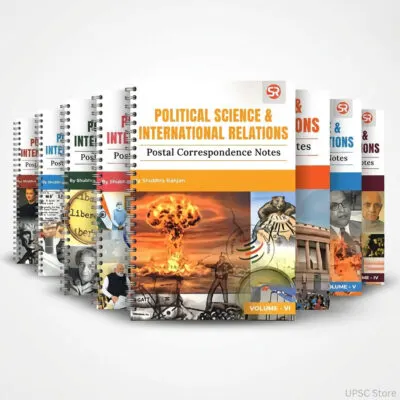
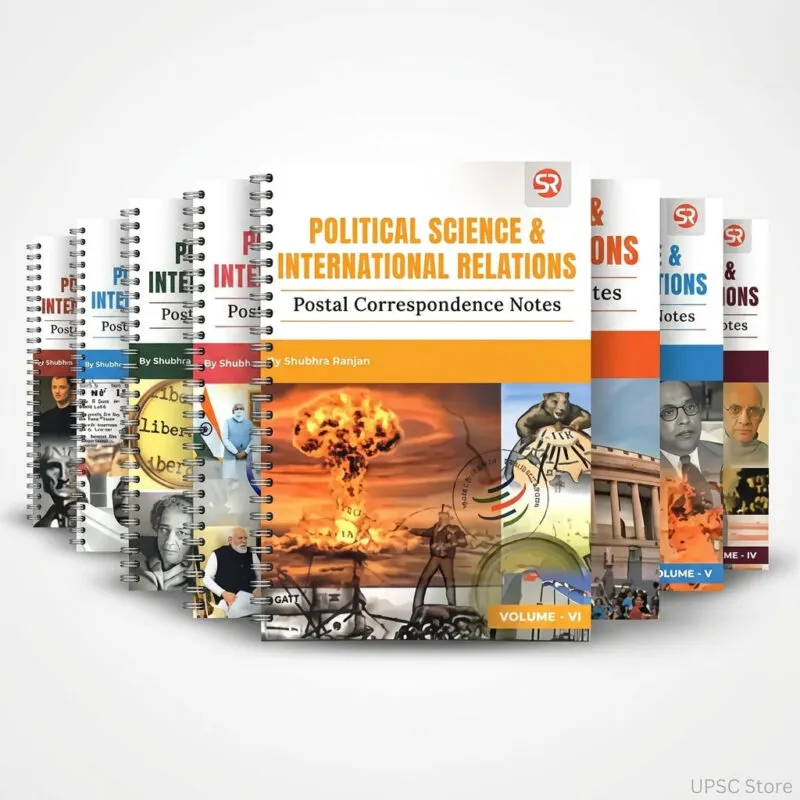
Shubhra Ranjan PSIR Handwritten Class Notes 2025-26 β 11 English Medium Printed Booklets for UPSC Political Science & International Relations Optional
Related: Shubhra Ranjan IAS notes Β· PSIR Class Handwritten books
Product Overview
| Feature | Details |
|---|---|
| Booklets Count | 11 Individual Printed Booklets β Full PSIR Optional Syllabus Coverage (Paper I + Paper II) |
| Language | English Medium |
| Publisher | Shubhra Ranjan (SR) β Postal Correspondence Notes Series |
| Edition | 2025-26 β Latest Genuine Batch |
| Condition | Brand New, Unmarked, Fresh Stock |
| Format | High-Quality Printed Booklets β Spiral or Book Binding |
| Paper Quality | 75 GSM Ultra-White β Highlighter Safe, Zero Bleed-Through |
| Shipping | Pan India Delivery in 3-5 Business Days β Tracked |
| Also Useful For | BPSC, UPPSC, MPPSC, RAS and all State PSC optional political science papers |
Complete Booklet Catalog
This 11-booklet set by Shubhra Ranjan covers the entire UPSC PSIR optional syllabus across both Paper I (Political Theory and Indian Politics) and Paper II (Comparative Politics and International Relations), making it a one-stop resource for serious PSIR optional aspirants. Whether you are a first-time PSIR optional candidate or revising for Mains, this set delivers structured, exam-oriented content written in accessible English prose backed by years of Shubhra Ranjan’s teaching expertise.
- Booklet 1: Political Theory β Core Concepts β Covers foundational concepts of political theory including the state, sovereignty, legitimacy, authority, power, and justice. Examines classical and modern interpretations from Plato to Rawls. Includes perspectives on rights, liberty, equality, and democracy with direct relevance to UPSC PSIR Paper I Section A.
- Booklet 2: Western Political Thought β Detailed analysis of thinkers from Plato, Aristotle, Machiavelli, Hobbes, Locke, Rousseau, Kant, Hegel, Marx, and Mill. Each thinker’s key ideas, historical context, and UPSC-relevant arguments are presented with answer-writing pointers suitable for PSIR Mains.
- Booklet 3: Indian Political Thought β Explores Kautilya, Manu, Vivekananda, Aurobindo, Tilak, Gandhi, Nehru, Ambedkar, Lohia, and M.N. Roy. Covers their philosophies on state, swaraj, nationalism, social justice, and secularism with UPSC Mains answer-writing examples.
- Booklet 4: Indian Government and Politics β Covers the Indian Constitution, Federalism, Parliamentary system, President, Governor, Judiciary, CAG, Election Commission, and constitutional amendments. Discusses party systems, pressure groups, and the nature of Indian democracy for PSIR Paper I Section B.
- Booklet 5: Indian Politics β Dynamics and Issues β Analyses political parties, electoral politics, coalition dynamics, regionalism, communalism, caste and politics, women’s political participation, and recent political trends in India relevant to UPSC PSIR Mains 2025-26.
- Booklet 6: Comparative Politics β Frameworks and Approaches β Introduces comparative political analysis, including the systems approach, structural-functionalism, political economy perspective, and post-behavioural critiques. Covers developed and developing political systems with PSIR Paper II application.
- Booklet 7: Political Institutions β Comparative Study β Comparative study of executives, legislatures, judiciaries, bureaucracies, and party systems across USA, UK, France, Germany, China, and Russia. Includes political development theories and modernisation debates for UPSC PSIR Paper II.
- Booklet 8: International Relations β Theory and Concepts β Covers realism, liberalism, neo-realism, neo-liberalism, constructivism, Marxist IR theory, post-colonialism, and feminist IR. Explains concepts of national interest, balance of power, deterrence, and collective security for UPSC PSIR Paper II Section A.
- Booklet 9: Global Political Economy and Organisations β Examines the evolution of the international economic order, NIEO debates, WTO, IMF, World Bank, globalisation, dependency theory, and the role of MNCs. Covers the UN system, its organs, specialised agencies, and reform debates.
- Booklet 10: India’s Foreign Policy β Detailed treatment of India’s foreign policy foundations, Non-Alignment, Panchsheel, Gujral Doctrine, Look East/Act East, India-US, India-China, India-Pakistan, India-Russia, India-EU relations, and India’s role in multilateral forums like BRICS, SCO, and G20.
- Booklet 11: Contemporary Global Issues and Recent IR Developments β Covers terrorism, nuclear proliferation, climate change and international negotiations, cyber security, Arctic politics, Indo-Pacific strategy, QUAD, refugee crisis, South-South cooperation, and current events directly relevant to UPSC PSIR Mains 2025-26.
In-Depth Content Breakdown: Booklet by Booklet
Booklet 1: Political Theory β Core Concepts
This booklet opens the UPSC PSIR optional journey by building a strong theoretical base across the most frequently tested concepts in Paper I. Topics include the nature and definitions of the state, theories of sovereignty from Bodin to Austin, authority and its bases, legitimacy as explored by Weber, and the evolving concept of power from classical realism to modern discourse theory. Liberty, equality, and justice receive dedicated treatment, with Rawlsian and libertarian perspectives contrasted against communitarian critiques β all framed with UPSC Mains answer formats in mind.
What sets this booklet apart is Shubhra Ranjan’s ability to link abstract political theory to real-world governance examples that UPSC examiners value. Tables contrasting negative and positive liberty, diagrams mapping theories of justice, and margin notes flagging high-frequency UPSC questions from previous years make this an active study tool rather than a passive reading resource. The language is clear, jargon is explained in context, and every section ends with key points suitable for quick revision before PSIR Mains.
Booklet 2: Western Political Thought
Western Political Thought is one of the highest-scoring areas in UPSC PSIR Paper I when prepared well, and this booklet addresses it with depth and precision. Each thinker β from Plato’s ideal state and Aristotle’s empirical approach to Machiavelli’s realism and Hobbes’s social contract β is presented in a structured format covering life and times, key works, central ideas, and UPSC relevance. Marx’s historical materialism, alienation, and class struggle receive extensive coverage given their recurring appearance in UPSC Mains PSIR papers.
Shubhra Ranjan’s class notes are known for their ability to make complex philosophical arguments accessible without oversimplifying them. This booklet retains that quality in printed form. Comparative tables between thinkers such as Locke versus Rousseau on the social contract, or Mill versus Marx on liberty, help aspirants write integrated UPSC answers. Previous year UPSC PSIR questions are referenced throughout so aspirants understand exactly which ideas to prioritise in their Mains preparation.
Booklet 3: Indian Political Thought
Indian Political Thought is a uniquely high-scoring section in UPSC PSIR Paper I for those who prepare it with cultural and historical sensitivity. This booklet covers Kautilya’s Arthashastra in detail β its theory of statecraft, saptanga theory, and foreign policy β alongside Manu’s social thought and its contemporary critiques. Gandhi’s political philosophy, including Satyagraha, Swaraj, trusteeship, non-violence, and his critique of modernity, receives extensive treatment with direct links to UPSC essay and ethics papers as well.
Nehru’s vision of a modern democratic socialist India, Ambedkar’s radical critique of caste and his constitutional thought, Lohia’s socialist framework, and M.N. Roy’s radical humanism are each treated with the depth the UPSC PSIR syllabus demands. Shubhra Ranjan’s notes in this booklet are particularly notable for connecting Indian thinkers to Western counterparts β Ambedkar and Dewey, Gandhi and Tolstoy β which enables aspirants to write analytically rich UPSC answers that stand out in evaluation.
Booklet 4: Indian Government and Politics
This booklet provides a structured treatment of India’s constitutional framework and governmental institutions as required for UPSC PSIR Paper I Section B. The Indian Constitution’s Preamble, Fundamental Rights, Directive Principles, and their judicial interpretation through landmark Supreme Court cases are covered in detail. The federal structure, centre-state relations, Finance Commission, Inter-State Council, and Governor’s role in coalition politics are explained with clarity relevant to both PSIR optional and GS Paper II of UPSC Mains.
Parliamentary procedures, the role of the Speaker, question hour, and budgetary process are covered alongside the President’s discretionary powers and constitutional conventions. The Election Commission, its evolution, Model Code of Conduct, and electoral reforms feature prominently. Shubhra Ranjan’s notes here are enriched by real case studies from Indian political history β Emergency of 1975, coalition governments, landmark judgments β that enable aspirants to write answer-boosting examples in their UPSC PSIR Mains responses.
Booklet 5: Indian Politics β Dynamics and Issues
Moving beyond institutions, this booklet explores the living dynamics of Indian politics that UPSC examiners regularly test in PSIR Paper I. Political parties β Congress, BJP, regional parties β their ideological evolution, voter base, and organisational structures are analysed. Electoral politics, first-past-the-post debates, anti-defection law, criminalisation of politics, and money in elections are covered with data from recent elections. Caste as a political factor, the OBC assertion since Mandal, and Dalit politics receive dedicated analytical treatment.
Communalism, secularism debates in India, minority rights, women’s political representation and the Women’s Reservation Bill, federalism in practice through recent GST implementation debates, and the politics of regionalism and language are all addressed. This booklet is particularly useful for UPSC PSIR aspirants writing 20-mark analytical answers on Indian political trends, as Shubhra Ranjan’s notes provide ready-made frameworks and factual anchors that prevent vague, marks-losing responses in PSIR Mains.
Booklet 6: Comparative Politics β Frameworks and Approaches
This booklet opens UPSC PSIR Paper II preparation by establishing the theoretical frameworks used in comparative political analysis. The traditional approach β historical, legal-formal β is contrasted against the behavioural revolution led by Almond, Powell, and Verba. Systems theory, structural-functionalism, political culture, political communication, and political socialisation are explained with clarity. The post-behavioural critique by David Easton and the subsequent turn toward political economy are mapped carefully for UPSC aspirants who need to use these frameworks as analytical lenses.
Dependency theory, world-systems theory (Wallerstein), and neo-colonial critiques are integrated into this section, equipping UPSC PSIR aspirants with tools to analyse both developed and developing world political systems. Shubhra Ranjan’s notes consistently translate these academic frameworks into exam-applicable language β meaning aspirants learn not just what structural-functionalism is but how to deploy it in a UPSC PSIR Mains answer on political development or state capacity, which directly translates to higher scores.
Booklet 7: Political Institutions β Comparative Study
This booklet delivers a comparative study of political institutions across major democracies and non-democratic systems β a consistently high-weightage area in UPSC PSIR Paper II. The US presidential system, UK Westminster model, French semi-presidential arrangement, German Federal Republic, the Chinese Communist Party system, and Russian managed democracy are each analysed through institutional, behavioural, and political economy lenses. Executives β their powers, accountability, and relations with legislatures β receive detailed country-by-country treatment.
Legislatures’ roles, decline of parliament thesis, upper house versus lower house dynamics, bicameralism debates, and judicial independence across these systems are covered with comparative tables. Political parties and party systems β two-party, multi-party, dominant party β are examined using Sartori’s framework. Bureaucracy’s role, new public management reforms, and military-civilian relations in developing countries are analysed. Shubhra Ranjan’s structured notes make this technically demanding booklet approachable and exam-ready for UPSC PSIR Mains aspirants.
Booklet 8: International Relations β Theory and Concepts
International Relations theory is the intellectual backbone of UPSC PSIR Paper II, and this booklet gives it the depth it deserves. Realism β classical (Morgenthau), structural (Waltz), neoclassical β is explained in detail alongside liberalism, complex interdependence (Keohane and Nye), and neo-liberal institutionalism. Constructivism (Wendt) explains how identity and norms shape state behaviour, a perspective increasingly valued in UPSC PSIR Mains answers. Marxist and critical theories, post-colonialism, and feminist IR round out the theoretical spectrum.
Conceptual clarity on national interest, balance of power, deterrence theory, collective security, and arms control is built through real historical examples β Cold War bipolarity, post-Cold War unipolarity debates, and emerging multipolarity. The booklet includes structured comparison charts of IR theories, tables mapping theorists to their core arguments, and practice question pointers from previous UPSC PSIR Mains papers. Shubhra Ranjan’s talent for making IR theory exam-applicable without losing academic rigour is on full display in this booklet.
Booklet 9: Global Political Economy and Organisations
This booklet addresses two vital areas of UPSC PSIR Paper II: global political economy and international organisations. The Bretton Woods system, its evolution, the Washington Consensus, globalisation’s political consequences, and alternative economic orders proposed through the Non-Aligned Movement and NIEO debates are analysed with historical depth. WTO’s dispute settlement, TRIPS, agricultural subsidies debates, and the Global South’s position in trade negotiations are explained with the nuance UPSC examiners expect in PSIR optional answers.
The United Nations system receives dedicated coverage β Security Council structure and reform debates, General Assembly resolutions, the role of the Secretary-General, and specialised agencies including UNESCO, WHO, ILO, and UNHCR. Peacekeeping operations, the Responsibility to Protect (R2P) doctrine, and humanitarian intervention debates feature prominently. Regional organisations β EU, ASEAN, African Union, SAARC β are compared for their integration models and effectiveness. Shubhra Ranjan’s notes provide crisp examples and evaluation frameworks that help aspirants write analytical UPSC PSIR Mains answers.
Booklet 10: India’s Foreign Policy
India’s Foreign Policy is arguably the most dynamic section of UPSC PSIR Paper II in recent years, and this booklet is the most current and detail-rich in the set. The foundational pillars β Non-Alignment, strategic autonomy, civilisational diplomacy β are traced from Nehru’s era through the Cold War to the post-1991 reorientation. The Look East policy’s evolution into Act East, the rise of economic diplomacy, and India’s growing strategic partnerships are mapped chronologically and thematically for UPSC PSIR Mains application.
Bilateral relations with every major partner β the US (Civil Nuclear Deal, QUAD, technology access), China (border disputes, BRI concerns, economic interdependence), Pakistan (terrorism, Simla Agreement, backchannel diplomacy), Russia (defence ties, S-400 controversy, Ukraine war implications), and the European Union β are each covered with sufficient depth for standalone 20-mark UPSC PSIR questions. India’s multilateral engagement through BRICS, SCO, G20, and the Global South leadership narrative is covered with 2025-relevant updates making this booklet current and exam-ready.
Booklet 11: Contemporary Global Issues and Recent IR Developments
The final booklet in this UPSC PSIR set addresses the contemporary global landscape that increasingly dominates PSIR Paper II questions. Terrorism and counter-terrorism frameworks post 9/11, the rise of non-state actors, nuclear proliferation (NPT regime, India’s nuclear doctrine, CTBT debates), and cyber security as a new domain of geopolitical competition are covered in structured, answer-ready formats. Climate change negotiations from Kyoto to Paris Agreement to COP outcomes are detailed with India’s position clearly articulated.
Indo-Pacific strategy, QUAD’s evolution, AUKUS implications for Asian security, China’s Belt and Road Initiative and counter-coalitions, Arctic geopolitics, and the refugee crisis and its international legal framework round out this booklet. South-South cooperation, the reform of global governance institutions, and India’s aspiration for a permanent UN Security Council seat are discussed with analytical frameworks. Shubhra Ranjan ensures this booklet is updated to reflect developments through 2025, making it the most directly relevant resource for UPSC PSIR Mains 2025-26 aspirants to buy online.
Physical Construction and Quality Standards
Every booklet in this Shubhra Ranjan PSIR 2025-26 printed set is manufactured to standards suited to the intense, month-long study cycles UPSC optional preparation demands β covering margins for annotation, binding that lasts through multiple revision cycles, and paper that handles every type of pen and highlighter without deterioration.
Paper Quality: 75 GSM Anti-Glare White Paper
The 75 GSM ultra-white paper used across all 11 PSIR booklets is selected for its high opacity, which ensures that text printed on one side does not bleed through or ghost onto the reverse side. This matters enormously when aspirants annotate with multiple coloured highlighters β yellow, orange, green, and pink β to colour-code political theory, Indian politics, IR theory, and India’s foreign policy sections. The anti-glare surface reduces eye strain during the extended daily study sessions that UPSC PSIR optional preparation requires, making these printed notes genuinely comfortable to study from for four to six hours at a stretch.
Printing Technology: High-Resolution Laser Printing
All text, tables, diagrams, flowcharts, and maps across the 11 PSIR booklets are produced using high-resolution laser printing technology. Laser toner bonds permanently to the paper fibre, meaning pages do not smudge when hands rest on them during writing practice β a critical quality for aspirants doing timed answer writing alongside their notes. IR theory comparison charts, political system diagrams, and India’s foreign policy timelines are rendered with sharp, clear lines that remain legible even at smaller font sizes. Flowcharts mapping federal relations, party system typologies, and UN organ structures are crisp and easy to read and annotate.
Binding and Durability
Each of the 11 PSIR booklets ships with either spiral binding or book binding depending on the booklet’s page count and content type, both chosen for durability under heavy use. Spiral-bound booklets open completely flat on a study desk, allowing aspirants to write margin notes alongside text without the spine forcing pages closed β essential when practising PSIR answer writing. Book-bound booklets use a reinforced spine and 300 GSM cover stock that resists bending and moisture absorption. All covers are printed with clear booklet titles and topic markers so aspirants can identify and pull out the required booklet instantly from a full stack of 11, saving time during focused revision sessions.
Key Features and Study Design
These Shubhra Ranjan PSIR Handwritten Class Notes 2025-26 are structured around the specific demands of UPSC Mains optional preparation β not generic political science study β with design choices that directly support answer writing, revision speed, and retention across both Paper I and Paper II.
- Full Syllabus Architecture: All 11 booklets map directly to the official UPSC PSIR optional syllabus sections β Political Theory, Indian Political Thought, Western Political Thought, Indian Government and Politics, Comparative Politics, and International Relations β ensuring zero syllabus gaps that could cost marks in UPSC Mains.
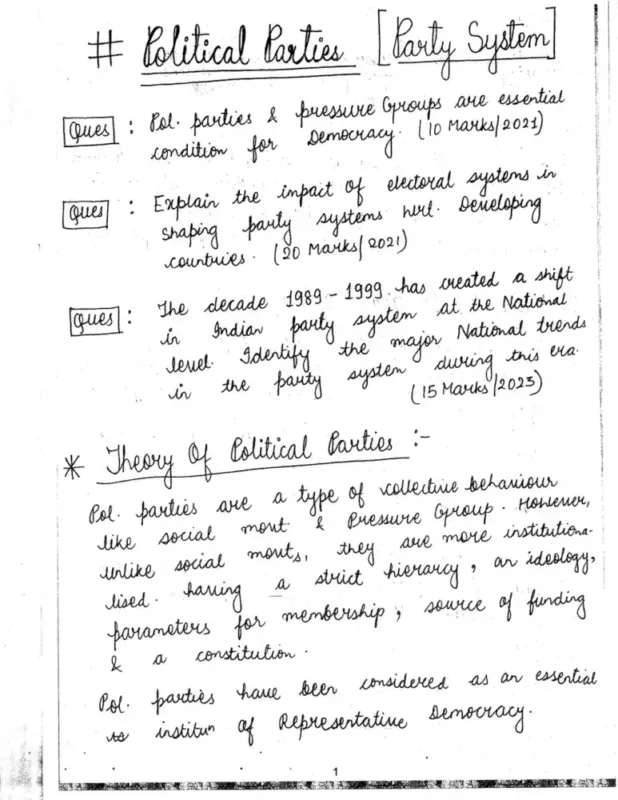
- Answer-Writing Frameworks Built In: Unlike raw reading material, Shubhra Ranjan’s notes include answer outlines, introduction-body-conclusion formats for key topics, and model paragraph structures so UPSC PSIR aspirants can directly practice writing scored responses from the notes without needing a separate answer-writing guide.
- Previous Year UPSC Question Mapping: High-frequency UPSC PSIR Mains questions from the last 10 years are referenced within relevant sections, allowing aspirants to see exactly which topics have been asked, how many times, and in what format β enabling strategic prioritisation during PSIR optional preparation.
- Comparative Tables and Visual Aids: Every booklet contains subject-specific tables β IR theory comparisons, thinker matrices, institutional structures, federal comparison charts β that compress dense content into quickly scannable formats ideal for the last-week revision phase before UPSC Mains.
- Updated for 2025-26 UPSC Cycle: The 2025-26 edition of these PSIR notes incorporates the latest developments in India’s foreign policy, recent UN and multilateral developments, current IR flashpoints, and updated data on Indian political dynamics β ensuring aspirants appearing in UPSC 2025-26 are not working from outdated material when they buy this set.
Shipping, Packaging and Delivery
All 11 PSIR booklets are individually shrink-wrapped to protect against moisture and surface scuffs during transit. The complete set is then packed inside a rigid corrugated cardboard box with corner edge protectors that prevent the covers from bending during handling at courier sorting facilities. A waterproof outer wrap is applied to every shipment regardless of destination, ensuring that booklets arrive in brand-new, unmarked condition even when shipments pass through high-humidity or high-rainfall zones across India. Every booklet is checked against a packing list before dispatch so no booklet from the 11-booklet set is missed.
Orders are dispatched within one business day of payment confirmation and typically arrive within 3-5 business days anywhere in India through our tracked courier network β from Delhi to Kochi, from Mumbai to Guwahati. A tracking ID is shared via WhatsApp and email upon dispatch. For any query, order update, or missing-booklet concern, reach our team directly on WhatsApp at +91 70045 49563 β a replacement booklet is dispatched within 48 hours if any item from the set is found damaged or missing on arrival. We want every UPSC PSIR aspirant to receive their notes in study-ready condition, every time.
Frequently Asked Questions (FAQ)
A: Shubhra Ranjan’s PSIR notes are widely regarded as among the most well-structured resources available for the UPSC PSIR optional. They cover the entire syllabus β Political Theory, Indian Politics, Comparative Politics, and International Relations β with answer-writing frameworks built in. Most successful PSIR optional candidates use these as their primary study base, supplemented by standard reference books like Johari and Mahendra Kumar for deeper thinker coverage and current affairs reading for IR updates.
A: This set contains 11 individual printed booklets covering the complete UPSC PSIR optional syllabus. The booklets span both Paper I (Political Theory, Indian Political Thought, Western Political Thought, and Indian Government and Politics) and Paper II (Comparative Politics, International Relations Theory, Global Political Economy, India’s Foreign Policy, and Contemporary Global Issues). All 11 booklets are shipped together in a single tracked parcel and arrive within 3-5 business days pan India.
A: The 11 booklets cover every topic listed in the UPSC PSIR optional syllabus: core political theory concepts, Western political thinkers (Plato to Mill and Marx), Indian political thinkers (Kautilya to Ambedkar and Lohia), Indian Constitution and government, Indian political dynamics, comparative political frameworks and institutions, IR theories (realism, liberalism, constructivism), international organisations and global political economy, India’s foreign policy, and contemporary global issues including Indo-Pacific, terrorism, and climate diplomacy.
A: Yes, these are the genuine 2025-26 edition of Shubhra Ranjan’s PSIR Postal Correspondence Notes, updated to reflect the latest developments in India’s foreign policy (including G20 presidency outcomes, India-China boundary talks, QUAD developments), recent UN Security Council reform discussions, current IR flashpoints, and updated data on Indian electoral and political developments. The 2025-26 edition is clearly marked on the cover and is the stock we dispatch β we do not sell older editions as current stock.
A: Political Science and International Relations is one of the most popular and consistently high-scoring optionals in UPSC CSE. It complements GS Papers II (Governance, Polity, IR) and GS Paper IV (Ethics, thinkers) significantly, reducing overall preparation load. The overlap with current affairs β particularly India’s foreign policy, multilateralism, and governance β means aspirants preparing PSIR optional are simultaneously strengthening their GS preparation. For aspirants with a background in humanities, law, or social sciences, PSIR is a strong optional choice.
A: Shubhra Ranjan’s PSIR notes are distinguished by their integration of answer-writing orientation into the content itself. Rather than presenting information in isolated bullet points, the notes build arguments and analytical frameworks that directly translate into UPSC Mains answer structures. The notes also include explicit mappings to previous year UPSC PSIR questions, comparison tables across thinkers and IR theories, and margin cues for high-priority topics β features less consistently found in notes from other institutes selling generic PSIR material.
A: Shubhra Ranjan’s PSIR notes form a strong and sufficient primary base for UPSC PSIR optional Mains preparation. Most toppers who chose PSIR have relied on these notes as their core resource. However, pairing them with targeted reference books β Johari’s Political Science, Mahendra Kumar’s IR, Lakshmikant for Indian Polity cross-reference β and regular answer-writing practice significantly improves scores. For Western Political Thought, supplementing with original text excerpts for key thinkers is advisable for top-end scoring.
A: You can buy the Shubhra Ranjan PSIR Handwritten Class Notes 2025-26 β all 11 booklets β directly from this product listing. The price displayed includes the complete 11-booklet set, standard tracked shipping, and transit-safe packaging to any address pan India. No separate shipping charges are added at checkout for standard delivery. To buy online now, simply add to cart from this page. For bulk orders or institute purchases, contact us on WhatsApp at +91 70045 49563 for a quote.
A: These booklets use 75 GSM ultra-white paper chosen for high opacity β multiple highlighter colors and gel pens work without bleed-through to the reverse side, ideal for color-coded revision. You can use yellow for political theory, green for Indian politics, orange for IR theory, and pink for India’s foreign policy across all 11 booklets without any ink showing through to the other side. The paper surface is also smooth enough for fine-tip markers and ballpoint annotations in the margins.
A: Yes, we deliver the complete 11-booklet Shubhra Ranjan PSIR Notes set to every pin code across India. Orders are dispatched within one business day and delivery typically takes 3-5 business days through our tracked courier network. A tracking ID is sent to your registered WhatsApp and email upon dispatch. Deliveries reach metro cities β Delhi, Mumbai, Chennai, Bengaluru, Kolkata, Hyderabad β in 2-3 days, and tier-2 and tier-3 towns within 4-5 business days. Contact +91 70045 49563 for any delivery query.
A: Yes, the Shubhra Ranjan PSIR 2025-26 notes are highly relevant for State PSC political science optional papers including BPSC, UPPSC, MPPSC, and RAS, all of which have PSIR or political science optional syllabi that overlap significantly with UPSC PSIR. The sections on Indian Government and Politics, Indian Political Thought, Comparative Institutions, and India’s Foreign Policy are particularly applicable. Aspirants preparing for multiple exams simultaneously will find these notes serve double duty effectively across both UPSC and State PSC preparation.
A: Every order is checked against a 11-booklet packing list before dispatch and packed in transit-safe corrugated packaging to prevent damage. In the rare event that a booklet arrives damaged or is missing from your parcel, simply send us a WhatsApp message at +91 70045 49563 with your order number and a photo of the received parcel. We will dispatch the replacement booklet within 48 hours at no additional cost. Customer support is available seven days a week and we prioritise resolving every issue before the aspirant’s next study session.
Summary
| Specification | Value |
|---|---|
| Booklets | 11 Printed Booklets |
| Language | English Medium |
| Subject | Political Science & International Relations (PSIR) |
| Edition | 2025-26 |
| Paper | 75 GSM Ultra-White |
| Binding | Spiral or Book Binding |
| Delivery | 3-5 Business Days Pan India |
| Also Useful For | BPSC, UPPSC, MPPSC, RAS and all State PSC political science optional |
Sold by UPSC Store, Mukherjee Nagar, Delhi β India’s trusted source for genuine coaching notes. Buy Shubhra Ranjan PSIR printed notes online today and receive your complete 11-booklet set at your doorstep with pan India delivery in 3-5 days.
Reference: UPSC official syllabus
Customer Reviews 634
Notes itne detailed hain ki kisi aur material ki zaroorat nahi padegi.
PSIR padne walo ke liye ye best choice hai.
Shubhra Ranjan ke notes bahut clear hain aur organization bhi top-notch hai. Highly recommended for serious UPSC aspirants!
Shubhra Ranjan ke notes bahut clear hain, PSIR ke liye perfect material hai.
Quality top notch, delivery fast, notes comprehensive. Highly recommended!
Content relevance aur presentation dono excellent hain, bilkul Shubhra Ranjan jaise detailed.
Notes achche hain par competing products ke compared thoda costly hai. Kaafi booklets mein repetition bhi hai.
Content badiya hai, handwriting clear hai. Perfect study companion for PSIR.
Aspirants Also Bought
More from the same category
About Shubhra Ranjan PSIR Handwritten Class Notes 2025-26
Shubhra Ranjan PSIR Handwritten Class Notes 2025-26 is a highly recommended UPSC study material from Shubhra Ranjan, specially designed for Political Science and International Relations preparation. Available in English medium, this material is crafted to match the exact requirements of the UPSC Civil Services Examination syllabus β covering both Prelims and Mains comprehensively.
Product Details
- Institute: Shubhra Ranjan
- Subject: Political Science and International Relations
- Medium: English
- Format: Handwritten Notes
- Delivery: Pan-India delivery in 3β5 working days
- Format: Original printed material, verified authentic
Why Buy from UPSC Store?
- β 100% Genuine Printed Material β Original printed notes, no photocopies or fake copies
- β Fast Delivery β Ships within 24 hours, arrives in 3β5 days pan-India
- β Secure Packaging β Bubble-wrapped and boxed to prevent damage in transit
- β Trusted by 10,000+ Aspirants β India's most reliable UPSC material marketplace
- β WhatsApp Support β Get expert guidance on material selection before ordering
Frequently Asked Questions
Yes, all products at UPSC Store are 100% genuine printed materials. We do not sell photocopies or fake copies.
Orders are dispatched within 24 hours and delivered across India in 3β5 working days via reputed courier partners.
Yes, we accept returns within 7 days if the product is damaged or incorrect. Check our refund policy for details.
We recommend pairing this with current affairs notes and a UPSC test series for comprehensive preparation. Browse more in Optional, Political Science, UPSC.