
Drishti IAS Indian Economy Notes 2025-26
About Drishti IAS Economy Notes 2025-26
The Drishti IAS Economy Notes 2025-26 is a printed UPSC study material set sold by UPSC Store — India’s trusted source for genuine, latest-batch civil services preparation books. This page covers full booklet details, syllabus coverage, pricing, shipping, and frequently asked questions. Useful for UPSC CSE, BPSC, UPPSC, MPPSC, RAS and other state PSC examinations.
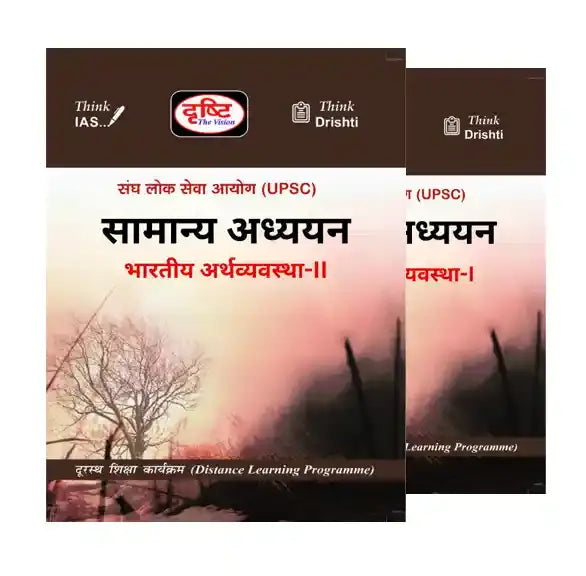
Drishti IAS Indian Economy Notes 2025-26 — 8 Hindi Medium Printed Booklets for UPSC GS Paper III
Related: Drishti IAS notes · Economy notes
Product Overview
| Feature | Details |
|---|---|
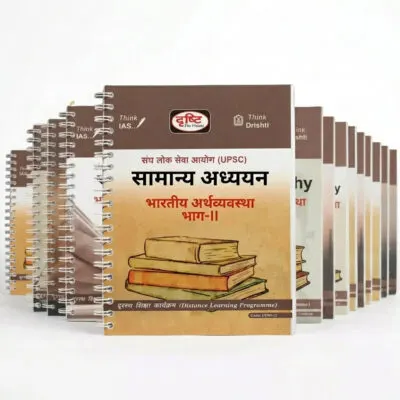
| Booklets Count | 8 Individual Printed Booklets — भारतीय अर्थव्यवस्था I और II का सम्पूर्ण कवरेज |
| Language | Hindi Medium (हिंदी माध्यम) |
| Publisher | Drishti IAS (Think IAS, Think Drishti — Distance Learning Programme) |
| Edition | 2025-26 — Latest Genuine Batch |
| Condition | Brand New, Unmarked, Fresh Stock |
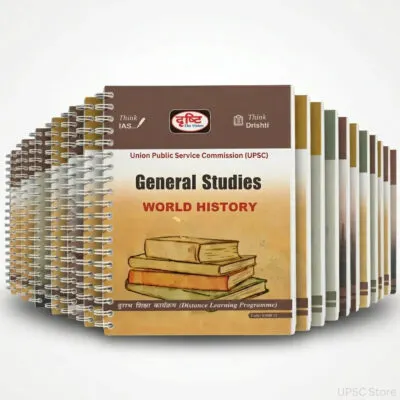
| Format | High-Quality Printed Booklets — Spiral or Book Binding |
| Paper Quality | 75 GSM Ultra-White — Highlighter Safe, Zero Bleed-Through |
| Shipping | Pan India Delivery in 4-7 business days — Tracked |
| Also Useful For | BPSC, UPPSC, MPPSC, RAS and all State PSC examinations |
Complete Booklet Catalog
These 8 Hindi medium printed booklets from Drishti IAS cover the entire UPSC GS Paper III Indian Economy syllabus — from foundational concepts of national income and planning to advanced topics like monetary policy, infrastructure, agriculture, and inclusive growth. Designed for Hindi medium UPSC aspirants who want naturally written, easy-to-absorb content that is not a mere translation from English sources but original Hindi writing aligned with the संघ लोक सेवा आयोग exam framework.
- Booklet 1: भारतीय अर्थव्यवस्था — परिचय एवं राष्ट्रीय आय (Introduction and National Income) — Nature and scope of Indian economy, basic concepts of national income, GDP, GNP, NNP, GVA, base year revision, methods of national income calculation, limitations, CSO and MOSPI data systems, economic survey overview, and India’s growth trajectory in post-reform era.
- Booklet 2: नियोजन एवं आर्थिक सुधार (Planning and Economic Reforms) — History of five-year plans, NITI Aayog structure and mandate versus Planning Commission, major economic reforms of 1991, LPG reforms, disinvestment policy, role of public sector enterprises, privatisation debates, and ongoing structural reform initiatives under current government policies.
- Booklet 3: मुद्रा, बैंकिंग एवं वित्तीय बाज़ार (Money, Banking and Financial Markets) — Functions of money, monetary policy instruments, RBI structure and functions, commercial banking, NPA crisis and resolution mechanisms, SARFAESI Act, IBC 2016, financial markets — capital market, money market, SEBI regulation, mutual funds, insurance sector, and fintech ecosystem.
- Booklet 4: राजकोषीय नीति एवं बजट (Fiscal Policy and Budget) — Components of Union Budget, revenue and capital account, fiscal deficit, revenue deficit, primary deficit, FRBM Act targets, public debt management, GST architecture and revenue sharing, direct and indirect taxes, tax-to-GDP ratio, black money and benami transactions legislation.
- Booklet 5: कृषि एवं ग्रामीण विकास (Agriculture and Rural Development) — Green Revolution legacy, second Green Revolution, crop production trends, MSP mechanism and debates, PM-KISAN, PM Fasal Bima Yojana, irrigation infrastructure, PMKSY, agricultural credit through NABARD, rural employment — MGNREGS analysis, land reforms, contract farming, and FPOs.
- Booklet 6: उद्योग, व्यापार एवं अवसंरचना (Industry, Trade and Infrastructure) — Industrial policy evolution, Make in India, PLI scheme sector analysis, MSME sector significance, special economic zones, India’s foreign trade policy, WTO disputes, balance of payments, current account deficit, FDI and FPI flows, infrastructure — roads, railways, ports, energy sector and investment models.
- Booklet 7: समावेशी विकास एवं सामाजिक क्षेत्र (Inclusive Growth and Social Sector) — Poverty measurement — Tendulkar, Rangarajan and Multidimensional Poverty Index, inequality indices, human development index, major flagship schemes — PM Awas Yojana, Swachh Bharat, Jal Jeevan Mission, health sector — Ayushman Bharat, education — NEP 2020 economic implications, skill development mission.
- Booklet 8: पर्यावरण, विज्ञान एवं प्रौद्योगिकी तथा वर्तमान आर्थिक घटनाक्रम (Environment-Economy Interface and Current Economic Affairs) — Green economy concepts, carbon markets, climate finance, renewable energy economics, digital economy — UPI, ONDC, e-commerce regulation, cryptocurrency and CBDC debates, gig economy, startup ecosystem, recent economic survey highlights, and current affairs integration for UPSC Mains 2026.
In-Depth Content Breakdown: Booklet by Booklet
Booklet 1: भारतीय अर्थव्यवस्था — परिचय एवं राष्ट्रीय आय
This opening booklet establishes the conceptual foundation every UPSC aspirant needs before tackling advanced economy topics for GS Paper III. It covers the nature of India’s mixed economy, the evolution from a command-oriented to a market-driven structure, and the critical national income accounting framework used by MOSPI. GDP at constant and current prices, the difference between GDP and GNP, NNP at market price and factor cost, and the GVA approach are all explained with clarity in naturally written Hindi — not translated jargon. The base year revision from 2004-05 to 2011-12 is analysed with its implications for India’s growth data.
The booklet uses structured comparison tables to show how India’s GDP growth stacks against BRICS peers, making data retention easier during revision. Flowcharts explaining the three methods of national income calculation — output, income, and expenditure — are printed with high clarity, allowing aspirants to draw them in UPSC Mains answer sheets. The role of Economic Survey as a pre-Budget document, CSO’s methodology, and how to interpret government data critically are covered in a dedicated sub-section. This content is equally useful for BPSC, UPPSC, and RAS prelims questions on basic economy concepts.
Booklet 2: नियोजन एवं आर्थिक सुधार
UPSC GS Paper III consistently tests the shift from centralised planning to indicative planning and the role of NITI Aayog. This booklet traces India’s planning journey from the First Five-Year Plan (1951) through the Twelfth Plan, highlighting key achievements, failures, and debates around each. The contrast between NITI Aayog’s advisory mandate and the erstwhile Planning Commission’s allocative power is explained through a side-by-side comparison that is ideal for UPSC Mains answer writing. The 1991 LPG reform — liberalisation, privatisation, globalisation — is treated with sufficient depth to answer both prelims MCQs and mains analytical questions.
The disinvestment policy section covers strategic disinvestment, minority stake sale, and the Air India privatisation case study as a contemporary example. Public sector enterprise classification, Navratna and Maharatna status criteria, and the rationale for privatisation debates in India are structured in bullet-point summaries that facilitate quick revision. The booklet also contains a timeline of major economic reforms from 1991 to 2025 — a unique feature that allows aspirants preparing for UPSC 2026 to see policy evolution at a glance. Hindi medium aspirants preparing for MPPSC and UPPSC will find this planning coverage directly mapped to state PSC syllabi as well.
Booklet 3: मुद्रा, बैंकिंग एवं वित्तीय बाज़ार
Monetary policy and the banking system form a high-weightage zone in both UPSC Prelims and GS Paper III Mains, and this booklet delivers the full spectrum. Starting from the basic functions of money — medium of exchange, store of value, standard of deferred payment — it builds up to the RBI’s monetary policy committee framework, repo rate, reverse repo rate, CRR, SLR, and open market operations. The transmission mechanism of monetary policy is explained with a cause-effect diagram showing how a rate cut moves through commercial banks to borrowers and ultimately influences GDP growth and inflation. This is exactly the kind of analytical content that scores marks in UPSC Mains.
The NPA crisis section provides a timeline of the bad loans problem, the role of the Asset Reconstruction Companies under SARFAESI Act, and how the Insolvency and Bankruptcy Code 2016 changed the resolution landscape. SEBI’s role in capital markets, the difference between primary and secondary markets, IPO processes, and the regulatory framework for mutual funds are covered with sufficient detail for UPSC. The fintech section includes payments banks, UPI architecture, and the regulatory sandbox — content that is current and increasingly tested. The booklet is structured so that aspirants can buy this as a standalone reference for the banking and finance portion of GS Paper III.
Booklet 4: राजकोषीय नीति एवं बजट
The Union Budget and fiscal management are recurring themes in UPSC GS Paper III, and this booklet demystifies the budget document for Hindi medium aspirants who find financial terminology intimidating. The booklet explains revenue receipts versus capital receipts, revenue expenditure versus capital expenditure, and why capital expenditure matters more for growth. Fiscal deficit, revenue deficit, effective revenue deficit, and primary deficit are defined with numerical examples drawn from recent Union Budgets, making abstract concepts tangible. The FRBM Act targets, their amendment history, and the COVID-19 era escape clause are covered with the policy context UPSC examiners expect.
The GST chapter within this booklet is particularly strong — covering the dual GST structure, CGST, SGST, IGST, the GST Council’s constitutional basis, compensation cess debates with states, and India’s GST revenue trajectory since 2017. Direct tax reforms including the new income tax regime, corporate tax reduction of 2019, and indirect tax rationalisation are covered alongside. Black money legislation — the Black Money Act 2015, Benami Transactions (Prohibition) Amendment Act 2016, and the PM Garib Kalyan Yojana amnesty scheme — are included as standalone subsections. This is UPSC-standard content that Hindi medium aspirants from BPSC and MPPSC backgrounds will find directly applicable.
Booklet 5: कृषि एवं ग्रामीण विकास
Agriculture occupies a dedicated and significant portion of the UPSC GS Paper III syllabus, and Drishti IAS has given it the space it deserves in this booklet. The Green Revolution’s legacy — from wheat and rice production gains to groundwater depletion and regional inequality — is analysed critically, preparing aspirants for UPSC Mains questions that demand balanced evaluation. The second Green Revolution concept, including focus on eastern India, pulses, and oilseeds, is explained with policy linkages to the National Food Security Mission. MSP mechanism — how it is calculated, which crops are covered, why it remains controversial — is treated with multiple perspectives as UPSC demands.
Government schemes coverage in this booklet is among the most current available for UPSC 2025-26 preparation. PM-KISAN direct benefit transfer, PM Fasal Bima Yojana claims data, and the Pradhan Mantri Krishi Sinchai Yojana’s watershed development component are all covered. MGNREGS is analysed as both a rural safety net and a demand-side agricultural labour market intervention. Agricultural credit flow through NABARD, Kisan Credit Card expansion, and the FPO formation push are covered in a dedicated credit section. Land reform history — zamindari abolition, tenancy reforms, land ceiling acts — provides the historical backdrop that UPSC often tests in its analytical questions.
Booklet 6: उद्योग, व्यापार एवं अवसंरचना
Industry and trade topics in UPSC GS Paper III require aspirants to understand both domestic industrial policy and India’s external economic engagement. This booklet traces India’s industrial policy evolution from the Industrial Policy Resolution 1956 to the current Make in India and Atmanirbhar Bharat frameworks. The Production Linked Incentive scheme is analysed sector by sector — electronics, pharmaceuticals, textiles, automobiles, food processing — with data on investment commitments and job creation targets. MSMEs receive a dedicated section covering their contribution to GDP and exports, credit access challenges, and the MSME definition revision of 2020.
India’s foreign trade policy — the current Foreign Trade Policy 2023 framework, export promotion through Merchandise Exports from India Scheme successors, and WTO dispute resolution involving India — is covered with enough depth for UPSC Mains analytical answers. Balance of payments accounting, current account deficit drivers, and capital account management are explained with India’s recent data trends. FDI policy liberalisation across sectors, the automatic route versus approval route framework, and the FPI regulation under SEBI are structured clearly. Infrastructure coverage spans roads under Bharatmala, railways capacity expansion, Sagarmala port-led development, and the energy transition — solar capacity targets and the green hydrogen mission.
Booklet 7: समावेशी विकास एवं सामाजिक क्षेत्र
Inclusive growth and poverty alleviation are central themes of UPSC GS Paper III and are frequently tested in both Prelims and Mains. This booklet opens with a rigorous comparison of poverty measurement methodologies — the Tendulkar Committee’s calorie-based approach, Rangarajan Committee’s revised estimates, and the NITI Aayog’s Multidimensional Poverty Index that tracks 12 indicators across health, education, and living standards. India’s MPI progress — reducing multidimensional poverty from 24.8% to 11.3% between 2015-16 and 2022-23 — is covered with data context that enables aspirants to write evidence-based UPSC Mains answers. The Gini coefficient and inequality debate complement the poverty analysis.
The flagship schemes section is thorough and current — PM Awas Yojana urban and rural housing targets and achievements, Swachh Bharat Mission Phase II outcomes, Jal Jeevan Mission’s Har Ghar Jal progress, and Ayushman Bharat PM-JAY coverage data are all included. Education economics under NEP 2020 — the foundational literacy mission, higher education financing, and the skill development ecosystem under PM Kaushal Vikas Yojana — are explained with their employment market implications. The human development index ranking context — where India stands versus comparable economies — gives aspirants the comparative perspective that UPSC analytical questions frequently demand. State PSC aspirants for BPSC, UPPSC, MPPSC, and RAS will find this section maps directly to state welfare scheme questions.
Booklet 8: पर्यावरण, विज्ञान एवं प्रौद्योगिकी तथा वर्तमान आर्थिक घटनाक्रम
The final booklet is where Drishti IAS Indian Economy notes truly differentiate themselves for UPSC 2026 preparation — it integrates the environment-economy interface and current economic affairs that are increasingly tested in both Prelims and Mains. Green economy concepts — circular economy, carbon credits, carbon border adjustment mechanism, and climate finance flows to developing nations — are explained with India’s negotiating position at COP summits as context. The renewable energy economics section covers solar and wind capacity economics, the Production Linked Incentive for solar modules, and the Green Hydrogen Mission’s funding structure and target milestones.
The digital economy chapter is among the most contemporary in any printed UPSC notes available to buy in Hindi medium — UPI transaction growth data, ONDC’s open network architecture, e-commerce regulation debates, and India’s data localisation policy are covered with regulatory context. Cryptocurrency regulation and the Reserve Bank of India’s CBDC pilot — the Digital Rupee — are explained with balanced perspectives that reflect UPSC’s approach to contested policy topics. The gig economy section covers platform workers, social security gaps, and the Code on Social Security 2020 provisions. The booklet closes with an economic survey and budget highlights section designed to bridge printed notes with current affairs for UPSC Mains 2026 answer writing.
Physical Construction and Quality Standards
Every booklet in this Drishti IAS Indian Economy 2025-26 set is manufactured to withstand the rigorous daily use of a serious UPSC aspirant — from morning study sessions through late-night revision cycles spanning months of preparation leading up to the Civil Services examination.
Paper Quality: 75 GSM Anti-Glare White Paper
The 75 GSM ultra-white paper used across all 2 Booklets is selected specifically for UPSC aspirant study habits. The high opacity rating ensures that text on the reverse side does not bleed through, which is critical when you are annotating with multiple highlighter colours for subject-wise colour-coding. The anti-glare finish significantly reduces eye strain during extended study sessions of four to six hours — a common daily requirement for serious UPSC preparation. Gel pens, ballpoint pens, and fluorescent highlighters in yellow, green, pink, and orange all perform cleanly on this paper without smearing or bleed-through to the other side.
Printing Technology: High-Resolution Laser Printing
All content in these Drishti IAS Hindi medium economy booklets is printed using high-resolution laser printing technology, which delivers sharp, crisp text even at smaller font sizes used for tables, footnotes, and data boxes. Flowcharts showing monetary policy transmission, budget accounting structures, and trade balance mechanisms are printed with line clarity that makes them easy to reproduce in UPSC Mains answer sheets. The laser toner is permanent and smudge-proof — pages will not streak if your hands are damp during long study sessions. Diagrams, maps showing industrial corridors, and comparative data tables retain full clarity throughout the booklet’s life.
Binding and Durability
Each booklet in the 2-booklet Drishti IAS Indian Economy set comes in either spiral binding or book binding depending on the batch. Spiral-bound booklets open completely flat on your study table — essential when you are writing notes alongside the printed text or referencing the booklet while writing practice answers. The 300 GSM laminated cover provides protection against moisture, coffee spills, and the general wear of being carried in bags between library sessions and home study. Book-bound editions are more compact for storage and can be stacked neatly on a shelf. Both formats are designed to survive the full 12 to 18 months of a UPSC preparation cycle without pages loosening or covers bending.
Key Features and Study Design
Drishti IAS Indian Economy Hindi medium notes are designed from the ground up for aspirants who think, plan, and write answers in Hindi — every structural and content decision in these 2 Booklets reflects that commitment to authentic Hindi medium UPSC preparation.
- Original Hindi Writing — Not Translation: Unlike many coaching materials that translate English content into Hindi, Drishti IAS content is originally written in Hindi. This means sentence construction, examples, and explanations are natural and intuitive, reducing the cognitive load for Hindi medium UPSC aspirants who have struggled with translated jargon in other notes.
- UPSC Syllabus Mapping: Each booklet’s table of contents is mapped against the official UPSC GS Paper III syllabus topic by topic. Aspirants can identify exactly which booklet covers which syllabus point — saving revision time and ensuring no topic is missed during UPSC Mains preparation for the 2026 examination cycle.
- Prelims and Mains Integration: Content is structured to serve both UPSC Prelims MCQ preparation and Mains answer writing. Key facts, definitions, and data points are boxed for Prelims retention, while analytical paragraphs with multiple perspectives are structured for Mains 150-word and 250-word answers on economy topics.
- Current Affairs Integration: The 2025-26 edition includes updated data from the latest Economic Survey, Union Budget, and policy announcements through mid-2025, making it relevant for UPSC 2026 Mains. Recent scheme updates, GST council decisions, and RBI policy shifts are incorporated into the relevant booklets rather than appended as afterthoughts.
- Answer Writing Framework: Each major topic includes a suggested answer structure — introduction approach, body paragraph organisation with policy-theory-data sequence, and conclusion with way-forward points. This answer writing guidance embedded within the content is a distinct Drishti IAS feature that directly supports UPSC Mains scoring for Hindi medium aspirants.
Shipping, Packaging and Delivery
Every order of Drishti IAS Indian Economy Notes 2025-26 is packed with care to ensure all 2 Booklets arrive in perfect, brand-new condition. Each set is first sealed in a shrink-wrap film that keeps all booklets together and protects them from moisture during transit. The shrink-wrapped set is then placed in a double-walled corrugated cardboard box chosen for its crush resistance. Reinforced edge protectors are added at all four corners of the box to prevent corner damage if the package is stacked or dropped during courier handling. A waterproof outer label with your delivery address and a unique tracking ID is affixed before dispatch.
All orders are dispatched within 24 hours of payment confirmation and are delivered across pan India within 4-7 business days via trusted courier partners with full tracking. You will receive your tracking ID via WhatsApp and email immediately after dispatch. For any queries, damaged booklets on arrival, or missing booklets, contact us directly on WhatsApp at +91 70045 49563 — any missing or damaged booklet is replaced within 48 hours of your complaint without any additional charge. We ship to all pin codes across India including Tier 2 and Tier 3 cities where UPSC aspirants preparing for Hindi medium examinations are based.
Frequently Asked Questions (FAQ)
A: These 2 Booklets cover the complete UPSC GS Paper III Indian Economy syllabus with depth appropriate for Mains answer writing. For most Hindi medium aspirants, Drishti IAS economy notes combined with regular current affairs reading from Economic Survey and Budget documents are sufficient for UPSC Mains 2026. You may supplement with Ramesh Singh’s Indian Economy book for additional numerical data, but the notes form a strong standalone foundation for the economy section of GS Paper III.
A: This set contains exactly 8 printed booklets covering the complete Indian Economy syllabus for UPSC GS Paper III. The 2 Booklets cover national income and introduction, planning and reforms, money and banking, fiscal policy and budget, agriculture and rural development, industry and trade, inclusive growth, and current economic affairs including digital economy and environment-economy interface. All 2 Booklets are included in a single purchase and shipped together in one package.
A: Yes — this listing is specifically for the Hindi medium edition of Drishti IAS Indian Economy Notes 2025-26. The content is originally written in Hindi as part of Drishti IAS’s Distance Learning Programme (Think IAS, Think Drishti series), which is purpose-built for Hindi medium UPSC aspirants. The Hindi used is natural and academic in register — not a mechanical translation — making it significantly more readable than many competing Hindi medium economy materials currently available to buy online.
A: The 2 Booklets collectively cover national income accounting, economic planning and NITI Aayog, monetary policy and banking system including NPA and IBC, fiscal policy and GST, agriculture and rural development schemes, industrial policy and foreign trade, poverty and inclusive growth with welfare schemes, and the digital economy and environment-economy interface. This maps to the complete UPSC GS Paper III economy syllabus and also covers relevant portions of UPSC Prelims economy questions that appear annually in the Civil Services Preliminary Examination.
A: Yes — the 2025-26 edition is the latest genuine batch available. Content has been updated to include recent Economic Survey data, Union Budget 2025 highlights, RBI monetary policy decisions, new government scheme launches, GST Council decisions, and current affairs developments relevant for UPSC Mains 2026. The digital economy and environment sections in Booklet 8 specifically incorporate developments through mid-2025. Always check the edition year on the cover when you buy printed UPSC notes online to ensure you have the latest batch.
A: Both are respected sources for UPSC economy preparation. Drishti IAS holds a distinct advantage for Hindi medium aspirants because its content is originally written in Hindi, making it more fluent and easier to absorb than Vision IAS Hindi notes which are largely translated from the English edition. Drishti IAS also integrates answer writing frameworks within the content — a feature Hindi medium aspirants find directly useful for UPSC Mains. Vision IAS notes are strong for English medium aspirants. For Hindi medium UPSC preparation, Drishti IAS economy notes are generally the preferred buy among serious aspirants.
A: Yes — these notes are structured to serve both UPSC Prelims and Mains preparation. Key facts, definitions, committee names, scheme details, and quantitative data are highlighted and boxed throughout the booklets for Prelims-style retention and MCQ preparation. Analytical sections with multi-perspective discussions, policy evaluation paragraphs, and suggested answer structures serve UPSC Mains GS Paper III answer writing. Many aspirants use these booklets as their primary economy resource for both stages of the UPSC Civil Services Examination, supplementing only with current affairs updates closer to the examination date.
A: These booklets use 75 GSM ultra-white paper chosen for high opacity — multiple highlighter colors and gel pens work without bleed-through to the reverse side, ideal for color-coded revision.
A: The current price for the complete 2-booklet set of Drishti IAS Indian Economy Hindi Medium Notes 2025-26 is displayed on this product page and includes all 2 Booklets shipped together with full tracking. Pricing reflects the genuine printed batch cost and delivery charges are included for pan India shipping. No separate shipping fee is charged. For bulk orders — for coaching institutes, study groups, or multiple aspirants ordering together — contact us on WhatsApp at +91 70045 49563 for applicable bulk pricing on this Drishti IAS economy notes set.
A: Immediately after your order is dispatched — within 24 hours of payment confirmation — you will receive your courier tracking ID via WhatsApp message on the mobile number provided at checkout. You can track your package in real time on the courier partner’s website. Typical pan India delivery time is 4-7 business days. If your tracking shows no movement for more than 48 hours or your package has not arrived within 6 business days, contact us on WhatsApp at +91 70045 49563 and we will resolve the issue immediately.
A: Yes — these 8 Hindi medium booklets are highly relevant for state PSC examinations that test Indian economy in their general studies papers. BPSC (Bihar), UPPSC (Uttar Pradesh), MPPSC (Madhya Pradesh), and RAS (Rajasthan) all have substantial Indian economy components in their prelims and mains syllabi that align closely with the UPSC GS Paper III content covered here. Hindi medium aspirants preparing for these state PSC examinations alongside UPSC will find significant syllabus overlap, making this a cost-effective buy that serves multiple examination targets simultaneously.
A: If any of the 2 Booklets are missing from your package or arrive damaged due to transit handling, contact us immediately on WhatsApp at +91 70045 49563 with a photo of the package and its contents. We will dispatch the replacement booklet within 48 hours of receiving your complaint at no additional charge. All our shipments are packed in double-walled corrugated boxes with edge protectors and shrink-wrapped to minimise damage risk, but if anything goes wrong during transit, we make it right quickly without any inconvenience to you.
Summary
| Specification | Value |
|---|---|
| Booklets | 8 Printed Booklets |
| Language | Hindi Medium (हिंदी माध्यम) |
| Paper | 75 GSM Ultra-White |
| Binding | Spiral or Book Binding |
| Delivery | 4-7 business days Pan India |
| Also Useful For | BPSC, UPPSC, MPPSC, RAS and all State PSC examinations |
Available at our store in Mukherjee Nagar, Delhi — the heart of India’s UPSC preparation ecosystem. Buy Drishti IAS Indian Economy Notes 2025-26 online and receive your complete 2-booklet Hindi medium set anywhere in India with pan India delivery in 4-7 days.
Reference: Civil Services Examination
Customer Reviews 207
Economy samajhne mein bohot madad mili, bilkul sahi investment.
All 8 booklets are comprehensive and well-organized for last-minute prep.
Kuch topics cover nahi hain jo UPSC mein puchche ja sakte hain. Phir bhi basic clearing ke liye theek hai.
Sache mein ye notes padhke economy section mein confidence aa gaya.
Content informative hai aur presentation bhi achchi hai. Kuch diagrams aur examples add hote to aur badhiya hota.
Organized booklets hain aur content bhi relevant hai current curriculum ke liye.
These notes are gold for UPSC aspirants, completely worth the investment.
8 booklets mein sab important topics cover ho gaye hain. Hindi explanation bhi clear hai.
Aspirants Also Bought
More from the same category
About Drishti IAS Indian Economy Notes 2025-26
Drishti IAS Indian Economy Notes 2025-26 is a highly recommended UPSC study material from Drishti IAS, specially designed for Indian Economy preparation. Available in Hindi medium, this material is crafted to match the exact requirements of the UPSC Civil Services Examination syllabus — covering both Prelims and Mains comprehensively.
Product Details
- Institute: Drishti IAS
- Subject: Indian Economy
- Medium: Hindi
- Format: Printed
- Delivery: Pan-India delivery in 4–7 working days
- Format: Original printed material, verified authentic
Why Buy from UPSC Store?
- ✅ 100% Genuine Printed Material — Original printed notes, no photocopies or fake copies
- ✅ Fast Delivery — Ships within 24 hours, arrives in 4–7 days pan-India
- ✅ Secure Packaging — Bubble-wrapped and boxed to prevent damage in transit
- ✅ Trusted by 10,000+ Aspirants — India's most reliable UPSC material marketplace
- ✅ WhatsApp Support — Get expert guidance on material selection before ordering
Frequently Asked Questions
Yes, all products at UPSC Store are 100% genuine printed materials. We do not sell photocopies or fake copies.
Orders are dispatched within 24 hours and delivered across India in 4–7 working days via reputed courier partners.
Yes, we accept returns within 7 days if the product is damaged or incorrect. Check our refund policy for details.
We recommend pairing this with current affairs notes and a UPSC test series for comprehensive preparation. Browse more in Drishti IAS, Economy, General Studies, UPSC.