


Sanskriti IAS Geography Optional Notes 2025-26
About Sanskriti IAS Geography Optional Hindi
The Sanskriti IAS Geography Optional Hindi is a printed UPSC study material set sold by UPSC Store — India’s trusted source for genuine, latest-batch civil services preparation books. This page covers full booklet details, syllabus coverage, pricing, shipping, and frequently asked questions. Useful for UPSC CSE, BPSC, UPPSC, MPPSC, RAS and other state PSC examinations.
Sanskriti IAS Geography Optional Notes 2025-26 — 7 Hindi Medium Printed Booklets for UPSC Mains Geography Optional
Related: Sanskriti IAS notes · Geography Optional Hindi books
Product Overview
| Feature | Details |
|---|---|
| Booklets Count | 10 Individual Printed Booklets — Full UPSC Geography Optional Syllabus Coverage |
| Language | Hindi Medium (हिंदी माध्यम) |
| Publisher | Sanskriti IAS (Geography Optional Series) |
| Edition | 2025-26 — Latest Genuine Batch |
| Condition | Brand New, Unmarked, Fresh Stock |
| Format | High-Quality Printed Booklets — Spiral or Book Binding |
| Paper Quality | 75 GSM Ultra-White — Highlighter Safe, Zero Bleed-Through |
| Shipping | Pan India Delivery in 3-5 Business Days — Tracked |
| Also Useful For | UPPSC, BPSC, MPPSC, RAS and all State PSC Geography Optional aspirants |
Complete Booklet Catalog
This 10-booklet set by Sanskriti IAS covers the entire UPSC Geography Optional syllabus in Hindi medium, structured across both Paper I (Physical Geography) and Paper II (Human and Economic Geography of India and the World). Designed for Hindi-medium UPSC aspirants targeting 500 marks in the optional segment, every booklet follows the official UPSC syllabus sequentially so you never miss a topic.
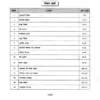
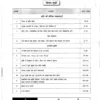
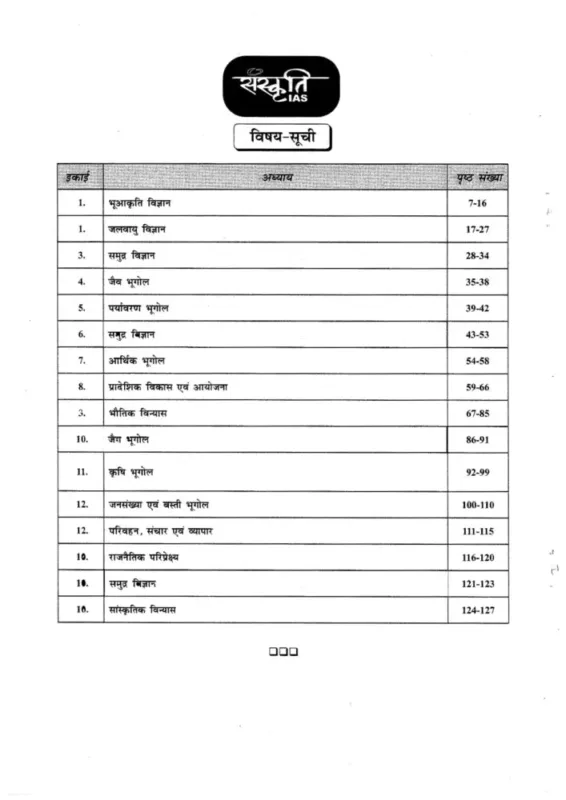
- Booklet 1: भौतिक भूगोल — पृथ्वी की उत्पत्ति एवं संरचना (Physical Geography — Origin and Structure of Earth) — Nebular hypothesis, Big Bang theory, internal structure of Earth, earthquake waves, isostasy, plate tectonics, continental drift, seafloor spreading, geosynclines, mountain building (orogenesis), volcanic activity, rock types and their formation cycles, and geomorphic processes.
- Booklet 2: भू-आकृति विज्ञान एवं जलवायु विज्ञान (Geomorphology and Climatology) — Weathering and mass wasting, fluvial, aeolian, glacial and coastal landforms, karst topography, atmospheric composition and structure, insolation and heat budget, pressure belts and wind systems, monsoon dynamics, climate classification (Köppen and Thornthwaite), cyclones and jet streams.
- Booklet 3: जल विज्ञान एवं समुद्र विज्ञान (Hydrology and Oceanography) — Hydrological cycle, river systems, groundwater, ocean floor relief, ocean temperature and salinity, ocean currents, tides, coral reefs, marine resources, El Niño and La Niña phenomena, tsunami and storm surges.
- Booklet 4: जैव भूगोल एवं पर्यावरण भूगोल (Biogeography and Environmental Geography) — Genesis and classification of soils, world soil distribution, biomes and vegetation zones, ecosystem structure and energy flow, biodiversity hotspots, environmental degradation, desertification, pollution types, conservation strategies, and sustainable development goals.
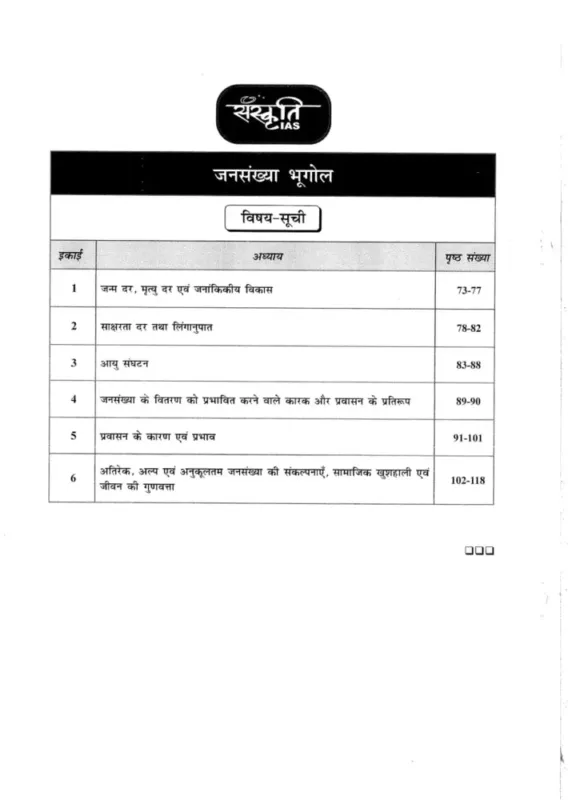
- Booklet 5: मानव भूगोल एवं जनसंख्या भूगोल (Human Geography and Population Geography) — Evolution of human geography, determinism vs. possibilism, population growth theories (Malthus, Demographic Transition), world population distribution and density, migration theories, urbanisation trends, rural settlements, human development index, cultural landscape.
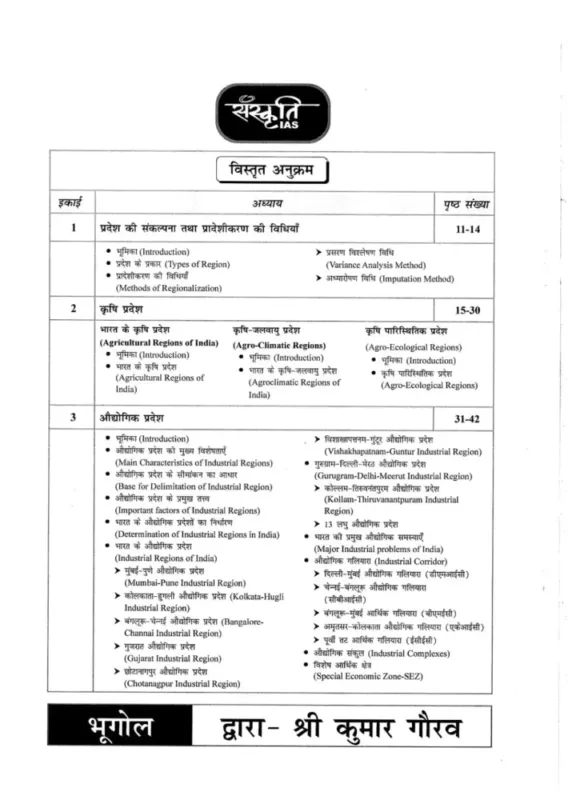
- Booklet 6: आर्थिक भूगोल — कृषि, उद्योग एवं व्यापार (Economic Geography — Agriculture, Industry and Trade) — Agricultural systems and land use, Green Revolution, world agricultural regions, industrial location theories (Weber, Losch, Perroux), industrial regions of the world, world trade patterns, economic blocs, globalisation and its geographic impacts, energy resources.
- Booklet 7: भारत का भूगोल — भौतिक, सामाजिक एवं आर्थिक (Geography of India — Physical, Social and Economic) — Physiographic divisions of India, drainage systems, Indian monsoon, soils and natural vegetation, population geography of India, agricultural geography, mineral and energy resources, industries, transport and communication networks, regional development and planning, international boundary issues.
In-Depth Content Breakdown: Booklet by Booklet
Booklet 1: भौतिक भूगोल — पृथ्वी की उत्पत्ति एवं संरचना (Physical Geography — Origin and Structure of Earth)
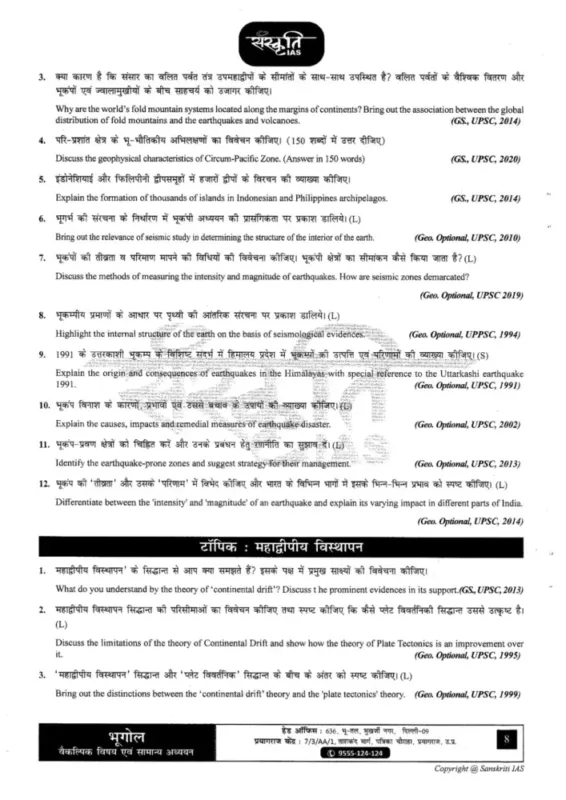
Booklet 1 forms the backbone of UPSC Geography Optional Paper I. It opens with cosmological theories — the Nebular Hypothesis, Big Bang, and planetesimal theories — before moving into Earth’s internal structure through seismic evidence. Plate tectonics, continental drift (Wegener’s hypothesis), seafloor spreading, and the Wilson Cycle are explained with clear diagrams. This booklet is critical because UPSC Paper I questions on geomorphology, earthquake zones, and mountain-building processes all trace back to these fundamental concepts, and aspirants who master this booklet build a strong base for scoring high in answer writing.
The booklet is structured with concept summaries followed by UPSC-style answer frameworks, making it unique for Hindi-medium students who struggle to find technical geography content in quality Hindi. Rock cycle diagrams, cross-sections of Earth’s layers, and comparison tables between different orogenic episodes are included. Isostasy (Airy and Pratt hypotheses) is explained with original Hindi terminology alongside standard English terms so aspirants can write bilingual answers with confidence. The booklet closes with a revision checklist mapped to previous years’ UPSC Geography Optional questions from this topic area.
Booklet 2: भू-आकृति विज्ञान एवं जलवायु विज्ञान (Geomorphology and Climatology)
Geomorphology is consistently one of the highest-scoring units in UPSC Geography Optional Paper I, and Booklet 2 addresses it with detailed coverage of landform development across every major agent — rivers (fluvial geomorphology), glaciers, wind, groundwater (karst), and coastal processes. Each landform type is explained with genesis, characteristics, and global examples. The climatology section covers atmospheric dynamics in depth: insolation, heat budget, pressure-wind systems, global circulation models, jet streams, and monsoon theories including the role of the Inter-Tropical Convergence Zone (ITCZ) — all written in accessible Hindi.
What distinguishes this booklet is the integration of map-based content with the text. Climatic zone distribution maps, pressure belt diagrams, and cross-section illustrations of glacial landforms appear alongside Hindi explanations — a combination rarely found in printed Hindi-medium optional notes. Köppen’s climate classification and Thornthwaite’s model are compared in a clear table format. Tropical and extra-tropical cyclone formation is covered with special attention to the Bay of Bengal cyclone patterns, which are frequently asked in UPSC Mains. The booklet also provides standard answer templates for 15-mark and 20-mark UPSC questions on climatology topics.
Booklet 3: जल विज्ञान एवं समुद्र विज्ञान (Hydrology and Oceanography)
Booklet 3 covers the hydrological cycle, groundwater movement, and river basin hydrology before transitioning into the vast domain of oceanography — a section that UPSC has been testing with increasing regularity in recent years. Ocean floor relief features (mid-oceanic ridges, trenches, abyssal plains, seamounts, guyots) are mapped and described in detail. Ocean temperature distribution (surface and vertical), salinity variation, and their combined effect on thermohaline circulation are explained with clear cause-and-effect reasoning. El Niño, La Niña, and the Indian Ocean Dipole are covered with their linkages to Indian monsoon variability.
The oceanography content in this booklet is particularly valuable for Hindi-medium aspirants because quality Hindi-language resources on ocean currents, tidal dynamics, and coral reef ecosystems are scarce in the market. Sanskriti IAS has structured this booklet so that each ocean current system — the Gulf Stream, Kuroshio, Humboldt, and others — is presented with a labelled map and a Hindi-language explanation of its climatic impact. Coral reef types (fringing, barrier, atoll) are explained with Darwin’s subsidence theory. The booklet concludes with tsunami formation mechanics and storm surge dynamics — topics directly relevant to disaster management and frequently asked in UPSC Geography Optional Paper I.
Booklet 4: जैव भूगोल एवं पर्यावरण भूगोल (Biogeography and Environmental Geography)
Booklet 4 covers biogeography and environmental geography — two areas that connect Geography Optional directly to GS Paper III (Environment) and GS Paper I content, giving aspirants an integrated advantage. Soil genesis, soil profile, and soil classification systems (USDA and Indian soil classification) are covered with distribution maps. World biomes — tropical rainforest, savanna, temperate grassland, taiga, tundra, and desert — are explained in terms of climate, vegetation, soil, and fauna relationships. Biodiversity hotspots are listed and mapped, and the concept of ecosystem services is introduced for answer enrichment.
Environmental geography topics — desertification, land degradation, deforestation, ozone depletion, climate change feedback loops, and the carbon cycle — are covered with both scientific accuracy and policy context, the latter being essential for writing high-quality UPSC answers. The booklet integrates UN frameworks such as UNFCCC, CBD, and UNCCD with geographic content, enabling aspirants to link geographical knowledge to current affairs in their optional answers. A dedicated section on sustainable development goals and their geographic dimensions rounds off the booklet. This integration of environment and geography is a key feature of Sanskriti IAS notes that sets them apart from purely descriptive alternatives.
Booklet 5: मानव भूगोल एवं जनसंख्या भूगोल (Human Geography and Population Geography)
Booklet 5 begins UPSC Geography Optional Paper II content with the theoretical foundations of human geography — environmental determinism (Ratzel), possibilism (Vidal de la Blache), stop-and-go determinism, and the behavioral approach. These theoretical frameworks are critically important for UPSC Geography Optional because examiners frequently ask candidates to evaluate geographic thought. Population geography follows: Malthusian theory, demographic transition model, world population distribution and density determinants, age-sex pyramid analysis, dependency ratio, and migration theories (Ravenstein’s laws, Lee’s push-pull model) are all covered in structured Hindi.
Urbanisation is given special treatment in this booklet — urban growth theories, primate city concept, rank-size rule, urban morphology models (Burgess, Hoyt, Harris-Ullman), urban sprawl, counter-urbanisation, and smart cities are explained and mapped to real-world examples from both India and the world. Rural settlement patterns, their classification, and the factors influencing settlement morphology are also included. Human Development Index methodology and regional HDI variations are explained with UNDP data context. The booklet is structured so that every theoretical concept is followed by an illustrative example and a model UPSC answer structure in Hindi.
Booklet 6: आर्थिक भूगोल — कृषि, उद्योग एवं व्यापार (Economic Geography — Agriculture, Industry and Trade)
Booklet 6 covers Economic Geography — one of the most scoring units in UPSC Geography Optional Paper II when prepared well. Agricultural systems are categorised and mapped: subsistence farming, plantation agriculture, Mediterranean agriculture, mixed farming, dairy farming, and market gardening. Von Thünen’s model of agricultural land use is explained with diagrams. World agricultural regions (Whittlesey’s classification) are covered systematically. The Green Revolution, its geographic impacts, and subsequent challenges of soil degradation and water table depletion are discussed with India-specific data, making this directly useful for GS Paper I and III as well.
Industrial location theory — Weber’s least-cost theory, Losch’s market area analysis, Perroux’s growth pole concept, and Myrdal’s cumulative causation — is explained clearly and linked to actual industrial regions globally (Ruhr Valley, Silicon Valley, Pittsburgh, Damodar Valley). World trade patterns, comparative advantage theory, trading blocs (WTO, NAFTA, EU, ASEAN, RCEP), and the geography of globalisation are covered in the latter part of the booklet. Energy geography — conventional and non-conventional sources, their geographic distribution, and geopolitical implications — is also included. This booklet is essential for aspirants aiming to score above 300 in Geography Optional.
Booklet 7: भारत का भूगोल — भौतिक, सामाजिक एवं आर्थिक (Geography of India — Physical, Social and Economic)
Booklet 7 is arguably the most important booklet in the set for UPSC Geography Optional, as India-specific geography questions form a substantial portion of Paper II and overlap with UPSC GS Paper I. The booklet opens with India’s physiographic divisions — the Himalayan Mountains, Northern Plains, Peninsular Plateau, Coastal Plains, and Island groups — covering their formation, characteristics, and strategic significance. Major river systems (Himalayan and Peninsular) are mapped with drainage patterns, flood behaviour, and inter-linking river debates. Indian monsoon mechanism, its onset, withdrawal, spatial variation, and failure years are explained in depth.
The social and economic geography sections cover India’s population geography (Census 2011 data with trend analysis), tribal distribution, linguistic regions, agricultural geography (crop-wise distribution maps, irrigation systems, food security issues), mineral and energy resource distribution, major industrial regions, and transport-communication network development. International boundaries — McMahon Line, Line of Actual Control, Radcliffe Line, and maritime boundaries — are explained with geopolitical context. Regional imbalances and planning regions are covered with reference to NITI Aayog frameworks. This booklet alone justifies buying the full Sanskriti IAS Geography Optional set as a primary study resource for any Hindi-medium UPSC aspirant.
Physical Construction and Quality Standards
Every booklet in this Sanskriti IAS Geography Optional Hindi set is manufactured to standards that support long, intensive study sessions. The physical construction has been chosen specifically for UPSC aspirants who annotate, highlight, and revise repeatedly over a 12–18 month preparation cycle.
Paper Quality: 75 GSM Anti-Glare White Paper
Each booklet uses 75 GSM ultra-white paper with an anti-glare surface finish — essential for geography notes that include maps, diagrams, and dense text in Hindi script. The high opacity (opacity index above 90%) ensures that text and diagrams printed on one side do not shadow through to the reverse, eliminating the bleed-through problem common in cheaper notes. Multiple highlighter colors — yellow, green, pink, and orange — can be applied without damaging legibility on the reverse side. This paper choice significantly reduces eye strain during long study sessions, which is particularly important for aspirants studying 8–10 hours daily in the months before UPSC Mains.
Printing Technology: High-Resolution Laser Printing
All seven booklets are produced using high-resolution laser printing technology, which delivers consistently sharp text in Hindi (Devanagari script) and crisp map outlines — a critical requirement for geography notes where map clarity directly determines how well the content can be absorbed and replicated in the exam hall. Laser toner is heat-fused to paper, making it permanently smudge-proof and water-resistant, unlike inkjet alternatives. Flowcharts, comparison tables, climate diagrams, and relief maps retain precise line definition even when the booklet is handled daily over months of preparation. Hindi text rendering is especially clean, with no pixelation or character blurring even at small font sizes used in data tables.
Binding and Durability
The booklets are available in spiral binding or book binding depending on the batch. Spiral-bound booklets open completely flat — a significant advantage for geography students who need to see full-width maps without the page curving into the spine. Flat-open binding also allows you to write revision notes in the margin alongside printed content without the page folding away. The cover uses 300 GSM art card with a laminated finish that resists daily wear, moisture, and the inevitable rough handling of field study and revision marathons. Book-bound editions are more compact for storage in standard shelves alongside other UPSC optional material.
Key Features and Study Design
These Sanskriti IAS Geography Optional Hindi notes have been designed keeping in mind the specific challenges faced by Hindi-medium UPSC aspirants preparing for an optional subject that demands both conceptual depth and answer-writing precision across 500 marks.
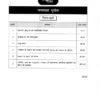
- Full Syllabus Mapping in Hindi: Every topic listed in the official UPSC Geography Optional syllabus (both Paper I and Paper II) is addressed in sequence across the 10 Booklets, enabling aspirants to track coverage with the UPSC-issued syllabus document side by side and verify there are no gaps in their preparation.
- Bilingual Technical Terms: Geography involves extensive technical terminology. Sanskriti IAS presents every key term in both Hindi and English — e.g., “अपरदन चक्र (Cycle of Erosion)” — so aspirants can write answers in Hindi medium while retaining the English term in brackets, a practice that UPSC examiners recognise and reward.
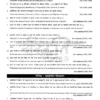
- Map-Integrated Content: Maps, sketch diagrams, cross-sections, and climatic charts are embedded within the text at the point of explanation rather than collected separately. This ensures aspirants develop the habit of linking descriptive content to spatial understanding, which is directly tested in UPSC Geography Optional answers.
- UPSC Answer Framework Templates: Each major topic includes a model answer outline — introduction, body structure, diagram cue, and conclusion — written in Hindi. These frameworks are based on previous years’ UPSC Geography Optional question patterns and help aspirants understand how to structure 10-mark, 15-mark, and 20-mark answers.
- Previous Year Question Integration: Throughout all 10 Booklets, relevant previous year UPSC Geography Optional questions are cited at the end of each major topic with brief suggested answer pointers. This real-time connection between content and actual exam questions is a key feature that makes these notes superior for self-study without classroom access.
Shipping, Packaging and Delivery
All 10 Booklets are individually shrink-wrapped before being packed together as a complete set. The set is then placed inside a rigid corrugated cardboard box with foam edge protectors and void fill to prevent movement during transit. The outer surface of the box is reinforced with strong BOPP tape on all seams. This multi-layer packaging system ensures that covers, spines, and printed pages arrive in brand-new condition regardless of the transit route. Geography booklets with maps and diagrams are particularly vulnerable to corner damage and moisture exposure — our packaging eliminates both risks. Each order is photographed before dispatch as part of our quality verification process.
Orders are dispatched within 24 hours of payment confirmation on business days. Pan India delivery is completed in 3–5 business days via tracked courier services including BlueDart, Delhivery, and DTDC. A tracking ID is shared via WhatsApp and email immediately after dispatch. For any query regarding your order — status update, damaged booklet, or missing item — reach us directly on WhatsApp at +91 70045 49563. Any missing or damaged booklet reported within 48 hours of delivery is replaced at no additional cost. We ship from our Mukherjee Nagar, Delhi warehouse, which means faster delivery to North India locations including UP, Bihar, Rajasthan, MP, and Haryana.
Frequently Asked Questions (FAQ)
A: Yes — Sanskriti IAS Geography Optional notes are written specifically in Hindi medium and are among the most well-structured printed optional notes available for Hindi-language UPSC aspirants. The content uses proper Hindi geographical terminology alongside English terms in brackets, enabling aspirants to write fluent Hindi-medium answers while maintaining technical accuracy. The notes are aligned to the official UPSC Geography Optional syllabus and are widely used by successful Hindi-medium candidates.
A: This set includes 7 printed booklets covering the complete UPSC Geography Optional syllabus across both Paper I and Paper II. Booklets 1 through 4 cover Physical Geography (Earth structure, geomorphology, climatology, hydrology, oceanography, biogeography, and environmental geography), while Booklets 5 through 7 cover Human Geography, Economic Geography, and the complete Geography of India. All 10 Booklets together form a self-sufficient set for UPSC Geography Optional preparation in Hindi medium.
A: Yes — the 10-booklet set is designed to cover every unit of the official UPSC Geography Optional syllabus (Paper I and Paper II) as published by the UPSC. Each booklet is mapped to specific syllabus units, and the topics are sequenced to match the order in which UPSC has arranged its syllabus document. Aspirants are encouraged to cross-check coverage using the official UPSC syllabus PDF alongside these notes to confirm topic-by-topic alignment before beginning their preparation.
A: These booklets use 75 GSM ultra-white paper chosen for high opacity — multiple highlighter colors and gel pens work without bleed-through to the reverse side, ideal for color-coded revision. The anti-glare surface finish also reduces eye strain during extended study sessions. The paper is thick enough to handle multiple rounds of highlighting and margin annotation without the pages becoming fragile or tearing at the edges during daily handling over a long preparation cycle.
A: Yes — this is the 2025-26 edition of Sanskriti IAS Geography Optional Hindi notes, reflecting the latest batch content. The notes incorporate recent data updates, current examples, and any syllabus-relevant developments up to the 2025-26 academic session. When you buy this set from our store, you receive the genuine latest batch — not old or residual stock from previous years. The edition year is printed on each booklet cover for verification.
A: Sanskriti IAS Geography Optional notes cover the full syllabus and are self-sufficient for conceptual preparation. However, for top scores (300+ out of 500), most successful aspirants supplement these notes with atlas work (Oxford School Atlas or Orient Blackswan), selective NCERT readings for foundational clarity, and consistent answer writing practice using previous years’ UPSC Geography Optional question papers. The notes provide the knowledge framework — systematic answer writing practice applied on that base determines the final score.
A: Sanskriti IAS Geography Optional Hindi notes are particularly valued by Hindi-medium aspirants for their accuracy in Hindi terminology, inclusion of maps and diagrams within the text, and alignment with UPSC’s question-asking patterns. Compared to coaching institutes that primarily produce English-medium content, Sanskriti IAS has focused specifically on the Hindi-medium optional market. The 10-booklet structured format makes them easier to manage and revise compared to bulkier single-volume alternatives available from other sources.
A: You can buy Sanskriti IAS Geography Optional Hindi notes 2025-26 directly from our UPSC Store online. We ship pan India with delivery in 3–5 business days. You can also reach us on WhatsApp at +91 70045 49563 to confirm stock availability before placing your order. Buying from our store ensures you receive the genuine 2025-26 batch — brand new, unmarked, and freshly stocked from our Mukherjee Nagar, Delhi warehouse.
A: Yes — these Sanskriti IAS Geography Optional Hindi notes are equally valuable for UPPSC (Uttar Pradesh PSC), BPSC (Bihar PSC), MPPSC (Madhya Pradesh PSC), RAS (Rajasthan PSC), and other State PSC Geography Optional aspirants. Geography Optional syllabi at most State PSCs closely mirror the UPSC syllabus, particularly the India-specific geography content. Hindi-medium aspirants preparing for any of these state-level examinations will find the 10-booklet set directly applicable to their syllabus and exam pattern.
A: Orders are dispatched within 24 hours of payment on business days and delivered pan India within 3–5 business days via tracked courier. The 10 Booklets are individually shrink-wrapped, packed in a rigid corrugated box with edge protectors, and sealed with reinforced tape to prevent any transit damage. A tracking ID is shared immediately after dispatch via WhatsApp and email. If any booklet arrives damaged, report it within 48 hours and we will replace it at no cost.
A: Yes — maps, sketch diagrams, cross-sections, climatic charts, and comparative tables are embedded throughout all 10 Booklets at the point of explanation. Geography Optional is highly visual, and UPSC examiners expect diagrams in answers for geomorphology, climatology, and India geography questions. The laser-printed maps are clear and accurately labelled in Hindi, and aspirants can use them as models for drawing exam-hall sketches. The inclusion of map-based content is one of the strongest practical advantages of this Sanskriti IAS set over text-only notes.
A: Please contact us directly on WhatsApp at +91 70045 49563 to check current payment and cash-on-delivery options available for your pin code. We offer multiple payment methods including UPI, bank transfer, and online payment gateway. Our team at the Mukherjee Nagar, Delhi store is available to assist with any order queries, bulk purchase requests, or guidance on which booklet sets to buy based on your specific UPSC or State PSC preparation stage and timeline.
Summary
| Specification | Value |
|---|---|
| Booklets | 10 Printed Booklets |
| Language | Hindi Medium (हिंदी माध्यम) |
| Paper | 75 GSM Ultra-White |
| Binding | Spiral or Book Binding |
| Edition | 2025-26 Latest Batch |
| Delivery | 3-5 Business Days Pan India |
| Also Useful For | UPPSC, BPSC, MPPSC, RAS and all State PSC Geography Optional aspirants |
Dispatched from our UPSC Store warehouse in Mukherjee Nagar, Delhi — India’s largest UPSC coaching hub. Buy Sanskriti IAS Geography Optional Hindi notes 2025-26 today and receive your complete 10-booklet set with pan India delivery in 3–5 business days.
Reference: UPSC official syllabus
Customer Reviews 256
Geography optional padne walo ke liye yeh notes game changer hote hain, highly recommend.
Sab kuch ek jagah mil gaya, aur kisi aur book ki zaroorat nahi padegi.
Content to bahut helpful hai lekin packaging mein improvement ho sakti thi, ek booklet slightly damaged tha.
Packaging aur presentation dono premium level ke hain.
10 booklets mein sab topics cover ho gaye. Bilkul satisfied hun.
Notes mein se sab relevant topics ho sakte, revision bhi easy hai.
Hindi edition bohot helpful tha, samajhne mein koi dikkat nahi ayi.
Detailed notes with proper structure, bohot helpful for UPSC preparation.
Aspirants Also Bought
More from the same category
About Sanskriti IAS Geography Optional Notes 2025-26
Sanskriti IAS Geography Optional Notes 2025-26 is a highly recommended UPSC study material from Sanskriti IAS, specially designed for Geography Optional preparation. Available in Hindi medium, this material is crafted to match the exact requirements of the UPSC Civil Services Examination syllabus — covering both Prelims and Mains comprehensively.
Product Details
- Institute: Sanskriti IAS
- Subject: Geography Optional
- Medium: Hindi
- Format: Printed
- Delivery: Pan-India delivery in 3–5 working days
- Format: Original printed material, verified authentic
Why Buy from UPSC Store?
- ✅ 100% Genuine Printed Material — Original printed notes, no photocopies or fake copies
- ✅ Fast Delivery — Ships within 24 hours, arrives in 3–5 days pan-India
- ✅ Secure Packaging — Bubble-wrapped and boxed to prevent damage in transit
- ✅ Trusted by 10,000+ Aspirants — India's most reliable UPSC material marketplace
- ✅ WhatsApp Support — Get expert guidance on material selection before ordering
Frequently Asked Questions
Yes, all products at UPSC Store are 100% genuine printed materials. We do not sell photocopies or fake copies.
Orders are dispatched within 24 hours and delivered across India in 3–5 working days via reputed courier partners.
Yes, we accept returns within 7 days if the product is damaged or incorrect. Check our refund policy for details.
We recommend pairing this with current affairs notes and a UPSC test series for comprehensive preparation. Browse more in Geography, Optional, UPSC.