

Hemant Jha IAS History Optional Hindi Notes 2025-26
About Hemant Jha History Hindi Notes
The Hemant Jha History Hindi Notes is a printed UPSC study material set sold by UPSC Store — India’s trusted source for genuine, latest-batch civil services preparation books. This page covers full booklet details, syllabus coverage, pricing, shipping, and frequently asked questions. Useful for UPSC CSE, BPSC, UPPSC, MPPSC, RAS and other state PSC examinations.
Hemant Jha IAS History Optional Hindi Notes 2025-26 — 5 Booklets Hindi Medium Printed Notes for UPSC History Optional
Related: Hemant Jha notes · History optional
Product Overview
| Feature | Details |
|---|---|
| Booklets Count | 12 Individual Printed Booklets — Covering Ancient India History Optional Syllabus in Full |
| Language | Hindi Medium (हिंदी माध्यम) |
| Publisher | Hemant Jha IAS Academy — ALS (Alternative Learning Systems), Mukherjee Nagar, Delhi |
| Edition | 2025-26 — Latest Genuine Batch |
| Condition | Brand New, Unmarked, Fresh Stock |
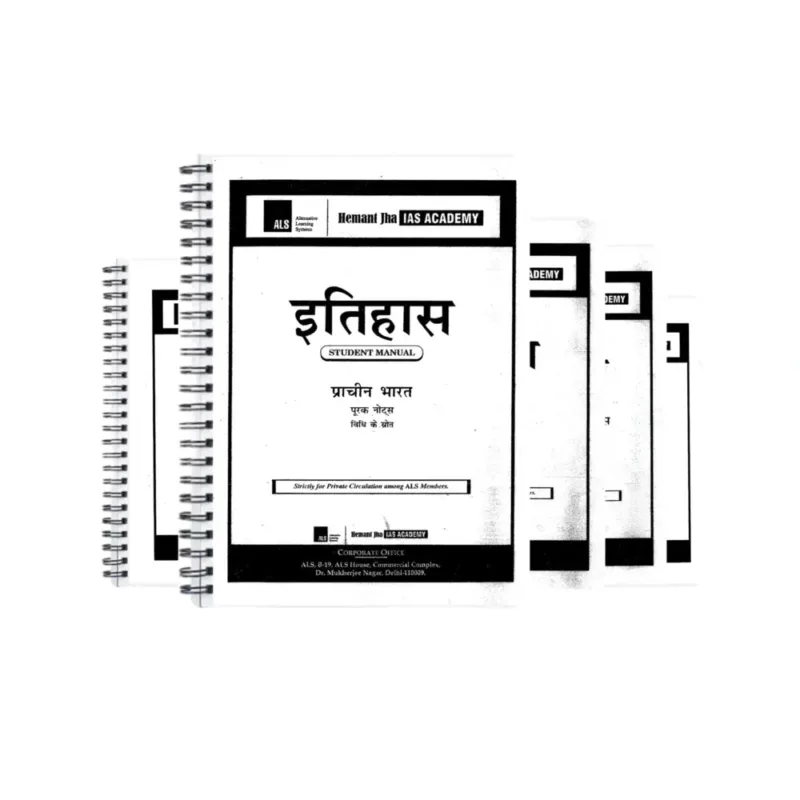
| Format | High-Quality Printed Booklets — Spiral or Book Binding (इतिहास Student Manual Series) |
| Paper Quality | 75 GSM Ultra-White — Highlighter Safe, Zero Bleed-Through |
| Shipping | Pan India Delivery in 3-5 Business Days — Tracked |
| Also Useful For | BPSC, UPPSC, MPPSC, RAS and all State PSC History Optional candidates |
Complete Booklet Catalog
This 5-booklet set from Hemant Jha IAS Academy (ALS — Alternative Learning Systems) covers the UPSC History Optional syllabus with a focused treatment of Ancient India and its supplementary themes, all written in Hindi medium for aspirants preparing in their native language. Each booklet is a standalone Student Manual designed to be studied in sequence, giving Hindi-medium UPSC candidates a structured and answer-writing-oriented resource that mirrors the depth demanded by UPSC Mains.
- Booklet 1: प्राचीन भारत — परिचय एवं स्रोत — Introduction to Ancient Indian history, prehistoric cultures, and sources of ancient history including archaeological, literary, epigraphic, numismatic, and foreign accounts. Covers Paleolithic, Mesolithic, and Neolithic phases, and how historians interpret pre-Vedic India. Essential for answering source-based questions in UPSC History Optional Paper I.
- Booklet 2: सिंधु घाटी सभ्यता — Indus Valley Civilisation — origin, extent, urban planning, drainage systems, trade, religion, script, and decline. Covers Harappa, Mohenjo-daro, Dholavira, Lothal, and Kalibangan in detail. Discusses debates about Aryan invasion and Dravidian connections relevant to UPSC question trends.
- Booklet 3: वैदिक काल — ऋग्वैदिक एवं उत्तर वैदिक — Rigvedic and Later Vedic periods — political organisation, society, economy, religion, position of women, varna system, and transition from pastoral to agrarian economy. Covers the Vedic corpus including Upanishads, Aranyakas, and Brahmanas, essential for UPSC History Optional Paper I.
- Booklet 4: महाजनपद काल एवं उदय — बौद्ध एवं जैन धर्म — Rise of the 16 Mahajanapadas, urban revolution, rise of heterodox sects — Buddhism and Jainism. Covers causes of emergence, teachings of Gautama Buddha and Mahavira, spread, sanghas, and their social relevance. Persian and Macedonian invasions and their impact on Indian history are also discussed.
- Booklet 5: मौर्य साम्राज्य — Mauryan Empire — Chandragupta Maurya, Bindusara, Ashoka. Administration, Arthashastra, Ashokan edicts, Dhamma, economic policy, art and architecture (stupas, pillars, rock-cut caves), and decline of the Mauryan Empire. Ashoka’s place in world history and UPSC-relevant analytical themes including secularism and welfare state parallels.
- Booklet 6: मौर्योत्तर काल — शुंग, कण्व, सातवाहन — Post-Mauryan period — Shungas, Kanvas, Satavahanas, Indo-Greeks, Shakas, Kushanas (Kanishka), Parthians. Political fragmentation and its cultural consequences. Gandhara and Mathura schools of art, Mahayana Buddhism, trade routes, and India’s contact with Central Asia and the Roman world.
- Booklet 7: गुप्त साम्राज्य एवं गुप्तोत्तर काल — Gupta Empire — political history, administration, land grants, feudalism, economy, coinage. Cultural achievements: Kalidasa, Aryabhata, Varahamihira, temple architecture, cave paintings (Ajanta, Bagh). Post-Gupta fragmentation, Harshavardhana, and the transition toward early medieval India as examined in UPSC History Optional Paper I.
- Booklet 8: दक्षिण भारत — संगम काल एवं प्रारंभिक राज्य — Sangam Age — Cheras, Cholas, Pandyas, Sangam literature, society, trade, and political structure. Rise of Pallavas, Chalukyas, and Rashtrakutas. Temple architecture styles: Dravida, Vesara, Nagara. Bhakti movement origins, Nayanmars and Alvars — all relevant UPSC Optional topics for South Indian ancient history.
- Booklet 9: धर्म, दर्शन एवं विचारधारा — Religion and philosophy in Ancient India — Six Schools of Indian Philosophy (Shad Darshanas), Bhagavatism, Shaivism, Shaktism, Tantrism, and the philosophical evolution of Hinduism. Covers syncretic traditions, debate between Brahmanical and non-Brahmanical streams, and their influence on Indian society and polity — a recurring UPSC History Optional theme.
- Booklet 10: प्राचीन भारत में कला एवं स्थापत्य — Art and architecture in Ancient India — Rock-cut architecture, stupas, chaityas, viharas, temple styles. Sculpture traditions: Gandhara, Mathura, Amaravati. Painting traditions: Ajanta, Bagh, Sittanavasal. Numismatic and epigraphic art. Covers the full spectrum of artistic developments UPSC asks in both Paper I and as source-based archaeology questions.
- Booklet 11: प्राचीन भारतीय समाज एवं अर्थव्यवस्था — Social structure — varna, jati, ashrama, gender relations, position of women in different periods. Economic history — agriculture, trade guilds (shrenis), urban economy, trade with Rome and Southeast Asia. Coinage systems, land revenue, and taxation from Mauryan to Gupta periods. Key UPSC History Optional analytical themes on social and economic evolution.
- Booklet 12: पूरक नोट्स एवं विविध — स्रोत, मानचित्र एवं संशोधन सामग्री — Supplementary notes and miscellaneous sources — additional reading material, maps of Ancient India, timeline charts, important terms and concepts glossary, previous year UPSC question analysis, model answer frameworks, and revision pointers. This booklet is specifically designed for final-stage UPSC History Optional preparation and answer writing practice.
In-Depth Content Breakdown: Booklet by Booklet
Booklet 1: प्राचीन भारत — परिचय एवं स्रोत
The opening booklet in Hemant Jha IAS Academy’s History Optional series establishes the methodological foundation for studying Ancient India for UPSC. It covers prehistoric cultures — Paleolithic, Mesolithic, Neolithic, and Chalcolithic — and then transitions into the historical period. The booklet systematically categorises sources: archaeological (excavations, pottery), literary (Vedic texts, epics, Buddhist Pali canon), epigraphic (inscriptions), numismatic, and foreign accounts (Megasthenes’ Indica, Fa-Hien, Xuanzang). This source-typology framework is directly tested in UPSC History Optional Paper I Section A questions.
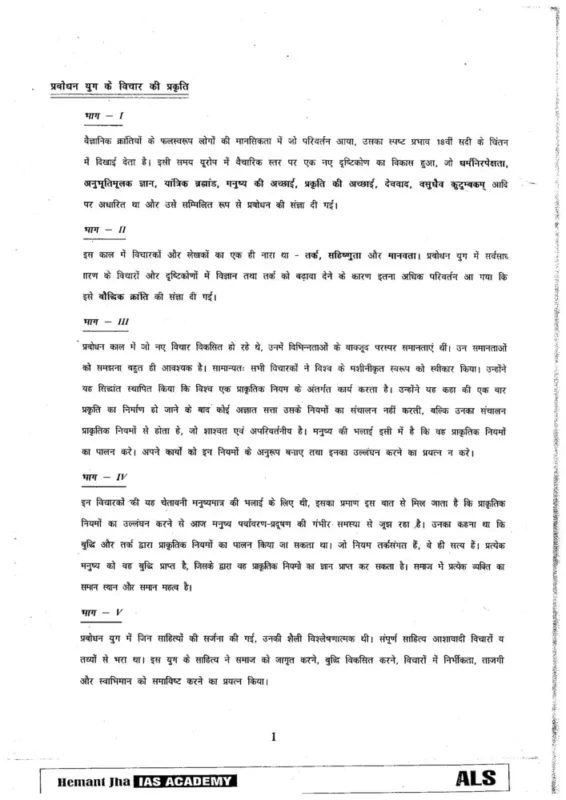
Written entirely in Hindi medium, this booklet is structured with clear headings, sub-headings, and margin notes designed for quick revision. Hemant Jha’s ALS Student Manual format presents information in layered prose supplemented by tables that compare different source types, timelines of prehistoric phases, and site maps. Hindi-medium aspirants will find the language precise yet accessible — neither overly academic nor superficial — making it ideal for building conceptual clarity before moving into the substantive civilisational topics covered in later booklets.
Booklet 2: सिंधु घाटी सभ्यता
The Indus Valley Civilisation booklet is one of the most content-rich in this UPSC History Optional set. It covers geographical extent, major sites (Harappa, Mohenjo-daro, Dholavira, Lothal, Kalibangan, Banawali), urban planning features (grid layout, drainage systems, granaries, citadels), material culture (pottery, seals, figurines, weights and measures), trade — both internal and external (Mesopotamia connections), religion (proto-Shiva, mother goddess, tree worship), and the undeciphered Indus script. UPSC has repeatedly asked analytical questions on urban features and trade networks of this civilisation.
The booklet dedicates a full section to the debate over the decline of the Indus Valley Civilisation — Aryan invasion theory (Wheeler), ecological/climatic theories, flood theories, and internal decay models. The Aryan-Dravidian identity debate is handled carefully with reference to current academic consensus. Hemant Jha’s Hindi-medium treatment makes these complex historiographical debates accessible through simplified comparison tables and annotated site diagrams, giving aspirants a ready tool for writing nuanced, multidimensional answers in the UPSC History Optional examination.
Booklet 3: वैदिक काल — ऋग्वैदिक एवं उत्तर वैदिक
This booklet covers the Vedic Age in two distinct phases: the Rigvedic period (c. 1500–1000 BCE) and the Later Vedic period (c. 1000–600 BCE). For the Rigvedic phase, topics include the tribal polity (jana, vis, grama), pastoral economy, the role of cattle, religious practices (yajnas, soma, Indra worship), and the early varna system. The political organisation — from raja to samiti and sabha — is discussed with UPSC answer frameworks that highlight the democratic and consultative elements of early Vedic governance, a theme UPSC examiners have tested repeatedly.
The Later Vedic section examines the shift to agriculture, the emergence of territorial kingdoms, the hardening of the varna-jati system, the decline of women’s status, and the expansion of the Vedic corpus into Brahmanas, Aranyakas, and Upanishads. Upanishadic philosophy — the concept of Brahman, Atman, karma, and rebirth — is explained in Hindi with philosophical clarity. The booklet also covers the significance of the Painted Grey Ware (PGW) culture as an archaeological marker of the Later Vedic period, integrating material culture with textual evidence as required in UPSC History Optional answers.
Booklet 4: महाजनपद काल एवं उदय — बौद्ध एवं जैन धर्म
The Mahajanapada booklet addresses the second urbanisation of Ancient India — the rise of 16 large territorial states, the causes of urban growth (iron technology, surplus agriculture, trade), and the political evolution from oligarchic republics (Vajji, Malla) to monarchies (Magadha, Kosala). The rise of Magadha as the dominant power — from Haryanka to Shishunaga to Nanda dynasties — is traced in detail. Persian (Achaemenid) and Macedonian (Alexander) invasions are covered for their political and cultural impact on northwestern India, a frequently tested UPSC topic.
Buddhism and Jainism occupy the core of this booklet. The life and teachings of Gautama Buddha — Four Noble Truths, Eightfold Path, Pratityasamutpada, Nirvana — are presented alongside the Buddhist Sangha, councils (Rajagriha, Vaishali, Pataliputra, Kashmir), and the spread of Buddhism across Asia. Jainism — Mahavira, Tirthankaras, Anekantavada, Ahimsa, Syadvada — is similarly detailed. Hemant Jha’s Hindi notes contextualise these religious movements as social reform responses to Brahmanical orthodoxy, giving aspirants the analytical lens UPSC History Optional demands for this period.
Booklet 5: मौर्य साम्राज्य
The Mauryan Empire booklet is among the most important in this UPSC History Optional set. It covers Chandragupta Maurya’s rise with Kautilya’s assistance, the Arthashastra as an administrative manual, Bindusara’s reign, and Ashoka’s transformative rule. Ashokan edicts — their types (rock edicts, pillar edicts, cave inscriptions), locations, language, and content — are detailed in full. Ashoka’s Dhamma — its elements, motivations, and impact on the empire — is analysed with reference to UPSC-style evaluative questions about whether Dhamma was a statecraft tool or genuine ethical reform.
The booklet provides a structured treatment of Mauryan administration: the central bureaucracy, provincial governors (kumara/aryaputra), district administration, the role of the spy system (gudhapurusha), judicial organisation, and the military. Economic policies — state control over mines, forests, agriculture (sita lands), trade regulation — are explained through Arthashastra references. Mauryan art and architecture — Ashokan pillars (lion capital at Sarnath as national emblem), stupas (Sanchi), and rock-cut caves (Barabar) — are covered with UPSC answer-writing notes on their artistic significance and symbolism.
Booklet 6: मौर्योत्तर काल — शुंग, कण्व, सातवाहन
This booklet navigates the complex post-Mauryan period — political fragmentation followed by new empire-building. The Shungas (Pushyamitra Shunga), Kanvas, and Satavahanas in the Deccan are covered alongside the foreign dynasties: Indo-Greeks (Menander — Milindapanha), Shakas, Parthians, and Kushanas. Kanishka’s reign — the Fourth Buddhist Council at Kashmir, Mahayana Buddhism, patronage of Gandhara art — is given particular attention as it is a high-frequency UPSC History Optional topic. Trade with Rome and the flourishing of Indian Ocean commerce during this era is explained with relevant trade route maps.
The cultural achievements of this period receive dedicated treatment in Hemant Jha’s Hindi notes. The Gandhara school (Hellenistic influence, grey schist, Buddha in human form) is compared with the Mathura school (indigenous tradition, red sandstone, yaksha influence) and the Amaravati school (narrative panels, limestone, Satavahana patronage). These artistic comparisons in tabular format are ideal for UPSC History Optional answers. The booklet also discusses the transition from Hinayana to Mahayana Buddhism, including the Bodhisattva concept and its philosophical implications, with Hindi-medium clarity.
Booklet 7: गुप्त साम्राज्य एवं गुप्तोत्तर काल
The Gupta Empire booklet covers what UPSC History Optional syllabi designate as the classical age of Ancient India. Political history from Chandragupta I to Skandagupta is covered including the Gupta administrative system, the role of feudatories, and the decentralised nature of Gupta governance. Economic history — land grants (agrahara, devagrahara), the beginnings of agrarian feudalism, decline of trade with Rome, guild system — is analysed as a structural shift from the Mauryan period. The booklet integrates Hemant Jha’s analytical framework on the feudalism debate (D.D. Kosambi, R.S. Sharma perspectives) in accessible Hindi.
Cultural achievements of the Gupta period are covered in full: Sanskrit literature (Kalidasa’s Abhijnanasakuntalam, Meghaduta; Vishakhadatta’s Mudrarakshasa), science (Aryabhata’s Aryabhatiya — heliocentric model, value of pi; Varahamihira’s Brihatsamhita), temple architecture (Dashavatara Temple at Deogarh, Bhitargaon), and cave paintings (Ajanta phases II and I). The post-Gupta section covers Harshavardhana (Hiuen-Tsang’s account, Bana’s Harshacharita), the Pushyabhutis, and the emergence of regional powers that mark the transition to early medieval India — a UPSC-relevant periodisation point.
Booklet 8: दक्षिण भारत — संगम काल एवं प्रारंभिक राज्य
South Indian history is a distinct and often under-prepared section of UPSC History Optional Paper I. This booklet addresses the Sangam Age — political history of the three Tamil kingdoms (Cheras, Cholas, Pandyas), Sangam literature (Five Epics — Silappadikaram, Manimekalai; Five Anthologies), the social structure described in Sangam texts (Tinai system — five ecological zones), trade with Rome (Roman coins, pepper, muslin), and the port cities of Kaveripattinam and Muzuris. UPSC has increasingly asked South Indian questions, making this booklet strategically important.
The booklet then transitions to the post-Sangam kingdoms — the Pallavas (Mahendravarman I, Narasimhavarman I, Mammalapuram shore temple, Kailasanatha temple), Chalukyas of Badami (Pulakesi II, Aihole inscription by Ravikirti), and Rashtrakutas. The Bhakti movement’s origins in Tamil Nadu — Nayanmars (Shaiva saints) and Alvars (Vaishnava saints), their devotional poetry, and their social significance as a protest against caste hierarchy — are explained in Hindi with relevant literary references. Temple architecture styles (Dravida vs. Nagara vs. Vesara) are compared in a clear tabular format useful for UPSC answer writing.
Booklet 9: धर्म, दर्शन एवं विचारधारा
This booklet provides a dedicated philosophical treatment that is rarely found in standard history optional materials. The Six Schools of Indian Philosophy (Nyaya, Vaisheshika, Samkhya, Yoga, Mimamsa, Vedanta) are explained in Hindi with their epistemological and metaphysical positions summarised in structured tables — ideal for UPSC answer writing where candidates must compare schools accurately. The evolution of Hinduism — from Vedic ritualism through Upanishadic inquiry to Puranic Bhagavatism — is traced as a continuous but evolving tradition. Shaivism, Shaktism, and Tantrism are covered with their regional variations and temple-cult connections.
The booklet examines ideological conflicts and syncretic processes in Ancient India — the debate between Brahmanical orthodoxy and the Shramana traditions (Buddhist, Jain, Ajivika), the role of state patronage in religious change, and the gradual assimilation of tribal and folk deities into mainstream Hinduism. Hemant Jha’s analytical approach in Hindi presents these as dynamic socio-religious processes rather than static doctrinal facts. This perspective is exactly what UPSC History Optional examiners reward in high-scoring answers — the ability to contextualise religious change within broader political economy and social history frameworks.
Booklet 10: प्राचीन भारत में कला एवं स्थापत्य
Art and architecture form a standalone, heavily tested section in UPSC History Optional Paper I, and this booklet gives it the dedicated space it deserves. The full arc from prehistoric cave art (Bhimbetka) through Mauryan court art (polished pillars, Didarganj Yakshi), post-Mauryan schools (Gandhara, Mathura, Amaravati), Gupta temple architecture, and early Dravida temples is covered with site-specific details. Stupa architecture — the evolution from hemispherical mound (Sanchi Stupa I) to multi-tiered towers — is explained with structural elements (anda, harmika, vedika, torana, pradakshinapatha) that regularly appear in UPSC questions.
Cave architecture receives detailed treatment — Ajanta (Hinayana phase: Caves 9, 10; Mahayana phase: Caves 1, 2, 16, 17 — painting themes and iconography), Ellora (Buddhist, Hindu, Jain — Kailasa Temple as rock-cut architecture pinnacle), Elephanta (Trimurti panel). The booklet includes annotated diagrams of structural elements and comparison tables for different regional styles. Numismatic art — Gupta gold coins as historical evidence of royal iconography — is also covered. This visual-analytical combination in Hindi makes this booklet indispensable for UPSC History Optional candidates who want to write precise, evidence-rich answers on art history questions.
Booklet 11: प्राचीन भारतीय समाज एवं अर्थव्यवस्था
Social and economic history is the analytical backbone of UPSC History Optional Paper I, and this booklet directly addresses the thematic questions that top-scorers master. Social structure — varna system origins and evolution, jati proliferation, ashrama system, the position of women across different periods (Rigvedic vs. Later Vedic vs. Mauryan vs. Gupta), untouchability and the Chandala class, and the treatment of women in Manusmriti vs. Buddhist texts — is covered with historiographical debates (Romila Thapar, Upinder Singh) referenced in Hindi. These analytical frameworks directly lift answer quality in UPSC History Optional.
The economic history section covers agrarian economy (land ownership patterns, irrigation, crop varieties), trade and commerce (internal overland routes, maritime routes — Periplus of the Erythraean Sea, ports), guilds (shrenis — their functions, internal organisation, banking role), coinage (punch-marked coins, Kushana gold, Gupta gold coins), and India’s place in world trade networks including the Roman connection. The booklet presents a clear economic periodisation — tribal economy, second urbanisation, Mauryan state economy, post-Mauryan trade boom, Gupta feudal agrarian shift — giving UPSC aspirants a confident structural narrative for economy-based questions.
Booklet 12: पूरक नोट्स एवं विविध — स्रोत, मानचित्र एवं संशोधन सामग्री
The final booklet in Hemant Jha IAS Academy’s 5-booklet History Optional set serves as the revision and consolidation tool for UPSC preparation. It contains supplementary notes covering topics that require additional depth or that have emerged as new question trends in recent UPSC History Optional papers. Maps of Ancient India — political maps for each major period (Mahajanapada map, Mauryan Empire, Gupta Empire, Satavahana territory, South Indian kingdoms) — are included as printed study aids that help aspirants with the spatial understanding of historical geography tested in UPSC.
This booklet also includes a structured analysis of previous year UPSC History Optional questions on Ancient India, organised by sub-topic, with model answer frameworks and key points for each. Important terms and concepts are compiled in a glossary with Hindi explanations — essential for Hindi-medium aspirants who need to use precise historical terminology in their UPSC answers. Timeline charts for cross-comparison of periods are included. For aspirants in the final weeks before UPSC Mains, this booklet functions as a standalone rapid-revision tool covering all 11 preceding booklets in condensed form.
Physical Construction and Quality Standards
Every booklet in this Hemant Jha IAS Academy History Optional set is manufactured to withstand the rigorous study schedule of a UPSC aspirant — extended daily study sessions, repeated page turning during revision, and active annotation during answer writing practice all demand materials built to last through the full 2025-26 preparation cycle.
Paper Quality: 75 GSM Anti-Glare White Paper
These booklets use 75 GSM ultra-white paper selected for high opacity and surface smoothness — two qualities that matter enormously during long study sessions. The paper’s opacity ensures zero bleed-through when you use highlighters, gel pens, or ballpoint pens to annotate. Multiple highlighter colours — yellow, green, pink, orange — can be used simultaneously without text on the reverse side becoming unreadable. The anti-glare surface reduces eye fatigue during extended reading, particularly important when covering dense Historical content across 5 Booklets in Hindi medium for UPSC preparation.
Printing Technology: High-Resolution Laser Printing
All 5 Booklets are printed using high-resolution laser printing technology that ensures every Devanagari character is rendered with perfect crispness — critical for Hindi-medium notes where font clarity directly affects reading speed and comprehension. Diagrams, maps of Ancient India, architectural sketches, art history figures, and comparison tables are all rendered with precision. Laser toner is permanent and smudge-proof — pages will not smear under hand moisture during examination pressure revision. Flowcharts showing dynastic timelines and art evolution remain sharp even when photocopied for additional revision sheets.
Binding and Durability
Each booklet features either spiral binding or quality book binding — both options are engineered for the specific use case of UPSC study. Spiral binding allows each booklet to open completely flat on your study desk, leaving both hands free for simultaneous note-taking alongside the printed text — an advantage that matters when practising answer writing for UPSC History Optional. The covers are printed on 300 GSM thick cardstock, providing a rigid protective shell against the daily wear of being carried in a bag, stacked, and repeatedly handled. Booklet spines are reinforced to prevent separation with heavy use across the 2025-26 preparation cycle.
Key Features and Study Design
Hemant Jha IAS Academy’s History Optional notes are designed with the specific answer-writing demands of UPSC Mains in mind — not merely as reading material but as an active preparation tool that builds both content knowledge and analytical response capabilities for Hindi-medium aspirants.
- हिंदी माध्यम में सम्पूर्ण पाठ्यक्रम (Complete Syllabus in Hindi Medium): Every topic from the UPSC History Optional Paper I syllabus on Ancient India is covered entirely in Hindi — precise Devanagari terminology, Hindi translations of key historical concepts, and Hindi-medium answer frameworks that help aspirants write fluent, accurate responses in UPSC Mains.
- ALS Student Manual Format — Layered Structure: Hemant Jha IAS Academy’s ALS (Alternative Learning Systems) Student Manual format presents content in a hierarchy of main points, sub-points, and analytical notes that mirrors the structure of a well-organised UPSC answer, helping aspirants internalise answer structure naturally through reading.
- Historiographical Analysis and Multiple Perspectives: Each major topic includes references to key historians (Romila Thapar, R.S. Sharma, D.D. Kosambi, Upinder Singh) and competing interpretations — the kind of multi-perspective analysis that UPSC History Optional examiners reward with higher marks in 20-mark analytical questions.
- Comparison Tables and Timeline Charts: Throughout all 5 Booklets, comparison tables (art schools, dynasty timelines, religious philosophies, administrative systems), flowcharts, and period maps are embedded in the text — reducing the need for separate diagram preparation and integrating visual learning into the standard study flow for UPSC aspirants.
- Previous Year UPSC Question Alignment: Topics are prioritised and annotated based on UPSC History Optional question frequency. High-frequency topics (Ashokan edicts, Gupta cultural achievement, Indus Valley Civilisation, Buddhist-Jain emergence) receive proportionally deeper treatment, ensuring aspirants spend their preparation time in alignment with actual UPSC examination demands.
Shipping, Packaging and Delivery
All 5 Booklets of the Hemant Jha IAS History Optional Hindi Notes 2025-26 set are dispatched from our UPSC Store in Mukherjee Nagar, Delhi, using a multi-layer protective packaging system. Each booklet is first individually shrink-wrapped to prevent moisture and dust exposure during transit. The complete 5-booklet set is then packed inside a corrugated cardboard box with reinforced edge protectors and foam padding inserts at corners to prevent bend damage. The outer carton is sealed with tamper-evident tape, ensuring the package arrives in the same fresh condition as when it left our store. Your History Optional notes will reach you undamaged, unmarked, and ready for immediate study.
Pan India delivery is completed within 3-5 business days through tracked courier services. Immediately upon dispatch, a tracking ID is shared via WhatsApp so you can monitor your shipment in real time. For any query about your order — tracking, delivery address update, or any concern about missing or damaged booklets — reach us on WhatsApp at +91 70045 49563. If any booklet from the 5-booklet set is found missing or damaged upon delivery, we replace it within 48 hours at no additional cost. Buy with full confidence — your UPSC History Optional preparation materials are in safe hands from our store to your desk.
Frequently Asked Questions (FAQ)
A: Yes — Hemant Jha IAS Academy’s ALS Student Manual series is specifically designed for Hindi-medium UPSC History Optional aspirants. The content is written entirely in Hindi with precise historical terminology in Devanagari, analytical frameworks aligned with UPSC examiner expectations, and historiographical references (Romila Thapar, R.S. Sharma) incorporated throughout. Many Hindi-medium toppers from Mukherjee Nagar coaching circles have used these notes as their primary preparation resource for UPSC History Optional Paper I.
A: This set includes exactly 12 printed booklets covering the Ancient India section of the UPSC History Optional syllabus — from prehistoric cultures and sources through the Indus Valley Civilisation, Vedic Age, Mauryan and Gupta empires, South Indian history, art and architecture, philosophy, and social-economic history, concluding with a supplementary notes and revision booklet containing maps, timelines, and previous year UPSC question analysis.
A: The set listed here — Hemant Jha IAS History Optional Hindi Notes 2025-26 — is entirely in Hindi medium (हिंदी माध्यम), including all explanations, analytical notes, comparison tables, and answer frameworks. These are ALS Student Manual notes specifically produced for Hindi-medium UPSC aspirants. If you are looking for English-medium History Optional notes, please check our store for separate English-medium offerings from other institutes.
A: The 5 Booklets cover the complete Ancient India section of UPSC History Optional Paper I — prehistoric cultures, sources, Indus Valley Civilisation, Rigvedic and Later Vedic periods, Mahajanapadas, Buddhism and Jainism, Mauryan Empire (Ashoka, Arthashastra, edicts), post-Mauryan period (Kushanas, Gandhara art), Gupta Empire and cultural achievements, South India (Sangam Age, Pallavas, Chalukyas, Bhakti movement), art and architecture, Indian philosophy, and Ancient Indian social-economic history.
A: These booklets use 75 GSM ultra-white paper chosen for high opacity — multiple highlighter colours and gel pens work without bleed-through to the reverse side, ideal for colour-coded revision. The anti-glare surface reduces eye fatigue during the extended study sessions that UPSC History Optional preparation demands. Laser printing ensures text and diagrams remain permanently sharp and smudge-proof even with frequent page handling throughout the 2025-26 preparation cycle.
A: Yes — this is the 2025-26 edition, the latest genuine batch from Hemant Jha IAS Academy (ALS — Alternative Learning Systems). The notes are updated to reflect current UPSC History Optional question trends, recent historiographical developments, and any syllabus-relevant updates. The supplementary booklet (Booklet 12) specifically includes analysis of recent UPSC History Optional question papers to ensure preparation is aligned with the current examination pattern.
A: Hemant Jha IAS Academy’s 5-booklet set is a strong primary resource covering the full Ancient India syllabus in depth. For a complete UPSC History Optional preparation strategy, these notes work best when combined with standard reference books (Romila Thapar’s Early India, R.S. Sharma’s Ancient India) for additional depth on select topics, and regular answer writing practice. However, for Hindi-medium aspirants, these notes provide sufficient content coverage to attempt all UPSC History Optional Paper I questions confidently without needing to rely on any other coaching institute’s material.
A: Hemant Jha IAS Academy’s ALS Student Manual approach emphasises analytical layering — main points, sub-points, and examiner-facing interpretive notes — rather than simple factual listing. The inclusion of historiographical debates (multiple historians’ perspectives) in Hindi is a distinguishing feature. Additionally, the 5-booklet structure allows for focused topic-wise revision, and the dedicated supplementary booklet with maps, timelines, and previous year UPSC question analysis adds a strategic preparation layer not commonly found in other Hindi-medium History Optional notes available in the market.
A: Yes — these notes are highly useful for candidates appearing in BPSC, UPPSC, MPPSC, RAS, and other State PSC examinations that include History as an optional subject. The Ancient India content covered in these 5 Booklets aligns with the History syllabi of most major State PSCs. Hindi-medium aspirants preparing for State PSCs will find the language, depth, and analytical approach directly applicable to state-level answer writing demands as well.
A: Orders are dispatched from our UPSC Store in Mukherjee Nagar, Delhi and delivered pan India within 3-5 business days via tracked courier. All 5 Booklets are individually shrink-wrapped, packed in a corrugated box with edge protectors, and sealed with tamper-evident tape. A tracking ID is sent via WhatsApp at +91 70045 49563 upon dispatch. If any booklet is missing or damaged, we replace it within 48 hours at no charge.
A: You can buy Hemant Jha IAS History Optional Hindi Notes 2025-26 directly from this product page — this is the official online store listing for the genuine ALS Student Manual 5-booklet set. Buying directly from our UPSC Store ensures you receive the latest 2025-26 edition, brand new and unmarked, with tracked pan India delivery in 3-5 days. Avoid unverified third-party resellers who may supply outdated editions or incomplete sets of these History Optional notes.
A: Each order is quality-checked and packed as a complete 5-booklet set before dispatch. However, if upon delivery you find any booklet missing, contact us immediately via WhatsApp at +91 70045 49563 with your order details and a photograph of what was received. We will dispatch the missing booklet within 48 hours at no additional cost. Our commitment is that every aspirant who buys Hemant Jha IAS History Optional notes from our store receives the complete, genuine 2025-26 set without exception.
Summary
| Specification | Value |
|---|---|
| Booklets | 12 Printed Booklets |
| Language | Hindi Medium (हिंदी माध्यम) |
| Institute | Hemant Jha IAS Academy — ALS (Alternative Learning Systems) |
| Edition | 2025-26 Latest Genuine Batch |
| Subject | History Optional — Ancient India (इतिहास — प्राचीन भारत) |
| Paper | 75 GSM Ultra-White, Highlighter Safe |
| Binding | Spiral or Book Binding, 300 GSM Cover |
| Delivery | 3-5 Business Days Pan India — Tracked |
| Also Useful For | BPSC, UPPSC, MPPSC, RAS and all State PSC History Optional |
Sold by UPSC Store — stationed in the heart of Mukherjee Nagar, Delhi, India’s largest UPSC coaching hub. Order today and receive your complete 5-booklet Hemant Jha IAS History Optional Hindi Notes 2025-26 set with pan India delivery in 3-5 days.
Reference: UPSC official syllabus
Customer Reviews 487
Booklets mein sab important topics cover ho gaye hain. Padhne ke baad confidence badhta hai.
Mast product, print quality bhi achha hai. Recommended for serious UPSC aspirants.
Hemant sir ka writing style bahut clear aur logical hai, samajhne mein madad milti hai.
Packing bilkul safe tha, notes condition mein perfect aaye.
Quality aur content dono hi ekdum perfect hain bilkul.
Paper quality nice hai lekin kuch topics ko aur detail mein samjhana chahiye tha.
History optional aspirants ke liye ye perfect study material hai.
Notes padhte hi concepts clear ho gaye. Kaafi recommend kar rahi hoon apne sabhi dost ko.
Aspirants Also Bought
More from the same category
About Hemant Jha IAS History Optional Hindi Notes 2025-26
Hemant Jha IAS History Optional Hindi Notes 2025-26 is a highly recommended UPSC study material from Hemant Jha IAS, specially designed for History Optional preparation. Available in Hindi medium, this material is crafted to match the exact requirements of the UPSC Civil Services Examination syllabus — covering both Prelims and Mains comprehensively.
Product Details
- Institute: Hemant Jha IAS
- Subject: History Optional
- Medium: Hindi
- Format: Printed
- Delivery: Pan-India delivery in 3–5 working days
- Format: Original printed material, verified authentic
Why Buy from UPSC Store?
- ✅ 100% Genuine Printed Material — Original printed notes, no photocopies or fake copies
- ✅ Fast Delivery — Ships within 24 hours, arrives in 3–5 days pan-India
- ✅ Secure Packaging — Bubble-wrapped and boxed to prevent damage in transit
- ✅ Trusted by 10,000+ Aspirants — India's most reliable UPSC material marketplace
- ✅ WhatsApp Support — Get expert guidance on material selection before ordering
Frequently Asked Questions
Yes, all products at UPSC Store are 100% genuine printed materials. We do not sell photocopies or fake copies.
Orders are dispatched within 24 hours and delivered across India in 3–5 working days via reputed courier partners.
Yes, we accept returns within 7 days if the product is damaged or incorrect. Check our refund policy for details.
We recommend pairing this with current affairs notes and a UPSC test series for comprehensive preparation. Browse more in History, Optional, UPSC.