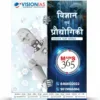

Vision IAS Science & Technology Mains 365 2025-26

Hindi Medium | Yearly Compilation | UPSC Study Material
Key Highlights:
📘 1 Booklets
📚 Science & Technology
🎓 Vision IAS
🏷️ Printed
🇬🇧 Hindi Medium
₹399 ₹799
Save ₹400 (50% OFF)
Only 16 sets left
Selling fast (70 sold this week)
5% OFF Use UPSC5% (COD Available)
10% OFF Use UPI10 (UPI Only)
Secure Payment
Fast Delivery
Safe Packaging

Vision IAS Science & Tech — UPSC Study Material

Related: Vision IAS Hindi current affairs · Science & Technology material

Buy Vision IAS Science & Tech printed booklets for UPSC Civil Services Examination preparation. This page lists complete details about Vision IAS Science & Tech including booklet count, language, syllabus coverage, pricing, and shipping.


Vision IAS Science & Technology Mains 365 Yearly Magazine 2025 – Hindi Medium

Vision IAS Science & Technology Mains 365 Yearly Magazine 2025 | Hindi Medium Edition – The Definitive Resource for UPSC GS Paper III

Product Overview

FieldDetail
Booklets Count1 Comprehensive Compilation (Consolidated Yearly Magazine)
LanguageHindi (Standard Academic & Technical Hindi)
PublisherVision IAS Educational Services
ConditionBrand New (Latest 2025 Edition)
FormatHigh-Definition Printed Softbound / Reinforced Paper Edition

Complete Booklet Catalog

This product consists of the singular, master-volume “Mains 365” specifically curated for the Science and Technology (Vigyan evam Praudyogiki) segment of the Civil Services Examination. The booklet is organized into the following thematic modules:

  • Module 1: Space Technology (Antariksh Praudyogiki) – Annual Mission Reviews & Policy.
  • Module 2: Biotechnology and Health (Jaiv Praudyogiki evam Swasthya) – Genetic Engineering, CRISPR, and Medical Innovation.
  • Module 3: Information Technology & Electronics (Suchna Praudyogiki) – AI, Quantum Computing, and Cybersecurity.
  • Module 4: Defense Technology (Raksha Praudyogiki) – Indigenous Platforms, Missile Systems, and Naval Advancements.
  • Module 5: Energy and Nuclear Science (Urja evam Paramanu Vigyan) – Renewable Innovations and Nuclear Power.
  • Module 6: Intellectual Property Rights (IPR) & Emerging Policy Issues.
  • Module 7: Miscellaneous Technological Developments (Vividh Praudyogiki Vikas).

Deep Dive: Physical Construction and Tactile Quality

The Vision IAS Science & Technology Mains 365 Yearly Magazine 2025 for Hindi Medium is engineered for the rigors of heavy academic usage. The physical composition of the booklet reflects the high standards required for an aspirant’s primary revision tool. The paper used is high-grade 75 GSM (Grams per Square Meter) bond paper, ensuring a substantial feel that prevents ink bleed-through, even when using heavy markers or highlighters. This is critical for UPSC aspirants who engage in multi-layered note-taking and underlining.

The ink used in the printing process is a specialized anti-glare, high-contrast carbon black. This ensures that the Hindi characters—with their intricate matras and conjuncts—remain crisp and legible under various lighting conditions, reducing eye strain during long nocturnal study sessions. The binding is a reinforced soft-touch wrap that allows the booklet to lay relatively flat on a desk, facilitating easier reading and scanning of the wide-format tables and flowcharts included within.

The margins of every page are intentionally wide. This “Executive Margin” design provides ample white space for students to jot down their own cross-references, mnemonic devices, or updates as the year progresses. The cover page is laminated with a moisture-resistant matte finish, protecting the internal content from minor spills and the wear-and-tear associated with being carried in a backpack daily.

Internal Structure: The Anatomy of a Mains 365 Page

The Science & Technology 2025 edition follows a meticulous hierarchical structure designed to facilitate “Active Recall” and “Interleaving Study.” Each chapter begins with a “Contextual Index” that links the current affairs topic to the static syllabus of the UPSC. For example, if the topic is “Quantum Key Distribution,” the booklet first provides a small box titled ‘Neev’ (Foundation), which explains the basic physics of quantum entanglement before diving into the year’s specific developments.

Data Visualization and Infographics

A standout feature of this booklet is its reliance on “Schematic Representations.” Instead of long, winding paragraphs, the booklet utilizes “Vikas Kram” (Developmental Timelines) to show the evolution of technologies like 5G to 6G or the transition of India’s space program from SLV to SSLV. Every major technology is accompanied by a “Labh-Haani” (Pros and Cons) table, which is formatted exactly as an aspirant should present an answer in the Mains exam.

The “Vision Special” Value Addition Boxes

Inside the booklet, you will find several recurring features that set the Vision IAS material apart:

  • Syllabus Mapping: Every topic is tagged with GS Paper 3 sub-headings, ensuring that the student never drifts away from the exam’s requirements.
  • Way Forward (Aage ki Raah): Every technological challenge discussed concludes with a prescriptive conclusion, providing the student with ready-made closing statements for their answers.
  • Case Studies (Udaharan/Mamla Adhyayan): Real-world applications of technology, such as the use of AI in Indian agriculture or drones for healthcare delivery in remote areas, are highlighted in grey-shaded boxes for easy identification.

Module Breakdown: Content Specificity

1. Space Technology (Antariksh Praudyogiki)

The space technology section covers over 40 pages of dense, information-packed content. It begins with the ISRO roadmap for 2024-2030, including the Gaganyaan mission’s technical specifications—discussing the crew module, environmental control systems, and the Vyommitra humanoid robot. The Hindi medium edition takes special care to translate technical orbital mechanics into understandable yet formal terminology. You will find detailed diagrams of the LVM3 launch vehicle and a comprehensive table of private sector participation in the Indian space economy, highlighting the role of IN-SPACe and NewSpace India Limited (NSIL).

2. Biotechnology and Genetic Research

This section is characterized by its heavy use of flowcharts. It explains the CRISPR-Cas9 mechanism through a step-by-step visual guide. The content covers the regulatory framework in India concerning Genetically Modified Crops (GM Crops), including the role of the GEAC (Genetic Engineering Appraisal Committee). The booklet dives deep into “Orphan Drugs,” “Precision Medicine,” and the “Genome India Project.” Each sub-topic includes a “Challenges” section that addresses ethical, legal, and social implications (ELSI), which are frequently asked in the UPSC Mains.

3. IT, AI, and Cybersecurity

The Information Technology chapter is perhaps the most dynamic part of the 2025 edition. It covers the Digital Personal Data Protection (DPDP) Act with a clause-by-clause analysis tailored for Hindi medium students. It explores the “Generative AI” boom, detailing Large Language Models (LLMs) and their potential impact on Indian governance. The “Cybersecurity” segment includes a map of India’s institutional framework, highlighting CERT-In and the National Critical Information Infrastructure Protection Centre (NCIIPC). The physical layout uses bold typography to highlight key terms like “Zero-Trust Architecture” and “Quantum Supremacy.”

4. Defense and Emerging Tech

In the Defense section, the booklet provides a categorized list of the “Positive Indigenisation Lists” issued by the Ministry of Defence. It details the “Integrated Battle Groups” (IBGs) and new-age warfare technologies like “Swarm Drones” and “Hypersonic Glide Vehicles.” Each missile system (Agni-V, Pralay, etc.) is presented in a comparison table showing range, payload, and propulsion systems. This makes the booklet an excellent comparative reference tool.

Technical Hindi Translation and Linguistic Precision

For a Science and Technology book in Hindi, the quality of translation is paramount. This 2025 edition avoids the common pitfall of “machine translation.” The terminology used is the official nomenclature used by government bodies and the UPSC itself. However, realizing that some terms are better understood in their English form, the booklet employs a “Bilingual Clarification” strategy where the English term is provided in brackets next to the Hindi term (e.g., ‘Navikarania Urja [Renewable Energy]’). This ensures that the student remains competitive and understands the international context of the technology being studied.

The Indexing and Revision System

The index of the Vision IAS Science & Technology Mains 365 is not just a list of pages. It is a “Thematic Matrix.” The index is color-coded (in grayscale shades) to differentiate between “High-Probability Topics” and “Supplementary Reading.” This allows students to prioritize their revision during the high-pressure weeks before the Mains exam. Each chapter also concludes with a “Quick Revision Square”—a single page that summarizes the entire chapter’s content into a mind map format.

Frequently Asked Questions (FAQ)

Q1: Is this the original Vision IAS publication or a photocopy?
A: This is a high-quality, professionally printed edition of the official Vision IAS Mains 365 material. It is produced using high-definition digital printing plates to ensure that every diagram and Hindi character is as clear as the original manuscript, utilizing premium 75 GSM paper.

Q2: Does this booklet cover the entire year of 2024 and the beginning of 2025?
A: Yes, the Mains 365 Science & Technology 2025 edition is a “Yearly” compilation. It typically covers current affairs from May/June of the previous year up to the latest pre-Mains updates of the current year (covering approximately 12-15 months of critical technological developments).

Q3: Is the Hindi medium translation difficult to understand for students from non-pure Hindi backgrounds?
A: No. The language is “Sarkari” or “UPSC-Standard” Hindi, which is formal yet accessible. The inclusion of English technical terms in parentheses helps bridge the gap for students who may have studied science in English during their schooling.

Q4: How does the “Mains 365” differ from the “PT 365” Science & Technology booklet?
A: While PT 365 focuses on facts, dates, and names for the Preliminary exam, this Mains 1 Booklet focuses on “Analysis,” “Impact,” “Challenges,” and “Solutions.” It is designed for descriptive answer writing, emphasizing the ‘Why’ and ‘How’ rather than just the ‘What’.

Q5: Are there any practice questions included in the booklet?
A: Yes. At the end of major thematic modules, the booklet includes “Mains Practice Questions” (Abhyas Prashna) based on the current trends of the UPSC. These are designed to help you apply the knowledge you’ve just read in a 150-250 word format.

Q6: What is the quality of the diagrams? Will the labels be readable?
A: The diagrams are one of the strongest physical features of this edition. They are printed in high resolution. Even complex diagrams, like the internal structure of a nuclear reactor or the layers of the atmosphere for satellite placement, have clear, legible Hindi labeling.

Q7: Can I use this for other State PSC exams like UPPCS or BPSC?
A: Absolutely. While tailored for UPSC, the Science & Technology developments are universal. The depth of content in this booklet is more than sufficient for any State Civil Services Mains examination, especially those that have adopted the UPSC pattern.

Q8: How should I integrate this booklet into my study schedule?
A: It is recommended to first read your basic NCERTs (Class 6-10) or the Vision IAS static Science & Technology notes. Once your foundation is ready, use this Mains 365 to add “current context” and “dynamic data” to your answers. Use the margins for cross-referencing your static notes.

Q9: Is the binding durable enough for multiple revisions?
A: Yes, the booklet uses a specialized side-stitch or high-quality adhesive binding (depending on the specific print run) that is designed for “Heavy Duty Study.” It can withstand being opened and closed hundreds of times without the pages falling out.

Q10: Does this edition include the latest 2025 Union Budget and Economic Survey highlights related to Science?
A: Yes, the 2025 edition incorporates relevant budgetary allocations for the Department of Space, Department of Atomic Energy, and Ministry of Science & Technology, ensuring your data in the exam is the most recent available.

Q11: Are there any “Mind Maps” included in the physical copy?
A: Yes, the booklet contains several full-page mind maps for complex topics like “Artificial Intelligence Governance” and “India’s Energy Transition Path 2047,” which are excellent for last-minute visual revision.

Q12: Is this a single booklet or a set of multiple thin booklets?
/A: For Science & Technology, it is traditionally released as one consolidated, thick volume to keep all related technological current affairs in one place for better thematic continuity.

Final Physical Specifications Checklist

  • Paper Quality: Premium 75 GSM White Bond.
  • Print Type: High-Contrast Digital Printing.
  • Language Accuracy: Professional Hindi Academic Translation.
  • Page Count: Approximately 120-150 pages (subject to the year’s news density).
  • Portability: Standard A4/Magazine size for ease of handling.

Frequently Asked Questions

Which UPSC paper is this for?

This is curated for UPSC GS Paper III Mains, focused on Science & Technology current affairs and analysis.

Is the medium Hindi?

Yes. The booklet uses standard academic and technical Hindi suitable for UPSC Mains writing.

How many booklets are included?

It is a single comprehensive consolidated yearly compilation booklet.

Is the booklet freshly printed?

Yes. Brand new, fresh stock from the 2025 edition by Vision IAS Educational Services.

Is COD available?

Yes, COD is supported on most pin codes. Free shipping above Rs.1999.

How long does delivery take?

Pan-India tracked delivery typically takes 4-7 business days.

Reference: UPSC official syllabus

Customer Reviews 121

4.5
Based on 121 reviews
5★
72
4★
36
3★
13
2★
0
1★
0
V
Vikram Patel
17 Apr 2026
✓ Verified

Sab topics covered hain properly aur examples bhi relevant the.

A
Amit Patel
09 Apr 2026
✓ Verified

Badiya product hai yaar.

R
Rohan Verma
05 Apr 2026
✓ Verified

Science & Technology ke liye isse better material nahi dekha maine.

P
Priya Sharma
04 Apr 2026
✓ Verified

Vision IAS ka quality hamesha best hota hai, yeh compilation bhi bahut helpful hai padhai ke liye.

M
Meera Saxena
31 Mar 2026
✓ Verified

Hindi medium ke liye best choice. Content bilkul on point.

K
Kavya Reddy
29 Mar 2026
✓ Verified

Regular updation ke saath yearly compilation bahut useful rahegi.

R
Ritika Sharma
11 Mar 2026
✓ Verified

Vision IAS ki quality mein koi compromise nahi aur Hindi clarity bhi badiya hai.

D
Deepak Reddy
07 Mar 2026
✓ Verified

Itna detailed aur systematically organized material kabhi dekha nahi, genius compilation.

🛍️

Aspirants Also Bought

More from the same category

View All

About Vision IAS Science & Technology Mains 365 2025-26

Vision IAS Science & Technology Mains 365 2025-26 is a highly recommended UPSC study material from Vision IAS, specially designed for Science & Technology preparation. Available in Hindi medium, this material is crafted to match the exact requirements of the UPSC Civil Services Examination syllabus — covering both Prelims and Mains comprehensively.

Product Details

  • Institute: Vision IAS
  • Subject: Science & Technology
  • Medium: Hindi
  • Format: Printed
  • Delivery: Pan-India delivery in 4–7 working days
  • Format: Original printed material, verified authentic

Why Buy from UPSC Store?

  • 100% Genuine Printed Material — Original printed notes, no photocopies or fake copies
  • Fast Delivery — Ships within 24 hours, arrives in 4–7 days pan-India
  • Secure Packaging — Bubble-wrapped and boxed to prevent damage in transit
  • Trusted by 10,000+ Aspirants — India's most reliable UPSC material marketplace
  • WhatsApp Support — Get expert guidance on material selection before ordering

Frequently Asked Questions

Is this product 100% original?

Yes, all products at UPSC Store are 100% genuine printed materials. We do not sell photocopies or fake copies.

How long does delivery take?

Orders are dispatched within 24 hours and delivered across India in 4–7 working days via reputed courier partners.

Can I return the product?

Yes, we accept returns within 7 days if the product is damaged or incorrect. Check our refund policy for details.

Which other study materials should I buy with this?

We recommend pairing this with current affairs notes and a UPSC test series for comprehensive preparation. Browse more in Current Affairs & Notes, Monthly, Science & Technology, UPSC, Vision IAS, Yearly.