Himanshu Sharma Geography Notes

Guidance IAS | 18 Booklets | 2025-26 | English Medium | UPSC Study Material

Key Highlights:
πŸ“˜ 18 Booklets
πŸ“š Geography
πŸŽ“ Guidance IAS
🏷️ Printed
πŸ‡¬πŸ‡§ English Medium
β‚Ή2,355
πŸŒ€ spiral βœ“
πŸ“˜ book-binding βœ“
Only 30 sets left
Selling fast (52 sold this week)
5% OFF Use UPSC5% (COD Available)
10% OFF Use UPI10 (UPI Only)
Secure Payment
Fast Delivery
Safe Packaging

About Himanshu Sharma Geography Notes 2025-26

The Himanshu Sharma Geography Notes 2025-26 is a printed UPSC study material set sold by UPSC Store β€” India’s trusted source for genuine, latest-batch civil services preparation books. This page covers full booklet details, syllabus coverage, pricing, shipping, and frequently asked questions. Useful for UPSC CSE, BPSC, UPPSC, MPPSC, RAS and other state PSC examinations.

Himanshu Sharma Geography Optional Notes 2025-26 β€” 12 English Medium Printed Booklets for UPSC Geography Optional

Related: Geography optional notes Β· Guidance IAS notes

Product Overview

FeatureDetails
Booklets Count12 Individual Printed Booklets β€” Complete Geography Optional Paper 1 and Paper 2 Coverage
LanguageEnglish Medium
PublisherGuidance IAS (Himanshu Sharma Geography Optional Series)
Edition2025-26 β€” Latest Genuine Batch
ConditionBrand New, Unmarked, Fresh Stock
FormatHigh-Quality Printed Booklets β€” Spiral or Book Binding
Paper Quality75 GSM Ultra-White β€” Highlighter Safe, Zero Bleed-Through
ShippingPan India Delivery in 3-5 Business Days β€” Tracked
Also Useful ForBPSC, UPPSC, MPPSC, RAS, and all State PSC Geography Optional candidates

Complete Booklet Catalog

This 18-booklet set by Himanshu Sharma of Guidance IAS covers the entire UPSC Geography Optional syllabus β€” both Paper 1 (Physical Geography) and Paper 2 (Human and Economic Geography, including India). Designed for English-medium UPSC Mains aspirants who want structured, exam-focused printed notes rather than raw textbooks.

  • Booklet 1: Climatology β€” Atmosphere structure and composition, solar radiation and heat budget, atmospheric pressure belts, wind systems, monsoon mechanism, jet streams, cyclones and anticyclones, El NiΓ±o and La NiΓ±a, climate classification by KΓΆppen and Thornthwaite, global warming and climate change impacts relevant to UPSC Mains questions.
  • Booklet 2: Geomorphology β€” Origin and evolution of Earth, plate tectonics and continental drift, folding and faulting, volcanoes and earthquakes, landform development through weathering and mass movement, fluvial, glacial, aeolian and karst landforms, slope theories by Davis, Penck and King, geomorphic processes and UPSC previous year question patterns.
  • Booklet 3: Oceanography β€” Ocean floor relief and distribution, ocean temperature and salinity, ocean currents β€” warm and cold, tides and waves, marine resources including polymetallic nodules, coral bleaching, sea-level rise, El NiΓ±o and ENSO linkages, submarine topography features including ridges, trenches, and abyssal plains relevant to UPSC Geography optional.
  • Booklet 4: Biogeography and Soil Geography β€” World biomes and ecosystem classification, factors controlling vegetation distribution, soil formation and pedogenesis, major soil orders, USDA soil taxonomy, world soil map, zonal and azonal soils, soil erosion and degradation, conservation measures, biodiversity hotspots and their geographical significance for UPSC optional mains.
  • Booklet 5: Environmental Geography β€” Concept of ecosystem and food chains, ecological balance, major environmental problems including desertification, deforestation and acid rain, international environmental agreements β€” Kyoto Protocol, Paris Agreement, sustainable development goals, environmental geography as a UPSC mains scoring area, pollution types and mitigation geography.
  • Booklet 6: Perspectives in Human Geography β€” Evolution of geographical thought from ancient to modern, determinism and possibilism, stop-and-go determinism, quantitative revolution, behavioral geography, humanistic geography, radical and feminist geography, post-modern geography, regional concept and approaches, Hartshorne and Sauer contributions β€” all major schools relevant to UPSC optional Paper 1 Section B.
  • Booklet 7: Economic Geography β€” Agriculture and Industry β€” World agricultural systems and types, Von Thunen model, Green Revolution geography, food security concerns, global distribution of major crops, industrial location theories by Weber, Losch and Pred, industrial regions of the world, globalization and industrial restructuring, special economic zones, and UPSC Mains answer-framing approaches for economic geography questions.
  • Booklet 8: Population and Settlement Geography β€” World population distribution and density, demographic transition theory, migration theories by Ravenstein and Lee, world urbanization trends, central place theory by Christaller, rank-size rule, primate city concept, rural settlement patterns and types, urban morphology models, urban problems and planning, population policies β€” relevant to UPSC Paper 2 Section A.
  • Booklet 9: Regional Planning and Political Geography β€” Concept of region and regionalization, regional imbalances, river basin planning, watershed management, political geography fundamentals β€” state, nation and territory, Heartland and Rimland theories, geopolitics, boundary types and disputes, maritime boundaries and UNCLOS, landlocked states, electoral geography, and UPSC mains questions linking geography to polity and international relations.
  • Booklet 10: Geography of India β€” Physical β€” Physiographic divisions of India, geological structure of the Indian subcontinent, drainage systems and river regimes, Indian monsoon mechanism and variability, Indian soils and land degradation, natural vegetation zones of India, biosphere reserves and national parks, Indian Ocean geopolitics, disaster-prone zones β€” earthquake, flood and cyclone belts β€” all essential UPSC India geography topics.
  • Booklet 11: Geography of India β€” Human and Economic β€” Population geography of India β€” census data trends, demographic dividend, poverty and HDI mapping, agricultural geography of India β€” cropping patterns, irrigation systems, food security; industrial geography of India β€” distribution of major industries, MSME sector, industrial corridors; transport geography, trade geography, urbanization in India, smart cities mission, and India-specific UPSC optional answers.
  • Booklet 12: Map Work, Diagrams and Previous Year Questions β€” Important geographical locations on world and India maps frequently asked in UPSC optional, diagrammatic explanations for complex geography concepts, previous year UPSC Geography optional questions (Paper 1 and Paper 2) organized topic-wise, model answer frameworks, time management strategies for geography optional, and revision tables for quick recall before UPSC Mains.

In-Depth Content Breakdown: Booklet by Booklet

Booklet 1: Climatology

Climatology is one of the most consistently tested topics in UPSC Geography optional Paper 1. This booklet by Himanshu Sharma covers the full atmospheric science syllabus β€” from the vertical structure of the atmosphere and radiation budget to pressure belts, global wind circulation, and monsoon dynamics. Topics like jet streams, western disturbances, tropical and temperate cyclones, and the El NiΓ±o-Southern Oscillation are treated with diagram-based explanations that make abstract atmospheric processes easy to visualize and write about in UPSC Mains answers.

The Guidance IAS approach in this booklet stands out because Himanshu Sharma connects each climatological concept directly to recent UPSC questions. Climate classification systems β€” both KΓΆppen and Thornthwaite β€” are presented in comparative tables, making them easy to revise. The section on global warming and climate change integrates scientific data with policy dimensions, helping aspirants write multi-dimensional answers. Special emphasis is given to India-specific climate anomalies and their geographical explanations, which are regularly tested in UPSC optional Paper 1 and Paper 2 India sections.

Booklet 2: Geomorphology

Geomorphology forms the structural backbone of UPSC Geography optional Paper 1. This booklet opens with the origin of the Earth and the internal structure of the planet before moving into plate tectonics β€” a topic that connects to volcanoes, earthquakes, folding, faulting, and mountain building. Himanshu Sharma presents slope development theories by Davis (Geographical Cycle), Penck (parallel retreat), and King (pediplain concept) with comparative diagrams, helping aspirants confidently answer theory-based questions that appear regularly in UPSC Geography optional.

Fluvial geomorphology, glacial landforms, aeolian (wind-driven) landforms, and karst topography are each given dedicated treatment with labeled diagrams that aspirants can reproduce in UPSC answer sheets. The booklet also discusses applied geomorphology β€” relevance of geomorphic processes to resource distribution and disaster management β€” a dimension that Himanshu Sharma specifically emphasizes at Guidance IAS for scoring higher marks. Mass movement types, weathering processes, and their UPSC previous year question linkages are covered in structured note format.

Booklet 3: Oceanography

Oceanography questions appear in both Paper 1 and indirectly in Paper 2 India geography section of UPSC optional. This booklet covers the full gamut β€” ocean floor topography including continental shelves, slopes, ridges, trenches, and abyssal plains; ocean temperature variation with depth and latitude; salinity distribution; and the critical topic of ocean currents β€” warm and cold, Atlantic and Pacific gyres, and their effects on coastal climates. Himanshu Sharma’s notes at Guidance IAS present these with clear current-distribution maps that UPSC aspirants can study and replicate.

Beyond physical oceanography, this booklet addresses economically important topics: marine mineral resources including polymetallic nodules and their UNCLOS implications, coral reef systems and bleaching events, sea-level rise as a climate geography issue, and the ENSO phenomenon with its Indian monsoon linkages. Tidal patterns β€” spring and neap tides β€” and wave dynamics are covered in a concise manner appropriate for UPSC Mains answer writing rather than overly technical treatment. The booklet is structured so aspirants can use it for both concept building and last-week revision.

Booklet 4: Biogeography and Soil Geography

Biogeography and soil geography together form a significant portion of UPSC Geography optional Paper 1. This booklet covers world biomes β€” tropical rainforests, savannas, Mediterranean, temperate grasslands, boreal forests, and tundra β€” with their geographical controls, flora-fauna characteristics, and human modification patterns. Soil formation processes β€” pedogenesis, horizonation, and leaching β€” are treated with clarity, followed by USDA soil taxonomy and the world distribution of major soil orders including oxisols, alfisols, mollisols, and aridisols, relevant to UPSC answer writing.

Himanshu Sharma’s Guidance IAS notes in this booklet present zonal, intrazonal, and azonal soils in comparison tables, making them ideal for UPSC revision. Soil erosion types β€” sheet, rill, gully, and wind erosion β€” are connected to conservation practices and India-specific soil degradation problems. The biogeography section includes biodiversity hotspots, their geographical basis, and the role of island biogeography theory in understanding species distribution. All content is calibrated to what UPSC Geography optional examiners have tested across the last ten years.

Booklet 5: Environmental Geography

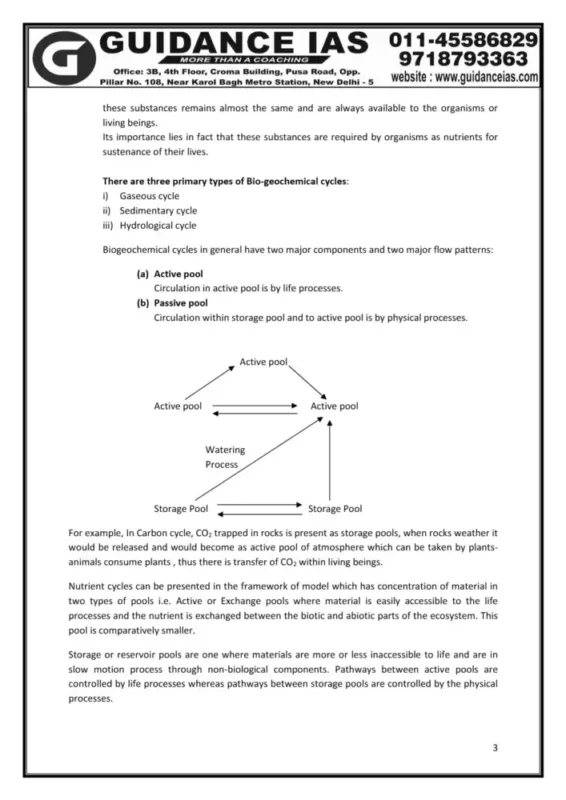
Environmental geography is an increasingly important UPSC optional topic that also overlaps with General Studies Paper 3. This booklet by Himanshu Sharma covers ecosystem structure and function, food chains and food webs, energy flow through ecosystems, and the major biogeochemical cycles β€” carbon, nitrogen, and water. Environmental problems including deforestation, desertification, acid rain, ozone depletion, and plastic pollution are covered with their geographical dimensions β€” helping UPSC aspirants write answers that combine physical geography with current affairs effectively.

International environmental agreements β€” from Stockholm 1972 to Rio Earth Summit, Kyoto Protocol, Nagoya Protocol, and the Paris Agreement 2015 β€” are presented in a chronological framework that aids retention. Sustainable development concepts, the Brundtland Commission, Agenda 21, and the 17 SDGs are linked to geographical themes throughout. Guidance IAS under Himanshu Sharma specifically addresses how environmental geography questions in UPSC optional frequently require answers that bridge science, policy, and contemporary events β€” this booklet is structured to enable exactly that kind of integrated response.

Booklet 6: Perspectives in Human Geography

The evolution of geographical thought is a consistent UPSC Geography optional Paper 1 Section B topic. This booklet traces the development of geography from classical Greek and Arab geography through the determinism of Ratzel, possibilism of Vidal de la Blache, and the stop-and-go determinism of Griffith Taylor. The quantitative revolution β€” spatial analysis, model building, and the use of statistics in geography β€” is treated with appropriate depth for UPSC optional, along with the subsequent behavioral and humanistic reactions against it led by geographers like Yi-Fu Tuan and Anne Buttimer.

Radical geography (Harvey, Peet), feminist geography, and postmodern approaches to geographical thought are given concise but UPSC-appropriate coverage. Himanshu Sharma at Guidance IAS organizes this booklet chronologically and thematically, making it easy to compare schools of thought β€” a skill directly tested in UPSC Geography optional. The contributions of Hartshorne on the nature of geography and Carl Sauer on cultural landscape are individually profiled. The booklet closes with the regional concept β€” formal, functional, and vernacular regions β€” and contemporary relevance of regional geography for UPSC Mains.

Booklet 7: Economic Geography β€” Agriculture and Industry

Economic geography covers a significant portion of UPSC Geography optional Paper 2. This booklet addresses world agricultural systems from subsistence to commercial, plantation to mixed farming, and their global distribution patterns. Von Thunen’s model of agricultural land use is explained with diagrams and real-world applications. The Green Revolution, its geographical spread, and food security implications are treated in the context of UPSC Mains answer requirements. Global commodity distribution β€” wheat, rice, cotton, rubber, coffee β€” is mapped and explained with climate-soil linkages.

Industrial location theory gets full treatment β€” Weber’s least-cost theory, Losch’s profit maximization, Pred’s behavioral matrix β€” all with UPSC-style applications. Major industrial regions of the world β€” Manufacturing Belt of USA, Ruhr Valley, Donbas, Tokyo-Yokohama β€” are profiled with their locational factors and contemporary changes under globalization and deindustrialization. India’s industrial geography is introduced here and expanded in Booklet 11. Special economic zones, global value chains, and the geography of services including IT corridors are covered with relevance to UPSC optional Paper 2 questions.

Booklet 8: Population and Settlement Geography

Population geography and settlement geography form core UPSC optional Paper 2 topics. This booklet covers world population distribution β€” factors of density and sparsity, ecumene and non-ecumene β€” along with demographic transition theory and its four stages. Migration theories by Ravenstein (laws of migration) and Lee (push-pull model) are covered with contemporary examples. World urbanization trends, problems of over-urbanization in developing countries, and counter-urbanization in developed countries are explained with UPSC answer-writing frameworks that Himanshu Sharma has refined at Guidance IAS.

Christaller’s central place theory, the rank-size rule, and the primate city concept are presented with diagrams and empirical examples. Rural settlement patterns β€” nucleated, dispersed, linear, and planned β€” and their geographic controls are covered alongside urban morphology models (Burgess, Hoyt, Harris-Ullman). Urban problems β€” housing, slums, traffic, pollution β€” and urban planning solutions are treated from a UPSC Geography optional perspective. The booklet bridges directly into the India-specific population and urban geography content in Booklets 10 and 11, making the learning sequence logical and progressive.

Booklet 9: Regional Planning and Political Geography

Regional planning and political geography together address UPSC optional Paper 2 Section A in depth. The regional planning section covers the concept of a region, types of regionalization, regional disparities and development planning, river basin planning (TVA model and Indian applications), watershed management, and the geography of poverty. Himanshu Sharma’s Guidance IAS notes connect regional planning theory to India-specific examples β€” backward districts, tribal area planning, hill area development β€” which gives UPSC aspirants contemporary data to use in their answers.

Political geography covers the geographical basis of the state, nation-state concept, boundaries β€” geometric, natural, cultural, and superimposed β€” and boundary disputes with examples from South Asia and globally. Heartland (Mackinder) and Rimland (Spykman) theories are presented in their historical and contemporary relevance for UPSC. UNCLOS provisions including EEZ, continental shelf, and maritime boundary disputes are explained clearly. Electoral geography, gerrymandering, and the geography of voting behavior are covered as they relate to UPSC Mains questions that integrate geography with governance and international relations.

Booklet 10: Geography of India β€” Physical

India’s physical geography is tested extensively in UPSC Geography optional Paper 2 Section B and also connects to General Studies. This booklet covers the physiographic divisions of India β€” Himalayan ranges (Greater, Lesser, Outer Himalayas), Indo-Gangetic Plains, Peninsular Plateau (Deccan, Chota Nagpur, Meghalaya), Coastal Plains (Malabar, Coromandel), and Island groups. The geological evolution of the subcontinent β€” Gondwanaland breakup, peninsular shield stability, and Himalayan orogeny β€” provides the structural basis for understanding India’s resource distribution and disaster vulnerabilities tested in UPSC optional.

The drainage system of India β€” the Himalayan (consequent, antecedent) and Peninsular rivers, their regimes and inter-linking proposals β€” is covered with river system diagrams. Indian monsoon mechanism β€” its onset, withdrawal, variability, and geographical controls β€” is treated in detail including ENSO and Indian Ocean Dipole linkages. Soil types across India, natural vegetation zones, biosphere reserves, and wildlife sanctuaries are catalogued. Disaster-prone zones β€” earthquake zones (I to V), flood-prone districts, cyclone belts (Bay of Bengal vs. Arabian Sea) β€” are mapped and explained for UPSC optional answer writing.

Booklet 11: Geography of India β€” Human and Economic

India’s human and economic geography is a high-scoring area in UPSC optional Paper 2. This booklet covers India’s population geography using latest census data trends β€” distribution, density, literacy, sex ratio, urbanization levels, religious and linguistic diversity mapped geographically. The demographic dividend concept, youth bulge, and aging population geography are treated with UPSC answer-writing guidance. Poverty mapping, HDI by states, and inter-state development disparities are covered with data tables that Himanshu Sharma updates for the 2025-26 batch at Guidance IAS.

Agricultural geography of India β€” cropping seasons (Kharif, Rabi, Zaid), irrigation types and coverage, Green Revolution regions, food grain production patterns, agricultural diversification β€” is covered in detail. Industrial geography maps major manufacturing industries β€” iron and steel, textile, chemical, auto β€” with their locational factors and current distribution. Transport geography (road, rail, waterways, airways) and trade geography including India’s export-import patterns are addressed. Urban geography including smart cities, AMRUT, and urban agglomeration growth rounds out this booklet’s coverage of topics directly tested in UPSC optional Paper 2.

Booklet 12: Map Work, Diagrams and Previous Year Questions

The final booklet in Himanshu Sharma’s Guidance IAS Geography optional set serves as a dedicated revision and practice tool. World map practice covers important straits, passes, water bodies, mountain peaks, deserts, rivers, and international boundaries that frequently appear in UPSC optional questions requiring locational identification. India map work covers rivers, dams, wildlife sanctuaries, industrial corridors, and cities frequently referenced in UPSC optional Paper 2. All map locations are annotated with brief notes on their geographical or geopolitical significance.

Diagrams for all major Geography optional concepts β€” geomorphic cycles, atmospheric circulation cells, ocean current maps, soil profiles, demographic transition curve, central place hierarchy, Von Thunen rings, Weber’s triangle β€” are compiled here for quick visual revision before UPSC Mains. Previous year UPSC Geography optional questions from both Paper 1 and Paper 2 are organized topic-wise with model answer frameworks that Himanshu Sharma has developed through years of teaching at Guidance IAS. Time management strategies and presentation tips for maximizing marks in UPSC optional answer writing complete this booklet.

Physical Construction and Quality Standards

When you buy Himanshu Sharma Guidance IAS Geography optional printed notes, you receive booklets manufactured to withstand months of daily UPSC preparation β€” the paper, printing, and binding are chosen specifically for the demands of optional subject study involving maps, diagrams, and dense written content.

Paper Quality: 75 GSM Anti-Glare White Paper

Each of the 12 Geography optional booklets uses 75 GSM ultra-white, anti-glare paper with high opacity ratings. This means that when you use multiple highlighter colors β€” yellow for definitions, green for examples, orange for UPSC previous year links β€” ink does not bleed through to the reverse side. Aspirants who study Geography optional for 6 to 8 hours daily will appreciate the anti-glare surface that reduces eye strain significantly compared to glossy or bright-white paper. Gel pens and ballpoint pens both write smoothly without feathering or ghosting on this paper grade.

Printing Technology: High-Resolution Laser Printing

All maps, diagrams, flowcharts, and text in these Guidance IAS Geography optional booklets are printed using high-resolution laser printing technology. Geography optional is a diagram-heavy subject β€” geomorphic cycle diagrams, atmospheric pressure diagrams, ocean current maps, soil profile sections, and demographic transition curves all require sharp, clear reproduction. Laser printing delivers crisp line work and permanent toner that does not smudge when pages are turned quickly or when booklets are stored in bags during field travel. Text remains legible even in reduced font sizes used for reference tables and map keys throughout Himanshu Sharma’s notes.

Binding and Durability

The 18 Booklets in this Guidance IAS Geography optional set are available in spiral or book binding depending on stock. Spiral-bound booklets open completely flat on a desk β€” essential when drawing diagrams or writing Geography optional practice answers alongside the notes. The 300 GSM laminated covers protect booklets from moisture, corner damage, and daily bag wear during UPSC preparation. Book-bound editions offer a more compact form factor for storage on bookshelves. Either format delivers booklets that hold together for the full duration of UPSC Mains preparation without page separation or spine failure.

Key Features and Study Design

These Himanshu Sharma Guidance IAS Geography optional notes are built around what UPSC optional examiners actually test β€” not generic textbook content but structured, answer-oriented material that helps aspirants convert study time directly into marks in the Geography optional paper.

  • Full Syllabus Coverage in 18 Booklets: All UPSC Geography optional Paper 1 topics (Physical Geography, Geomorphology, Climatology, Oceanography, Biogeography, Human Geography perspectives) and Paper 2 topics (Economic Geography, Population and Settlement, Political Geography, India Geography) are covered across 12 dedicated booklets, ensuring no syllabus gap when you buy this complete set.
  • Diagram-Rich Format for Geography Optional: Geography optional is one of the most diagram-dependent UPSC optional subjects. Himanshu Sharma’s Guidance IAS notes include labeled diagrams for every major concept β€” atmospheric cells, fluvial landforms, tectonic features, soil profiles, and demographic curves β€” all reproducible in UPSC Mains answer sheets within exam time constraints.
  • UPSC Previous Year Question Integration: Questions from UPSC Geography optional papers over the past ten years are woven into the notes topic-wise, helping aspirants understand the pattern of how each concept is tested, what depth of answer is expected, and which topics carry higher repetition frequency. This directly improves UPSC optional exam performance.
  • Updated for 2025-26 UPSC Cycle: The Guidance IAS 2025-26 batch notes by Himanshu Sharma incorporate the latest data β€” updated census figures, new industrial corridors, revised environmental agreements, and current geopolitical geography developments β€” that UPSC optional questions increasingly reference in contemporary context questions.
  • English Medium, Structured for Self-Study: Written in clear, exam-appropriate English, these printed notes can be used independently without attending Guidance IAS classroom sessions. The language is precise and the structure β€” definitions, explanations, diagrams, examples, UPSC relevance β€” follows a consistent pattern across all 18 Booklets, making them equally effective for self-study aspirants who buy online and prepare from home.

Shipping, Packaging and Delivery

When you buy Himanshu Sharma Guidance IAS Geography optional notes from our store, every order is packed with the care that printed UPSC study material deserves. All 18 Booklets are individually shrink-wrapped to prevent moisture entry during transit. The complete set is then packed in a double-wall corrugated cardboard box with foam edge protectors at all four corners. Fragile stickers are applied to discourage rough handling. This packaging protocol ensures that your Geography optional notes arrive in the same brand-new, unmarked condition they left our warehouse in, regardless of how far the delivery travels across India.

We deliver pan India in 3-5 business days with full tracking. Once your order is dispatched, a tracking ID is shared via WhatsApp at +91 70045 49563 so you can monitor your shipment in real time. If any booklet in your Geography optional set arrives with a printing defect, missing pages, or transit damage, we replace the affected booklet within 48 hours of you reporting it to us on WhatsApp. We ship to all major cities and towns across India β€” Delhi, Mumbai, Chennai, Kolkata, Bengaluru, Hyderabad, Patna, Lucknow, Jaipur, Bhopal, and all other locations where UPSC aspirants buy printed notes online.

Frequently Asked Questions (FAQ)

Q1: Are Himanshu Sharma Geography notes sufficient for UPSC optional?

A: Himanshu Sharma’s Guidance IAS Geography optional notes cover the complete UPSC optional syllabus across 18 Booklets β€” Physical Geography, Human Geography, Economic Geography, and India Geography for both Paper 1 and Paper 2. For most UPSC aspirants, these notes combined with standard reference books like Majid Husain for Human Geography and NCERT atlases for map work form a sufficient and well-rounded study resource. Toppers using structured coaching notes alongside standard references consistently perform well in Geography optional.

Q2: How many booklets are included in Guidance IAS Geography optional notes?

A: This set includes 12 individual printed booklets covering the complete UPSC Geography optional syllabus. The booklets span Climatology, Geomorphology, Oceanography, Biogeography and Soil Geography, Environmental Geography, Perspectives in Human Geography, Economic Geography, Population and Settlement Geography, Regional Planning and Political Geography, Physical Geography of India, Human and Economic Geography of India, and a final Map Work and Previous Year Questions booklet. All 12 are included in a single order when you buy online from our store.

Q3: Is Guidance IAS Geography notes available in English medium?

A: Yes, this product is the English medium edition of Himanshu Sharma’s Guidance IAS Geography optional notes for 2025-26. All 18 Booklets β€” text, diagrams, maps, tables, and model answer frameworks β€” are entirely in English. These notes are specifically designed for UPSC aspirants who write their optional papers in English medium. If you are looking for Hindi medium Geography optional notes, please check our store separately as availability varies by batch and edition.

Q4: What is the price of Himanshu Sharma Geography notes 2025-26?

A: The current price of the complete 18-booklet set of Himanshu Sharma Guidance IAS Geography optional notes 2025-26 is listed on this product page and is updated regularly. Our store offers these printed notes at competitive prices significantly lower than buying directly at coaching centers in Delhi. Occasional discount offers are announced on our WhatsApp channel at +91 70045 49563. The price covers all 18 Booklets, secure packaging, and pan India tracked delivery within 3-5 business days.

Q5: Do Guidance IAS Geography notes cover the full UPSC optional syllabus?

A: Yes, the 18 Booklets in this Himanshu Sharma Guidance IAS set cover the complete UPSC Geography optional syllabus as prescribed by the UPSC for Civil Services Mains Examination. Paper 1 coverage includes Physical Geography (Geomorphology, Climatology, Oceanography, Biogeography, Environmental Geography) and Perspectives in Human Geography. Paper 2 coverage includes Economic Geography, Population, Settlement, Regional Planning, Political Geography, and the full India Geography section. UPSC aspirants can cross-check coverage against the official UPSC Geography optional syllabus notification.

Q6: Are these Geography notes updated for UPSC 2025-26 exam?

A: Yes, these are the genuine 2025-26 batch notes from Guidance IAS, updated by Himanshu Sharma for the current UPSC examination cycle. Updates include the latest demographic and census data, new industrial corridors and infrastructure geography, current environmental geography developments including COP updates and climate data, and recently tested UPSC optional question patterns. When you buy these printed notes from our store, you receive the current batch stock β€” not old editions from previous years.

Q7: How do Himanshu Sharma Geography notes compare to other coaching notes?

A: Himanshu Sharma’s Guidance IAS Geography optional notes are known for their structured approach to diagram integration and UPSC previous year question linkage throughout each booklet. Compared to other coaching notes available in the market, these notes offer strong coverage of geographical thought and economic geography which are areas where many aspirants lose marks. The 18-booklet format breaks the large UPSC optional syllabus into manageable study units. Ultimately, the best notes are the ones an aspirant consistently revises β€” buying printed notes and revising multiple times is the proven UPSC optional strategy.

Q8: Can I buy Guidance IAS Geography optional notes online with home delivery?

A: Yes, you can buy Himanshu Sharma Guidance IAS Geography optional notes 2025-26 directly from this page with secure online payment and pan India home delivery in 3-5 business days. We deliver to all states and union territories in India. You do not need to visit Karol Bagh, Delhi or any coaching center to access these notes. Orders are tracked and a WhatsApp update is sent at +91 70045 49563 upon dispatch. This makes buying printed UPSC study material online from anywhere in India completely convenient.

Q2: What is the paper quality? Can I use a highlighter?

A: These booklets use 75 GSM ultra-white paper chosen for high opacity β€” multiple highlighter colors and gel pens work without bleed-through to the reverse side, ideal for color-coded revision. Geography optional involves heavy annotation β€” circling map features, underlining key processes, marking UPSC question-relevant points β€” and this paper grade handles all of that without degrading readability. The anti-glare surface also makes long study sessions of 6 to 8 hours significantly more comfortable on the eyes than reflective paper alternatives.

Q10: Are these notes useful for State PSC Geography optional candidates?

A: Yes, while these notes are primarily designed for UPSC Civil Services Mains Geography optional, they are equally useful for BPSC, UPPSC, MPPSC, RAS, and all other State PSC examinations that offer Geography as an optional subject. The India Geography booklets (Booklets 10 and 11) are particularly relevant for state PSC candidates who need strong coverage of Indian physical and human geography. The content standard and syllabus alignment across all 18 Booklets makes them a strong resource for any competitive examination featuring Geography optional.

Q11: How should I sequence my study using these 18 Booklets?

A: Himanshu Sharma recommends beginning with Geomorphology (Booklet 2) and Climatology (Booklet 1) as the foundation of Physical Geography before moving to Oceanography (Booklet 3) and Biogeography (Booklet 4). After completing Paper 1 physical sections, move to Perspectives in Human Geography (Booklet 6) and then Economic Geography (Booklet 7) and Population Geography (Booklet 8). The India Geography booklets (10 and 11) are best studied after the world geography concepts are clear. Use the Map Work and PYQ booklet (Booklet 12) continuously throughout preparation as a running revision tool.

Q12: What if a booklet is missing or damaged when I receive the order?

A: If any booklet in your 18-booklet Geography optional set arrives damaged, with missing pages, or if a booklet is missing from the package, contact us immediately on WhatsApp at +91 70045 49563 with a photo of the received package. We replace the affected booklet within 48 hours of report at no additional cost to you. Our packaging protocol β€” shrink wrap, corrugated box, foam edge protectors β€” is specifically designed to prevent transit damage. In the rare event of courier mishandling, we resolve it fully and promptly so your UPSC preparation is not disrupted.

Summary

SpecificationValue
Booklets12 Printed Booklets
LanguageEnglish Medium
FacultyHimanshu Sharma β€” Guidance IAS
Edition2025-26
Paper75 GSM Ultra-White
BindingSpiral or Book Binding
Delivery3-5 Business Days Pan India
Also Useful ForBPSC, UPPSC, MPPSC, RAS, and all State PSC Geography Optional

Sold by UPSC Store β€” Mukherjee Nagar, Delhi. Buy Himanshu Sharma Guidance IAS Geography optional printed notes online and receive your complete 18-booklet set with pan India delivery in 3-5 days.

Reference: Civil Services Examination

Customer Reviews 275

4.5
Based on 275 reviews
5β˜…
164
4β˜…
81
3β˜…
30
2β˜…
0
1β˜…
0
A
Arjun Mishra
20 Apr 2026
βœ“ Verified

Quality mein koi compromise nahi hai.

S
Sanjay Reddy
18 Apr 2026
βœ“ Verified

Content is decent lekin zyada innovative nahi hai. Booklets cover syllabus but presentation average hai.

H
Harish Chopra
18 Apr 2026
βœ“ Verified

Geography prepration ke liye best hai. Recommend karunga sabko.

D
Divya Nair
17 Apr 2026
βœ“ Verified

Guidance IAS material quality ke liye jaana hai, bilkul sach hai.

H
Harsh Puri
16 Apr 2026
βœ“ Verified

Basics ke liye theek hai lekin advanced topics thoda weak lagta hai. Revision notes ke liye acha hai.

S
Shreya Bhat
15 Apr 2026
βœ“ Verified

Very detailed yet easily digestible material. Packing quality bhi excellent, booklets bilkul intact paaye.

V
Vikram Patel
14 Apr 2026
βœ“ Verified

Mujhe geography samajhne mein kafi help mila in booklets. Content ko coverage 10/10 hai.

M
Manish Tiwari
11 Apr 2026
βœ“ Verified

Quality achhi hai overall, lekin 18 booklets thode heavy hain carry karne mein.

πŸ›οΈ

Aspirants Also Bought

More from the same category

View All β†’

About Himanshu Sharma Geography Notes

Himanshu Sharma Geography Notes is a highly recommended UPSC study material from Guidance IAS, specially designed for Geography preparation. Available in English medium, this material is crafted to match the exact requirements of the UPSC Civil Services Examination syllabus β€” covering both Prelims and Mains comprehensively.

Product Details

  • Institute: Guidance IAS
  • Subject: Geography
  • Medium: English
  • Format: Printed
  • Delivery: Pan-India delivery in 3–5 working days
  • Format: Original printed material, verified authentic

Why Buy from UPSC Store?

  • βœ… 100% Genuine Printed Material β€” Original printed notes, no photocopies or fake copies
  • βœ… Fast Delivery β€” Ships within 24 hours, arrives in 3–5 days pan-India
  • βœ… Secure Packaging β€” Bubble-wrapped and boxed to prevent damage in transit
  • βœ… Trusted by 10,000+ Aspirants β€” India's most reliable UPSC material marketplace
  • βœ… WhatsApp Support β€” Get expert guidance on material selection before ordering

Frequently Asked Questions

Is this product 100% original?

Yes, all products at UPSC Store are 100% genuine printed materials. We do not sell photocopies or fake copies.

How long does delivery take?

Orders are dispatched within 24 hours and delivered across India in 3–5 working days via reputed courier partners.

Can I return the product?

Yes, we accept returns within 7 days if the product is damaged or incorrect. Check our refund policy for details.

Which other study materials should I buy with this?

We recommend pairing this with current affairs notes and a UPSC test series for comprehensive preparation. Browse more in Geography, Optional, UPSC.