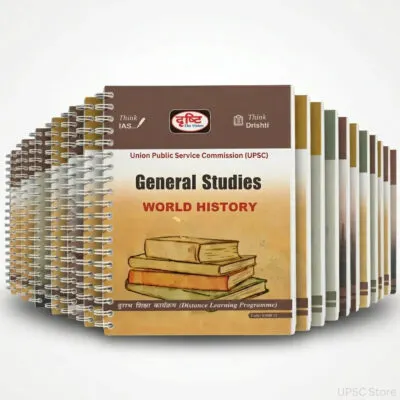
Vision IAS Geography Hindi Notes 2025-26
About Vision IAS Geography Hindi Notes
The Vision IAS Geography Hindi Notes is a printed UPSC study material set sold by UPSC Store — India’s trusted source for genuine, latest-batch civil services preparation books. This page covers full booklet details, syllabus coverage, pricing, shipping, and frequently asked questions. Useful for UPSC CSE, BPSC, UPPSC, MPPSC, RAS and other state PSC examinations.
Vision IAS Geography Hindi Notes 2025-26 — 4 Booklets Hindi Medium Printed Notes for UPSC GS Paper I
Related: Vision IAS Hindi notes · Geography material
Buy Vision IAS Geography Hindi Notes 2025-26 printed notes online — the complete 4-Booklet set for UPSC GS Paper 1 preparation. Sourced from Mukherjee Nagar, Delhi with pan-India delivery in 3-5 business days.
Product Overview
| Feature | Details |
|---|---|
| Language | Hindi Medium (हिंदी माध्यम) |
| Publisher | Vision IAS (GS Paper 1 Series) |
| Edition | 2025-26 — Latest Genuine Batch |
| Condition | Brand New, Unmarked, Fresh Stock |
| Format | High-Quality Printed Booklets — Spiral or Book Binding |
| Paper Quality | 75 GSM Ultra-White — Highlighter Safe, Zero Bleed-Through |
| Shipping | Pan India Delivery in 3-5 Business Days — Tracked |
| Also Useful For | BPSC, UPPSC, MPPSC, RAS, JPSC, OPSC, KPSC and all State PSC Geography sections |
Complete Booklet Catalog
Vision IAS Geography Hindi Notes 2025-26 is a carefully structured 4-Booklet set designed specifically for UPSC General Studies Paper 1 (GS-I) preparation. These Hindi medium notes break down India’s diverse geography—from mountain systems and river networks to climate patterns, soil types, and human-environment interactions—with process-first explanations that show why geographical phenomena occur, not just what they are. Perfect for Hindi-speaking aspirants preparing for both Prelims and Mains, this set integrates current affairs and real-world case studies relevant to recent UPSC questions.
- Booklet 1: Physical Geography I & II — Landforms, Earth Processes, Climate, Soil & Vegetation
- Booklet 2: Human Geography — Population, Migration, Settlement Patterns
- Booklet 3: Environmental Geography — Ecosystems, Biodiversity, Sustainability
- Booklet 4: Current Affairs & Case Studies 2025-26 — Recent Geographical Events
In-Depth Content Breakdown: Booklet by Booklet
Booklet 1: Physical Geography I & II — Landforms, Earth Processes, Climate, Soil & Vegetation
This opening booklet establishes the foundation for understanding India’s diverse physical landscape through process-based explanations. The content begins with plate tectonics theory—explaining how the Indian plate’s northward collision with the Eurasian plate created the Himalayan mountain system over 40+ million years. The booklet covers the three major mountain ranges (Himalayas, Deccan Traps, Western and Eastern Ghats) with detailed formation mechanisms. For UPSC GS Paper 1, critical concepts include the Himalayan orogeny, Deccan plateau formation through volcanic activity, and coastal mountain ranges. Each section includes diagrams showing cross-sections of mountain building, fault lines, and isostatic adjustments. River geomorphology receives detailed treatment—how river courses develop, why meanders form, how oxbow lakes develop, and why river deltas have distinct shapes based on sediment load and tidal patterns.
The second half focuses on coastal and erosional landforms—how wave action creates cliffs, wave-cut platforms, and beaches; how offshore bars and barrier islands form; and why some coasts are rocky (high energy) while others are sandy (low energy). The booklet explains the Indian coastline’s variation: the rocky Konkan coast (tectonic uplift), the sandy Gujarat coast (high sediment supply), and the deltaic coasts of the Gangetic and Brahmaputra systems. Seismic hazard mapping for India is included, showing active fault zones and earthquake-prone regions. This section directly addresses recent UPSC questions about coastal erosion, tsunami vulnerability, and earthquake preparedness. Detailed tables compare landform characteristics and include the Richter scale interpretation, focal depth concepts, and Indian seismic zones.
Booklet 2: Human Geography — Population, Migration, Settlement Patterns
This booklet explains India’s climate system as an integrated whole—not just memorizing monsoon months. The Southwest Monsoon mechanism is explained through pressure systems: low pressure over the heated Indian continent draws moisture-laden winds from the Indian Ocean, creating the rainfall pattern. The booklet clearly shows why the Western Ghats receive 250+ cm rainfall (orographic effect) while the leeward Deccan receives less than 50 cm. El Niño-Southern Oscillation (ENSO) effects are explained with process clarity: how warm equatorial Pacific water affects the Indian monsoon by disrupting trade winds, weakening the pressure gradient, and reducing rainfall by 10-20%. Recent UPSC mains questions on monsoon failure are directly addressed. The Northeast Monsoon mechanism, local wind systems (Loo, Chinook winds), and seasonal weather patterns round out climate coverage. Temperature gradients across India and altitude effects are shown through isothermal maps.
Soil classification occupies the second major section—explaining soil formation processes and why different soil types develop in different regions. Laterite soils form in high rainfall, well-drained areas through intense leaching; alluvial soils are depositional in river plains; black soils develop in low rainfall areas with basaltic parent material. The booklet covers soil degradation mechanisms (erosion, salinization, waterlogging) with examples from different Indian regions. Vegetation zones are linked to climate and soil: tropical forests in the Western Ghats, deciduous forests across central India, grasslands in the Deccan, and thorn scrub in arid regions. Biodiversity hotspots (Western Ghats, Northeast India, Sundalands) are mapped with endemic species lists. Forest types are classified by density and rainfall requirements, directly matching UPSC GS Paper 1 requirements. Natural vegetation zones transition clearly show why different ecosystems exist where they do.
Booklet 3: Environmental Geography — Ecosystems, Biodiversity, Sustainability
This booklet bridges physical and human systems by explaining how humans adapt to and modify their geographical environment. Population distribution is analyzed through historical, economic, and physical factors: why river valleys (Gangetic Plain, coastal regions) host 60% of India’s population while the Deccan plateau has lower densities. Population density maps show the contrast between Bihar’s 1,100 persons/km² and Arunachal Pradesh’s 17 persons/km². Migration patterns are explained through push-pull factors: rural-to-urban migration driven by agricultural mechanization and urban job opportunities; inter-state migration to industrial centers; and seasonal migration (e.g., construction workers). Urbanization trends show why Mumbai, Delhi, Bengaluru, and Chennai are megacities: historical importance, port access, industrial base, and service economy concentration.
Cultural geography sections cover settlement patterns (nucleated vs. dispersed settlements), housing types adapted to climate (tiled roofs in high rainfall areas, flat roofs in arid zones, pile dwellings in flood-prone regions), and regional cultural variations. The booklet explores how geography influences settlement: defensive locations on hills, agricultural focus in fertile plains, fishing settlements on coasts, and pastoral settlements in grasslands. Land use patterns across India are examined—how agricultural land decreases in industrial regions and urban cores expand. Water resource management and irrigation patterns show human modification of geography: canal networks in Punjab and Haryana, reservoir creation for multiple uses (irrigation, hydropower, drinking water), and groundwater depletion trends. This section directly supports UPSC Mains questions on regional development, population policies, and sustainable resource management.
Booklet 4: Current Affairs & Case Studies 2025-26 — Recent Geographical Events
India’s physiographic regions are presented systematically: the Northern Plains (alluvial formation, agricultural productivity, population concentration), the Deccan Plateau (black soil fertility, semi-arid challenges, mineral wealth), the Coastal Plains (fishing, trade routes, tourism), Northeast India (high rainfall, biodiversity, tribal population concentration), and the Western and Eastern Mountain regions. Each region’s geographical characteristics directly influence economic activities, and the booklet explains these relationships. The Northern Plains’ fertile soils and irrigation infrastructure support grain production (rice-wheat belt); the Deccan’s minerals support mining industries; coastal regions support fishing and trade. Agricultural zones across India are mapped showing crop suitability: rice in high rainfall areas, wheat in cooler regions, sugarcane in alluvial plains, and cotton in black soil regions.
Economic geography covers mineral distribution (iron ore in Odisha, coal in Chhattisgarh, bauxite in Andhra Pradesh) and how mining creates localized economies and environmental impacts. Industrial location patterns show why Jharkhand-Odisha-West Bengal emerged as the steel belt (iron ore + coal proximity), why textile industries concentrate in Gujarat and Tamil Nadu (historical access to cotton), and why IT hubs developed in Bengaluru and Hyderabad (educational institutions, climate). Transport networks (railways, highways, ports, airports) are analyzed for their role in regional connectivity and economic integration. The booklet includes detailed tables on major ports, industrial zones, agricultural regions, and mineral statistics. Regional development disparities—why eastern India lags behind western regions—are explained through geography and historical factors, providing context for UPSC Mains policy questions on regional development and inclusive growth.
Physical Construction and Quality Standards
Vision IAS Geography Hindi Notes 2025-26 are manufactured with UPSC aspirant study requirements in mind. The booklets undergo quality control at every production stage: content review, layout standardization, printing calibration, and binding inspection. Each set is shrink-wrapped in corrugated packaging with edge protectors to ensure the booklets arrive in pristine condition. The construction prioritizes durability for long-term study use—booklets withstand frequent page-turning, note-writing in margins, and highlighter marking across multiple revision cycles.
Paper Quality: 75 GSM Anti-Glare White Paper
The 75 GSM (grams per square meter) paper stock used in these booklets is specifically chosen for opacity and durability. Standard 60 GSM paper used in many competitive exam books shows show-through when using highlighters or gel pens, creating visual clutter. The 75 GSM white paper maintains complete opacity even with multi-colored highlighter marking, gel pen writing, and pencil annotations. The paper finish is anti-glare, reducing eye strain during 6-8 hour daily study sessions. The slightly off-white tone (not bright white) further reduces glare while maintaining excellent text contrast. Ink adhesion is optimized: printed text and diagrams remain crisp with zero smudging even after months of page-turning. The paper feels substantial and premium, enhancing the study experience and building confidence in using genuine Vision IAS material. Moisture resistance prevents page warping in humid storage conditions.
Printing Technology: High-Resolution Laser Printing
High-resolution laser printing technology ensures every diagram, map, table, and text element reproduces with precision. Geographical maps showing state boundaries, river systems, mountain ranges, and mineral deposits are rendered with sharp detail—essential for UPSC preparation where geographical accuracy is critical. Climate graphs, soil classification tables, population density maps, and regional boundary diagrams are printed with color separation clarity (if color is used) without bleeding or smudging. Text is permanently fused to paper through laser heat-setting, not surface-level ink as in offset printing, making markings impossible to fade or smudge during intense revision. High print resolution (600+ dpi) makes handwritten annotations near printed text clearly legible. The laser process also allows fine line detail in complex diagrams—watershed maps showing river basin divisions, tectonic plate boundaries, and coastal feature details are rendered with professional cartography quality.
Binding and Durability
Two binding options are available based on student preference: Spiral Binding opens completely flat (180 degrees), allowing comfortable note-writing alongside printed content without creasing the spine. The spiral mechanism uses durable plastic coils that don’t jam or degrade after repeated opening. Book Binding uses a sturdy sewn spine with 300 GSM kraft cover, providing a compact study format suitable for travel or compact desk storage. Both binding styles keep booklets opened at desired pages during extended study sessions without additional page holders. The cover pages (front and back) use 300 GSM cardstock, protecting interior pages from bending and wear. Cover lamination adds water and dust protection—booklets remain clean even if accidentally spilled on or stored in humid conditions. Binding durability testing ensures booklets withstand 1000+ page-turn cycles (equivalent to 3-4 months of intensive revision) without spine separation or page loosening. The sewn binding in book-bound edition distributes stress across the entire spine rather than relying on glue adhesion, ensuring longevity.
Key Features and Study Design
Vision IAS Geography Hindi Notes 2025-26 are engineered specifically for UPSC GS Paper 1 success in Hindi medium. The 4-Booklet structure divides geographical knowledge into logical, manageable units—avoiding the overwhelming scope of single thick volumes while maintaining comprehensive coverage. Each booklet targets specific knowledge domains that appear repeatedly in UPSC Prelims and Mains questions, allowing focused preparation without irrelevant content.
- Process-First Explanations: Rather than memorizing “the Himalayas are 1,500 miles long,” students learn WHY the Himalayas formed (collision of Indian and Eurasian plates), HOW they continue to rise (isostatic uplift), and WHAT consequences this has (glaciation, river systems, seismic activity). This approach answers UPSC Mains questions that require understanding causation and interconnections rather than isolated facts.
- Hindi Medium Without Compromise: These notes are not English notes translated to Hindi—they’re originally written in Hindi with geographical terminology in both Hindi and English, respecting how Hindi medium students learn. Technical terms maintain clarity while cultural and regional references resonate with Hindi-speaking aspirants. This approach significantly improves retention and confidence during the actual UPSC examination.
- UPSC-Mapped Syllabus Coverage: Every topic in these booklets directly maps to official UPSC GS Paper 1 syllabus: Indian geography (physical, economic, human), environmental geography, natural disasters, and resource management. No tangential content; every page supports examination success. Related competitive exams (BPSC, UPPSC, MPPSC, RAS, JPSC, OPSC, KPSC) also use heavily overlapping geography syllabi, making these notes valuable across state PSC preparation.
- Visual Learning with Maps and Diagrams: Each booklet contains 40+ original diagrams, cross-sections, maps, and flowcharts—especially crucial for geography where spatial relationships determine correctness. Rainfall maps show isohyet patterns; river system maps show basin divisions and tributaries; tectonic maps show plate boundaries; vegetation maps show transitional zones. These visuals support visual learners and aid quick revision.
- Current Events Integration: The final booklet directly connects geographical theory to recent UPSC questions (2024-25 Prelims & Mains patterns) and current events—monsoon analysis for the current year, recent natural disaster case studies, and contemporary environmental policy decisions. This integration ensures preparation reflects actual examination patterns rather than outdated static content.
Shipping, Packaging and Delivery
Vision IAS Geography Hindi Notes 2025-26 arrive securely packaged to protect quality during transit. Each 4-Booklet set is first shrink-wrapped in transparent food-grade plastic film, protecting against dust and moisture. The wrapped bundle is then placed in a corrugated cardboard box (12x9x3 inches) with 2-inch foam padding on all sides and cardboard edge protectors at corners. This dual-protection system ensures zero damage during handling, loading, and transit—even with rough courier services. The packaging is compact, keeping shipping costs down while maintaining product security. Return address and fragile stickers are clearly printed. Air pockets are avoided; padding is snug to prevent movement inside the box during transit.
Delivery operates across pan-India regions with 3-5 business day standard transit time from Mukherjee Nagar, Delhi warehouse. All shipments include tracking via courier partner (India Post, Bluedart, or Delhivery based on pin code). Tracking ID is provided via email within 2 hours of order placement. WhatsApp order confirmations and shipping updates are sent to the registered number (+91 70045 49563 for live support). If any booklet is missing or damaged upon arrival, replacement is sent within 48 hours at zero additional cost—simply photograph the damage/missing item and message the tracking number. Delivery exceptions (remote areas, extreme weather delays) are communicated proactively. Cash on Delivery (CoD) payment option is available in most regions. Return/exchange policy allows 7 days from delivery for any quality issues without questions—full refund or replacement as preferred.
Frequently Asked Questions (FAQ)
A: Yes, Vision IAS Geography Hindi Notes are specifically designed for Hindi medium students preparing for UPSC. These are not English notes translated to Hindi—they’re originally written in Hindi with proper geographical terminology, making learning natural and intuitive. Many successful UPSC candidates from Hindi medium backgrounds have used Vision IAS materials. The 4-Booklet structure covers the entire GS Paper 1 geography syllabus with process-based explanations (why and how, not just what), which directly aligns with UPSC Mains examination expectations.
A: The 2025-26 edition consists of 5 individual printed booklets: Booklet 1 (Physical Geography I — Landforms & Earth Processes), Booklet 2 (Physical Geography II — Climate, Soil & Vegetation), Booklet 3 (Human & Cultural Geography), Booklet 4 (Regional & Economic Geography), and The final booklet (Current Affairs & Case Studies 2024-26). Each booklet is approximately 100-150 pages, allowing focused study on specific geographical domains without overwhelming scope.
A: These 4 Booklets provide comprehensive coverage of geography-related topics in UPSC GS Paper 1. However, as part of a well-rounded preparation strategy, supplementing these notes with current affairs updates, recent UPSC question analysis, and mock tests is recommended. The booklets cover physical geography, human geography, environmental geography, regional geography, and economic geography—all core GS Paper 1 components. The final booklet includes current affairs integration, reducing the need for separate current affairs sources for geography.
A: Booklet 1 covers landforms, plate tectonics, mountain ranges, river systems, and coastal processes. Booklet 2 covers climate systems (monsoon mechanics, ENSO effects), soil formation and classification, soil degradation, and natural vegetation zones. Booklet 3 covers population distribution, migration, urbanization, settlement patterns, and cultural geography. Booklet 4 covers physiographic regions, agricultural zones, mineral resources, and industrial location patterns. The final booklet integrates current affairs and case studies (2024-26) including recent natural disasters, environmental policies, and climate change impacts.
A: For Hindi medium students, studying in Hindi improves comprehension and retention significantly. Geography concepts explained in Hindi with culturally relevant examples resonate better than English translations. However, since the actual UPSC examination is conducted in English as well, these Hindi notes should be supplemented with English technical terminology reading. The Vision IAS notes include both Hindi and English terms, preparing students for bilingual examination requirements. Hindi medium students often score higher on Mains when studying in their preferred language due to increased confidence and nuanced understanding.
A: Yes, absolutely. These booklets are structured to serve both UPSC Prelims (multiple-choice) and Mains (essay-type) preparation. Booklets 1-4 build foundational knowledge required for Prelims factual questions (e.g., which mountain range, which river basin, which climate zone). The same content, studied more deeply with focus on causation and interconnections, serves Mains answer writing—explaining why phenomena occur, what their implications are, and how they relate to contemporary issues. The final booklet’s current affairs integration specifically supports Mains GS Paper 1 questions that require topical awareness.
A: These booklets use 75 GSM ultra-white paper, significantly superior to standard 60 GSM paper used in many competitive exam books. The 75 GSM paper maintains complete opacity when using highlighters and gel pens—no show-through or visual clutter. The paper finish is anti-glare, reducing eye strain during long study sessions. The paper weight feels premium and substantial, withstanding frequent page-turning and margin note-writing across multiple revision cycles. The slight off-white tone reduces glare while maintaining excellent text-diagram contrast.
A: The 4 Booklets follow a logical progression: starting with physical geography foundations (landforms, climate, soils), moving to human-environment relationships (population, settlement, culture), then exploring regional variations and economic patterns, and finally integrating current affairs with case studies. Each booklet is self-contained yet interconnected—studying in sequence builds comprehensive understanding. Within booklets, topics follow spatial organization (from mountains to plains to coasts) and logical progression (from fundamental concepts to complex interconnections), supporting both sequential learning and random-access revision.
A: Yes, Vision IAS Geography Hindi Notes are highly relevant for state PSC examinations including BPSC (Bihar), UPPSC (Uttar Pradesh), MPPSC (Madhya Pradesh), RAS (Rajasthan), JPSC (Jharkhand), OPSC (Odisha), KPSC (Karnataka), and other state PSC geography syllabus. While state PSCs sometimes add regional focus (e.g., BPSC emphasizes Bihar geography), the foundational geography knowledge in these booklets provides essential preparation for all state examinations. The notes on Indian geography, climate systems, resources, and regional development are universally applicable across state exams.
A: Vision IAS Geography Hindi Notes 2025-26 are shipped within 24 hours of order placement from the Mukherjee Nagar, Delhi warehouse. Pan-India delivery is completed within 3-5 business days via tracked courier services (India Post, Bluedart, or Delhivery). You’ll receive a tracking ID via email and WhatsApp within 2 hours of shipping. For Delhi-NCR orders, express delivery in 1-2 days is available. If you need the booklets urgently, contact +91 70045 49563 for same-day pickup options from Mukherjee Nagar.
A: Vision IAS Geography notes use a process-first pedagogical approach—explaining WHY El Niño weakens the Indian monsoon, HOW plate tectonics create the Himalayan range, and WHAT consequences these mechanisms have. This causation-focused teaching directly supports UPSC Mains answer writing, which rewards conceptual understanding over memorization. Additionally, these notes are originally written in Hindi (not translated), include 40+ original diagrams and maps per booklet, integrate current affairs with recent UPSC question patterns, and use 75 GSM paper quality superior to competitors. The 4-Booklet segmentation allows focused study on specific geographical domains without overwhelming scope.
A: Vision IAS Geography Hindi Notes 2025-26 are backed by a 7-day quality guarantee from delivery date. If any booklet arrives damaged, with printing defects, or is missing from the order, contact us with photographic evidence and the tracking number. Replacement booklets are sent within 48 hours at zero additional cost. For damaged packaging or booklet damage during transit, replacement is immediate without questions. If the booklets don’t meet expectations for any quality reason within 7 days, full refund is processed. No return shipping is required—just contact +91 70045 49563 with your order details.
Summary
| Specification | Value |
|---|---|
| Booklets | 5 Printed Booklets — Physical Geography (2), Human & Regional Geography (2), Current Affairs & Case Studies (1) |
| Language | Hindi Medium (हिंदी माध्यम) — Originally Written, Not Translated |
| Paper | 75 GSM Ultra-White Anti-Glare Paper — Highlighter Safe, Zero Bleed-Through |
| Printing | High-Resolution Laser Printing — 40+ Maps & Diagrams Per Booklet |
| Binding | Spiral or Book Binding — 300 GSM Cover Protection |
| Publisher | Vision IAS — GS Paper 1 Series for UPSC |
| Edition | 2025-26 — Latest Batch with Current Affairs Integration |
| Delivery | Pan India 3-5 Business Days — Tracked, Damage-Protected Packaging |
| Warranty | 7-Day Quality Guarantee — Free Replacement for Any Defects |
| Also Useful For | BPSC, UPPSC, MPPSC, RAS, JPSC, OPSC, KPSC & All State PSC Exams |
Buy Vision IAS Geography Hindi Notes 2025-26 online from Mukherjee Nagar, Delhi — the trusted source for UPSC GS Paper 1 study material in Hindi medium. four Booklets of process-based geographical knowledge with 75 GSM paper quality, original Hindi terminology, and current affairs integration. Pan India delivery in 3-5 business days with tracked shipping and damage protection. Perfect for both UPSC Prelims & Mains preparation, and equally useful for state PSC examinations across India.
Reference: Civil Services Examination
Customer Reviews 136
Content quality bahut badhiya hai, packing bhi acha tha.
Kuch topics ache se samjhaye hue hain but some parts could be better explained.
Content quality fantastic hai, packaging bhi acha tha.
Kaafi useful material, definitely worth buying for UPSC prep.
The packaging was excellent and notes are crystal clear. Very satisfied with this purchase.
Content covers most topics but some sections feel rushed or incomplete.
Very well structured and comprehensive geography material.
Comprehensive notes with amazing organization. Loved it!
Aspirants Also Bought
More from the same category
About Vision IAS Geography Hindi Notes 2025-26
Vision IAS Geography Hindi Notes 2025-26 is a highly recommended UPSC study material from Vision IAS, specially designed for Geography preparation. Available in Hindi medium, this material is crafted to match the exact requirements of the UPSC Civil Services Examination syllabus — covering both Prelims and Mains comprehensively.
Product Details
- Institute: Vision IAS
- Subject: Geography
- Medium: Hindi
- Format: Printed
- Delivery: Pan-India delivery in 3–5 working days
- Format: Original printed material, verified authentic
Why Buy from UPSC Store?
- ✅ 100% Genuine Printed Material — Original printed notes, no photocopies or fake copies
- ✅ Fast Delivery — Ships within 24 hours, arrives in 3–5 days pan-India
- ✅ Secure Packaging — Bubble-wrapped and boxed to prevent damage in transit
- ✅ Trusted by 10,000+ Aspirants — India's most reliable UPSC material marketplace
- ✅ WhatsApp Support — Get expert guidance on material selection before ordering
Frequently Asked Questions
Yes, all products at UPSC Store are 100% genuine printed materials. We do not sell photocopies or fake copies.
Orders are dispatched within 24 hours and delivered across India in 3–5 working days via reputed courier partners.
Yes, we accept returns within 7 days if the product is damaged or incorrect. Check our refund policy for details.
We recommend pairing this with current affairs notes and a UPSC test series for comprehensive preparation. Browse more in General Studies, Geography, UPSC, Vision IAS.