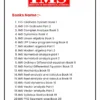
IMS Mathematics Optional Notes 2025-26

20 Booklets | English Medium | UPSC Study Material

Key Highlights:
πŸ“˜ 20 Booklets
πŸ“š Mathematics Optional
πŸŽ“ IMS (Institute of Mathematical Sciences)
🏷️ Printed
πŸ‡¬πŸ‡§ English Medium
β‚Ή4,799
πŸŒ€ spiral βœ“
πŸ“˜ book-binding βœ“
Only 33 sets left
Selling fast (55 sold this week)
5% OFF Use UPSC5% (COD Available)
10% OFF Use UPI10 (UPI Only)
Secure Payment
Fast Delivery
Safe Packaging

About IMS Maths Optional UPSC Notes

The IMS Maths Optional UPSC Notes is a printed UPSC study material set sold by UPSC Store β€” India’s trusted source for genuine, latest-batch civil services preparation books. This page covers full booklet details, syllabus coverage, pricing, shipping, and frequently asked questions. Useful for UPSC CSE, BPSC, UPPSC, MPPSC, RAS and other state PSC examinations.

IMS Mathematics Optional Notes 2025-26 β€” 16 Booklets English Printed Notes for UPSC Mains Mathematics Optional

Related: IMS Mathematics Β· Mathematics optional notes

Product Overview

FeatureDetails
Booklets Count20 Individual Printed Booklets β€” Full Mathematics Optional Syllabus Coverage (Paper 1 + Paper 2)
LanguageEnglish Medium
PublisherIMS β€” Institute of Mathematical Sciences (K. Venkanna Series)
Edition2025-26 β€” Latest Genuine Batch
ConditionBrand New, Unmarked, Fresh Stock
FormatHigh-Quality Printed Booklets β€” Spiral or Book Binding
Paper Quality75 GSM Ultra-White β€” Highlighter Safe, Zero Bleed-Through
ShippingPan India Delivery in 4-7 business days β€” Tracked
Also Useful ForBPSC, UPPSC, MPPSC, RAS and all State PSC Mathematics Optional candidates

Complete Booklet Catalog

This 16-booklet set by K. Venkanna of IMS covers the entire UPSC Mathematics Optional syllabus across both Paper 1 and Paper 2, structured for systematic topic-by-topic mastery. Designed for IAS and IFoS aspirants who want printed, classroom-quality notes without attending physical coaching, this set is the closest offline alternative to attending IMS’s own mathematics optional batch in person.

  • Booklet 1: Linear Algebra β€” Vector spaces, subspaces, linear dependence and independence, basis, dimension, linear transformations, matrix representation, rank and nullity theorem, eigenvalues and eigenvectors, Cayley-Hamilton theorem, diagonalisation, bilinear and quadratic forms, canonical forms including Jordan canonical form.
  • Booklet 2: Calculus β€” Real numbers, limits and continuity, differentiability, mean value theorems, Taylor’s theorem, maxima and minima, Riemann integration, fundamental theorem of calculus, improper integrals, sequences and series of functions, uniform convergence, power series, and functions of several variables including partial derivatives.
  • Booklet 3: Analytic Geometry β€” 2D β€” Cartesian and polar coordinates in two dimensions, conic sections: parabola, ellipse, hyperbola, rectangular hyperbola, polar equations of conics, chord of contact, pair of tangents, director circle, asymptotes, conjugate diameters, and families of circles.
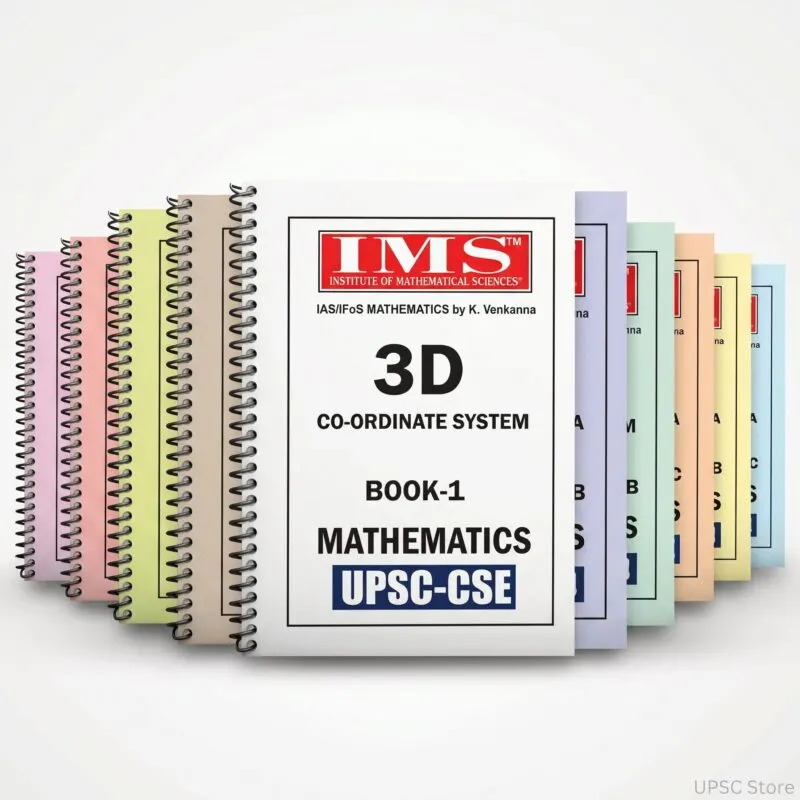
  • Booklet 4: 3D Co-ordinate System β€” Book 1 β€” Three-dimensional geometry fundamentals: coordinates in space, direction cosines and direction ratios, equations of a straight line in 3D, skew lines, shortest distance, plane equations, angle between planes, distance of a point from a plane, and intersection geometry.
  • Booklet 5: 3D Co-ordinate System β€” Book 2 β€” Sphere, cone, cylinder, conicoids in three dimensions; central conicoids, paraboloids, plane sections of conicoids, generating lines, confocal conicoids, and reduction to standard forms β€” with solved UPSC-pattern numerical problems throughout.
  • Booklet 6: Ordinary Differential Equations β€” Formation and solution of first-order ODEs, exact equations, integrating factors, second-order linear ODEs with constant coefficients, Euler-Cauchy equations, variation of parameters, power series solutions, Frobenius method, Sturm-Liouville theory, and special functions including Legendre and Bessel functions.
  • Booklet 7: Dynamics and Statics β€” Statics: equilibrium of forces, moments, couples, friction, centre of gravity. Dynamics: kinematics and kinetics of a particle, Newton’s laws, work-energy theorem, impulse-momentum, projectile motion, central forces, Kepler’s laws, moment of inertia, and motion of rigid bodies.
  • Booklet 8: Vector Analysis β€” Scalar and vector fields, gradient, divergence, curl, vector identities, line integrals, surface integrals, volume integrals, Gauss divergence theorem, Stokes’ theorem, Green’s theorem β€” with proof-based theory and application-level problems aligned to UPSC question patterns.
  • Booklet 9: Abstract Algebra β€” Groups: subgroups, cyclic groups, cosets, normal subgroups, quotient groups, homomorphisms, isomorphism theorems, permutation groups, Sylow theorems. Rings: ideals, ring homomorphisms, integral domains, fields, polynomial rings, and unique factorisation domains.
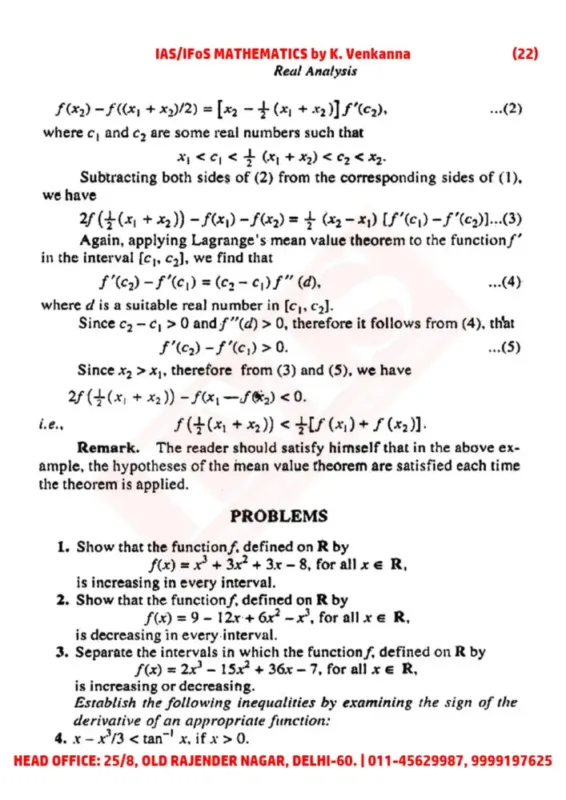
  • Booklet 10: Real Analysis β€” Metric spaces, open and closed sets, completeness, compactness, connectedness, sequences and series in metric spaces, continuous and uniformly continuous functions, differentiability, Riemann-Stieltjes integration, Lebesgue measure and integration, LΒ² spaces, and Fourier series convergence.
  • Booklet 11: Complex Analysis β€” Complex number system, Cauchy-Riemann equations, analytic functions, harmonic functions, elementary functions, MΓΆbius transformations, complex integration, Cauchy’s integral theorem and formula, Taylor and Laurent series, singularities, residues, contour integration, and conformal mappings.
  • Booklet 12: Linear Programming β€” Formulation of linear programming problems, graphical method, simplex method, big-M method, two-phase method, duality theory, dual simplex method, sensitivity analysis, integer programming, transportation problem, assignment problem, and game theory fundamentals.
  • Booklet 13: Partial Differential Equations β€” Formation of PDEs, methods of solution of first-order PDEs, Charpit’s method, classification of second-order PDEs, method of separation of variables, heat equation, wave equation, Laplace equation, boundary value problems, and Green’s function approach.
  • Booklet 14: Numerical Analysis and Computer Programming β€” Numerical solution of algebraic equations, interpolation methods including Newton and Lagrange, numerical differentiation and integration, Gaussian quadrature, numerical solution of ODEs including Euler and Runge-Kutta, algorithm design, flowcharts, and FORTRAN/C programming basics for UPSC syllabus.
  • Booklet 15: Mechanics and Fluid Dynamics β€” Generalised coordinates, Lagrangian mechanics, Hamiltonian mechanics, Hamilton’s equations, principle of least action, small oscillations, rigid body dynamics, Euler’s equations of motion, and fluid dynamics: equation of continuity, Euler’s and Bernoulli’s equations, two-dimensional flows, potential flow.
  • Booklet 16: Topology and Functional Analysis β€” Book 1 β€” Topological spaces, open and closed sets, bases, subbases, product topology, subspace topology, compact spaces, locally compact spaces, connected and path-connected spaces, separation axioms (T0 through T4), Urysohn’s lemma, and Tychonoff’s theorem.
  • Booklet 17: Topology and Functional Analysis β€” Book 2 β€” Normed linear spaces, Banach spaces, Hilbert spaces, bounded linear operators, dual spaces, Hahn-Banach theorem, open mapping theorem, closed graph theorem, uniform boundedness principle, and spectral theory of operators with UPSC-focused solved examples.
  • Booklet 18: Statistics and Probability β€” Probability axioms, conditional probability, Bayes’ theorem, random variables, probability distributions including Binomial, Poisson, Normal, Exponential, expectation and variance, correlation, regression, sampling distributions, hypothesis testing, chi-square test, and t-test for UPSC Mathematics Paper 2.
  • Booklet 19: Previous Years’ Questions β€” Paper 1 β€” Solved previous years’ UPSC CSE/IFoS Mathematics Optional Paper 1 questions (2015–2024) with model answers, stepwise working, examiner-expected format, marking strategy, and common error analysis for Linear Algebra, Calculus, Analytic Geometry, ODE, Dynamics, and Vector Analysis.
  • Booklet 20: Previous Years’ Questions β€” Paper 2 β€” Solved previous years’ UPSC CSE/IFoS Mathematics Optional Paper 2 questions (2015–2024) with model answers, examiner-expected layout, time-bound solution strategies, and high-yield topic identification covering Abstract Algebra, Real and Complex Analysis, PDE, Numerical Analysis, and Mechanics.

In-Depth Content Breakdown: Booklet by Booklet

Booklet 1: Linear Algebra

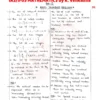
Linear Algebra is one of the highest-scoring topics in UPSC Mathematics Optional Paper 1, and K. Venkanna’s IMS notes treat it with the rigour that the exam demands. This booklet opens with vector spaces and methodically builds through subspaces, linear maps, and the rank-nullity theorem before tackling eigenvalue theory. The coverage of Cayley-Hamilton theorem includes both the standard proof and direct application to matrix-inversion problems, which appear frequently in UPSC Mains. Canonical forms β€” especially Jordan form β€” are presented with worked-out numerical examples step by step, matching the answer-writing format expected by UPSC examiners.

What sets this IMS booklet apart is the structured treatment of bilinear and quadratic forms, a topic many aspirants skip but which regularly yields high marks in the exam. Each theorem is followed by at least two UPSC-pattern problems, and a summary table at the end condenses key results for last-minute revision. The booklet uses consistent notation aligned with standard textbooks so students moving between IMS notes and reference books like Hoffman-Kunze or Schaum’s face zero confusion. If you buy printed mathematics optional notes, this booklet alone justifies the investment for Paper 1 preparation.

Booklet 2: Calculus

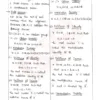
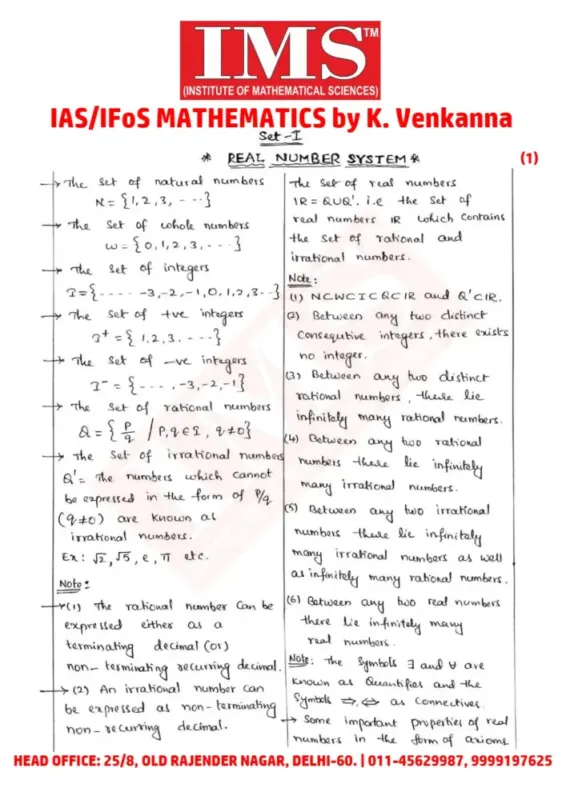
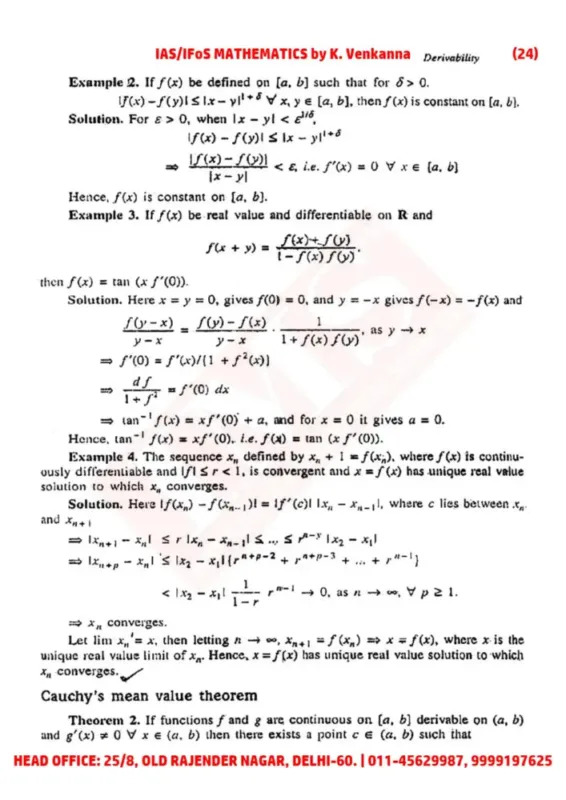
Calculus in UPSC Mathematics Optional is not high-school calculus β€” it demands proof-based understanding of convergence, uniform continuity, and multivariate differentiation at a real analysis level. This IMS booklet by K. Venkanna bridges that gap, opening with a rigorous treatment of the real number system and moving through limits, continuity, and differentiability with epsilon-delta proofs presented in clean, readable form. The mean value theorems β€” Rolle’s, LMVT, and Cauchy’s β€” are covered with geometric interpretation and standard UPSC exam problems so aspirants understand both the theory and the application format.

The treatment of functions of several variables is particularly strong: partial derivatives, total differentials, Jacobians, maxima and minima using second-order conditions, and Lagrange multipliers are all covered with multi-step solved problems. Improper integrals and sequences of functions, including pointwise and uniform convergence tests, are structured to directly address PYQ patterns. The booklet also contains a dedicated section on double and triple integrals with change of order and change of variable techniques, areas where aspirants tend to lose marks due to setup errors. Buy this set to cover all these topics under one roof.

Booklet 3: Analytic Geometry β€” 2D

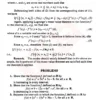
Two-dimensional analytic geometry covers a significant slice of Paper 1, and this IMS booklet organises the content into conic sections, pole-polar theory, and families of curves with complete derivations. K. Venkanna’s notes introduce each conic β€” parabola, ellipse, and hyperbola β€” through their standard equations and then systematically extend to the general second-degree equation, conditions for type-classification, and the rotation-translation approach to reduction. This treatment ensures aspirants can handle any form of a conic-section problem without relying on pattern-matching alone.

The booklet is particularly strong on chord of contact, pair of tangents from external points, and director circles β€” topics that appear regularly in UPSC Mathematics Optional Paper 1 but are given shallow coverage in most textbooks. Polar equations of conics and their geometric interpretation are presented with both standard derivation and solved numericals. Asymptotes, conjugate diameters, and the rectangular hyperbola are grouped logically so aspirants can revise conic-family properties in one sitting. Diagrams are printed clearly with axis labels, making this booklet effective even without a teacher to explain the geometry.

Booklet 4: 3D Co-ordinate System β€” Book 1

Three-dimensional geometry is one of the most visualisation-intensive topics in UPSC Mathematics Optional, and K. Venkanna’s IMS notes address this with extensive use of annotated 3D diagrams printed at high resolution. Book 1 of the 3D series begins with coordinates in three-dimensional space, direction cosines, and direction ratios β€” building the foundational language for everything that follows. The equations of a straight line in 3D are derived in multiple forms (symmetric, parametric, two-plane form) so aspirants are comfortable no matter how a question is framed in the UPSC exam.

The booklet gives careful treatment to skew lines and the formula for shortest distance between them, a topic that combines geometric intuition with algebraic computation and is a frequent source of dropped marks. Plane equations in various forms β€” intercept form, normal form, general form β€” are followed by problems on angles between planes, families of planes, and the distance formula. Intersection geometry (line meeting plane, two planes meeting in a line) is handled through both elimination and parametric substitution, ensuring aspirants have flexibility in exam answers. The booklet closes each topic with a compact formula box for rapid last-minute recall.

Booklet 5: 3D Co-ordinate System β€” Book 2

Book 2 of the 3D Coordinate System series extends into second-degree surfaces β€” sphere, cone, cylinder β€” and the more advanced conicoids that form the bulk of UPSC’s higher 3D geometry questions. The IMS treatment opens with the sphere: general equation, centre and radius, plane section, and tangent plane, with each result derived and then applied to three or four UPSC-level problems. Cones are covered through their vertex-form and the enveloping cone, and cylinders are presented through both the standard and oblique forms, maintaining the rigour aspirants need for proof-type questions.

The treatment of general conicoids β€” ellipsoid, hyperboloid, paraboloid β€” is the strongest section of this booklet. Generating lines of ruled surfaces, plane sections of conicoids, and confocal conicoids are topics that appear in IFoS Mathematics Optional with increasing frequency and are covered here with complete derivations followed by model answers in UPSC-expected format. The reduction of the general second-degree equation to canonical (standard) form is done step by step, making a topic often considered advanced accessible to self-studying aspirants. Buy this booklet to ensure Paper 1’s geometry section is fully covered.

Booklet 6: Ordinary Differential Equations

Ordinary Differential Equations form a core segment of UPSC Mathematics Optional Paper 1, and this IMS booklet by K. Venkanna provides one of the most organised treatments available in printed notes format. The booklet progresses from first-order equations β€” separable, exact, Bernoulli, and integrating-factor types β€” through second-order linear equations with constant and variable coefficients. The variation-of-parameters method and the method of undetermined coefficients are both covered with multiple solved problems so aspirants can apply either technique depending on the question’s form.

The power series and Frobenius method sections are particularly detailed, covering ordinary and regular singular points, indicial equations, and the construction of two independent solutions β€” topics that many aspirants find intimidating but which are high-value in UPSC Mains. Sturm-Liouville theory is presented with its connection to eigenfunction expansions, and Bessel and Legendre equations are solved in full with the resulting special functions clearly tabulated. The booklet ends with a summary of solution strategies organised by equation type, helping aspirants quickly identify the right approach during time-constrained exam conditions.

Booklet 7: Dynamics and Statics

This booklet covers the classical mechanics content of UPSC Mathematics Optional Paper 1, split between Statics and Dynamics, both of which reward aspirants who practice numerical problem-solving methodically. The Statics section covers equilibrium under coplanar forces, moments, couples, friction β€” including problems on ladders and wedges β€” and centre of gravity using integration methods. Each concept is tied to a solved problem formatted in the stepwise style that UPSC examiners reward with full marks. The treatment avoids overly abstract formalism in favour of the applied, problem-solving approach that Mathematics Optional demands.

The Dynamics section opens with kinematics before moving into Newton’s laws, work-energy and impulse-momentum theorems, and projectile motion with range, time of flight, and maximum-height formulae all derived. Central force motion and Kepler’s laws are presented as both theoretical results and as problems where aspirants calculate orbital parameters. Rigid body dynamics β€” moment of inertia and Euler’s equations β€” are covered with standard results for common shapes (disc, ring, sphere, rod) in a reference table. This booklet is essential for aspirants who find Physics-adjacent mechanics topics harder than pure mathematics, as the IMS approach makes the transition smooth.

Booklet 8: Vector Analysis

Vector Analysis bridges Mathematics Optional Paper 1 (vector calculus applications) and underpins topics across Paper 2 (fluid dynamics), making this IMS booklet especially high-value. The booklet begins with scalar and vector fields, then derives gradient, divergence, and curl with geometric interpretation before proving key vector identities. Line integrals over arbitrary paths and surface integrals over parametrised surfaces are set up and evaluated through multiple worked examples, emphasising the correct orientation and parameterisation conventions that earn full marks in UPSC Mains.

The three major integral theorems β€” Gauss’s Divergence Theorem, Stokes’ Theorem, and Green’s Theorem β€” are each given proof-plus-application treatment. The proofs are written to UPSC answer length standards and the applications include physical interpretations (flux through surfaces, circulation of a field) that help aspirants remember which theorem to apply. Common UPSC problem types β€” converting between surface and volume integrals, evaluating line integrals using Stokes’ theorem as shortcut β€” are identified explicitly. The booklet’s final pages compile standard results and identities for quick revision, making it a useful reference tool throughout preparation.

Booklet 9: Abstract Algebra

Abstract Algebra is the foundational topic of UPSC Mathematics Optional Paper 2, and K. Venkanna’s IMS notes provide a rigorous yet exam-focused treatment that balances proof writing with problem-solving. Group theory is developed from axioms through subgroups, cyclic groups, cosets, and Lagrange’s theorem to normal subgroups, quotient groups, and homomorphism theorems. The isomorphism theorems (First, Second, Third) are stated, proved, and applied to standard UPSC-type problems where aspirants must identify quotient structures or count subgroups of a given order.

Sylow’s theorems β€” one of the most technically demanding parts of the UPSC Mathematics Optional syllabus β€” are covered with full statements, complete proofs, and multiple applications to counting problems. Ring theory follows with ideals (principal, prime, maximal), ring homomorphisms, polynomial rings, and unique factorisation domains, each illustrated through concrete examples like β„€[x] and β„š[x]. The booklet’s organisation β€” definition, theorem, proof, worked example β€” is consistent throughout, making it ideal for aspirants who are self-studying Abstract Algebra without classroom instruction. This is among the most sought-after booklets in the IMS mathematics optional set.

Booklet 10: Real Analysis

Real Analysis is widely considered the hardest topic in UPSC Mathematics Optional and this IMS booklet treats it with the depth required for high scores. The treatment begins with metric spaces, developing the language of open sets, closed sets, convergence, and Cauchy sequences in a general setting before specialising to the real line. Compactness is covered through both sequential compactness and the Heine-Borel theorem, with applications to continuity and uniform continuity proofs β€” topics that appear as proof-type questions in UPSC Mains almost every year.

The Riemann-Stieltjes integral is developed rigorously, with conditions for integrability and properties proven and applied. Lebesgue measure and Lebesgue integration are introduced clearly, with Lebesgue’s dominated convergence theorem and monotone convergence theorem presented as exam-ready proofs. Fourier series β€” their convergence and Parseval’s identity β€” are covered in the final section with standard results formatted for direct use in answers. Throughout the booklet, K. Venkanna’s experience teaching this material at IMS is evident in the selection of examples, which closely mirror actual UPSC CSE and IFoS question patterns from recent years.

Booklet 11: Complex Analysis

Complex Analysis is a high-scoring topic for well-prepared aspirants because it has a compact, well-defined syllabus with predictable question types. This IMS booklet covers analytic functions through the Cauchy-Riemann equations, harmonic conjugates, and the connection between analyticity and complex differentiability. Elementary functions β€” exponential, trigonometric, logarithmic, and power functions β€” are treated in their complex forms with branch cuts and Riemann surfaces introduced at the level required for UPSC. MΓΆbius (bilinear) transformations and conformal mappings are covered with the cross-ratio property and standard examples of mapping circles to lines.

The core of the booklet is complex integration: Cauchy’s integral theorem, Cauchy’s integral formula, and their consequences including Liouville’s theorem and the Fundamental Theorem of Algebra. Taylor and Laurent series expansions are derived and applied to classify singularities (removable, poles, essential), and the Residue Theorem is presented with multiple contour integration examples including real definite integrals evaluated via residues. This last topic β€” evaluating real integrals using complex methods β€” is a perennial favourite in UPSC Mathematics Optional and the IMS notes give it dedicated, multi-page treatment with four or five fully worked example types.

Booklet 12: Linear Programming

Linear Programming in UPSC Mathematics Optional Paper 2 is one of the most scoring topics because it is algorithmic, and aspirants who practise the procedures can score full marks reliably. This IMS booklet covers the formulation of LP problems from word problems β€” a skill tested directly in UPSC β€” before moving through graphical method and the Simplex algorithm with complete pivot-operation tables. The Big-M and two-phase methods for handling artificial variables are explained with parallel worked examples so aspirants understand when and why to use each approach.

Duality theory is presented with the primal-dual relationship, complementary slackness conditions, and the dual simplex method, all of which appear in UPSC Mathematics Optional questions at a theorem-plus-application level. Sensitivity analysis β€” changes in objective coefficients and RHS constants β€” is covered with numerical examples. The transportation problem (NWCM, Vogel’s approximation, MODI method) and the assignment problem (Hungarian algorithm) are fully worked through. A final section on two-person zero-sum game theory, including saddle points, dominance, and mixed strategies via LP, rounds out the booklet and covers all Linear Programming topics in the UPSC Mathematics Optional syllabus.

Booklet 13: Partial Differential Equations

Partial Differential Equations feature in both Paper 1 (formation and first-order methods) and Paper 2 (classification and boundary value problems) of UPSC Mathematics Optional, and this IMS booklet covers the full continuum. First-order PDE methods β€” Lagrange’s method, Charpit’s method, and the method of characteristics β€” are presented with the geometric interpretation of characteristics alongside algebraic solution procedures, helping aspirants understand both the why and the how. Standard forms of first-order PDEs and their direct integration are organised into a concise reference section.

Second-order PDE classification (hyperbolic, parabolic, elliptic) via the discriminant condition is followed by canonical form reduction β€” a theoretical topic that UPSC examiners have tested repeatedly. The method of separation of variables is applied to the heat equation, wave equation, and Laplace equation in rectangular and polar coordinates, with eigenfunction expansions and Fourier series solutions shown in full. Boundary value problems with non-homogeneous boundary conditions are handled through superposition. The booklet includes a solved set of previous-years’-question-style problems at the end, directly mapping the theory to UPSC exam expectations.

Booklet 14: Numerical Analysis and Computer Programming

Numerical Analysis is a reliable marks-scorer in UPSC Mathematics Optional Paper 2 because the algorithms are fixed and practice leads to near-perfect answers. K. Venkanna’s IMS booklet covers all numerical methods in the UPSC syllabus: root-finding methods (Bisection, Regula-Falsi, Newton-Raphson), interpolation (Newton’s forward and backward difference formulae, Lagrange interpolation, divided differences), and numerical differentiation through difference operators. Each method is presented with a full numerical example worked from first principles, allowing aspirants to follow the template in exam conditions.

Numerical integration β€” Trapezoidal rule, Simpson’s rules, Gaussian quadrature β€” and numerical solution of ODEs β€” Euler’s method, Runge-Kutta methods (RK4 in particular) β€” are covered with error analysis included for each, since UPSC questions often ask for error bounds or comparison of methods. The Computer Programming section covers algorithm design, flowchart conventions, and the FORTRAN/C programming syntax required by the UPSC Mathematics Optional syllabus, including programs for numerical root-finding and sorting. This section, often neglected by aspirants, can yield easy marks and the IMS booklet makes it approachable even for those without a programming background.

Booklet 15: Mechanics and Fluid Dynamics

Mechanics and Fluid Dynamics occupy a significant portion of UPSC Mathematics Optional Paper 2, and this IMS booklet provides the bridge between the classical dynamics of Paper 1 and the advanced Lagrangian-Hamiltonian framework of Paper 2. Generalised coordinates and Lagrange’s equations of motion are derived from first principles with applications to standard systems (pendulums, coupled oscillators, rolling bodies). Hamilton’s equations and the Hamiltonian formalism are presented alongside Lagrangian mechanics so aspirants can compare the two frameworks β€” a common UPSC proof-type question.

Hamilton’s principle (principle of least action) is stated and applied, and small oscillations about equilibrium are covered through the normal mode approach. The fluid dynamics section begins with the equation of continuity, Euler’s equation of motion for ideal fluids, and Bernoulli’s equation with applications. Two-dimensional irrotational flow is treated through the stream function and velocity potential, with complex potential and standard flow patterns (source, sink, doublet, uniform flow) systematically covered. Blasius theorem and the circle theorem are presented as tools for calculating forces on cylinders, which are recurring UPSC IFoS examination topics.

Booklet 16: Topology and Functional Analysis β€” Book 1

Topology is among the most abstract topics in UPSC Mathematics Optional Paper 2, and K. Venkanna’s IMS booklet manages this abstraction by building from concrete examples before generalising. Topological spaces are introduced through open-set axioms with examples from the real line, discrete topology, and cofinite topology so aspirants develop intuition alongside formal definitions. Bases and subbases, subspace topology, and product topology are all covered with standard examples used in UPSC questions. Compact spaces are treated through open covers, Heine-Borel, and the finite intersection property with applications to continuous functions on compact sets.

Connected and path-connected spaces are distinguished carefully β€” a nuance that UPSC examinees often conflate in proof answers. The separation axioms (T0 through T4) are systematically presented with examples showing why each implication holds or fails, a topic that requires clear organisation to present in an exam answer. Urysohn’s lemma is proved in full and Tychonoff’s theorem is stated with a sketch of its proof. Throughout, the booklet maintains a definition-theorem-example structure that allows aspirants to navigate abstract material efficiently and produces answer-writing clarity on a subject where many UPSC aspirants struggle to score full marks.

Booklet 17: Topology and Functional Analysis β€” Book 2

Book 2 transitions from Topology into Functional Analysis β€” the study of infinite-dimensional normed spaces β€” which forms the more calculation-intensive and proof-intensive part of UPSC Mathematics Optional Paper 2. Normed linear spaces and Banach spaces are introduced through standard examples (lp spaces, C[a,b]) with properties proven rigorously. Hilbert spaces are developed with emphasis on inner product properties, orthonormal bases, the Gram-Schmidt process, and the Riesz representation theorem β€” all of which have appeared in UPSC and IFoS question papers in recent years.

Bounded linear operators and their properties, dual spaces, and the four foundational theorems of Functional Analysis β€” Hahn-Banach, Open Mapping, Closed Graph, and Uniform Boundedness (Banach-Steinhaus) β€” are each given statement, proof, and application treatment. The proofs are written to UPSC answer-length standards: rigorous but not padded, matching the format that examiners reward. Spectral theory of operators, including eigenvalues, point spectrum, and the spectral radius formula, rounds out the booklet. Aspirants who invest in this booklet alongside Book 1 will find Topology and Functional Analysis transform from a feared section into a reliable marks-scorer in UPSC Mains.

Booklet 18: Statistics and Probability

Statistics and Probability form a self-contained section in UPSC Mathematics Optional Paper 2, and this IMS booklet covers the complete syllabus with a balance of theory and applied problem-solving. Probability axioms, conditional probability, and Bayes’ theorem are presented with standard UPSC problem types β€” total probability rule, posterior probability β€” worked through in detail. Discrete and continuous random variables, their probability distributions, expectation, variance, and moment-generating functions are all developed systematically, with particular attention to the Binomial, Poisson, Normal, and Exponential distributions that dominate UPSC questions.

Correlation and regression β€” both simple linear regression theory and the method of least squares β€” are covered with numerical examples since UPSC regularly tests the computation of regression coefficients and correlation coefficients. Sampling distributions (t, F, chi-square) are presented with their standard uses in hypothesis testing, and hypothesis testing methodology β€” null hypothesis, test statistic, critical region, p-value β€” is explained clearly. The chi-square goodness-of-fit test and t-tests for means are worked through with numerical examples in UPSC answer format. For aspirants who have a non-statistics background, this booklet provides everything they need to score well on this section without any supplementary reading.

Booklet 19: Previous Years’ Questions β€” Paper 1

Previous year question practice is irreplaceable in UPSC Mathematics Optional preparation, and this IMS booklet compiles and solves Paper 1 questions from 2015 through 2024, giving aspirants a decade of exam-pattern insight. Each question is solved in the stepwise format that UPSC examiners use when awarding marks, so aspirants can benchmark their own answer quality against the expected standard. Topics covered in the solved set include Linear Algebra, Calculus, Analytic Geometry, ODEs, Dynamics, and Vector Analysis β€” the full Paper 1 domain. Common examiner preferences β€” specific theorem statements, the degree of rigour expected in proofs, the level of detail in numerical work β€” are visible across the ten years of solved questions.

The booklet includes an analysis of high-frequency topics: which subtopics appear every year, which appear in cycles, and which carry the highest average marks. This strategic analysis helps aspirants allocate preparation time intelligently β€” a critical skill when managing a 500-mark optional alongside five General Studies papers. A section on common errors β€” incorrect theorem application, incomplete proofs, unsimplified final answers β€” is included with the corrected versions shown. Buy this IMS Mathematics Optional notes set for the previous years’ solution booklets alone, as solving ten years of questions with model answers is the single most effective revision activity for UPSC Mathematics Optional.

Booklet 20: Previous Years’ Questions β€” Paper 2

This booklet mirrors the Paper 1 PYQ compilation but for UPSC Mathematics Optional Paper 2, covering Abstract Algebra, Real Analysis, Complex Analysis, Topology, Functional Analysis, Partial Differential Equations, Numerical Analysis, Mechanics, Fluid Dynamics, Linear Programming, and Statistics from 2015 through 2024. The solved questions allow aspirants to see how advanced Paper 2 topics translate into specific exam questions β€” Abstract Algebra questions tend toward isomorphism theorems and Sylow theory; Complex Analysis questions tend toward contour integration and residue computation; Topology questions test separation axioms and compactness proofs.

The booklet’s time-bound solution strategies are particularly valuable: each solved answer includes an estimated time to write, helping aspirants develop the pace required to attempt all questions within the three-hour UPSC exam window. High-yield topics β€” those appearing in six or more of the ten years surveyed β€” are highlighted with a star marker in the table of contents, guiding last-month revision priorities. The booklet also includes a section on answer presentation β€” how to structure a 20-mark proof versus a 10-mark application problem β€” that reflects K. Venkanna’s experience mentoring IAS and IFoS selections through IMS. This is the final booklet in the set and the one most directly tied to exam-day performance.

Physical Construction and Quality Standards

These IMS Mathematics Optional printed notes are manufactured to withstand twelve to eighteen months of intensive UPSC preparation β€” daily use, margin annotations, colour-coded highlighting, and repeated revision β€” without pages loosening, ink fading, or bindings splitting under heavy use.

Paper Quality: 75 GSM Anti-Glare White Paper

Every booklet in this 20-piece IMS Mathematics Optional set is printed on 75 GSM ultra-white paper chosen for high opacity, meaning mathematical notation, diagrams, and printed text on one side do not bleed or show through to the reverse side. Multiple highlighter colours β€” yellow, green, blue, orange β€” can be applied to the same page without smearing or ghosting, supporting the colour-coded revision systems favoured by UPSC toppers. The anti-glare surface significantly reduces eye strain during the three to five hour daily study sessions that Mathematics Optional preparation demands, making the IMS printed notes more comfortable to use than photocopied or low-GSM alternatives.

Printing Technology: High-Resolution Laser Printing

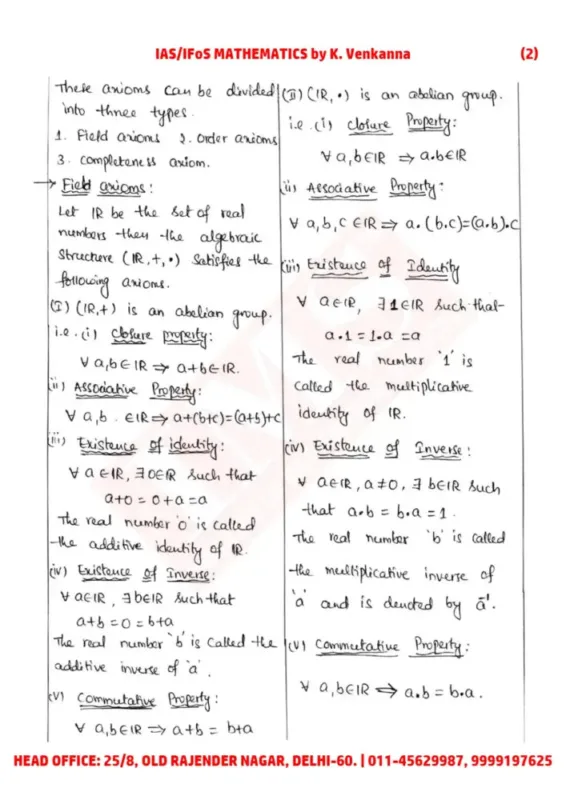
Mathematical content places higher demands on printing quality than text-only material β€” subscripts, superscripts, Greek letters, integral signs, matrix brackets, and geometric diagrams must all be rendered at high resolution to remain legible at standard reading distance. The IMS Mathematics Optional booklets are printed using high-resolution laser technology that produces crisp lines, sharp notation, and clearly differentiated symbols throughout all 16 Booklets. Permanent laser toner is smudge-proof from day one β€” no waiting period, no fingerprint smearing β€” so aspirants can begin annotating immediately. Flowcharts, 3D coordinate diagrams, and function graphs retain full clarity without pixel artifacts or blurred edges.

Binding and Durability

The binding used across the IMS Mathematics Optional 16-booklet set is selected for the specific demands of mathematics study: the ability to lie completely flat on a desk while working through multi-step calculations. Spiral binding, where used, allows the booklet to fold back 360 degrees so no pages need to be held open during problem-solving, freeing both hands for writing. Book-bound volumes feature reinforced spine gluing with a 300 GSM laminated cover that resists daily handling, bag pressure, and moisture. Thick cover stock protects the interior pages from corner damage during transport, and the compact booklet format means individual volumes fit easily into bags without the bulk and weight of single-volume comprehensive textbooks.

Key Features and Study Design

These IMS Mathematics Optional notes are structured around one objective: maximum marks in UPSC Mains Mathematics Optional Paper 1 and Paper 2 through the most direct path from current knowledge to exam-ready performance under K. Venkanna’s proven teaching framework.

  • Faculty-Authored by K. Venkanna, IMS: K. Venkanna is among India’s most recognised Mathematics Optional faculty for UPSC, with a track record of producing IAS and IFoS selections from IMS. These notes carry his direct pedagogical approach β€” theorem selection, proof depth, and problem type β€” rather than being compiled by anonymous editors, giving aspirants the benefit of his examination insight throughout all 16 Booklets.
  • Full 500-Mark Optional Coverage: Mathematics Optional accounts for 500 marks (250 per paper) in UPSC Mains β€” the largest single marks bloc after Essay. This 16-booklet set covers the complete UPSC Mathematics Optional syllabus for both Paper 1 and Paper 2 without requiring any supplementary material, making it a self-sufficient preparation resource for aspirants who buy this printed set.
  • UPSC Answer-Format Alignment: Every solved problem in the booklets is written in the stepwise, clearly headed format that UPSC Mathematics Optional examiners use when marking. Aspirants studying from these notes naturally internalise the correct presentation style β€” theorem statement before proof, units and labels in diagrams, boxed final answers β€” so their own answer books reflect expected norms from day one of writing practice.
  • Dedicated Previous Years’ Question Booklets: Two full booklets (19 and 20) are dedicated exclusively to solved UPSC previous years’ questions for Paper 1 and Paper 2 respectively, covering ten years of exam papers with model answers, topic-frequency analysis, and time-per-question guidance. This makes the IMS set unique among available printed Mathematics Optional materials β€” most competitors provide PYQs only as brief appendices rather than as full standalone booklets.
  • IFoS Dual Utility: The IMS Mathematics Optional notes are explicitly authored for both IAS (CSE) and IFoS (Indian Forest Service) aspirants, as both examinations share the same Mathematics Optional syllabus. Aspirants attempting IFoS alongside CSE get full value from this single purchase, and IMS regularly has IFoS Mathematics Optional selections in its alumni record, making the notes credible for both examination tracks simultaneously.

Shipping, Packaging and Delivery

All 20 IMS Mathematics Optional booklets are individually shrink-wrapped before being bundled together and placed in a double-walled corrugated cardboard box sized to eliminate internal movement during transit. Foam edge protectors are added at all eight corners of the box to absorb impact from the drops and compressions that are routine in courier handling. The outer box is sealed with reinforced packaging tape across all seams, and a “FRAGILE β€” PRINTED MATERIAL” label is applied on two faces. The assembly is waterproof-sleeved before handover to the courier partner, protecting against moisture exposure during the last-mile delivery stage where printed materials are most vulnerable to damage.

Orders are dispatched within one business day of payment confirmation and delivered pan India within 4-7 business days through a fully tracked courier network. A tracking ID is sent to your registered WhatsApp or email within 24 hours of dispatch, allowing real-time shipment monitoring. For any query β€” tracking updates, address changes before dispatch, or damaged-in-transit claims β€” reach us on WhatsApp at +91 70045 49563, available seven days a week. If any booklet from the 20-piece set is found missing, damaged, or with printing defects on delivery, a replacement booklet is dispatched within 48 hours of your reporting the issue, at zero additional cost to you.

Frequently Asked Questions (FAQ)

Q1: Are IMS Mathematics Optional notes good for UPSC preparation?

A: Yes β€” IMS (Institute of Mathematical Sciences) is one of India’s oldest dedicated mathematics optional coaching institutes, and K. Venkanna’s notes are authored by a faculty member with a long record of IAS and IFoS selections. The notes balance rigorous proof coverage with exam-format problem-solving, covering the complete UPSC Mathematics Optional syllabus across 20 printed booklets. They are used by serious aspirants who want classroom-quality material in printed format without the cost and location constraints of in-person coaching attendance at IMS.

Q2: How many booklets are included in IMS Mathematics Optional notes 2025-26?

A: This set contains exactly 20 individual printed booklets covering the complete UPSC Mathematics Optional syllabus for both Paper 1 and Paper 2. The set includes topic-wise booklets from Linear Algebra and Calculus through Topology, Functional Analysis, and Fluid Dynamics, plus two dedicated booklets of solved UPSC previous years’ questions (one each for Paper 1 and Paper 2) covering ten years of exam papers with model answers in UPSC-expected format.

Q3: Are IMS Mathematics Optional notes available in English medium?

A: Yes β€” all 16 Booklets in this set are in English medium exclusively. K. Venkanna’s IMS Mathematics Optional notes have historically been produced in English, consistent with how Mathematics Optional is typically answered in UPSC Mains (mathematical notation and terminology is universal, but the connecting prose is in English). Hindi medium aspirants attempting Mathematics Optional typically do so in English as well, given the nature of the subject, so this English-medium set serves the full range of UPSC aspirants taking Mathematics as their optional.

Q4: What topics are covered in IMS Mathematics Optional notes for UPSC?

A: The 16 Booklets cover every topic in the UPSC Mathematics Optional syllabus: Linear Algebra, Calculus, Analytic Geometry (2D and 3D), Ordinary Differential Equations, Dynamics and Statics, Vector Analysis for Paper 1; and Abstract Algebra, Real Analysis, Complex Analysis, Linear Programming, Partial Differential Equations, Numerical Analysis and Computer Programming, Mechanics and Fluid Dynamics, Topology, Functional Analysis, and Statistics and Probability for Paper 2. Two additional booklets contain solved UPSC previous years’ questions across both papers.

Q5: Are IMS Mathematics Optional notes updated for the 2025-26 UPSC syllabus?

A: Yes β€” this is the 2025-26 edition, the latest genuine batch available. The UPSC Mathematics Optional syllabus is stable and has not changed in recent years, but IMS updates its notes periodically to incorporate recent UPSC question patterns, new solved examples from recent exam papers, and any corrections or enhancements to existing content. The 2025-26 edition includes solved questions from the most recent available UPSC Mathematics Optional papers, making it the most current printed resource available for UPSC Mains 2025 preparation.

Q6: What is the paper quality? Can I use a highlighter?

A: These booklets use 75 GSM ultra-white paper chosen for high opacity β€” multiple highlighter colors and gel pens work without bleed-through to the reverse side, ideal for color-coded revision. The anti-glare surface reduces eye strain during extended study sessions, which is important for Mathematics Optional aspirants who typically study this subject for three to five hours daily. The paper is thick enough to handle both pen annotations on one side and highlighting on the same or reverse side without compromising readability.

Q7: Do IMS Mathematics Optional notes cover both Paper 1 and Paper 2 of UPSC Mains?

A: Yes β€” the 16-booklet set provides complete coverage of both UPSC Mathematics Optional Paper 1 and Paper 2. Paper 1 topics (Linear Algebra, Calculus, Analytic Geometry, ODE, Dynamics, Vector Analysis) are covered in approximately the first eight topical booklets, and Paper 2 topics (Abstract Algebra, Real and Complex Analysis, Topology, Functional Analysis, PDE, Numerical Analysis, Mechanics, Fluid Dynamics, Statistics) are covered in the following ten topical booklets. The final two booklets are dedicated solved PYQ sets, one per paper, covering ten years of UPSC question papers.

Q8: Which is better for UPSC Maths Optional β€” IMS notes or other available notes?

A: IMS notes by K. Venkanna are among the most structured and syllabus-aligned printed resources available for UPSC Mathematics Optional. What distinguishes them is the combination of proof-level rigour with exam-format answer templates, and the inclusion of two full PYQ booklets. Different aspirants prefer different resources based on learning style; however, IMS notes are specifically designed for self-study and cover the full 500-mark optional without requiring supplementary textbooks. Many UPSC Mathematics Optional selections β€” in both CSE and IFoS β€” attribute their preparation to the IMS K. Venkanna notes series.

Q9: Is Mathematics a good optional subject for UPSC?

A: Mathematics Optional is considered one of the most rewarding optional choices for aspirants with a strong mathematics background (typically B.Sc./B.E./B.Tech. graduates). It offers objective, marking-scheme-based scoring that reduces examiner subjectivity, a stable and well-defined syllabus, and less overlap with General Studies compared to humanities optionals. Aspirants who score well in Mathematics Optional typically achieve very high overall Mains marks. The prerequisite is genuine mathematical aptitude and willingness to invest the preparation time required β€” at least six to eight months of focused study using a structured resource like the IMS 16-booklet set.

Q10: Can these notes be used for IFoS (Indian Forest Service) Mathematics Optional?

A: Yes β€” the IMS Mathematics Optional notes are explicitly authored for both IAS (UPSC CSE) and IFoS aspirants. The cover of the series states “IAS/IFoS Mathematics” directly, and the syllabus coverage aligns with the UPSC IFoS Mathematics Optional syllabus, which shares considerable overlap with UPSC CSE Mathematics Optional. IFoS aspirants can buy this printed set with full confidence that it addresses their examination requirements. The previous-years’-question booklets also include IFoS paper solutions, making this set doubly valuable for candidates appearing in both examinations.

Q11: Are these notes useful for State PSC Mathematics Optional examinations?

A: Yes β€” while these notes are designed for UPSC CSE and IFoS Mathematics Optional, the core mathematics content is directly applicable to state PSC examinations including BPSC, UPPSC, MPPSC, RAS, and other state PSCs that offer Mathematics as an optional subject in their Mains examinations. The UPSC Mathematics Optional syllabus is typically a superset of state PSC syllabi, so aspirants preparing with this IMS 16-booklet set will find their state PSC Mathematics Optional coverage is automatically addressed. The rigour of K. Venkanna’s notes ensures state PSC aspirants are over-prepared rather than under-prepared.

Q12: How do I place an order and how long will delivery take?

A: Add the IMS Mathematics Optional Notes 2025-26 (16 Booklets) to your cart and complete checkout on this store. Orders are dispatched within one business day and delivered pan India within 4-7 business days via tracked courier. You will receive a tracking ID on your registered WhatsApp or email within 24 hours of dispatch. For any queries before or after purchase β€” including bulk orders, address changes, or delivery concerns β€” contact us directly on WhatsApp at +91 70045 49563. Our team is available seven days a week to assist UPSC aspirants with their orders.

Summary

SpecificationValue
Booklets20 Printed Booklets
LanguageEnglish Medium
FacultyK. Venkanna β€” IMS (Institute of Mathematical Sciences)
Edition2025-26 Latest Genuine Batch
Paper75 GSM Ultra-White
BindingSpiral or Book Binding
CoverageFull UPSC Mathematics Optional β€” Paper 1 + Paper 2 + 10 Years PYQs
Delivery4-7 business days Pan India
Also Useful ForBPSC, UPPSC, MPPSC, RAS and all State PSC Mathematics Optional

Sourced from Mukherjee Nagar, Delhi β€” India’s largest UPSC study material hub. Order today and receive your complete IMS Mathematics Optional 16-booklet set within 4-7 business days, anywhere in India.

Reference: Civil Services Examination

Customer Reviews 140

4.5
Based on 140 reviews
5β˜…
84
4β˜…
42
3β˜…
14
2β˜…
0
1β˜…
0
S
Shruti Iyer
25 Apr 2026
βœ“ Verified

Booklets mein detailed examples aur practice problems diye hain.

S
Sanjay Tiwari
20 Apr 2026
βœ“ Verified

Booklets bohot helpful ho gaye. Content bhi zyada simplified aur practical hai.

S
Shreya Nair
14 Apr 2026
βœ“ Verified

Content is so well explained, totally worth it.

S
Shreya Bansal
06 Apr 2026
βœ“ Verified

Notes helpful hain mathematics ke liye. Ek-do chapters mein thoda confusion tha but manageable hai.

D
Deepak Nair
21 Mar 2026
βœ“ Verified

Content is adequate for preparation but lacks depth in some areas. Decent value for money.

N
Nikhil Agarwal
21 Mar 2026
βœ“ Verified

Material acha hai but packaging thoda improve ho sakti thi. Otherwise fine product.

P
Pooja Yadav
15 Mar 2026
βœ“ Verified

Concepts ko samajhna bilkul aasan ho gaya in these booklets.

A
Aditya Joshi
15 Mar 2026
βœ“ Verified

Comprehensive and student-friendly material.

About IMS Mathematics Optional Notes 2025-26

IMS Mathematics Optional Notes 2025-26 is a highly recommended UPSC study material from IMS (Institute of Mathematical Sciences), specially designed for Mathematics Optional preparation. Available in English medium, this material is crafted to match the exact requirements of the UPSC Civil Services Examination syllabus β€” covering both Prelims and Mains comprehensively.

Product Details

  • Institute: IMS (Institute of Mathematical Sciences)
  • Subject: Mathematics Optional
  • Medium: English
  • Format: Printed
  • Delivery: Pan-India delivery in 4–7 working days
  • Format: Original printed material, verified authentic

Why Buy from UPSC Store?

  • βœ… 100% Genuine Printed Material β€” Original printed notes, no photocopies or fake copies
  • βœ… Fast Delivery β€” Ships within 24 hours, arrives in 4–7 days pan-India
  • βœ… Secure Packaging β€” Bubble-wrapped and boxed to prevent damage in transit
  • βœ… Trusted by 10,000+ Aspirants β€” India's most reliable UPSC material marketplace
  • βœ… WhatsApp Support β€” Get expert guidance on material selection before ordering

Frequently Asked Questions

Is this product 100% original?

Yes, all products at UPSC Store are 100% genuine printed materials. We do not sell photocopies or fake copies.

How long does delivery take?

Orders are dispatched within 24 hours and delivered across India in 4–7 working days via reputed courier partners.

Can I return the product?

Yes, we accept returns within 7 days if the product is damaged or incorrect. Check our refund policy for details.

Which other study materials should I buy with this?

We recommend pairing this with current affairs notes and a UPSC test series for comprehensive preparation. Browse more in Mathematics, Optional, UPSC.