


Vajiram & Ravi Geography Optional Notes 2025-26
About Vajiram Geography Optional Notes 2025-26
The Vajiram Geography Optional Notes 2025-26 is a printed UPSC study material set sold by UPSC Store — India’s trusted source for genuine, latest-batch civil services preparation books. This page covers full booklet details, syllabus coverage, pricing, shipping, and frequently asked questions. Useful for UPSC CSE, BPSC, UPPSC, MPPSC, RAS and other state PSC examinations.
Vajiram & Ravi Geography Optional Notes 2025-26 — 11 English Medium Printed Booklets for UPSC Mains Geography Optional Paper
Related: Vajiram & Ravi notes · Geography optional
Product Overview
| Feature | Details |
|---|---|
| Booklets Count | 11 Individual Printed Booklets — Full Paper I & Paper II UPSC Geography Optional Syllabus |
| Language | English Medium |
| Publisher | Vajiram & Ravi Institute for IAS Examination |
| Faculty | Shabbir A Bashir |
| Edition | 2025-26 — Latest Genuine Batch |
| Condition | Brand New, Unmarked, Fresh Stock |
| Format | High-Quality Printed Booklets — Spiral or Book Binding |
| Paper Quality | 75 GSM Ultra-White — Highlighter Safe, Zero Bleed-Through |
| Shipping | Pan India Delivery in 3-5 Business Days — Tracked |
| Also Useful For | BPSC, UPPSC, MPPSC, RAS and all State PSC Geography Optional candidates |
Complete Booklet Catalog
The Vajiram & Ravi Geography Optional 2025-26 set by faculty Shabbir A Bashir spans 11 printed booklets covering the entire UPSC Geography Optional syllabus across Paper I (Physical Geography, Human Geography) and Paper II (Geography of India). These notes are structured for UPSC Mains answer writing, offering crisp bullet-point content, diagram-rich explanations, and fact-dense coverage ideal for aspirants targeting high scores in the Geography optional papers.
- Booklet 1: Geomorphology — Origin and evolution of the earth, interior of the earth, continental drift theory, plate tectonics, seismicity and volcanism, weathering and mass wasting, fluvial geomorphology, slope development theories, cycle of erosion by Davis and Penck, landforms and their association with rock structures.
- Booklet 2: Climatology — Atmosphere — composition and structure, insolation and heat budget, temperature distribution, atmospheric pressure and wind systems, monsoon theories, jet streams, air masses and fronts, cyclones and anticyclones, precipitation types, climate classification by Koppen and Thornthwaite, global warming and climate change.
- Booklet 3: Oceanography — Origin of ocean basins, bottom relief of the oceans, temperature and salinity distribution, ocean currents — causes and types, tides, coral reefs and atolls, El Nino and La Nina, marine resources, ocean deposits, continental shelf and slope, mid-oceanic ridges and deep-sea trenches.
- Booklet 4: Biogeography and Environmental Geography — Genesis of soils, soil classification, soil erosion and conservation, plant and animal adaptations, biomes of the world, ecosystem structure and energy flow, biodiversity hotspots, environmental degradation, deforestation and desertification, carbon cycle, ecological footprint concepts.
- Booklet 5: Human Geography — Perspectives and Population — Nature of human geography, determinism and possibilism, stop-and-go determinism, human geography schools of thought, population growth and distribution, demographic transition theory, population theories — Malthus, migration theories, population policies, age-sex pyramids, fertility and mortality patterns.
- Booklet 6: Settlement and Cultural Geography — Rural settlements — types and patterns, urban settlements — origin and growth, classification of towns, urban morphology, central place theory, rank-size rule, primate cities, urban hierarchy, cultural geography — regions, diffusion of culture, language and religion as geographic factors, ethnicity and geography.
- Booklet 7: Economic Geography — Agriculture and Industry — Von Thunen’s agricultural location theory, types of farming, green revolution, food security and agriculture, industrial location theories — Weber, Losch, growth poles, types of industries, special economic zones, globalisation and industrial change, agglomeration economies, industrial clusters worldwide.
- Booklet 8: Transport, Trade and Regional Development — Transport networks — road, rail, water and air, Ullman’s bases of interaction, trade patterns — comparative advantage, regional disparities, regional planning theories, core-periphery model, Friedmann’s model, sustainable development goals and geography, port geography and maritime trade routes.
- Booklet 9: Geography of India — Physical Setting — Physiographic divisions of India, drainage system, Himalayan and Peninsular rivers, Indian monsoon — origin and mechanism, natural vegetation zones, soil types of India, mineral resources distribution, coastal geography, islands and their significance, natural hazards and disaster management.
- Booklet 10: Geography of India — Human and Economic — Population distribution and density in India, demographic characteristics, tribal population, urbanisation in India, agricultural regions, crop patterns, irrigation systems, industrial regions, energy resources, transport networks in India, tourism geography, regional imbalances in development.
- Booklet 11: Contemporary Issues and Map Work — Geopolitics and India’s border issues, regional cooperation — SAARC, ASEAN, environmental issues in India, climate change impacts, sustainable development in Indian context, geographic information systems overview, remote sensing applications, cartography basics, important map-based questions frequently asked in UPSC Geography optional examination.
In-Depth Content Breakdown: Booklet by Booklet
Booklet 1: Geomorphology
Geomorphology forms the backbone of UPSC Geography Optional Paper I, and this booklet by Shabbir A Bashir addresses every sub-theme demanded by the syllabus. Topics span from the origin of the earth and interior structure to the most tested theories in UPSC — continental drift by Wegener, sea-floor spreading, and modern plate tectonics. Earthquakes, volcanoes, and their global distribution are covered with precision. The booklet also addresses slope development theories including Davis’s geographical cycle and Penck’s parallel retreat model, frequently asked in UPSC Mains.
The structure of this booklet follows a logical progression from internal earth processes to external geomorphic agents — fluvial, glacial, aeolian, and coastal. Vajiram & Ravi’s signature approach of crisp bullet points is evident throughout, with diagrams of landform profiles, river capture, and karst topography included for visual retention. Each theoretical model is followed by its criticism and contemporary relevance for UPSC answer writing. Rock structure–landform relationships, including those of granite, limestone, and volcanic rocks, are mapped clearly to exam questions.
Booklet 2: Climatology
Climatology carries significant weight in UPSC Geography Optional and this booklet covers the entire range from atmospheric composition and solar radiation to global climate patterns. The insolation–temperature–pressure–wind chain is explained systematically, making it easy to build interlinking answers. Monsoon theories — traditional Halley’s theory, jet stream theory, ITCZ theory, and El Nino–Southern Oscillation — are treated in detail with diagrams and UPSC-specific analytical points. Climate classification by Koppen and Thornthwaite is included with world distribution maps that students can replicate in answer sheets.
This booklet stands out for its treatment of contemporary climate topics — global warming mechanisms, greenhouse gas dynamics, climate feedback loops, and their geographic consequences. Air masses, fronts, cyclones and anticyclones are explained with formation conditions, global distribution, and case studies relevant to UPSC questions on extreme weather events. Precipitation types and their geographic distribution are tabulated clearly. The booklet integrates contemporary issues like Arctic amplification and polar vortex disruption, reflecting updated content for the 2025-26 UPSC examination cycle.
Booklet 3: Oceanography
Oceanography is a consistently tested unit in UPSC Geography Optional Paper I, and this booklet covers the topic from ocean basin origin to marine resource geography. The bottom relief of oceans — continental shelf, slope, abyssal plain, mid-oceanic ridges, and deep-sea trenches — is covered with cross-sectional diagrams essential for UPSC answer illustration. Ocean temperature distribution across latitudinal and depth gradients, salinity patterns and their controlling factors, and thermohaline circulation are explained with clarity. Ocean currents — both warm and cold — are mapped geographically with their influence on adjacent coasts and climates.
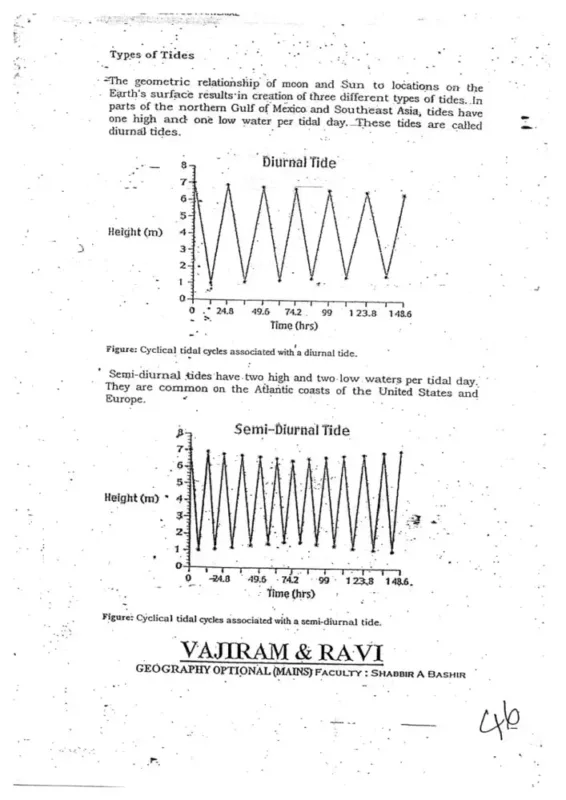
Tides — their types, causes, and geographic distribution — are explained with clear illustrations. Coral reefs and atoll formation theories, including Darwin’s subsidence theory and the glacial control theory, are covered in answer-writing format. The El Nino and La Nina phenomena and their global geographic impacts — on Indian monsoon, Australian droughts, and South American fisheries — are documented in Vajiram & Ravi’s fact-dense style. Ocean deposits classification and the economic geography of marine resources including fisheries and deep-sea mining are also addressed.
Booklet 4: Biogeography and Environmental Geography
Soil geography and biogeography represent an important segment of UPSC Geography Optional Paper I. This booklet opens with soil formation — parent material, climate, relief, biota, and time as factors — followed by zonal, intrazonal, and azonal soil classification. Soil erosion types, consequences, and conservation methods are described with policy references relevant to India. The booklet then transitions into plant geography, covering the major biomes of the world — tropical rainforest, savanna, temperate grassland, boreal forest, and tundra — with their geographic distribution, species characteristics, and climate linkages.
Environmental geography, an increasingly important overlay for UPSC optional answers, is treated with rigor here. Ecosystem structure, trophic levels, and biogeochemical cycles — carbon, nitrogen, phosphorus — are explained diagrammatically. Biodiversity hotspots and their geographic basis are listed with regional examples. Topics like desertification, deforestation, and their geographic drivers are connected to UPSC-relevant policy frameworks such as the Paris Agreement, CBD, and India’s national action plans. The ecological footprint concept and sustainable geography principles wrap up this booklet effectively.
Booklet 5: Human Geography — Perspectives and Population
Human geography forms the theoretical backbone of Paper I’s second half, and this booklet establishes the philosophical and empirical foundations clearly. The evolution of human geography as a discipline — from environmental determinism (Ratzel, Semple) to possibilism (Vidal de la Blache) and stop-and-go determinism — is explained with scholarly attribution essential for UPSC answers. Behaviouralism, welfare geography, and radical geography are also introduced to ensure syllabus completeness. This analytical framing helps aspirants craft high-scoring theoretical answers in UPSC Mains.
Population geography topics — growth, distribution, density, and composition — are treated with emphasis on UPSC-relevant data and trends. Demographic transition theory, its four stages, and its application to developing countries including India are explained with comparative analysis. Malthusian theory and its critiques, optimum population theory, and over- and under-population concepts are covered. Migration — types, theories (Lee’s push-pull, Ravenstein’s laws), and global patterns — receives dedicated treatment. Age-sex pyramids of different country types are illustrated, enabling visual representation in UPSC Mains answers.
Booklet 6: Settlement and Cultural Geography
Settlement geography — both rural and urban — is a high-scoring topic in UPSC Geography Optional and this booklet addresses it with the depth required for 20-mark answers. Rural settlement types — clustered, nucleated, dispersed, and linear — are explained with geographic and cultural determinants. Urban settlement origin theories and functional classification of towns are followed by an analytical discussion of urban morphology models — concentric zone (Burgess), sector model (Hoyt), and multiple nuclei model (Harris and Ullman). These are presented with diagrams suited for UPSC answer sheets.
Central place theory by Christaller and Losch’s marketing principle are explained with hexagonal hinterland diagrams and k-value analysis. Rank-size rule and the primate city concept — with global examples — are covered in a comparative framework. Cultural geography topics including the geographic basis of language distribution, religion, ethnicity, and cultural diffusion (expansion and relocation) are explained with world examples. This integration of cultural factors into geographic analysis equips UPSC aspirants to write multi-dimensional answers that examiners reward in Geography optional evaluation.
Booklet 7: Economic Geography — Agriculture and Industry
Economic geography is central to both the optional papers and this booklet by Shabbir A Bashir addresses agricultural and industrial location theories with UPSC answer-writing precision. Von Thunen’s isolated state model — its assumptions, concentric ring pattern, and critique — is explained diagrammatically with its relevance to modern land-use patterns. Types of farming — subsistence, commercial, plantation, mixed — and their global geographic distribution are mapped systematically. Green revolution — its spread, achievements, and geographic limitations — is covered with India-specific data useful for Paper II linkages.
Industrial location theories receive detailed treatment: Weber’s least-cost theory with isodapane concept, Losch’s profit maximization approach, and growth pole theory by Perroux are explained with geographic examples and their shortcomings. Types of industries — agro-based, mineral-based, knowledge-based — and their locational factors are tabulated. The role of SEZs in industrial geography, globalisation’s effect on manufacturing location, and the geographic shift of industries from developed to developing nations are analyzed. Agglomeration economies and industrial clustering with global case studies such as Silicon Valley and Detroit complete this unit.
Booklet 8: Transport, Trade and Regional Development
This booklet covers transport geography, trade theory, and regional development models — three sub-themes that frequently generate UPSC Mains questions. Transport network analysis — graph theory, connectivity indices, beta and gamma indices — is explained with simple worked examples. The comparative geographic advantages of road, rail, waterway, and air transport are mapped globally. Ullman’s three bases of spatial interaction — complementarity, intervening opportunity, and transferability — are explained with geographic examples and their application to understanding trade flows and regional linkages.
Trade geography — comparative advantage, terms of trade, and WTO’s geographic dimensions — are addressed with policy relevance. Regional development theories receive strong coverage: Friedmann’s core-periphery model, Myrdal’s cumulative causation, Hirschman’s polarisation and trickle-down effects, and growth pole theory are explained analytically. These models are directly applicable to UPSC questions on regional imbalances in India. Port geography and maritime trade route significance, chokepoints like Strait of Malacca and Hormuz, and their geopolitical implications are documented with map references useful for optional answer enrichment.
Booklet 9: Geography of India — Physical Setting
Paper II of UPSC Geography Optional is entirely India-focused, and this booklet establishes the physical foundation for India’s geography. The physiographic division of India — Himalayas (Sub-Himalaya, Lesser, Greater, Trans), Northern Plains, Peninsular Plateau, Coastal Plains, and Islands — is covered with formation history and geographic characteristics. The drainage system — Himalayan rivers (Indus, Ganga, Brahmaputra systems) and Peninsular rivers (east-flowing vs west-flowing) — is mapped with hydrological characteristics. The Indian monsoon mechanism, onset patterns, and regional variability are explained with the latest scientific understanding.
Natural vegetation zones of India — tropical evergreen, deciduous, thorny, montane, and tidal forests — are correlated with climate, soil, and altitude parameters. India’s soil diversity — alluvial, black, red, laterite, arid, and mountain soils — is mapped region-wise with agricultural significance. Mineral resources — iron ore, coal, bauxite, manganese, mica — and their geographic distribution are tabulated for quick revision. India’s coastal geography, including the contrasting characteristics of the east and west coasts, deltas, estuaries, and the Andaman, Nicobar, and Lakshadweep island systems, are covered in detail.
Booklet 10: Geography of India — Human and Economic
Human and economic geography of India forms the core of UPSC Geography Optional Paper II and this booklet covers it with the density and analytical depth the exam demands. Population distribution, density patterns, and demographic characteristics — literacy, sex ratio, age structure, urbanisation levels — are documented with Census data references. The tribal population’s geographic distribution and associated developmental challenges are addressed. India’s urban geography — growth of million-plus cities, metropolitan areas, urban agglomerations, and the nature of India’s urban transition — is analyzed with UPSC-relevant policy linkages.
Agricultural geography of India — crop regions, irrigation systems, land reforms, and food security — is covered with regional specificity. Industrial geography covers major industrial regions: Mumbai-Pune corridor, Damodar Valley, Bengaluru IT cluster, and emerging corridors under national industrial policy. Energy resources — conventional and non-conventional — and their geographic distribution are tabulated. Transport networks — Golden Quadrilateral, North-South/East-West corridors, major ports, and airports — are mapped. Regional imbalances in development between states and the geographic basis of these disparities provide strong UPSC answer material throughout this booklet.
Booklet 11: Contemporary Issues and Map Work
Contemporary geographic issues and map-based questions are integral to UPSC Geography Optional success, and this final booklet addresses both dimensions. India’s border geopolitics — the Line of Actual Control, Line of Control, and maritime boundaries — are explained with geographic context essential for UPSC answers. Regional cooperation frameworks — SAARC, BIMSTEC, ASEAN — are analyzed through a geographic lens. Environmental geography in the Indian context — river water disputes, desertification in Rajasthan, floods in Assam, urban heat islands — is documented with map references and current policy responses.
Geographic information systems (GIS) and remote sensing are introduced at the conceptual level required by the UPSC syllabus, covering data layers, satellite imagery types, and their applications in resource mapping and disaster management. Cartography basics — map projections, scale, thematic maps, and choropleth construction — are explained with annotation guidelines for UPSC answer sheets. The booklet closes with a curated set of frequently asked map-based questions from previous UPSC Geography optional papers, with annotated solutions that train aspirants to accurately locate and label features that examiners expect in high-scoring answers.
Physical Construction and Quality Standards
These Vajiram & Ravi Geography Optional 2025-26 printed booklets are manufactured to endure the demands of daily UPSC study — repeated handling, travel between home and library, and intensive annotation sessions — while maintaining readability and structural integrity throughout a 12–18 month preparation cycle.
Paper Quality: 75 GSM Anti-Glare White Paper
Each booklet in the Vajiram & Ravi Geography Optional 2025-26 set is printed on 75 GSM ultra-white paper chosen for its superior opacity. Multiple highlighter colors — yellow, green, pink, and blue — can be applied without any bleed-through to the reverse side, making color-coded revision fully practical. The anti-glare surface finish reduces eye strain during extended reading sessions, which is critical for UPSC aspirants studying six to eight hours daily. Text density is optimized — not too light to miss detail, not too dark to strain the eyes — achieving the ideal balance for Geography optional study materials.
Printing Technology: High-Resolution Laser Printing
All 11 booklets are produced using high-resolution laser printing technology, which delivers sharp, crisp text reproduction at 600 DPI or higher. This matters particularly for Geography optional notes because diagrams — landform profiles, climate graphs, population pyramids, location theory models, and map outlines — require precise line definition that inkjet or photostat printing cannot reliably deliver. Laser toner is permanently bonded to the paper, ensuring smudge-proof output that survives highlighter passes, water droplets, and years of shelf storage. Flowcharts, tables, and annotated diagrams throughout these booklets reproduce with clarity that aids rapid visual learning.
Binding and Durability
The binding format — spiral or book binding — is chosen for durability and practical usability during active UPSC preparation. Spiral-bound booklets open completely flat on a desk, enabling comfortable side-by-side writing of notes without the spine resistance that damages pages in lesser bindings. The 300 GSM laminated cover resists moisture, scuffs, and daily bag-and-desk handling. Book-bound editions offer a compact spine-stacking advantage for library shelves and travel bags. Both formats are stitched and glued to prevent page loss even after months of daily use, ensuring your Geography optional investment stays intact through revision cycles and test series seasons.
Key Features and Study Design
The Vajiram & Ravi Geography Optional 2025-26 notes by Shabbir A Bashir are structured around one goal: enabling UPSC aspirants to write high-scoring, analytically rich answers in Geography optional Papers I and II under examination conditions.
- Shabbir A Bashir Faculty Content: These notes carry the pedagogical framework of Vajiram & Ravi’s Geography optional faculty, known for integrating theoretical models with map-based and current affairs-linked applications that UPSC examiners consistently reward in Geography optional evaluations.
- Crisp Bullet-Point Architecture: Vajiram & Ravi’s signature bullet-point style reduces complex geographic theories — Von Thunen, Christaller, Friedmann — into exam-ready points that can be deployed in 10-mark and 20-mark answers quickly and without confusion during the three-hour UPSC Mains paper.
- Diagram-Rich Presentation: Geography optional demands answer-sheet diagrams — erosional landforms, climate graphs, population pyramids, hexagonal trade area models — and these booklets include labeled, hand-replication-ready diagrams throughout, specifically designed to add value in UPSC answer writing.
- Full Syllabus Mapping Across 11 Booklets: The 11-booklet structure mirrors the UPSC Geography optional syllabus division — Physical Geography, Human Geography, and Indian Geography — ensuring no unit is under-covered. Each booklet maps directly to specific syllabus sub-sections for targeted preparation and selective revision.
- Updated 2025-26 Content: The 2025-26 edition reflects updated geographic data, revised demographic statistics, current policy frameworks, and contemporary geographic issues — climate change, geopolitical shifts, and India’s economic geography developments — ensuring UPSC aspirants are not preparing with outdated content in a competitive environment.
Shipping, Packaging and Delivery
Every order of Vajiram & Ravi Geography Optional Notes 2025-26 is packed to withstand transit damage across all Indian delivery zones. Each set of 11 booklets is first individually shrink-wrapped to prevent moisture and dust exposure. The complete set is then placed in a rigid corrugated cardboard box with corner edge protectors and foam padding to prevent cover damage and spine stress during courier handling. The outer box is reinforced with heavy-duty packaging tape and clearly labeled for handling care. The result is that your Geography optional notes arrive in the same brand-new, unmarked condition they left our dispatch facility.
Standard pan India delivery takes 3-5 business days via tracked courier partners. A tracking ID is shared via SMS and WhatsApp within 24 hours of dispatch, allowing you to monitor your shipment. For order queries, replacement requests, or delivery follow-up, reach us on WhatsApp at +91 70045 49563. In the rare event of a missing or damaged booklet from your 11-booklet set, we initiate a replacement dispatch within 48 hours at no additional cost. Orders placed before 12 PM on business days are dispatched same-day from our Mukherjee Nagar, Delhi facility.
Frequently Asked Questions (FAQ)
A: Vajiram & Ravi Geography Optional notes by Shabbir A Bashir provide strong syllabus coverage and are a reliable core study resource for UPSC Mains. However, for optimal results, most successful candidates supplement these notes with standard reference books like Majid Husain’s Geography of India and Human Geography, along with UPSC previous year papers. The notes handle theoretical frameworks and answer-writing structure well, but atlas work and current geographic issues should be practiced separately for complete UPSC Geography optional preparation.
A: The Vajiram & Ravi Geography Optional notes 2025-26 set includes exactly 11 printed booklets. These cover the complete UPSC Geography Optional syllabus across Paper I — covering Geomorphology, Climatology, Oceanography, Biogeography, Human Geography perspectives, Population, Settlement, and Economic Geography — and Paper II covering the Geography of India including physical setting, human geography, economic geography, and contemporary issues with map work. All 11 booklets are dispatched together as a single complete set.
A: The Vajiram & Ravi Geography Optional notes 2025-26 set available here is in English medium only. Geography optional at UPSC can be attempted in Hindi, but these specific notes by Shabbir A Bashir are prepared and printed in English. Hindi medium aspirants planning to write Geography optional answers in Hindi should factor in the language medium requirement before purchasing. For Hindi medium Geography optional study material, separate products may be available — please check the store or contact us on WhatsApp at +91 70045 49563 for guidance.
A: The 11 booklets cover: Geomorphology (earth structure, plate tectonics, landforms), Climatology (atmospheric systems, climate classification), Oceanography (ocean relief, currents, tides), Biogeography and Environmental Geography, Human Geography perspectives and Population, Settlement and Cultural Geography, Economic Geography (agriculture and industry), Transport and Regional Development, Physical Geography of India, Human and Economic Geography of India, and Contemporary Issues with Map Work. This covers the complete UPSC Geography Optional syllabus for both Paper I and Paper II.
A: These booklets use 75 GSM ultra-white paper chosen for high opacity — multiple highlighter colors and gel pens work without bleed-through to the reverse side, ideal for color-coded revision. The anti-glare surface also reduces eye strain during long Geography optional study sessions where map study and theoretical content require sustained reading. Ballpoint pens and fine-liners can also be used for marginal annotations without ghosting on the reverse side.
A: Yes, the edition available here is the 2025-26 batch, which reflects updated geographic data, revised demographic and economic statistics, and contemporary issues relevant to the current UPSC examination cycle. Content includes current environmental geography developments, updated India economic geography data, and geopolitical issues relevant to recent UPSC Geography optional question trends. Always verify the edition year on the cover when you receive the set — the cover will clearly read 2025-26 for this specific batch.
A: If you are a self-study aspirant or preparing alongside a job, buying Vajiram & Ravi Geography Optional printed notes gives you the core classroom content at a fraction of the cost and time investment of attending the institute. These notes represent the structured content taught in Vajiram & Ravi’s Geography optional program. Classroom programs add live doubt-solving and peer interaction, but the notes themselves are the primary study material. For UPSC Geography optional, buying these printed notes is a cost-effective and proven preparation strategy.
A: Vajiram & Ravi Geography Optional notes are known for crisp bullet-point content and fact density, making them strong for quick revision and answer-point generation. KSG Geography optional notes tend to be more elaborative with longer explanatory paragraphs, while Aleph notes are valued for diagram intensity. Vajiram’s style suits aspirants who prefer structured lists over lengthy prose. Many UPSC Geography optional toppers have used Vajiram notes as their primary resource. Ultimately, the right choice depends on your learning style, and many serious aspirants buy multiple sets for cross-referencing.
A: These are genuine, original Vajiram & Ravi Geography Optional notes 2025-26 — not photocopies or unauthorized reproductions. They are printed on 75 GSM quality paper using laser printing technology, with proper binding and laminated covers. The content is sourced from the authentic Vajiram & Ravi study material batch for the 2025-26 academic cycle. Each booklet is brand new, unmarked, and dispatched in shrink-wrapped condition directly from our stock in Mukherjee Nagar, Delhi. We do not sell pirated, scanned, or inferior-quality reproductions.
A: Yes. While these notes are specifically structured for UPSC Geography Optional, the content is equally relevant for Geography optional in state civil services examinations including BPSC, UPPSC, MPPSC, RAS, and other State PSC exams that carry Geography as an optional subject. The theoretical frameworks, physical and human geography content, and India-specific geographic coverage in Paper II align well with most State PSC Geography optional syllabi. Aspirants targeting multiple examinations — UPSC plus a State PSC — will find strong value in this 11-booklet set.
A: All orders are dispatched within 24 hours of confirmation on working days. Standard pan India delivery takes 3-5 business days via tracked courier. A tracking ID is sent via SMS and WhatsApp within 24 hours of dispatch. You can reach us on WhatsApp at +91 70045 49563 for real-time order status, delivery queries, or any issues with your shipment. Remote pin codes may take one additional day. If any booklet from your 11-booklet Vajiram Geography Optional set is missing or damaged on arrival, we replace it within 48 hours at no charge.
A: You can buy Vajiram & Ravi Geography Optional notes 2025-26 online directly from this store — the UPSC Store based in Mukherjee Nagar, Delhi. We offer the complete 11-booklet set, brand new and genuine, with pan India delivery in 3-5 business days. Buying directly from our store ensures you receive the correct 2025-26 edition batch with proper binding, full booklet count, and quality packaging. For bulk orders, institute purchases, or queries before you buy, contact us via WhatsApp at +91 70045 49563 for prompt assistance.
Summary
| Specification | Value |
|---|---|
| Booklets | 11 Printed Booklets |
| Faculty | Shabbir A Bashir |
| Institute | Vajiram & Ravi |
| Language | English Medium |
| Edition | 2025-26 |
| Paper | 75 GSM Ultra-White |
| Binding | Spiral or Book Binding |
| Delivery | 3-5 Business Days Pan India |
| Condition | Brand New, Unmarked |
| Also Useful For | BPSC, UPPSC, MPPSC, RAS and all State PSC Geography Optional |
Dispatched from our store in Mukherjee Nagar, Delhi — India’s UPSC preparation hub. Order your Vajiram & Ravi Geography Optional Notes 2025-26 today and receive the complete 11-booklet set at your door with pan India delivery in 3-5 days.
Reference: Civil Services Examination
Customer Reviews 340
Geography optional ke liye ye sab se best available resource hai.
Booklets are well-organized and content is comprehensive. Mast material for optional prep.
Bilkul sahi.
Very detailed aur well-organized notes, bilkul helpful.
Notes comprehensive hain aur quality decent hai. Packaging mein thoda damage tha lekin product fine tha.
Print quality aur content dono top-notch hain. Best investment!
Notes ki quality bahut achhi hai aur syllabus ko well-organize kiya gaya hai, recommend karungi.
Perfect study material for UPSC preparation. Clear explanations and quality content throughout.
Aspirants Also Bought
More from the same category
About Vajiram & Ravi Geography Optional Notes 2025-26
Vajiram & Ravi Geography Optional Notes 2025-26 is a highly recommended UPSC study material from Vajiram & Ravi, specially designed for Geography preparation. Available in English medium, this material is crafted to match the exact requirements of the UPSC Civil Services Examination syllabus — covering both Prelims and Mains comprehensively.
Product Details
- Institute: Vajiram & Ravi
- Subject: Geography
- Medium: English
- Format: Printed
- Delivery: Pan-India delivery in 3–5 working days
- Format: Original printed material, verified authentic
Why Buy from UPSC Store?
- ✅ 100% Genuine Printed Material — Original printed notes, no photocopies or fake copies
- ✅ Fast Delivery — Ships within 24 hours, arrives in 3–5 days pan-India
- ✅ Secure Packaging — Bubble-wrapped and boxed to prevent damage in transit
- ✅ Trusted by 10,000+ Aspirants — India's most reliable UPSC material marketplace
- ✅ WhatsApp Support — Get expert guidance on material selection before ordering
Frequently Asked Questions
Yes, all products at UPSC Store are 100% genuine printed materials. We do not sell photocopies or fake copies.
Orders are dispatched within 24 hours and delivered across India in 3–5 working days via reputed courier partners.
Yes, we accept returns within 7 days if the product is damaged or incorrect. Check our refund policy for details.
We recommend pairing this with current affairs notes and a UPSC test series for comprehensive preparation. Browse more in Geography, Optional, UPSC, Vajiram and Ravi.