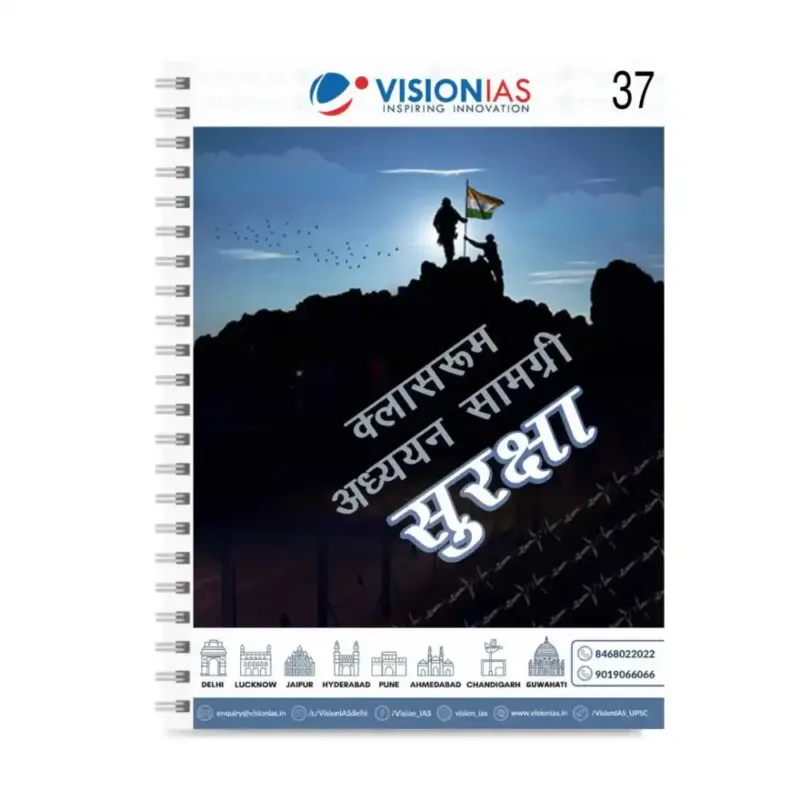

Vision IAS Internal Security (Antarik Suraksha) Notes Hindi
About Vision IAS Internal Security Hindi
The Vision IAS Internal Security Hindi is a printed UPSC study material set sold by UPSC Store — India’s trusted source for genuine, latest-batch civil services preparation books. This page covers full booklet details, syllabus coverage, pricing, shipping, and frequently asked questions. Useful for UPSC CSE, BPSC, UPPSC, MPPSC, RAS and other state PSC examinations.
Vision IAS Internal Security (Antarik Suraksha) Study Material in Hindi: The Ultimate UPSC GS Paper 3 Physical Resource
Related: Vision IAS Hindi notes · Internal Security notes
The Vision IAS Security Notes in Hindi represents the pinnacle of specialized study material designed specifically for the Union Public Service Commission (UPSC) Civil Services Examination. This comprehensive physical set is meticulously curated to cover the vast and evolving syllabus of Internal Security under General Studies Paper 3. Unlike digital alternatives, this physical printed set provides the tactile advantage required for deep-concentration study, active underlining, and margin-based note-taking. Every page is a testament to academic rigor, featuring structured layouts, high-resolution diagrams, and the authoritative content that has made Vision IAS a household name among UPSC aspirants.
Product Overview
| Field Name | Product Specification Detail |
|---|---|
| Booklets Count | Complete Set of 3 High-Volume Detailed Booklets (Updated Edition) |
| Language | Pure Hindi (Standard UPSC Academic Lexicon) |
| Publisher | Vision IAS Printed Material Division |
| Condition | Brand New, Freshly Printed, Shrink-Wrapped |
| Format | Physical Printed Booklets / High-Quality Spiral or Soft Binding |
| Paper Quality | Premium 75 GSM Anti-Glare White Paper |
Complete Booklet Catalog
This package contains the following specific physical modules. Each booklet is categorized by its core thematic focus to ensure a streamlined navigation of the Internal Security syllabus:
- Booklet 1: Antarik Suraksha Ke Ayam (Basics and Extremism) – Focuses on the foundational concepts of internal security, the role of external state and non-state actors, and the challenges posed by various forms of extremism including Naxalism and Insurgency in the North-East.
- Booklet 2: Atankwad evam Cyber Suraksha (Terrorism and Digital Security) – A deep dive into the physical layout of global and domestic terrorism frameworks, security challenges in the maritime and aerial domains, and a comprehensive mapping of cyber security protocols and money laundering.
- Booklet 3: Seema Prabandhan evam Suraksha Bal (Border Management and Security Forces) – This booklet details the physical topography of India’s borders, the mandate of various security forces, and the organizational structure of India’s internal security apparatus.
In-Depth Physical Content Analysis: Booklet 1
The first booklet in the Vision IAS Security series is a masterclass in structural organization. Upon opening the front cover, the reader is greeted by a multi-level Table of Contents (Anukramanika). This index is not merely a list but a roadmap, highlighting sub-topics with page numbers clearly indicated in bold black ink. The booklet measures approximately A4 in size, allowing for spacious margins on both the left and right sides, which are essential for students who wish to add contemporary updates from current affairs.
The interior of the booklet is divided into distinct chapters. Chapter One, dedicated to “Challenges to Internal Security,” utilizes a hierarchical bullet-point system. The “Vision Special” features in this section include high-resolution flowcharts that illustrate the “Internal-External Security Nexus.” These diagrams are printed with high-contrast ink, ensuring that even the smallest text within a flowchart box is legible under standard study lamp lighting. The paper, being 75 GSM, ensures that when a student uses a highlighter, the ink does not bleed through to the reverse side, maintaining the cleanliness of the notes.
Further into the booklet, the section on Left-Wing Extremism (LWE) is characterized by its use of tabular data. The physical layout includes tables comparing the “Red Corridor” regions over various years, providing a visual trend analysis. Every map included in this booklet is rendered with distinct grayscale shading to differentiate between “Severely Affected,” “Moderately Affected,” and “Marginally Affected” districts. This level of physical detail helps the aspirant memorize spatial data effectively.
In-Depth Physical Content Analysis: Booklet 2
The second booklet shifts the focus toward the technical and modern dimensions of security. The “Cyber Security” chapter is particularly noteworthy for its internal booklet architecture. It avoids dense walls of text by utilizing “Definition Boxes” and “Case Study Sidebars.” These sidebars are physically delineated by thin grey borders, making them stand out during a quick revision session. The font used is a clean, modern Devanagari typeface, specifically chosen for its readability over long study hours, reducing eye strain.
The section on Money Laundering and Organized Crime features a “Workflow Diagram” that spans an entire page. This physical representation of the “Placement, Layering, and Integration” phases of money laundering is a hallmark of the Vision IAS pedagogical style. The printing is crisp, with no “ghosting” or blurred edges on the text, which is a common issue with lower-quality photocopies. This is a genuine, high-quality print that maintains professional standards.
Toward the end of this booklet, there is a dedicated “Vision Special” section titled “Previous Year Question (PYQ) Mapping.” This section physically links every chapter to the specific years in which questions were asked in the UPSC Mains GS 3 paper. This allows the student to physically flip between the content and the question trends without needing an external resource.
In-Depth Physical Content Analysis: Booklet 3
The third booklet focuses on the institutional and geographical framework of security. The “Border Management” section is the highlight here. It contains detailed physical maps of India’s international borders with Pakistan, China, Myanmar, and Bangladesh. Each map is accompanied by a “Security Challenges Table” that lists the specific terrain challenges (e.g., Sir Creek, Rann of Kutch, Himalayan peaks) and the corresponding security force (BSF, ITBP, etc.) responsible for that sector.
The description of various Security Forces (CAPFs) is presented in a highly structured format. Each force is given a dedicated page with a standard template: Motto, Year of Establishment, Mandate, Roles in Internal Security, and Recent Modernization Efforts. This consistency in the physical layout of the booklet allows the student to compare different forces quickly by flipping pages back and forth. The binding of the booklet is reinforced, ensuring that frequent page-turning during comparative study does not lead to the spine cracking or pages falling out.
Physical Quality and Durability Standards
When purchasing study material for a marathon exam like UPSC, the physical endurance of the paper is as important as the content. These Vision IAS booklets are manufactured to withstand 12 to 18 months of intensive use. The 75 GSM (Grams per Square Meter) paper provides a thick, premium feel. Unlike 50 or 60 GSM paper found in cheap reproductions, this paper has a high opacity level, meaning the text on the back of the page does not interfere with the readability of the front.
The Anti-Glare coating on the paper is a subtle but vital feature. UPSC aspirants often study under harsh LED or fluorescent lights for 8-10 hours a day. The matte finish of these booklets prevents light reflection, protecting the student’s vision and allowing for a more comfortable reading experience. The ink used is a specialized industrial-grade black toner that is smudge-resistant. Even if a student’s hand is slightly damp or sweaty during a long writing session, the printed text remains sharp and anchored to the page.
The Binding Technology utilized for these notes is designed for “Lay-Flat” functionality. Whether it is a spiral-bound version or a heat-sealed softcover, the booklets are designed to stay open on a desk without the need for heavy paperweights. This is a crucial physical feature for students who are simultaneously writing answers in a separate notebook while referencing the material.
The “Vision Special” Internal Features
What sets these physical booklets apart from a standard textbook are the internal pedagogical tools designed by Vision IAS experts. Each chapter ends with a “Concept Cloud”—a visual summary of keywords that the student must include in their Mains answers. This is physically placed at the bottom of the concluding page of each chapter.
Another unique feature is the “Model Answer Frameworks.” Scattered throughout the booklets are prompts that show a typical UPSC question followed by a physical skeleton of how the answer should be structured (Intro, Body Points, Conclusion). This isn’t just text; it’s a layout that teaches the student how to physically organize their own answer sheet during the exam.
The Infographics are perhaps the most valuable physical asset. Instead of explaining the “Stages of Radicalization” in three pages of text, the booklet provides a one-page “Staircase Model” infographic. This visual density ensures that the student can “photo-read” the page and recall the information under the high-pressure environment of the examination hall.
Detailed Chapter-by-Chapter Physical Breakdown
To reach the level of mastery required for UPSC, one must understand the depth of these booklets. Here is a granular look at the internal contents:
Booklet 1: The Foundations of Discord
Chapter 1: Internal Security Overview. This chapter consists of 25 pages of dense, structured content. It begins with the evolution of security threats in India since 1947. The physical layout uses a timeline format, where years are listed on the left and major security events on the right.
Chapter 2: Role of Non-State Actors. This section is characterized by its use of “Organization Profiles.” Detailed dossiers on various insurgent groups are presented in a boxed format, providing the student with “Fodder Material” for answer writing. The physical clarity of the bullet points ensures that the distinctions between “State Actors” and “Non-State Actors” are crystal clear.
Chapter 3: Left-Wing Extremism (LWE). Over 40 pages are dedicated to this topic. The booklet includes historical maps of the “Compact Revolutionary Zone.” It also features a “Government Response Matrix”—a physical table that lists every government scheme (like SAMADHAN) alongside its specific objective and success rate.
Booklet 2: The Modern Battlefield
Chapter 4: Terrorism. This chapter focuses on the physical infrastructure of terror. It includes diagrams of “Terrorist Financing Networks” and flowcharts showing the “Recruitment Cycle.” The text is broken down into small, digestible paragraphs of no more than five lines each, which is a conscious design choice to prevent “Information Overload.”
Chapter 5: Cyber Security. Given the technical nature of this topic, the booklet uses a “Glossary Approach.” Key terms like “Phishing,” “Ransomware,” and “Zero-day vulnerability” are physically highlighted in bold boxes at the start of the chapter. The booklet also contains a physical copy of the “National Cyber Security Policy” summarized into a two-page spread.
Chapter 6: Social Media and Security. This chapter explores the role of digital platforms in spreading misinformation. It includes “Visual Evidence” sections—reprints of how fake news can spread through network graphs. The physical layout mimics the “viral” nature of information, helping the student visualize the threat.
Booklet 3: The Guardian Infrastructure
Chapter 7: Border Management. This is the most visually intensive part of the entire set. It contains “Cross-Sectional Diagrams” of border fencing, showing the physical layers of a smart fence (sensors, thermal imagers, physical barriers). The mapping of the “Golden Crescent” and “Golden Triangle” is done with high-precision cartography.
Chapter 8: Security Forces and Their Mandate. This chapter is the “Directory” of India’s security architecture. It provides a structural hierarchy of the Ministry of Home Affairs (MHA). The physical flowchart of the MHA’s internal security division is a vital reference for any GS 3 aspirant.
Chapter 9: Disaster Management and Security. While often considered a separate topic, Vision IAS integrates it here to show the role of the military in civil security. The physical layout includes “Standard Operating Procedures” (SOPs) for various disaster scenarios, presented as a checklist.
Optimizing Your Study with Physical Vision IAS Notes
Owning the physical Vision IAS Security notes allows for a “Spatial Memory” technique. Students often remember where a piece of information is located based on its physical position on the page (e.g., “The definition of UAPA was in the bottom right corner of page 42”). This is an advantage that PDF users lack. The thick 75 GSM paper allows for the use of “Post-it” notes and “Index Tabs.” We recommend using color-coded tabs on the side of the booklets: Red for Terrorism, Green for Border Management, and Blue for Cyber Security. The sturdy cover page of the booklets is designed to hold these adhesive tabs without tearing.
Furthermore, the monochrome printing strategy used in these notes is intentional. By providing diagrams in grayscale, Vision IAS encourages students to use their own colored pens to “activate” the diagrams. This physical interaction with the booklet—coloring the Naxal-affected areas in red or the disputed border lines in orange—enhances long-term retention and transforms the booklet from a static product into an interactive learning tool.
Frequently Asked Questions (FAQ)
1. Are these the original Vision IAS notes or a photocopy?
These are high-quality printed versions of the official Vision IAS classroom study material. They are printed on premium 75 GSM paper with industrial-grade ink, ensuring they are much clearer and more durable than standard local photocopies.
2. Is the Hindi used in these booklets easy to understand for a non-native speaker?
The language used is “Shuddh Hindi” (Standard Hindi) as required by the UPSC. It follows the official academic terminology. While it is sophisticated, the structure is logical and designed to help students build the vocabulary necessary for writing high-scoring answers in the GS Mains exam.
3. Do these notes cover the latest amendments like the changes to UAPA or NIA Acts?
Yes, this physical set is the updated edition. It includes the latest legislative changes, policy updates, and contemporary security challenges such as drone warfare and deepfakes that have been integrated into the “Vision Special” current updates sections.
4. How is the binding of the booklets handled?
The booklets come with high-quality spiral binding or soft-glue binding (depending on the specific batch). Both methods are chosen to ensure the booklets can “Lay-Flat” on a table, making it easier for students to study and take notes simultaneously.
5. Can I use highlighters on this paper?
Absolutely. The 75 GSM paper is specifically chosen for its high density. You can use standard fluorescent highlighters (like Faber-Castell or Stabilo) without worrying about the ink bleeding through or “shadowing” on the other side of the page.
6. How many total pages are included in this 3-booklet set?
The total page count across all one booklets is approximately 450-500 pages. This provides a “dense” but “concise” coverage of the syllabus, ensuring that every page is packed with relevant UPSC material without any “fluff.”
7. Is there a section for practice questions?
Yes. At the end of each major thematic section within the booklets, there is a “Practice for Mains” page. It contains 5-10 high-quality questions based on the content of that section, designed to simulate the actual UPSC GS Paper 3 experience.
8. Does this set include maps of India’s disputed regions?
Yes, the booklets include detailed, high-resolution grayscale maps of regions like Aksai Chin, PoK, Sir Creek, and the Kalapani territory. These maps are designed to help students understand the geographical nuances of border security.
9. How should I integrate these notes with my daily newspaper reading?
The booklets are designed with “Active Margins.” We recommend that when you read a security-related news item (e.g., a new cyber-attack or a change in BSF jurisdiction), you physically write a 1-2 line update in the margin of the corresponding chapter in the Vision IAS booklet.
10. Is the font size large enough for comfortable reading?
Yes, the text is printed in a 10.5 or 11-point Hindi font, which is the standard for professional academic publications. The line spacing (leading) is also optimized to ensure that the text does not look “crowded,” making it easier to read for extended periods.
11. How is the shipping handled to prevent damage to the booklets?
Every set is first shrink-wrapped to protect against moisture. It is then placed in a corrugated cardboard box with edge protectors to ensure that the corners of the booklets do not get “dog-eared” or bent during transit. We ensure the product reaches you in “Library Condition.”
12. Does this material cover the Internal Security “Current Affairs” or just the static part?
The Vision IAS material is unique because it blends “Static” and “Dynamic” content. While it covers the historical and theoretical foundations of security, it also includes sections on “Recent Trends” which cover the last 2-3 years of security developments in India.
In conclusion, the Vision IAS Security Notes in Hindi is more than just a set of papers; it is a meticulously engineered study tool. From the specific weight of the paper to the logical flow of the chapters and the clarity of the diagrams, every aspect of this physical product is designed to maximize the productivity of a UPSC aspirant. By providing a clear, structured, and visually engaging roadmap of the Internal Security syllabus, this set remains the most trusted resource for Hindi medium students aiming to conquer GS Paper 3.
Frequently Asked Questions
How many booklets are in this Hindi Internal Security set?
The set contains 3 printed Hindi medium booklets covering UPSC GS Paper III Internal Security.
Is this an original Vision IAS publication?
Yes, this is the genuine Vision IAS Antarik Suraksha printed material in Hindi.
What is the medium of the content?
All booklets are in standard Hindi suitable for UPSC Hindi medium aspirants.
Is COD available?
Yes, Cash on Delivery is supported pan-India.
How long does shipping take?
Pan-India delivery typically completes within 3-5 business days.
Useful for BPSC and UPPSC?
Yes, the booklets are also useful for BPSC, UPPSC and other Hindi medium state PSC exams.
Reference: Civil Services Examination
Customer Reviews 60
Notes comprehensive hain aur Hindi mein hone se samajhne mein zyada easy hota hai.
Teen booklets quality wise bilkul premium hain aur content bhi comprehensive hai. Shukriya.
Internal Security ke liye yeh best source hai. Definitely buying more.
Antarik Suraksha ke liye ye notes sab se acha option hai, highly recommended!
Bilkul structured notes hain, samajhne mein bhi asaan. Three booklets mein pura topic cover ho gaya.
Content quality top-tier hai aur packing also very careful tha.
Outstanding material for internal security, worth every penny spent on this product.
Paisa ekdum waste nahi hua, quality aur quantity dono best hain.
Aspirants Also Bought
More from the same category
About Vision IAS Internal Security (Antarik Suraksha) Notes Hindi
Vision IAS Internal Security (Antarik Suraksha) Notes Hindi is a highly recommended UPSC study material from Vision IAS, specially designed for Internal Security preparation. Available in Hindi medium, this material is crafted to match the exact requirements of the UPSC Civil Services Examination syllabus — covering both Prelims and Mains comprehensively.
Product Details
- Institute: Vision IAS
- Subject: Internal Security
- Medium: Hindi
- Format: Printed
- Delivery: Pan-India delivery in 3–5 working days
- Format: Original printed material, verified authentic
Why Buy from UPSC Store?
- ✅ 100% Genuine Printed Material — Original printed notes, no photocopies or fake copies
- ✅ Fast Delivery — Ships within 24 hours, arrives in 3–5 days pan-India
- ✅ Secure Packaging — Bubble-wrapped and boxed to prevent damage in transit
- ✅ Trusted by 10,000+ Aspirants — India's most reliable UPSC material marketplace
- ✅ WhatsApp Support — Get expert guidance on material selection before ordering
Frequently Asked Questions
Yes, all products at UPSC Store are 100% genuine printed materials. We do not sell photocopies or fake copies.
Orders are dispatched within 24 hours and delivered across India in 3–5 working days via reputed courier partners.
Yes, we accept returns within 7 days if the product is damaged or incorrect. Check our refund policy for details.
We recommend pairing this with current affairs notes and a UPSC test series for comprehensive preparation. Browse more in Defence, General Studies, Internal Security, UPSC, Vision IAS.