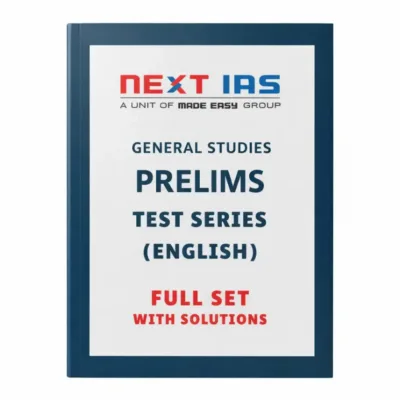


Next IAS General Studies Prelims Test Series Notes 2026-27
About Next IAS GS Prelims Test
The Next IAS GS Prelims Test is a printed UPSC study material set sold by UPSC Store β India’s trusted source for genuine, latest-batch civil services preparation books. This page covers full booklet details, syllabus coverage, pricing, shipping, and frequently asked questions. Useful for UPSC CSE, BPSC, UPPSC, MPPSC, RAS and other state PSC examinations.
Next IAS General Studies Prelims Test Series Notes 2026-27 | 22 Booklets | Hindi Medium | UPSC Study Material
Related: Next IAS notes Β· GS test series
Next IAS General Studies Prelims Test Series Notes 2026-27 is a comprehensive and meticulously designed study package for aspirants preparing for the UPSC Civil Services Preliminary Examination. This complete set of 22 booklets in Hindi Medium covers the entire UPSC syllabus in a structured, exam-oriented manner, making it ideal for serious candidates who want to achieve top scores in the Prelims. Crafted by experienced faculty at Next IAS, this series combines conceptual clarity with rigorous practice to give aspirants a definitive edge over competition.
The package is specially designed for Hindi medium students who often face a lack of quality study material in their preferred language. With updated content aligned with the latest UPSC trends and pattern, this set of 22 booklets ensures that no topic is left untouched. Whether you are a first-time aspirant or a seasoned candidate looking to improve your Prelims score, this test series notes package provides exactly the depth and breadth required to clear the UPSC Preliminary Examination with confidence.
Booklet-Wise Content Description
Booklet 1: Indian History β Ancient and Medieval Period
This booklet covers the complete spectrum of Ancient and Medieval Indian History as required for UPSC Prelims. Starting from the Indus Valley Civilisation through the Vedic Age, Mahajanapadas, Mauryan and Gupta Empires, and progressing to the medieval Sultanate and Mughal periods, every topic is explained with factual precision and conceptual depth. Key dynasties, rulers, administrative systems, art, culture, and socio-economic developments are all covered comprehensively.
The booklet also includes previous years’ questions mapped to specific topics, helping aspirants understand which areas carry more weightage in the actual UPSC examination. Special emphasis has been placed on religious movements like Buddhism, Jainism, Bhakti, and Sufi traditions, which frequently appear in the Prelims. The content is presented in clear, concise Hindi, making it accessible and easy to revise for Hindi medium students preparing seriously for the 2026-27 UPSC cycle.
Booklet 2: Indian History β Modern Period
The Modern Indian History booklet comprehensively covers the colonial period from the advent of European powers to India’s independence in 1947. Topics include British expansion, socio-religious reform movements, the Indian National Movement, revolutionary activities, and the constitutional development of India. The role of key leaders like Gandhi, Nehru, Subhash Chandra Bose, Ambedkar, and many others is discussed with factual accuracy.
This booklet pays special attention to the events and movements that shaped modern India, including the Non-Cooperation Movement, Civil Disobedience Movement, Quit India Movement, and the formation of the Indian National Congress. Important acts, commissions, and policies of the British government are clearly tabulated for quick revision. The content is enriched with maps, timelines, and summaries that are particularly helpful for last-minute revision before the UPSC Prelims examination.
Booklet 3: Indian Polity and Governance
Indian Polity is one of the most scoring subjects in UPSC Prelims, and this booklet ensures complete mastery of the topic. It covers the Indian Constitution from its historical background and framing to its fundamental features, Fundamental Rights, Directive Principles, and Fundamental Duties. Parliamentary procedures, federalism, emergency provisions, and constitutional bodies are all explained with precision and clarity.
The governance section covers topics like administrative tribunals, regulatory bodies, constitutional amendments, and election-related provisions. The booklet includes a detailed discussion of landmark Supreme Court judgments that have shaped constitutional interpretation, which is highly relevant for current UPSC Prelims trends. Written in simple yet precise Hindi, this booklet serves as a one-stop reference for polity preparation and is invaluable for Hindi medium candidates who find English-language materials difficult to grasp deeply.
Booklet 4: Indian Economy β Basics and Microeconomics
This booklet introduces aspirants to the fundamental concepts of economics that form the backbone of UPSC Prelims economy questions. Topics like demand and supply, market structures, price determination, elasticity, consumer behaviour, and production theory are explained with India-specific examples. The basic macro indicators like GDP, GNP, NNP, and national income accounting are also covered with conceptual clarity.
Special focus is given to economic reforms in India post-1991 and their impact on various sectors of the economy. The booklet explains concepts like liberalisation, privatisation, and globalisation in a straightforward manner, along with their outcomes. Banking and monetary policy basics, including the role of RBI, are also introduced in this booklet. The explanations are enriched with data, graphs, and real-world examples that help Hindi medium students build a strong foundation for the economy section of UPSC Prelims.
Booklet 5: Indian Economy β Current Economic Developments
This booklet focuses on contemporary economic developments relevant to the UPSC Prelims examination. It covers topics such as government budgeting, fiscal policy, taxation reforms like GST, infrastructure development, agricultural economy, poverty and unemployment, and various flagship government schemes. The content is updated with the latest economic data and policy announcements, making it highly relevant for the 2026-27 examination cycle.
The booklet also includes sections on international economic institutions like WTO, IMF, World Bank, and their roles in shaping India’s economic policy. Topics like balance of payments, foreign exchange reserves, external debt, and trade agreements are explained clearly. The inclusion of current affairs-based economic topics ensures that aspirants are not caught off guard by questions on recent economic developments that regularly appear in UPSC Prelims, especially in the last two to three years.
Booklet 6: Indian Geography β Physical Geography
Physical Geography is a high-scoring section, and this booklet provides thorough coverage of India’s physiographic divisions, drainage systems, climate patterns, natural vegetation, and soil types. The Himalayas, Indo-Gangetic plains, Peninsular Plateau, coastal plains, and island groups are all explained with detailed maps and diagrams. Monsoon dynamics, cyclones, and weather patterns unique to India are also covered comprehensively.
The booklet integrates physical geography concepts with ecology and environment topics, helping aspirants understand how physical features influence biodiversity, climate, and human settlement patterns. River systems including major tributaries, interstate water disputes, and their geographical significance are highlighted. The use of well-labelled maps within the booklet makes it an excellent resource for visual learners, and regular practice questions at the end of each chapter ensure concept retention for Hindi medium UPSC aspirants.
Booklet 7: Indian Geography β Human and Economic Geography
Human and Economic Geography covers population distribution, demographic trends, urbanisation, agriculture, industries, transport networks, and regional development in India. The booklet provides a detailed analysis of agricultural practices, major crops, irrigation systems, and food security challenges in India, which are frequently tested in UPSC Prelims. Industrial policies, special economic zones, and infrastructure corridors are also discussed.
The booklet also covers energy resources, mineral distribution, fisheries, and forest resources across different regions of India. Trade patterns, port connectivity, and the role of logistics in economic development are explained with updated data. Human Development Index parameters, regional disparities, and demographic dividend concepts are covered in the context of India’s developmental journey. This booklet ensures that aspirants have a well-rounded understanding of India’s economic geography as tested in UPSC Civil Services Preliminary Examination.
Booklet 8: World Geography
World Geography is an essential component of UPSC Prelims, and this booklet covers all major topics including the solar system, internal structure of the earth, plate tectonics, volcanoes and earthquakes, ocean currents, winds and pressure belts, and world climate zones. Major biomes, world rivers, mountain ranges, and desert formations are explained with supporting maps and diagrams to aid visual understanding.
The booklet also covers important geographical features of each continent, major international waterways, straits, seas, and their strategic significance. Economic geography of the world, including major mineral-producing regions, oil and gas fields, major agricultural belts, and trading blocs, is discussed in a UPSC-relevant manner. The content is carefully curated to match the type and difficulty level of questions asked in UPSC Prelims, making it an indispensable resource for comprehensive geography preparation.
Booklet 9: Environment and Ecology β Part 1
Environment and Ecology has become one of the most important sections of UPSC Prelims in recent years. This booklet covers ecosystem concepts, food chains, food webs, ecological pyramids, nutrient cycles, and biodiversity at various levels. Special attention is given to India’s biodiversity hotspots, endemic species, endangered flora and fauna, and conservation strategies like national parks, wildlife sanctuaries, and biosphere reserves.
The booklet also explains concepts of ecological succession, adaptation, and the significance of keystone species in maintaining ecosystem balance. International conventions and agreements related to biodiversity, such as CBD, CITES, Ramsar Convention, and the Nagoya Protocol, are explained with their relevance to India. IUCN categories, Red Data Book, and conservation biology principles are also covered. This booklet lays the conceptual foundation needed for tackling the increasingly complex ecology questions in UPSC Prelims.
Booklet 10: Environment and Ecology β Part 2
The second part of Environment and Ecology extends coverage to environmental pollution, climate change, renewable energy, environmental laws, and sustainable development. Topics like air pollution, water pollution, soil contamination, noise pollution, and their health impacts are explained with Indian examples and relevant legislation. Climate change mechanisms, greenhouse gases, global warming potential, and India’s climate commitments under international agreements are discussed in detail.
This booklet also covers environmental impact assessment, environmental clearance processes, and the role of the National Green Tribunal in environmental governance. Topics like solid waste management, e-waste, plastic pollution, and environmental accounting are included for comprehensive coverage. The Paris Agreement, UNFCCC, Kyoto Protocol, and related international environmental frameworks are explained clearly. With environment questions becoming more conceptual and application-based in UPSC Prelims, this booklet provides the analytical understanding required to score well.
Booklet 11: Science and Technology β Part 1
Science and Technology is a dynamic section of UPSC Prelims that requires both conceptual knowledge and awareness of recent developments. This booklet covers basics of physics, chemistry, and biology that are directly relevant to UPSC Prelims questions. Topics like nuclear technology, space science, defence technology, biotechnology basics, and information technology are explained in simple language suitable for non-science background students.
The booklet focuses on applied science topics that appear frequently in UPSC Prelims, such as nanotechnology, artificial intelligence fundamentals, satellite technology, missile systems, and genome mapping. India’s achievements in space research through ISRO missions, defence developments, and scientific institutions are covered comprehensively. Each topic is presented with its real-world applications and relevance to India’s development, making it easier for Hindi medium aspirants to connect scientific concepts with policy and current affairs contexts.
Booklet 12: Science and Technology β Part 2
This continuation of the Science and Technology series focuses on emerging technologies and their implications for society and governance. Topics like blockchain technology, quantum computing, cybersecurity, 5G and telecommunications, drone technology, and renewable energy technologies are discussed with appropriate depth for UPSC Prelims. India’s digital infrastructure initiatives and technology-driven governance are also covered.
Biotechnology applications in agriculture, medicine, and industry are discussed in detail, including genetically modified organisms, gene editing techniques like CRISPR, and their regulatory frameworks in India. Pharmaceutical developments, vaccine technology, and biodefence are also included given their increased relevance after the COVID-19 pandemic. The booklet also covers India’s technology policy framework, research institutions, and innovation ecosystem, providing a complete picture of science and technology topics as tested in the UPSC Civil Services Preliminary Examination.
Booklet 13: Art, Culture, and Heritage
Indian Art, Culture, and Heritage is a crucial section for UPSC Prelims that requires in-depth knowledge of performing arts, visual arts, architecture, festivals, languages, religions, and philosophical traditions. This booklet provides comprehensive coverage of classical dance forms, music traditions, theatre arts, puppetry, and folk art forms from different regions of India. Architectural styles from ancient temples to medieval mosques and colonial buildings are explained with illustrative examples.
The booklet covers UNESCO World Heritage Sites in India, protected monuments, and the work of the Archaeological Survey of India. Religious texts, philosophical schools including Nyaya, Vaisheshika, Samkhya, Yoga, Mimamsa, and Vedanta, are discussed briefly but precisely. The Geographical Indications of India for handicrafts and cultural products, tribal art traditions, and intangible cultural heritage are also covered. This booklet ensures that aspirants are well-prepared for the culture-heavy questions that regularly appear in UPSC Prelims.
Booklet 14: Internal Security and Disaster Management
Internal Security is a significant topic in UPSC Prelims GS Paper 1, and this booklet covers all dimensions of security threats facing India. Topics include left-wing extremism, insurgency in the Northeast, cross-border terrorism, cybersecurity threats, organised crime, and communal tensions. The role of various security agencies like NIA, NSG, CRPF, BSF, and their mandates are explained clearly. India’s border management challenges and coastal security frameworks are also discussed.
Disaster Management covers the legal framework under the Disaster Management Act 2005, the role of NDMA, SDMA, and NDRF in disaster preparedness and response. Different types of natural disasters including floods, earthquakes, cyclones, tsunamis, and droughts are covered with India-specific context. Early warning systems, community-based disaster management, and rehabilitation strategies are explained. The booklet also touches upon technological tools like satellite imagery and GIS in disaster management, which reflect the current approach of UPSC in testing these topics.
Booklet 15: Schemes and Programmes of Government of India
This booklet is a comprehensive compilation of important Central Government schemes, programmes, and initiatives that are regularly tested in UPSC Prelims. Organised sector-wise covering agriculture, health, education, rural development, urban development, women and child welfare, skill development, and financial inclusion, this booklet covers hundreds of schemes with their objectives, target beneficiaries, implementing agencies, and key features.
The booklet is regularly updated to include the latest government schemes and policy announcements relevant to the 2026-27 examination cycle. Important schemes like PM-KISAN, Ayushman Bharat, MGNREGS, PM Awas Yojana, Jal Jeevan Mission, and many others are explained in detail. The inclusion of scheme-wise quick reference tables makes last-minute revision extremely efficient. For Hindi medium aspirants who find English government documents difficult to navigate, this booklet serves as an invaluable resource in their native language.
Booklet 16: Indian Agriculture and Rural Development
Agriculture remains central to India’s economy and is a frequently tested topic in UPSC Prelims. This booklet covers India’s agricultural profile, cropping patterns, irrigation systems, agricultural marketing, price support mechanisms, and farm credit systems. Green Revolution, White Revolution, Blue Revolution, and other transformative developments in Indian agriculture are discussed with their impacts and current relevance.
Rural development programmes, Panchayati Raj institutions, land reforms, and rural poverty alleviation strategies are also covered comprehensively. The booklet discusses new challenges in Indian agriculture like climate change impact, water scarcity, soil degradation, and the need for sustainable agricultural practices. Organic farming, natural farming, precision agriculture, and allied sectors like animal husbandry, dairying, and fisheries are also included. This booklet provides a holistic understanding of agrarian issues that are increasingly prominent in UPSC Prelims and Mains examinations.
Booklet 17: International Relations and Foreign Policy
International Relations and India’s Foreign Policy are important components of UPSC Prelims, and this booklet covers India’s bilateral relationships with major countries, regional groupings, and India’s participation in multilateral forums. India’s neighbourhood first policy, Act East policy, and engagement with major powers like USA, Russia, China, Japan, and European nations are discussed with historical context and current developments.
The booklet also covers important international organisations like the United Nations and its specialised agencies, G20, BRICS, SCO, SAARC, ASEAN, and their significance for India. Key treaties, conventions, and international agreements in which India participates are listed and explained. India’s stand on global issues like nuclear disarmament, climate change, terrorism, and maritime security is discussed. The booklet ensures that aspirants have a current and comprehensive understanding of India’s position in the global order as required for UPSC Prelims.
Booklet 18: Social Issues and Social Justice
Social Issues and Social Justice form an important part of UPSC GS preparation, and this booklet covers poverty, inequality, caste-based discrimination, gender disparity, child labour, communalism, regionalism, and minority rights. Constitutional provisions and legislative frameworks for social protection are discussed, including SC/ST Prevention of Atrocities Act, Right to Education, POCSO Act, and laws protecting women’s rights.
The booklet also covers welfare programmes targeting marginalised communities, reservation policies and their constitutional basis, schemes for OBCs, EWS, persons with disabilities, and elderly citizens. Social indicators like HDI, Gender Development Index, Multidimensional Poverty Index, and India’s performance on these indices are discussed. The impact of urbanisation, migration, and technological change on social structures in India is also analysed. This booklet helps aspirants develop an analytical framework for understanding and answering social issue-related questions in UPSC Prelims.
Booklet 19: Current Affairs β Part 1
Current Affairs is one of the most critical components of UPSC Prelims success, and this booklet compiles important current events from the first half of the examination cycle. It covers developments in polity, governance, economy, science and technology, environment, and international relations from a UPSC perspective. Each topic is presented not merely as a news item but with the necessary background, context, and conceptual connection to the static syllabus.
The booklet is organised thematically to make revision easier, grouping related events together for better retention. Important government decisions, judicial pronouncements, policy changes, appointments to constitutional and statutory bodies, India’s achievements in various fields, and international events of significance to India are all covered. The focus is on events that have examination relevance rather than mere news reporting, making this booklet a highly targeted and efficient current affairs resource for UPSC Prelims aspirants preparing in Hindi medium.
Booklet 20: Current Affairs β Part 2
The second Current Affairs booklet covers developments from the second half of the examination cycle, ensuring complete and up-to-date coverage for the 2026-27 UPSC Prelims. It follows the same thematic and UPSC-relevant approach as Part 1, covering all major sectors and issues that emerged during this period. Special attention is given to economic surveys, budget announcements, census data, and major government reports released during the year.
This booklet also includes important international summits, bilateral agreements, sports achievements of national significance, major disasters and India’s response, and significant scientific discoveries and technological milestones. The content is regularly reviewed by experts to ensure that only examination-relevant current affairs are included. For Hindi medium students who struggle to access quality current affairs compilations in Hindi, this booklet is a comprehensive solution that eliminates the need to rely on multiple English-language sources.
Booklet 21: Practice Questions β GS Paper 1 (Set A)
This booklet contains a full set of practice MCQs designed on the lines of actual UPSC Prelims GS Paper 1. The questions are created by experienced faculty who have a thorough understanding of UPSC examination trends. Each question tests conceptual understanding rather than rote memory, mimicking the analytical difficulty level of actual UPSC Prelims questions. Detailed explanations for each answer help aspirants understand the reasoning and avoid repeating mistakes.
The practice set covers all major topics of the UPSC GS Prelims syllabus proportionally, ensuring balanced preparation. Negative marking is incorporated in the answer sheets to make the practice realistic, helping aspirants develop an effective elimination strategy for the actual examination. The difficulty distribution in this booklet matches that of recent UPSC Prelims papers, with a mix of factual, analytical, and current affairs-based questions. Regular practice with this booklet is essential for building the speed and accuracy needed to clear the UPSC Prelims cutoff.
Booklet 22: Practice Questions β GS Paper 1 (Set B) and Mock Test
The final booklet in this comprehensive series contains a second full-length practice set and a complete mock test simulating actual UPSC Prelims conditions. The practice questions in Set B are slightly more challenging than Set A, designed to push aspirants to the highest level of preparation. Topics from across the entire syllabus are randomly mixed as in the actual examination, helping aspirants manage question diversity effectively.
The mock test at the end of this booklet is a full simulation of UPSC Prelims GS Paper 1 with 100 questions to be completed in 120 minutes. Detailed performance analysis guidance, answer keys with explanations, and topic-wise performance assessment tools are included to help aspirants identify and address their weak areas before the actual examination. This booklet is the ultimate testing ground for 2026-27 UPSC Prelims aspirants to benchmark their preparation and fine-tune their exam strategy in the final weeks before the examination.
Frequently Asked Questions (FAQs)
Q1. Is this study material suitable for first-time UPSC aspirants?
Yes, this Next IAS Prelims Test Series Notes package is suitable for both first-time aspirants and repeat candidates. The content is structured from fundamental concepts to advanced topics, making it easy for beginners to follow while also offering sufficient depth for experienced aspirants. The Hindi medium presentation removes language barriers for students who are more comfortable studying in Hindi. The practice questions and mock tests help first-time aspirants understand the examination pattern thoroughly before appearing in the actual UPSC Prelims.
Q2. Is the content updated for the 2026-27 UPSC Prelims examination?
Yes, all 22 booklets in this package are updated and aligned with the latest UPSC syllabus and examination trends applicable for the 2026-27 Prelims cycle. Current affairs content is compiled from relevant periods, government schemes are updated to include recent launches, and static topics are reviewed to incorporate any new developments or policy changes. The team at Next IAS regularly updates their study material to ensure aspirants have the most current and examination-relevant information available for their preparation.
Q3. Can this material replace standard textbooks like NCERTs?
This package is designed to complement and significantly reduce the dependence on multiple standard textbooks. While NCERTs provide foundational understanding, this series provides a concise, UPSC-oriented synthesis of all relevant content from NCERTs and other standard references. For aspirants with limited time, this package can serve as the primary study material. However, for deep conceptual preparation, aspirants may occasionally refer to specific NCERTs or standard reference books alongside this series for maximum effectiveness.
Q4. How many practice questions are included in the package?
The package includes two full-length practice sets (Set A and Set B) each containing 100 MCQs, along with a complete mock test of 100 questions, giving aspirants 300 high-quality practice questions in total. In addition, individual subject booklets contain chapter-end practice questions and previous years’ question references. This comprehensive practice framework is designed to ensure that aspirants are fully prepared to handle any type of question that appears in the actual UPSC Prelims GS Paper 1 examination.
Q5. Is the Hindi used in these booklets easy to understand for students from all regions?
Yes, the language used in these booklets is Standard Modern Hindi that is accessible to students from all Hindi-speaking regions as well as those who have learned Hindi as a second language. Technical terms are often presented alongside their English equivalents to avoid any confusion. The writing style is simple, direct, and examination-focused without unnecessary literary complexity. This approach ensures that Hindi medium aspirants can focus entirely on understanding content rather than struggling with the language itself.
Q6. How is this package different from other Hindi medium study materials available in the market?
This Next IAS package stands apart due to the brand credibility and teaching expertise of Next IAS, one of India’s leading UPSC coaching institutions. Unlike generic study materials, these booklets are written by faculty who have direct experience of UPSC examination patterns and know exactly what level of detail is required. The integration of test series questions with study notes, regular content updates, and comprehensive coverage of all 22 topic areas in a single cohesive package makes it distinctly superior to most alternatives available in the Hindi medium market.
Q7. Can this package be used for UPSC Mains preparation as well?
While this package is primarily designed and optimised for UPSC Prelims preparation, the strong conceptual foundation it builds across subjects like Polity, Economy, History, Geography, and Environment is also beneficial for Mains preparation. However, for Mains, aspirants should supplement this package with answer writing practice, essay preparation, and more detailed study of specific topics. The current affairs booklets are particularly useful for both Prelims and Mains as they provide relevant background information for answer enrichment.
Q8. What is the recommended study schedule for using all 22 booklets effectively?
For aspirants with 10 to 12 months of preparation time, we recommend covering two to three booklets per month systematically, starting with History, Polity, Geography, and Economy as priority subjects, followed by Environment, Science and Technology, and other sections. Current Affairs booklets should be integrated throughout the preparation period. The practice question booklets should be attempted only after completing the subject-wise study, and the mock test should be taken under actual examination conditions approximately four to six weeks before the UPSC Prelims examination date.
Q9. Are maps, diagrams, and tables included in the booklets?
Yes, relevant maps, diagrams, tables, flowcharts, and infographics are incorporated throughout the booklets wherever they aid understanding and retention. Geography booklets are richly illustrated with regional maps. Science and Technology sections include schematic diagrams for important concepts. Economy sections contain data tables and trend charts. The use of visual aids is particularly helpful for Hindi medium aspirants who benefit from multi-modal learning to retain complex information about geography, ecology, and science topics commonly tested in UPSC Prelims.
Q10. What is the physical quality of the booklets in terms of paper and printing?
All 22 booklets are printed on high-quality paper with clear, sharp printing that ensures comfortable reading during long study sessions. The font size is chosen to be easy on the eyes, and the layout is clean and well-organised with proper headings, subheadings, bullet points, and white space for margin notes. The booklets are bound to ensure durability through months of regular use. The physical quality is designed to match the expectations of serious UPSC aspirants who will be using these materials extensively throughout their preparation period.
Q11. Are previous years’ UPSC questions incorporated in these booklets?
Yes, previous years’ UPSC Prelims questions are strategically integrated throughout the subject-wise booklets to help aspirants understand which topics are given more weightage in the actual examination. These questions serve multiple purposes: they validate the relevance of topics covered, help aspirants understand the exact type of questions asked by UPSC, and provide ready practice material. Analysis of previous years’ trends is also provided to help aspirants prioritise topics during their limited preparation time before the UPSC Prelims examination.
Q12. Is this package available with any additional digital support or online resources?
This physical booklet package from Next IAS may be complemented by the digital resources and online test series offered by Next IAS through their official platform. While the booklets themselves are comprehensive standalone resources, aspirants can additionally access Next IAS online portals, video lectures, and digital test series for supplementary practice and conceptual clarification. The combination of physical notes and digital resources from the same institution ensures consistency in approach and quality throughout the preparation journey for UPSC Prelims 2026-27.
Physical Quality Details
Paper Quality
The booklets are printed on premium quality white offset paper that provides an excellent reading experience. The paper weight is carefully selected to balance durability with a lighter overall weight for the complete set, making the booklets easy to carry. The paper is smooth enough for comfortable reading without causing eye strain during extended study sessions, and it also allows aspirants to make light pencil annotations and underline key points without any ink bleed-through affecting readability on the reverse side.
Print Quality
Next IAS has used high-resolution printing technology for these booklets, ensuring that all text, including fine print in tables and footnotes, is crisp and clearly legible. Diagrams, maps, and charts are printed with sufficient resolution to make all labels and details visible without requiring magnification. The ink quality ensures long-lasting print that does not fade with regular use. Black and white printing is used effectively with varied font weights, sizes, and formatting to create clear visual hierarchy within each booklet’s content structure.
Binding Type
Each booklet in the set of 22 is bound using a sturdy staple or perfect binding method appropriate to the booklet thickness, ensuring that pages remain intact through months of daily use. The binding is reinforced to withstand repeated opening and closing during intensive revision sessions. The spine of each booklet clearly mentions the booklet number and subject title, making it easy to locate specific booklets quickly when studying or revising. The binding quality reflects Next IAS’s commitment to providing professional-grade study materials for serious UPSC aspirants.
Cover Design and Labelling
Each booklet features a professionally designed colour cover that clearly indicates the booklet number, subject area, medium of instruction (Hindi), and the year of the examination cycle (2026-27). The covers are printed on thick glossy cardstock that provides additional durability to each booklet. The colour coding used across different subject booklets makes the entire set visually organised and easy to manage. The Next IAS branding on each cover ensures authenticity and helps aspirants distinguish these materials from unauthorised reproductions.
Font and Layout
The typography used across all 22 booklets is carefully standardised to ensure a comfortable and consistent reading experience. The main body text is set in a clear, legible Hindi font at an appropriate size for extended reading without eye fatigue. Headings and subheadings are distinguished using larger bold fonts, creating a clear navigational hierarchy within each booklet. Important terms, definitions, and key facts are highlighted using bold or underlined formatting. Ample margin space is provided on each page for aspirants to add personal notes, diagrams, or revision markers as they study.
Summary Table
| Feature | Details |
|---|---|
| Product Name | Next IAS General Studies Prelims Test Series Notes 2026-27 |
| Total Booklets | 22 Booklets (Complete Set) |
| Medium of Instruction | Hindi Medium |
| Target Examination |
Frequently Asked Questions
How many tests are in this Hindi GS series?
22 booklets contain sectional and full-length GS Prelims tests with solutions.
Is this the 2026-27 batch?
Yes, this is the latest Hindi medium Next IAS test series batch.
Is COD supported?
Yes, COD is available on serviceable PIN codes.
Useful for BPSC or UPPSC?
Yes, BPSC, UPPSC and MPPSC Hindi medium aspirants benefit from these GS tests.
When will it be delivered?
Dispatch in 24-48 hours; delivery in 3-7 working days with tracking.
What is the paper and binding?
75 GSM ultra-white paper with spiral or book binding.
Reference: UPSC official syllabus
Customer Reviews 166
Hindi medium mein sab kuch clear hai, test series bilkul relevant hai UPSC ke liye.
Some sections are really helpful, others feel rushed. Good reference material but not comprehensive enough.
Quality mein koi compromise nahi, booklets itni useful hain.
Content toh bagaimaan hai lekin 22 booklets manage karna thoda hectic ho gaya. Kaafi time consumption wala course.
Notes bohot detailed hain. 22 booklets sab relevant topics cover karte hain.
Yeh material mera preparation level badha diya, bilkul worth buying.
Content akela hi preparation complete kar dunga. Quality mein koi compromise nahi.
Test series kaafi useful nikli aur content well-structured tha. Definitely recommend karunga.
Aspirants Also Bought
More from the same category
About Next IAS General Studies Prelims Test Series Notes 2026-27
Next IAS General Studies Prelims Test Series Notes 2026-27 is a highly recommended UPSC study material from Next IAS, specially designed for UPSC Civil Services Preliminary Examination preparation. Available in Hindi medium, this material is crafted to match the exact requirements of the UPSC Civil Services Examination syllabus β covering both Prelims and Mains comprehensively.
Product Details
- Institute: Next IAS
- Subject: UPSC Civil Services Preliminary Examination
- Medium: Hindi
- Format: Printed
- Delivery: Pan-India delivery in 3β5 working days
- Format: Original printed material, verified authentic
Why Buy from UPSC Store?
- β 100% Genuine Printed Material β Original printed notes, no photocopies or fake copies
- β Fast Delivery β Ships within 24 hours, arrives in 3β5 days pan-India
- β Secure Packaging β Bubble-wrapped and boxed to prevent damage in transit
- β Trusted by 10,000+ Aspirants β India's most reliable UPSC material marketplace
- β WhatsApp Support β Get expert guidance on material selection before ordering
Frequently Asked Questions
Yes, all products at UPSC Store are 100% genuine printed materials. We do not sell photocopies or fake copies.
Orders are dispatched within 24 hours and delivered across India in 3β5 working days via reputed courier partners.
Yes, we accept returns within 7 days if the product is damaged or incorrect. Check our refund policy for details.
We recommend pairing this with current affairs notes and a UPSC test series for comprehensive preparation. Browse more in General Studies, Next IAS, Test Series, UPSC.