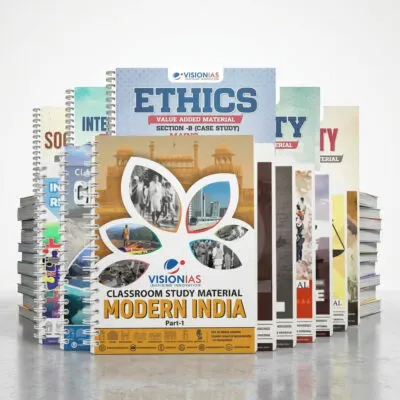



Vision IAS English GS Study Material Notes 2025-26
About Vision IAS Complete GS Notes
The Vision IAS Complete GS Notes is a printed UPSC study material set sold by UPSC Store — India’s trusted source for genuine, latest-batch civil services preparation books. This page covers full booklet details, syllabus coverage, pricing, shipping, and frequently asked questions. Useful for UPSC CSE, BPSC, UPPSC, MPPSC, RAS and other state PSC examinations.
Vision IAS English GS Study Material 2025-26 — 38 Printed Booklets for UPSC GS Paper I, II, III & IV
Related: Vision IAS notes · UPSC General Studies
Product Overview
| Feature | Details |
|---|---|
| Booklets Count | 38 Individual Printed Booklets — Complete GS Paper I, II, III & IV Coverage |
| Language | English Medium |
| Publisher | Vision IAS (Classroom Study Material Series) |
| Edition | 2025-26 — Latest Genuine Batch |
| Condition | Brand New, Unmarked, Fresh Stock |
| Format | High-Quality Printed Booklets — Spiral or Book Binding |
| Paper Quality | 75 GSM Ultra-White — Highlighter Safe, Zero Bleed-Through |
| Shipping | Pan India Delivery in 3-5 Business Days — Tracked |
| Also Useful For | BPSC, UPPSC, MPPSC, RAS and all State PSC Examinations |
Complete Booklet Catalog
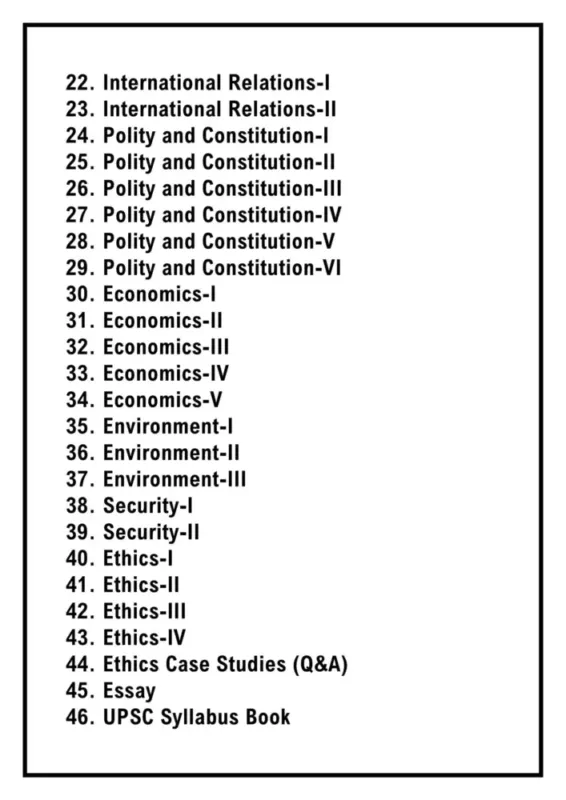
This 46-booklet Vision IAS Classroom Study Material set covers every segment of the UPSC Civil Services Mains syllabus across GS Paper I, II, III, and IV — along with Essay and a dedicated UPSC Syllabus reference booklet. Designed for serious aspirants targeting UPSC Mains 2026, this printed set replicates the exact material distributed inside Vision IAS coaching classrooms.
- Booklet 1: Ancient History — Indus Valley Civilisation, Vedic Period, Mahajanapadas, Mauryan and Gupta Empires, religious movements including Buddhism and Jainism, art and architecture of ancient India, socio-economic structures, and temple building traditions relevant to GS Paper I.
- Booklet 2: Medieval History — Delhi Sultanate, Mughal administration, Bhakti and Sufi movements, regional kingdoms, agrarian and economic systems, architecture and cultural synthesis between the 8th and 18th centuries as mapped to UPSC GS Paper I.
- Booklet 3: Modern Indian History I — British expansion, economic impact of colonial rule, early resistance movements, Revolt of 1857, formation of Indian National Congress, early nationalist thought, and constitutional developments up to 1905.
- Booklet 4: Modern Indian History II — Swadeshi Movement, Montagu-Chelmsford Reforms, Non-Cooperation Movement, Civil Disobedience, Round Table Conferences, Quit India Movement, and role of mass leaders including Gandhi, Nehru, Patel, and Bose.
- Booklet 5: Modern Indian History III — Cabinet Mission, Partition, Independence, integration of princely states, Constitution drafting, and the political landscape of 1947–1950 bridging freedom struggle with post-independence governance for UPSC GS Paper I.
- Booklet 6: Post-Independence Indian History — Nehruvian era policies, Green Revolution, Emergency period, coalition politics, economic liberalisation 1991, and major political developments shaping modern India’s governance and society up to recent years.
- Booklet 7: World History I — American and French Revolutions, Industrial Revolution, colonialism and imperialism, World War I causes and consequences, Russian Revolution, and inter-war period political movements as tested in UPSC GS Paper I.
- Booklet 8: World History II — World War II, decolonisation movements in Asia and Africa, Cold War dynamics, formation of the United Nations, Non-Aligned Movement, and the collapse of the Soviet Union mapped to UPSC GS Paper I syllabus.
- Booklet 9: Art and Culture — Indian classical dance forms, music traditions, painting schools, sculpture and architecture from ancient through medieval periods, UNESCO heritage sites, intangible cultural heritage, fairs and festivals, and literature for GS Paper I.
- Booklet 10: Society I — Indian social structure, caste system, social reforms, tribal communities, rural-urban migration, gender issues, communalism, regionalism, secularism, and role of civil society in India’s social transformation for UPSC GS Paper I.
- Booklet 11: Society II — Poverty and social exclusion, human development indices, women empowerment, youth demographics, ageing population, globalisation’s impact on Indian society, social movements, and contemporary social challenges examined in UPSC GS Paper I.
- Booklet 12: Geography I — Physical geography fundamentals — Earth’s interior, plate tectonics, earthquakes and volcanoes, landforms and their formation processes, drainage systems, and geomorphology topics directly linked to UPSC GS Paper I physical geography questions.
- Booklet 13: Geography II — Climatology and oceanography — atmospheric circulation, monsoon systems, ocean currents, climate change science, El Niño, La Niña, ITCZ, and their effects on Indian agriculture and disaster frequency for UPSC GS Paper I.
- Booklet 14: Geography III — Indian geography — physiographic divisions, river systems, soil types, natural vegetation, wildlife habitats, Indian agriculture patterns, irrigation systems, and mineral distribution with maps aligned to UPSC GS Paper I requirements.
- Booklet 15: Geography IV — Economic geography — resources, energy geography, industrial location theories, transport networks, urbanisation patterns, population distribution, and human development geography topics as per the UPSC GS Paper I and III overlap.
- Booklet 16: Geography V — World geography — continents and regions, political geography, important straits, islands, chokepoints, regional geography of Africa, South-East Asia, Europe, and the Americas relevant to both GS Paper I and International Relations paper.
- Booklet 17: Polity and Constitution I — Making of the Indian Constitution, sources and features, Preamble, Fundamental Rights, Right to Equality, Right to Freedom, cultural and educational rights, and constitutional remedies with landmark Supreme Court judgments.
- Booklet 18: Polity and Constitution II — Directive Principles of State Policy, Fundamental Duties, constitutional amendments, Parliament — composition, powers, sessions, legislative process, parliamentary committees, and anti-defection law for UPSC GS Paper II.
- Booklet 19: Polity and Constitution III — President, Vice-President, Prime Minister, Council of Ministers, Cabinet system, Governor, state legislatures, Centre-State relations, Inter-State Council, Finance Commission, and emergency provisions for GS Paper II.
- Booklet 20: Polity and Constitution IV — Judiciary — Supreme Court, High Courts, judicial review, Public Interest Litigation, judicial activism, subordinate courts, tribunals, Lokpal, CAG, Election Commission, and constitutional bodies for UPSC GS Paper II.
- Booklet 21: Polity and Constitution V — Local self-government — 73rd and 74th Amendments, Panchayati Raj institutions, urban local bodies, devolution of powers, federalism, cooperative federalism, and NITI Aayog vs Planning Commission debate for GS Paper II.
- Booklet 22: Polity and Constitution VI — Statutory bodies, regulatory bodies, pressure groups, NGOs, SHGs, social movements, civil services neutrality, citizens charter, e-governance, transparency legislation, and RTI Act for UPSC GS Paper II governance topics.
- Booklet 23: Governance — Governance concepts, good governance indicators, e-governance frameworks, digital India initiatives, government schemes for welfare, grievance redressal systems, citizen-state interface, and government performance evaluation for UPSC GS Paper II.
- Booklet 24: Social Justice — Welfare schemes, poverty alleviation programmes, health sector policies, education reforms, women and child development schemes, SC/ST welfare legislation, food security, employment generation, and social security framework for GS Paper II.
- Booklet 25: International Relations I — India’s foreign policy evolution, Non-Alignment, bilateral relations with USA, Russia, China, Japan, and EU, neighbourhood-first policy, Act East policy, and India’s role in multilateral institutions for UPSC GS Paper II.
- Booklet 26: International Relations II — International organisations — UN system, WTO, IMF, World Bank, BRICS, SCO, G20, SAARC, ASEAN, and contemporary global issues including terrorism, climate diplomacy, cyber security, and nuclear non-proliferation for GS Paper II.
- Booklet 27: Economics I — Basic economic concepts, national income accounting, GDP, GNP, inflation, monetary policy, fiscal policy, RBI functions, banking sector reforms, financial inclusion, and macroeconomic fundamentals for UPSC GS Paper III.
- Booklet 28: Economics II — Indian economy — planning legacy, agriculture sector issues, land reforms, food processing, MSP debate, agricultural subsidies, crop insurance schemes, and rural economy development for UPSC GS Paper III economic section.
- Booklet 29: Economics III — Industry and infrastructure — industrial policy, Make in India, manufacturing challenges, infrastructure financing, PPP models, logistics sector, ports, railways modernisation, and investment environment for UPSC GS Paper III.
- Booklet 30: Economics IV — External sector — balance of payments, exchange rate management, trade policy, FDI and FII, export promotion, special economic zones, WTO commitments, and India’s trade agreements for UPSC GS Paper III economic segment.
- Booklet 31: Economics V — Government budgeting, fiscal deficit, revenue deficit, FRBM Act, public debt, taxation system — direct and indirect taxes, GST architecture, black money, disinvestment policy, and public expenditure management for GS Paper III.
- Booklet 32: Environment I — Ecology fundamentals, biodiversity hotspots, ecosystem services, National Parks, Wildlife Sanctuaries, Biosphere Reserves, CITES, Ramsar sites, and India’s biodiversity legislation for UPSC GS Paper III environment segment.
- Booklet 33: Environment II — Climate change — UNFCCC, Paris Agreement, India’s NDCs, carbon markets, renewable energy policy, solar and wind energy expansion, energy transition, and green finance for UPSC GS Paper III and essay writing.
- Booklet 34: Environment III — Pollution types and control, solid waste management, water conservation, wetlands, river rejuvenation, environmental impact assessment, EIA notification reforms, green tribunal, and environmental laws for GS Paper III.
- Booklet 35: Science and Technology I — Space technology, ISRO missions, defence technology, nuclear technology, biotechnology advances, nanotechnology, IT sector, emerging technologies including AI and blockchain, and IPR framework for UPSC GS Paper III.
- Booklet 36: Science and Technology II — Health technology, pharmaceuticals, genome sequencing, robotics, 5G and telecom policy, cybersecurity challenges, digital economy, data protection legislation, and science policy frameworks for UPSC GS Paper III.
- Booklet 37: Security I — Internal security challenges — left-wing extremism, insurgency in the North-East, J&K security situation, organised crime, human trafficking, money laundering, role of media in national security for GS Paper III security section.
- Booklet 38 onwards: Disaster Management, Ethics I–IV, Ethics Case Studies Q&A, Essay, and UPSC Syllabus Book — Disaster risk reduction, NDMA framework, Sendai Framework, and a full four-part Ethics series covering foundational concepts, attitude, aptitude, case studies with model answers, essay writing strategy, and the complete UPSC Mains syllabus reference booklet.
In-Depth Content Breakdown: Booklet by Booklet
Booklet 1: Ancient History
Ancient History forms an essential foundation for UPSC GS Paper I, contributing 3–5 direct questions per Mains examination cycle. This booklet covers the Indus Valley Civilisation’s urban planning and trade networks, Vedic society’s transition from Rigvedic to later Vedic periods, the heterodox movements of Buddhism and Jainism, Mauryan imperial administration under Chandragupta and Ashoka, Gupta-era cultural achievements, and the post-Gupta regional kingdoms that shaped India’s civilisational legacy.
The booklet is structured with clear thematic sections supported by timelines, comparative tables contrasting different dynasties, and annotated diagrams of major archaeological sites. Vision IAS presents Ancient History not just as a fact repository but as a conceptual framework — students are guided through how ancient socio-political structures connect to constitutional values and cultural identity questions that appear in GS Paper I and even Essay papers.
Booklet 2: Medieval History
Medieval History in the UPSC GS Paper I syllabus spans the 8th through 18th centuries — a period that Vision IAS covers with particular depth in this booklet. Topics include the Arab conquest of Sindh, Rajput resistance, the Delhi Sultanate’s administrative innovations, Vijayanagara Empire, Mughal consolidation under Akbar, and Maratha expansion. The bhakti and Sufi movements receive dedicated analysis, connecting spiritual history to social reform narratives tested in UPSC Mains answers.
The booklet uses a dual-column layout alternating factual summaries with analytical perspectives — a feature that mirrors the way Vision IAS faculty deliver classroom sessions. Architectural heritage from Qutub Minar to Taj Mahal is discussed not just as facts but within economic and political contexts. Comparative questions between Mughal and Maratha governance systems, a favourite UPSC Mains format, are addressed with structured answer frameworks directly embedded into the notes.
Booklets 3–5: Modern Indian History I, II & III
Split across three booklets, Modern Indian History is one of the highest-yielding segments of UPSC GS Paper I. Booklet 3 traces British economic exploitation through deindustrialisation, drain of wealth theory, and early nationalist formation. Booklet 4 advances through Gandhian mass movements — Non-Cooperation, Civil Disobedience, and Quit India — with detailed analysis of each movement’s causes, nature, participants, and outcomes structured for 15-mark and 20-mark UPSC Mains answers.
Booklet 5 covers the endgame of colonial rule — the 1946 Cabinet Mission, Partition’s political economy, and integration of 562 princely states. Vision IAS weaves in the contributions of lesser-discussed freedom fighters alongside mainstream leaders, addressing a recurring UPSC Mains demand. Together, these three booklets equip aspirants with source-based analytical frameworks, enabling answers that go beyond textbook narration toward critical historical evaluation demanded by UPSC examiners.
Booklet 6: Post-Independence Indian History
This booklet bridges the gap between freedom struggle history and contemporary governance — a connection UPSC examiners increasingly test. Coverage spans Nehru’s socialist planning model, Lal Bahadur Shastri’s agricultural focus, Indira Gandhi’s banking nationalisation and Emergency, coalition governments of the 1990s, and the 1991 liberalisation shift. Each era is contextualised against global events, giving aspirants a complete picture for integrated UPSC Mains answers across GS Paper I and II.
Vision IAS has structured this booklet with cause-effect chains for each political event, making it ideal for analytical UPSC Mains answers. The Emergency section includes detailed discussion of the 42nd and 44th Constitutional Amendments. The 1991 reforms section connects directly to GS Paper III economics topics, and Vision IAS explicitly cross-references relevant economics booklets here — a study design advantage that saves aspirants significant revision time during UPSC Mains preparation.
Booklets 7–8: World History I & II
World History booklets address the direct UPSC GS Paper I syllabus segment on 18th–20th century world history. Booklet 7 opens with the intellectual underpinnings of the American and French Revolutions, follows through the Industrial Revolution’s global consequences, European imperialism’s impact on Asia and Africa, and culminates in World War I and the Russian Revolution. Cause-effect analysis is presented in formats directly replicable in UPSC Mains answers.
Booklet 8 covers the devastating arc of World War II, decolonisation movements across Asia and Africa, Cold War bipolarity, proxy conflicts, the Non-Aligned Movement’s significance for India’s foreign policy, and the Soviet Union’s dissolution. Maps of post-war geopolitical reorganisation, tables of colonial and post-colonial leaders, and timelines of international treaty milestones are included — study aids that make these booklets far more useful than standard NCERT textbook content for UPSC preparation.
Booklet 9: Art and Culture
Art and Culture is a perennial source of 5–8 marks per UPSC Mains examination across GS Paper I. Vision IAS covers all classical dance forms — Bharatanatyam, Kathak, Odissi, Kuchipudi, Manipuri, Sattriya, Mohiniyattam, and Kathakali — with their regional origins, stylistic features, and notable exponents. Classical music traditions (Hindustani and Carnatic), major painting schools from Mughal miniatures to Madhubani, and sculpture traditions from Gandhara to Chola bronzes are documented with visual reference context.
UNESCO Intangible Cultural Heritage listings, Geographical Indication tags for Indian crafts, and India’s prominent heritage sites are covered with the kind of current-affairs linkage that Vision IAS is known for. The booklet also addresses literary traditions across major Indian languages, making it relevant for both UPSC Prelims (Art and Culture section) and UPSC Mains GS Paper I. Festival-religion-region mapping tables help aspirants answer both fact-based and analytical culture questions efficiently.
Booklets 10–11: Society I & II
Society booklets address UPSC GS Paper I’s social structure and social issues segment — an area that overlaps considerably with GS Paper II’s social justice topics. Booklet 10 dissects India’s caste system historically and sociologically, examines tribal communities and their constitutional protections, analyses communalism and secularism as ongoing debates, and covers the role of civil society organisations in democratic India. Vision IAS grounds abstract sociological concepts in contemporary examples for sharper UPSC Mains answers.
Booklet 11 extends into human development indicators — HDI, Gender Inequality Index, Multidimensional Poverty Index — and their implications for policy. Women empowerment legislation, youth bulge demographics, ageing population challenges, and the social impact of globalisation are covered with both data and critical analysis. Together, these booklets build the interdisciplinary thinking that UPSC examiners reward — connecting society to governance, economics, and ethics in the kind of multi-dimensional answers that score in the 13–15 mark range.
Booklets 12–16: Geography I–V
Five Geography booklets provide unmatched depth for UPSC GS Paper I’s physical and human geography segments. Booklet 12 covers geomorphology — plate tectonics, earthquake zones, volcanic activity, and landform types — with diagrams. Booklet 13 addresses climatology, including monsoon mechanics, ocean circulation, and climate change science. Booklet 14 is dedicated to Indian geography — physiographic divisions, river systems, soil classification, and agricultural zones. Booklet 15 covers economic and resource geography. Booklet 16 addresses world regional geography with chokepoints and political geography.
Vision IAS Geography booklets are map-intensive by design. Each physical geography concept is paired with an annotated map, and Indian geography chapters include district-level data tables that support UPSC Prelims fact-based questions as much as Mains analytical ones. The climate change content in Booklet 13 deliberately connects to Environment booklets 32–34, creating a study network across the 46-booklet set. This cross-referencing approach reflects Vision IAS’s classroom teaching methodology and makes this printed set more strategically valuable than standalone geography textbooks for UPSC aspirants.
Booklets 17–22: Polity and Constitution I–VI
Six Polity and Constitution booklets form the backbone of GS Paper II preparation. Booklet 17 starts with constitutional history — why India chose parliamentary democracy, what the Constituent Assembly debates reveal about constitutional intent, and the structure of Fundamental Rights with landmark Supreme Court cases. Booklet 18 covers the Parliament’s functioning with procedural detail that UPSC examiners test repeatedly. Booklets 19–22 extend through the executive, judiciary, federalism, local governance, and statutory bodies — the full canvas of UPSC GS Paper II Polity segment.
Vision IAS structures each Polity booklet to separate constitutional provisions from judicial interpretations from current affairs developments — a three-layer analysis that mirrors what UPSC Mains answers demand. Recent Supreme Court judgments, constitutional amendments post-2019, and debates around judicial appointments, electoral reforms, and cooperative federalism are woven into these booklets. The six-booklet structure allows aspirants to study each constitutional theme in isolation before integrating them — a learning design that accelerates UPSC Mains answer writing readiness.
Booklets 23–24: Governance and Social Justice
Governance booklet addresses e-governance, digital India, citizen charter principles, government scheme performance, RTI implementation, and public administration reforms — areas that generate 3–5 direct UPSC GS Paper II questions per year. Social Justice booklet covers flagship schemes — PM-KISAN, Ayushman Bharat, Poshan Abhiyaan, PM Awas Yojana — alongside constitutional and legislative protections for marginalised communities including SC, ST, OBC, women, and persons with disability.
The Governance booklet uses a scheme-analysis template for each major government programme — background, objectives, beneficiaries, implementation mechanism, achievements, and challenges — which directly maps to UPSC Mains question formats. The Social Justice booklet bridges policy analysis with rights-based frameworks, connecting scheme evaluations to DPSP provisions and international human rights commitments. Together, these booklets cover the applied governance dimension of UPSC GS Paper II that separates high-scorers from average performers in the Mains examination.
Booklets 25–26: International Relations I & II
International Relations booklets are among the most current-affairs-intensive in the 46-booklet Vision IAS set. Booklet 25 covers India’s bilateral relationships — the strategic partnership with the USA, the historically complex ties with China, the time-tested friendship with Russia, and the Neighbourhood First policy encompassing Pakistan, Bangladesh, Nepal, Sri Lanka, and Bhutan. India’s Look East/Act East policy evolution and its multilateral commitments are analysed with geopolitical context.
Booklet 26 examines international organisations in detail — UN Security Council reform debates, WTO dispute mechanisms, IMF and World Bank voting share discussions, BRICS and SCO expansion, and G20 India’s presidency legacy. Contemporary global security issues — nuclear non-proliferation, cyber warfare, climate diplomacy, and terrorism — are covered from India’s policy perspective. Vision IAS updates IR content with the most recent ministerial-level developments, making these booklets immediately useful for UPSC Mains 2026 current-affairs-linked questions.
Booklets 27–31: Economics I–V
Five Economics booklets comprehensively cover UPSC GS Paper III’s economic development segment. Booklet 27 builds macroeconomic fundamentals — GDP measurement, inflation dynamics, monetary transmission, and RBI’s policy toolkit. Booklet 28 focuses on agriculture — a perennial UPSC Mains topic — covering MSP reform debates, PM-KISAN, Farmer Producer Organisations, and the unfinished land reform agenda. Booklets 29–31 address industry, external sector, and fiscal policy respectively, completing the full GS Paper III economics map.
Vision IAS Economics booklets distinguish themselves through data literacy — each booklet includes Economic Survey data, Union Budget highlights, and RBI Annual Report figures contextualised for answer writing. Booklet 31’s coverage of GST — its architecture, revenue performance, rate rationalisation debates, and comparison with pre-GST indirect tax structure — is particularly detailed and reflects the complexity of questions UPSC has asked in recent Mains papers. Aspirants who buy this set gain access to structured economic analysis that standalone economics textbooks do not provide.
Booklets 32–34: Environment I–III
Three Environment booklets address UPSC GS Paper III’s ecology and environment segment — one of the most dynamic areas of the UPSC Mains syllabus given India’s climate commitments and biodiversity legislation changes. Booklet 32 covers ecology foundations, biodiversity hotspots, Protected Area network, international conventions including CBD and CITES, and India-specific biodiversity legislation. Booklet 33 is dedicated to climate change science, international negotiations, and India’s renewable energy expansion. Booklet 34 addresses pollution control and environmental governance.
Vision IAS Environment booklets incorporate recent developments — COP summits, India’s updated NDCs, new Ramsar site designations, and EIA notification amendments — ensuring the 2025-26 edition remains highly relevant for UPSC Mains 2026. Booklet 33’s climate section uses a cause-and-consequence mapping format that aspirants can directly apply while writing UPSC Mains answers on climate impacts, adaptation, and India’s energy transition policy. These three booklets together address approximately 10–15 marks of direct UPSC GS Paper III questions per year.
Booklets 35–36: Science and Technology I & II
Science and Technology booklets are structured to make technical content accessible to non-science UPSC aspirants without sacrificing analytical depth. Booklet 35 covers space technology — ISRO milestones including Chandrayaan, Gaganyaan, and commercial launch services — alongside defence technology, nuclear energy policy, and emerging technologies like artificial intelligence, machine learning, blockchain, and nanotechnology. IPR framework and India’s innovation ecosystem are included as Policy-S&T bridge topics.
Booklet 36 addresses biotechnology and healthcare — genome sequencing, CRISPR, vaccine technology developments post-COVID, and pharmaceutical policy. Cybersecurity, data protection legislation, and the regulatory environment around emerging technologies receive dedicated analysis that connects to both GS Paper II (governance of technology) and GS Paper III (S&T development). The booklet closes with a forward-looking section on 6G, quantum computing, and semiconductor policy — areas Vision IAS correctly anticipates as upcoming UPSC Mains question themes.
Booklets 37 onwards: Security, Disaster Management, Ethics, Essay & Syllabus
The Security booklets cover UPSC GS Paper III’s internal security segment — left-wing extremism, insurgency dynamics, border management, cyber threats, and organised crime networks. Disaster Management covers NDMA, State Disaster Management Authorities, Sendai Framework targets, and India’s disaster risk reduction architecture. The four Ethics booklets systematically build GS Paper IV competence — from foundational concepts and emotional intelligence to public service values and integrity frameworks — with model answers and case study banks.
The Ethics Case Studies Q&A booklet is particularly valued by UPSC aspirants: it provides structured approach methods for the 20-mark case study questions that now determine GS Paper IV scores at the margin. The Essay booklet covers essay writing technique, theme analysis, structure strategies, and practice essays across diverse UPSC Mains essay topics. The UPSC Syllabus booklet completes the set — a printed, annotated copy of the complete UPSC CSE Mains syllabus with Vision IAS topic mapping guidance for holistic preparation.
Physical Construction and Quality Standards
Every booklet in this Vision IAS 2025-26 GS set is manufactured to withstand months of intensive daily UPSC study — multiple revision cycles, heavy highlighting, margin annotation, and the physical demands of carrying notes between home and coaching centre.
Paper Quality: 75 GSM Anti-Glare White Paper
The 75 GSM ultra-white paper used across all 46 Booklets delivers a combination of weight and brightness that is ideal for extended UPSC study sessions. The paper’s high opacity means text and diagrams printed on one side do not bleed through to the reverse — a critical requirement when using multiple highlighter colours and gel pens for colour-coded revision. The anti-glare surface reduces eye strain during 6–8 hour daily study sessions that UPSC preparation typically demands. Paper thickness prevents feathering even with felt-tip markers.
Printing Technology: High-Resolution Laser Printing
All 46 Booklets are laser-printed at high resolution, ensuring that maps, flowcharts, diagrams, and tables reproduce with complete clarity. Laser toner is permanently fused to the paper surface, making it smudge-proof and water-resistant — a practical advantage for aspirants who annotate notes during revision. Fine-detail elements such as constituency maps, economic data tables, and constitutional diagram flowcharts appear crisp and legible at normal reading distance. This print quality matches what Vision IAS distributes inside Delhi classroom centres.
Binding and Durability
Booklets are available in spiral binding or book binding formats. Spiral-bound booklets open completely flat — a practical feature for aspirants writing margin notes alongside printed content during UPSC answer writing practice. The rigid 300 GSM cover protects pages during daily handling, commuting, and storage. Book-bound booklets offer a more compact form factor suited to library and desk study. Both formats use strong adhesive and stitching to prevent page separation even after repeated opening and closing across hundreds of study hours.
Key Features and Study Design
These Vision IAS 2025-26 printed booklets are engineered around one goal: maximising UPSC Mains score through structured, syllabus-mapped, analytically oriented study material that saves preparation time while deepening conceptual understanding across all four GS papers.
- Complete 46-booklet GS Coverage: This single set covers every topic across UPSC GS Paper I, II, III, and IV, plus Essay — eliminating the need to buy separate resources for different subjects and ensuring uniform quality and cross-referencing throughout your UPSC preparation.
- UPSC Syllabus-First Design: Every booklet is structured around the official UPSC CSE Mains syllabus. Topics are sequenced in the order UPSC tests them, with explicit syllabus callouts marking each chapter — making it easy to track coverage and identify gaps during UPSC revision.
- Analytical Frameworks for Answer Writing: Vision IAS embeds answer-writing structures — introduction templates, body paragraph frameworks, and conclusion formats — throughout the content, training aspirants to translate reading into high-scoring UPSC Mains answers simultaneously.
- Current Affairs Integration: The 2025-26 edition integrates the latest policy developments, Supreme Court judgments, international agreements, and Union Budget data directly into relevant chapters — removing the disconnect between static notes and current affairs that troubles many UPSC aspirants.
- Ethics Case Study Bank Included: A dedicated Ethics Case Studies Q&A booklet provides solved case study answers with step-by-step stakeholder analysis, ethical theory application, and practical resolution strategies — directly targeting the 20-mark case study questions in UPSC GS Paper IV.
Shipping, Packaging and Delivery
All 46 Booklets are shipped together as a single tracked consignment from our Mukherjee Nagar, Delhi dispatch centre. Each set is individually shrink-wrapped to protect covers and prevent moisture damage during transit. The shrink-wrapped set is then placed inside a rigid corrugated cardboard box with foam edge protectors at all six faces — preventing corner damage to booklet covers. Additional void-fill packing material prevents movement inside the box during courier transit, ensuring every booklet arrives in brand-new condition regardless of your delivery location across India.
Pan India delivery is completed within 3-5 business days from order confirmation. A tracking ID is shared via SMS and WhatsApp immediately upon dispatch. For order tracking, replacement requests, or any query about your Vision IAS study material set, contact us on WhatsApp at +91 70045 49563 — available 7 days a week. In the rare event that a booklet is missing or damaged in transit, we replace it within 48 hours of your report, no questions asked. Bulk orders for coaching centres and study groups are handled with dedicated logistics support.
Frequently Asked Questions (FAQ)
A: This Vision IAS 2025-26 set contains 38 individual printed booklets covering the complete UPSC Mains GS syllabus. The set includes Ancient History, Medieval History, Modern Indian History (3 parts), Post-Independence History, World History (2 parts), Art and Culture, Society (2 parts), Geography (5 parts), Polity and Constitution (6 parts), Governance, Social Justice, International Relations (2 parts), Economics (5 parts), Environment (3 parts), Science and Technology (2 parts), Security (2 parts), Disaster Management, Ethics (4 parts), Ethics Case Studies Q&A, Essay, and a UPSC Syllabus reference booklet.
A: Yes. The 2025-26 edition is specifically designed for aspirants targeting UPSC Mains 2026. Vision IAS has updated this edition with the latest policy developments, Supreme Court judgments, Union Budget data, and international agreements through mid-2025. The syllabus-first structure, answer-writing frameworks, and current affairs integration make it one of the most strategically valuable printed study materials available for UPSC Mains 2026 preparation in English medium.
A: Yes, this 46-booklet set covers all four UPSC Mains GS papers completely. GS Paper I is covered through History (46 Booklets), Geography (46 Booklets), Art and Culture, and Society (46 Booklets). GS Paper II is covered through Polity and Constitution (46 Booklets), Governance, Social Justice, and International Relations (46 Booklets). GS Paper III is covered through Economics (46 Booklets), Environment (46 Booklets), Science and Technology (46 Booklets), Security (46 Booklets), and Disaster Management. GS Paper IV is covered through the four Ethics booklets and the Ethics Case Studies Q&A booklet.
A: This is the genuine 2025-26 batch printed by Vision IAS — the same material distributed to Vision IAS classroom students in Delhi for the current academic cycle. The content has been updated to include developments through early 2025 across all subject areas, including COP summit outcomes, Supreme Court constitutional bench judgments, Union Budget 2025-26 economic data, ISRO mission updates, and revised biodiversity convention decisions relevant to UPSC GS Paper III.
A: These booklets use 75 GSM ultra-white paper chosen for high opacity — multiple highlighter colours and gel pens work without bleed-through to the reverse side, ideal for colour-coded revision. The anti-glare surface also reduces eye strain during the extended daily study sessions that UPSC preparation demands. Felt-tip markers and ballpoint pens also write cleanly without feathering, making these booklets suitable for heavy annotation alongside the printed content.
A: You can buy this complete 46-booklet Vision IAS 2025-26 GS study material set directly from our UPSC Store online. We source genuine fresh-batch Vision IAS classroom printed materials and ship them pan India with tracked delivery within 3-5 business days. For WhatsApp ordering or queries, contact +91 70045 49563. This is the same authentic printed material available at Vision IAS’s Mukherjee Nagar, Delhi centre — now accessible to aspirants across India.
A: Vision IAS study material is widely used by self-study UPSC aspirants precisely because it is structured to be self-sufficient. The 46-booklet set includes answer-writing frameworks, current affairs integration, syllabus callouts, and an Ethics Case Studies Q&A booklet that together replicate much of what happens inside Vision IAS classrooms. Many successful UPSC Mains qualifiers have used Vision IAS printed notes as their primary resource without formal coaching, supplementing with standard NCERTs for foundational reading and a current affairs magazine for monthly updates.
A: Both Vision IAS and Vajiram and Ravi produce high-quality UPSC classroom study materials. Vision IAS notes are known for greater analytical depth, structured answer-writing frameworks, and stronger current affairs integration within static chapters. Vajiram and Ravi notes are often praised for factual density and diagram quality. Vision IAS’s 46-booklet structure with dedicated Ethics case study and Essay booklets gives it a slight edge for GS Paper IV-focused aspirants. Serious UPSC aspirants often review both, but the Vision IAS 2025-26 set’s cross-referencing design makes it a more integrated standalone resource.
A: The Vision IAS 2025-26 set includes four dedicated Ethics booklets plus a separate Ethics Case Studies Q&A booklet — five booklets total for UPSC GS Paper IV. Ethics I covers foundational moral philosophy and human values. Ethics II covers attitude, aptitude, and emotional intelligence. Ethics III covers public service values, integrity, probity in governance, and anti-corruption frameworks. Ethics IV covers philosophical thinkers and their relevance to public administration. The Case Studies Q&A booklet provides model answers for scenario-based questions with stakeholder analysis and ethical theory application.
A: Yes. This Vision IAS 46-booklet GS set is highly useful for BPSC, UPPSC, MPPSC, RAS, and other State PSC examinations. The GS syllabus for most State PSCs closely mirrors the UPSC Mains syllabus across History, Geography, Polity, Economics, Environment, and Ethics. State PSC aspirants particularly benefit from the Governance, Social Justice, and Economics booklets, which cover central scheme implementation topics tested in UPPSC and BPSC Mains papers. The Polity and Constitution series and Environment booklets are equally relevant for all major State PSC competitive examinations.
A: This specific listing is for the English medium Vision IAS 2025-26 GS study material set — 46 Booklets in English. Vision IAS also produces a separate Hindi medium classroom study material set for the same 2025-26 academic year. If you are preparing for UPSC in Hindi medium, please visit our store’s Hindi medium section or contact us on WhatsApp at +91 70045 49563 to confirm Hindi medium availability, current stock, and delivery timelines for your location across India.
A: All 46 Booklets are shrink-wrapped as a bundle, then packed inside a rigid corrugated cardboard box with foam edge protectors and void-fill material to prevent movement during courier transit. The packaging is designed to protect booklet corners and covers through the full 3-5 day delivery journey across India. A tracking ID is shared immediately upon dispatch. In the rare event that any booklet arrives damaged or is missing from the shipment, we replace it within 48 hours of receiving your WhatsApp message at +91 70045 49563.
Summary
| Specification | Value |
|---|---|
| Booklets | 38 Printed Booklets |
| Language | English Medium |
| Paper | 75 GSM Ultra-White |
| Binding | Spiral or Book Binding |
| Delivery | 3-5 Business Days Pan India |
| Also Useful For | BPSC, UPPSC, MPPSC, RAS and all State PSC Examinations |
Buy this Vision IAS 2025-26 English GS study material set online and receive all 46 Booklets at your doorstep anywhere in India within 3-5 business days. Sourced directly from Mukherjee Nagar, Delhi — India’s leading UPSC preparation hub — and shipped with full tracking to ensure your UPSC preparation begins without delay.
Reference: UPSC official syllabus
Customer Reviews 664
Bilkul mast notes hain. Content bahut comprehensive hai.
Material achha hai par kuch booklets ki printing quality average thi. Padhai toh theek se ho sakti hai.
Notes quality bohot acchi hai, preparation ke liye ideal.
Content structured perfectly, notes banane ki tension hi nahi rahi.
Material quality bilkul sahi hai aur organization bhi excellent. Definitely helping in studies.
42 booklets mein bilkul comprehensive coverage hai, revision bhi asaan ho gaya.
All 38 booklets mein balanced coverage hai aur examples bhi relevant hain.
Best GS material available. Concepts clear ho jaate hain isse.
Aspirants Also Bought
More from the same category
About Vision IAS English GS Study Material Notes 2025-26
Vision IAS English GS Study Material Notes 2025-26 is a highly recommended UPSC study material from Vision IAS, specially designed for General Studies preparation. Available in English medium, this material is crafted to match the exact requirements of the UPSC Civil Services Examination syllabus — covering both Prelims and Mains comprehensively.
Product Details
- Institute: Vision IAS
- Subject: General Studies
- Medium: English
- Format: Printed
- Delivery: Pan-India delivery in 3–5 working days
- Format: Original printed material, verified authentic
Why Buy from UPSC Store?
- ✅ 100% Genuine Printed Material — Original printed notes, no photocopies or fake copies
- ✅ Fast Delivery — Ships within 24 hours, arrives in 3–5 days pan-India
- ✅ Secure Packaging — Bubble-wrapped and boxed to prevent damage in transit
- ✅ Trusted by 10,000+ Aspirants — India's most reliable UPSC material marketplace
- ✅ WhatsApp Support — Get expert guidance on material selection before ordering
Frequently Asked Questions
Yes, all products at UPSC Store are 100% genuine printed materials. We do not sell photocopies or fake copies.
Orders are dispatched within 24 hours and delivered across India in 3–5 working days via reputed courier partners.
Yes, we accept returns within 7 days if the product is damaged or incorrect. Check our refund policy for details.
We recommend pairing this with current affairs notes and a UPSC test series for comprehensive preparation. Browse more in General Studies, UPSC, Vision IAS.