

AK Das Economics Kalinga IAS Notes 2025-26
About AK Das Economics Kalinga IAS
The AK Das Economics Kalinga IAS is a printed UPSC study material set sold by UPSC Store — India’s trusted source for genuine, latest-batch civil services preparation books. This page covers full booklet details, syllabus coverage, pricing, shipping, and frequently asked questions. Useful for UPSC CSE, BPSC, UPPSC, MPPSC, RAS and other state PSC examinations.
AK Das Economics Kalinga IAS 2025-26 — 10 English Medium Printed Booklets for UPSC Economics Optional
Related: Economy notes · Optional subjects
Product Overview
| Feature | Details |
|---|---|
| Booklets Count | 10 Individual Printed Booklets — Full UPSC Economics Optional Syllabus (Paper I + Paper II) |
| Language | English Medium |
| Publisher | Kalinga IAS (AK Das Economics Optional Series) |
| Edition | 2025-26 — Latest Genuine Batch |
| Condition | Brand New, Unmarked, Fresh Stock |
| Format | High-Quality Printed Booklets — Spiral or Book Binding |
| Paper Quality | 75 GSM Ultra-White — Highlighter Safe, Zero Bleed-Through |
| Shipping | Pan India Delivery in 3-5 Business Days — Tracked |
| Also Useful For | BPSC, UPPSC, MPPSC, RAS and all State PSC Economics papers |
Complete Booklet Catalog
This 5-booklet set by AK Das from Kalinga IAS covers the entire UPSC Economics Optional syllabus across both Paper I and Paper II, structured to help aspirants build micro-to-macro understanding and score high in all 500 optional marks. Designed for serious UPSC Mains Economics Optional candidates who want faculty-guided printed study material in English medium.
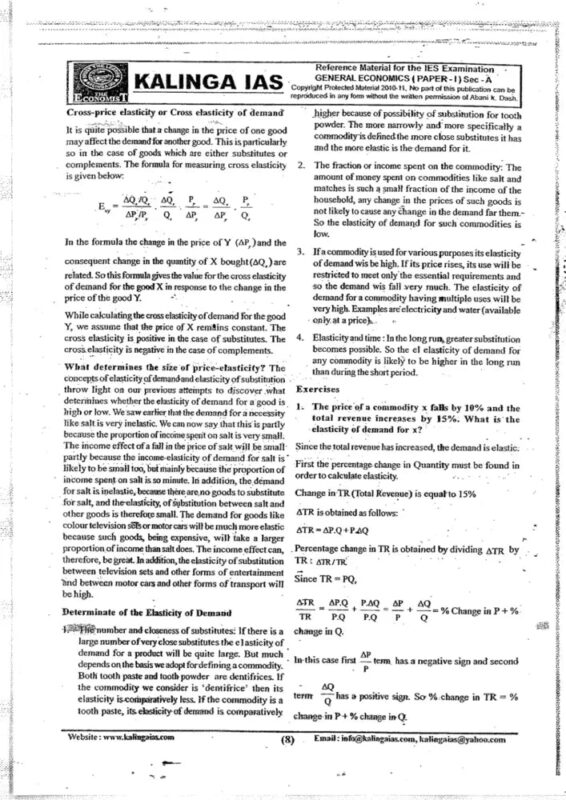
- Booklet 1: Micro Economics — Consumer Theory and Demand Analysis — Covers utility theory, indifference curves, budget constraints, revealed preference, elasticity of demand, consumer surplus, Giffen goods, income and substitution effects, and demand forecasting. Foundation booklet for General Economics Paper I, aligned directly with the UPSC Economics Optional syllabus and IES examination requirements.
- Booklet 2: Micro Economics — Production, Costs and Market Structures — Covers production functions, laws of returns, cost curves (short-run and long-run), perfect competition, monopoly, monopolistic competition, oligopoly, Cournot model, Bertrand competition, price discrimination, and welfare economics. Crucial for UPSC Economics Optional Paper I micro theory questions.
- Booklet 3: Macro Economics — National Income, Employment and Money — Covers national income accounting, classical and Keynesian models, consumption function, investment multiplier, IS-LM framework, theories of money demand and supply, quantity theory of money, inflation, deflation, and stagflation. Core content for UPSC Economics Optional Paper I macroeconomics section.
- Booklet 4: Macro Economics — Growth, Business Cycles and Open Economy — Covers theories of economic growth (Harrod-Domar, Solow, endogenous growth), business cycle theories, balance of payments, exchange rate determination, purchasing power parity, Mundell-Fleming model, and international capital flows. Essential for UPSC Economics Optional macroeconomics and open economy questions.
- Booklet 5: Public Finance and Fiscal Policy — Covers public expenditure theories, Musgrave’s classification, Wagner’s law, taxation principles, direct and indirect taxes, GST structure, fiscal federalism, deficit financing, public debt management, fiscal responsibility, and FRBM Act. Directly relevant to General Economics Paper II and UPSC GS3 economics questions on government budgeting.
- Booklet 6: Money, Banking and Financial Sector — Covers functions of commercial banks, credit creation, RBI functions and monetary policy instruments, CRR, SLR, repo rate, open market operations, NBFC regulation, financial inclusion, banking sector reforms, NPA crisis, and Narasimham Committee recommendations. Covers UPSC Economics Optional Paper I and Paper II monetary economics sections.
- Booklet 7: International Economics and Trade Theory — Covers absolute advantage, comparative advantage, Heckscher-Ohlin theorem, Stolper-Samuelson theorem, terms of trade, trade policy instruments, WTO, GATT, regional trade agreements, UNCTAD, IMF and World Bank roles, and trade and development linkages. Essential for General Economics Paper II international economics sections.
- Booklet 8: Indian Economy — Planning, Agriculture and Rural Development — Covers India’s planning history, NITI Aayog, agricultural sector performance, Green Revolution, land reforms, rural credit, NABARD, Minimum Support Price, food security, PDS, MGNREGA, and rural infrastructure. Highly relevant for UPSC Economics Optional Paper II Indian economy sections and GS3 economy preparation.
- Booklet 9: Indian Economy — Industry, Infrastructure and Services Sector — Covers industrial policy evolution, liberalisation of 1991, MSME sector, infrastructure financing, PPP models, SEZs, disinvestment policy, services sector growth drivers, IT-ITES sector, Make in India, and Atmanirbhar Bharat initiatives. Critical for UPSC Economics Optional Paper II industry and infrastructure questions.
- Booklet 10: Economic Reforms, Poverty, Inequality and Sustainable Development — Covers LPG reforms of 1991, poverty measurement (Tendulkar, Rangarajan committees), inequality trends, social sector expenditure, HDI and Human Development, SDGs, environmental economics, climate change economics, green GDP, and recent economic survey themes. Rounds off the full UPSC Economics Optional syllabus for Paper II.
In-Depth Content Breakdown: Booklet by Booklet
Booklet 1: Micro Economics — Consumer Theory and Demand Analysis
This booklet forms the conceptual foundation of UPSC Economics Optional Paper I. AK Das of Kalinga IAS begins with ordinal and cardinal utility theories, moves through indifference curve analysis, budget line shifts, and income-consumption curves. The treatment of revealed preference theory aligns with UPSC’s demand for both theoretical understanding and analytical application. Elasticity concepts — price, income, cross, and arc elasticity — are covered with worked numerical examples that prepare aspirants for quantitative questions in both UPSC Mains and IES examinations.
The booklet is structured with clearly numbered sections, making it easy to locate specific topics during revision. Diagrams for consumer equilibrium, corner solutions, and Giffen goods are drawn with precision and labelled in a way that aspirants can replicate in answer sheets. AK Das includes comparative tables distinguishing cardinal from ordinal utility schools, which serve as quick-reference tools during the final weeks before UPSC Mains. The notes reflect the faculty’s classroom teaching style — direct, jargon-aware, and exam-focused.
Booklet 2: Micro Economics — Production, Costs and Market Structures
Booklet 2 advances from consumer theory into the producer side of the economy — an area where UPSC Economics Optional Paper I regularly tests both theoretical models and their real-world applications. AK Das covers the Cobb-Douglas production function, isoquants, ridge lines, and returns to scale in detail. Cost curve derivation from production theory is handled systematically, with short-run and long-run distinctions made clear through diagrams. Market structure analysis spans from perfect competition through monopoly to oligopoly, covering Cournot, Bertrand, and Stackelberg models that frequently appear in UPSC optional answer writing.
A standout feature of this Kalinga IAS booklet is its treatment of price discrimination — first, second, and third degree — with numerical examples and graphical illustrations. Welfare economics concepts including Pareto optimality, Kaldor-Hicks criterion, and market failures are woven into the market structure discussion, enabling aspirants to connect micro theory to policy analysis. AK Das includes structured notes on anti-monopoly regulation and competition policy in India, making this booklet useful beyond UPSC optional for GS3 economic policy questions as well.
Booklet 3: Macro Economics — National Income, Employment and Money
This booklet is the cornerstone of UPSC Economics Optional Paper I macroeconomics preparation. AK Das opens with national income accounting identities and measurement approaches — output, income, and expenditure methods — before transitioning into employment theory. The classical full-employment model is contrasted with Keynes’s effective demand principle, with the consumption function, marginal propensity to consume, and investment multiplier developed in full analytical detail. IS-LM framework construction is covered step by step, with policy implications of fiscal and monetary shifts clearly mapped for UPSC answer writing.
Money supply components (M0 through M4), high-powered money, money multiplier, and the transmission mechanism of monetary policy are laid out in a logical teaching sequence that mirrors how UPSC questions move from definitional to analytical. AK Das includes a dedicated section on inflation theories — demand-pull, cost-push, and structural inflation — along with the Phillips curve and stagflation debate. Kalinga IAS notes are known for integrating Indian data points within theoretical frameworks, which is particularly evident in this booklet’s treatment of RBI monetary policy operations and Indian inflation dynamics.
Booklet 4: Macro Economics — Growth, Business Cycles and Open Economy
Booklet 4 tackles the dynamic macroeconomics content of UPSC Economics Optional that tends to differentiate top scorers. Growth theory — from classical Harrod-Domar through Solow’s neoclassical model to endogenous growth theories of Romer and Lucas — is covered with both mathematical exposition and intuitive explanation. The steady-state concept, golden rule of capital accumulation, and convergence hypothesis are explained with diagrams that aspirants can reproduce in UPSC Mains answer sheets. Business cycle theories (Kitchin, Juglar, Kondratiev, and real business cycle models) are included as a reference section.
The open economy section of this booklet is particularly strong, covering balance of payments accounting, the Mundell-Fleming model under fixed and flexible exchange rates, and implications of capital mobility for monetary and fiscal policy effectiveness. Exchange rate theories — purchasing power parity, interest rate parity, and portfolio balance — are given structured treatment. AK Das connects these theories to India’s external sector challenges, including current account deficit management, capital flow volatility, and foreign exchange reserve policy. This makes the booklet doubly useful for both UPSC Economics Optional Paper I and Indian economy questions in GS3.
Booklet 5: Public Finance and Fiscal Policy
Public finance is a high-scoring area in UPSC Economics Optional Paper II, and Booklet 5 by AK Das of Kalinga IAS provides thorough coverage of both theoretical and applied dimensions. The booklet opens with public expenditure theories — Wagner’s Law, Peacock-Wiseman hypothesis, and displacement effect — before moving to the principles of taxation: equity, efficiency, and administrative feasibility. Direct and indirect tax structures in India are analysed, with a detailed breakdown of GST architecture, GST Council functioning, and revenue implications for centre-state fiscal relations. UPSC aspirants will find this directly applicable to both optional exam answers and GS3 questions on government finance.
The fiscal policy section covers deficit types — revenue, fiscal, primary, and effective revenue deficit — with analysis of the FRBM Act and its successive amendments, including the escape clause mechanism introduced post-pandemic. Fiscal federalism is treated with reference to Finance Commission recommendations, devolution principles, and horizontal equity considerations. AK Das includes a comparative table of major Finance Commission awards that serves as an excellent revision aid. Public debt management, Domar’s debt sustainability condition, and the crowding-out debate are covered with sufficient depth for full-length UPSC Mains answer writing.
Booklet 6: Money, Banking and Financial Sector
Banking and financial sector content in UPSC Economics Optional has grown in importance as India’s financial architecture has evolved rapidly. AK Das structures Booklet 6 to cover both the theoretical underpinnings of monetary economics and the institutional realities of India’s banking sector. Credit creation by commercial banks, the money multiplier mechanism, and limitations on credit expansion are explained with numerical illustrations. RBI’s monetary policy framework — the Flexible Inflation Targeting regime, Monetary Policy Committee, and the various policy rate instruments — is covered with reference to the RBI Act and its 2016 amendment.
The NPA crisis, SARFAESI Act, IBC framework, and bank recapitalisation debates are included in a dedicated section that AK Das updates annually, making the 2025-26 edition of Kalinga IAS economics notes particularly relevant for UPSC Mains. NBFC regulation, shadow banking concerns, digital payment infrastructure, and financial inclusion schemes (Jan Dhan, PM SVANidhi) are covered in sufficient depth. The booklet also addresses foreign exchange management, FEMA provisions, and capital account convertibility debates — topics that bridge monetary economics with India’s open economy management and frequently appear in UPSC Economics Optional Paper II.
Booklet 7: International Economics and Trade Theory
Trade theory is a staple of UPSC Economics Optional Paper I and Paper II, and Booklet 7 provides a structured pathway from classical to modern trade theories. AK Das begins with Ricardo’s comparative advantage, moves through factor proportions theory (Heckscher-Ohlin), and addresses the Leontief Paradox and its interpretations. The Stolper-Samuelson and Rybczynski theorems are treated with mathematical derivations alongside intuitive explanations. New trade theory contributions by Krugman — economies of scale, intra-industry trade, and product differentiation — are included, reflecting the updated UPSC syllabus demands and IES examination requirements.
Trade policy instruments — tariffs, quotas, subsidies, anti-dumping duties, and voluntary export restraints — are covered with welfare analysis using partial equilibrium diagrams that are standard UPSC Economics Optional answer tools. WTO rules, dispute settlement mechanism, and the failures of the Doha Round are analysed with reference to India’s negotiating positions. Regional integration theory (free trade areas, customs unions, common markets) is covered with European Union and ASEAN examples. AK Das includes a section on India’s trade performance, export competitiveness challenges, and the National Export Policy — connecting international trade theory to Indian economy ground realities tested in UPSC Mains.
Booklet 8: Indian Economy — Planning, Agriculture and Rural Development
Booklet 8 is the first of the core Indian economy booklets in this AK Das Kalinga IAS set, covering the developmental history of India’s economy from planned development to market reforms. The evolution of India’s five-year plans — objectives, achievements, and failures — is summarised in a table format for efficient UPSC revision. NITI Aayog’s mandate, structure, and key reports (including Economic Survey highlights) are included. Agricultural sector analysis covers Green Revolution outcomes and second Green Revolution debates, agricultural productivity challenges, crop insurance schemes (PMFBY), and price support mechanisms including MSP controversy and its relation to WTO commitments.
Rural development institutions — NABARD, cooperative credit societies, and microfinance institutions — are analysed with reference to credit reach and financial inclusion outcomes. Land reform history, land ceiling legislation, and tenancy reform outcomes are covered for UPSC Economics Optional Paper II questions on Indian agrarian structure. MGNREGA’s employment guarantee design, implementation challenges, and economic multiplier effects on rural wages are given detailed treatment. AK Das includes updated data on rural poverty reduction, SECC findings, and PM Awas Yojana targets — keeping this Kalinga IAS 2025-5 Booklet current with the latest policy landscape that UPSC Mains aspirants need to reference.
Booklet 9: Indian Economy — Industry, Infrastructure and Services Sector
India’s industrial and services sector transformation is a central theme in UPSC Economics Optional Paper II, and Booklet 9 by AK Das covers this comprehensively. Industrial policy evolution — from the Industrial Policy Resolution of 1948 through the 1991 New Industrial Policy — is analysed with attention to licensing regime, public sector dominance, and market liberalisation outcomes. The MSME sector’s role in employment and exports is covered with reference to the revised MSME classification and government support schemes. Make in India, Production Linked Incentive (PLI) schemes, and Atmanirbhar Bharat industrial strategy are included with critical economic analysis.
Infrastructure financing is treated in detail, covering National Infrastructure Pipeline, public-private partnership models, hybrid annuity model, and infrastructure investment trusts (InvITs and REITs). The services sector section analyses India’s comparative advantage in IT-ITES, business process management, and financial services, along with the structural transformation debate about whether India has skipped industrialisation. SEZ policy, its performance, and controversies are covered. AK Das includes a section on the digital economy — UPI ecosystem, fintech regulation, and digital infrastructure (BharatNet, 5G rollout) — updating the Kalinga IAS 2025-26 economics notes to reflect the current UPSC Mains exam environment.
Booklet 10: Economic Reforms, Poverty, Inequality and Sustainable Development
The final booklet in this AK Das Kalinga IAS 5-booklet set brings together reform economics, welfare analysis, and sustainability themes that are heavily tested in UPSC Economics Optional Paper II. LPG reforms of 1991 — liberalisation, privatisation, and globalisation — are evaluated critically, covering balance of payments crisis origins, IMF conditionalities, and post-reform growth outcomes. Poverty measurement methodologies are covered in detail, comparing Tendulkar and Rangarajan committee approaches, absolute versus relative poverty, and multidimensional poverty index. Inequality trends in India — Gini coefficient data, wealth concentration, and inter-state divergence — are analysed with reference to Oxfam reports and official household surveys.
Sustainable development economics brings together environmental economics theory — externalities, public goods, Coase theorem, Pigouvian taxes, and common pool resource management — with India’s policy responses to climate change. The Green GDP concept, natural capital accounting, and India’s Nationally Determined Contributions under the Paris Agreement are covered. SDG India Index, performance on health, education, gender equity, and clean energy goals are included. AK Das concludes the set with recent Economic Survey themes and Budget analysis frameworks, ensuring aspirants who buy this Kalinga IAS 2025-26 economics optional set have everything needed for a high-scoring UPSC Mains performance.
Physical Construction and Quality Standards
Every booklet in the AK Das Kalinga IAS Economics 2025-26 set is produced to standards that match the demands of a UPSC aspirant’s rigorous daily study schedule — built to last through months of intensive reading, underlining, and revision without degradation in quality.
Paper Quality: 75 GSM Anti-Glare White Paper
The 75 GSM ultra-white paper used across all 5 Booklets in this Kalinga IAS economics set is chosen for two primary reasons: opacity and surface smoothness. High opacity means text printed on one side does not bleed or ghost onto the reverse, which is critical when using multiple highlighter colours for topic-wise colour coding — a strategy widely used by UPSC Economics Optional aspirants. The anti-glare surface finish reduces eye strain during long reading sessions under both natural and artificial light, making it practical for 8-10 hour study schedules. Gel pens, ballpoint pens, and all major highlighter brands perform cleanly on this surface.
Printing Technology: High-Resolution Laser Printing
All 5 Booklets are printed using high-resolution laser technology, which delivers sharp, smudge-proof text and clean diagram reproduction. Economics notes rely heavily on graphical content — supply-demand diagrams, IS-LM curves, production possibility frontiers, Lorenz curves, and macroeconomic growth model graphs. Laser printing ensures these diagrams are printed at a resolution that makes axis labels, intersection points, and curve annotations legible without magnification. Flowcharts covering policy transmission mechanisms and institutional structures are rendered with clean lines. Unlike inkjet-printed alternatives, laser-printed pages are fully water-resistant and do not smear when damp fingers turn pages during exam-season study sessions.
Binding and Durability
Booklets in this AK Das Kalinga IAS economics set are available in spiral binding or book binding depending on the production batch. Spiral-bound booklets lie completely flat on a study desk, allowing aspirants to write margin notes alongside printed content without the booklet curling — particularly useful when annotating the 5 Booklets across a full academic year. Book-bound formats are compact and slide easily into standard exam preparation bags. All booklets feature a 300 GSM laminated cover that resists moisture, bending, and corner wear. The spine labelling follows a consistent format — booklet number, topic, and subject — enabling quick identification during revision when all 5 Booklets are in use simultaneously.
Key Features and Study Design
These 10 AK Das Kalinga IAS Economics booklets are designed specifically for UPSC Economics Optional Mains preparation, integrating faculty expertise with structured content organisation to support answer writing, revision, and conceptual clarity throughout the preparation cycle.
- Faculty-Authored Content by AK Das: AK Das is a recognised faculty member at Kalinga IAS with deep expertise in economics optional coaching. These printed notes reflect his classroom teaching approach — structured, syllabus-aligned, and answer-writing-oriented. Aspirants who buy these notes get faculty-curated content rather than generic textbook summaries, which matters significantly for the 500-mark economics optional in UPSC Mains.
- Full Syllabus Coverage Across Both Papers: The 5-booklet structure maps directly onto UPSC Economics Optional Paper I (micro, macro, quantitative methods, mathematical economics) and Paper II (Indian economy, planning, agriculture, industry, public finance). No major syllabus area is left uncovered, making this set a standalone resource that reduces the need for multiple reference books during UPSC preparation.
- Diagram-Rich Economics Content: Economics is a diagram-intensive optional subject — every theory from indifference curves to IS-LM to Solow growth model requires graphical representation in UPSC answers. AK Das Kalinga IAS booklets include clearly drawn, labelled diagrams throughout, enabling aspirants to study the correct graphical form and replicate it accurately in UPSC Mains answer sheets under timed conditions.
- Updated 2025-26 Edition with Current Policy Content: The 2025-26 edition of Kalinga IAS economics notes incorporates the latest Union Budget analysis, Economic Survey key themes, RBI Annual Report data, and recent policy developments including PLI scheme performance, digital payment statistics, and climate finance commitments. This ensures aspirants who buy the 2025-26 set are not studying outdated policy content in a rapidly evolving Indian economy environment.
- Useful for IES and State PSC Economics Papers: Beyond UPSC Mains Economics Optional, these booklets are directly applicable to the Indian Economic Service (IES) examination — General Economics Paper I and Paper II. Aspirants appearing for BPSC, UPPSC, MPPSC, RAS, and other State PSC economics papers will also find the Indian economy booklets (8, 9, and 10) highly relevant for state-level economic policy and development questions.
Shipping, Packaging and Delivery
All 5 Booklets in the AK Das Kalinga IAS Economics 2025-26 set are individually shrink-wrapped before being placed inside a reinforced corrugated cardboard box. Foam corner protectors and bubble wrap padding are used to prevent movement during transit, ensuring that covers, spines, and page edges arrive in perfect condition regardless of the shipping distance. The outer box is sealed with reinforced packing tape and marked as “Printed Study Material — Handle with Care” to reduce rough handling at sorting facilities. Every order is quality-checked by hand before dispatch from our Mukherjee Nagar, Delhi store location.
Delivery across India is completed within 3-5 business days from the date of dispatch, with all orders sent through tracked courier services. A tracking ID is shared via WhatsApp and email immediately after dispatch so aspirants can monitor their package in real time. For any post-delivery concerns — including a missing booklet, damaged cover, or incorrect item — contact us on WhatsApp at +91 70045 49563 and the issue will be resolved within 48 hours with a replacement dispatched at no additional cost. We serve UPSC aspirants across Delhi, Mumbai, Chennai, Kolkata, Hyderabad, Patna, Jaipur, Lucknow, Bhopal, and all tier-2 and tier-3 cities nationwide.
Frequently Asked Questions (FAQ)
A: Yes — Kalinga IAS economics notes by AK Das are widely used by UPSC Economics Optional aspirants across India. AK Das brings strong command of both theoretical economics and Indian economy dimensions, which is exactly what UPSC Mains Economics Optional demands. The notes are structured for answer writing with diagrams, analytical frameworks, and policy data integrated throughout all 5 Booklets, making them a preferred choice among serious UPSC optional candidates.
A: The AK Das Economics Kalinga IAS 2025-26 set contains 10 individual printed booklets. These 5 Booklets together cover the complete UPSC Economics Optional syllabus — Paper I (micro, macro, quantitative methods) and Paper II (Indian economy, planning, agriculture, industry, public finance, international economics). Each booklet is separately bound, making topic-wise study and revision easy to manage throughout the UPSC preparation year.
A: Yes — the AK Das Economics Kalinga IAS 2025-26 set listed here is entirely in English medium. All 5 Booklets use clear academic English suitable for UPSC Mains answer writing. Aspirants preparing for UPSC Economics Optional in English medium will find the language accessible and aligned with the standard expected in UPSC answer sheets. This makes it suitable for both UPSC Civil Services and IES General Economics paper preparation in English.
A: The 5 Booklets cover micro economics (consumer theory, production, market structures), macro economics (national income, IS-LM, growth theories, open economy), public finance (taxation, fiscal policy, fiscal federalism), money and banking (RBI, monetary policy, NPA), international trade theory (comparative advantage, WTO, trade policy), and Indian economy (planning, agriculture, industry, services, poverty, inequality, sustainable development) — covering the full UPSC Economics Optional Paper I and Paper II syllabus.
A: Kalinga IAS AK Das economics notes are specifically designed for the Economics Optional subject, offering deeper coverage of economic theory, mathematical economics, and advanced macro and micro content required for UPSC Paper I. Vision IAS notes are more oriented toward GS3 economy. For aspirants who have chosen Economics as their optional subject, the AK Das Kalinga IAS 5-booklet set provides more rigorous, optional-exam-level content than general GS economy notes from any institute.
A: While these booklets are primarily designed for UPSC Economics Optional (Paper I and Paper II), Booklets 5 through 10 — covering public finance, banking, Indian economy, industry, poverty, and sustainable development — are directly relevant to UPSC GS3 (Indian Economy and Issues). Aspirants who buy this set get substantial GS3 economics preparation alongside their optional subject study, making it a high-value investment for candidates who have chosen Economics optional for UPSC Mains.
A: The current price of the AK Das Economics Kalinga IAS 2025-26 5-booklet set is listed on this product page and reflects the latest pricing for genuine fresh-stock booklets. The price includes nationwide tracked delivery within 3-5 business days. For bulk orders — multiple sets for study groups or coaching centres — contact us on WhatsApp at +91 70045 49563 for institutional pricing and expedited dispatch options from our Mukherjee Nagar, Delhi store.
A: Yes — the 2025-26 edition of AK Das Kalinga IAS economics notes is fully aligned with the current UPSC Economics Optional syllabus. The Indian economy booklets incorporate 2024-25 Union Budget provisions, Economic Survey data, RBI monetary policy decisions, and latest policy scheme updates including revised PLI performance figures, PMFBY claims data, and SDG India Index 2024 results. When you buy the 2025-26 edition, you receive the most current batch of Kalinga IAS economics notes available.
A: These booklets use 75 GSM ultra-white paper chosen for high opacity — multiple highlighter colours and gel pens work without bleed-through to the reverse side, ideal for colour-coded revision. The anti-glare surface also prevents eye strain during long study sessions. Aspirants can safely use yellow, green, orange, and pink highlighters alongside ballpoint and gel pens for annotations throughout all 5 Booklets in the AK Das Kalinga IAS economics set.
A: Yes — the AK Das Kalinga IAS economics booklets are directly relevant to the IES (Indian Economic Service) examination. The cover text on Booklet 1 itself references “Economic Service, General Economics Paper II,” confirming IES applicability. Booklets covering micro, macro, public finance, international economics, and Indian economy align closely with IES General Economics Paper I and Paper II syllabus requirements. Aspirants appearing for IES alongside UPSC will find significant content overlap that makes buying this set doubly worthwhile.
A: Absolutely. Aspirants preparing for BPSC, UPPSC, MPPSC, RAS, and other State PSC examinations that include economics optional or economics papers in their syllabus will find Booklets 5 through 10 — covering Indian economy, public finance, agriculture, rural development, industry, and poverty — highly applicable. State PSC economics syllabi typically focus more on applied Indian economy, where Kalinga IAS AK Das 2025-26 notes provide thorough, data-rich coverage relevant to state-level economic questions.
A: You can buy AK Das Economics Kalinga IAS 2025-26 printed notes directly from this product page at our UPSC Store. We are based in Mukherjee Nagar, Delhi — India’s primary hub for UPSC study material — and ship tracked orders pan India. Delivery is completed within 3-5 business days to all major cities and tier-2 locations. For urgent orders or queries before you buy, reach our team on WhatsApp at +91 70045 49563 for same-day response and order confirmation.
Summary
| Specification | Value |
|---|---|
| Booklets | 10 Printed Booklets |
| Language | English Medium |
| Subject | Economics Optional (Paper I + Paper II) |
| Faculty | AK Das — Kalinga IAS |
| Edition | 2025-26 |
| Paper | 75 GSM Ultra-White |
| Binding | Spiral or Book Binding |
| Delivery | 3-5 Business Days Pan India |
| Also Useful For | IES Examination, BPSC, UPPSC, MPPSC, RAS and State PSC Economics Papers |
Sold and dispatched from Mukherjee Nagar, Delhi — India’s UPSC preparation hub. Order today and receive your AK Das Economics Kalinga IAS 2025-26 printed notes set with pan India delivery in 3-5 days.
Reference: UPSC official syllabus
Customer Reviews 257
Yeh material sach mein game changing hai. AK Das ka style bahut samajhne mein aasan.
Content bilkul perfect hai economics ke liye, bas packing thoda normal hai.
Economics samajhne ke liye ye notes must-have hain.
Economics itna clear kabhi nahi samjha. AK Das ke booklets se sab clear ho gaya.
Revison ke liye sahi hai lekin pehli baar padne ke liye aur detailed notes chahiye honge. Quality theek hai.
Delivery fast tha aur packaging bhi proper tha.
All five booklets are excellent and very well-written for aspirants.
Booklets well organized and content is relevant for current UPSC syllabus.
Aspirants Also Bought
More from the same category
About AK Das Economics Kalinga IAS Notes 2025-26
AK Das Economics Kalinga IAS Notes 2025-26 is a highly recommended UPSC study material from Premium IAS Correspondence Division, specially designed for Economics preparation. Available in English medium, this material is crafted to match the exact requirements of the UPSC Civil Services Examination syllabus — covering both Prelims and Mains comprehensively.
Product Details
- Institute: Premium IAS Correspondence Division
- Subject: Economics
- Medium: English
- Format: Printed
- Delivery: Pan-India delivery in 3–5 working days
- Format: Original printed material, verified authentic
Why Buy from UPSC Store?
- ✅ 100% Genuine Printed Material — Original printed notes, no photocopies or fake copies
- ✅ Fast Delivery — Ships within 24 hours, arrives in 3–5 days pan-India
- ✅ Secure Packaging — Bubble-wrapped and boxed to prevent damage in transit
- ✅ Trusted by 10,000+ Aspirants — India's most reliable UPSC material marketplace
- ✅ WhatsApp Support — Get expert guidance on material selection before ordering
Frequently Asked Questions
Yes, all products at UPSC Store are 100% genuine printed materials. We do not sell photocopies or fake copies.
Orders are dispatched within 24 hours and delivered across India in 3–5 working days via reputed courier partners.
Yes, we accept returns within 7 days if the product is damaged or incorrect. Check our refund policy for details.
We recommend pairing this with current affairs notes and a UPSC test series for comprehensive preparation. Browse more in Economy, Optional, UPSC.