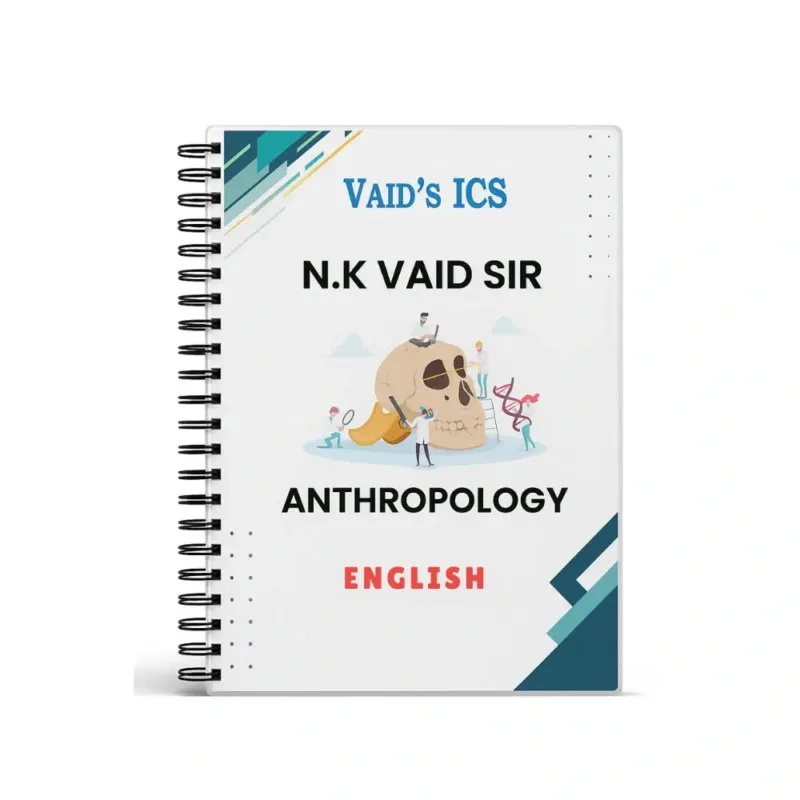


NK Vaid Anthropology Notes 2025-26
About NK Vaid Anthropology Notes 2025-26
The NK Vaid Anthropology Notes 2025-26 is a printed UPSC study material set sold by UPSC Store β India’s trusted source for genuine, latest-batch civil services preparation books. This page covers full booklet details, syllabus coverage, pricing, shipping, and frequently asked questions. Useful for UPSC CSE, BPSC, UPPSC, MPPSC, RAS and other state PSC examinations.
NK Vaid Anthropology Notes 2025-26 β 6 English Medium Printed Booklets for UPSC Anthropology Optional (Paper 1 & Paper 2)
Related: NK Vaid Anthropology Β· Anthropology optional
Product Overview
| Feature | Details |
|---|---|
| Booklets Count | 6 Individual Printed Booklets β Complete Paper 1 & Paper 2 Coverage |
| Language | English Medium |
| Publisher | Vaid’s ICS (NK Vaid Sir Anthropology Series) |
| Edition | 2025-26 β Latest Genuine Batch |
| Condition | Brand New, Unmarked, Fresh Stock |
| Format | High-Quality Printed Booklets β Spiral or Book Binding |
| Paper Quality | 75 GSM Ultra-White β Highlighter Safe, Zero Bleed-Through |
| Shipping | Pan India Delivery in 3-5 Business Days β Tracked |
| Also Useful For | BPSC, UPPSC, MPPSC, RAS and all State PSC Anthropology Optional Candidates |
Complete Booklet Catalog
This 1-booklet set by NK Vaid Sir of Vaid’s ICS covers the entire UPSC Anthropology optional syllabus β Paper 1 (Theoretical & Physical Anthropology) and Paper 2 (Indian Anthropology & Applied Anthropology) β in structured, exam-focused English medium printed notes. Designed for UPSC Mains aspirants who want classroom-quality material delivered to their doorstep, this set is among the most sought-after Anthropology optional resources available online today.
- Booklet 1: Foundations of Anthropology & Human Evolution β Meaning, scope and history of Anthropology; its relationship with other disciplines; organic evolution, theories of evolution, Darwin and Neo-Darwinism; genetics basics including Mendelian genetics, chromosomal theory, mutation, and genetic drift; human evolution from Dryopithecus to Homo sapiens sapiens with fossil evidence and cranial features.
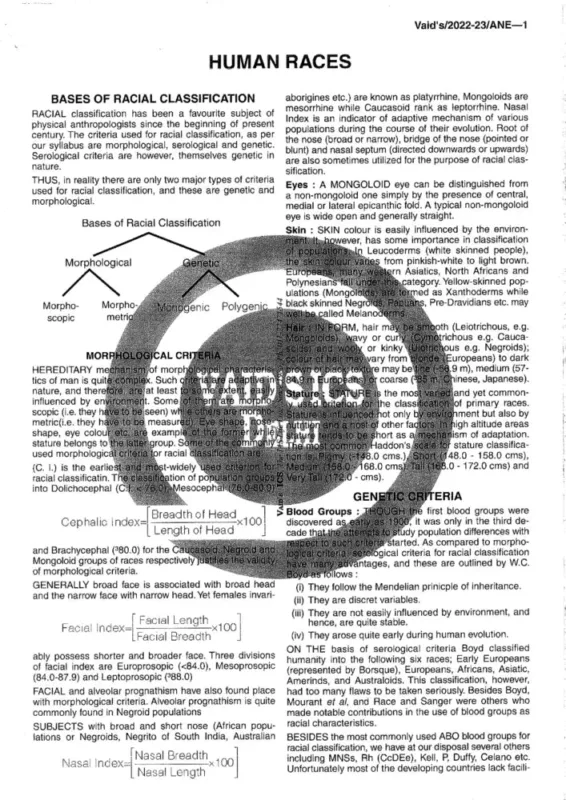
- Booklet 2: Physical Anthropology β Primatology, Race & Forensic Anthropology β Comparative anatomy of primates; primate taxonomy and behaviour; racial classification and critiques of race concept; biological basis of race; racism and UNESCO statements; forensic anthropology methods including osteometry, stature estimation, age and sex determination from skeletal remains; dermatoglyphics and somatometry.
- Booklet 3: Social & Cultural Anthropology β Theories, Kinship & Social Organisation β Major theoretical perspectives: evolutionism, diffusionism, functionalism, structural-functionalism, structuralism, culture and personality school, and post-modernism; kinship terminology, descent, alliance theory, marriage forms and prohibitions; family types; political organisation from band to state; social stratification, caste, class and gender.
- Booklet 4: Economic Anthropology, Religion & Anthropological Methods β Subsistence patterns and economic systems in pre-industrial societies; gift exchange, reciprocity and redistribution; religion, magic and witchcraft; myth, ritual and symbolism; fieldwork methodology; participant observation; interview techniques; genealogical method; case study and life history approaches; ethics in anthropological research; quantitative vs qualitative methods.
- Booklet 5: Indian Anthropology β Tribes, Culture & Racial & Linguistic History β Prehistoric India β Paleolithic, Mesolithic, Neolithic, Chalcolithic and Iron Age cultures; racial and linguistic elements of Indian population; scheduled tribes β distribution, problems and development; tribal identity and integration vs isolation debate; major tribes of India with ethnographic profiles; folk, classical and tribal culture continuum; village studies and caste in India.
- Booklet 6: Applied Anthropology, Contemporary Issues & Previous Year Questions β Scope and relevance of applied anthropology; development anthropology and tribal development programmes; concept of health, disease and nutrition among tribal populations; reproductive health and fertility patterns; urbanisation and its impact on tribal communities; anthropology of disaster; tribal movements and rights; contemporary debates on indigenous peoples; selected UPSC previous year questions with model answer frameworks.
In-Depth Content Breakdown: Booklet by Booklet
Booklet 1: Foundations of Anthropology & Human Evolution
This opening booklet establishes the conceptual bedrock of UPSC Anthropology optional Paper 1. It begins with the definition, scope and sub-disciplines of Anthropology β physical, social, cultural, archaeological and linguistic β and their interrelationships with sociology, biology and psychology. The booklet then moves into organic evolution, covering Lamarckism, Darwinism and the Modern Synthetic Theory in clear comparative tables. Genetics receives dedicated treatment: Mendelian principles, chromosomal theory of inheritance, linkage and crossing over, mutation types and genetic drift are explained with diagrams suitable for direct use in UPSC Mains answers.
The second half of Booklet 1 traces human evolution from early hominids to anatomically modern humans. Each fossil form β Dryopithecus, Ramapithecus, Australopithecus, Homo habilis, Homo erectus, archaic Homo sapiens, Neanderthals and Cro-Magnon β is covered with cranial capacity, morphological features, geographic distribution and stratigraphic age. NK Vaid Sir’s structured note format uses clearly labelled comparison charts making it straightforward to write point-based 150-word and 250-word UPSC answers. This booklet alone covers nearly 30β35% of Paper 1 Section A weightage in recent UPSC Mains exams.
Booklet 2: Physical Anthropology β Primatology, Race & Forensic Anthropology
Booklet 2 covers the biological and physical dimensions of Anthropology essential for UPSC Paper 1. Primatology is treated systematically β primate taxonomy (Prosimii vs Anthropoidea), anatomical adaptations, social behaviour patterns of gorillas, chimpanzees, gibbons and baboons, and their relevance to understanding human evolution. The race concept is analysed critically: traditional racial classifications by Blumenbach, Hooton and Coon are juxtaposed with modern critiques, UNESCO anti-racism statements and the biological invalidity of fixed racial categories β a topic that appears recurrently in UPSC Anthropology optional questions.
Forensic Anthropology receives detailed coverage in this booklet, making it especially valuable for candidates targeting applied sections of the UPSC exam. Methods of sex determination from pelvis and skull, age estimation from dentition and epiphyseal fusion, stature reconstruction from long bone measurements, and identification through dermatoglyphics are all explained with methodology flowcharts. Somatometric techniques including cephalic index, nasal index and stature indices are presented in tabular form, giving aspirants ready-made revision material. Buy this set to access NK Vaid’s forensic anthropology content, which is notably more structured than many competing printed notes in the market.
Booklet 3: Social & Cultural Anthropology β Theories, Kinship & Social Organisation
This booklet is the most theory-heavy in the set and directly addresses the dominant portion of UPSC Anthropology Paper 1 Section B. All major theoretical schools are covered: Classical Evolutionism (Tylor, Morgan, Spencer), Diffusionism (British, German-Austrian, American), Functionalism (Malinowski), Structural-Functionalism (Radcliffe-Brown), French Structuralism (LΓ©vi-Strauss), the Culture and Personality school (Benedict, Mead), and Post-Modern critiques. Each school is presented with key thinkers, central concepts, major works, criticisms and UPSC-oriented evaluation paragraphs β a format that saves aspirants significant time in constructing complete Mains answers.
Kinship and social organisation β consistently high-scoring topics in UPSC Anthropology optional β receive thorough treatment. Kinship terminology systems (Descriptive vs Classificatory; Crow, Omaha, Eskimo, Hawaiian and Sudanese systems) are covered with diagrams. Descent theory (unilineal, bilateral and cognatic) and alliance theory (elementary and complex structures) are explained alongside marriage forms β monogamy, polygyny, polyandry, group marriage β with cross-cultural examples. Political organisation is traced from egalitarian band societies through segmentary lineages to chiefdoms and states, using classic ethnographic examples from Nuer, Trobriand Islands and the Tallensi that UPSC examiners expect to see referenced.
Booklet 4: Economic Anthropology, Religion & Anthropological Methods
Booklet 4 addresses UPSC Anthropology Paper 1’s economic, religious and methodological sections β areas where many aspirants lose marks due to underprepared answers. Economic Anthropology covers formalist vs substantivist debate (Firth vs Polanyi and Dalton), modes of exchange (reciprocity, redistribution and market exchange following Polanyi’s framework), subsistence strategies from hunting-gathering to pastoralism and horticulture, and the concept of moral economy. Gift exchange is analysed through Mauss’s classic work with applications to tribal Indian contexts, linking Paper 1 content directly to Paper 2 India-based questions β a cross-referencing strategy NK Vaid Sir builds into his notes.
Religion in Anthropology is covered with Tylor’s animism, Frazer’s magic-religion continuum, Durkheim’s sacred-profane distinction, Turner’s ritual symbolism and Geertz’s interpretive approach to religion as a cultural system. Anthropological fieldwork methodology β the most direct marks-earning section for UPSC optional preparation β is treated rigorously: Malinowski’s participant observation model, ethical dilemmas in fieldwork, RAI Notes and Queries tradition, genealogical method, sociometry, and the debate between emic and etic approaches. Case study examples from classic ethnographies are included to help UPSC aspirants write well-referenced Mains answers.
Booklet 5: Indian Anthropology β Tribes, Culture & Racial & Linguistic History
Booklet 5 shifts to UPSC Anthropology Paper 2 β the Indian context β and is arguably the most exam-critical booklet in this set. Prehistoric India is covered chronologically: Lower Paleolithic Soanian and Acheulian cultures, Mesolithic at Bhimbetka and Adamgarh, Neolithic-Chalcolithic cultures of Mehrgarh and Ahar, and the Iron Age transition. The racial history of India covers Negrito, Proto-Australoid, Mongoloid, Mediterranean, Western Brachycephals and Nordic elements using Guha and Risley’s classifications alongside modern genetic perspectives β a topic directly targeted by UPSC in recent Mains cycles.
Indian tribes receive ethnographic treatment through region-by-region analysis: Andaman & Nicobar islands (Jarawa, Onge, Sentinelese, Great Andamanese), Northeast India (Naga, Mizo, Bodo), Central India (Gond, Muria, Baiga, Birhor), and Western and Southern India (Bhil, Chenchu, Toda, Irula). Each tribe is profiled for economy, kinship, religion, material culture and contemporary challenges. The integration vs isolation vs assimilation debate involving Verrier Elwin, G.S. Ghurye and Nehru’s Panchsheel policy is presented as a structured comparison chart β one of the most reliably tested topics in UPSC Anthropology optional Paper 2.
Booklet 6: Applied Anthropology, Contemporary Issues & Previous Year Questions
The final booklet in the NK Vaid Vaid’s ICS set covers Applied Anthropology β the growing scoring section of UPSC Anthropology Paper 2 β along with contemporary issues and model answer frameworks. Applied Anthropology’s scope, history (British colonial anthropology to development anthropology) and key figures (Malinowski, Mead, Tax) are covered. Development-related topics include tribal development programmes under the Five-Year Plans and post-liberalisation era, Forest Rights Act 2006, PESA 1996, land alienation, displacement and rehabilitation β all topics that have appeared in UPSC Mains Anthropology optional in the last five years.
Health Anthropology within this booklet covers concepts of disease aetiology in folk and tribal medical systems, ethno-medicine, nutrition and malnutrition among tribal groups, reproductive health (fertility, TFR and contraception in tribal contexts), and anthropology of HIV/AIDS. Tribal movements β Santhal Rebellion, Munda Ulgulan, Tana Bhagat movement, and contemporary Naxal-tribal interface β are covered with sociological analysis frameworks suitable for UPSC answer writing. The booklet closes with a curated set of previous year UPSC Anthropology optional questions (Paper 1 and Paper 2) with answer plan outlines, making it a powerful revision and self-assessment tool in the weeks before the UPSC Mains examination.
Physical Construction and Quality Standards
When you buy printed notes for a high-stakes exam like UPSC, physical quality directly impacts your study efficiency. These NK Vaid Vaid’s ICS Anthropology booklets are produced to standards that match serious daily-use requirements: months of repeated reading, annotation, and active revision sessions without degradation.
Paper Quality: 75 GSM Anti-Glare White Paper
Each booklet in this NK Vaid Anthropology 2025-26 set is printed on 75 GSM ultra-white paper chosen specifically for high opacity and low glare. Unlike thin 60 GSM paper common in budget-market alternatives, 75 GSM provides genuine bleed-through prevention β you can use fluorescent yellow, orange, pink and green highlighters on the same page without any colour showing through to the reverse side. The bright-white tone provides strong contrast with black text, reducing eye strain during long UPSC preparation sessions that routinely run four to six hours at a stretch. This paper weight is the consistent choice of serious UPSC coaching institutes.
Printing Technology: High-Resolution Laser Printing
All six Anthropology booklets are produced using high-resolution laser printing technology that delivers 1200 DPI clarity across text, diagrams, evolution timelines, kinship diagrams and ethnographic maps. Laser toner is thermally fused to the paper surface, making every page permanently smudge-proof β unlike inkjet-printed alternatives that can smear when pages rub together. Diagrams of primate taxonomy trees, cephalic index comparison charts, and Indian tribal distribution maps reproduce with sharp edges and legible labels at all zoom levels. Flowcharts used in fieldwork methodology sections and answer-writing frameworks remain crisp for the full duration of your UPSC preparation cycle.
Binding and Durability
These NK Vaid Anthropology printed booklets are available in spiral binding or book binding, both constructed for durability under intensive daily use. Spiral binding allows the booklet to lie fully flat on your study desk β enabling side-by-side note writing, annotation and simultaneous reference to multiple booklets during UPSC Anthropology optional revision without spine stress. Book binding provides a compact, shelf-friendly format with a 300 GSM laminated cover that resists moisture and surface scratches. Both binding types are reinforced for repeated opening and closing cycles over the 12β18 month UPSC preparation timeline without page separation or spine cracking.
Key Features and Study Design
NK Vaid Sir’s Anthropology notes from Vaid’s ICS are structured around the specific demands of UPSC Mains optional answer writing β not generic subject learning. Every design choice in these 1 Booklet supports faster recall, better answer structuring, and higher scoring in the UPSC Anthropology optional examination.
- UPSC Syllabus-Aligned Organisation: Every booklet maps precisely to the UPSC Anthropology optional syllabus sections for Paper 1 and Paper 2. There is no extraneous academic content β every topic, subtopic and example is chosen for its direct relevance to UPSC Mains question patterns over the past decade.
- Comparison Tables and Classification Charts: Racial classification systems, kinship terminology types, evolutionary fossil comparisons, theoretical school summaries and tribal ethnographic profiles are presented as structured tables β ready for direct adaptation into UPSC Mains 150-word and 250-word answers without extensive reformatting.
- Ethnographic Examples with Exam Context: Classic ethnographic references β Malinowski’s Trobriand Islanders, Evans-Pritchard’s Nuer, Turner’s Ndembu, Elwin’s Baiga β are included not as academic citations but as deployable answer enrichments that UPSC examiners specifically reward in the Anthropology optional marking scheme.
- Cross-Paper Linkages Built In: NK Vaid Sir’s notes explicitly flag topics from Paper 1 that directly connect to Paper 2 Indian Anthropology questions β for example, linking alliance theory to Indian kinship systems, or linking applied anthropology debates to tribal development policy β helping UPSC aspirants write integrated, high-scoring answers.
- Previous Year Question Integration: Selected UPSC Anthropology optional previous year questions (last 10 years) are embedded within relevant topic sections, and Booklet 6 contains dedicated PYQ answer frameworks. This allows aspirants to test their preparation topic-by-topic as they progress through the material.
Shipping, Packaging and Delivery
Every order of NK Vaid Anthropology Notes 2025-26 is packed to withstand full transit stress. Each set of 1 Booklet is individually shrink-wrapped to prevent moisture entry, then placed in a rigid corrugated cardboard box with foam edge protectors on all four corners. The outer carton is sealed with reinforced water-resistant tape and labelled with fragile-goods handling instructions. This multi-layer packaging ensures that the booklets arrive in the same pristine, unmarked, brand-new condition they left our Mukherjee Nagar, Delhi fulfilment centre β with covers intact, spiral bindings undamaged, and pages uncreased.
Orders are dispatched within 24 hours of payment confirmation and delivered pan India within 3β5 business days via tracked courier services. As soon as your order is shipped, a tracking ID is sent directly to your registered mobile number and email. For any shipping queries, missing booklet reports, or delivery status updates, reach our support team on WhatsApp at +91 70045 49563 β available seven days a week. If any booklet is found missing or damaged on delivery, a replacement is dispatched within 48 hours of your report at zero additional cost to you.
Frequently Asked Questions (FAQ)
A: NK Vaid Sir’s Vaid’s ICS Anthropology notes are designed to cover the complete UPSC Anthropology optional syllabus for both Paper 1 and Paper 2. Most serious UPSC Anthropology optional aspirants use these notes as their primary study material and supplement with standard reference texts like Ember & Ember or R. Naroll for deeper reading on specific topics. For UPSC Mains answer writing, these 1 Booklet provide sufficient coverage of theory, ethnographic examples, Indian tribes, applied anthropology and previous year question frameworks to prepare a strong optional performance.
A: This set contains exactly 6 individual printed booklets covering the complete UPSC Anthropology optional syllabus. The 1 Booklet span Paper 1 topics β foundations, human evolution, physical anthropology, social and cultural anthropology, economic anthropology, religion and research methods β and Paper 2 topics including Indian prehistoric cultures, racial and linguistic history, tribal India, applied anthropology and contemporary issues with previous year question frameworks.
A: Yes β the NK Vaid Anthropology notes available here are in English medium only. All 1 Booklet are written, printed and structured in English. These are the notes produced by N.K. Vaid Sir at Vaid’s ICS for English medium UPSC Anthropology optional aspirants. If you are looking for Hindi medium Anthropology optional notes, you would need to look for a separate Hindi edition, which may be available as a different product.
A: These booklets use 75 GSM ultra-white paper chosen for high opacity β multiple highlighter colours and gel pens work without bleed-through to the reverse side, ideal for colour-coded revision. You can use fluorescent yellow for definitions, pink for UPSC key terms, orange for ethnographic examples, and green for dates or thinkers β all on the same page β without any colour showing through to the back, even on two-sided printed pages.
A: Vaid’s ICS Anthropology notes by NK Vaid Sir are widely regarded among UPSC Anthropology optional aspirants as one of the most structured and exam-oriented study materials available. The notes are built around UPSC Mains answer-writing requirements β organised content with comparison tables, ethnographic examples flagged for deployment in answers, and previous year question integration. Many UPSC Mains qualifiers with Anthropology optional cite Vaid’s ICS material as a core component of their preparation strategy.
A: You can buy NK Vaid Anthropology Notes 2025-26 β the complete 1-booklet English medium set β directly from this product page. This store ships pan India with delivery in 3β5 business days via tracked courier. For order support or bulk purchase enquiries, contact our team on WhatsApp at +91 70045 49563. You are buying brand new, unmarked, genuine Vaid’s ICS printed notes dispatched from our Mukherjee Nagar, Delhi fulfilment centre.
A: Yes β all 1 Booklet together cover the complete UPSC Anthropology optional syllabus for both Paper 1 and Paper 2 as notified by UPSC. Paper 1 coverage includes meaning and scope of Anthropology, human evolution, genetics, primatology, race and forensic anthropology, social and cultural anthropology theories, kinship, marriage, family, political and economic organisation, religion, and anthropological research methods. Paper 2 coverage includes prehistoric India, racial and linguistic history, Indian tribes, culture and civilisation studies, applied anthropology, development, health, and contemporary issues.
A: Standard textbooks like Ember & Ember’s Cultural Anthropology and P. Nath’s Anthropology provide deep academic coverage but are not organised for UPSC Mains answer writing. NK Vaid’s Vaid’s ICS notes are specifically structured for UPSC β with syllabus alignment, comparison tables, ethnographic examples and previous year question frameworks built in. Most successful UPSC Anthropology optional candidates use Vaid’s ICS notes as their primary revision material and refer to standard texts only for deeper understanding of specific topics where they need additional clarity.
A: These are professionally printed booklets β not photocopies or hand-written scan reproductions. All 6 NK Vaid Anthropology booklets are laser printed at 1200 DPI on 75 GSM ultra-white paper with either spiral or book binding and a 300 GSM laminated cover. The print quality is sharp, permanent and smudge-proof, with clearly reproduced diagrams, kinship charts, evolution timelines and ethnographic maps. Every set dispatched from our store is brand new and unmarked.
A: Yes β these NK Vaid Vaid’s ICS Anthropology printed notes are useful for all State PSC examinations that offer Anthropology as an optional subject, including BPSC, UPPSC, MPPSC, RAS and other State PSCs. Since the syllabus for Anthropology optional at State PSC level largely mirrors the UPSC syllabus structure, the content coverage β especially Indian tribes, applied anthropology, social organisation and physical anthropology β applies directly across these examinations.
A: Orders for NK Vaid Anthropology Notes 2025-26 are dispatched from our Mukherjee Nagar, Delhi store within 24 hours of payment confirmation. Pan India delivery is completed in 3β5 business days via tracked courier. Your tracking ID will be sent to your registered mobile and email immediately after dispatch. For delivery to remote pin codes, an additional 1β2 days may apply. Contact us on WhatsApp at +91 70045 49563 for real-time tracking assistance or urgent delivery queries.
A: If any of the 1 Booklet in your NK Vaid Anthropology set arrives missing or physically damaged, contact our support team on WhatsApp at +91 70045 49563 within 48 hours of delivery with your order number and a photo of the damaged or missing item. We will dispatch a replacement booklet within 48 hours of your report at absolutely no additional cost. Every order is packed in reinforced corrugated packaging to minimise transit damage, but we fully guarantee the condition of every booklet we sell.
Summary
| Specification | Value |
|---|---|
| Booklets | 6 Printed Booklets |
| Language | English Medium |
| Faculty / Institute | NK Vaid Sir β Vaid’s ICS |
| Edition | 2025-26 Latest Batch |
| Paper | 75 GSM Ultra-White |
| Binding | Spiral or Book Binding |
| Delivery | 3-5 Business Days Pan India |
| Also Useful For | BPSC, UPPSC, MPPSC, RAS and all State PSC Anthropology Optional |
Dispatched from our store in Mukherjee Nagar, Delhi β the heart of India’s UPSC preparation community. Buy NK Vaid Anthropology Notes 2025-26 today and receive your complete 1-booklet set pan India in 3β5 days.
Reference: Civil Services Examination
Customer Reviews 245
Notes are organized well but some concepts need clearer explanation. Helpful overall.
Outstanding notes! Structuring aur content dono excellent hain.
Material decent hai for anthropology optional. Padhne mein achha laga but comparison mein other authors bhi badhiya hain.
Mast product for anthropology optional.
Content bohot relevant hai UPSC ke liye, packaging bhi acha tha.
Bilkul sahi notes hain. Padhai mein bahut madad mili.
Content relevant and well-structured. Definitely worth the investment for UPSC prep.
These notes ne mera approach hi badal diya. Anthropology ab mere liye interesting aur manageable ho gaya.
Aspirants Also Bought
More from the same category
About NK Vaid Anthropology Notes 2025-26
NK Vaid Anthropology Notes 2025-26 is a highly recommended UPSC study material from NK Vaid Anthropology Institute, specially designed for Anthropology Optional preparation. Available in English medium, this material is crafted to match the exact requirements of the UPSC Civil Services Examination syllabus β covering both Prelims and Mains comprehensively.
Product Details
- Institute: NK Vaid Anthropology Institute
- Subject: Anthropology Optional
- Medium: English
- Format: Printed
- Delivery: Pan-India delivery in 3β5 working days
- Format: Original printed material, verified authentic
Why Buy from UPSC Store?
- β 100% Genuine Printed Material β Original printed notes, no photocopies or fake copies
- β Fast Delivery β Ships within 24 hours, arrives in 3β5 days pan-India
- β Secure Packaging β Bubble-wrapped and boxed to prevent damage in transit
- β Trusted by 10,000+ Aspirants β India's most reliable UPSC material marketplace
- β WhatsApp Support β Get expert guidance on material selection before ordering
Frequently Asked Questions
Yes, all products at UPSC Store are 100% genuine printed materials. We do not sell photocopies or fake copies.
Orders are dispatched within 24 hours and delivered across India in 3β5 working days via reputed courier partners.
Yes, we accept returns within 7 days if the product is damaged or incorrect. Check our refund policy for details.
We recommend pairing this with current affairs notes and a UPSC test series for comprehensive preparation. Browse more in Anthropology, Optional, UPSC.