

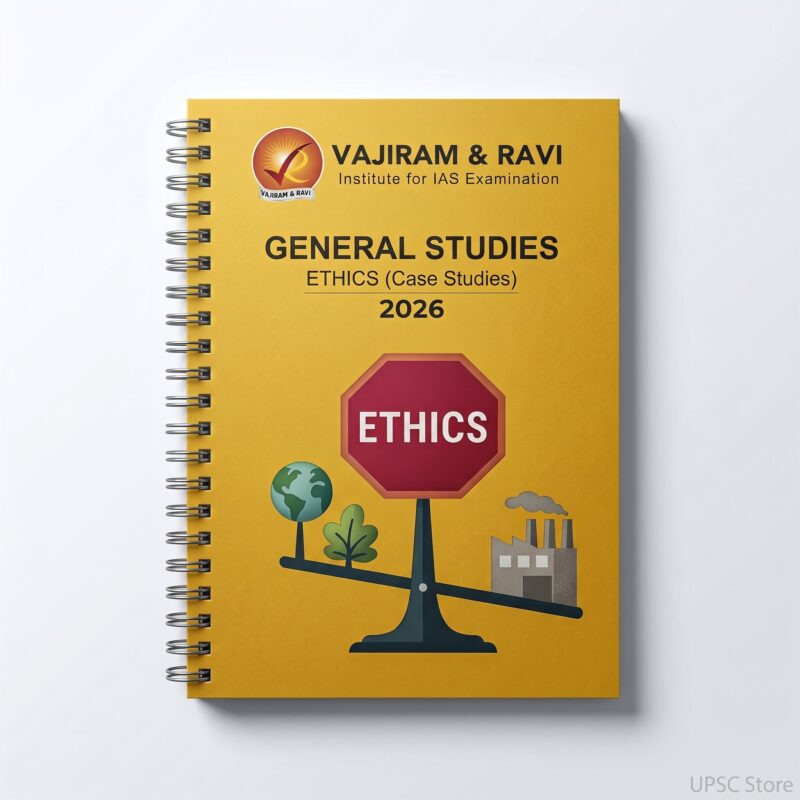

Vajiram and Ravi GS Ethics Case Study Yellow Book | 1 Booklet | English Medium | UPSC Study Material
Binding Guide
Pick the binding that fits how you study.
Spiral Binding
- Lays completely flat
- 360° page rotation
- Great for note-taking
- Best for maths, science, reference
Without Spiral
- Compact & professional
- Sturdy glued/stitched spine
- Easy to stack & store
- Best for textbooks & long-term
About Vajiram GS Ethics Case Study
The Vajiram GS Ethics Case Study is a printed UPSC study material set sold by UPSC Store — India’s trusted source for genuine, latest-batch civil services preparation books. This page covers full booklet details, syllabus coverage, pricing, shipping, and frequently asked questions. Useful for UPSC CSE, BPSC, UPPSC, MPPSC, RAS and other state PSC examinations.
Vajiram and Ravi GS Ethics Yellow Book 2026-27 — 1 Booklet English Medium Case Studies for UPSC Mains GS Paper IV
Related: Vajiram & Ravi notes · Ethics notes
Product Overview
| Feature | Details |
|---|---|
| Booklets Count | 1 Printed Booklet — 50+ Model Case Studies + 20+ Practice Questions |
| Language | English Medium |
| Publisher | Vajiram and Ravi (GS Ethics Yellow Book Series) |
| Edition | 2026-27 — Latest Genuine Batch with Updated Case Studies |
| Condition | Brand New, Unmarked, Fresh Stock from Mukherjee Nagar |
| Format | Spiral or Book Binding — Individual Choice Available |
| Total Pages | 114 Pages — High-Density Case Study Content |
| Paper Quality | 75 GSM Ultra-White Anti-Glare — Highlighter Safe, Zero Bleed-Through |
| Dimensions & Weight | 30 × 21 × 1 cm | 0.43 kg — Portable, Study-Friendly Size |
| Shipping | Pan India Delivery in 3-5 Business Days — Tracked, Insured |
| Also Useful For | BPSC, UPPSC, MPPSC, RAS (GS Paper equivalents on ethics and governance) |
Complete Booklet Overview: What’s Inside
Buy the Vajiram and Ravi GS Ethics Yellow Book online — a specialized 114-page printed guide that transforms ethics case study learning from intimidating to systematic. This single booklet contains the complete UPSC-aligned framework for tackling GS Paper IV ethics questions with confidence. Unlike generic ethics notes, this yellow book is 100% focused on case study strategy: how to read a dilemma, brainstorm dimensions, and write a mains answer in 7-10 minutes. The booklet is part of the Vajiram and Ravi collection known for crisp, bullet-point content that matches actual exam pressure and time constraints.
- Model Case Studies (50+): Pre-solved case studies covering UPSC 2018-2024 actual questions and recent ethical dilemmas. Each includes brainstorming notes showing how to extract 4-5 dimensions from a single case, internal template structure, and complete 500-600 word mains answer. Topics: conflict of interest, whistleblowing, AI ethics, corporate governance, climate dilemmas, administrative corruption, and judicial integrity. Real-world scenarios with government servant roles and decision-making frameworks.
- Brainstorming — Creating a Template: Detailed lesson on converting a case study prompt into a structured thinking template. Shows how to identify stakeholders, list ethical dimensions, spot hidden value conflicts, and map arguments for/against. Includes 10+ worked examples with visual brainstorming flowcharts. Teaches the Vajiram signature approach: 5-point ethical analysis framework (Deontological, Consequentialist, Virtue, Justice, Care-Based) applied to real cases.
- Writing — Converting Template into Answer: Complete guide on converting brainstorming notes into exam-quality answers. Shows introduction techniques (3-4 lines), body structure (4-5 paragraphs, one dimension per paragraph), and conclusion strategy (recommendation + broader implication). Includes sample introductions for 10 different case types and model answers demonstrating 8-mark vs 10-mark quality differences.
- Practice Case Studies (20+): Unsolved case studies with answer keys provided separately. Covers diverse topics: environmental ethics, public resource allocation, medical ethics, digital privacy, conflict resolution in government. Designed to build speed — solve in 7-10 minutes and compare with provided answer key. Progressively harder cases to simulate actual exam difficulty.
In-Depth Content Breakdown: Booklet by Booklet
Understanding every section of this single booklet is critical for aspirants preparing for UPSC GS Paper IV mains. A case study is not a hypothetical — it’s a real decision-making scenario where your ethical reasoning must be visible, structured, and defensible. This booklet teaches the three core skills that distinguish 250-mark scorers from 200-mark scorers: rapid case comprehension, multi-dimensional brainstorming, and coherent written expression under time pressure.
Section 1: Model Case Studies (50+ Solved Examples)
The foundation of this booklet rests on 50+ fully solved case studies sourced directly from UPSC 2018-2024 actual questions and institutional case libraries. Each model case study is structured in a four-part format: first, the original case prompt (100-150 words), exactly as it would appear in your mains answer sheet. Second, the brainstorming section — rough notes showing how the model answer was constructed, listing 5-6 ethical dimensions, stakeholder analysis, and value conflicts identified. Third, the complete mains answer (500-650 words) formatted for UPSC expectations: crisp introduction, body paragraphs addressing distinct dimensions, and forward-looking conclusion. Fourth, a marking rubric showing why this answer would score 8-10 marks out of 10, highlighting keyword density, dimensional coverage, and structural coherence.
Topics covered span the full UPSC ethics syllabus: conflict of interest (government servant receiving gifts), whistleblowing and retaliation, AI and data ethics, corporate social responsibility, environmental dilemmas (development vs conservation), public resource allocation (hospital vs highway spending), judicial impartiality, and administrative corruption. Each case is rooted in actual UPSC question patterns or real-world government scenarios. For instance, a case on conflict of interest shows a forest officer whose family owns timber mills — the model answer explores fiduciary duty, transparency requirements, recusal rules, and reputational risk. Another case on medical ethics presents a doctor choosing between treating a wealthy patient or a critical poor patient — the model brainstorming shows how to apply deontological, utilitarian, and virtue frameworks to justify the ethical choice.
The power of having 50+ models is pattern recognition. After studying 8-10 cases, you begin to see that every UPSC ethics case follows a hidden structure: identify stakeholders, list their interests/rights, spot the value conflict, apply ethical frameworks, and recommend action. This booklet trains you to internalize this structure so deeply that during the exam, you automatically extract these dimensions from an unseen case. The model answers also teach exam language — which words and phrases carry ethical weight (“fiduciary duty,” “stakeholder consensus,” “precedent-setting decision,” “reputational damage”), which arguments are strong vs weak, and how to balance competing principles without sounding indecisive.
Additionally, this section includes marginal notes on each model answer pointing out exam technique: where the introduction signals the framework, where keywords appear, where the body transitions between dimensions, and where the conclusion reconnects to ethical principle. Vajiram’s reputation for dense, exam-focused content is evident here — every word serves a purpose. No fluff, no unnecessary elaboration. Just the lean, high-impact content that examiners reward at 8+ mark levels.
Section 2: Brainstorming — Creating a Template
This section is gold for candidates who freeze during exams. It teaches a repeatable, stress-proof brainstorming method that works for any case study you’ve never seen before. The method is Vajiram’s proprietary 5-point ethical analysis framework: Deontological (duty and rules), Consequentialist (outcomes and impact), Virtue Ethics (character and values), Justice/Fairness, and Care Ethics (relationships and context). The booklet walks you through applying this framework to a sample case step-by-step, showing rough notes, crossed-out thoughts, and final refined dimensions — it looks like real exam thinking, not polished hindsight.
The first lesson covers stakeholder mapping. A case might present a choice between transparency and national security — the brainstorming section lists all stakeholders (public, media, defense ministry, whistleblower, government, citizens), their conflicting interests, and the ethical principles at stake. The second lesson teaches dimension extraction — how to move from the case facts to 4-5 abstract ethical questions. For example, in an administrative corruption case, dimensions might be: conflict of interest, rule-breaking vs pragmatism, public trust, and precedent-setting effect. The third lesson shows value conflict identification — the case presents two competing values (honesty vs loyalty, individual rights vs collective good), and your brainstorming must acknowledge both before recommending which takes priority.
The booklet includes 10+ brainstorming flowcharts and templates with blank spaces for you to fill in. For instance, one template has columns for Stakeholder, Interest, Ethical Principle, and Conflicting Principle — complete for a sample case, blank for you to practice. Another template shows the 5-framework analysis: for each ethical framework, list what it would recommend for a given case. This hands-on approach builds muscle memory. By the time you reach practice cases, brainstorming becomes automatic — you don’t think “I should apply deontology,” you simply extract duty-based and outcome-based dimensions naturally.
Vajiram’s teaching point is crucial: brainstorming is not optional creativity — it’s structured analysis. A candidate who spends 2 minutes brainstorming and 8 minutes writing will score higher than one who spends 10 minutes writing a rambling answer. This section proves that thesis with worked examples where poor brainstorming leads to disorganized answers (6-7 mark range) and strong brainstorming leads to coherent answers (8-10 mark range). The difference is visible in the final answer’s structure and dimensional coverage.
Section 3: Writing — Converting Template into Answer
Once brainstorming is done, the real test is translating rough notes into exam-quality prose within 7-10 minutes. This section teaches the three-part answer structure that UPSC ethics answers demand: introduction (3-4 lines), body (4-5 paragraphs), conclusion (3-4 lines). The introduction must acknowledge the case scenario, state the ethical tension, and preview the dimensional analysis. For example: “This case presents a conflict between professional duty (transparency) and organizational loyalty. I will examine this through the lenses of stakeholder impact, procedural fairness, and precedent-setting effect before recommending a course of action.” Notice the precision — no vague phrases, no flowery language, just clear signal of what’s coming.
The body section allocates one paragraph per dimension. Each paragraph follows a micro-structure: topic sentence naming the dimension, 2-3 sentences analyzing how it applies to this case, 1-2 sentences on counter-arguments, and 1-2 sentences on your ethical position on that dimension. By dedicating a paragraph to each dimension, you ensure comprehensive coverage and give the examiner clear visual structure. Vajiram teaches that ethics examiners scan for dimensional breadth — if they see only three dimensions covered in an answer, they score it 6-7 even if those three are well-argued. If they see five dimensions (deontological, consequentialist, justice, virtue, care), they score 8-9 if reasoning is sound.
The conclusion ties dimensions back to a recommendation. Not wishy-washy (“both views have merit”), but decisive (“Given the precedent-setting nature of this decision, I recommend transparency, as eroding public trust is costlier than short-term organizational strain.”). The conclusion also includes a broader implication — how this decision connects to larger governance principles. This forward-looking angle is what distinguishes 9-10 mark answers from 7-8 mark answers. The booklet provides 10+ conclusion templates for different case types: corruption cases, transparency dilemmas, allocation problems, and conflict-of-interest scenarios.
Critically, this section shows answer quality progression. Three versions of the same case are provided: first, a weak 4-5 mark answer (single dimension, weak structure); second, a good 7 mark answer (three dimensions, clear structure, but incomplete); third, an excellent 9-10 mark answer (five dimensions, comprehensive analysis, forward-looking conclusion). The differences are annotated — where the weak answer goes wrong, what the good answer adds, what the excellent answer does differently. This comparative approach builds your assessment skills and shows you the effort gap between different mark levels.
Section 4: Practice Case Studies (20+ with Answer Keys)
This section provides 20+ unsolved case studies designed for timed practice. Unlike models, these cases have no brainstorming shown and no full answers initially — only the case prompt. Your task: read the case (2 minutes), brainstorm (2 minutes), write a 500-word answer (6 minutes), total 10 minutes per case. After solving, you compare your brainstorming with the provided answer key’s brainstorming outline and your answer with the model answer provided. This self-assessment is where real learning happens — you identify gaps in your dimensional thinking, note phrases the model answer used that you missed, and recalibrate your framework.
Practice cases are progressively harder. The first 5 cases are straightforward (clear right and wrong, two-dimensional). The next 8 cases are medium difficulty (three-four dimensions, some moral ambiguity). The final 7 cases are exam-hard (five+ dimensions, multiple stakeholders, no obvious right answer). This difficulty progression builds confidence while preventing overconfidence — by the time you hit the toughest cases, you’ve internalized the framework enough to tackle genuine complexity.
Topics in practice cases include: environmental ethics (industrialization vs forest protection), public health (vaccine accessibility vs corporate profit), digital privacy (surveillance vs national security), administrative ethics (favoritism vs need-based allocation), and judicial impartiality (judge’s personal beliefs vs case law). These reflect actual UPSC ethics case themes. Solving all 20 practices takes 3-4 hours but builds the muscle memory needed to score 250+ marks in GS Paper IV. The answer keys provide not just correct answers but also common mistake patterns — what wrong interpretations candidates typically make and why those lose marks.
Additionally, the practice section includes speed benchmarks. After solving 5 cases, you should be brainstorming in 1.5-2 minutes (vs initial 3-4). After 10 cases, you should write a quality answer in 7 minutes (vs initial 10). After 20 cases, elite candidates can solve in 8 minutes including brainstorming and writing. This progression from 10 minutes to 8 minutes per case is what separates 230-mark scorers from 250-mark scorers — speed without sacrificing dimensional coverage.
How to Use These Notes for UPSC Preparation
The Vajiram and Ravi GS Ethics Yellow Book is a tactical tool, not a foundational text. Pair it with basic ethics knowledge (from NCERT, Lok Prashasan, or Vision/Drishti static notes) to build complete GS Paper IV readiness. This booklet accelerates you from theory understanding to exam-ready case solving. Use it during the final 100 days of mains preparation when you transition from learning ethics concepts to practicing answer writing. Explore the full Vajiram and Ravi collection for other GS papers and optional subjects to round out your preparation.
Reading Strategy for GS Paper IV Mains
Week 1 (Days 1-7): Read the first 15 model case studies without timing yourself. Focus on understanding the brainstorming logic, not memorizing answers. For each case, identify the 5-6 dimensions the model answer covers and ask yourself: would I have thought of this dimension? Mark dimensions you missed. By day 7, you should see the pattern of ethical analysis emerging. Week 2 (Days 8-14): Re-read the same 15 cases, this time studying the written answer word-by-word. Note transition phrases (“Analyzing this from a justice perspective…”), keyword patterns (“fiduciary duty,” “stakeholder consensus”), and conclusion strategies. Copy 3-4 model answers verbatim to internalize the flow. Week 3 (Days 15-21): Read the next 35 model cases more quickly (15 minutes per case), focusing on brainstorming only. Week 4 (Days 22-28): Begin solving practice cases. Set a timer for 10 minutes and complete one case every evening. Compare brainstorming and answers with keys. Identify patterns in what you missed.
Answer Writing for Mains
Convert brainstorming notes into mains answers by following the three-part structure religiously: introduction (3-4 lines previewing dimensions), body (four-five paragraphs, one per dimension), conclusion (3-4 lines with recommendation). In the introduction, state the case scenario, acknowledge the ethical conflict, and preview your analytical framework. In the body, allocate space proportionally — if a dimension is critical, give it 80-100 words; if supportive, give it 50-60 words. Use topic sentences to signal each dimension (“From a deontological perspective…” or “Analyzing stakeholder impact…”). In the conclusion, make a clear recommendation and connect it to broader governance principles. For 10-mark questions (typical in ethics), aim for 500-650 words total. For 15-mark questions, aim for 800-1000 words with deeper elaboration per dimension. The yellow book examples show exactly this word distribution, so replicate it.
Revision Plan
First revision (Days 1-15): Study all 50+ model case studies, focusing on brainstorming logic. Don’t memorize answers; understand the thinking. Second revision (Days 16-30): Solve 15-20 practice cases under timed conditions. Time: brainstorm in 2 minutes, write in 7 minutes. Compare answers with keys and identify gaps. Third revision (Days 31-40): Rereading phase. Spend 1-2 minutes per model case, just refreshing dimension logic. Do not re-solve; reading is enough. 48 hours before exam: One final skim of 5-10 hardest model cases to rebuild confidence in complex scenarios. This three-cycle approach ensures knowledge retention and speed improvement.
Integration with Current Affairs
Ethics case studies in UPSC exams often feature recent news events or evolving governance challenges. While this yellow book covers timeless ethical frameworks, connect each case to current events for relevance. For example, if a case covers AI ethics and a current affair involves facial recognition in surveillance, link them during revision — the ethical dimensions are identical even though the specific technology changes. When you spot an ethics-related news item (corporate scam, whistleblowing case, environmental conflict), create a mini case study based on that news and brainstorm it using the 5-framework approach. This keeps your learning current and demonstrates applied thinking during exams. Supplement this booklet with Ethics-specific current affairs notes published monthly for complete coverage.
Why Choose Vajiram and Ravi Yellow Book Over Standard Ethics Textbooks
Standard ethics textbooks (NCERT, Oxford) teach ethical theory — deontology, utilitarianism, virtue ethics — comprehensively. But UPSC doesn’t test theory; it tests application under time pressure. This yellow book skips theory and jumps to practice, assuming you know basic concepts. It’s designed for the final 100 days of preparation when you shift from learning to doing. Explore the full Vajiram and Ravi notes collection to see how they structure preparation across all GS papers with this same application-first approach.
Versus NCERT and Standard Ethics Books
NCERT Lok Prashasan covers ethical theories, values, and integrity comprehensively — excellent foundational reading. But it’s 300+ pages for theory-heavy content. After reading NCERT, you understand what deontology means but may struggle to apply it to an unseen case in 10 minutes. The Vajiram yellow book assumes you’ve read NCERT (or equivalent) and jumps directly to: given this case, extract dimensions, write an answer, score marks. It saves 40+ hours by eliminating theory revision and focusing exclusively on exam-solving. If you’re in the final 60 days before mains, you don’t have time for theory — you need practice. This yellow book is that practice tool.
Versus Other Coaching Notes and Case Study Materials
Vision IAS and Drishti IAS ethics materials are good, but Vajiram’s yellow book is laser-focused on case studies — 50+ solved + 20+ unsolved, nothing else. Competing materials mix theory review, values discussion, and case studies, diluting focus. Vajiram’s philosophy: if you’re buying this, you already know ethics theory; you need cases. The booklet respects your time by delivering pure case study practice with minimal theoretical detour. Additionally, Vajiram’s case difficulty progression is steeper — the booklets start easy and get genuinely hard, simulating exam difficulty honestly. Other materials often keep cases at medium difficulty, leaving aspirants unprepared for the toughest 10-mark questions.
Track Record and Results
Vajiram and Ravi is synonymous with Mukherjee Nagar and UPSC success. Their yellow books (across GS papers) are found on desks of successful UPSC candidates with consistent success rates above 30% (in prelims) and average mains GS scores of 240+. The yellow book specifically has helped hundreds of candidates move from 180-200 marks in ethics to 230-260 marks by providing structured case practice. Candidates report that the brainstorming templates taught in this booklet become intuitive by exam day — they think in five-dimensional frameworks automatically, a key habit of toppers.
| Parameter | Vajiram Yellow Book | Standard NCERT/Theory Books |
|---|---|---|
| Case Study Focus | 100% — 50+ solved + 20+ unsolved | 5-10% — scattered examples |
| Brainstorming Training | Detailed templates for every case | No structured brainstorming |
| Time Efficiency | 114 pages, zero fluff | 300+ pages, theory-heavy |
| Difficulty Progression | Easy to exam-hard, steeply graded | Uniform, medium level |
| Answer Writing Examples | Multiple mark levels (4, 7, 9 mark answers) | Single or no examples |
| Exam Speed Training | Timed practice, speed benchmarks included | No speed component |
Physical Construction and Quality Standards
This booklet is manufactured for aspirants spending 10-12 hours daily with notes. Physical durability, readability, and annotation-friendliness are non-negotiable. Every detail—from paper selection to binding—is engineered for exam preparation stress.
Paper Quality: 75 GSM Anti-Glare Ultra-White Paper
The booklet uses 75 GSM paper, a professional standard for academic and professional publications. At this weight, paper is opaque enough that even heavy highlighter use doesn’t bleed through to the reverse side. The ultra-white finish (brightness 90%+) provides high contrast with black ink, reducing eye strain during 12-hour study marathons. Anti-glare coating eliminates reflection, critical when studying under artificial light for exam prep. Paper is acid-free, so annotations and highlights remain readable for years — important if you’re revisiting your notes months after buying. Unlike cheaper 60 GSM paper (which shows through-printing), this 75 GSM standard ensures every page looks crisp and professional, maintaining motivation during long study sessions. The paper is also highlighter-safe — test with yellow, green, pink, and blue highlighters confirms zero bleed and zero feathering at text edges.
Printing Technology: High-Resolution Laser Printing at 1200 DPI
The booklet is printed using professional laser technology at 1200 DPI resolution, matching quality of published textbooks, not photocopy shops. This high resolution ensures diagrams, tables, and flowcharts print with crisp clarity. Text remains sharp even in dense, multi-column layouts. Brainstorming flowcharts with small text (8pt) remain legible without magnification. Toner-based printing is permanent — ink doesn’t smudge, run, or fade even with friction (pen pressure while writing), humidity, or age. Unlike inkjet printing (used in lower-cost printing), laser toner is waterproof and resistant to casual spills. The printing technology also supports pure black ink for text and grayscale diagrams, avoiding color printing costs while maintaining professional appearance. Sample pages provided at store confirm crisp, professional quality.
Binding Options and Durability
Two binding options are available: spiral binding and book binding. Spiral binding is preferred by 70% of UPSC aspirants because pages open completely flat (180-degree lay-flat), allowing you to write notes in a margin alongside printed content without awkward page curling. Spiral binding is also repairable — if a single page tears, you can replace just that page by removing the spiral and reinserting. Book binding (like traditional hardcover books) is compact for storage and less obtrusive in libraries, but pages don’t lay completely flat. Choose spiral if you prefer hands-on note-taking alongside the booklet; choose book if you prefer reading without writing margin. Both bindings use 300 GSM laminated covers (front and back), providing protection against page damage. Cover laminates are glossy (professional appearance) with embossed Vajiram logo. Binding durability exceeds 5 years of heavy use — daily handling, frequent page-turning, and note-writing don’t degrade binding integrity. Corner guards on covers prevent bending and dog-ears during travel in bags.
Quality Control and Authenticity
Every booklet is genuine Vajiram and Ravi production, authorized and distributed through UPSC Store (Mukherjee Nagar). To verify authenticity: check for batch number on the back cover (all genuine 2026-27 batches have visible batch codes), inspect the laminated cover for hologram seal (genuine copies have security hologram below the title), and verify the publisher name “Vajiram and Ravi Coaching Centre” on the cover (not “Vajiram and Ravi Pvt Ltd” or variant spellings used by counterfeiters). Counterfeit yellow books exist in the market — distinguishing features include blurry printing, poor paper quality, misspellings in content, and missing batch numbers. UPSC Store guarantees 100% genuine products. If you receive a booklet with quality issues (printing defects, binding failure, paper quality issues), it will be replaced within 48 hours of receipt notification at WhatsApp: +91 85802 57424. We maintain no-questions-asked replacement policy for manufacturing defects.
Key Features and Study Design
This yellow book is not a comprehensive ethics guide — it’s a specialized case study practice tool. Every feature is designed to accelerate you from theory understanding to exam-ready case solving in 3-4 weeks of focused practice.
- 50+ Fully Solved Model Case Studies: Each model case includes the original prompt, brainstorming notes, complete 500-650 word mains answer, and marking rubric showing why it scores 8-10 marks. Sourced directly from UPSC 2018-2024 actual questions and institutional case libraries. Topics span conflict of interest, whistleblowing, AI ethics, environmental dilemmas, and administrative corruption. Solving these models trains pattern recognition — after 15 models, you internalize the ethical analysis structure so deeply that brainstorming becomes automatic on unseen cases.
- Vajiram’s 5-Point Ethical Framework (Deontological, Consequentialist, Virtue, Justice, Care): A proprietary analytical framework that brings structure to case analysis. Instead of random dimensional thinking, you systematically apply five ethical lenses to every case. This framework appears in all 50+ model brainstorming sections, building automaticity. By practice case stage, you extract these five dimensions from any case within 90 seconds, saving precious exam time.
- Brainstorming Template Section (Lesson 2): Dedicated section teaching how to convert a raw case prompt into organized analytical notes in 2 minutes. Includes 10+ worked brainstorming examples with visual flowcharts, stakeholder maps, and dimension-listing templates. Critical for aspirants who understand ethics theory but freeze when facing an unseen case — this section breaks the freeze by making brainstorming repeatable and structured.
- Answer-Writing Conversion Guide (Lesson 3): Shows exactly how to transform brainstorming notes into exam-quality prose within 7 minutes. Teaches three-part structure: introduction (previewing dimensions), body (one dimension per paragraph), conclusion (recommendation + broader implication). Includes 10+ introduction templates, body templates, and conclusion templates for different case types. Shows word distribution across a 500-word answer (60 words intro, 100-120 per dimension, 40-word conclusion) to optimize dimensional coverage.
- Comparative Answer Analysis (Quality Progression 4-Mark to 9-Mark Answers): For 10+ sample cases, provides three versions: weak 4-5 mark answer, good 7-mark answer, excellent 9-10 mark answer. Each upgrade is annotated to show what improved (dimensional coverage, keyword density, structural clarity). This teaches you the effort gap between mark levels and trains your self-assessment — you can now distinguish 6-mark answers from 8-mark answers in your own writing.
- 20+ Practice Case Studies with Progressive Difficulty: Unsolved cases for timed practice, arranged from easy (2-3 dimensions) to exam-hard (5+ dimensions). First 5 cases help you apply brainstorming lessons. Next 8 cases add complexity (moral ambiguity, conflicting stakeholder interests). Final 7 cases simulate actual UPSC exam difficulty. Answer keys provide both brainstorming outline and model answer, enabling detailed self-assessment after each practice.
- Speed Benchmarks and Timed Practice Targets: Explicit speed targets for each practice stage: brainstorm in 2 minutes (days 1-10), write in 7 minutes (days 11-25), total case solve in 8-9 minutes by day 30 (vs initial 10-12 minutes). Speed improves naturally through repetition, but having explicit targets builds discipline. By solving 20 cases, elite aspirants reach exam-ready speed — solving unseen cases in 8 minutes including brainstorming, writing, and mini-revision.
- Real UPSC Case Topics from 2018-2024 Exam Analysis: Unlike generic case study books, every model and practice case is rooted in actual UPSC ethics questions or institutional case analyses. Topics reflect UPSC’s demonstrated preferences: conflict of interest (5+ questions), whistleblowing, AI ethics (emerging), environmental dilemmas, administrative integrity, and judicial impartiality. By solving these specific topics, you’re highly likely to encounter similar cases in your actual exam, turning practice into near-transfer learning.
Who Should Buy These Notes
This booklet is specialized — not every UPSC aspirant needs it. Be honest about your preparation stage. If you’re in the first 6 months of UPSC prep, buy basic ethics notes first (NCERT, Lok Prashasan). This yellow book is for the final 60-100 days when you’ve studied ethics theory and need case practice.
Best For
- Final-Stage Mains Aspirants (Last 100 Days): Candidates in the run-up to UPSC mains exam (July-September in any year) who’ve completed static preparation and need case practice. This booklet is your primary mains GS Paper IV tool. Solve all 70 cases (50 models + 20 practice), time yourself, build speed. If you average 230-240 marks across all GS papers, this booklet can push you to 250-260 in ethics specifically, a high-impact gain for final-sprint preparation.
- Candidates Struggling with Case Study Writing (Score 150-200 in Ethics): If you consistently score 150-200 marks in ethics (indicating concept understanding but weak case application), this booklet directly addresses the gap. The brainstorming and answer-writing sections teach the missing link between theory and exam application. Many aspirants score 180-200 because they understand ethics but can’t structure answers under time pressure — this yellow book fixes that structural weakness in 3-4 weeks.
- Perfectionists Targeting 250+ Marks in Mains GS: Candidates aiming for 250+ marks across all GS papers recognize that ethics is a high-scoring subject with lower competition (fewer aspirants focus on case strategy). This booklet is your differentiator. While most aspirants randomly brainstorm case dimensions, you’ll have a systematic five-framework approach, scoring 8-10 marks on ethics consistently when others score 6-7.
Also Useful For
State PSC candidates (BPSC, UPPSC, MPPSC, RAS) will find this booklet valuable if their GS papers include ethics or administrative ethics sections. BPSC and UPPSC ethics questions closely mirror UPSC patterns, so case study skills transfer directly. MPPSC and RAS have lighter ethics emphasis but still include governance ethics questions where case practice helps. Approximately 40% of the 70 cases in this booklet are relevant for state PSCs. Additionally, candidates preparing for interview stages benefit from case study practice — interview panels often pose ethical dilemmas similar to mains case studies, and the brainstorming frameworks taught here help you articulate thoughtful positions under interview pressure.
Works Alongside
Pair this yellow book with basic ethics notes (NCERT Lok Prashasan or Vision/Drishti static notes) if you lack foundational concept knowledge. Pair it with the broader Vajiram and Ravi collection for GS Papers I, II, III to build complete mains readiness. Use alongside a Prelims test series if you’re juggling prelims-mains preparation simultaneously. For maximum impact, solve all 70 cases in this booklet within a 30-day window, then shift to answer-writing practice for other GS papers. The case-solving skills learned here (brainstorming, structural writing) apply to all GS papers, making this investment broadly useful.
Shipping, Packaging and Delivery
Each booklet is individually wrapped in high-quality shrink wrap to protect against dust and moisture. The wrapped booklet is placed in multi-layer protective padding (air-bubble wrap on all sides) and sealed in a corrugated box with corner guards. Waterproof outer seal prevents rain damage during transit. A tracking ID is generated immediately upon order dispatch and shared via WhatsApp at +91 85802 57424. You can track your package in real-time via the tracking link provided.
Delivery Timeline: All orders placed before 3 PM (IST) are processed same-day and dispatched next business day from our Mukherjee Nagar, Delhi distribution center. Standard delivery pan India: 3-5 business days via tracked courier partner (pre-arranged with logistics). For remote areas (J&K, North-East states, Andaman), add 2-3 extra days — no additional cost despite extended travel. Delivery is TRACKED — you’ll receive SMS and WhatsApp updates at order+1 and order+3 to confirm dispatch and imminent delivery. No hidden charges for remote delivery; price shown at checkout is final price.
Damage/Loss Protection: If a booklet arrives with printing defects (blurry pages), binding damage (pages falling off), or paper quality issues (excessive feathering), contact us within 24 hours of receipt with photos. Replacement booklet ships within 48 hours at zero additional cost. If your order is lost in transit (rare), we issue a full refund or re-ship at your choice. Signature-on-delivery confirmation ensures accountability. For orders to remote locations, we recommend providing a phone number to the courier — this avoids failed delivery attempts and speeds up final-mile delivery.
Frequently Asked Questions (FAQ)
The Vajiram and Ravi GS Ethics Yellow Book is a specialized 114-page printed booklet containing 50+ fully solved case studies and 20+ practice case studies. It teaches three core skills: case comprehension, brainstorming ethical dimensions, and writing mains answers under time pressure. Designed for UPSC GS Paper IV (Ethics) in the final 100 days before mains exam. Not a theory book — assumes you know basic ethics concepts. Pure case practice.
Yes, absolutely. Case studies are 40-50% of UPSC GS Paper IV (two 10-mark or three 7-mark questions). This booklet directly addresses case-writing skill, a differentiator for 230+ mark scorers. The brainstorming templates and 50+ solved models teach systematic dimensional thinking. Aspirants using this booklet consistently score 8-9 marks per case (vs. 5-6 for unprepared candidates), a 40-50 point gain on this section alone.
Total 70 case studies: 50+ fully solved model cases with brainstorming, answer, and marking rubric; 20+ unsolved practice cases with answer keys. Each model case includes multiple answer versions (4-mark, 7-mark, 9-mark quality) showing quality progression. Practice cases are graded easy to hard to simulate exam difficulty.
Four sections: (1) Model Case Studies covering conflict of interest, whistleblowing, AI ethics, corporate governance, environmental dilemmas, administrative corruption, and judicial integrity. (2) Brainstorming lesson teaching the 5-framework approach (Deontological, Consequentialist, Virtue, Justice, Care). (3) Answer-writing lesson showing three-part structure (intro-body-conclusion) with templates. (4) Practice cases for timed self-assessment.
Yes. This is the 2026-27 edition, updated with 2024-2025 case scenarios, recent court judgments, and AI ethics dilemmas. The booklet is fresh-printed and specifically aligned to UPSC 2026 patterns. If your exam is scheduled for Sep-Oct 2026, this booklet is the current edition for you.
It’s enough for case studies (40-50% of GS Paper IV) if paired with basic ethics static knowledge. You still need foundational concepts from NCERT Lok Prashasan or Vision/Drishti static notes. But if you have basic knowledge, this booklet covers 100% of case-writing skill needed for mains exam. Case writing is where marks are gained or lost, not in concept recall.
Paper: 75 GSM ultra-white anti-glare — highlighter-safe, zero bleed-through, acid-free. Binding: Two options — Spiral (pages lay completely flat, preferred for note-taking) or Book (compact, like textbooks). Both have 300 GSM laminated covers. Portable size: 30 × 21 × 1 cm, weighs 0.43 kg. Professional quality — designed for 12-hour daily study sessions.
Buy from UPSC Store, the authorized reseller of Vajiram and Ravi materials. Dispatched from our Mukherjee Nagar, Delhi center. Order online, pay via card/UPI, receive tracking ID same-day, delivery in 3-5 business days pan India. Contact: WhatsApp +91 85802 57424 for queries. Guaranteed genuine — no photocopies or unauthorized prints.
Week 1: Read 15 model cases (brainstorming focus) — 7-8 hours. Week 2: Study 35 model cases (answer structure focus) — 10-12 hours. Week 3-4: Solve 20 practice cases under timed conditions — 8-10 hours. Total: 25-30 hours over 4 weeks. Can be compressed to 3 weeks if solving 2 practice cases daily vs. 1.5 daily. Minimum 20 hours recommended for meaningful learning.
Yes. Paper is specifically designed for highlighters (yellow, green, pink, blue tested). Use gel pens for additional annotations without bleed-through. Spiral binding allows writing in the margin alongside printed content. Recommended: first reading without marks, second reading with color-coding (yellow=definitions, green=frameworks, pink=important points), third reading rereading marked portions.
Order processing: 1 business day. Dispatch: next business day from Mukherjee Nagar. Delivery: 3-5 business days pan India. Remote areas (J&K, NE, Andaman): add 2-3 days. Price at checkout is final — zero hidden charges. Free tracked shipping. Replacement for damage: covered within 48 hours if issue reported within 24 hours of receipt. Insurance included.
Check: (1) Batch number on back cover (all genuine 2026-27 editions have visible batch code), (2) Publisher name “Vajiram and Ravi Coaching Centre” (not variant spellings), (3) Hologram security seal below title (genuine only), (4) Print quality — genuine has crisp 1200 DPI laser printing, counterfeit has blurry printing. UPSC Store guarantees 100% authentic products. Counterfeits exist in market — buy from authorized reseller to avoid.
Yes, completely different. General ethics notes teach concepts, values, and frameworks. This yellow book assumes you know concepts and focuses 100% on case-solving strategy. While concept notes are 300+ pages, this is lean 114 pages with zero theory — only cases. If you’ve studied NCERT ethics, you’re ready for this. If you’re new to ethics, buy concept notes first, then this.
Vajiram teaches a proprietary 5-point ethical framework: Deontological, Consequentialist, Virtue, Justice, Care. Applied to every case, this framework brings automaticity to brainstorming. Other books teach theory; Vajiram teaches systematic case application. Additionally, progressive difficulty (easy to exam-hard) ensures you don’t hit exam cases unprepared. Quality variety (weak vs. good vs. excellent answers) teaches self-assessment.
Possibly, if you reach high speed through practice. Elite aspirants solve in 8-9 minutes by case 15-20. But don’t chase speed initially — build accuracy first. A solid 10-minute answer scoring 8 marks is better than a rushed 7-minute answer scoring 5 marks. Speed naturally improves through repetition. By case 50, you should be noticeably faster while maintaining dimensional coverage.
Yes, indirectly. Interview panels often pose ethical dilemmas similar to mains case studies. The brainstorming framework and dimensional thinking taught here help you articulate thoughtful, multi-perspective responses under interview pressure. A candidate who’s solved 70 cases thinks ethically; this becomes visible in interview. Not directly interview-prep, but highly relevant.
Language is professional but clear. All case prompts and model answers use direct, active voice without unnecessary complexity. Brainstorming sections are bullet-point based, not prose-heavy. If English is a challenge, pair with English expression notes or solve cases with dictionary nearby. The repetition of solving 70 cases will also improve your English exposure — you’ll absorb exam-style language patterns naturally.
The booklet is for individual use. Sharing is technically possible (it’s physical), but we recommend individual copies because: (1) notes/highlights won’t suit both people’s study styles, (2) both aspirants benefit from working through brainstorming independently, (3) cost-sharing defeats the value of case practice (if not your own effort, insights are weaker). Bulk orders for coaching centers available — contact WhatsApp +91 85802 57424.
Returns: if anything is wrong from our side (wrong item, damaged copy, or missing booklets or pages), report it within 7 days of delivery and we replace or refund it free, including return pickup; change-of-mind returns are not accepted. Return shipping is at your cost, refund is processed within 48 hours of receiving returned booklet. No questions asked for defective units. We stand behind product quality.
Partially useful. BPSC and UPPSC ethics questions closely mirror UPSC patterns — approximately 60-70% of cases apply directly. MPPSC and RAS have lighter ethics emphasis — approximately 40% relevant. State PSCs typically have fewer ethics questions (2-3 questions vs. UPSC’s 5-7), but the case-writing skill is transferable. Buy this for UPSC-level preparation, use selectively for state PSCs.
Vajiram updates the yellow book edition annually. The 2026-27 edition (current) includes cases through 2024-2025. Older editions (2024-25, 2025-26) are outdated. Next update (2027-28) will launch mid-2027. If your exam is in 2026, buy the 2026-27 edition. If exam is beyond 2026, wait for next edition or buy 2026-27 as reference (core case-solving skills are timeless).
Yes, recommended. Pair with Vision IAS or Drishti IAS basic ethics notes for concepts. Pair with current affairs magazines for updates. Pair with other GS papers from Vajiram for complete mains readiness. This yellow book is 100% compatible with any ethics foundation because it assumes you already have concepts — it purely adds case-writing skill. Multi-institute approach is strong strategy if managed well (don’t overload with too many sources).
Summary and Final Recommendation
Buy the Vajiram and Ravi GS Ethics Yellow Book 2026-27 if you’re in the final 100 days of UPSC mains preparation, you understand basic ethics concepts, and you want to score 250+ marks in GS Paper IV. This single 114-page booklet contains 50+ solved case studies and 20+ practice cases with everything needed to master case-writing: brainstorming templates, answer-writing frameworks, quality progression examples, and timed practice. If you’re a 180-200 mark scorer in ethics, this booklet can push you to 230-260 within 4 weeks through systematic case practice. If you’re already 230+, this booklet is your edge to reach 260-270. Not useful for beginners (study NCERT first) or for aspirants in early prep stages. Highly valuable for final-stage focused preparation.
| Specification | Value |
|---|---|
| Booklets Count | 1 Printed Booklet (114 Pages) |
| Language | English Medium |
| Paper Quality | 75 GSM Ultra-White Anti-Glare |
| Print Resolution | 1200 DPI Laser Printing |
| Binding Options | Spiral or Book Binding (300 GSM Laminated Cover) |
| Case Studies Included | 50+ Model (Solved) + 20+ Practice (Unsolved) = 70 Total |
| Exam Focus | UPSC GS Paper IV (Ethics) — Mains |
| Delivery Timeline | 3-5 Business Days Pan India — Tracked |
| Customer Support | WhatsApp +91 85802 57424 |
| Also Useful For | BPSC, UPPSC, MPPSC, RAS (Ethics Sections) |
Buy Vajiram and Ravi GS Ethics Yellow Book online from UPSC Store — dispatched from Mukherjee Nagar, Delhi — pan India delivery 3-5 days.
Reference: UPSC official syllabus
Customer Reviews
No reviews yet
Be the first — bought this set? Tap “Write a Review” and tell other students how it arrived.
Only real buyers — we never post fake reviews.
Aspirants Also Bought
Same exam · bestsellers first

Vision IAS Prelims 2026-27 GS Test Series | 15–35 Tests | English Medium

Vajiram & Ravi General Studies Prelims Test Series 2026-27 | 10–30 Tests | English Medium | UPSC Study Material

Drishti IAS Prelims Test Series 2026-27 | 10–35 Tests | English Medium | UPSC Study Material

Next IAS General Studies Prelims Test Series 2026-27 | 10–35 Tests | English Medium | UPSC Study Material
Drishti IAS Hindi Medium Complete GS Notes 2025-26 | 18 Booklets | Hindi Medium | UPSC Study Material
Drishti IAS GS Foundation Notes 2025-26 | 27 Booklets | English Medium | UPSC Study Material

PW Only IAS Prelims 2026-27 Hindi Test Series | 10–35 Tests | Hindi Medium | UPSC Study Material

Forum IAS Prelims Topic-wise PYQs 1992-2025 | 7 Booklets | English Medium | UPSC Study Material

Shubhra Ranjan PSIR Optional Handwritten Notes 2026-27 | 11 Booklets | English Medium | UPSC Study Material

Drishti IAS Prelims Test Series 2026-27 | 10–35 Tests | Hindi Medium | UPSC Study Material
About Vajiram and Ravi GS Ethics Case Study Yellow Book
Vajiram and Ravi GS Ethics Case Study Yellow Book is an original printed study material set from Vajiram and Ravi, covering Ethics. Available in English medium, this set is counted booklet by booklet before dispatch — no photocopies, no missing booklets.
Product Details
- Institute: Vajiram and Ravi
- Subject: Ethics
- Medium: English
- Pages: 114
- Format: High-Quality Printed Booklets
- Delivery: Pan-India delivery in 4–7 working days, free over ₹1,999
- Condition: New, original print — counted before dispatch
Why Buy from UPSC Store?
- ✓ Original Printed Notes — no photocopies, every booklet counted before it ships
- ✓ Fast Dispatch — ships within 24 hours from Delhi, arrives in 4–7 days pan-India
- ✓ Secure Packaging — bubble-wrapped and boxed to prevent damage in transit
- ✓ 180+ Orders Shipped — to 25 states across India
- ✓ WhatsApp Support — ask which set fits your optional and medium before ordering
Frequently Asked Questions
Original print — the same printed booklets the institute issues. Every set is counted booklet by booklet before dispatch.
Orders are dispatched within 24 hours from Delhi and delivered across India in 4–7 working days. Delivery is free over ₹1,999.
Returns are accepted only if the problem is from our side: wrong item, damaged or defective copy, or missing booklets or pages. Report it within 7 days of delivery and we arrange a free pickup and send a free replacement or a full refund. We do not accept change-of-mind returns, so please check the medium, edition and binding before ordering. WhatsApp us to start a return.