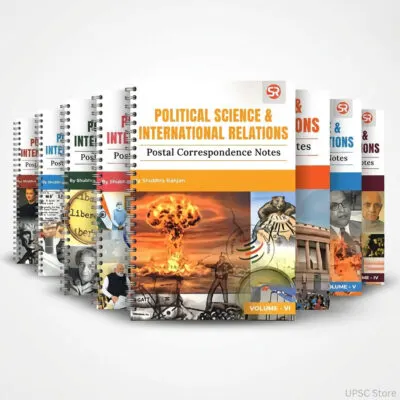
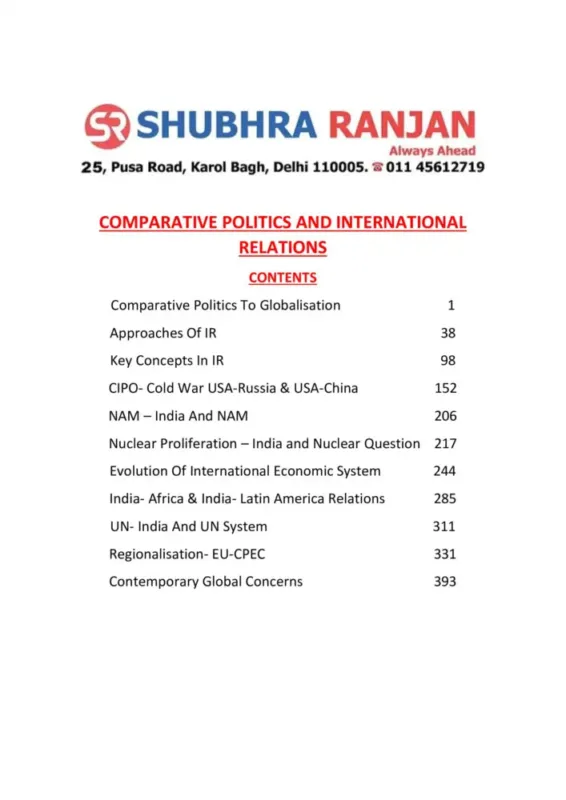



Shubhra Ranjan PSIR Optional Notes 2025-26
About Shubhra Ranjan IAS PSIR Optional
The Shubhra Ranjan IAS PSIR Optional is a printed UPSC study material set sold by UPSC Store β India’s trusted source for genuine, latest-batch civil services preparation books. This page covers full booklet details, syllabus coverage, pricing, shipping, and frequently asked questions. Useful for UPSC CSE, BPSC, UPPSC, MPPSC, RAS and other state PSC examinations.
Shubhra Ranjan PSIR Optional Notes 2025-26 β 4 English Medium Printed Booklets for UPSC Political Theory and Western Political Thought
Related: Shubhra Ranjan IAS notes Β· PSIR Optional books
Product Overview
| Feature | Details |
|---|---|
| Booklets Count | 4 Individual Printed Booklets β Full Coverage of Political Theory and Western Political Thought for UPSC PSIR Optional Paper I |
| Language | English Medium |
| Publisher | Shubhra Ranjan IAS Classes (PSIR Optional Series 2025-26) |
| Edition | 2025-26 β Latest Genuine Batch |
| Condition | Brand New, Unmarked, Fresh Stock |
| Format | High-Quality Printed Booklets β Spiral or Book Binding |
| Paper Quality | 75 GSM Ultra-White β Highlighter Safe, Zero Bleed-Through |
| Shipping | Pan India Delivery in 3-5 Business Days β Tracked |
| Also Useful For | BPSC, UPPSC, MPPSC, RAS and all State PSC Political Science Optional Paper |
Complete Booklet Catalog
This 4-booklet set by Shubhra Ranjan covers the entire Political Theory and Western Political Thought segment of UPSC PSIR Optional Paper I, one of the most scoring and intellectually rich sections of the syllabus. Designed for serious UPSC aspirants choosing Political Science and International Relations as their optional, these printed notes bring classroom-quality instruction directly to your study desk.
- Booklet 1: Political Theory β Foundations and Core Concepts β Covers the meaning, nature, and scope of political theory, the relationship between political theory and political science, normative versus empirical approaches, the decline and revival of political theory, traditions of political thought, and the role of ideology in political life. Includes structured notes on key definitional debates and exam-ready answer frameworks aligned with the UPSC PSIR optional syllabus.
- Booklet 2: Western Political Thought β Greek and Medieval Thinkers β Detailed treatment of Plato’s ideal state, theory of justice, philosopher-king, and theory of knowledge. Aristotle’s classification of constitutions, concept of citizenship, slavery, and the polis. Covers Cicero, St. Augustine, and St. Thomas Aquinas on natural law, church-state relations, and medieval political theology. Key quotes and exam angles for each thinker included.
- Booklet 3: Western Political Thought β Social Contract and Liberal Tradition β In-depth coverage of Machiavelli’s political realism, Hobbes’s Leviathan and the state of nature, Locke’s theory of natural rights and limited government, Rousseau’s general will and popular sovereignty, and Montesquieu’s separation of powers. Examines the Enlightenment roots of liberal democracy and connects each thinker’s ideas to UPSC Mains answer writing expectations.
- Booklet 4: Western Political Thought β Modern and Contemporary Thinkers β Covers Hegel’s dialectic and theory of the state, Marx’s historical materialism and class struggle, J.S. Mill on liberty and representative government, Bentham and utilitarian ethics, Gramsci’s hegemony, Hannah Arendt on power and totalitarianism, and Rawls’s theory of justice. Includes comparative tables, thinker timelines, and high-value answer pointers for UPSC PSIR Paper I.
In-Depth Content Breakdown: Booklet by Booklet
Booklet 1: Political Theory β Foundations and Core Concepts
This foundational booklet opens with a rigorous discussion of the meaning, scope, and nature of political theory β a topic that frequently appears as a direct question in UPSC PSIR optional Paper I. The notes distinguish between traditional normative theory, empirical political science, and post-behavioral approaches. The revival of political theory post-1970s β prompted by Rawls, Berlin, and others β is treated with the depth UPSC Mains answers demand. Key concepts like justice, liberty, equality, rights, and power are introduced here, providing the conceptual vocabulary aspirants need to write high-scoring answers throughout the optional paper.
The second portion of this booklet examines the relationship between political theory and political ideology, exploring how liberal, socialist, conservative, and nationalist traditions shape political discourse. Shubhra Ranjan’s notes present these through short structured paragraphs, bullet-point concept maps, and quote boxes, making revision efficient during the final weeks before UPSC Mains. The booklet closes with a set of probable UPSC questions drawn from previous years’ PSIR optional papers, allowing aspirants to test their conceptual grasp immediately after reading each section.
Booklet 2: Western Political Thought β Greek and Medieval Thinkers
Plato receives the most expansive treatment in this booklet, covering his theory of Forms, the allegory of the cave, the tripartite soul, the ideal state structured around guardians, auxiliaries, and producers, and his concept of justice as harmony. The notes connect Plato’s philosophy of knowledge directly to his political prescriptions, which is precisely the analytical angle UPSC Mains examiners reward. Aristotle follows with his teleological conception of the state, the classification of governments into six types, his defense of private property, and his views on slavery and natural hierarchy β all critical PSIR optional topics for UPSC Paper I Section A.
Medieval political thought is covered through Cicero’s natural law tradition, St. Augustine’s City of God and City of Man duality, and St. Thomas Aquinas’s synthesis of Aristotelian reason with Christian theology. These thinkers are often underweighted by aspirants, yet UPSC has repeatedly asked questions on Aquinas’s theory of law and Augustine’s views on political authority. Shubhra Ranjan’s notes fill this gap with precise, exam-ready summaries. A comparative table contrasting Greek and medieval conceptions of the state and justice helps aspirants write integrative answers during UPSC Mains.
Booklet 3: Western Political Thought β Social Contract and Liberal Tradition
This booklet begins with Machiavelli, whose separation of ethics from politics marks the birth of modern political thought. The notes cover The Prince and Discourses, virtΓΉ and fortuna, the role of the ruler, and Machiavelli’s republicanism β angles that UPSC PSIR optional Paper I has tested across multiple years. Hobbes’s Leviathan is treated in depth: the state of nature as a war of all against all, natural rights, the social contract as absolute sovereignty, and the absence of a right to rebellion. The Hobbesian model is contrasted with Locke’s throughout the booklet, a comparison that regularly appears in UPSC optional examinations.
Locke’s Second Treatise receives careful attention β natural rights to life, liberty, and property, the right to revolution, consent of the governed, and the origins of constitutionalism. Rousseau’s concept of the general will, the distinction between the will of all and the general will, his critique of property, and his vision of direct democracy follow. Montesquieu’s typology of governments and his doctrine of separation of powers are covered with clear diagrams showing how executive, legislative, and judicial separation maps onto modern constitutional design β a connection UPSC Mains answers benefit from enormously.
Booklet 4: Western Political Thought β Modern and Contemporary Thinkers
Hegel’s political philosophy is one of the most challenging topics in UPSC PSIR optional, and this booklet handles it with admirable clarity. The dialectical method, the role of history, the state as ethical life (Sittlichkeit), civil society versus the state, and Hegel’s views on war and nationalism are all covered with structured definitions and illustrative examples. Marx builds directly on Hegel β the notes trace the progression from Hegelian idealism to Marxist materialism, covering base and superstructure, modes of production, class struggle, alienation, ideology, and the theory of the state. These remain among the most frequently tested areas in UPSC PSIR Paper I Section A.
J.S. Mill’s liberalism β covering On Liberty, harm principle, utilitarianism, representative government, and the subjection of women β is treated with attention to the tension between individual freedom and collective welfare. Gramsci’s concept of hegemony, the role of organic intellectuals, and civil society are covered next, followed by Hannah Arendt on totalitarianism and the human condition. The booklet closes with Rawls’s theory of justice: the original position, veil of ignorance, the two principles of justice, and critiques from libertarian and communitarian positions. Comparative answer frameworks for Rawls vs. Nozick and Rawls vs. Sandel are included β high-value content for UPSC PSIR optional mains answers.
Physical Construction and Quality Standards
Every booklet in this Shubhra Ranjan PSIR optional set is manufactured to withstand months of intensive daily use during UPSC preparation β resisting wear through repeated revisions, travel to test centers, and long library sessions without losing print quality or structural integrity.
Paper Quality: 75 GSM Anti-Glare White Paper
The 75 GSM ultra-white paper used across all four booklets is selected for its high opacity, ensuring that text and diagrams on one side never bleed through to the reverse. This matters enormously during intensive UPSC PSIR optional revision when aspirants annotate with multiple highlighter colors β yellow for key thinkers, green for concepts, pink for UPSC question angles. The anti-glare surface reduces eye strain during four- to six-hour study sessions, and the paper weight is firm enough to support fountain pens, gel pens, and all standard highlighter brands without smearing or feathering.
Printing Technology: High-Resolution Laser Printing
All four booklets are printed using high-resolution laser printing technology, delivering sharp, consistently black text across every page. Political theory notes depend on precision β a misread word in a Hegel or Rawls passage can change the entire meaning of an answer. Laser-printed toner bonds permanently to the paper fiber, making these notes smudge-proof even when pages are handled repeatedly during revision cycles. Flowcharts comparing thinkers, timelines of Western political thought, and conceptual diagrams are rendered with crisp line clarity β exactly the visual quality UPSC aspirants need for accurate recall during PSIR optional Mains.
Binding and Durability
The booklets are available in spiral binding or book binding depending on stock. Spiral-bound editions open completely flat on a desk, allowing aspirants to write margin notes, add sticky tabs, and place booklets alongside answer sheets during practice writing without the spine resisting. Book-bound editions offer a more compact form factor, fitting easily into a bag alongside other UPSC PSIR optional materials. All editions use a 300 GSM thick cover with a laminated finish that resists moisture, creasing, and corner damage β ensuring the booklets look and function like new even after months of daily UPSC study use.
Key Features and Study Design
These Shubhra Ranjan PSIR optional notes are purpose-built for UPSC Mains optional preparation, structured to help aspirants build both conceptual depth and answer-writing speed across the Western Political Thought segment of Paper I.
- Thinker-Wise Structured Coverage: Each major political thinker from Plato to Rawls gets a dedicated, self-contained section with definition boxes, key arguments, UPSC-relevant angles, and likely exam questions β making targeted revision possible even in the final days before UPSC Mains.
- Comparative Analysis Tables: Side-by-side comparison tables for frequently paired thinkers β Plato vs. Aristotle, Hobbes vs. Locke, Marx vs. Hegel, Rawls vs. Nozick β help aspirants write integrative, high-scoring UPSC PSIR optional answers that demonstrate analytical thinking rather than rote recall.
- Previous Year Question Alignment: UPSC PSIR optional questions from 2015 to 2024 are mapped against each topic, allowing aspirants to immediately understand which thinkers and concepts carry the highest examination weight and prioritize their preparation time accordingly.
- Concept Maps and Flowcharts: Visual representations of complex ideas β Hegel’s dialectic, Marx’s base-superstructure model, Rawls’s original position β are presented as clean flowcharts designed for rapid revision and accurate reproduction in UPSC Mains answer sheets as value-adding diagrams.
- Answer-Writing Frameworks: Each booklet section closes with model answer outlines for 10-mark and 15-mark UPSC PSIR optional questions, showing aspirants exactly how to structure introduction, body arguments, thinker references, and a critical conclusion within strict UPSC word limits.
Shipping, Packaging and Delivery
All four Shubhra Ranjan PSIR optional booklets are packed with care to ensure they arrive in perfect, ready-to-study condition. Each set is individually shrink-wrapped to keep pages clean and aligned, then placed inside a rigid double-walled corrugated cardboard box with foam edge protectors at each corner. The outer box is sealed with tamper-evident tape and clearly labeled with your delivery address and order ID. This multi-layer transit packaging ensures that no booklet suffers cover creasing, moisture damage, or spine stress during the delivery journey β whether your address is in Delhi, Mumbai, Chennai, Hyderabad, Kolkata, or any remote pin code across India.
Orders are dispatched within 24 hours of payment confirmation and delivered pan India within 3-5 business days via tracked courier partners. You receive a tracking ID by WhatsApp or SMS as soon as your order ships. For queries, replacements, or status updates, reach us directly on WhatsApp at +91 70045 49563 β our team responds within a few hours on all working days. If any booklet in your set arrives damaged or is missing from the package, we replace it within 48 hours at no additional cost. Buy with confidence β your UPSC PSIR optional study material is in safe hands.
Frequently Asked Questions (FAQ)
A: Shubhra Ranjan is widely regarded as one of the most trusted names in UPSC PSIR optional preparation. Her printed notes for Political Theory and Western Political Thought are structured to match the exact depth and analytical style UPSC Mains examiners expect. The material balances conceptual clarity with answer-writing application, making it suitable for both first-time optional choosers and aspirants revising before their final UPSC attempt.
A: This set includes 4 printed booklets covering Political Theory and Western Political Thought β the core of UPSC PSIR optional Paper I Section A. The four booklets progress from foundational political theory concepts through Greek, medieval, early modern social contract thinkers, and finally modern and contemporary thinkers including Marx, Mill, Gramsci, Arendt, and Rawls. All four booklets are shipped together in a single tracked package.
A: Yes. The 4-booklet set covers every major thinker listed under the Western Political Thought segment of the UPSC PSIR optional Paper I syllabus β from Plato and Aristotle through medieval natural law theorists, social contract thinkers like Hobbes, Locke, and Rousseau, and modern thinkers including Hegel, Marx, Mill, Gramsci, Arendt, and Rawls. Thinker-specific sections include key arguments, UPSC question angles, and comparative frameworks to ensure complete syllabus coverage.
A: The booklets listed in this product are English medium only. PSIR optional, particularly the Western Political Thought segment, is most effectively studied in English given the original source texts and academic discourse are in English. Shubhra Ranjan’s printed notes for PSIR optional are universally produced in English, and this 2025-26 edition maintains that standard throughout all four booklets.
A: The Political Theory booklets cover the meaning, nature, and scope of political theory; normative versus empirical approaches; the decline and revival of political theory; and core concepts including justice, liberty, equality, rights, and power. Western Political Thought coverage includes Plato, Aristotle, Aquinas, Machiavelli, Hobbes, Locke, Rousseau, Montesquieu, Hegel, Marx, J.S. Mill, Bentham, Gramsci, Hannah Arendt, and John Rawls β the complete UPSC PSIR optional Paper I Section A syllabus.
A: Shubhra Ranjan’s PSIR optional notes are authored by a faculty member who has specialized exclusively in Political Science and International Relations for UPSC optional preparation over many years. The material emphasizes analytical depth, thinker-by-thinker argument mapping, and answer-writing frameworks tailored to UPSC Mains. Vision IAS and Vajiram notes tend toward broader GS-style summaries. For PSIR optional specifically, Shubhra Ranjan’s approach is considered more aligned with the depth UPSC Mains examiners reward.
A: Yes. This is the 2025-26 edition, the latest genuine batch from Shubhra Ranjan IAS Classes. The content is updated to reflect recent UPSC PSIR optional question trends, including contemporary relevance of classical thinkers, new question formats introduced in recent Mains cycles, and updated answer-writing guidance. When you buy this set, you receive the most current version of Shubhra Ranjan’s Political Theory and Western Political Thought notes available for UPSC 2025-26 preparation.
A: Many UPSC aspirants preparing for PSIR optional without classroom coaching use Shubhra Ranjan’s printed notes as their primary study resource. The notes are written in a self-explanatory style with concept definitions, argument structures, and answer frameworks built into each section. For aspirants who cannot attend classroom sessions in Delhi or other cities, these printed booklets effectively replicate the structured learning experience and are widely considered sufficient for thorough PSIR optional self-study.
A: These booklets use 75 GSM ultra-white paper chosen for high opacity β multiple highlighter colors and gel pens work without bleed-through to the reverse side, ideal for color-coded revision. Yellow, green, pink, and orange highlighters all perform cleanly on this paper. The anti-glare surface also reduces eye fatigue during extended UPSC study sessions, and the paper weight supports fountain pens and all standard ballpoint brands without any feathering or ink spread.
A: You can buy Shubhra Ranjan PSIR optional printed notes directly from this product page on our UPSC Store. We ship pan India from our Mukherjee Nagar, Delhi base within 24 hours of order confirmation. Delivery takes 3-5 business days to any address across India via tracked courier. To buy or for any pre-purchase queries, you can also reach us on WhatsApp at +91 70045 49563. This is one of the most searched PSIR optional study materials available to buy online in India.
A: Yes. While these booklets are primarily designed for UPSC PSIR optional Paper I, the Political Theory and Western Political Thought content they cover is directly relevant to Political Science optional papers for BPSC, UPPSC, MPPSC, RAS, and other State PSC examinations. State PSC political science optional syllabi substantially overlap with the UPSC PSIR optional syllabus in the political theory section, making these notes a valuable resource for state-level aspirants as well.
A: We take full responsibility for the condition of your order on arrival. If any booklet in your Shubhra Ranjan PSIR optional set arrives damaged, with missing pages, or is absent from the package, contact us immediately on WhatsApp at +91 70045 49563 with a photo of the package. We dispatch a replacement within 48 hours at no additional charge. Every order is tracked end-to-end, and our packaging is designed to withstand transit stress β but in the rare event of an issue, we resolve it without delay.
Summary
| Specification | Value |
|---|---|
| Booklets | 4 Printed Booklets β Political Theory and Western Political Thought |
| Language | English Medium |
| Paper | 75 GSM Ultra-White, Anti-Glare, Highlighter Safe |
| Binding | Spiral or Book Binding with 300 GSM Laminated Cover |
| Edition | 2025-26 β Latest Genuine Batch |
| Delivery | 3-5 Business Days Pan India β Tracked Courier |
| Also Useful For | BPSC, UPPSC, MPPSC, RAS and all State PSC Political Science Optional |
| Contact | WhatsApp +91 70045 49563 |
Dispatched from our store in Mukherjee Nagar, Delhi β the heart of UPSC optional study material in India. Order today and receive your Shubhra Ranjan PSIR optional 2025-26 printed booklets within 3-5 business days, anywhere in India.
Reference: Civil Services Examination
Customer Reviews 148
Best investment for UPSC prep seriously.
Shubhra Ranjan notes are crystal clear and cover all important topics. Highly recommended for PSIR optional!
Perfect notes, delivered on time. PSIR optional ke liye best choice hai.
Booklets theek-thaak hain lekin printing quality mein thoda improvement ho sakti thi.
Notes bahut comprehensive hain aur well-organized bhi. Must buy for serious UPSC aspirants.
Good quality
Content is well-structured and presentation bilkul professional hai.
These notes are seriously helpful for PSIR optional preparation, bohot recommended.
Aspirants Also Bought
More from the same category
About Shubhra Ranjan PSIR Optional Notes 2025-26
Shubhra Ranjan PSIR Optional Notes 2025-26 is a highly recommended UPSC study material from Shubhra Ranjan, specially designed for Political Science and International Relations (PSIR) preparation. Available in English medium, this material is crafted to match the exact requirements of the UPSC Civil Services Examination syllabus β covering both Prelims and Mains comprehensively.
Product Details
- Institute: Shubhra Ranjan
- Subject: Political Science and International Relations (PSIR)
- Medium: English
- Format: Printed
- Delivery: Pan-India delivery in 3β5 working days
- Format: Original printed material, verified authentic
Why Buy from UPSC Store?
- β 100% Genuine Printed Material β Original printed notes, no photocopies or fake copies
- β Fast Delivery β Ships within 24 hours, arrives in 3β5 days pan-India
- β Secure Packaging β Bubble-wrapped and boxed to prevent damage in transit
- β Trusted by 10,000+ Aspirants β India's most reliable UPSC material marketplace
- β WhatsApp Support β Get expert guidance on material selection before ordering
Frequently Asked Questions
Yes, all products at UPSC Store are 100% genuine printed materials. We do not sell photocopies or fake copies.
Orders are dispatched within 24 hours and delivered across India in 3β5 working days via reputed courier partners.
Yes, we accept returns within 7 days if the product is damaged or incorrect. Check our refund policy for details.
We recommend pairing this with current affairs notes and a UPSC test series for comprehensive preparation. Browse more in Optional, Political Science, UPSC.