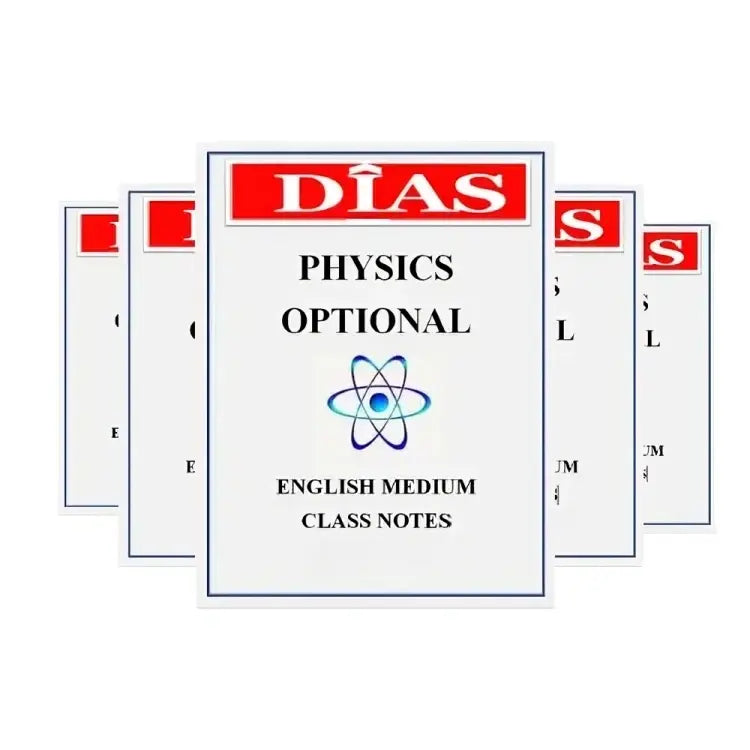
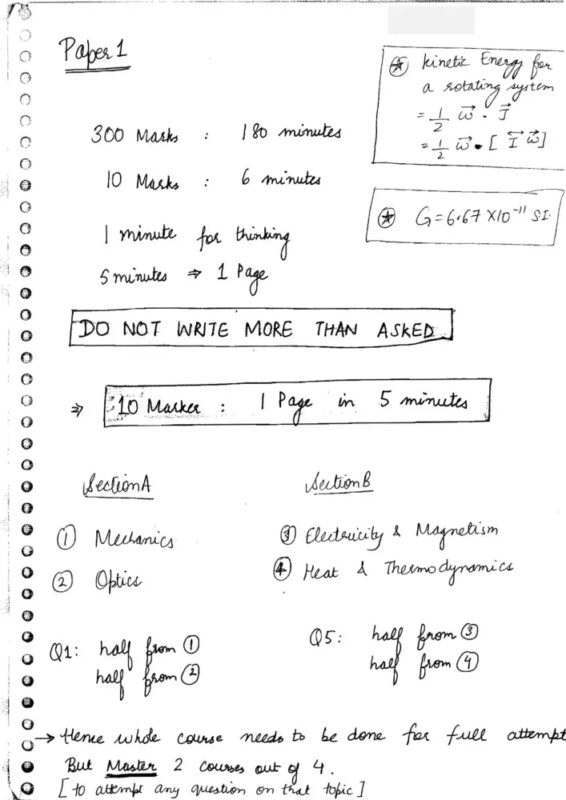
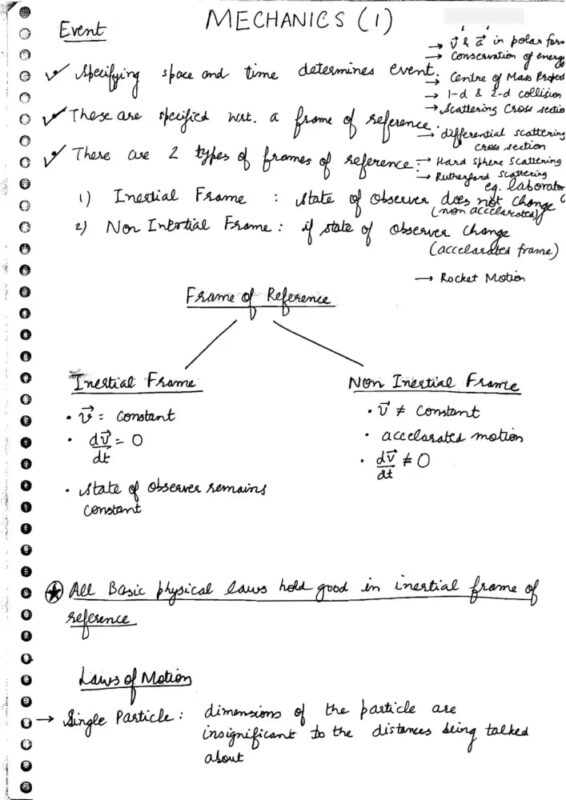


DIAS IAS Physics Optional Notes 2025-26
About DIAS IAS Physics Optional Notes
The DIAS IAS Physics Optional Notes is a printed UPSC study material set sold by UPSC Store β India’s trusted source for genuine, latest-batch civil services preparation books. This page covers full booklet details, syllabus coverage, pricing, shipping, and frequently asked questions. Useful for UPSC CSE, BPSC, UPPSC, MPPSC, RAS and other state PSC examinations.
DIAS IAS Physics Optional Notes 2025-26 β 8 Booklets English Medium Printed Class Notes for UPSC Mains Physics Optional
Related: Physics optional Β· Optional subjects
Product Overview
| Feature | Details |
|---|---|
| Booklets Count | 10 Individual Printed Booklets β Complete UPSC Physics Optional Syllabus Paper I & Paper II |
| Language | English Medium |
| Publisher | DIAS IAS (Physics Optional Class Notes Series) |
| Edition | 2025-26 β Latest Genuine Batch |
| Condition | Brand New, Unmarked, Fresh Stock |
| Format | High-Quality Printed Booklets β Spiral or Book Binding |
| Paper Quality | 75 GSM Ultra-White β Highlighter Safe, Zero Bleed-Through |
| Shipping | Pan India Delivery in 3-5 Business Days β Tracked |
| Also Useful For | BPSC, UPPSC, MPPSC, RAS, and All State PSC Candidates with Physics Optional |
Complete Booklet Catalog
This 8-booklet set from DIAS IAS covers the entire UPSC Physics Optional syllabus across both Paper I and Paper II, structured as classroom lecture notes designed for systematic Mains preparation. Whether you are a fresh aspirant choosing Physics Optional or a repeat candidate strengthening your answers, this set gives you organised, exam-focused content that maps directly to UPSC’s official syllabus.
- Booklet 1: Mechanics and General Properties of Matter β Newton’s laws of motion, conservation of energy and momentum, rigid body dynamics, moment of inertia, rotational motion, gravitation, Kepler’s laws, central force problems, special theory of relativity β Lorentz transformation, mass-energy equivalence, relativistic mechanics and four-vectors relevant to UPSC Paper I.
- Booklet 2: Oscillations, Waves and Acoustics β Simple harmonic motion, damped and forced oscillations, resonance, Q-factor, wave motion, phase and group velocity, superposition of waves, Lissajous figures, ultrasonic production and detection, acoustics of buildings, reverberation time and Sabine’s formula relevant to UPSC Paper I.
- Booklet 3: Optics β Ray and Wave Optics β Fermat’s principle, reflection and refraction, thick and thin lenses, aberrations, interference by division of amplitude and wavefront, Michelson interferometer, Newton’s rings, Fraunhofer and Fresnel diffraction, diffraction gratings, Rayleigh criterion, polarisation β Brewster’s law, double refraction, optical activity for UPSC Paper I.
- Booklet 4: Electricity and Magnetism β Coulomb’s law, Gauss’s theorem, electric potential, dielectrics, capacitors, Biot-Savart law, Ampere’s theorem, magnetic properties of materials, electromagnetic induction, Maxwell’s equations, electromagnetic waves, Poynting vector, boundary conditions for UPSC Paper I.
- Booklet 5: Thermal and Statistical Physics β Laws of thermodynamics, Carnot cycle, entropy, thermodynamic potentials, Maxwell’s thermodynamic relations, kinetic theory of gases, Maxwell-Boltzmann distribution, transport phenomena, quantum statistics β Bose-Einstein and Fermi-Dirac distributions, Planck’s radiation law and black body radiation for UPSC Paper I.
- Booklet 6: Quantum Mechanics β Part I β Origins of quantum mechanics, wave-particle duality, de Broglie hypothesis, Heisenberg uncertainty principle, SchrΓΆdinger wave equation, probability interpretation, operators and expectation values, particle in a box, step potential, harmonic oscillator, hydrogen atom energy levels for UPSC Paper II.
- Booklet 7: Quantum Mechanics β Part II and Atomic Physics β Angular momentum in quantum mechanics, spin, Pauli matrices, perturbation theory, variational principle, WKB approximation, vector atom model, LS and jj coupling, Zeeman effect, Paschen-Back effect, Frank-Hertz experiment, X-rays, Moseley’s law for UPSC Paper II.
- Booklet 8: Nuclear and Particle Physics β Nuclear structure and binding energy, liquid drop model, shell model, nuclear forces, radioactive decay laws, alpha, beta and gamma decay, nuclear reactions, fission and fusion, reactors, particle accelerators, elementary particles, conservation laws, quark model and standard model overview for UPSC Paper II.
- Booklet 9: Solid State Physics and Electronics β Crystal structure, Bravais lattices, X-ray diffraction, Bragg’s law, free electron theory, band theory, semiconductors, p-n junction, diodes, transistors, amplifiers, oscillators, logic gates, integrated circuits, operational amplifiers, analogue and digital electronics for UPSC Paper II.
- Booklet 10: Spectroscopy and Modern Physics β Rotational, vibrational and electronic spectra, Raman effect, NMR and ESR spectroscopy, laser physics β Einstein’s A and B coefficients, laser types, holography, fibre optics, superconductivity β BCS theory, Meissner effect, Josephson junction, nanomaterials and recent developments for UPSC Paper II.
In-Depth Content Breakdown: Booklet by Booklet
Booklet 1: Mechanics and General Properties of Matter
Mechanics forms the backbone of UPSC Physics Optional Paper I and carries significant weightage in the final Mains examination. This booklet from DIAS IAS addresses Newton’s laws with vector formulation, work-energy theorem, conservation principles, and collision dynamics. Rigid body rotation β including theorems on moment of inertia and applications β is treated with enough depth for 20-mark answers. Gravitational potential and field theory, Kepler’s three laws with derivations, and an introduction to central force problems bridge classical mechanics with modern applications, ensuring UPSC aspirants can write structured, scoring answers.
The special theory of relativity section in this booklet is particularly well-structured for UPSC, covering Lorentz transformations, time dilation, length contraction, and mass-energy equivalence with step-by-step derivations that translate directly into answer-writing templates. Diagrams illustrate relativistic phenomena clearly, making abstract concepts visual. DIAS IAS has included solved numerical examples that mirror the style of UPSC Mains questions, and quick-recall boxes summarise key formulas for last-minute revision. This booklet alone sets a strong foundation for the entire Paper I preparation.
Booklet 2: Oscillations, Waves and Acoustics
Oscillations and waves appear consistently in UPSC Physics Optional Paper I, making this DIAS IAS booklet a priority resource. The treatment of simple harmonic motion begins with differential equation formulation and moves through energy in SHM, superposition, and Lissajous figures β each with worked examples. Damped oscillations are covered with quality factor derivation, forced oscillations with steady-state amplitude, and resonance conditions with real-world applications. Wave motion theory β transverse and longitudinal, phase velocity, group velocity β is presented in a progressive, layered format that builds answer depth.
The acoustics portion of this booklet directly addresses UPSC syllabus requirements with Sabine’s formula for reverberation, factors affecting acoustics of buildings, and absorption coefficients. Ultrasonic generation using piezoelectric and magnetostriction methods and detection techniques are covered with labelled diagrams. DIAS IAS has organised this content so that definitions, derivations, and application notes appear in a consistent three-tier format throughout β ideal for aspirants who want to write structured UPSC answers that score on both scientific accuracy and presentation clarity.
Booklet 3: Optics β Ray and Wave Optics
Optics is one of the highest-scoring units in UPSC Physics Optional and this DIAS IAS booklet treats it with the depth it deserves across both Paper I topics β ray optics and wave optics. Fermat’s principle is derived geometrically before moving to lens maker’s equation, thick lens theory, and chromatic and spherical aberrations with corrective methods. The interference section covers Young’s double slit, Fresnel biprism, Newton’s rings, and Michelson interferometer β all with fringe-width derivations and diagram templates that aspirants can reproduce in the exam hall.
Diffraction theory in this booklet is structured around Fraunhofer and Fresnel classifications with single slit, double slit, and diffraction grating patterns derived from first principles. Resolving power calculations using Rayleigh criterion are presented with telescope and microscope applications that appear directly in UPSC questions. Polarisation β Brewster’s law, Malus’s law, double refraction, quarter-wave and half-wave plates, and optical activity β completes this unit. DIAS IAS has added comparison tables between different optical instruments that simplify revision before the UPSC Mains examination.
Booklet 4: Electricity and Magnetism
Electricity and Magnetism carries a large share of UPSC Physics Optional Paper I marks and the DIAS IAS treatment in this booklet is both rigorous and answer-oriented. Electrostatics opens with Coulomb’s law in vector form, Gauss’s theorem with applications to symmetric charge distributions, and Laplace and Poisson equations. Dielectric properties β polarisation, susceptibility, and boundary conditions β are followed by steady current theory, Ohm’s law in field form, and Kirchhoff’s laws. Biot-Savart and Ampere’s laws are derived with applications to solenoids, toroids, and finite current-carrying conductors.
Maxwell’s equations receive focused treatment in this booklet β starting from their differential and integral forms, physical meaning of each equation, and their unification of electricity, magnetism, and optics. Electromagnetic wave propagation in free space, dielectrics, and conductors is derived using Maxwell’s equations, with Poynting vector and radiation pressure as direct applications. DIAS IAS has structured this booklet so each major topic ends with a set of previous year UPSC question pointers, allowing aspirants to benchmark their preparation and identify gaps before the Mains examination.
Booklet 5: Thermal and Statistical Physics
Thermal and Statistical Physics is a conceptually demanding section of UPSC Physics Optional Paper I, and this DIAS IAS booklet handles it with clarity and depth. The first law of thermodynamics, internal energy, and enthalpy lead into second law statements, Carnot cycle efficiency derivation, and entropy as a state function. Thermodynamic potentials β Helmholtz free energy, Gibbs free energy, enthalpy β and Maxwell’s thermodynamic relations are derived and tabulated for quick recall. Phase transitions, Clausius-Clapeyron equation, and van der Waals equation of state for real gases are presented with worked problems.
Statistical mechanics in this booklet covers Boltzmann’s entropy formula, Maxwell-Boltzmann velocity distribution with derivation and applications, mean free path, viscosity, thermal conductivity, and diffusion. Quantum statistics β Bose-Einstein condensation, Fermi-Dirac distribution with application to metals, and Planck’s radiation formula β are derived from partition functions. DIAS IAS has provided comparison tables between classical and quantum statistics and included sample UPSC-style long-answer templates for Planck’s law derivation and entropy calculations, making this booklet particularly valuable for scoring 15-20 marks per question in UPSC Mains.
Booklet 6: Quantum Mechanics β Part I
Quantum Mechanics is the conceptual heart of UPSC Physics Optional Paper II, and this first dedicated booklet from DIAS IAS builds the subject from its historical and mathematical foundations. The failure of classical mechanics β photoelectric effect, Compton scattering, de Broglie hypothesis β provides motivation before SchrΓΆdinger’s wave equation is introduced in both time-dependent and time-independent forms. Probability density, normalisation, and expectation values are treated rigorously. Operators β momentum, kinetic energy, Hamiltonian β and their eigenvalue equations are explained with the operator algebra needed for UPSC-level answer writing.
Applications of the SchrΓΆdinger equation in this booklet include the particle-in-a-box with energy quantisation, finite square well, step potential with transmission and reflection coefficients, and the quantum harmonic oscillator using ladder operators. The hydrogen atom solution β separation of variables, radial wave functions, and energy levels β is treated in full with quantum number significance clearly explained. DIAS IAS has included energy level diagrams, wave function plots, and probability density graphs that aspirants can sketch in the UPSC examination to support written answers and earn presentation marks.
Booklet 7: Quantum Mechanics β Part II and Atomic Physics
Building on the foundations laid in Booklet 6, this DIAS IAS booklet addresses angular momentum algebra, spin angular momentum, Pauli spin matrices, and addition of angular momenta β topics that consistently appear in UPSC Physics Optional Paper II. Perturbation theory β both time-independent (non-degenerate and degenerate) and time-dependent β is covered with application to Stark effect and selection rules for radiative transitions. The variational principle and WKB approximation are treated as additional problem-solving tools that UPSC aspirants need for high-scoring answers.
Atomic physics in this booklet addresses vector atom model, quantum numbers and their physical significance, LS and jj coupling schemes, Hund’s rules, and spectroscopic term symbols β all presented with worked examples that map to UPSC question patterns. Zeeman effect (normal and anomalous), Paschen-Back effect, and Stark effect are derived and illustrated with spectral line splitting diagrams. X-ray spectra, Moseley’s law, and the Frank-Hertz experiment are covered with sufficient analytical depth for UPSC Mains answer writing. DIAS IAS provides structured note formats throughout this booklet for easier revision.
Booklet 8: Nuclear and Particle Physics
Nuclear Physics is a high-value unit in UPSC Physics Optional Paper II, and this DIAS IAS booklet addresses it from nuclear structure basics through to particle physics fundamentals. Nuclear size, binding energy per nucleon, and the semi-empirical mass formula (liquid drop model) are derived with Q-value calculations. The shell model β magic numbers, spin-orbit coupling, and ground state spin-parity assignments β is presented with a structured table of predictions versus experimental values. Nuclear forces β their range, charge independence, and saturation β are discussed with exchange force theory.
Radioactive decay laws, decay series, alpha decay with Gamow’s tunnel theory, beta decay and neutrino hypothesis, gamma emission and internal conversion are each treated analytically. Nuclear reactions β Q-value, cross-section, compound nucleus model, direct reactions β lead into fission mechanism, critical mass, and reactor physics. Particle accelerators β cyclotron, betatron, synchrotron β are described with labelled diagrams. Elementary particle classification, conservation laws, quark model, and the standard model overview give UPSC aspirants the modern physics context needed for contemporary UPSC questions on nuclear and particle physics.
Booklet 9: Solid State Physics and Electronics
Solid State Physics and Electronics spans a major portion of UPSC Physics Optional Paper II, and this DIAS IAS booklet covers both theoretical foundations and practical electronics applications. Crystal systems, Bravais lattices, Miller indices, and Bragg’s law derivation with X-ray diffraction applications are presented with labelled diagrams of cubic crystal structures. Free electron model β Fermi energy, density of states, specific heat anomaly β leads into band theory, Brillouin zones, and the distinction between conductors, semiconductors, and insulators. Effective mass and hole concept are clearly explained.
The electronics portion of this booklet covers p-n junction theory, I-V characteristics, rectifier circuits, Zener diode, photodiode, LED, and solar cell. Bipolar junction transistors β CE, CB, and CC configurations β and FETs are analysed with small signal models. Operational amplifiers, feedback theory, oscillator circuits, logic gates, Boolean algebra, combinational and sequential circuits are treated at the UPSC-required depth. DIAS IAS has structured this booklet so analogue and digital electronics content is clearly separated, with circuit diagrams and truth tables that aspirants can reproduce accurately in the UPSC Mains examination hall.
Booklet 10: Spectroscopy and Modern Physics
The final booklet in the DIAS IAS Physics Optional 2025-26 set covers molecular spectroscopy and modern physics topics that form a distinctive and scoring segment of UPSC Paper II. Rotational spectra of diatomic molecules β rigid rotor model, selection rules, moment of inertia calculations β lead into vibrational spectra with harmonic and anharmonic oscillator models. Electronic spectra, Franck-Condon principle, and Raman spectroscopy with classical and quantum mechanical treatments are covered. NMR and ESR spectroscopy are introduced with physical basis and chemical shift significance relevant to UPSC questions.
Laser physics in this booklet begins with Einstein’s A and B coefficients, population inversion conditions, and types of lasers β He-Ne, COβ, ruby, and semiconductor. Holography, optical fibre principles, and numerical aperture calculations are covered with applications. Superconductivity β zero resistance, Meissner effect, Type I and Type II superconductors, BCS theory outline, Josephson effect β is treated at the UPSC answer-writing level. Nanomaterials β quantum confinement, surface-to-volume ratio effects, and applications β round out this booklet. DIAS IAS has included recent exam trend analysis for this unit, helping aspirants prioritise topics for UPSC 2025-26 Mains.
Physical Construction and Quality Standards
When you buy DIAS IAS Physics Optional printed notes, you receive a set built to survive an intensive UPSC preparation cycle β multiple reads, heavy annotation, and regular handling over twelve to eighteen months of study without deterioration.
Paper Quality: 75 GSM Anti-Glare White Paper
Every booklet in this DIAS IAS Physics Optional set is printed on 75 GSM ultra-white paper selected for its high opacity, which prevents text from showing through to the reverse side even under bright study lamps. Aspirants who use multiple highlighter colours for UPSC revision β a popular technique for Physics Optional where colour-coding derivations, definitions, and previous year questions separately is common β will find no bleed-through or ghosting. The anti-glare surface reduces eye strain during long daily study sessions, which is critical when revising dense quantum mechanics and electromagnetism content for UPSC Mains.
Printing Technology: High-Resolution Laser Printing
All ten booklets use high-resolution laser printing technology that renders complex Physics diagrams β interference patterns, wave functions, energy level diagrams, crystal structures, circuit schematics β with the crispness needed for visual study. Laser toner is permanently fused to the paper surface, making printed text and diagrams smudge-proof under repeated finger contact and when notes are written alongside in the margins. Mathematical equations, Greek symbols, and subscript-superscript notation β abundant in Physics Optional content β print with the clarity required for accurate reading and transcription during UPSC answer preparation.
Binding and Durability
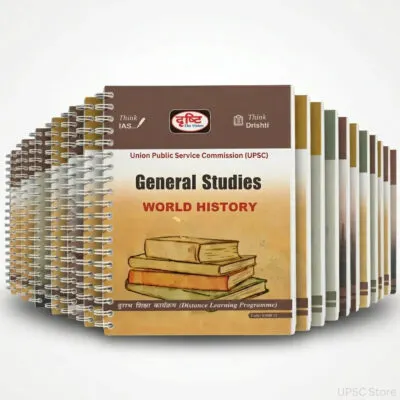
DIAS IAS Physics Optional booklets are available in spiral binding or book binding formats. Spiral-bound booklets open fully flat on a desk, allowing aspirants to write margin notes alongside printed text without the spine fighting back β particularly useful when working through derivations and numerical problems in Quantum Mechanics and Solid State Physics. Book-bound versions offer compact storage and a cleaner carry profile for those studying at libraries. All booklets feature a 300 GSM laminated cover that resists bending, moisture, and daily bag wear, keeping the set in presentation-ready condition throughout a full UPSC Mains preparation cycle.
Key Features and Study Design
These DIAS IAS Physics Optional notes are designed around the specific demands of UPSC Mains β where 500 marks ride on this single subject β and structured to support both first-read learning and last-minute targeted revision with equal effectiveness.
- Full Syllabus Coverage in Correct Sequence: All 8 Booklets follow the UPSC Physics Optional syllabus paper order exactly β Paper I topics in Booklets 1-5 and Paper II in Booklets 6-10 β eliminating the need to reorder or cross-reference between different sources during UPSC preparation.
- Derivation Templates for UPSC Answer Writing: Key derivations β Maxwell’s equations, SchrΓΆdinger equation, Planck’s radiation formula, Gamow tunnel theory β are structured as step-by-step templates that UPSC aspirants can adapt directly into Mains answers, improving both accuracy and time management in the exam hall.
- Integrated Numerical Examples: Physics Optional UPSC questions frequently include numerical problems carrying 10-15 marks. Each booklet incorporates solved numericals alongside theory, demonstrating how to set up, execute, and present numerical solutions at the standard expected in UPSC Mains evaluation.
- Diagrams Designed for Exam Reproduction: Every diagram β from crystal structures to wave function plots β is drawn at a scale and complexity that UPSC aspirants can reproduce freehand within two to three minutes in the examination, a critical skill for scoring presentation marks in Physics Optional Mains answers.
- Previous Year UPSC Question Alignment: Topic-end pointers throughout the booklets flag which UPSC previous year questions are answered by each section of content, allowing aspirants to self-test after each topic and measure their readiness for the actual UPSC Mains Physics Optional papers.
Shipping, Packaging and Delivery
Your DIAS IAS Physics Optional Notes 2025-26 set is packed with care to ensure all 8 Booklets arrive in perfect, exam-ready condition. Each set is shrink-wrapped as a unit to hold booklets together during transit, then placed inside a rigid corrugated cardboard shipping box with foam corner edge protectors. The outer box is taped on all seams and labelled with a fragile sticker. This multi-layer packaging system ensures no spine damage, page creasing, or moisture ingress during the 3-5 day pan India delivery period β a particularly important consideration during monsoon months when standard packaging often fails.
Once your order is dispatched, you receive a courier tracking ID via SMS and email so you can monitor delivery status at every stage. Delivery is completed within 3-5 business days to all major cities and most pin codes across India β from Delhi and Mumbai to Patna, Lucknow, Bhopal, Jaipur, and Bengaluru. For any query about your order, damaged item on arrival, or missing booklet, contact our UPSC Store team on WhatsApp at +91 70045 49563 β any missing or damaged booklet is replaced within 48 hours of your complaint, no questions asked.
Frequently Asked Questions (FAQ)
A: DIAS IAS Physics Optional notes 2025-26 cover the entire UPSC Physics Optional syllabus across both Paper I and Paper II in 10 structured booklets. For most aspirants, this set forms a strong core resource. Pairing these notes with standard reference texts like Irodov for numericals and Griffiths for Electrodynamics and Quantum Mechanics can strengthen your preparation further. Many UPSC qualifiers have used institute notes as their primary resource and supplemented selectively rather than attempting to study multiple complete textbooks alongside.
A: This set includes exactly 10 individual printed booklets covering the complete UPSC Physics Optional syllabus. Booklets 1 through 5 address Paper I topics β Mechanics, Waves and Acoustics, Optics, Electricity and Magnetism, and Thermal and Statistical Physics. Booklets 6 through 10 address Paper II β Quantum Mechanics (two booklets), Nuclear and Particle Physics, Solid State Physics and Electronics, and Spectroscopy and Modern Physics. Every booklet is individually bound and clearly labelled for easy identification.
A: The current selling price for the complete 8-booklet DIAS IAS Physics Optional Notes 2025-26 set is displayed on this product page and reflects genuine 2025-26 batch printed material. This price covers all 8 Booklets, premium 75 GSM paper printing, quality binding, and tracked pan India delivery within 3-5 business days. The price is significantly lower than the cost of attending classroom coaching and represents a high-value investment given Physics Optional accounts for 500 of UPSC Mains total marks.
A: Physics is considered a scoring optional for candidates with a strong science background β typically graduates or postgraduates in Physics or Engineering. The subject has a well-defined, static UPSC syllabus with objective answers, making it possible to score 280-330 out of 500 with focused preparation. Unlike humanities optionals, Physics answers are verifiable and marking is relatively consistent. The key challenge is covering the vast syllabus and practising numericals β both of which are addressed systematically in the DIAS IAS 8-booklet notes set for UPSC 2025-26.
A: The current DIAS IAS Physics Optional Notes 2025-26 set listed here is available in English medium only. Physics Optional content β equations, derivations, notation β is globally standardised in English, and most UPSC aspirants who take Physics Optional appear in English medium. If you require Hindi medium Physics Optional notes, please contact our team on WhatsApp at +91 70045 49563 and we will advise on available options from DIAS or other institutes that publish in Hindi medium.
A: Yes β the 8-booklet DIAS IAS Physics Optional Notes 2025-26 set is structured to cover every topic listed in the official UPSC Physics Optional syllabus for both Paper I and Paper II. Mechanics, Optics, Waves, Electricity and Magnetism, and Thermal Physics complete Paper I. Quantum Mechanics, Atomic Physics, Nuclear Physics, Solid State Physics, Electronics, and Spectroscopy complete Paper II. Before buying, you can cross-reference the booklet titles listed in the catalog section above against the official UPSC Physics Optional syllabus available on the UPSC website.
A: DIAS IAS has been a prominent name in Physics Optional coaching in Delhi’s Mukherjee Nagar area for many years. Their notes are known for clear derivation structures, relevant solved numericals, and syllabus-mapped content. Compared to other available options β such as Abhi Physics notes, Avadh Singhal notes, or Quantum IAS Physics handwritten notes β DIAS IAS printed notes offer a complete 8-booklet typed and printed format that is easier to read and annotate than handwritten alternatives, especially for aspirants who struggle with handwritten notes legibility.
A: DIAS IAS Physics Optional Notes 2025-26 provide a solid, UPSC-focused foundation across the entire syllabus. Many successful UPSC qualifiers have used a single good set of coaching notes as their primary resource and devoted the saved time to answer writing practice and previous year paper solving rather than reading multiple books. The realistic approach is to thoroughly master these 8 Booklets, solve 15-20 years of UPSC previous year Physics Optional questions, and practise numerical problems from standard references β this combination is more effective than accumulating multiple incomplete resources.
A: These booklets use 75 GSM ultra-white paper chosen for high opacity β multiple highlighter colors and gel pens work without bleed-through to the reverse side, ideal for color-coded revision. Physics Optional aspirants commonly use separate colours for definitions, derivation steps, numerical setups, and previous year question markers β all of which work cleanly on this paper. The anti-glare finish also reduces eye fatigue during extended study sessions covering mathematically dense content like Quantum Mechanics and Statistical Physics.
A: You can buy DIAS IAS Physics Optional Notes 2025-26 directly from this product page by clicking the Add to Cart or Buy Now button. After order confirmation, the set is dispatched from our Mukherjee Nagar, Delhi store within one business day. Pan India delivery takes 3-5 business days with full courier tracking. You will receive a tracking link via SMS and email. For expedited shipping queries or bulk orders, reach us on WhatsApp at +91 70045 49563 and our team will assist promptly.
A: Yes β this is the current 2025-26 batch of DIAS IAS Physics Optional Notes, sourced as fresh stock directly for this edition. The UPSC Physics Optional syllabus is largely static, but each new batch incorporates any updated question patterns, revised numerical examples, and content refinements based on recent UPSC Mains papers. You are buying the most current available printed notes from DIAS IAS for the 2025-26 UPSC examination cycle β not old or outdated stock from previous years.
A: Yes β DIAS IAS Physics Optional Notes 2025-26 are useful beyond UPSC for any state PSC examination that includes Physics as an optional subject. Candidates appearing in BPSC, UPPSC, MPPSC, RAS, and other state PSC examinations with Physics Optional will find significant syllabus overlap with UPSC Physics Optional content. Since UPSC sets the highest standard for Physics Optional preparation, aspirants who study from DIAS IAS UPSC-level notes are typically well above the level required for most state PSC Physics Optional papers.
Summary
| Specification | Value |
|---|---|
| Booklets | 10 Printed Booklets |
| Language | English Medium |
| Paper | 75 GSM Ultra-White |
| Binding | Spiral or Book Binding |
| Delivery | 3-5 Business Days Pan India |
| Also Useful For | BPSC, UPPSC, MPPSC, RAS, and All State PSC with Physics Optional |
Sourced and dispatched from our UPSC Store in Mukherjee Nagar, Delhi β the hub of India’s top UPSC coaching institutes. Buy DIAS IAS Physics Optional Notes 2025-26 today and receive your complete 8-booklet set with pan India delivery in 3-5 days.
Reference: Civil Services Examination
Customer Reviews 231
Booklet quality aur content dono premium level ke hain.
Diwani booklets hain, structured material bahut acchi tarah se organize hai.
Best physics optional notes. Worth every penny!
Best investment for my UPSC prep. Highly recommended!
Booklets mein kaafi detailed explanations hain. Kuch topics aur examples add hote to better hota.
Bilkul comprehensive notes, packing bhi maza tha aur delivery on time. 10/10 product.
Material is okayish for self-study, but supplementary reading zaroori padega. Price thoda zyada ho sakta tha.
Booklets quality bilkul sahi hain aur content bhi detailed hai.
Aspirants Also Bought
More from the same category
About DIAS IAS Physics Optional Notes 2025-26
DIAS IAS Physics Optional Notes 2025-26 is a highly recommended UPSC study material from DIAS IAS, specially designed for Physics Optional preparation. Available in English medium, this material is crafted to match the exact requirements of the UPSC Civil Services Examination syllabus β covering both Prelims and Mains comprehensively.
Product Details
- Institute: DIAS IAS
- Subject: Physics Optional
- Medium: English
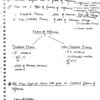
- Format: Handwritten Notes
- Delivery: Pan-India delivery in 3β5 working days
- Format: Original printed material, verified authentic
Why Buy from UPSC Store?
- β 100% Genuine Printed Material β Original printed notes, no photocopies or fake copies
- β Fast Delivery β Ships within 24 hours, arrives in 3β5 days pan-India
- β Secure Packaging β Bubble-wrapped and boxed to prevent damage in transit
- β Trusted by 10,000+ Aspirants β India's most reliable UPSC material marketplace
- β WhatsApp Support β Get expert guidance on material selection before ordering
Frequently Asked Questions
Yes, all products at UPSC Store are 100% genuine printed materials. We do not sell photocopies or fake copies.
Orders are dispatched within 24 hours and delivered across India in 3β5 working days via reputed courier partners.
Yes, we accept returns within 7 days if the product is damaged or incorrect. Check our refund policy for details.
We recommend pairing this with current affairs notes and a UPSC test series for comprehensive preparation. Browse more in Optional, Physics, UPSC.