

Sosin Anthropology Notes 2025-26
About Sosin Anthropology Compact 2025-26 Notes
The Sosin Anthropology Compact 2025-26 Notes is a printed UPSC study material set sold by UPSC Store — India’s trusted source for genuine, latest-batch civil services preparation books. This page covers full booklet details, syllabus coverage, pricing, shipping, and frequently asked questions. Useful for UPSC CSE, BPSC, UPPSC, MPPSC, RAS and other state PSC examinations.
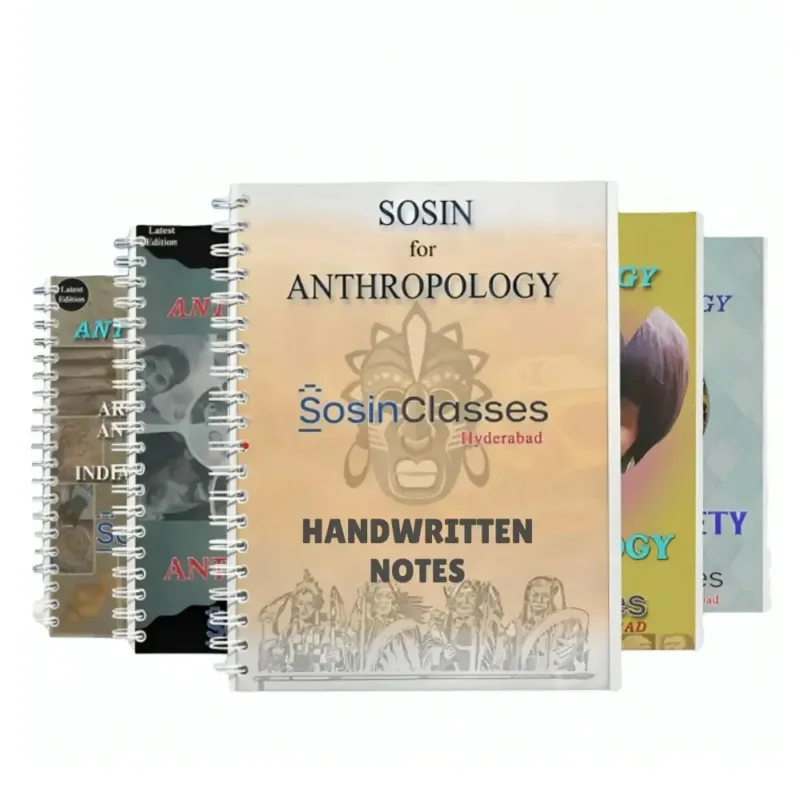
Sosin Classes Anthropology Handwritten Notes 2025-26 — 6 English Medium Printed Booklets for UPSC Mains Anthropology Optional
Related: Sosin notes · Anthropology Compact books
Product Overview
| Feature | Details |
|---|---|
| Booklets Count | 6 Individual Printed Booklets — Full UPSC Anthropology Optional Syllabus, Paper I and Paper II |
| Language | English Medium |
| Publisher | Sosin Classes, Hyderabad (Sosin Anthropology Handwritten Notes Series) |
| Edition | 2025-26 — Latest Genuine Batch |
| Condition | Brand New, Unmarked, Fresh Stock |
| Format | High-Quality Printed Booklets — Spiral or Book Binding |
| Paper Quality | 75 GSM Ultra-White — Highlighter Safe, Zero Bleed-Through |
| Shipping | Pan India Delivery in 4-7 business days — Tracked |
| Also Useful For | BPSC, UPPSC, MPPSC, RAS and All State PSC Anthropology Optional |
Complete Booklet Catalog
This 3-booklet set from Sosin Classes, Hyderabad, covers the entire UPSC Anthropology optional syllabus across Paper I and Paper II in structured, handwritten-style printed notes. Designed for UPSC Mains aspirants who prefer crisp, point-based handwritten content over dense textbooks, this set is ideal for first-time optional takers as well as repeat candidates aiming to revise efficiently.
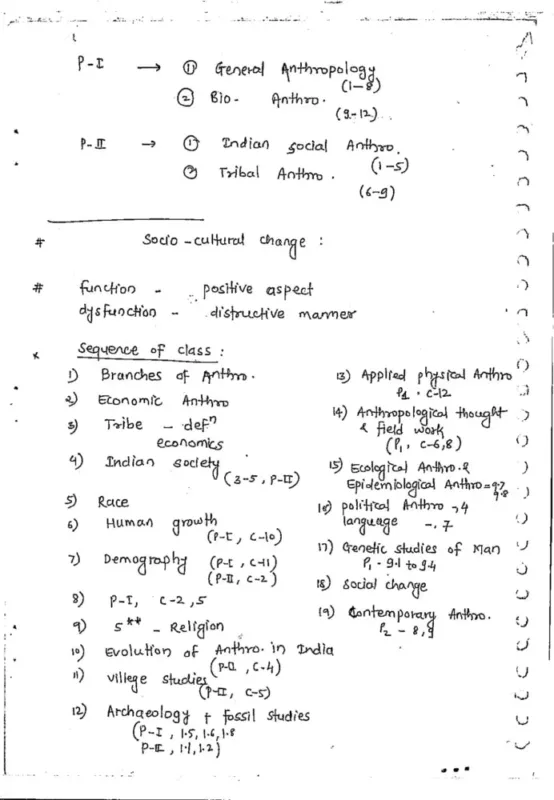
- Booklet 1: Foundations of Anthropology and Human Evolution — Covers the nature, scope and branches of Anthropology; relationship with other disciplines; human evolution including Dryopithecus, Ramapithecus, Australopithecus, Homo erectus, Homo sapiens; primate behaviour; fossil record; principles of evolution including natural selection, mutation and genetic drift relevant to UPSC Paper I.
- Booklet 2: Biological Anthropology and Human Genetics — Covers genetics and its relevance to Anthropology; Mendelian inheritance; chromosomal aberrations; molecular anthropology; race and racism; biological basis of race; human growth and development; somatoscopy; somatometry; dermatoglyphics; blood groups and their anthropological significance; epidemiology relevant to UPSC Paper I.
- Booklet 3: Archaeological Anthropology and Prehistoric Cultures — Covers Stone Age cultures in India and the world; Paleolithic, Mesolithic and Neolithic traditions; Bronze Age and Iron Age; archaeological methods and dating techniques; Indian prehistoric sites including Bhimbetka, Inamgaon, Mehrgarh; development of settled life; pastoralism; cultural diffusionism and cultural evolution theories as per UPSC Paper I syllabus.
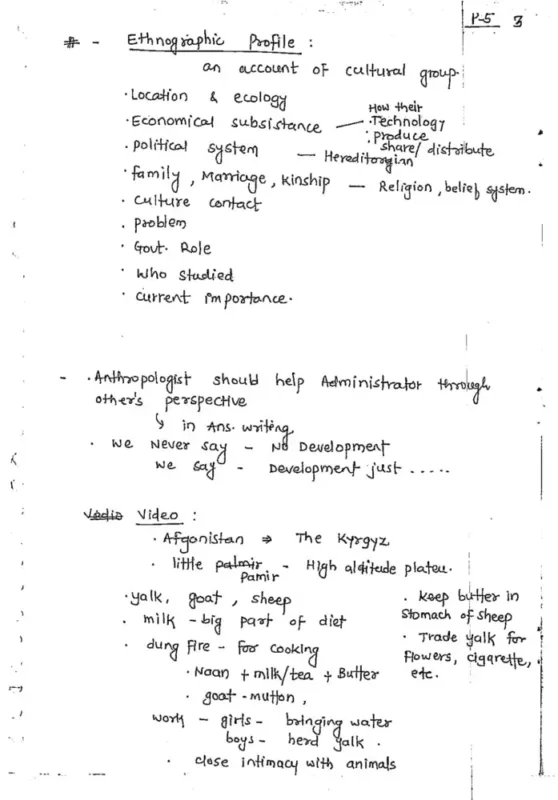
- Booklet 4: Social and Cultural Anthropology — Covers major theoretical perspectives including evolutionism, functionalism, structuralism, post-structuralism, symbolic anthropology; family, marriage and kinship systems; political organisation; economic anthropology; religion, magic and ritual; language and culture; ethnographic methods; fieldwork tradition; culture change and acculturation theories for UPSC Paper I.
- Booklet 5: Indian Anthropology and Tribal Studies — Covers anthropological study of Indian civilisation; concepts of great and little traditions; sacred complex; universalisation and parochialization; caste system; features and problems; tribe-caste continuum; scheduled tribes in India; tribal identity; issues of land alienation; forest rights; tribal movements; PESA Act; integration versus assimilation debate aligned with UPSC Paper II.
- Booklet 6: Applied Anthropology and Contemporary Issues — Covers applied anthropology in development projects; Anthropology and tribal welfare; Indian Renaissance and reform movements; constitutional provisions for SCs and STs; Anthropology of health and disease; nutritional anthropology; demographic anthropology; disaster management; ethnicity; indigenous knowledge systems; forensic anthropology; Anthropology and gender studies for UPSC Paper II.
In-Depth Content Breakdown: Booklet by Booklet
Booklet 1: Foundations of Anthropology and Human Evolution
This opening booklet establishes the conceptual base every UPSC Anthropology optional aspirant requires. It covers the meaning, scope and branches of Anthropology — physical, social, archaeological and applied — and maps out the subject’s relationship with biology, sociology, psychology and history. The booklet then moves into the evolution of man, discussing the major fossil primates including Dryopithecus and Ramapithecus through to Homo sapiens sapiens. UPSC Paper I questions on evolution are frequently framed around these milestones, and Sosin Classes has structured the content so that each stage is clearly demarcated with notes on cranial capacity, tool use and locomotion.
The second portion of this booklet deals with primate behaviour and its evolutionary implications, covering social organisation among non-human primates, foraging strategies and communication. The handwritten format uses flow diagrams and comparison tables that distinguish each hominin type side by side — a feature aspirants find valuable during rapid revision before UPSC Mains. Theories of evolution including Lamarckism, Darwinism and the synthetic theory are explained with point-by-point breakdowns. The booklet closes with a dedicated section on the principles of natural selection, mutation rates and genetic drift, all framed in the context of UPSC Paper I questions from previous years.
Booklet 2: Biological Anthropology and Human Genetics
Biological Anthropology is one of the most scoring yet conceptually demanding segments of the UPSC Anthropology optional, and this booklet addresses it with structured clarity. It opens with the fundamentals of Mendelian genetics — laws of segregation, independent assortment and their exceptions — before moving into population genetics, Hardy-Weinberg equilibrium and the forces that alter allele frequencies in human populations. The application of genetics to Anthropology, including molecular markers used to trace human migration routes, is covered with diagrams. Blood group systems — ABO, Rh, MN — are discussed in their anthropological context: how they vary across populations and what they reveal about ancestral relationships relevant to UPSC Paper I.
The booklet further covers human growth and development across life stages, somatometry techniques, dermatoglyphics and their significance in identifying biological affinities and forensic applications. The section on race and racism is presented as a conceptual critique — addressing the biological non-validity of race while explaining how anthropologists have historically approached race classification. Chromosomal aberrations and their phenotypic consequences are listed in a tabular format for quick revision. The final portion covers disease ecology and epidemiology as studied through an anthropological lens, including nutrition-related deficiency diseases frequently asked in UPSC Paper I multiple-choice and descriptive questions.
Booklet 3: Archaeological Anthropology and Prehistoric Cultures
This booklet maps the entire prehistoric timeline relevant to the UPSC Anthropology optional syllabus. It begins with the concept of culture and the culture-area approach before detailing Lower Paleolithic tool traditions — Oldowan and Acheulian — Middle Paleolithic Mousterian industry, and Upper Paleolithic blade cultures. The Indian prehistoric sequence receives dedicated coverage, with sites like Bhimbetka rock shelters, Hunsgi-Baichbal valley, Attirampakkam and Inamgaon discussed in terms of their cultural assemblages and what they reveal about early human settlement patterns. UPSC questions regularly ask candidates to place Indian prehistoric cultures in their global context, and this booklet provides exactly that framework.
The Mesolithic and Neolithic transitions are treated with attention to subsistence shifts — from hunting-gathering to settled agriculture and pastoralism. Mehrgarh’s significance as one of South Asia’s earliest Neolithic sites is highlighted with a timeline. The booklet covers archaeological dating methods including radiocarbon dating, thermoluminescence, dendrochronology and potassium-argon dating, formatted as a comparative table — a revision-friendly presentation. Cultural diffusionism theories by Elliot Smith, Perry and Graebner are contrasted with independent invention and parallel evolution arguments. The Bronze Age Harappan civilisation and its anthropological interpretation conclude this booklet, aligning with UPSC Paper I’s archaeological Anthropology segment.
Booklet 4: Social and Cultural Anthropology
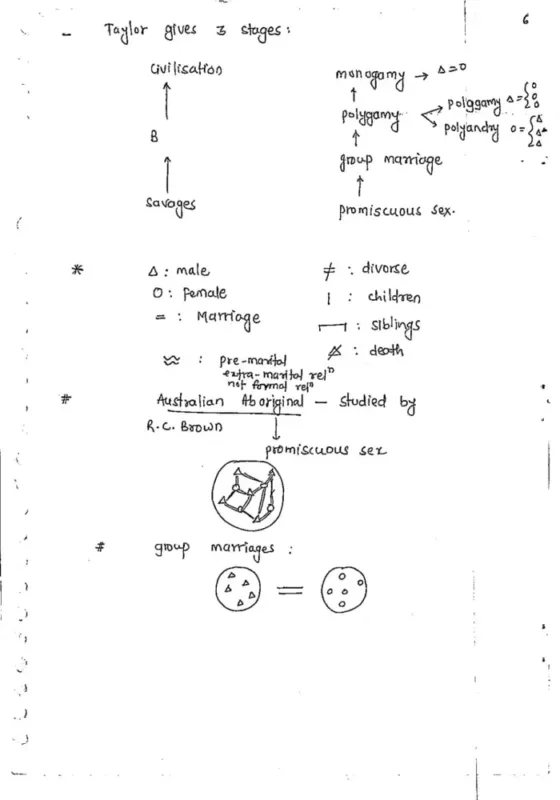
Social and Cultural Anthropology forms a substantial portion of UPSC Anthropology Paper I, and this booklet is among the most content-dense in the Sosin set. It opens with a history of anthropological thought — from classical evolutionism through Morgan and Tylor to Boasian historical particularism, Malinowskian functionalism, Radcliffe-Brown’s structural-functionalism, Lévi-Strauss’s structuralism and beyond into post-modern critiques. Each school is presented with key theorists, core concepts and critiques — formatted as structured notes that are easy to reproduce in UPSC answer sheets. Marriage systems — cross-cousin marriage, levirate, sororate, polyandry and polygyny — are explained with tribal examples from India and the world.
Kinship terminologies — Eskimo, Hawaiian, Iroquois, Crow, Omaha and Sudanese — are presented alongside lineage and descent systems in a diagram-heavy format that UPSC aspirants can directly reference for descriptive answers. The section on religion covers animism, totemism, shamanism, mana and taboo, with ethnographic examples. Economic anthropology covers reciprocity, redistribution and market exchange as defined by Polanyi and Mauss. The fieldwork tradition — from Malinowski in the Trobriands to Indian ethnographies — is discussed with methodological notes on participant observation, interview techniques and ethics in fieldwork. Culture change theories including acculturation, assimilation, syncretism and cultural renaissance close this booklet.
Booklet 5: Indian Anthropology and Tribal Studies
UPSC Anthropology Paper II is dominated by Indian Anthropology and tribal issues, and this booklet is the core resource for that portion. It opens with the anthropological approach to studying Indian civilisation, covering Redfield’s concepts of great tradition and little tradition and how Marriott and Singer applied the sacred complex and universalisation-parochialization models to Indian settings. The varna and jati system is analysed from structural, functional and historical perspectives, with Ambedkar’s and Ghurye’s contrasting interpretations presented side by side. The tribe-caste continuum debate — involving scholars like Bailey, Beteille and Fürer-Haimendorf — is a frequently asked UPSC topic and is covered with notable examples.
Scheduled tribe distribution across India is mapped by region with population data, language families and cultural characteristics. Issues affecting tribal communities — land alienation, bonded labour, displacement due to development projects, loss of forest rights — are discussed with constitutional provisions including the Fifth and Sixth Schedules and the PESA Act 1996. Major tribal movements — Santhal Rebellion, Munda Ulgulan, Naxal influence areas — are covered in their historical and contemporary dimensions. Integration versus isolation versus assimilation policy debates are presented with the positions of Nehru, Elwin and Ghurye. This booklet directly addresses the most UPSC Mains-relevant aspects of Paper II.
Booklet 6: Applied Anthropology and Contemporary Issues
The final booklet in the Sosin Anthropology 2025-26 set covers applied and contemporary dimensions of the subject that have become increasingly prominent in recent UPSC Mains papers. Applied Anthropology’s role in development projects — dam construction, tribal rehabilitation, health interventions — is examined with field-based examples. The Indian Renaissance and reform movements are covered from an anthropological standpoint, including contributions of thinkers like Ram Mohan Roy, Vivekananda and Phule in reshaping Indian social structures. Constitutional safeguards for Scheduled Castes and Scheduled Tribes — Articles 15, 16, 17, 46, 244, 275 — are listed with explanatory notes for quick recall during UPSC Mains.
Medical and nutritional Anthropology sections cover disease patterns among tribal populations, indigenous medical systems, WHO definitions of health and anthropological critiques of biomedical models. Demographic Anthropology touches on fertility, mortality, migration and their cultural determinants — topics increasingly appearing in UPSC Paper II. Forensic Anthropology covers skeletal identification, age and sex determination from skeletal remains, DNA fingerprinting and bite mark analysis. A dedicated section on gender, feminist anthropology and women’s issues in tribal societies rounds off the booklet. Indigenous knowledge systems and their relevance to sustainable development are discussed with specific Indian examples — a recurring theme in recent UPSC optional papers.
Physical Construction and Quality Standards
Every booklet in the Sosin Anthropology 2025-26 set is produced to a standard that supports long-duration study sessions demanded by UPSC preparation. From paper selection to binding type, each element is chosen to hold up through months of repeated use, highlighting and margin annotation.
Paper Quality: 75 GSM Anti-Glare White Paper
The 75 GSM ultra-white paper used in these booklets is selected specifically for UPSC study material. The high opacity of this paper grade ensures that text printed on the reverse side does not show through, keeping each page visually clean. Aspirants who use multiple highlighter colours for colour-coded revision — a common technique for UPSC Anthropology optional — will find that fluorescent yellow, green, orange and pink highlighters all perform without bleed-through. The anti-glare surface reduces eye fatigue during extended reading sessions of 6 to 8 hours, which is routine for serious UPSC optional preparation.
Printing Technology: High-Resolution Laser Printing
All six booklets are produced using high-resolution laser printing technology, which delivers consistently sharp text and clearly reproduced diagrams. Sosin Classes’ notes include comparison tables, flow diagrams of evolutionary timelines, kinship charts and anatomical sketches — all of which require printing precision to remain legible at the detail level needed for UPSC answer writing. Laser toner is permanent and smudge-proof, meaning pages do not smear when hands rest on them during writing practice. Flowcharts showing cultural evolution theories or tribal movement timelines are rendered with line clarity that rivals commercially published books, making these printed notes as functional as any standard textbook.
Binding and Durability
The booklets are available in spiral or book binding depending on stock batch. Spiral binding allows each booklet to open completely flat on a study desk, which is particularly useful when copying diagrams or writing practice answers alongside the notes. The 300 GSM laminated cover protects the interior pages during daily transport in bags and prevents corner wear over the months-long UPSC Mains preparation cycle. Book-bound copies are more compact for shelf storage and for candidates who prefer not to carry spiral-bound material to examination halls for last-day revision. Either binding type sustains the full preparation season without page loss or spine damage.
Key Features and Study Design
Sosin Classes has designed these Anthropology notes specifically around the demands of UPSC Mains optional preparation — the content flow, presentation style and revision aids all reflect years of coaching experience in the subject from Hyderabad.
- Handwritten-Style Presentation: The notes replicate the structured handwritten style preferred by UPSC toppers — crisp point-form writing, underlined keywords and margin notes — making it easier for aspirants to reproduce answers in the same format under exam conditions.
- Full Syllabus Mapping: All six booklets together cover the complete UPSC Anthropology optional syllabus for both Paper I and Paper II as prescribed by the Union Public Service Commission, leaving no unit unaddressed for Mains preparation.
- Diagram and Table Integration: Complex topics like hominin evolution, kinship terminologies and blood group distributions are presented using labeled diagrams and comparison tables, reducing the time needed to build visual memory for UPSC answer writing.
- Answer-Writing Ready Format: Content is structured as numbered points and short paragraphs aligned to UPSC’s 10-mark and 15-mark question formats, making it straightforward to directly adapt note content into graded answers during Mains.
- Updated for 2025-26 Exam Cycle: The 2025-26 edition reflects the most recent UPSC question trends, including contemporary tribal issues, applied Anthropology in policy contexts and recent archaeological findings relevant to Indian prehistory covered in Paper II.
Shipping, Packaging and Delivery
Each order of Sosin Anthropology 2025-26 notes is packed to ensure all 3 Booklets arrive in the exact brand-new, unmarked condition they leave the warehouse. The set is first individually shrink-wrapped to protect covers from moisture and friction. The shrink-wrapped bundle is then placed inside a corrugated cardboard box with cardboard edge protectors on all six faces to prevent corner crushing during transit. Bubble wrap lines the interior. The outer box is sealed with reinforced tape and labelled with a fragile sticker. This multi-layer packaging system means the booklets survive courier handling across all pin codes in India without bending, water damage or cover scuffing.
Delivery across India is completed within 3 to 5 business days from the date of order confirmation. A tracking ID is shared via email and WhatsApp immediately after dispatch so you can monitor your shipment in real time. For any queries about your order — tracking, delayed delivery or missing booklets — WhatsApp our support team at +91 70045 49563. If any booklet in your set arrives damaged or is found missing, we replace it within 48 hours of receiving a photograph of the issue. We serve buyers in Delhi, Mumbai, Chennai, Kolkata, Hyderabad, Bengaluru, Patna, Lucknow, Jaipur, Bhopal and every other city and town across India.
Frequently Asked Questions (FAQ)
A: Yes — Sosin Classes, Hyderabad, is a well-regarded name among UPSC Anthropology optional aspirants. The handwritten-style notes are structured for Mains answer writing, covering both Paper I and Paper II in a format that allows candidates to directly adapt the content into 10-mark and 15-mark answers. Many UPSC qualifiers who took Anthropology as their optional have used Sosin notes as their primary study resource, citing the point-based format and integrated diagrams as key advantages over standard textbooks during revision.
A: This set includes 6 printed booklets. The six booklets together cover the complete UPSC Anthropology optional syllabus — from human evolution, biological Anthropology and prehistoric cultures in Paper I to Indian Anthropology, tribal studies and applied Anthropology in Paper II. Each booklet is a standalone unit focused on a defined segment of the syllabus, making it easy to carry individual booklets for targeted revision without needing to transport the full set at once.
A: Yes. The 3-booklet set available here is entirely in English medium. Sosin Classes produces its Anthropology notes in English, making this set suitable for candidates appearing in the English medium UPSC Mains examination. The language used is clear and accessible — technical terms are explained in context, and the point-based writing style reflects the kind of English expected in UPSC answer sheets. If you are looking for Hindi medium Anthropology notes, please check our other listings.
A: These booklets use 75 GSM ultra-white paper chosen for high opacity — multiple highlighter colours and gel pens work without bleed-through to the reverse side, ideal for colour-coded revision. Fluorescent yellow, green, orange and pink highlighters all perform without any ink seeping to the back of the page. The anti-glare surface also reduces eye fatigue during the long study sessions that UPSC Anthropology optional preparation demands.
A: Yes. All 3 Booklets together address the complete UPSC Anthropology optional syllabus as prescribed by the Union Public Service Commission for both Paper I and Paper II. Paper I topics including human evolution, biological Anthropology, genetics, prehistoric archaeology and social-cultural Anthropology are covered across Booklets 1 to 4. Paper II topics including Indian Anthropology, scheduled tribes, tribal movements, applied Anthropology and contemporary issues are addressed in Booklets 5 and 6. No major UPSC syllabus unit is omitted.
A: Yes. The edition available here is the 2025-26 batch, which is the latest update from Sosin Classes. It incorporates recent UPSC question trends, including applied Anthropology in development policy, contemporary tribal rights issues under PESA and Forest Rights Act, recent findings from Indian archaeological sites and gender studies in Anthropology — all topics that have featured more prominently in UPSC Mains Anthropology optional in recent years. You receive fresh stock printed from the latest 2025-26 batch.
A: Sosin Classes and Braintree are both popular choices for UPSC Anthropology optional. Sosin’s notes are known for their handwritten-style point-based format that directly mirrors UPSC answer-writing structure, with strong coverage of Indian Anthropology and tribal studies in Paper II. The diagram integration for topics like hominin evolution and kinship terminologies is a noted strength. Braintree notes are also widely used. Many UPSC aspirants use Sosin notes as their primary resource and cross-reference with Braintree for supplementary reading — both serve different study preferences.
A: Yes — you can buy Sosin Anthropology handwritten notes online directly from this store. We are a UPSC study material store based in Mukherjee Nagar, Delhi, and we stock genuine 2025-26 batch Sosin Anthropology booklets. Simply add the set to your cart and place your order. Pan India delivery is completed in 3 to 5 business days with a tracking ID shared after dispatch. WhatsApp +91 70045 49563 if you need help with your order before or after purchase.
A: These are high-quality laser-printed booklets — not photocopies. The printing is done using professional laser printing technology which produces sharp, permanently bonded text and clearly legible diagrams. Unlike photocopy-quality reproduction which can appear grey or faint, these booklets have strong contrast, consistent line weights and clean white backgrounds. The result is a reading experience comparable to commercially published books, which matters during the 6 to 8 hours of daily study typical of serious UPSC Anthropology optional preparation.
A: Yes. While this set is primarily designed for UPSC Mains Anthropology optional, it is equally useful for BPSC, UPPSC, MPPSC, RAS and other State PSC examinations that offer Anthropology as an optional subject. The syllabus overlap between UPSC and most state PSCs in Anthropology is significant — particularly in Indian Anthropology, tribal studies, social-cultural Anthropology and applied Anthropology. State PSC candidates will find these notes cover the core content needed for their examinations without requiring a separate set of notes.
A: Orders are typically dispatched within 1 business day of confirmation. Delivery across India takes 3 to 5 business days via tracked courier. You will receive a tracking ID on your registered email and WhatsApp number as soon as the package is dispatched. Deliveries to metro cities like Delhi, Mumbai, Bengaluru, Hyderabad and Chennai generally arrive within 3 business days. For remote PIN codes, delivery may take up to 5 business days. For urgent orders or bulk purchases, WhatsApp us at +91 70045 49563 before placing your order.
A: We have a straightforward resolution process for damaged or missing booklets. If any of the 3 Booklets in your Sosin Anthropology set arrives damaged or is found missing from the package, photograph the issue and send it to our WhatsApp number +91 70045 49563. We will dispatch a replacement booklet within 48 hours of receiving your message. Our multi-layer packaging system — shrink wrap, bubble wrap, corrugated box with edge protectors — is designed to prevent transit damage, but we stand behind every order with this replacement guarantee.
Summary
| Specification | Value |
|---|---|
| Booklets | 6 Printed Booklets |
| Language | English Medium |
| Paper | 75 GSM Ultra-White |
| Binding | Spiral or Book Binding |
| Delivery | 4-7 business days Pan India |
| Also Useful For | BPSC, UPPSC, MPPSC, RAS and All State PSC Anthropology Optional |
Sold by your trusted UPSC study material store in Mukherjee Nagar, Delhi — buy Sosin Anthropology 2025-26 notes online today and receive your complete 3-booklet set with pan India delivery in 4-7 days.
Reference: Civil Services Examination
Customer Reviews 373
Bilkul mast material hai bhai. Handwriting saaf aur concepts crystal clear hain.
Content to good hai but presentation could be better.
Booklets are crisp and well-organized. Content coverage is solid for Anthropology.
Useful for UPSC anthropology preparation.
Content relevant hai, booklets well organized hain.
Material is okay for basics but explanations could be more detailed. Zyada comprehensive notes expect kar raha tha.
Handwritten format mein padhai zyada effective ho jaati hai, great product.
Notes clear hain, booklets acche se package the.
Aspirants Also Bought
More from the same category
Vision IAS Social Justice Notes 2025-26 | 2 Booklets | Hindi Medium | UPSC Study Material
Vision IAS Government Schemes PT 365 2025-26 | 2 Booklets | English Medium | UPSC Study Material
SS Pandey Sociology Optional Notes 2025-26 | 4 Booklets | Hindi Medium | UPSC Study Material
Vision IAS Ethics Mains 365 2025-26 | 1 Booklet | English Medium | UPSC Study Material
Vision IAS Hindi Medium GS Complete Printed Notes 2025-26 | 46 Booklets
Vajiram & Ravi Geography Optional Notes 2025-26 | 11 Booklets | English Medium | UPSC Study Material
Vajiram & Ravi General Science Chemistry Notes 2025-26 | 1 Booklet | English Medium | UPSC Study Material
Vision IAS Art and Culture PT 365 Notes 2025-26 | 1 Booklet | English Medium | UPSC Study Material
Vision IAS Economy PT 365 2025-26 | 1 Booklet | English Medium | UPSC Study Material
Piyush Chaubey PSIR Notes | 3 Booklets | English Medium | UPSC Study Material
Parmar SSC GK History 4.0 Hindi Notes 2026-27 | 1 Booklet | Hindi Medium | UPSC Study Material

Vision IAS Social Justice GS Paper II | English Medium | UPSC Study Material
About Sosin Anthropology Notes 2025-26
Sosin Anthropology Notes 2025-26 is a highly recommended UPSC study material from Sosin Classes, specially designed for Anthropology preparation. Available in English medium, this material is crafted to match the exact requirements of the UPSC Civil Services Examination syllabus — covering both Prelims and Mains comprehensively.
Product Details
- Institute: Sosin Classes
- Subject: Anthropology
- Medium: English
- Format: Handwritten
- Delivery: Pan-India delivery in 4–7 working days
- Format: Original printed material, verified authentic
Why Buy from UPSC Store?
- ✅ 100% Genuine Printed Material — Original printed notes, no photocopies or fake copies
- ✅ Fast Delivery — Ships within 24 hours, arrives in 4–7 days pan-India
- ✅ Secure Packaging — Bubble-wrapped and boxed to prevent damage in transit
- ✅ Trusted by 10,000+ Aspirants — India's most reliable UPSC material marketplace
- ✅ WhatsApp Support — Get expert guidance on material selection before ordering
Frequently Asked Questions
Yes, all products at UPSC Store are 100% genuine printed materials. We do not sell photocopies or fake copies.
Orders are dispatched within 24 hours and delivered across India in 4–7 working days via reputed courier partners.
Yes, we accept returns within 7 days if the product is damaged or incorrect. Check our refund policy for details.
We recommend pairing this with current affairs notes and a UPSC test series for comprehensive preparation. Browse more in Anthropology, Optional, UPSC.