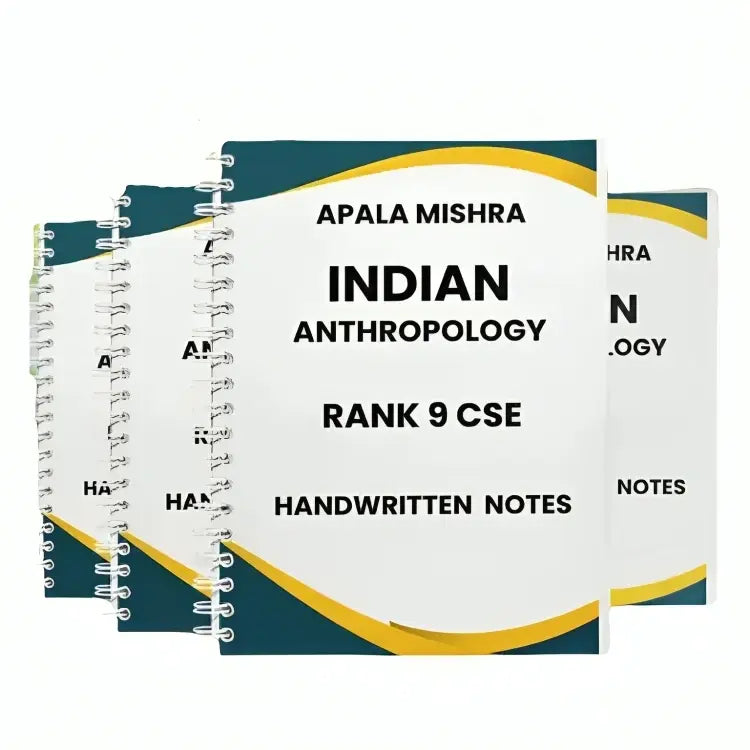


Apala Mishra Anthropology Notes 2024-25
About Apala Mishra Anthropology Notes 2024-25
The Apala Mishra Anthropology Notes 2024-25 is a printed UPSC study material set sold by UPSC Store β India’s trusted source for genuine, latest-batch civil services preparation books. This page covers full booklet details, syllabus coverage, pricing, shipping, and frequently asked questions. Useful for UPSC CSE, BPSC, UPPSC, MPPSC, RAS and other state PSC examinations.
Apala Mishra Anthropology Notes 2024-25 β 7 English Medium Printed Booklets for UPSC Anthropology Optional
Related: Anthropology optional Β· Optional subjects
Product Overview
| Feature | Details |
|---|---|
| Booklets Count | 7 Individual Printed Booklets β Full UPSC Anthropology Optional Syllabus (Paper I + Paper II) |
| Language | English Medium |
| Publisher | Apala Mishra β Independent Faculty (Rank 9, CSE) |
| Edition | 2024-25 β Latest Genuine Batch |
| Condition | Brand New, Unmarked, Fresh Stock |
| Format | High-Quality Printed Booklets β Spiral or Book Binding |
| Paper Quality | 75 GSM Ultra-White β Highlighter Safe, Zero Bleed-Through |
| Shipping | Pan India Delivery in 3-5 Business Days β Tracked |
| Also Useful For | BPSC, UPPSC, MPPSC, RAS and all State PSC Anthropology Optional candidates |
Complete Booklet Catalog
This 4-booklet set by Apala Mishra β AIR 9, Civil Services Examination β covers the entire UPSC Anthropology optional syllabus across both Paper I and Paper II in structured, topper-verified English medium printed notes. Designed for serious UPSC aspirants who want organised, exam-focused content without sifting through multiple reference books, this set is the go-to study material for anthropology optional preparation.
- Booklet 1: Meaning, Scope and Development of Anthropology β Covers the definition and branches of anthropology β physical, social-cultural, archaeological, and linguistic; relationship with other disciplines; history of anthropological thought; contributions of key theorists including Tylor, Morgan, Boas, Malinowski, Radcliffe-Brown, Evans-Pritchard, and LΓ©vi-Strauss; schools of thought including evolutionism, diffusionism, functionalism, and structuralism.
- Booklet 2: Human Evolution and Biological Anthropology β Covers biological basis of life; cell structure; DNA, RNA, protein synthesis; principles of heredity; Mendelian genetics; chromosomal theory; mutations; human evolution β Dryopithecus, Ramapithecus, Australopithecus, Homo habilis, Homo erectus, Neanderthal, Cro-Magnon, and modern Homo sapiens; fossil evidence and evolutionary mechanisms.
- Booklet 3: Concept of Race, Human Variation and Applied Biological Anthropology β Racial classification systems; biological basis of racial variation; ABO, Rh, MN blood group systems; skin colour genetics; sickle cell anaemia and its anthropological significance; forensic anthropology; growth and development; aging; human adaptability in diverse ecological environments including high altitude, arid zones, and cold climates.
- Booklet 4: Social and Cultural Anthropology β Concepts and Institutions β Marriage: types, rules, and theories; family: structure, functions, types; kinship: descent, alliance, terminology systems; political organisation: band, tribe, chiefdom, state; economic anthropology: subsistence patterns, exchange, reciprocity, redistribution; religion, magic, witchcraft; ritual and belief systems; social stratification; caste and class from anthropological perspectives.
- Booklet 5: Prehistoric Archaeology and Indian Prehistoric Cultures β Stone Age cultures: Palaeolithic, Mesolithic, Neolithic; Bronze Age and Iron Age; tools and technology; cave paintings and rock art; major prehistoric sites in India; Indus Valley Civilisation; cultural continuity and change; ethnoarchaeology; archaeological methods and dating techniques including radiocarbon, potassium-argon, and dendrochronology.
- Booklet 6: Indian Anthropology β Tribes, Ethnography and Socio-Cultural Change β Concept of tribe in India; tribal demography and distribution; major tribal communities β Gonds, Santhals, Mundas, Bhils, Nagas, and others; problems of tribal communities: land alienation, indebtedness, displacement; tribal movements; integration vs. isolation debate; Nehru’s Panchsheel; constitutional safeguards for Scheduled Tribes; ethnographic studies of Indian tribes; peasant studies.
- Booklet 7: Applied Anthropology, Development and Contemporary Issues β Role of anthropology in tribal and rural development; research methods in anthropology: fieldwork traditions, participant observation, interview techniques; applied anthropology in health, nutrition, and education; Anthropological Survey of India; ethnicity, nationalism, and identity; gender and feminist anthropology; globalisation and cultural change; human rights from an anthropological perspective; UPSC-specific case studies and answer-writing strategies.
In-Depth Content Breakdown: Booklet by Booklet
Booklet 1: Meaning, Scope and Development of Anthropology
This opening booklet lays the conceptual groundwork that every UPSC Anthropology optional aspirant needs to master first. It covers the definition, branches, and scope of anthropology, establishing its relationship with sociology, psychology, biology, history, and economics. The booklet traces the intellectual history of anthropological thought β from 19th-century evolutionists like Tylor and Morgan to the structural-functionalists of the 20th century β providing the theoretical backbone that UPSC Paper I questions frequently probe. Getting this foundation right is critical to scoring well in both papers.
What distinguishes this booklet is Apala Mishra’s ability to distil dense theoretical content into exam-ready notes. Key theorists are presented in comparative tables β their schools, methods, major works, and contributions β making revision fast and effective. The booklet includes structured summaries of evolutionism, diffusionism, historical particularism, functionalism, structural-functionalism, structuralism, and culture and personality school. Special attention is given to how these schools are frequently pitted against each other in UPSC questions, with model answer frameworks provided for commonly repeated exam questions.
Booklet 2: Human Evolution and Biological Anthropology
Biological anthropology forms a substantial portion of UPSC Anthropology Paper I, and this booklet addresses it with the depth the exam demands. It begins with the molecular biology of heredity β cell structure, DNA replication, RNA, protein synthesis β and builds to Mendelian genetics, chromosomal theory, Hardy-Weinberg equilibrium, and the genetic mechanisms driving evolution. The hominid evolutionary sequence is covered in detail: Dryopithecus through Australopithecus to modern Homo sapiens, with fossil evidence, cranial capacities, tool traditions, and geographic distribution clearly noted for each stage.
The booklet uses annotated diagrams and labelled illustrations of skull morphology, dentition patterns, and skeletal features to help aspirants answer diagram-based questions in the UPSC optional paper. The evolutionary timeline is presented as a clean comparative chart β a format proven effective for quick revision before the exam. Genetic drift, gene flow, natural selection, and mutation are explained in accessible language without losing scientific accuracy, and the content is mapped directly to the UPSC syllabus to ensure nothing extraneous is included and nothing essential is missed.
Booklet 3: Concept of Race, Human Variation and Applied Biological Anthropology
This booklet tackles one of the most nuanced areas of Anthropology Paper I β the concept of race, human biological variation, and its misuse in pseudo-scientific racism. Apala Mishra’s notes deconstruct racial classification systems (Deniker, Hooton, Coon) and present the modern scientific consensus that race is a social construct with limited biological validity. Blood group distribution (ABO, Rh, MN systems), dermatoglyphics, skin colour genetics, and their geographic variation are covered in detail, as these topics appear repeatedly in UPSC mains questions and carry significant marks.
A particularly valuable portion of this booklet deals with human adaptability in extreme environments β high-altitude acclimatisation among Andean and Tibetan populations, thermal adaptation in Arctic and desert-dwelling groups, and nutritional adaptation. Applied biological anthropology topics including forensic anthropology, growth and developmental norms, ageing, and the anthropology of disease are covered in the final section. Sickle cell anaemia is treated as a model case study in the interaction of genetics, environment, and natural selection β a topic that has appeared in multiple UPSC optional papers and is frequently mishandled by unprepared candidates.
Booklet 4: Social and Cultural Anthropology β Concepts and Institutions
Social and cultural anthropology concepts form the core of UPSC Anthropology Paper I’s second half, and this booklet is among the most content-rich in the set. Marriage is covered across all its dimensions β rules (endogamy, exogamy, hypergamy, levirate, sororate), forms (monogamy, polygyny, polyandry, group marriage), theories (alliance theory, exchange theory), and cross-cultural case studies. Family types β nuclear, extended, joint β are examined with structural and functional perspectives. Kinship systems β including descent theory (patrilineal, matrilineal, bilateral, double descent) and alliance theory β are presented with detailed terminology charts.
Political organisation is structured along the classic band-tribe-chiefdom-state continuum with ethnographic examples drawn from classic studies (Evans-Pritchard’s Nuer, Fortes and Evans-Pritchard’s African Political Systems). Economic anthropology covers substantivist versus formalist debates, Mauss on gift exchange, Malinowski’s Kula ring, and Polanyi’s reciprocity-redistribution-market framework. Religion, magic, witchcraft, and ritual are addressed through Frazer, Tylor, Durkheim, Weber, Turner, and Geertz β with UPSC-focused summaries that clarify each scholar’s distinct contribution to the anthropology of religion.
Booklet 5: Prehistoric Archaeology and Indian Prehistoric Cultures
Prehistoric archaeology is an area where many UPSC Anthropology optional candidates struggle due to the volume of factual content β tool types, site names, cultural periods, and dating methods. This booklet organises that content systematically. The Stone Age sequence β Lower Palaeolithic, Middle Palaeolithic, Upper Palaeolithic, Mesolithic, Neolithic β is covered with tool industries (Acheulian, Mousterian, Aurignacian), associated hominin species, and representative sites. The Chalcolithic and Bronze Age cultures, culminating in the Indus Valley Civilisation, are examined with archaeological evidence and cultural interpretations.
Indian prehistoric cultures receive dedicated treatment: Soanian and Acheulian industries in the Siwalik Hills, Mesolithic cultures of Central India, Neolithic cultures of South India and Kashmir, Chalcolithic cultures of Maharashtra and Madhya Pradesh, and Iron Age megalithic cultures of the Deccan. Scientific dating methods β radiocarbon (C14), potassium-argon, thermoluminescence, dendrochronology, and pollen analysis β are explained with their principles, applications, and limitations. Rock art sites including Bhimbetka are covered in detail. The booklet includes site-location maps and a master chronology table that is particularly useful during last-week revision.
Booklet 6: Indian Anthropology β Tribes, Ethnography and Socio-Cultural Change
UPSC Anthropology Paper II is substantially about Indian society, tribes, and socio-cultural change, and this booklet provides the most directly exam-applicable content in the entire set. The concept of tribe in India is examined critically β constitutional definition, sociological definitions, and the ongoing academic debate about tribe versus caste versus peasant. Tribal demography and geographic distribution are covered region by region, with major tribes β Gonds, Santhals, Mundas, Bhils, Nagas, Todas, Andamanese, Chenchus β examined through ethnographic case studies drawn from classic fieldwork accounts.
Problems facing tribal communities are addressed with the analytical depth UPSC demands: land alienation and the Forest Rights Act 2006, displacement by development projects, bonded labour, educational deprivation, and health crises. Tribal movements β Santhal Hul, Munda Ulgulan, Naxalism β are examined as responses to these structural problems. The integration versus isolation debate is anchored in the competing positions of Verrier Elwin and G.S. Ghurye, which is a perennial UPSC question topic. Constitutional provisions under the Fifth and Sixth Schedules, Panchayats (Extension to Scheduled Areas) Act, and the role of NCST are covered in UPSC-answer-ready format.
Booklet 7: Applied Anthropology, Development and Contemporary Issues
The final booklet addresses applied dimensions of anthropology and contemporary issues β an area the UPSC has increasingly emphasised in recent years. The role of anthropology in development is examined through the lens of tribal development programmes, Integrated Tribal Development Projects, and critical evaluations of mainstream development models. Research methods β fieldwork, participant observation, interviewing, genealogical method, case study approach, and rapid ethnographic assessment β are covered in sufficient depth to answer methodology-based questions that appear in Paper I as well.
Contemporary issues covered include ethnicity and identity politics, gender and feminist anthropology, globalisation’s impact on tribal and rural cultures, human rights and anthropological ethics, and the anthropological perspective on environmental degradation. The Anthropological Survey of India and its People of India project are treated as standalone topics. Apala Mishra has included answer-writing tips, model 150-word and 250-word answers, and a list of high-probability questions based on the past 10 years of UPSC optional papers. This makes Booklet 7 not just a content resource but a strategic exam-preparation tool for the final weeks before the Mains examination.
Physical Construction and Quality Standards
These printed booklets are manufactured to withstand the demands of serious UPSC Anthropology optional preparation β daily handling, multi-colour annotation, repeated revision cycles across months of intensive study. Every physical aspect has been chosen to support long study sessions without causing fatigue or damage to the notes.
Paper Quality: 75 GSM Anti-Glare White Paper
Each booklet in this Apala Mishra Anthropology Notes 2024-25 set is printed on 75 GSM ultra-white paper selected specifically for its high opacity and anti-glare surface. The paper weight ensures that even heavy-tipped markers and fluorescent highlighters β yellow, green, pink, blue β do not bleed through to the reverse side, keeping your notes clean and legible throughout extended study sessions. The slight anti-glare texture significantly reduces eye strain during the 3-4 hour reading sessions that UPSC Anthropology optional preparation demands, making this set genuinely comfortable to study from over months.
Printing Technology: High-Resolution Laser Printing
All seven booklets are produced using high-resolution laser printing technology, which delivers crisp, uniformly dark text that remains fully legible even in smaller font sizes used for tables and diagrams. Evolutionary diagrams, skull morphology illustrations, kinship diagrams, site-location maps, and chronological charts are reproduced at print quality that makes every label and data point readable without a magnifying glass. Laser toner is permanently fused to the paper β it does not smudge when your hands are damp, does not fade under fluorescent library lighting, and retains full clarity after repeated page-turning over a long preparation cycle.
Binding and Durability
Booklets are available in either spiral binding or book binding depending on stock at the time of dispatch. Spiral-bound booklets open completely flat on a desk β essential when you are writing notes alongside the printed content or working from diagrams that span a full page. A 300 GSM laminated cover protects the front and back of each booklet against moisture, bending, and the general wear that comes from being carried in a bag to the library, coaching centre, or exam hall. Book-bound editions offer a more compact form factor that stacks neatly on a shelf and is easier to carry as a set during travel or commute revision.
Key Features and Study Design
These notes are designed by a Rank 9 CSE topper who cleared the UPSC Anthropology optional herself β which means every structural choice, every diagram, every summary table reflects what actually works in the examination hall rather than what looks good in theory.
- Topper-Authored Content: Written by Apala Mishra, AIR 9 in the Civil Services Examination, these notes reflect the exact depth and framing that earns high scores in UPSC Anthropology optional β not just textbook summaries but exam-calibrated content with answer-writing strategies built in.
- Complete Syllabus Coverage: All seven booklets together cover the entire UPSC Anthropology optional syllabus β Paper I (biological and social anthropology, human evolution, prehistoric archaeology) and Paper II (Indian anthropology, tribal studies, applied anthropology) β so you buy this one set and have everything you need.
- Diagram-Rich Format: Evolutionary timelines, skull morphology charts, kinship diagrams, culture-area maps, tool typology illustrations, and blood group distribution tables are integrated throughout the notes β because UPSC Anthropology questions routinely require annotated diagrams as part of the answer.
- Comparative Theory Tables: Each major theoretical school and thinker is presented in a comparative table format β name, school, method, key works, key concepts, and critique β allowing you to revise the entire history of anthropological thought in under 30 minutes before the exam.
- Model Answer Frameworks: Booklet 7 includes model 150-word and 250-word answers for high-probability questions drawn from 10 years of UPSC Mains papers, giving you tested answer structures that you can adapt and personalise for the actual examination rather than constructing answers from scratch under pressure.
Shipping, Packaging and Delivery
Every order of Apala Mishra Anthropology Notes 2024-25 is packed with the care that printed study material deserves. Each set of 4 Booklets is first shrink-wrapped as a complete bundle to keep all booklets together and dust-free during transit. The shrink-wrapped bundle is then placed inside a rigid corrugated cardboard box with foam edge protectors at all four corners to absorb impact during courier handling. A “Do Not Bend” label is affixed to the outer packaging, and the box is sealed with reinforced tape. This packaging protocol ensures that your booklets arrive in the same brand-new, unmarked condition they left our Mukherjee Nagar, Delhi store in β no bent covers, no moisture damage, no crushed corners.
We ship pan India with estimated delivery in 3-5 business days from the date of dispatch. Every order receives a tracking ID via SMS and email so you can monitor your shipment in real time. For any queries β order status, address changes, or delivery concerns β reach us on WhatsApp at +91 70045 49563, where our team responds within business hours. In the rare event that any booklet in your set arrives damaged or is found missing, we will arrange a replacement dispatch within 48 hours of you reporting the issue to us with a photograph. Your preparation should not be delayed by logistics, and we stand behind every order we ship.
Frequently Asked Questions (FAQ)
A: For most UPSC Anthropology optional aspirants, these 4 Booklets provide a strong and sufficient foundation. They cover the complete Paper I and Paper II syllabus with sufficient analytical depth for the Mains examination. Most successful candidates supplement these notes with NCERT readings in biology and sociology, and standard reference texts like Ember and Ember or P. Nath for specific topics. Used alongside previous years’ question papers, these notes are a highly effective primary study resource for the optional.
A: This set includes exactly 7 printed booklets. Together they cover the full UPSC Anthropology optional syllabus β from meaning and scope of anthropology and human evolution in the early booklets, through social and cultural anthropology and prehistoric archaeology, to Indian tribal anthropology and applied anthropology with answer-writing strategies in the final booklet. You receive all 4 Booklets in a single shipment, packed together as one complete set.
A: Yes, this set is entirely in English medium. All 4 Booklets β including theoretical content, diagrams, tables, ethnographic case studies, and model answer frameworks β are written and printed in English. This makes the set directly usable for aspirants writing the UPSC Mains examination in English, which represents the majority of anthropology optional candidates. There is no Hindi medium edition of this particular set available currently through our store.
A: The 4 Booklets cover the complete UPSC Anthropology optional syllabus: meaning, scope, and history of anthropological thought; human evolution and genetics; race, human variation, and biological adaptability; social institutions including marriage, family, and kinship; political and economic anthropology; prehistoric archaeology and Indian prehistoric cultures; Indian tribal communities and their problems; constitutional safeguards; applied anthropology; research methods; and contemporary issues including gender, ethnicity, globalisation, and human rights.
A: Yes, this is the 2024-25 edition of Apala Mishra Anthropology Notes, updated to reflect the current UPSC Anthropology optional syllabus. The content in contemporary issues sections β including recent developments in tribal policy, the Forest Rights Act, and applied anthropology β reflects updates relevant to the 2024-25 examination cycle. The UPSC Anthropology optional syllabus itself has been stable for several years, so the core theoretical and factual content remains accurate and examination-relevant across recent editions.
A: The primary differentiator of Apala Mishra Anthropology Notes is that they are authored by a Rank 9 CSE topper who chose and cleared Anthropology as her optional β meaning the content is calibrated to what the UPSC examination actually rewards. Compared to generic coaching institute notes, these notes tend to have stronger answer-writing frameworks, more targeted comparative theory tables, and clearer integration of diagram-drawing guidance. Candidates who have used multiple anthropology optional note sets frequently cite Apala Mishra’s notes as more exam-focused and analytically mature.
A: Yes, beginners can use these notes effectively, particularly aspirants who are new to anthropology as a discipline. The booklets are structured in a logical learning sequence β starting from foundational concepts and building progressively toward applied and contemporary topics. That said, complete beginners to biology may benefit from reading Class 12 NCERT Biology alongside Booklet 2 on human evolution. For social anthropology sections, a basic reading of Class 11 and 12 NCERT Sociology provides useful context before diving into the more advanced content in Booklets 4 and 6.
A: You can buy Apala Mishra Anthropology Notes 2024-25 directly through our UPSC Store online. We are based in Mukherjee Nagar, Delhi β India’s largest UPSC coaching hub β and ship pan India with delivery in 3-5 business days. Add to cart on this page, complete your order, and receive your tracking ID within 24 hours of dispatch. For queries before placing your order, reach us on WhatsApp at +91 70045 49563. We stock genuine, brand-new copies of the 2024-25 edition and do not sell older editions as current stock.
A: These booklets use 75 GSM ultra-white paper chosen for high opacity β multiple highlighter colors and gel pens work without bleed-through to the reverse side, ideal for color-coded revision. Yellow, green, pink, and blue highlighters can all be used safely across all pages. The anti-glare surface also means the paper does not reflect harsh fluorescent light, which reduces eye strain during the extended daily study sessions that UPSC Anthropology optional preparation requires. Gel pens, ballpoint pens, and pencils all work cleanly on this paper grade.
A: Anthropology has consistently been among the highest-scoring UPSC optional subjects, with a manageable syllabus compared to humanities optionals like History or Geography. The overlap between anthropology and General Studies β tribal issues, human evolution, social institutions, Indian society β provides an efficiency advantage for candidates who choose it. These notes are suitable for both first-attempt and repeat candidates. The structured, syllabus-mapped format and built-in answer-writing frameworks make them particularly effective for first-attempt aspirants who want a clear roadmap through the optional syllabus.
A: Yes. While these notes are specifically designed for UPSC Anthropology optional, the core syllabus coverage β human evolution, social institutions, Indian tribal communities, prehistoric cultures, and applied anthropology β is directly relevant for State PSC candidates in BPSC, UPPSC, MPPSC, RAS, and other state-level civil services examinations that offer Anthropology as an optional subject. The theoretical depth and factual coverage in these booklets meet and often exceed state PSC requirements, making them a high-value investment for state-level candidates as well.
A: Orders are dispatched within 1-2 business days and delivered pan India in 3-5 business days via tracked courier. All 4 Booklets are shrink-wrapped together and packed inside a rigid corrugated box with corner protectors β the packaging is designed specifically to prevent bent covers, moisture damage, and transit wear. You receive a tracking ID via SMS and email. If any booklet arrives damaged or is missing, contact us on WhatsApp at +91 70045 49563 with a photograph and we will send a replacement within 48 hours.
Summary
| Specification | Value |
|---|---|
| Booklets | 7 Printed Booklets |
| Language | English Medium |
| Author | Apala Mishra (Rank 9, CSE) |
| Edition | 2024-25 |
| Paper | 75 GSM Ultra-White |
| Binding | Spiral or Book Binding |
| Condition | Brand New, Unmarked |
| Delivery | 3-5 Business Days Pan India |
| Also Useful For | BPSC, UPPSC, MPPSC, RAS and all State PSC Anthropology Optional |
Sourced directly from Mukherjee Nagar, Delhi β India’s UPSC preparation hub. Buy Apala Mishra Anthropology Notes 2024-25 online today and receive your complete 4-booklet set with pan India delivery in 3-5 business days, tracked from dispatch to your door.
Reference: UPSC official syllabus
Customer Reviews 361
Bindass notes, bookmark ke liye recommend kar rahi hoon.
Revision ke liye perfect hai ye notes. Thoda expensive tha but useful hai.
Quality bilkul theek hai aur content bhi comprehensive hai.
Bilkul sahi notes hai. Apala Mishra ke notes se anthropology clear ho gaya.
Boht helpful booklets. Quality bhi excellent hai aur content organized hai.
These notes cover anthropology topics comprehensively and are easy to understand.
Achche notes hain but ek-do topics mein aur depth chahiye tha.
7 booklets mein itna sab kuch hai, exam ke liye perfect preparation.
Aspirants Also Bought
More from the same category
About Apala Mishra Anthropology Notes 2024-25
Apala Mishra Anthropology Notes 2024-25 is a highly recommended UPSC study material from Apala Mishra, specially designed for Anthropology preparation. Available in English medium, this material is crafted to match the exact requirements of the UPSC Civil Services Examination syllabus β covering both Prelims and Mains comprehensively.
Product Details
- Institute: Apala Mishra
- Subject: Anthropology
- Medium: English
- Format: Printed
- Delivery: Pan-India delivery in 3β5 working days
- Format: Original printed material, verified authentic
Why Buy from UPSC Store?
- β 100% Genuine Printed Material β Original printed notes, no photocopies or fake copies
- β Fast Delivery β Ships within 24 hours, arrives in 3β5 days pan-India
- β Secure Packaging β Bubble-wrapped and boxed to prevent damage in transit
- β Trusted by 10,000+ Aspirants β India's most reliable UPSC material marketplace
- β WhatsApp Support β Get expert guidance on material selection before ordering
Frequently Asked Questions
Yes, all products at UPSC Store are 100% genuine printed materials. We do not sell photocopies or fake copies.
Orders are dispatched within 24 hours and delivered across India in 3β5 working days via reputed courier partners.
Yes, we accept returns within 7 days if the product is damaged or incorrect. Check our refund policy for details.
We recommend pairing this with current affairs notes and a UPSC test series for comprehensive preparation. Browse more in Anthropology, Optional, UPSC.