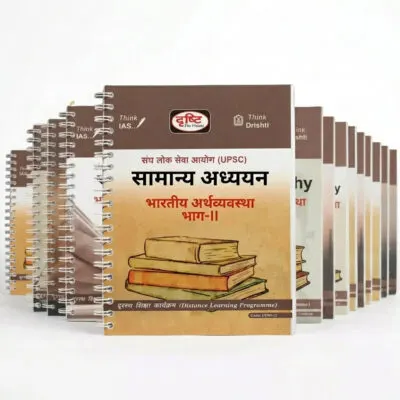
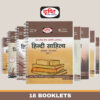
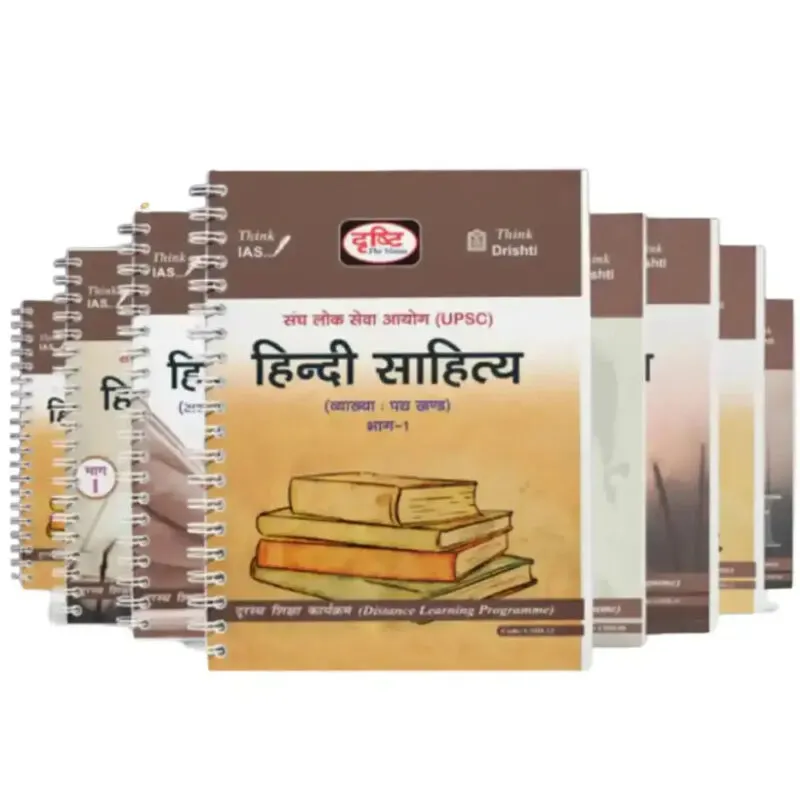
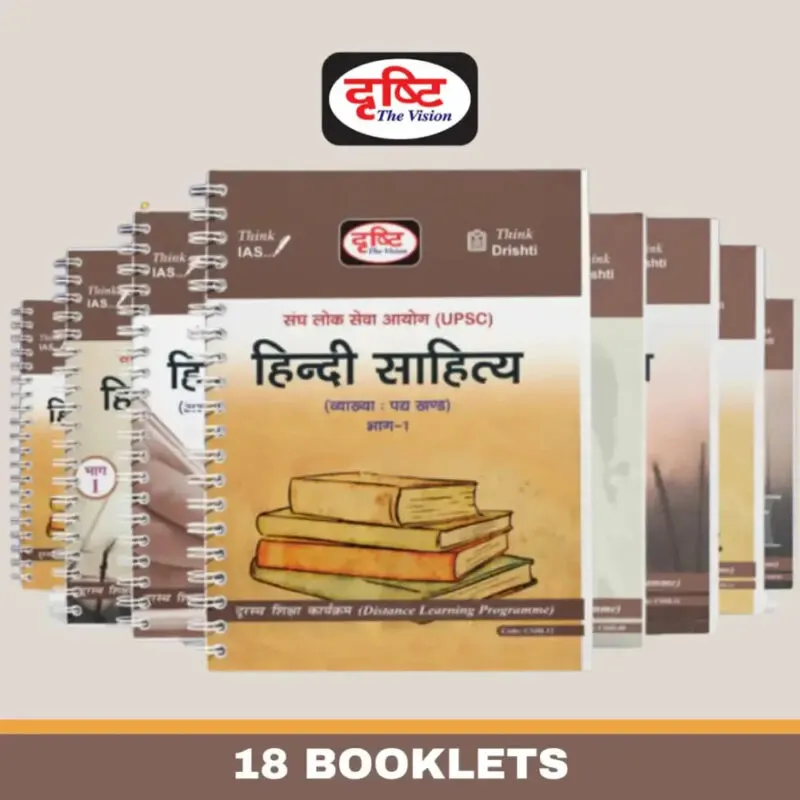
Drishti IAS Hindi Sahitya Notes 2025-26

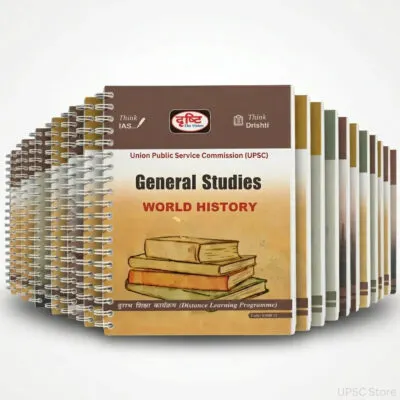
13 Booklets | Hindi Medium | UPSC Study Material
Key Highlights:
📘 13 Booklets
📚 Hindi Sahitya
🎓 Drishti IAS
🏷️ Printed
🇬🇧 Hindi Medium
₹2,645
🌀 spiral
📘 book-binding
Only 21 sets left
Selling fast (90 sold this week)
5% OFF Use UPSC5% (COD Available)
10% OFF Use UPI10 (UPI Only)
Secure Payment
Fast Delivery
Safe Packaging

About Drishti IAS Hindi Sahitya Notes

The Drishti IAS Hindi Sahitya Notes is a printed UPSC study material set sold by UPSC Store — India’s trusted source for genuine, latest-batch civil services preparation books. This page covers full booklet details, syllabus coverage, pricing, shipping, and frequently asked questions. Useful for UPSC CSE, BPSC, UPPSC, MPPSC, RAS and other state PSC examinations.

Drishti IAS Hindi Sahitya Notes 2025-26 | 13 Booklets | Hindi Medium | UPSC Study Material
Related: Drishti IAS notes · Hindi Sahitya optional

Drishti IAS Hindi Sahitya Notes 2025-26 is a meticulously crafted study material designed exclusively for UPSC Civil Services Examination aspirants who have opted for Hindi Literature as their optional subject. This comprehensive set of 13 Booklets covers the entire UPSC syllabus for Hindi Sahitya in a structured, easy-to-understand format, written in pure Hindi medium. Whether you are a beginner starting your UPSC journey or an experienced aspirant looking for revision material, these notes serve as the ultimate companion for your preparation.

The notes are prepared by experienced faculty members at Drishti IAS who have an in-depth understanding of the UPSC examination pattern, marking scheme, and expected answer presentation style. Each booklet is logically organized to ensure progressive learning, starting from foundational concepts and gradually moving toward advanced literary analysis, criticism, and answer-writing techniques. The material is updated for the 2025-26 examination cycle, ensuring all content aligns with the latest UPSC syllabus and recent trends in question paper patterns.


Complete Booklet-wise Content Overview

Booklet 1: Hindi Bhasha Ka Udbhav aur Vikas (Origin and Development of Hindi Language)

This foundational booklet traces the historical journey of the Hindi language from its earliest roots in Apabhramsha and Prakrit to its modern standardized form. It covers the linguistic evolution through various stages, including Vedic Sanskrit, Classical Sanskrit, Pali, Prakrit, and Apabhramsha, providing a thorough understanding of how Hindi emerged as a distinct language. The booklet also discusses the geographical spread of Hindi and its dialects across the Indian subcontinent.

Special attention is given to the socio-political factors that shaped the development of Hindi as a national language, including its role during the Indian independence movement and its eventual recognition as an official language of the Indian Republic. The booklet includes detailed maps of dialect regions, timelines of linguistic evolution, and comparative charts that help aspirants visualize the language’s growth. UPSC-relevant questions from previous years are integrated throughout the booklet to help students understand what examiners expect in their answers.

Additionally, this booklet explores the influence of foreign languages such as Persian, Arabic, Turkish, Portuguese, and English on Hindi vocabulary and grammar. It explains the concept of Khari Boli and its rise to prominence over other dialects like Braj Bhasha and Awadhi. The standardization efforts of scholars like Bharatendu Harishchandra and the contributions of institutions like the Hindi Sahitya Sammelan are discussed in considerable detail, equipping aspirants with both factual knowledge and analytical perspectives essential for scoring high marks in the UPSC optional paper.

Booklet 2: Adikal – Veer Gatha Kaal (Early Period of Hindi Literature)

This booklet comprehensively covers the Adikal, also known as the Veer Gatha Kaal, which represents the earliest period of Hindi literature spanning approximately from 1000 CE to 1375 CE. It introduces students to the major literary works and poets of this era, including Chandravardai’s Prithviraj Raso, Vidyapati’s compositions, and the Apabhramsha literature that bridges Sanskrit and Hindi. The booklet explains the social, cultural, and political context in which these works were created.

The content includes a critical analysis of the defining characteristics of Adikal literature, such as its focus on heroism, valor, royal patronage, and the glorification of Rajput warriors. The booklet discusses controversies surrounding the authenticity of certain texts, including the ongoing scholarly debate about the historical accuracy of Prithviraj Raso. Important literary devices, themes, and poetic styles prevalent in this period are explained clearly, with relevant examples and quotes that can be directly used in UPSC answers to demonstrate textual knowledge and analytical depth.

This booklet also examines the Siddha and Nath poetry traditions that coexisted during the Adikal period, providing an understanding of the religious and philosophical underpinnings of early Hindi literature. The influence of Tantric thought, yogic practices, and folk traditions on the literary output of this period is explored through detailed textual analysis. Aspirants will find ready-to-use answer frameworks, important quotes from primary texts, and examiner-focused summaries that make revision before the examination both efficient and thorough, saving valuable preparation time.

Booklet 3: Bhaktikal – Sant Kavya aur Sufi Kavya (Devotional Period – Saint Poetry and Sufi Poetry)

The Bhaktikal booklet is one of the most important in the entire set, covering the golden age of Hindi literature that flourished from approximately 1375 CE to 1700 CE. It provides an exhaustive study of the two major streams of Bhakti poetry — the Nirguna Bhakti tradition represented by poets like Kabir, Raidas, and Dadu Dayal, and the Saguna Bhakti tradition represented by Tulsidas, Surdas, and Mirabai. Each poet’s life, philosophy, and major works are discussed in detail.

The booklet gives special attention to the Sufi Kavya tradition, represented by poets like Malik Muhammad Jayasi, whose epic Padmavat is analyzed in depth. The synthesis of Hindu and Islamic thought in Sufi poetry is explained through the concept of Prem Marg (the path of love), which forms the central theme of these works. The booklet includes comparative analyses of different Bhakti streams, helping aspirants understand the ideological distinctions and similarities that are frequently tested in UPSC examinations through both factual and analytical questions.

Critical literary evaluation of major Bhakti texts, including the Ramcharitmanas, Sursagar, and Bijak, forms an important part of this booklet. Students are provided with thematic analysis of these works, covering aspects such as devotion, social reform, gender representation, and caste critique. The booklet also discusses the social impact of the Bhakti movement on Indian society and its relevance to contemporary India. Strategically placed UPSC-style answer templates and important passages from primary texts make this booklet an indispensable resource for optional subject preparation in Hindi Sahitya.

Booklet 4: Bhaktikal – Ram Kavya aur Krishna Kavya (Ram Literature and Krishna Literature)

This dedicated booklet explores the two most prominent Saguna Bhakti streams — the Ram Kavya tradition centered on the worship of Lord Rama and the Krishna Kavya tradition devoted to Lord Krishna. The Ram Kavya section provides a detailed analysis of Tulsidas’s Ramcharitmanas, including its composition, narrative structure, philosophical content, and social significance. The booklet discusses how Tulsidas synthesized the Brahmanical tradition with the popular Bhakti movement to create a work of unparalleled influence on North Indian culture.

The Krishna Kavya section focuses on the Ashtachhap poets, particularly Surdas, whose Sursagar is regarded as one of the greatest works of Hindi literature. The booklet explores the poetic genius of Surdas through his depiction of Krishna’s childhood (Bal Leela), his romantic relationship with Radha, and the philosophical concept of Vatsalya Bhakti (devotional love of a parent for the divine). Other Ashtachhap poets, including Kumbhandas, Paramananddas, and Nandadas, are also discussed with appropriate critical evaluation suitable for UPSC answers.

Comparative analysis between Ram Kavya and Krishna Kavya forms an important analytical component of this booklet. Students learn to critically evaluate the differences in theological perspective, narrative style, and social impact between these two traditions. The booklet provides detailed notes on the concept of Lok Mangal (universal welfare) in Tulsidas’s poetry and the concept of Madhurya Bhakti (devotion through romantic love) in the Krishna tradition. Answer-writing templates for common UPSC questions on this topic are provided, making this booklet particularly valuable for students who want to maximize their score in the Hindi Sahitya optional paper.

Booklet 5: Ritikal – Riti Siddha, Riti Baddha aur Riti Mukta Kavya (Classical Period Poetry)

The Ritikal booklet covers the period of classical Hindi poetry that flourished from approximately 1700 CE to 1900 CE, a period characterized by its highly ornate style, emphasis on rhetorical devices (Alankars), and the codification of poetic rules. The booklet introduces the three major sub-categories of Ritikal poetry — Riti Siddha (poetry that implicitly follows rhetorical rules), Riti Baddha (poetry that explicitly defines and follows rhetorical rules), and Riti Mukta (poetry that breaks free from formal constraints while retaining the period’s sensibility).

Major poets of the Ritikal period, including Keshavdas, Bihari, Bhushan, and Ghananand, are studied in considerable depth. The booklet provides detailed analysis of Bihari’s Satsai, one of the most celebrated works of this period, examining its structure, themes, and poetic devices. The patriotic poetry of Bhushan, who celebrated the valor of Chhatrapati Shivaji and Maharana Pratap, is presented as a counterpoint to the more romantic themes dominant in the period. Ghananand’s Riti Mukta poetry, which expresses intense personal emotion, is analyzed as a precursor to modern Hindi poetry.

The booklet provides an in-depth explanation of the Alankara Shastra (science of poetic ornaments) as practiced during the Ritikal period, covering major figures of speech such as Upama, Rupak, Utpreksha, Yamak, and Shlesh. This technical knowledge is essential for answering UPSC questions that require literary analysis and identification of poetic devices in given passages. The social and cultural context of Ritikal poetry, including its association with royal courts and its elitist character, is critically examined, with comparative notes that help aspirants place this literature in a broader historical framework essential for high-scoring answers.

Booklet 6: Aadhunik Kaal – Bharatendu Yug aur Dwivedi Yug (Modern Period – Bharatendu Era and Dwivedi Era)

This booklet marks the beginning of modern Hindi literature and covers two pivotal periods: the Bharatendu Yug (1857-1900) and the Dwivedi Yug (1900-1920). The Bharatendu Yug section focuses on the revolutionary contributions of Bharatendu Harishchandra, who is universally acknowledged as the father of modern Hindi literature. The booklet examines how Bharatendu transformed Hindi literature from a courtly, elitist pursuit into a vehicle for social reform, national awakening, and public discourse during the colonial period.

The Dwivedi Yug section analyzes the contributions of Mahavir Prasad Dwivedi, who served as the editor of the influential literary journal Saraswati and standardized modern Hindi grammar and prose style. This period saw Hindi literature turn toward social realism, historical subjects, and didactic themes. The booklet covers major writers and poets of both periods, including Pratanarayan Mishra, Badrinarayan Chaudhary ‘Premghan,’ and Maithilisharan Gupt, whose nationalistic poetry reflected the growing anti-colonial sentiment of the time.

The socio-political backdrop of both periods is thoroughly analyzed, helping aspirants understand how colonial rule, the 1857 uprising, the rise of Indian nationalism, and the social reform movements influenced literary production. The development of Hindi drama, prose fiction, journalism, and criticism during these two periods is covered systematically. The booklet includes ready-made notes on major works such as Maithilisharan Gupt’s Bharat Bharati and Saket, along with answer-writing frameworks that demonstrate how to present historical literary analysis effectively in the UPSC examination to secure maximum marks.

Booklet 7: Chhayavad – Prasad, Nirala, Pant, Mahadevi Verma (The Romantic Revival in Hindi Poetry)

The Chhayavad booklet covers one of the most celebrated movements in Hindi literary history — the Romantic Revival that flourished approximately between 1918 and 1936. Often compared to English Romanticism, Chhayavad poetry is characterized by its celebration of nature, individualism, mysticism, and the use of symbolic language. The booklet introduces the four pillars of Chhayavad — Jaishankar Prasad, Suryakant Tripathi ‘Nirala,’ Sumitranandan Pant, and Mahadevi Verma — providing detailed biographical and literary profiles of each poet.

Jaishankar Prasad’s multifaceted genius as a poet, playwright, and novelist is analyzed through his major works, including Kamayani, Ansoo, and Lahar. The booklet examines Kamayani as the greatest epic of the Chhayavad period, exploring its philosophical themes of Shraddha (faith), Manu (reason), and Ida (intellect). Nirala’s revolutionary contributions to Hindi poetry, including his pioneering use of free verse (Mukt Chhand) and his deeply humanistic poetry for the marginalized, are studied through works like Saroj Smriti and Ram Ki Shakti Pooja. Pant’s nature mysticism and Mahadevi Verma’s feminine mysticism are also analyzed in depth.

The booklet provides critical evaluation of Chhayavad as a literary movement, including the debates surrounding its definition, its relationship to Western Romanticism, and the feminist dimensions of Mahadevi Verma’s poetry. Important poetic passages from primary texts are provided in Devanagari script with detailed explanatory notes, enabling aspirants to quote directly in their UPSC answers. The booklet also addresses the question of why Chhayavad declined and what legacy it left for subsequent movements in Hindi literature, equipping students with the analytical framework needed to answer both descriptive and critical questions in the examination paper.

Booklet 8: Pragativad aur Prayogvad – Nayi Kavita (Progressivism and Experimentalism – New Poetry)

This booklet covers three important post-Chhayavad movements in Hindi poetry: Pragativad (Progressive Poetry), Prayogvad (Experimental Poetry or Tarसaptaka tradition), and the Nayi Kavita (New Poetry) movement. The Pragativadi movement, influenced by Marxist ideology and the Progressive Writers’ Association founded in 1936, sought to bring literature closer to social reality, class struggle, and the lives of ordinary people. Major progressive poets like Kedarnath Agarwal, Nagarjuna, and Shamsher Bahadur Singh are studied through their representative works and ideological commitments.

The Prayogvad movement, launched with the publication of Tar Saptaka in 1943 edited by Sachchidananda Hirananda Vatsyayana ‘Ajneya,’ represented a deliberate break from the ideological certainties of progressive poetry. The seven poets of Tar Saptaka — including Ajneya, Muktibodh, and others — experimented with free verse, imagistic poetry, and psychological interiority. The booklet provides detailed analysis of Ajneya’s contributions to Hindi poetry and his role in shaping the Nayi Kavita movement that followed Prayogvad in the 1950s and 1960s.

Nayi Kavita, represented by poets like Sarveshwar Dayal Saxena, Dharmvir Bharati, Kedarnath Singh, and Kunwar Narayan, is analyzed as a humanistic response to the existential anxieties of post-independence India. The booklet examines how Nayi Kavita engaged with themes of alienation, urban experience, memory, and political disillusionment. Gajanan Madhav Muktibodh’s complex, visionary poetry is given special attention, with detailed analysis of his major poem Andhera Mein (In the Darkness). The booklet concludes with comparative notes and answer templates that help aspirants effectively discuss these movements in their UPSC optional examination.

Booklet 9: Hindi Upanyas – Premchand aur Premchand Parant (Hindi Novel – Premchand and Post-Premchand Era)

This booklet provides a comprehensive study of the Hindi novel, beginning with its early development in the late nineteenth century and progressing through the golden age of Premchand to the post-Premchand experimental novelists. The early Hindi novel, including works by Lala Shrinivas Das and Devaki Nandan Khatri, is briefly examined to establish the genre’s origins. The booklet then transitions into a detailed study of Munshi Premchand, universally acknowledged as the greatest Hindi novelist, exploring his literary philosophy of Adarshvadi Yatharthvad (Idealistic Realism).

Major novels of Premchand — including Godaan, Gaban, Rangabhumi, Nirmala, and Sewasadan — are analyzed in depth, covering themes, characterization, narrative technique, and social commentary. Special emphasis is placed on Godaan, Premchand’s masterpiece, which is analyzed as an indictment of the feudal-colonial system’s devastating impact on Indian peasantry. The booklet examines Premchand’s treatment of caste, gender, poverty, and nationalism, providing thematic frameworks that aspirants can use to answer both specific and broad analytical questions in the UPSC optional paper.

Post-Premchand novelists, including Jainendra Kumar, Agyeya, Yashpal, and Bhisham Sahni, are studied as writers who moved beyond social realism toward psychological fiction, existentialism, and partition literature. Jainendra Kumar’s psychoanalytic approach, Agyeya’s modernist sensibility in Shekhar Ek Jivani, Yashpal’s Marxist perspective in Jhootha Sach, and Bhisham Sahni’s humane portrayal of partition in Tamas are analyzed in considerable depth. The booklet provides comparative analysis of these novelists’ techniques and ideologies, equipping aspirants with the critical vocabulary needed to write sophisticated literary analysis in their UPSC Hindi Sahitya optional examination.

Booklet 10: Hindi Kahani – Udbhav se Samkalin Kahani Tak (Hindi Short Story – From Origin to Contemporary)

This booklet traces the evolution of the Hindi short story from its earliest examples in the early twentieth century to the diverse and dynamic contemporary short fiction being written today. The booklet begins with the proto-short stories of Kishorilal Goswami and Ramchandra Shukla before examining the landmark contributions of Premchand, who established the short story as a major literary form in Hindi. Premchand’s famous stories, including Kafan, Poos Ki Raat, Nasha, and Bade Bhai Sahab, are analyzed thematically and technically.

Post-independence Hindi short fiction is examined through major movements and individual authors. The Nayi Kahani (New Story) movement of the 1950s-60s, represented by Mohan Rakesh, Rajendra Yadav, and Kamleshwar, is studied as a shift from social realism toward psychological depth, urban alienation, and middle-class anxieties. Important stories such as Mohan Rakesh’s Malbe Ka Malik, Rajendra Yadav’s Sara Akash, and Kamleshwar’s Rajniti are analyzed in detail, with emphasis on the narrative techniques and thematic innovations that distinguish Nayi Kahani from the Premchand tradition.

Contemporary Hindi short fiction, including Samanantar Kahani (Parallel Story), Sachetan Kahani (Conscious Story), and Dalit and feminist short fiction, is covered in the latter sections of the booklet. Writers like Nirmal Verma, Mannu Bhandari, Usha Priyamvada, Omprakash Valmiki, and Mudrarakshasa are studied to provide a comprehensive picture of the breadth and diversity of contemporary Hindi short fiction. The booklet includes extensive notes on narrative technique, point of view, symbolism, and character analysis that equip aspirants to write detailed literary criticism in their UPSC examination answers, thereby helping them achieve high marks in the optional paper.

Booklet 11: Hindi Natak aur Rangmanch (Hindi Drama and Theatre)

This booklet provides a systematic study of Hindi drama from the Bharatendu period to contemporary theatre. The pre-modern dramatic tradition in Sanskrit and regional languages is briefly discussed to provide a historical context before focusing exclusively on modern Hindi drama. Bharatendu Harishchandra’s pioneering contributions to Hindi drama — including original plays like Andher Nagari and Bharat Durdasha — are analyzed as works that used theatrical form for social critique and nationalist expression during the colonial period.

The Prasad era drama is studied in detail, with special focus on Jaishankar Prasad’s historical plays such as Chandragupta, Dhruvaswamini, and Skandagupta. The booklet examines how Prasad’s dramas, while often considered more suitable for reading than stage performance (Shravya Natya), represent significant achievements in poetic drama. The post-independence period saw Hindi drama turn toward social realism with the works of Mohan Rakesh, whose plays Aadhe Adhure, Ashadha Ka Ek Din, and Lehron Ke Rajhans are analyzed as landmarks in the development of modern Hindi theatre.

The booklet also covers the contributions of other important playwrights, including Jagdish Chandra Mathur, Dharamvir Bharati (Andha Yug), Surendra Verma, and Mani Madhukar. Dharamvir Bharati’s Andha Yug, a verse play based on the aftermath of the Mahabharata war, receives detailed analysis as a profound meditation on violence, power, and human dignity. The parallel theatre movement and street theatre traditions are also discussed. The booklet concludes with notes on staging, theatrical conventions, and the relationship between dramatic text and performance, giving aspirants a well-rounded understanding of Hindi drama essential for comprehensive answers in UPSC Hindi Sahitya optional examinations.

Booklet 12: Hindi Nibandh aur Anya Gadya Vidhayen (Hindi Essay and Other Prose Forms)

This booklet covers the rich tradition of Hindi prose writing, with special emphasis on the essay (Nibandh) as a literary form, along with other significant prose genres including autobiography (Atmakatha), biography (Jeevani), travelogue (Yatra Sahitya), and literary criticism (Alochna). The Hindi essay tradition is traced from Bharatendu Harishchandra’s journalistic essays through the formal essay writing of Ramchandra Shukla, Hazari Prasad Dwivedi, and Vidyaniwas Misra, providing a historical overview of how the genre developed and diversified over time.

Ramchandra Shukla, the father of modern Hindi literary criticism, is studied in considerable depth. His landmark work Chintamani and his magnum opus Hindi Sahitya Ka Itihas (History of Hindi Literature) are analyzed for their critical methodology, historical perspective, and lasting influence on Hindi literary scholarship. Hazari Prasad Dwivedi’s humanistic and culturally rich essays, drawing on Sanskrit learning and folk traditions, are contrasted with Shukla’s more systematic critical approach, providing aspirants with the framework to compare and evaluate major Hindi prose stylists.

The booklet provides detailed notes on the Hindi autobiography tradition, covering works like Mahadevi Verma’s Smriti Ki Rekhayein, Ramvriksha Benipuri’s Mitti Ki Mooratein, and Rahul Sankrityayan’s Meri Jeevan Yatra. Hindi travelogue writing, a genre in which Rahul Sankrityayan excelled, is discussed with reference to major works. Hindi literary criticism from Ramchandra Shukla through Namvar Singh and beyond is analyzed as an evolving intellectual tradition. The booklet includes critical evaluation frameworks and answer templates that help aspirants effectively analyze and compare prose writers and their contributions in their UPSC Hindi Sahitya optional paper examinations.

Booklet 13: Hindi Sahitya Ka Itihas aur Samkalin Paridrishya (History of Hindi Literature and Contemporary Scenario)

The final booklet serves as both a comprehensive overview of the entire history of Hindi literature and a detailed examination of the contemporary literary scene. It synthesizes the content of the previous twelve booklets into a coherent historical narrative, providing aspirants with the broad perspective needed to answer questions that require knowledge spanning multiple literary periods. The major literary histories of Hindi — by Ramchandra Shukla, Hazari Prasad Dwivedi, and Ramvilas Sharma — are compared and evaluated for their methodological approaches and interpretive frameworks.

The contemporary Hindi literary scene is examined in detail, covering the diverse movements and voices that characterize Hindi literature in the twenty-first century. Dalit literature (Dalit Sahitya) and its challenge to the upper-caste dominated mainstream is studied through the works of Omprakash Valmiki, whose autobiography Joothan is analyzed as a landmark in Dalit life-writing. Women’s writing (Stri Sahitya) and its evolution from the Chhayavad period to contemporary feminist voices is traced, highlighting writers like Mridula Garg, Mannu Bhandari, Mrinal Pande, and Nasira Sharma.

Adivasi literature, the literature of the Indian diaspora, and the growing body of translation literature are also addressed in this booklet, reflecting the expanding boundaries of what constitutes Hindi literature in the contemporary period. The booklet includes a comprehensive timeline of Hindi literary history, a glossary of important literary terms and movements, and a bibliography of recommended primary and secondary texts for further reading. Revision notes, important questions from previous years’ UPSC papers, and model answers make this concluding booklet an invaluable tool for final examination preparation, ensuring that aspirants enter the examination hall fully confident and thoroughly prepared.


Physical Quality and Production Standards

Paper Quality

The Drishti IAS Hindi Sahitya Notes 2025-26 are printed on premium 70 GSM white offset paper, carefully selected to provide an optimal reading experience during extended study sessions. The paper is thick enough to prevent bleed-through from double-sided printing while remaining light enough to keep the overall weight of the booklet set manageable for daily carry. The bright white surface of the paper ensures high contrast with the printed text, reducing eye strain significantly during long hours of reading. The paper is also acid-free, ensuring that the booklets remain in good condition throughout your preparation period without yellowing, brittleness, or deterioration, making them suitable for repeated use across multiple revision cycles without compromising quality.

Print Quality

Every booklet in this set is produced using high-resolution offset printing technology that delivers sharp, clear, and consistently legible text throughout all 13 volumes. The printing uses high-density black ink that maintains uniform darkness across all pages, ensuring that there are no faded sections or inconsistent print quality that could impede reading. Headings, subheadings, and important keywords are printed in bold to facilitate quick identification of key concepts during revision. Diagrams, charts, and tables are rendered with precision and clarity, with clean lines and well-defined borders that make visual information easy to interpret. The overall print quality reflects professional publishing standards, ensuring a smooth and distraction-free study experience for serious UPSC aspirants.

Binding Type

All 13 Booklets feature perfect binding, a professional bookbinding technique that uses a strong adhesive spine to hold all pages together securely. This binding method ensures that pages do not loosen, tear, or fall out even after months of regular and intensive use, which is a common problem with staple-bound or saddle-stitched booklets used by students during preparation. The perfect binding also allows the booklets to lie relatively flat when opened, making it comfortable to read and write notes simultaneously. The spine of each booklet is clearly labeled with the booklet number and topic name, making it easy to identify and retrieve individual booklets from a stack or shelf without having to open them, saving time and effort during focused revision sessions.

Cover Design

The cover of each booklet is designed with a professional, distinctive aesthetic that reflects the academic seriousness of the content within. Each booklet cover features the Drishti IAS branding prominently, along with clear labeling of the booklet number, topic name, and the examination year 2025-26, ensuring easy identification at a glance. The covers are printed on thick 250 GSM art board with matte lamination, providing a premium tactile feel while also offering protection against wear, moisture, and physical damage during daily handling and transport. The color-coded system used across the 13 Booklets allows aspirants to quickly identify and locate specific subject areas, further enhancing the organizational efficiency of the complete set during intensive study and revision periods.

Font and Typography

The typography of these notes has been carefully designed to maximize readability and minimize cognitive fatigue during extended reading sessions. The primary text is set in a clean, standard Devanagari font at an optimal 12-point size, striking the ideal balance between fitting adequate content on each page and maintaining comfortable readability. Line spacing is set at 1.5 to ensure that lines of text are well-separated, preventing the eye from accidentally jumping between lines during reading. Section headings are set in a larger, bolder font that creates a clear visual hierarchy on the page, making the structure of content immediately apparent and facilitating efficient navigation through the booklet. Important terms, definitions, and key concepts are consistently highlighted through bolding and underlining, making them stand out for quick identification during revision.

Booklet Size and Dimensions

Each booklet in the Drishti IAS Hindi Sahitya Notes set is produced in the standard A4 format (210mm × 297mm), which is the most widely used and universally preferred size for academic study materials in India. The A4 format provides ample space for wide margins, which aspirants can use for making personal annotations, writing mnemonics, and adding supplementary notes from classroom lectures or other reference materials. The physical dimensions of the booklets make them compatible with standard file folders, binders, and document bags, facilitating easy organization and transport. The thickness of individual booklets is kept manageable by distributing content across 13 separate volumes, ensuring that no single booklet is excessively bulky, heavy, or difficult to handle during study sessions, examinations, or while commuting.


Frequently Asked Questions (FAQs)

Q1. Is this study material sufficient for complete UPSC Hindi Sahitya optional preparation?

Yes, these 13 Booklets are designed to cover the complete UPSC syllabus for Hindi Sahitya optional comprehensively. They cover all major literary periods, significant authors, important works, literary movements, and critical concepts prescribed in the UPSC syllabus. However, aspirants are encouraged to supplement these notes with primary text reading, particularly for the major literary works discussed extensively in the UPSC optional papers. Regular answer writing practice using the templates and frameworks provided in the booklets is also strongly recommended to maximize examination performance and develop the analytical writing skills needed.

Q2. Are these notes updated for the 2025-26 UPSC examination cycle?

Yes, the Drishti IAS Hindi Sahitya Notes are thoroughly updated for the 2025-26 UPSC examination cycle. The content has been reviewed and revised by the Drishti IAS faculty team to ensure alignment with the current UPSC syllabus, the latest examination trends observed in recent years, and any modifications in the question paper pattern. The notes also incorporate recent scholarly perspectives and critical viewpoints that may be relevant to contemporary UPSC examinations. Aspirants can trust that the material they are studying reflects the most current and relevant content for their upcoming examination without needing additional updates.

Frequently Asked Questions

Does the 13-Booklet set cover the full Hindi Sahitya syllabus?

Yes, all 13 Booklets together cover Paper I and Paper II of the UPSC Hindi Literature optional.

Are these prepared by Drishti IAS faculty?

Yes, the booklets are compiled by Drishti IAS Hindi Sahitya faculty for the 2025-26 batch.

Can I purchase fewer booklets from this set?

This listing ships only the complete 13-Booklet set; partial purchase is not available here.

What paper quality is used?

75 GSM ultra-white paper that is highlighter safe with no bleed-through during revision.

Is COD available for this large set?

Yes, COD is supported on serviceable pin codes; prepaid options are also offered at checkout.

How is the package shipped safely?

All 13 Booklets are bubble-wrapped and packed in a corrugated box with tracked courier service.

Reference: Civil Services Examination

Customer Reviews 110

4.5
Based on 110 reviews
5★
65
4★
33
3★
12
2★
0
1★
0
M
Meera Kapoor
23 Apr 2026
✓ Verified

Notes bohot detailed hain aur Hindi medium mein samajhne easy hai.

A
Aditya Kumar
21 Apr 2026
✓ Verified

Excellent quality and very comprehensive material for Hindi literature preparation.

R
Rajesh Kumar Sharma
18 Apr 2026
✓ Verified

Drishti ke notes sab se badhiya hain, padh ke bilkul clear ho gaya sab kuch.

K
Karan Mehta
13 Apr 2026
✓ Verified

Hindi Sahitya ka saara concept clear ho gaya in padhkar. Booklets ka quality bhi bahut acha hai.

H
Harsh Mehta
06 Apr 2026
✓ Verified

Drishti IAS se bohot expect karte the aur wo meet ho gaya.

P
Priya Verma
26 Mar 2026
✓ Verified

Quality ekdum top-notch hai. 17 booklets mein sab kuch cover ho gaya.

A
Ankit Patel
26 Mar 2026
✓ Verified

Shukriya notes bhejne ke liye.

A
Ashok Pandey
25 Mar 2026
✓ Verified

Print quality achchi hai aur language bhi samajh mein aati hai.

🛍️

Aspirants Also Bought

More from the same category

View All

About Drishti IAS Hindi Sahitya Notes 2025-26

Drishti IAS Hindi Sahitya Notes 2025-26 is a highly recommended UPSC study material from Drishti IAS, specially designed for Hindi Sahitya preparation. Available in Hindi medium, this material is crafted to match the exact requirements of the UPSC Civil Services Examination syllabus — covering both Prelims and Mains comprehensively.

Product Details

  • Institute: Drishti IAS
  • Subject: Hindi Sahitya
  • Medium: Hindi
  • Format: Printed
  • Delivery: Pan-India delivery in 3–5 working days
  • Format: Original printed material, verified authentic

Why Buy from UPSC Store?

  • 100% Genuine Printed Material — Original printed notes, no photocopies or fake copies
  • Fast Delivery — Ships within 24 hours, arrives in 3–5 days pan-India
  • Secure Packaging — Bubble-wrapped and boxed to prevent damage in transit
  • Trusted by 10,000+ Aspirants — India's most reliable UPSC material marketplace
  • WhatsApp Support — Get expert guidance on material selection before ordering

Frequently Asked Questions

Is this product 100% original?

Yes, all products at UPSC Store are 100% genuine printed materials. We do not sell photocopies or fake copies.

How long does delivery take?

Orders are dispatched within 24 hours and delivered across India in 3–5 working days via reputed courier partners.

Can I return the product?

Yes, we accept returns within 7 days if the product is damaged or incorrect. Check our refund policy for details.

Which other study materials should I buy with this?

We recommend pairing this with current affairs notes and a UPSC test series for comprehensive preparation. Browse more in Drishti IAS, Hindi Sahitya, Optional, UPSC.