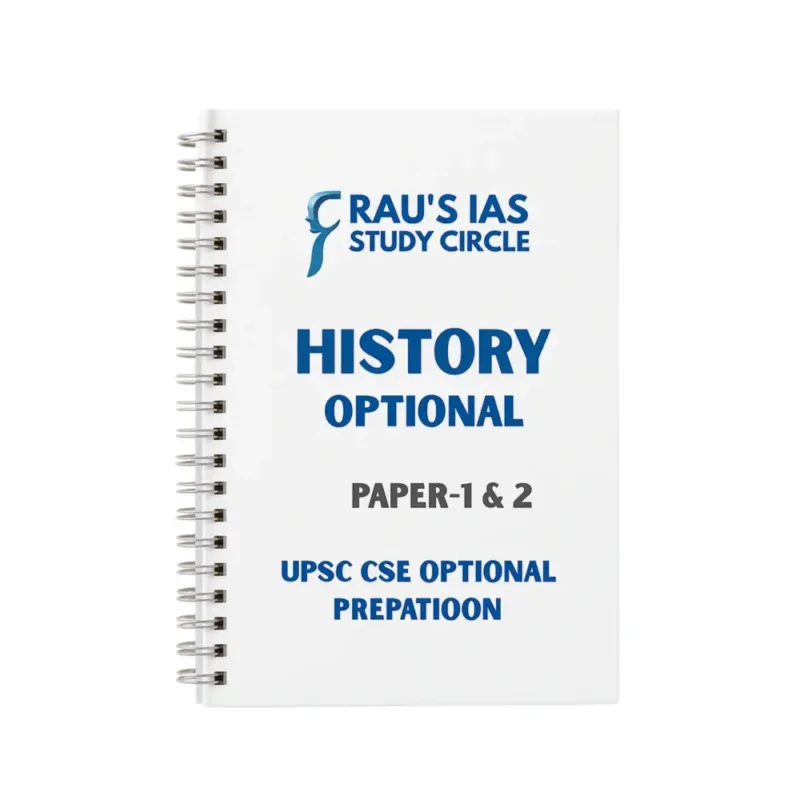



Rau’s IAS History Optional Notes 2025-26
Rau's IAS History Optional 2025-26 — UPSC Study Material
Related: Rau's IAS notes · History Optional books
Buy Rau's IAS History Optional 2025-26 printed booklets for UPSC Civil Services Examination preparation. This page lists complete details about Rau's IAS History Optional 2025-26 including booklet count, language, syllabus coverage, pricing, and shipping.
Rau’s IAS Study Circle History Optional 2025-26 — 12 English Medium Printed Booklets for UPSC Mains History Optional Paper 1 & Paper 2
Product Overview
| Feature | Details |
|---|---|
| Booklets Count | 12 Individual Printed Booklets — Full Coverage of UPSC History Optional Paper 1 & Paper 2 |
| Language | English Medium |
| Publisher | Rau’s IAS Study Circle (History Optional Series 2025-26) |
| Edition | 2025-26 — Latest Genuine Batch |
| Condition | Brand New, Unmarked, Fresh Stock |
| Format | High-Quality Printed Booklets — Spiral or Book Binding |
| Paper Quality | 75 GSM Ultra-White — Highlighter Safe, Zero Bleed-Through |
| Shipping | Pan India Delivery in 3-5 Business Days — Tracked |
| Also Useful For | BPSC, UPPSC, MPPSC, RAS and all State PSC History Optional candidates |
Complete Booklet Catalog
This 6-booklet set from Rau’s IAS Study Circle covers the entire UPSC History Optional syllabus across Paper 1 (Ancient, Medieval, and early Modern India along with World History) and Paper 2 (Modern India, Indian National Movement, and post-Independence period). Designed for serious UPSC Mains aspirants who want structured, syllabus-mapped printed notes without the need to attend classroom coaching at Rau’s IAS Study Circle, Delhi.
- Booklet 1: Sources and Historiography — Ancient India — Prehistoric cultures, Harappan Civilisation, sources of ancient Indian history, archaeological evidence, literary sources including Vedic texts, Puranas and foreign accounts, historiographical debates, significance of inscriptions and numismatic evidence for UPSC History Optional Paper 1 Section A.
- Booklet 2: Vedic Age, Janapadas and Mahajanapadas — Early and Later Vedic cultures, social and economic changes, rise of Jainism and Buddhism, republican polities, Nanda Empire, Mauryan administration under Chandragupta and Ashoka, Ashokan Dhamma, decline of the Mauryas, post-Mauryan kingdoms including Kushanas and Satavahanas.
- Booklet 3: Gupta Empire, Post-Gupta Period and Regional Kingdoms — Gupta political history, administration and economy, golden age of art and culture, decline, Harsha’s empire, rise of regional powers including Chalukyas, Pallavas, Rashtrakutas, Palas, Pratiharas, land grants and feudalism debates, agrarian structure and trade networks.
- Booklet 4: South Indian History and Cultural Developments in Ancient India — Sangam Age polity and society, Chola Empire administration and naval expansion, temple architecture styles, bhakti movement origins, art and architecture from Mauryan to medieval periods, development of language and literature, science and technology achievements in ancient India.
- Booklet 5: Early Medieval India and the Delhi Sultanate — Arab conquest of Sind, Ghaznavid and Ghurid invasions, establishment of the Delhi Sultanate, administrative structures of the Slave dynasty, Khaljis, Tughlaqs, Sayyids and Lodis, agrarian economy, Iqta system, position of women, Sufi and Bhakti movements in medieval India.
- Booklet 6: Mughal Empire — Political and Administrative History — Foundation by Babur and Humayun, Sher Shah Suri’s administrative reforms, Akbar’s consolidation and Mansabdari system, Din-i-Ilahi and religious policy, Jahangir and Nur Jahan, Shah Jahan’s architecture, Aurangzeb’s religious policies and Deccan campaigns, causes of Mughal decline, Maratha rise under Shivaji.
- Booklet 7: Medieval India — Economy, Society, Culture and Regional States — Agricultural production and land revenue systems, trade routes and merchant guilds, position of peasants and artisans, Vijayanagara Empire, Bahmani Sultanate, Bengal Sultanate, Kashmir under Zain-ul-Abidin, Rajput polity, Sikh movement under Guru Nanak and successors, Indo-Islamic art and architecture.
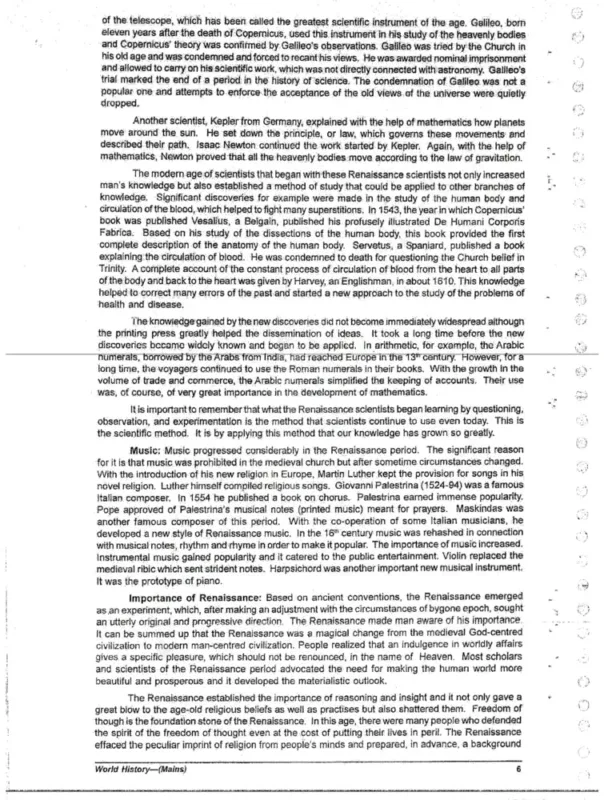
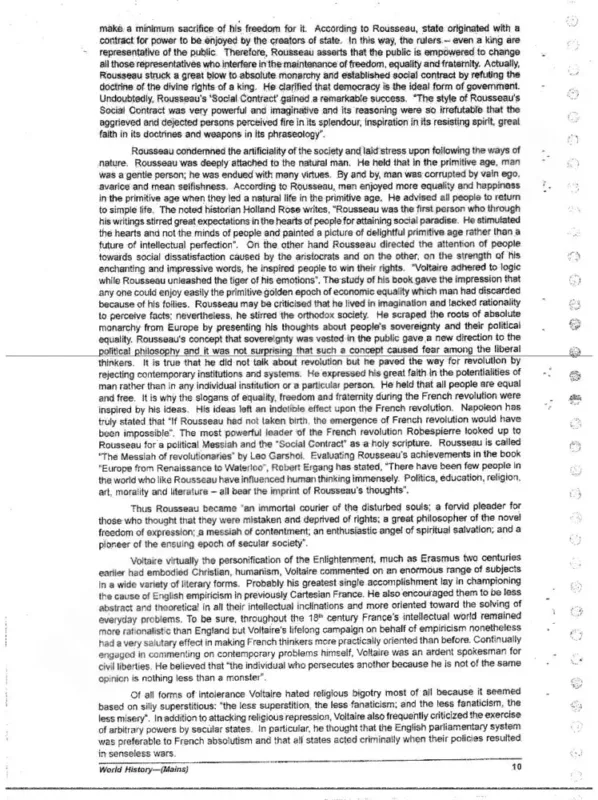
- Booklet 8: World History — Renaissance to World Wars — European Renaissance and Reformation, Age of Discovery, rise of nation-states, American and French Revolutions, Industrial Revolution and its social impact, imperialism and colonialism, Congress of Vienna, unification of Germany and Italy, World War I causes and consequences, Russian Revolution of 1917, Treaty of Versailles and interwar period.
- Booklet 9: World History — World War II to Cold War and Decolonisation — Rise of fascism in Europe, causes and phases of World War II, Holocaust, formation of the United Nations, origins of the Cold War, NATO and Warsaw Pact, Korean War, Cuban Missile Crisis, Vietnam War, collapse of colonialism in Asia and Africa, Non-Aligned Movement, end of the Cold War and collapse of the Soviet Union.
- Booklet 10: Modern India — British Expansion and Colonial Economy — Battle of Plassey and Buxar, expansion of British power, Subsidiary Alliance and Doctrine of Lapse, administrative changes post-1857, economic impact of British rule including deindustrialisation and drain of wealth, land revenue settlements, famines, rise of Indian bourgeoisie, early nationalist organisations before the Indian National Congress.
- Booklet 11: Indian National Movement — Congress to Independence — Foundation of INC, moderate and extremist phases, Swadeshi Movement, Home Rule League, role of Gandhi and mass movements including Non-Cooperation, Civil Disobedience and Quit India, revolutionary nationalism, Muslim League and communal politics, Cripps Mission, Cabinet Mission Plan, Partition and Independence in 1947.
- Booklet 12: Post-Independence India and Integration of Princely States — Integration of princely states under Sardar Patel, linguistic reorganisation of states, land reforms and abolition of zamindari, first three Five Year Plans, Nehru’s foreign policy and Panchsheel, 1962 and 1965 wars, Green Revolution, Emergency period, economic liberalisation background, social movements and constitutional amendments for UPSC History Optional Paper 2.
In-Depth Content Breakdown: Booklet by Booklet
Booklet 1: Sources and Historiography — Ancient India
This opening booklet addresses the foundational Section A of UPSC History Optional Paper 1 by covering prehistoric cultures from the Palaeolithic to the Chalcolithic, Harappan urban planning, and the full range of historical sources including inscriptions, coins, archaeological reports, and literary texts. The UPSC Mains syllabus explicitly demands an understanding of historiography, and Rau’s IAS Study Circle has dedicated substantial space to debates surrounding Aryan migration, periodisation of ancient Indian history, and the contributions of colonial versus nationalist historians.
The booklet is structured with topic-wise headings that map directly onto the official UPSC syllabus, making revision faster during the final months of UPSC Mains preparation. Each major source category — epigraphic, numismatic, archaeological, and literary — is presented with specific examples and their historical significance. Helpful comparison tables contrast key historians’ interpretations, while timelines of prehistoric and proto-historic cultures give aspirants quick reference anchors. The text maintains analytical depth appropriate for writing 250-word UPSC answers without padding or superficial treatment.
Booklet 2: Vedic Age, Janapadas and Mahajanapadas
Booklet 2 covers one of the highest-scoring areas of UPSC History Optional Paper 1 — the Vedic period through the rise of the Mauryan Empire. The Early and Later Vedic transitions are explained with evidence from the Rigveda and Atharvaveda, tracing the shift from a pastoral to an agrarian economy. The rise of heterodox sects — Jainism under Mahavira and Buddhism under Gautama Buddha — is treated with attention to social causes, doctrinal differences, and UPSC-relevant comparison points. Mauryan administration under Chandragupta Maurya, Bindusara, and Ashoka receives detailed coverage including the Arthashastra perspective.
Rau’s IAS Study Circle organises this booklet around the concept of state formation, a recurring analytical theme in UPSC History Optional questions. The treatment of Ashokan Dhamma distinguishes between Dhamma as policy and Dhamma as religion — a distinction examiners frequently test. Post-Mauryan sections cover the Kushanas’ role in trans-Asian trade and the Satavahanas’ relationship with Brahmanical and Buddhist traditions. Tables comparing Buddhist and Jain philosophical positions, and a structured breakdown of Megasthenes’ Indica, make this booklet particularly useful for both Paper 1 answer writing and factual recall during UPSC Mains.
Booklet 3: Gupta Empire, Post-Gupta Period and Regional Kingdoms
The Gupta period is often described as the classical age of Indian civilisation, and UPSC History Optional Paper 1 questions regularly probe both the political achievements and the cultural florescence of this era. This booklet traces the rise of the Guptas from Chandragupta I through Skandagupta, covering land grants, administrative decentralisation, trade decline, and the feudalism debate among historians like D.D. Kosambi, R.S. Sharma, and B.N.S. Yadava. The post-Gupta vacuum and the emergence of regional powers — Chalukyas, Pallavas, Rashtrakutas, and the Pala-Pratihara-Rashtrakuta tripartite struggle — are treated in an interconnected analytical framework.
A significant feature of this booklet is its structured handling of the feudalism versus trade-decline debate, which has appeared repeatedly as a long-answer question in UPSC History Optional. Charts comparing the administrative systems of major regional kingdoms help aspirants organise comparative answers efficiently. Harsha’s empire is covered with reference to Hiuen Tsang’s observations, with critical evaluation of his reliability as a historical source. The booklet also discusses the agrarian economy, the position of the Vaishya community under the Guptas, and the impact of land grants on political decentralisation — all directly relevant to UPSC Mains answer writing.
Booklet 4: South Indian History and Cultural Developments in Ancient India
This booklet addresses the South India component of UPSC History Optional Paper 1, beginning with Sangam literature as a historical source and covering the political economy of the early Tamil kingdoms — Cheras, Cholas, and Pandyas. The Chola Empire under Rajaraja I and Rajendra I receives focused treatment covering naval expeditions, the revenue system, local self-government through the sabhas and ur assemblies, and temple as an economic institution. The bhakti movement’s South Indian origins, from the Alvars and Nayanmars onward, are situated within their socio-political context as required by the UPSC syllabus.
The second half of this booklet covers cultural developments across ancient India — a thematic section that UPSC examiners use for integrated questions cutting across political periods. Architecture is covered from the Mauryan pillar to the Dravidian and Nagara styles, with annotated descriptions of key monuments. The development of Sanskrit, Pali, and Prakrit literature is traced chronologically. Scientific contributions — Aryabhata’s astronomy, Charaka and Sushruta in medicine, Brahmagupta in mathematics — are covered with enough specificity to support UPSC answer writing. Tables and diagrams assist visual learners in mapping temple architecture styles across periods.
Booklet 5: Early Medieval India and the Delhi Sultanate
This booklet opens UPSC History Optional Paper 1’s medieval section with the Arab conquest of Sind under Muhammad bin Qasim and its limited political impact, followed by a thorough treatment of the Ghaznavid invasions and the Ghurid conquest that established permanent Muslim rule. The Delhi Sultanate receives systematic coverage across five dynasties — Slave, Khalji, Tughlaq, Sayyid, and Lodi — with attention to administrative innovations, military organisation, revenue policy, and urban growth. The Iqta system and its evolution is treated as a central organising theme since it underpins many UPSC long-answer questions on the Sultanate period.
Rau’s IAS Study Circle integrates social and religious history alongside political narrative, ensuring that UPSC aspirants can address questions on the position of women, the role of the ulema, Sufi orders and their socio-religious impact, and the Bhakti movement’s growth during the Sultanate period. The treatment of Alauddin Khalji’s economic reforms — market control, price regulation, and military reforms — is detailed enough to form the basis of a standalone 250-word UPSC answer. The booklet concludes with Firuz Shah Tughlaq’s welfare measures and the political fragmentation leading to Timur’s invasion, structured to highlight causes and consequences as UPSC examiners expect.
Booklet 6: Mughal Empire — Political and Administrative History
The Mughal Empire is the most heavily tested area of UPSC History Optional Paper 1 medieval section, and this booklet reflects that weight with its detailed coverage. Babur’s military strategy at Panipat and Khanwa, Humayun’s dual reign and Sher Shah Suri’s intervening administrative revolution, and Akbar’s consolidation through the Rajput alliance policy and the Mansabdari-Jagirdari system are covered with the analytical depth UPSC Mains demands. The debate over Akbar’s religious policy — Sulh-i-Kul, the Ibadat Khana, and Din-i-Ilahi — is presented with multiple historiographical perspectives from S.R. Sharma to Irfan Habib.
The booklet covers the reigns of Jahangir, Shah Jahan, and Aurangzeb with appropriate differentiation of their religious, administrative, and foreign policies. Aurangzeb’s Deccan policy and its role in Mughal decline is treated as a central UPSC question theme, drawing on the debate between traditional interpretations and revisionist historians. The rise of Shivaji — his guerrilla warfare, administrative system, and challenge to Mughal authority — forms the closing section of this booklet. Structured comparative tables on revenue administration across Mughal reigns and a flowchart of the Mansabdari system make this booklet a strong revision resource for UPSC History Optional.
Booklet 7: Medieval India — Economy, Society, Culture and Regional States
This thematic booklet covers the social and economic history of medieval India, an area that UPSC History Optional Paper 1 tests through both direct questions and analytical components embedded in political history questions. Agricultural production systems, artisan guilds, long-distance trade networks connecting India with Central Asia and Southeast Asia, and the condition of peasants and urban workers are covered in depth drawing on Irfan Habib’s Agrarian System of Mughal India and other standard references. The Vijayanagara Empire receives extended treatment covering its administrative structure, the Nayankara system, and its role as a bulwark against the Deccan Sultans.
The booklet also addresses the cultural synthesis of medieval India — Indo-Islamic architecture from the Qutb Minar to the Taj Mahal, the development of Urdu and regional languages, miniature painting schools, music traditions, and the contributions of Amir Khusrau. The Sikh movement from Guru Nanak through the creation of the Khalsa under Guru Gobind Singh is covered with attention to its socio-religious character and its evolving relationship with Mughal authority. Regional states including the Bengal Sultanate under Husain Shah, Kashmir under Zain-ul-Abidin, and the Rajput kingdoms are given sufficient coverage for UPSC Mains short-answer questions.
Booklet 8: World History — Renaissance to World Wars
World History is a component of UPSC History Optional Paper 1 Section B that many aspirants underweight, yet it regularly accounts for a significant portion of total marks. This booklet covers the European Renaissance and its intellectual foundations, the Protestant Reformation and its political consequences, the Age of Discovery and its impact on global trade and colonialism, and the Scientific Revolution. The American Revolution is analysed as a political and ideological watershed with connections to Enlightenment philosophy, while the French Revolution receives extended coverage including the Reign of Terror, Napoleonic era, and its impact on European nationalism and the Congress of Vienna settlement.
The Industrial Revolution is treated as an economic and social transformation, covering factory systems, urbanisation, labour movements, and the emergence of capitalism and socialism as ideological responses. European imperialism and its theoretical justifications — from Social Darwinism to the White Man’s Burden — are covered with examples from Africa, Asia, and the Americas. The causes and course of World War I, including the alliance system, the July Crisis, Western Front stalemate, and the Versailles settlement, are explained with the analytical clarity required for UPSC 250-word answers. The Russian Revolution of 1917 is treated as both a response to World War I and as an independent ideological event.
Booklet 9: World History — World War II to Cold War and Decolonisation
Continuing directly from Booklet 8, this booklet opens with the rise of fascism in Italy under Mussolini and Germany under Hitler, covering the ideological foundations, economic grievances, and institutional failures that enabled their ascent. World War II is covered across its major theatres — European, North African, and Pacific — with attention to turning points like Stalingrad, the Allied invasion of Normandy, and the atomic bombings of Hiroshima and Nagasaki. The Holocaust and its implications for international human rights law are given appropriate coverage. The formation of the United Nations and the post-war international order are explained as outcomes of wartime diplomacy.
The Cold War section covers the Truman Doctrine, Marshall Plan, Berlin Blockade, Korean War, Cuban Missile Crisis, and the Vietnam War, with clear explanation of the ideological contest between the USA and USSR. The decolonisation wave across Asia and Africa — Indian independence, Chinese Revolution, independence movements in Southeast Asia, and African nationalism — is treated as a connected global process. The Non-Aligned Movement’s origins and India’s role are covered in both their Cold War context and their relevance to UPSC History Optional Paper 1. The booklet closes with the collapse of the Soviet Union and the transition to a unipolar world, providing a complete picture of post-1945 world history.
Booklet 10: Modern India — British Expansion and Colonial Economy
Opening UPSC History Optional Paper 2, this booklet covers the establishment and consolidation of British power in India from the Battle of Plassey (1757) through the post-1857 reorganisation. The East India Company’s transformation from a trading corporation to a territorial power is traced through the battles of Plassey and Buxar, the Subsidiary Alliance under Wellesley, and the Doctrine of Lapse under Dalhousie. The 1857 uprising — its causes, course, regional variations, and historiographical debates over its character as mutiny versus war of independence — receives detailed analytical coverage appropriate for UPSC long-answer questions.
The colonial economy section draws on nationalist economic critique — the drain of wealth theory from Dadabhai Naoroji, deindustrialisation of the textile industry, the impact of permanent and ryotwari revenue settlements on the peasantry, and the recurrence of famines under British rule. The emergence of a new middle class, the development of railways and their dual purpose, and the rise of early nationalist organisations like the Indian Association and the Indian National Congress’s foundation in 1885 are all covered. The booklet integrates social reform movements — Raja Ram Mohan Roy, Brahmo Samaj, Arya Samaj, and the anti-caste movements — within the broader transformation of Indian society under colonial rule.
Booklet 11: Indian National Movement — Congress to Independence
This booklet covers the most intensively tested portion of UPSC History Optional Paper 2 — the Indian National Movement from the moderate phase of the INC through independence and partition in 1947. The moderate leaders — Dadabhai Naoroji, Gopal Krishna Gokhale, and their constitutional methods — are contrasted with the extremist approach of Bal Gangadhar Tilak, Bipin Chandra Pal, and Lala Lajpat Rai. The Swadeshi Movement of 1905-08 is analysed as a turning point that introduced mass politics. Revolutionary nationalism — from the Ghadar Party to the Bengal revolutionaries and Bhagat Singh — is given proportionate coverage relative to the UPSC syllabus.
Gandhi’s entry into Indian politics and the transformation of the INC into a mass organisation is central to this booklet. The Non-Cooperation Movement, Civil Disobedience Movement, and Quit India Movement are each treated with their causes, course, social composition of participation, Gandhi’s strategies, and government responses. The booklet addresses the parallel development of Muslim communal politics through the Muslim League, the Lahore Resolution of 1940, the Congress-League divergence during World War II, the Cabinet Mission Plan, and the events leading to partition. Subhas Chandra Bose and the Indian National Army receive focused coverage as a frequently tested UPSC topic.
Booklet 12: Post-Independence India and Integration of Princely States
The final booklet addresses UPSC History Optional Paper 2’s post-independence section, which candidates sometimes neglect despite its regular appearance in the exam. Sardar Patel’s integration of over 560 princely states — through negotiation, accession instruments, and military action in Hyderabad and Junagadh — is treated as a political and administrative achievement with detailed factual support. The reorganisation of states on linguistic lines, the States Reorganisation Commission, and the creation of new states are covered with attention to the political debates involved. Land reforms — zamindari abolition, tenancy reforms, and land ceilings — and their uneven implementation are analysed as both economic policy and political process.
Nehru’s domestic policy — the Nehruvian model of mixed economy, the Planning Commission, and the first three Five Year Plans — is covered alongside his foreign policy framework of Panchsheel, Non-Alignment, and India’s role in the Korean and Suez crises. The 1962 Sino-Indian War and the 1965 Indo-Pakistan War are covered in their political and diplomatic contexts. The Green Revolution and its social consequences, the Emergency of 1975-77, and background to economic liberalisation complete the narrative arc of post-independence India as defined by the UPSC History Optional Paper 2 syllabus. This booklet ensures candidates can write structured, evidence-based answers on modern Indian history’s most recent phase.
Physical Construction and Quality Standards
Rau’s IAS Study Circle printed notes are produced to withstand the rigorous demands of UPSC preparation — months of daily use, annotation, highlighting, and repeated revision cycles. The physical standards of this 6-booklet set ensure the materials hold up from the first reading in July through the final revision week before UPSC Mains.
Paper Quality: 75 GSM Anti-Glare White Paper
Every booklet in this Rau’s IAS History Optional set uses 75 GSM ultra-white paper selected specifically for UPSC study use. The increased paper weight delivers high opacity, meaning text and diagrams on the reverse side do not shadow through, even when the page is held up to strong light. Multiple highlighter colours — yellow, green, pink, orange — and gel pens can be used on both sides of each page without any bleed-through, making colour-coded revision fully practical. The anti-glare surface reduces eye strain during long study sessions of four to six hours, a daily reality for UPSC History Optional preparation.
Printing Technology: High-Resolution Laser Printing
All text, tables, maps, timelines, and diagrams in these Rau’s IAS History Optional booklets are produced using high-resolution laser printing technology. Laser printing deposits toner permanently onto the page surface, making it fully smudge-proof and resistant to moisture — unlike inkjet printing which can smear when pages become damp. Historical maps showing trade routes, empire boundaries, and battle locations are reproduced with sharp cartographic clarity. Flowcharts illustrating administrative systems, comparison tables of dynasties, and diagrammatic representations of economic models are all rendered with precision that supports quick visual comprehension during UPSC revision.
Binding and Durability
These Rau’s IAS History Optional booklets are available in spiral binding or book binding depending on stock. Spiral-bound booklets open completely flat on any desk surface, allowing aspirants to write their own annotations, additional notes, or practice answer points directly alongside the printed text — a workflow preferred by most UPSC History Optional toppers. Book-bound booklets offer a more compact, shelf-friendly format for candidates who prefer cleaner storage. All editions use 300 GSM laminated covers with matte finish — resistant to corner damage, liquid splashes, and the ordinary wear of being carried in a bag during commutes to libraries or study centres.
Key Features and Study Design
These Rau’s IAS History Optional printed notes are designed around one objective: helping UPSC Mains candidates write scoring, structured answers across all sections of History Optional Paper 1 and Paper 2 within the time constraints of the actual examination.
- Full UPSC Syllabus Coverage Across Both Papers: All 6 Booklets together cover every single topic listed in the official UPSC History Optional syllabus for Paper 1 and Paper 2 — from prehistoric cultures to post-independence India — ensuring no topic is left unaddressed during UPSC Mains preparation.
- Historiographical Analysis Integrated Throughout: UPSC History Optional rewards candidates who can present multiple historians’ interpretations on contested topics. Rau’s IAS Study Circle integrates historiographical debates — from Romila Thapar to Irfan Habib to Bipan Chandra — directly within the relevant topic sections rather than isolating them, enabling more analytical UPSC answer writing.
- Answer-Writing Frameworks Embedded in Text: Each major topic includes suggested answer structures, key points for 150-word and 250-word UPSC answers, and frequently repeated exam themes highlighted with special markers, helping aspirants transition from reading to writing practice with minimum additional effort.
- Visual Aids — Maps, Timelines, and Comparison Tables: History Optional demands spatial and chronological understanding. These booklets include annotated historical maps of empire extents, trade routes, and battle sites; chronological timelines for major dynasties; and comparison tables that place rulers, policies, and movements side by side for quick UPSC revision.
- Updated Content for 2025-26 UPSC Exam Cycle: The 2025-26 edition from Rau’s IAS Study Circle incorporates revisions based on recent UPSC History Optional question papers, ensuring coverage of emerging question patterns including interdisciplinary themes connecting history with art, economy, and social movements as UPSC has tested in recent years.
Shipping, Packaging and Delivery
Every order of Rau’s IAS History Optional 6-booklet set is packed with the care appropriate for study materials that will be used daily for months. Booklets are individually shrink-wrapped in clear plastic film to prevent moisture entry during transit. The full set is then packed in a double-walled corrugated cardboard box with foam edge protectors on all corners and a rigid cardboard insert beneath the booklets to prevent flex damage in transit. A waterproof outer layer is applied before sealing. The final parcel is compact and labelled with the order details, making identification at delivery straightforward.
Orders are dispatched within one business day of payment confirmation and are delivered across India in 3-5 business days via tracked courier services. A tracking ID is sent to your registered email and WhatsApp number immediately upon dispatch. If you have questions about your order status, availability of specific editions, or want to confirm stock before purchasing, contact our team on WhatsApp at +91 70045 49563. In the rare event of a missing booklet, a damaged copy, or an incorrect item, replacements are processed and re-dispatched within 48 hours of reporting — no complicated returns process required.
Frequently Asked Questions (FAQ)
A: Yes. The 2025-26 edition is directly relevant for candidates preparing for UPSC CSE Mains 2025 and 2026. Rau’s IAS Study Circle updates content based on recent question paper trends, ensuring coverage aligns with the current UPSC History Optional examination pattern. The analytical depth of the notes — including historiographical debates, comparative frameworks, and answer-writing cues — makes them suitable for aspirants targeting high scores in both History Optional Paper 1 and Paper 2 during the UPSC Mains examination.
A: This package contains exactly 12 printed booklets. The set is divided to cover UPSC History Optional Paper 1 across approximately seven booklets — spanning Ancient India, Medieval India, and World History — and Paper 2 across approximately five booklets covering Modern India, the Indian National Movement, and post-independence India. Together the 6 Booklets address the complete official UPSC History Optional syllabus as prescribed by the Union Public Service Commission, with no sections left uncovered.
A: Yes, the complete UPSC History Optional syllabus for both Paper 1 and Paper 2 is covered across these 6 Booklets. Paper 1 coverage includes all sections from prehistoric cultures and Harappan civilisation through the Mughal Empire, South Indian history, cultural developments in ancient and medieval India, and the full World History component from the Renaissance to the Cold War. Paper 2 coverage includes British expansion, colonial economy, social reform movements, the Indian National Movement, and post-independence developments up to the period specified in the current UPSC syllabus.
A: The current price of this 6-booklet set is displayed on the product page and reflects the genuine 2025-26 printed edition from Rau’s IAS Study Circle. Pricing is competitive relative to the cost of purchasing individual coaching modules or photocopied notes. No hidden charges are added at checkout. The listed price includes standard tracked shipping across India with delivery in 3-5 business days. For bulk orders or institutional purchases, contact the store via WhatsApp at +91 70045 49563 for applicable discounts.
A: The 6-booklet set listed on this product page is in English medium only — the language used in Rau’s IAS Study Circle’s classroom History Optional course. English-medium aspirants preparing for UPSC History Optional will find the language clear, academic, and appropriate for exam answer writing. If you require Hindi-medium History Optional printed notes, please search our store for Hindi-medium alternatives from other institutes, as Rau’s IAS History Optional material is produced and sold exclusively in English medium for UPSC preparation.
A: Both Rau’s IAS Study Circle and Vajiram & Ravi are established Delhi-based UPSC coaching institutes with strong History Optional tracks. Rau’s IAS History Optional notes are known for their analytical treatment of historiographical debates and World History coverage, while Vajiram notes tend to be more narrative in approach. The choice depends on the aspirant’s answer-writing style preference. Many UPSC History Optional candidates use Rau’s IAS notes as their primary source alongside standard reference books by Bipin Chandra, Satish Chandra, and Upinder Singh for cross-referencing.
A: Absolutely. You can buy these Rau’s IAS History Optional printed notes directly through this online store without enrolling in any classroom or online course at Rau’s IAS Study Circle. This is the most practical option for self-study candidates outside Delhi, working professionals preparing for UPSC alongside employment, or aspirants who have already attended coaching elsewhere and want to supplement with Rau’s IAS material. The notes are structured to be self-sufficient, with sufficient explanation for independent study without the need for corresponding classroom lectures.
A: Yes. This is the 2025-26 edition, updated by Rau’s IAS Study Circle to reflect recent UPSC History Optional question paper trends including the increased emphasis on analytical and interdisciplinary questions. Content revisions include updated historiographical discussions, expanded coverage of economic and social history themes that UPSC has tested more frequently in recent years, and refined answer-writing frameworks based on toppers’ approaches. Aspirants should ensure they are purchasing the 2025-26 edition — as displayed in this product listing — rather than older editions which may not reflect the current UPSC pattern.
A: These booklets use 75 GSM ultra-white paper chosen for high opacity — multiple highlighter colors and gel pens work without bleed-through to the reverse side, ideal for color-coded revision. The paper is anti-glare, reducing eye fatigue during extended UPSC study sessions. Yellow, green, pink, and orange highlighters all perform cleanly on both sides of the page. The increased paper weight compared to standard 60 GSM newsprint-grade paper used in cheaper photocopy notes also makes these booklets significantly more durable over months of daily use during UPSC History Optional preparation.
A: Yes. Candidates appearing for BPSC, UPPSC, MPPSC, RAS, and other State PSC examinations that offer History as an optional subject will find significant overlap with the UPSC History Optional syllabus covered in these 6 Booklets. Ancient India, Medieval India, the Indian National Movement, and post-independence history are core components of most State PSC History Optional syllabi. World History coverage is specific to UPSC and may not be directly relevant to all State PSC exams, but the Indian history booklets represent strong, syllabus-aligned material for State PSC History Optional preparation as well.
A: Orders are typically dispatched within one business day of payment confirmation. Delivery across India takes 3-5 business days via tracked courier. You will receive a tracking ID on your registered email and WhatsApp number as soon as the order is dispatched from our Mukherjee Nagar, Delhi store. Remote pin codes in northeastern states, Jammu & Kashmir, Ladakh, and Andaman & Nicobar may occasionally require an additional one to two days. If you need your Rau’s IAS History Optional notes urgently before a specific date, contact us on WhatsApp at +91 70045 49563 to confirm delivery feasibility to your pin code.
A: If any booklet from your Rau’s IAS History Optional 6-booklet set arrives missing, damaged, or incorrect, contact us immediately on WhatsApp at +91 70045 49563 with a photograph of the parcel and the issue. Replacement booklets are re-dispatched within 48 hours of verified reporting at no additional cost to you. We pack all orders in double-walled corrugated boxes with shrink-wrapped individual booklets and foam edge protectors to prevent transit damage, but in the rare event of courier mishandling, we take full responsibility for resolving the issue quickly so your UPSC History Optional preparation is not disrupted.
Summary
| Specification | Value |
|---|---|
| Booklets | 12 Printed Booklets |
| Language | English Medium |
| Paper | 75 GSM Ultra-White |
| Binding | Spiral or Book Binding |
| Delivery | 3-5 Business Days Pan India |
| Also Useful For | BPSC, UPPSC, MPPSC, RAS and all State PSC History Optional candidates |
Sold by UPSC Store — Mukherjee Nagar, Delhi’s trusted source for genuine printed coaching notes. Buy Rau’s IAS History Optional 2025-26 online today and receive your complete 6-booklet set anywhere in India with tracked delivery in 3-5 days.
Reference: UPSC official syllabus
Customer Reviews 138
Printing quality achhi hai aur notes comprehensively likhe hue hain. Kuch sections mein zyada examples hote to better hota.
Notes bohot acche hain, packaging bhi maza tha.
Exactly what I needed for history optional. Clear aur concise notes.
Notes bilkul point-to-point likhe hue hain, exam prep ke liye perfect. Koi unnecessary info nahi.
Worth the investment!
Good material yaar!
Notes quality badhiya hai, delivery bhi fast tha.
Rau sir ke notes pure pointe pe hain, content bahut comprehensive hai.
Aspirants Also Bought
More from the same category
About Rau’s IAS History Optional Notes 2025-26
Rau’s IAS History Optional Notes 2025-26 is a highly recommended UPSC study material from Rau’s IAS, specially designed for History Optional preparation. Available in English medium, this material is crafted to match the exact requirements of the UPSC Civil Services Examination syllabus — covering both Prelims and Mains comprehensively.
Product Details
- Institute: Rau’s IAS
- Subject: History Optional
- Medium: English
- Format: Printed
- Delivery: Pan-India delivery in 3–5 working days
- Format: Original printed material, verified authentic
Why Buy from UPSC Store?
- ✅ 100% Genuine Printed Material — Original printed notes, no photocopies or fake copies
- ✅ Fast Delivery — Ships within 24 hours, arrives in 3–5 days pan-India
- ✅ Secure Packaging — Bubble-wrapped and boxed to prevent damage in transit
- ✅ Trusted by 10,000+ Aspirants — India's most reliable UPSC material marketplace
- ✅ WhatsApp Support — Get expert guidance on material selection before ordering
Frequently Asked Questions
Yes, all products at UPSC Store are 100% genuine printed materials. We do not sell photocopies or fake copies.
Orders are dispatched within 24 hours and delivered across India in 3–5 working days via reputed courier partners.
Yes, we accept returns within 7 days if the product is damaged or incorrect. Check our refund policy for details.
We recommend pairing this with current affairs notes and a UPSC test series for comprehensive preparation. Browse more in History, Optional, Rau's IAS, UPSC.