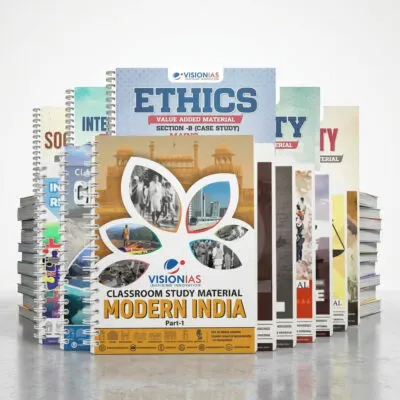
Vision IAS World History

English Medium | 2 Booklets | 2024 | UPSC Study Material
Key Highlights:
📘 2 Booklets
📚 World History
🎓 Vision IAS
🏷️ Printed
🇬🇧 English Medium
₹688
🌀 spiral
📘 book-binding
Only 19 sets left
Selling fast (50 sold this week)
5% OFF Use UPSC5% (COD Available)
10% OFF Use UPI10 (UPI Only)
Secure Payment
Fast Delivery
Safe Packaging

About Vision IAS World History Notes

The Vision IAS World History Notes is a printed UPSC study material set sold by UPSC Store — India’s trusted source for genuine, latest-batch civil services preparation books. This page covers full booklet details, syllabus coverage, pricing, shipping, and frequently asked questions. Useful for UPSC CSE, BPSC, UPPSC, MPPSC, RAS and other state PSC examinations.


Vision IAS World History Product Description

Vision IAS World History Comprehensive Printed Study Material – English Medium: The Definitive GS Paper I Reference Set for UPSC CSE

Related: Vision IAS notes · UPSC History material

Product Overview

Feature CategorySpecifications & Details
Booklets Count2 High-Density Printed Booklets (Comprehensive Set)
LanguageEnglish (Standard Academic English for UPSC)
PublisherVision IAS (Exclusive Printed Edition)
ConditionBrand New (Freshly Printed & Quality Checked)
FormatHigh-Quality Printed Physical Copy
Paper Quality75 GSM Ultra-White Executive Paper
BindingReinforced Soft-Bind / High-Tension Industrial Spiral

Complete Booklet Catalog

The Vision IAS World History curriculum is meticulously divided into two primary volumes, designed to cover the entire spectrum of the UPSC GS Paper I syllabus from the 18th century to the late 20th century. Below is the detailed inventory of the booklets included in this package:

  • Booklet 1: Foundations of the Modern World & Age of Revolutions

    • Focus: Enlightenment, American Revolution, French Revolution, Industrial Revolution, and Rise of Nationalism.
    • Internal Index: Comprehensive Chronology from 1750 to 1850.
  • Booklet 2: Global Conflicts, Ideologies & The Modern Era

    • Focus: World War I, World War II, Rise of Totalitarianism (Nazism/Fascism), Decolonization, Russian Revolution, and the Cold War era.
    • Internal Index: Detailed Post-War reconstruction and Global Institutional analysis.

Physical Product Engineering & Material Standards

This is not a standard photocopy; it is a professionally engineered study resource. The physical integrity of the Vision IAS World History Notes is prioritized to withstand the rigorous 12–18 month preparation cycle of a UPSC aspirant. Every page is printed on 75 GSM (Grams per Square Meter) paper, which ensures a premium tactile experience and prevents ink bleed-through. This is particularly crucial for students who use highlighters, gel pens, or heavy ink markers to annotate their notes.

The printing utilizes Anti-Glare Carbon-Black Ink technology. Standard prints often reflect light under desk lamps, causing eye strain during long night-study sessions. Our specialized ink ensures high contrast and matte finish, making the text legible under various lighting conditions. The font size is optimized at 10.5pt Arial/Times New Roman for maximum readability without increasing the bulk of the booklet excessively.

The binding is a Reinforced Industrial Grade solution. We recognize that these booklets are flipped thousands of times. The spine is treated with high-flexibility adhesive or high-tension spirals (depending on the batch) that allow the book to lay flat on a desk—a critical feature for hands-free reading and note-taking. The cover page is a 250 GSM laminated cardstock, providing a moisture-resistant barrier against accidental spills and environmental humidity.

Deep Dive: Booklet 1 – The Dawn of Modernity

Booklet 1 serves as the structural foundation for understanding the “Modern World.” The content is organized chronologically, but with a thematic overlay that aligns with the UPSC Mains requirement of “Events from 18th Century.”

Chapter 1: The Enlightenment and Its Impact

The internal content of this chapter begins with a Conceptual Framework Diagram. It maps out the transition from the Middle Ages to the Age of Reason. The booklet provides a tabular comparison of different thinkers—Montesquieu, Voltaire, and Rousseau—detailing their specific philosophical contributions and how those theories translated into political action. This section is characterized by “Key Takeaway Boxes” that summarize the impact of the Enlightenment on global democracy.

Chapter 2: The American Revolution

The booklet features high-resolution grayscale maps showing the 13 Colonies and the territorial shifts after the Treaty of Paris. The internal layout includes a “Causes and Consequences” flowchart, which breaks down complex economic factors like the Stamp Act and the Tea Act into digestible bullet points. A unique feature of this booklet is the “Comparative Analysis” section, where the American Revolution is compared with the French Revolution in a side-by-side table.

Chapter 3: The French Revolution & Napoleon

This is one of the most data-dense chapters. The internal content uses a Multi-Phase Timeline. Phase 1 (National Assembly), Phase 2 (Legislative Assembly), Phase 3 (National Convention), and Phase 4 (The Directory). The booklet uses bold headers to distinguish between socio-political causes and immediate triggers. The section on Napoleon Bonaparte includes a “Legacy Assessment” chart, evaluating his role as a “Modernizer” vs. a “Tyrant,” which is a recurring theme in UPSC questions.

Chapter 4: The Industrial Revolution

This chapter moves away from pure politics into socio-economic history. The internal formatting uses Micro-indices for specific inventions (Steam engine, Spinning Jenny) and their economic cascading effects. The booklet includes a specialized section on the “Social Impact,” detailing urbanization and the rise of the working class, presented through contemporary excerpts and statistical estimates of the era.

Deep Dive: Booklet 2 – Global Conflicts and Shifting Paradigms

Booklet 2 transitions into the 20th century, where the complexity of international relations increases. The Vision IAS editorial team has structured this booklet to handle the “Clash of Ideologies.”

Chapter 5: World War I and the Treaty of Versailles

The internal content is designed around “System of Alliances.” A complex web of treaties is simplified into a graphic map showing the Triple Entente and the Central Powers. The booklet meticulously lists the terms of the Treaty of Versailles in a “Impact on Germany” list, which helps students memorize specific clauses like Article 231 (War Guilt Clause). There is a specific “Analytical Sidebar” discussing the failure of the League of Nations.

Chapter 6: The Inter-War Years & Rise of Dictatorships

This section contains detailed profiles of Fascism in Italy and Nazism in Germany. The physical layout utilizes Bulletized Comparison Pillars between the two ideologies. The “Great Depression” section is presented with a focus on the “Global Domino Effect,” showing how economic collapse in the US led to political radicalization in Europe.

Chapter 7: World War II and the New World Order

Unlike standard history books, these notes focus on the “Political Outcomes” rather than just military battles. The internal content highlights the Yalta and Potsdam conferences. It includes a schematic representation of the birth of the United Nations, highlighting the structure of the Security Council and the General Assembly as per the UN Charter.

Chapter 8: Decolonization and the Cold War

This is a critical section for UPSC GS Paper I and International Relations (GS Paper II). The booklet provides a Geopolitical Map of the Cold War era, highlighting “Proxy War” zones like Korea and Vietnam. The decolonization section is organized by region (Africa, SE Asia), providing a comparative study of the “Patterns of Independence.” The internal content ends with a section on the “Disintegration of the USSR,” listing the 14 internal and external causes in a hierarchical list.

“Vision Special” Internal Formatting Features

What sets these printed booklets apart from generic textbooks is the UPSC-Centric Internal Architecture. Every chapter is infused with specific design elements to aid memory retention:

  • The “Vision Focus” Boxes: Interspersed throughout the text, these boxes highlight potential “Mains Question” areas. For example, in the French Revolution chapter, a Vision Focus box might ask, “To what extent did the French Revolution fulfill the ideals of Liberty, Equality, and Fraternity?” and provide a 4-point structure for the answer.
  • Gray-Scale Topographical Maps: These are not just decorative. Each map is specifically annotated to show boundary changes relevant to the syllabus, such as the Unification of Italy or the Balkan Crisis.
  • Wide Margins for Active Recall: Every page is designed with a 1.5-inch outer margin. This is a deliberate physical design choice to allow students to jot down keywords, date mnemonics, or cross-references to current affairs.
  • Terminology Glossaries: At the end of major sections, the booklet provides a “Key Terms” list (e.g., Bourgeoisie, Proletariat, Lebensraum, Glasnost) ensuring students use the correct academic vocabulary in their answers.

Syllabus Mapping and Content Coverage

The physical content of these booklets is strictly curated to match the UPSC Civil Services Examination (CSE) Mains Syllabus. The notes exclude unnecessary academic fluff found in standard history degrees and focus purely on the following dimensions:

  1. Events from the 18th Century: Detailed coverage of the 1700s.
  2. Industrial Revolution: Economic and social transformation.
  3. World Wars: Causes, courses, and long-term consequences.
  4. Redrawing of National Boundaries: Post-war treaties and the formation of new states.
  5. Colonization and Decolonization: Imperialist motives and the struggle for freedom.
  6. Political Philosophies: Detailed chapters on Communism, Capitalism, and Socialism.

How to Utilize the Physical Booklet for Maximum Marks

To maximize the utility of these Vision IAS World History notes, students are advised to follow a Layered Reading Approach. The physical layout supports this. In the first pass, focus on the Bolded Headers and Timelines to establish a chronological skeleton. In the second pass, dive into the Tabled Data for comparative analysis. Because the paper is 75 GSM, students should use color-coded highlighters—Yellow for dates, Pink for personalities, and Green for theoretical concepts.

The “Summary Tables” at the end of each booklet are designed for the “Last Week Revision” phase. These tables compress 50 pages of content into 2-3 pages of high-yield facts, making them indispensable for the period between the UPSC Prelims and Mains examinations.

Frequently Asked Questions (FAQ)

1. Is this the original Vision IAS printed material or a photocopied version?
This is a high-quality printed edition, utilizing premium 75 GSM paper and industrial-grade binding. It is designed to match the clarity and professional standards of original classroom material, ensuring no blurred text or missing diagrams.

2. Does the World History set cover the 2024-2025 UPSC syllabus updates?
Yes, these notes are updated to reflect the current trend of questions asked by the UPSC. While the core of World History remains static, the “Analysis and Impact” sections are updated to provide the perspective required for modern Mains answers.

3. What is the quality of the maps? Are they readable?
The maps are printed using high-resolution grayscale technology. Unlike standard photocopies where maps often turn into black blobs, our printing process preserves the boundary lines, text labels, and shading, making them fully functional for study.

4. Can I use a highlighter on the pages?
Absolutely. The 75 GSM executive paper is specifically chosen for its “low-absorbency” and “high-opacity” properties, which prevents highlighter ink from bleeding through to the reverse side of the page.

5. How is the product packaged for shipping to prevent damage?
Every order is triple-layered. The booklets are first placed in a moisture-proof plastic sleeve, followed by a layer of bubble wrap, and finally enclosed in a corrugated cardboard box or a heavy-duty tamper-proof courier bag to ensure they arrive in pristine condition.

6. Are these notes sufficient for the World History portion of GS Paper I?
Vision IAS notes are widely considered the gold standard for World History. They cover every topic mentioned in the UPSC syllabus. When combined with the “Vision Focus” answer writing hints included in the booklets, they provide a comprehensive solution without the need for additional bulky textbooks like Norman Lowe or Arjun Dev.

7. What if I find a printing defect in my copy?
We maintain a strict quality control process. However, if a booklet contains missing pages or illegible printing, we offer a hassle-free replacement policy. Ensure you contact customer support within 48 hours of delivery.

8. Is there space in the booklets for me to write my own notes?
Yes, the booklets are designed with wide side margins and extra “Notes” pages at the end of each major chapter specifically for the purpose of personal annotation and adding points from current affairs or mock tests.

9. How do these notes handle complex ideologies like Socialism and Communism?
The booklets use a “Comparative Ideology Matrix.” This table breaks down the economic, social, and political tenets of Capitalism, Socialism, and Communism side-by-side, making it easy to understand the fundamental differences and historical conflicts between them.

10. Is this set suitable for beginners who have no background in history?
The material is structured in a “Basic to Advanced” flow. Each booklet starts with a “Contextual Introduction” that explains the global state of affairs before the specific era begins, making it accessible for students from Science, Commerce, or Engineering backgrounds.

*Note: This product description is focused on the physical study material and its internal educational structure. Visual representations in the listing are of the actual printed product.*

Reference: UPSC official syllabus

Customer Reviews 171

4.5
Based on 171 reviews
5★
102
4★
51
3★
18
2★
0
1★
0
R
Rajesh Kumar Singh
23 Apr 2026
✓ Verified

Mast booklets yaar, bilkul comprehensive hai. Vision IAS ne world history ko bahut clearly explain kiya hai.

S
Sneha Malhotra
21 Apr 2026
✓ Verified

Bohot detailed aur comprehensive material mila. Bilkul sahi choice.

A
Arjun Verma
19 Apr 2026
✓ Verified

Booklets bilkul on-point hain world history ke liye. Paisa barbaad nahi hua definitely.

R
Rahul Verma
17 Apr 2026
✓ Verified

Quality bohot acha hai aur concepts bilkul clear ho gaye.

A
Anjali Singh
13 Apr 2026
✓ Verified

Padhne layak material hai, sabkuch samajh aa gaya easily.

K
Kavya Desai
12 Apr 2026
✓ Verified

Bohot helpful material mila, packaging bhi secure thi.

A
Arjun Desai
05 Apr 2026
✓ Verified

Covers important world history topics but feels slightly outdated in some sections. Helps for basic concept clarity.

A
Arjun Patel
28 Mar 2026
✓ Verified

Amazing quality aur comprehensive coverage.

About Vision IAS World History

Vision IAS World History is a highly recommended UPSC study material from Vision IAS, specially designed for World History preparation. Available in English medium, this material is crafted to match the exact requirements of the UPSC Civil Services Examination syllabus — covering both Prelims and Mains comprehensively.

Product Details

  • Institute: Vision IAS
  • Subject: World History
  • Medium: English
  • Format: Printed
  • Delivery: Pan-India delivery in 3–5 working days
  • Format: Original printed material, verified authentic

Why Buy from UPSC Store?

  • 100% Genuine Printed Material — Original printed notes, no photocopies or fake copies
  • Fast Delivery — Ships within 24 hours, arrives in 3–5 days pan-India
  • Secure Packaging — Bubble-wrapped and boxed to prevent damage in transit
  • Trusted by 10,000+ Aspirants — India's most reliable UPSC material marketplace
  • WhatsApp Support — Get expert guidance on material selection before ordering

Frequently Asked Questions

Is this product 100% original?

Yes, all products at UPSC Store are 100% genuine printed materials. We do not sell photocopies or fake copies.

How long does delivery take?

Orders are dispatched within 24 hours and delivered across India in 3–5 working days via reputed courier partners.

Can I return the product?

Yes, we accept returns within 7 days if the product is damaged or incorrect. Check our refund policy for details.

Which other study materials should I buy with this?

We recommend pairing this with current affairs notes and a UPSC test series for comprehensive preparation. Browse more in General Studies, History, UPSC, Vision IAS.