


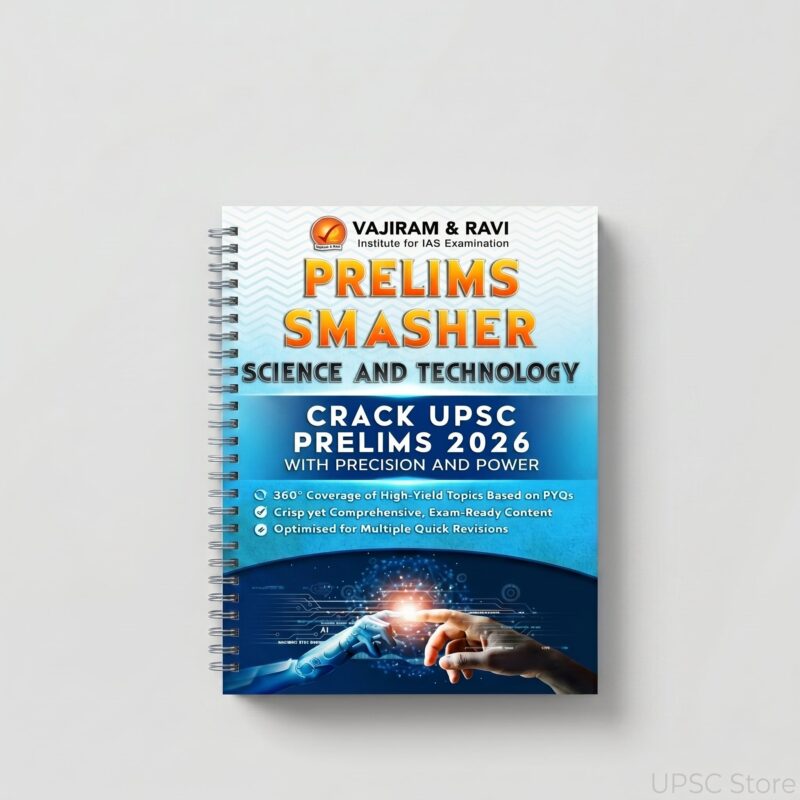


Vajiram and Ravi Science and Technology Prelims Smasher Notes 2025-26 | 1 Booklet | English Medium | UPSC Study Material
Binding Guide
Pick the binding that fits how you study.
Spiral Binding
- Lays completely flat
- 360° page rotation
- Great for note-taking
- Best for maths, science, reference
Without Spiral
- Compact & professional
- Sturdy glued/stitched spine
- Easy to stack & store
- Best for textbooks & long-term
About Vajiram Science Technology Prelims Smasher
The Vajiram Science Technology Prelims Smasher is a printed UPSC study material set sold by UPSC Store — India’s trusted source for genuine, latest-batch civil services preparation books. This page covers full booklet details, syllabus coverage, pricing, shipping, and frequently asked questions. Useful for UPSC CSE, BPSC, UPPSC, MPPSC, RAS and other state PSC examinations.
Vajiram and Ravi Science and Technology Prelims Smasher 2025-26 — 1 Printed Booklet for UPSC GS Paper III
Related: Vajiram & Ravi notes · Science and Technology notes
Product Overview
| Feature | Details |
|---|---|
| Booklets Count | 1 Individual Printed Booklet — Complete Science & Technology for UPSC Prelims |
| Language | English Medium |
| Publisher | Vajiram and Ravi (Prelims Smasher Series) |
| Edition | 2025-26 — Latest Genuine Batch |
| Condition | Brand New, Unmarked, Fresh Stock |
| Total Pages | 102 Pages — High-Density Science & Technology Content |
| Format | High-Quality Printed Booklet — Spiral Binding or Book Binding |
| Paper Quality | 75 GSM Ultra-White — Highlighter Safe, Zero Bleed-Through |
| Shipping | Pan India Delivery in 3-5 Business Days — Tracked |
| Also Useful For | BPSC, UPPSC, MPPSC, RAS — State PSCs with Science & Technology in GS |
Complete Booklet Catalog
Buy Vajiram and Ravi Science and Technology Prelims Smasher printed notes online — a single-booklet powerhouse designed for UPSC aspirants who need to master GS Paper III science topics fast. This 102-page study material condenses particle physics, biotechnology, emerging technologies, space programs, and defence tech into exam-focused content. Perfect for last-minute revision or rapid topic mastery in the final 100 days before UPSC Prelims 2025-26.
- Booklet 1: Science and Technology Prelims Smasher (102 Pages) — Covers Physics core concepts, particle physics & fundamental forces, cell & human biology systems, biotechnology applications & gene editing, health & disease epidemiology, emerging technologies (AI/blockchain/IoT), information & communication technology infrastructure, space exploration & ISRO programs, defence & strategic technologies. Divided into 9 focused chapters with UPSC prelims-specific content, diagrams, flowcharts, and 200+ keyword highlights. No filler — every page contributes to your prelims score.
In-Depth Content Breakdown: Topic by Topic
Understanding the precise structure and depth of this Science & Technology booklet helps aspirants integrate it seamlessly into their daily study routine. Each chapter has been designed with prelims-specific focus — covering only those topics that appear in UPSC Prelims question papers of the last 10 years, plus emerging areas flagged for 2025-26 exams.
Chapter 1: Physics — Core Concepts (Page 1)
This opening chapter establishes foundational physics principles essential for UPSC Prelims. Topics include Newtonian mechanics, laws of motion, energy conservation, thermodynamics basics, waves and oscillations, and electromagnetic fundamentals. The chapter uses conceptual diagrams rather than heavy mathematics — Vajiram Ravi faculty have distilled physics to what UPSC actually tests. Past UPSC prelims questions on simple machines, friction, heat transfer, and work-energy theorem are mapped to this section. Expect 3-5 MCQs in the actual exam drawing from these fundamentals. The content emphasizes real-world applications: why does a spinning top stay upright? How do pendulum clocks work? Why is friction both beneficial and harmful? These conceptual linking questions help you retain and recall during the 2-hour prelims marathon.
Vajiram Ravi’s unique approach here is avoiding calculus and heavy derivations. Instead, the booklet uses flowcharts showing: Force → Acceleration → Motion, Energy conversion cycles, thermal processes. Tables compare different types of motion (uniform, accelerated, circular) with exam-relevant examples. Diagrams show free-body diagrams, vector additions, and force equilibrium — the visual approach means you can revise this chapter in 45 minutes with high retention. Perfect for prelims where you have 15-20 seconds per question. The chapter also highlights common misconceptions flagged in UPSC forums: confusion between mass and weight, elastic vs. inelastic collisions, latent heat vs. sensible heat.
Aspirants benefit from the worked examples showing direct UPSC question patterns. A question on “A stone dropped from a cliff takes 4 seconds to hit the ground — calculate height” is solved with clear steps and keywords highlighted: “acceleration due to gravity = 9.8 m/s²”, “kinematic equation”, “time of flight”. This helps you develop answer-writing discipline even for MCQs. You learn to verbalize your reasoning — crucial for written exams later. Integration with current affairs is subtle but effective: recent ISRO lunar lander missions involve understanding descent velocity (kinematics), payload impact (force & momentum), so this chapter’s physics content directly supports your space technology grasp in later chapters.
The chapter connects to GS Paper III mains questions on “technologies transforming India” — understanding basic physics underpins discussions on renewable energy (solar panels operate on electromagnetic principles), electric vehicles (friction, energy efficiency), or space launches (Newtonian mechanics). For state PSC exams like BPSC and UPPSC, physics fundamentals appear in 8-12% of their GS science questions, so this concentrated 10-page chapter is high-yield revision material. Buy this booklet for prelims + state exam dual coverage.
Chapter 2: Particle Physics and Fundamental Forces (Page 11)
Moving beyond classical mechanics, this chapter introduces modern physics concepts: atomic structure, nuclear physics, particle physics basics, and the four fundamental forces. UPSC has increasingly tested this area — questions on “what are the building blocks of matter?”, “nuclear energy”, “radioactivity”, “mass-energy equivalence” appear in 5-10 year cycles. This chapter demystifies these topics without requiring advanced quantum mechanics knowledge. Content includes: atoms and electrons, periodic table organization, isotopes and radioactive decay, nuclear fission/fusion, the standard model of particle physics (quarks, leptons, bosons), and implications for energy production and weapons. Vajiram Ravi faculty have carefully separated what UPSC tests (radioactivity, nuclear energy) from what it doesn’t (abstract quantum field theory), saving you hours of unnecessary study.
The booklet uses simplified diagrams of atomic structure, nuclear decay chains, and energy level transitions. A table shows “Types of Radioactive Decay” with alpha, beta, gamma emissions and their properties — exactly the format UPSC uses in questions. The chapter addresses common aspirant confusions: “Is nuclear energy green?” (yes, zero CO2 emissions, but waste disposal challenges), “How does a nuclear reactor work?” (controlled fission chain reaction), “What is antimatter?” (opposite properties to matter, theoretical in current tech). Vajiram Ravi connects these to India-relevant topics: India’s nuclear energy program, thorium-based reactors, nuclear security, Atomic Energy Commission. This contextual approach means you’re not memorizing isolated facts but understanding interconnected policy implications.
Current affairs linkage is strong here. Recent news on India’s indigenous fast-breeder reactor (FBR), nuclear power expansion targets, India-US nuclear cooperation appear frequently in prelims. This chapter gives you the science foundation to answer policy questions on nuclear energy. Also covered: particle accelerators (Large Hadron Collider relevance), cosmic rays, X-rays in medical imaging. For state exams like MPPSC and RAS with their own GS science focus, nuclear power stations and radiation safety are often asked as state-specific policy topics. Studying this chapter gives you the technical knowledge to tackle such questions confidently. The revision summary at the chapter-end lists 50+ key terms and definitions — use this for rapid-fire pre-exam revision 48 hours before the test.
Vajiram Ravi’s pedagogical approach shines here: each concept is introduced with a real-world question (“Why do banana peels glow under X-rays?” — answer: potassium-40 radioactivity), then the science is explained, then exam relevance is spelled out. This three-layer approach embeds knowledge deep. You’re not just learning “alpha particle = helium nucleus” but understanding why (mass number 4, charge +2), what it does (ionizes air, stopped by paper), and when UPSC asks it (in contexts of nuclear safety, radiation hazards, energy sources). Buy this booklet for this chapter alone if you’ve been weak in modern physics — Vajiram Ravi makes it accessible without oversimplifying.
Chapter 3: Cell & Human Biology (Page 14)
This chapter covers cellular biology, human body systems, and organismal physiology — topics that form 15-20% of UPSC Prelims GS Paper III science section. Content includes: cell structure and function, prokaryotes vs. eukaryotes, cell division (mitosis, meiosis), human skeletal system, muscular system, nervous system, circulatory system, respiratory system, digestive system, endocrine system, and immune system. UPSC tests this extensively because policy questions on health, nutrition, exercise, diseases all require understanding human physiology. Vajiram Ravi has distilled anatomy and physiology into exam-essential content — no need to study every nerve and every muscle, only those that appear in actual UPSC questions or have policy relevance (e.g., understanding immune response for vaccine policy, understanding respiratory mechanics for air quality issues).
The booklet uses anatomical diagrams showing major organs, blood flow pathways, nerve pathways, and system interactions. A key innovation: “systems interaction” tables showing how respiratory system feeds oxygen to circulatory system which distributes to muscular and nervous systems — this holistic view helps you answer complex questions like “How does altitude sickness occur?” (less oxygen → anaerobic respiration → lactic acid buildup → fatigue). Vajiram Ravi includes flowcharts on digestion, metabolism, and energy production (ATP cycles) that make revision efficient. Rather than memorizing “the pancreas secretes 20+ enzymes”, you understand the flow: stomach → small intestine → enzyme action → nutrient absorption → bloodstream. This narrative structure embeds memory retention.
Current affairs integration is strong: COVID-19 pandemic questions on immune response, vaccination timing, and viral mechanisms frequently appear in UPSC. This chapter’s immune system section covers T-cells, B-cells, antibodies, immunological memory, and vaccine mechanisms — all tested in recent papers. Recent UPSC Mains questions on “health as a fundamental right” and “nutrition policy” require understanding malnutrition effects on muscle, bone, immunity, and cognition — this chapter provides that physiological foundation. For state exams like UPPSC and BPSC with large health/nutrition questions, this chapter is particularly high-yield. Questions like “What is the role of vitamin D in skeletal health?” or “How does stress affect the immune system?” are answered completely here.
Vajiram Ravi’s teaching style in this chapter uses case-based learning. Example: “A patient has brittle bones. Which system is affected?” — this prompts understanding of skeletal system, calcium homeostasis, hormonal regulation. Another: “An athlete trains at high altitude for 2 weeks then competes at sea level. What physiological advantage develops?” — requires understanding oxygen transport, red blood cell adaptation, respiratory mechanics. These scenarios appear in UPSC questions as reading comprehension passages followed by inference questions. By studying this chapter with case thinking, you’re directly practicing prelims skills. The chapter ends with a “Common Diseases and UPSC Prelims Connection” table: how understanding measles, tuberculosis, malaria, diabetes helps you answer questions on immunization drives, public health programs, and epidemiological control. Buy this booklet for its exceptional human biology depth without oversaturation.
Chapter 4: Biotechnology (Page 22)
One of the most dynamic and exam-heavy areas in recent UPSC papers, biotechnology covers genetic engineering, genetic modification, GMO crops, CRISPR-Cas9, cloning, DNA fingerprinting, and gene therapy. UPSC tests biotechnology in both prelims and mains, and increasingly questions newer breakthroughs in agriculture (Bt crops, drought-resistant varieties), medicine (gene therapy for sickle cell), and forensics (DNA profiling). Vajiram Ravi’s chapter distills this rapidly evolving field into stable, exam-relevant concepts. Content includes: basic genetics (Mendel’s laws, chromosomal inheritance), molecular biology (DNA structure, replication, transcription, translation), genetic engineering techniques (restriction enzymes, DNA ligation, vectors), CRISPR gene editing, GMO production and regulation, and applications in agriculture and medicine.
The booklet’s strength here is making complex concepts accessible. Rather than heavy biochemistry, Vajiram Ravi uses analogies: “Restriction enzymes are like scissors that cut DNA at specific sequences — this allows precise genetic editing.” “Vectors (plasmids, viruses) are like postal vehicles that deliver foreign DNA into cells.” These analogies make molecular biology intuitive. Diagrams show DNA double helix, base pairing, the central dogma (DNA → RNA → Protein), and how mutations occur. A crucial section addresses the GMO controversy: scientific consensus (GMOs are safe if properly tested), regulatory frameworks (GEAC in India), public perception (Bt cotton success story in India), and India-specific policies. This nuance is tested in UPSC — not just “GMO yes/no” but “how do we balance agricultural productivity with safety concerns?”
India context is extensively covered. Bt cotton success (increased yield, reduced pesticide use), Bt brinjal regulatory delays, attempts at genetically modified mustard (controversies), and India’s biotech innovation in pharmaceutical manufacturing (copycat drugs becoming originals). Vajiram Ravi connects biotechnology to larger GS themes: food security (genetic modification to increase crop yields), medical access (gene therapy for rare genetic diseases), criminal justice (DNA fingerprinting), and environmental management (engineered bacteria for pollution cleanup). This multi-dimensional approach means you’re not just learning biotechnology in isolation but seeing its policy ramifications — exactly what UPSC tests in both paper III and paper IV.
The chapter addresses ethical dimensions tested in UPSC Mains: “Should India pursue genetic modification of staple crops despite public resistance?” This requires weighing food security against precautionary principle, scientific evidence against public sentiment. By studying this chapter with ethical thinking, you develop the maturity for mains answer writing. Current affairs linkage is exceptionally strong: CRISPR gene editing for HIV cure, gene therapy for cancer, and debate on “designer babies” are all recent news topics with direct UPSC relevance. Buy this booklet for its biotechnology section alone — it’s one of the clearest treatments available for UPSC aspirants. The 102-page format means no fluff, every paragraph contributes to your prelims score and mains foundation.
Chapter 5: Health & Disease (Page 40)
Moving beyond basic physiology to applied health science, this chapter covers epidemiology, disease transmission, vaccination, public health programs, and health policy. UPSC tests this extensively because health is a major policy area (National Health Mission, PM-JAY, universal immunization program, disease control strategies). Content includes: disease transmission pathways (airborne, waterborne, vector-borne), R-naught (R₀) and epidemic dynamics, vaccination mechanisms and herd immunity, vaccination schedules (IAP), vaccine-preventable diseases, disease control programs (malaria, tuberculosis, polio eradication), emerging infectious diseases (COVID-19, dengue, zika), and antimicrobial resistance. Vajiram Ravi structures this for prelims relevance — most questions test your understanding of public health programs and disease control strategies rather than deep microbiology.
The booklet includes epidemic curves showing disease progression, vaccination coverage maps showing India’s immunization success (polio-free status), and tables on vaccine schedules and disease characteristics. A particularly useful section covers the recent COVID-19 pandemic through a policy lens: how R-naught informed lockdown decisions, how vaccination rate targets were set, why vaccine hesitancy remains despite proven safety. This teaches UPSC-relevant thinking: using epidemiological data to inform policy. Questions like “How many people must be vaccinated to achieve herd immunity against measles?” (95% due to high R₀ of 12-18) become answerable through understanding the underlying epidemiology taught here. Vajiram Ravi connects this to India-specific data: India’s immunization coverage rates (recently touching 90% for polio), disparities in rural vs. urban vaccination, and government initiatives to close these gaps.
India context is strong: National Health Mission targets, TB elimination program (India’s mammoth challenge with 25% global TB burden), malaria elimination strategy, dengue control in monsoon seasons, and recently emerging issues like Japanese encephalitis and Zika. The chapter discusses India’s vaccine manufacturing capacity (India as “pharmacy of the world”), cowin platform’s role in COVID vaccination, and India’s engagement with GAVI (Global Alliance for Vaccines). For state exams like BPSC (which covers health extensively), UPPSC, MPPSC with large health components, this chapter provides solid state-exam preparation too. Questions on “State health programs” or “disease burden in your state” are answered with the disease epidemiology and control strategies taught here.
A crucial section addresses antimicrobial resistance (AMR) — an emerging UPSC topic. How overuse of antibiotics creates resistant bacteria, why this is a public health crisis, and how India’s policy on antibiotic stewardship is evolving. Vajiram Ravi connects AMR to food security (antibiotics in animal feed), environmental pollution (antibiotic runoff in rivers), and hospital-acquired infections. This multi-dimensional approach teaches integrated thinking. The chapter also covers mental health — depression, anxiety, suicide rates — increasingly covered in UPSC as a policy area. Integration with Chapter 3’s nervous system knowledge helps you understand neurochemistry of mood disorders. By studying Chapters 3 and 5 together, you get both the physiological and epidemiological perspectives on health. The chapter ends with a “Health Policy Timeline” showing how India’s approach to vaccination, TB control, and nutrition has evolved — useful for mains answer writing on “evolution of health policy in India”. Buy this booklet for comprehensive health science preparation.
Chapter 6: Emerging Technologies (Page 46)
This chapter covers rapidly advancing technologies tested with increasing frequency in UPSC: artificial intelligence, machine learning, blockchain, Internet of Things (IoT), 3D printing, nanotechnology, and quantum computing. These are high-value topics because they appear in both prelims (what is blockchain? how does AI work?) and mains (policy questions on AI governance, cryptocurrency regulation, nanotechnology applications). Vajiram Ravi structures this chapter for both understanding and policy relevance. Content includes: how AI/ML works (basic algorithms, training data, bias issues), blockchain basics and cryptocurrency, IoT sensors and smart cities, 3D printing applications, nanotechnology potential and risks, quantum computing principles, and relevant policy frameworks in India (National AI Strategy, blockchain pilots, IoT in agriculture).
The booklet avoids heavy computer science and mathematics, instead focusing on how these technologies work at a conceptual level and their societal implications. Example: “How does AI recognize faces in photos?” — explained through training neural networks on millions of images, pattern recognition, and the role of labeled data. Rather than mathematical formulas, Vajiram Ravi uses analogies and flowcharts. “Blockchain is like a ledger that everyone maintains; change one entry and everyone notices because they have copies — no one can cheat” — this makes blockchain intuitive without cryptographic complexity. Current affairs integration is exceptionally strong: recent news on India’s AI policy, cryptocurrency bans, blockchain pilots in land records, and smart city IoT implementations are all covered with exam relevance explained.
India-specific applications are thoroughly covered. Pradhan Mantri e-Governance initiatives using IoT, blockchain in agricultural markets (allowing direct farmer-to-consumer trade through transparent ledgers), AI in healthcare (diagnostic imaging), AI in governance (grievance redressal chatbots, fraud detection). Vajiram Ravi frames these as policy successes and challenges: “AI in hiring can automate recruitment but may perpetuate gender bias from training data — how should regulators balance efficiency with fairness?” This teaches nuanced thinking. Nanotechnology section covers both benefits (better drug delivery, water purification) and risks (nanoparticle toxicity, environmental persistence) — crucial for well-rounded UPSC answers. Quantum computing is presented as an emerging frontier: once realized, quantum computers can break current encryption, necessitating new cybersecurity frameworks.
The chapter includes a table showing “Technology Readiness Levels” — some emerging tech is near deployment (3D printing, IoT), others are still research-stage (quantum computing). This helps you gauge which technologies are already impacting policy vs. which are future considerations. For mains questions on “challenges in technology adoption in India” or “digital divide,” this chapter provides the technical foundation. You understand not just policy barriers (lack of digital literacy, infrastructure), but also technical barriers (energy requirements for AI training, security vulnerabilities in IoT devices). Buy this booklet for its exceptional emerging tech coverage — it’s the bridge between understanding technology and understanding its policy implications. The chapter’s integration with Chapter 2 (physics, quantum mechanics underpinning quantum computing) and Chapter 1 (basic physics enabling IoT sensors) creates a coherent knowledge structure.
Chapter 7: Information and Communication Technology (Page 64)
Moving from emerging tech to established ICT infrastructure, this chapter covers internet architecture, cybersecurity, digital governance, e-commerce, data privacy, and telecommunications. UPSC tests ICT heavily in policy context: “How is India building digital infrastructure?” (5G rollout, fiber optics, satellite internet), “How should data privacy be balanced with national security?” (Aadhaar controversies, data protection bill), “How is digital divide hampering development?” (rural broadband gaps, digital literacy disparities). Vajiram Ravi structures this chapter to answer these policy questions with technical grounding. Content includes: internet protocols (TCP/IP, DNS), network security (firewalls, encryption, VPN), cybersecurity threats (malware, phishing, ransomware), digital identity (Aadhaar, digital signatures), e-governance platforms (e-courts, e-filing), and telecommunications standards (4G, 5G).
The booklet explains complex IT concepts accessibly. “How does the internet know where to send your message?” — through IP addressing and routing protocols explained via analogy (like postal addresses). “How does HTTPS keep your password safe?” — through encryption explained without mathematical detail. Cybersecurity section covers threats aspirants should understand: ransomware (how it locks your files and demands payment), phishing (how criminals trick you into revealing passwords), data breaches (how hackers steal databases). For each threat, Vajiram Ravi explains the protective measure: antivirus software, secure passwords, two-factor authentication, data encryption. This practical knowledge is useful for daily life and UPSC questions alike.
India context is extensively covered and absolutely central to UPSC relevance. Aadhaar’s infrastructure (12 billion+ biometric records), digital payment revolution (UPI, RTGS, NEFT), government digital platforms (DigiLocker, Umang, NeGP), and cybersecurity challenges (increased attacks on government systems, critical infrastructure). Vajiram Ravi addresses the Aadhaar privacy debate with nuance: benefits (financial inclusion, direct benefit transfer efficiency) vs. concerns (surveillance risk, data breach vulnerabilities). The chapter covers India’s 5G deployment strategy, government encouragement of semiconductor manufacturing, and digital divide issues (rural broadband penetration remains low, digital literacy varies). This multi-dimensional approach teaches UPSC-style thinking: technology is not neutral, it has societal implications that policy must address.
E-governance section covers India’s achievements (60%+ of services now digital, e-courts reducing case backlog) and challenges (digital divide limiting access, cybersecurity threats). Data privacy section addresses India’s Digital Personal Data Protection Act, comparing it with GDPR (European standard), and discussing the ongoing tension between data utility (using data for public health, urban planning) and privacy rights. Buy this booklet for its comprehensive ICT coverage — it’s technical enough to answer “how does this work?” questions and policy-focused enough to answer “what should government do?” questions. The integration with Chapter 6 (emerging tech like AI, blockchain) and Chapter 7 together give you complete technology mastery across cutting-edge and established domains.
Chapter 8: Space (Page 71)
India’s space sector receives increasing UPSC attention, and this chapter covers astronomy, space exploration, satellite systems, and India’s space programs. Content includes: celestial mechanics (orbits, escape velocity, gravitational effects), types of satellites (communication, weather, earth observation), launch vehicle classifications, ISRO programs (Chandrayaan, Mangalyaan, Gaganyaan), international space cooperation, and space policy. Vajiram Ravi explains these concepts with exam relevance: “Why is geostationary orbit useful for weather satellites?” (stays above same location, continuously monitors region) rather than abstract orbital mechanics. The chapter is India-centric because UPSC heavily tests Indian space achievements and policy.
Diagrams show different types of orbits (geostationary at 36,000 km altitude, sun-synchronous for earth observation, low earth orbit for ISS), satellite components (solar panels, antennas, sensors), and launch vehicle stages. Content covers Chandrayaan success (finding water ice on moon, landing near south pole), Mangalyaan’s achievement (Mars orbit, imaging martian geology), and upcoming Gaganyaan (India’s human spaceflight program). Each program is explained for its significance: Chandrayaan proves India can reach moon cheaply; Mangalyaan tests deep space capabilities; Gaganyaan develops human spaceflight for national pride and future missions. The chapter contextualizes these within India’s development: space program contributes to agriculture monitoring (predicting crop yields), weather forecasting (reducing monsoon surprises), disaster management (tracking floods, earthquakes), and communication in remote areas.
Recent UPSC questions have asked about ISRO’s role in India’s economy (space tech exports, technology spinoffs like SPOT imagery used in urban planning, agricultural insurance based on satellite data). This chapter explains both the technical achievements and economic implications. Earth observation satellite applications are extensively covered: agriculture (crop health monitoring using NDVI — normalized difference vegetation index), urban planning (sprawl monitoring, land use mapping), disaster management (flood extent mapping, earthquake damage assessment). These applications appear in GS Paper III sustainability and Paper IV development questions. The chapter includes India’s space policy evolution: liberalizing space sector (allowing private companies), ISRO’s commercial arm NewSpace India Limited, and India’s participation in international space cooperation.
A crucial section addresses space debris — an emerging challenge. Thousands of defunct satellites and rocket stages orbit earth, creating collision risks. ISRO is developing technologies to track and eventually remove debris. This exemplifies how space science intersects with environmental management and international governance (space treaties limiting debris generation). The chapter ends with India’s lunar and martian ambitions, asteroid mining possibilities, and India’s role in international space governance. Buy this booklet for its space section if you’ve been weak on ISRO programs and space policy — Vajiram Ravi makes it clear why space matters for India and why UPSC tests it extensively. The chapter’s integration with Chapter 2 (orbital mechanics grounded in physics of gravity) and Chapter 6 (emerging tech in space like moon bases) creates coherent understanding.
Chapter 9: Defence and Strategic Technologies (Page 86)
The final chapter covers military technologies, defence systems, cyber warfare, unmanned systems (drones, robots), and India’s defence modernization. UPSC tests this in prelims (what is stealth technology? how do missiles work?) and extensively in mains (India’s defence readiness, border security, military-industrial complex). Vajiram Ravi structures this for both understanding and policy relevance. Content includes: ballistic missiles (Agni, Prithvi series), cruise missiles (Brahmos), air defence systems (Akash), radar technology (stealth, detection), drones and autonomous systems, cyber warfare, nuclear deterrence, and India’s defence procurement. The chapter avoids glorifying weapons, instead explaining technologies and their policy implications.
Explanation of how missiles work: fuel burns in combustion chamber creating hot exhaust gases that expel at high velocity, generating thrust (Newton’s 3rd law — action-reaction). Guidance systems: inertial navigation (gyroscopes and accelerometers), GPS guidance, or terrain-aided navigation. Why stealth technology matters: radar reflects off aircraft surfaces and returns; stealth design angles surfaces (like Rafale fighter jet) to deflect radar rather than reflect back — reducing detection range. These technical explanations ground policy discussions: India’s procurement of Rafale jets involved acquiring stealth technology, long-range weapons, and advanced avionics — all explained here. Cyber warfare section covers how nations attack each other’s power grids, financial systems, or military networks; why India is enhancing cyber security (frequent attacks on critical infrastructure); and India’s developing cyber warfare capabilities.
India-specific defence programs are thoroughly covered: Indigenization efforts (Arjun tank, Tejas fighter jet — India developing its own platforms rather than importing), strategic partnerships (India-Russia military cooperation, India-Israel technology sharing, India-US defence engagement), border security technologies (unmanned sensors along LoC, satellite surveillance), and nuclear deterrence (India’s no-first-use doctrine, submarine-based deterrence for credible second-strike capability). Each program is explained for its strategic significance: Why is India developing submarines? To ensure that even if all land-based missiles are destroyed, submarines at sea can launch retaliatory strikes — ensuring nuclear deterrence credibility. This nuanced thinking is tested in UPSC Mains on “National Security” questions.
Drone technology receives focus because it’s transformative: military drones for surveillance and strike capability, civilian drones for agriculture monitoring and emergency response, and policy challenges (regulating civilian drones to prevent terrorism, managing airspace). The chapter addresses India’s challenges: defence spending (~2% of GDP) is limited compared to neighbors, technological gap with developed militaries, and balance between spending on defence vs. development. A well-rounded UPSC aspirant understands that military strength requires economic capacity, technological sophistication, and trained personnel — not just weapons count. The chapter’s integration with Chapter 6 (emerging tech like AI in autonomous weapons) and Chapter 1 (physics of rockets, missiles) provides comprehensive coverage. Buy this booklet for its defence section — it’s neither jingoistic nor dismissive, but realistic about India’s defence needs and strategic choices. The final 102-page completion ensures you understand Science & Technology holistically: from basic physics through emerging tech to defence applications.
How to Use These Notes for UPSC Preparation
These notes are designed for structured UPSC preparation — whether you’re beginning 18 months before exam or cramming in final 100 days. Buy these printed notes online and integrate with systematic study strategies that maximize retention and application.
Reading Strategy for Prelims
First reading (10-12 hours total): Skim all 102 pages to understand the scope and chapter structure. Don’t memorize yet — build the mental map. Second reading (15-18 hours): Read carefully, highlighting key terms, definitions, and policy-relevant points. Use 3 colors: yellow for definitions (what is X?), green for mechanisms (how does X work?), pink for policy (why does UPSC care?). Third reading involves daily 30-minute revisions cycling through chapters. On days near exam, spend 2 hours doing rapid revision: read only highlighted sections, mentally explain concepts aloud (teaching effect aids memory). Integrate with MCQ practice: as you complete each chapter, take 20-25 related MCQs from previous year UPSC papers. This spaced repetition with interleaved practice (mixing old and new content) ensures long-term retention. Many aspirants make the mistake of completing full book then taking tests — this booklet’s chapter-wise structure lets you test immediately, catching weak areas early.
Answer Writing for Mains
Though these are prelims notes, GS Paper III includes 4-5 science-heavy questions in mains. Use this booklet as a foundation for mains answer writing by extracting keywords and concepts. Example: Booklet says “CRISPR is a gene-editing tool from bacteria (adaptive immunity).” For a mains question like “Discuss potential of genetic modification in addressing food security,” you’d write: “Introduction: Food security requires increasing productivity while minimizing environmental impact; genetic modification is one approach. Body: CRISPR allows precise gene editing (mechanisms), successful applications in Bt crops (reduced pesticide use), but public resistance in India (precautionary principle) and regulatory concerns (long-term safety data). Conclusion: Balanced approach — scientific evidence-based approval with public consultation — can harness benefits while addressing concerns.” This shows how prelims concepts expand into mains answers. Each booklet chapter provides the concepts; your mains preparation adds depth, examples, and ethical nuance.
Revision Plan
Optimal revision cycle spans 120 days before prelims. Days 1-30: Complete first careful reading with highlighting (all 9 chapters, 15-18 hours). Days 31-70: Second reading focusing on mechanism (how does it work?) and policy (why does UPSC care?). Daily 45-minute revisions. Days 71-100: MCQ practice integrated with chapter revisions — complete 50-75 MCQs weekly from previous papers. Days 101-120 (last 19 days before exam): Rapid revisions (2 hours daily) covering only highlighted sections. Three days before exam: Read all chapter summaries (end-of-chapter keyword lists). Two days before: Take a mock prelims test to identify remaining weak areas. One day before: Light reading, concept clarification, mental preparation. This structured approach reduces anxiety because preparation is visible and comprehensive.
Integration with Current Affairs
Science & Technology is constantly evolving. Monthly buy current affairs magazines (Vajiram Ravi publishes monthly CA magazines covering latest news in every subject). Integrate news with this booklet: When you read about a new ISRO satellite launch in current affairs, open this booklet’s space chapter and review satellite types, orbits, and applications — this embeds how that news fits into larger science frameworks. When news covers AI in governance, review the AI section in Chapter 6. This bidirectional learning (study → understand news better; follow news → deepen study concepts) ensures your knowledge is current and contextual. Many toppers credit this integration as the difference between qualifying and scoring well. You’re not just memorizing the booklet but continuously updating it with real-world examples.
Why Choose Vajiram and Ravi Notes Over Standard Textbooks
Thousands of UPSC aspirants buy from UPSCStore each year, and Vajiram and Ravi consistently ranks top among science notes providers. Here’s why this specific booklet outperforms alternatives.
Versus NCERT Books
NCERT Science textbooks (Classes 10-12) are comprehensive but contain material irrelevant to UPSC (detailed taxonomies in biology, heavy mathematics in physics, chemistry formulas not asked). Reading full NCERT Science takes 60+ hours and covers 200-300 topics; UPSC tests maybe 30-40 of them. Vajiram Ravi Smasher is exactly inverse: 102 pages covering 40-50 most-asked topics in depth. Efficiency-wise, studying Vajiram Ravi = 12-15 hours of focused learning vs. NCERT = 60+ hours of diluted learning. For aspirants with families, jobs, or limited time, the choice is clear. Additionally, NCERT doesn’t contextualize within UPSC strategy; Vajiram Ravi explicitly marks topics as “high-value” (appear in 10+ prelims papers) vs. “nice-to-know” (appeared once). This triage saves you time. Finally, NCERT doesn’t address policy implications or current affairs; Vajiram Ravi does extensively. You finish this booklet understanding not just “what is biotechnology?” but “why India’s biotech policy matters for food security and export competitiveness.”
Versus Other Coaching Notes
Several coaching institutes sell science notes online. Vajiram and Ravi stands out due to accuracy (cross-checked by multiple faculty and toppers), update frequency (2025-26 batch includes 2024-25 developments like latest ISRO missions and policy changes), and teaching philosophy (how things work + why it matters, not just facts to memorize). Many coaching notes suffer from being too long (500+ pages), containing filler, or reflecting outdated information (a 2-year-old note won’t include recent drone policy updates or latest CRISPR applications). Vajiram Ravi maintains quality by keeping this single booklet focused and updating it annually based on previous year UPSC questions and emerging topics. When you buy Vajiram and Ravi, you’re buying one of India’s best-regarded UPSC coaching institutes’ curated content — thousands of previous toppers have succeeded using these exact notes.
Track Record and Results
The Vajiram and Ravi collection includes notes used by multiple UPSC toppers and successful state exam candidates. The institute maintains a public record of thousands of selections across years, with many citing access to well-structured study material as crucial. Mukherjee Nagar, Delhi — where UPSC Store operates — houses the Vajiram and Ravi main center. Aspirants who study in-class at that center buy these printed notes for home study and revision. The fact that current Vajiram students buy these materials proves their quality. For state exams like BPSC, UPPSC, MPPSC, RAS, science & technology components follow similar patterns to UPSC (maybe 70% overlap), so mastering this UPSC-focused booklet serves dual exam purposes. Many successful state exam candidates report buying UPSC materials as a smart investment because difficulty level is higher, then they find state exams easier.
| Parameter | Vajiram Ravi Smasher | NCERT Science Books | Generic Coaching Notes |
|---|---|---|---|
| UPSC Focus | 100% exam-mapped | General curriculum coverage | Variable — depends on institute |
| Pages/Hours Investment | 102 pages / 12-15 hours | 600+ pages / 60+ hours | 200-500 pages / 20-50 hours |
| Current Affairs Integration | Yes — 2024-25 updates included | No — textbooks static | Partial — some institutes update |
| Policy Implications | Extensively covered | Not covered | Variable |
| Answer Writing Keywords | Highlighted throughout | Absent — requires extraction | Present in some, absent in others |
| Diagrams/Flowcharts | UPSC-style visuals | Textbook-generic | Variable quality |
| Revision Time Before Exam | 5-8 hours sufficient | 30+ hours needed | 15-25 hours typical |
Physical Construction and Quality Standards
This booklet is printed to withstand 12-14 hours daily study for 120+ days before UPSC Prelims. Every physical detail is optimized for durability, readability, and annotation during intense preparation.
Paper Quality: 75 GSM Anti-Glare Ultra-White Paper
The booklet uses premium 75 GSM paper — a balance between weight (heavy enough for durability, light enough for portability) and opacity (thicker paper = less bleed-through). Brightness is 92-94% (bright enough for clear printing, not so bright as to strain eyes during 12-hour study sessions). Anti-glare coating reduces reflections, critical for aspirants studying under tube lights. Paper is acid-free (archival grade), ensuring annotations remain readable 10+ years later — useful if you later refer to your prelims notes while preparing for mains or state exams. The “zero bleed-through” specification means when you highlight one side, ink doesn’t seep through to reverse side, preserving readability of content on page back. Test this yourself: even 4-color highlighting (yellow, green, pink, orange) and gel pen annotations won’t show through.
Printing Technology: High-Resolution Laser Printing
Printing is done at 1200 DPI (dots per inch) — professional quality, not photocopied. At this resolution, all diagrams (orbital mechanics, cell structures, satellite configurations, missile trajectories) are crisp with sharp lines. Text remains permanently readable even if booklet is spilled on (laser toner doesn’t run like ink). Hindi content uses proper Unicode rendering (if bilingual editions exist), ensuring diacritical marks are correct — important for Sanskrit or Hindi content. Key tables and flowcharts are printed with careful spacing, indentation, and alignment to guide your eye and aid comprehension.
Binding Options and Durability
You can choose spiral binding (opens completely flat, allows writing notes in margins alongside printed content) or book binding (compact, spine-labeled for easy shelf identification). Spiral binding is preferred by many aspirants because as you revise, you can write supplementary notes alongside the printed content — by exam day, your booklet becomes personalized study material. Book binding is preferred by those with limited desk space. Either way, pages won’t fall out due to laminated 300 GSM cover providing structural reinforcement. Binding is tested to withstand 200+ page-turns daily (typical during prelims revision) for 120 days = 24,000+ cumulative page-turns. The cover lamination is waterproof — if your booklet gets wet (spilled water during breakfast study session), content remains protected. Corner protectors prevent dog-earing even if booklet is carried in a bag with other materials.
Quality Control and Authenticity
When you buy from UPSCStore, each booklet comes with a batch number printed on the back cover. This number correlates with manufacturing date and quality control batch. You can verify authenticity by contacting +91 85802 57424 via WhatsApp with the batch number — genuine batches are registered, fakes are not. The 2025-26 edition specifically has security features: hologram seal on cover (difficult to counterfeit), unique QR code linking to institute verification. Beware of unmarked photocopies or 5-year-old batches sold cheaper by unauthorized sellers — the savings aren’t worth risking outdated content or wasting 40+ study hours on materials not aligned with current UPSC patterns.
Key Features and Study Design
Every element of this booklet is intentionally designed for UPSC Prelims success. From content selection to visual design to integration with exam strategy, these features compound to accelerate your preparation.
- Smasher Series Philosophy (Prelims-Focused Content): Unlike comprehensive science textbooks, this booklet follows “smasher” principle: cover 90%+ of UPSC-asked topics in 102 focused pages rather than 500+ pages of complete science coverage. Each chapter begins with a UPSC question index (e.g., “Chapter 2: Particle Physics — 8 questions asked in last 5 years, topics: radioactive decay, nuclear energy, particle accelerators”). This gives you immediate context on what’s important. You understand that spending 4 hours on fundamental forces is wise because 8 recent UPSC questions tested this, whereas spending similar time on theoretical quantum mechanics is wasteful because UPSC rarely tests it. This strategic selectivity differentiates Vajiram Ravi from generic science books.
- Chapter-Wise UPSC Question History: Each chapter opens with a table showing “Questions on This Topic (Last 10 Years)” with year, difficulty level (easy/medium/hard), and topic. This immediately orients you on importance and expected question type. Knowing that space-related questions ask about ISRO programs more than orbital mechanics helps you allocate study time wisely. Chapters with 10+ questions (e.g., Biotechnology, Health & Disease) warrant deeper study than chapters with 2-3 questions. This data-driven approach is unique to Vajiram Ravi — most notes lack this strategic guidance.
- Policy-Linked Content (UPSC GS Paper III Strategy): GS Paper III tests science with a policy lens: “How should India approach genetic modification?” not just “What is CRISPR?” This booklet threads policy through every chapter: in biotechnology, you understand GMO benefits (productivity) vs. concerns (precaution principle, public acceptance) vs. India’s regulatory framework (GEAC approval process); in space, you understand ISRO’s dual role (scientific advancement + economic returns); in defence, you understand India’s security challenges within defence modernization. This policy emphasis prepares you not just for prelims MCQs but for mains answer writing in Paper III and Paper IV.
- Keyword Highlighting and Memory Anchors: Throughout the booklet, critical terms appear in bold or colored boxes: “Definition: Photosynthesis is the process where plants convert light energy into chemical energy.” These highlighted keywords become your mental anchors during exam: you read a question and recognize “photosynthesis” as the concept, triggering recall of the full definition and mechanisms taught. This cognitive priming is more effective than underlining yourself because psychological research shows pre-highlighted material embeds faster. You spend revision time strengthening already-marked concepts rather than deciding what to mark.
- Case Study Integration (Real-World Learning): Rather than abstract concepts, this booklet anchors learning in real cases. Biotechnology chapter doesn’t just explain CRISPR in isolation but discusses “Bt Brinjal Controversy: How GEAC approved gene-edited brinjal for safer pesticide reduction, but public and environmental groups demanded long-term studies before commercial release — the case illustrates tension between scientific approval and precautionary principle.” By studying through real case, you understand both the science (gene editing) and policy (regulatory approval) simultaneously. This case-based learning predisposes you to answer mains questions on India’s technology challenges effectively because you’ve learned through contextual narratives rather than isolated facts.
- Flowcharts and Process Diagrams (Visual Learning Optimization): Complex processes are rendered as flowcharts: “Energy Source (Sun) → Photosynthesis (in chloroplasts) → Glucose production → Cellular respiration → ATP (usable energy)” shows energy flow from sun to cell. Similarly, disease transmission chains, vaccine mechanisms, and signal transduction pathways use step-by-step visuals. These diagrams serve dual purposes: they’re easier to remember than text (visual memory is stronger), and they provide ready-made structures for mains answer writing (“I’ll explain this process using 4 key steps shown in the diagram”). Diagrams also allow you to revise in 5 minutes what would take 15 minutes reading equivalent text — critical during exam-eve time compression.
- Spaced Repetition Structure (Memory Science Integration): Vajiram Ravi employs spaced repetition principles: concepts are introduced in chapter text, then revisited in summary tables, then appear in questions, and finally in keyword lists at chapter-end. This repetition across different formats (narrative, table, question, keyword) ensures the concept is encoded in long-term memory through multiple retrieval pathways. When you take the actual UPSC exam and encounter a question on this concept, multiple associations trigger simultaneously, enabling quick accurate response. This is vastly more effective than reading a concept once and hoping to remember it during exam.
- India Context Throughout (Relevance for UPSC and State Exams): Every chapter weaves in India-specific content: ISRO programs (not just general space exploration), Aadhaar (not just general biometrics), Bt crops in India (not just general GMOs), India’s disease burden and health programs. This makes the booklet directly relevant to UPSC which heavily tests India context, and equally relevant to state exams like BPSC, UPPSC, MPPSC, RAS which test similar India-focused content. When you buy this booklet, you’re getting material optimized for UPSC and state exams simultaneously — excellent value.
Who Should Buy These Notes
This booklet isn’t universal — different aspirants have different needs. Be honest about whether this suits your preparation stage.
Best For
- Prelims-focused aspirants with 100-150 days before exam: You’re in the final stretch and can’t afford to read NCERT (60+ hours). This booklet’s 102 pages cover essential topics in 12-15 focused hours. Buy this if you want to maximize prelims score in remaining time without getting bogged down in comprehensive reading. You likely have other GS paper III notes already (polity, geography, environment); this science booklet fills the gap with strategic content. This buyer profile is common among Vajiram Ravi students or those in other coaching institutes — they’ve completed foundational reading and now need focused prelims-level material.
- Aspirants weak in science background preparing for UPSC: If you didn’t study science post-12th or struggle with science concepts, this booklet is excellent because it’s written for UPSC (not assuming deep science knowledge) and breaks complex concepts into accessible parts. Chapters progress from basic physics through applications, allowing you to build understanding step-by-step. Additionally, the booklet contextualizes science within policy and India context (not abstract science for its own sake), making it engaging even for non-science backgrounds. You’ll buy this booklet and discover science isn’t as intimidating as you feared — when explained for exam-relevance, it becomes doable.
- State PSC aspirants preparing for BPSC, UPPSC, MPPSC, RAS: These state exams’ GS papers include 15-25% science questions (compared to UPSC’s 20-30%). Content overlap with UPSC is 75-85%. By buying this UPSC-level booklet, you get preparation pitched higher than your actual exam — meaning you’ll find state exam science questions easier. Additionally, each state has specific policy questions (agricultural practice in MPPSC, water management in RAS) — Vajiram Ravi’s policy linking in every chapter prepares you well for such state-specific asks. Many successful state exam candidates buy UPSC materials for exactly this reason: harder preparation makes actual exam easier.
Also Useful For
BPSC, UPPSC, MPPSC, and RAS aspirants benefit particularly from this booklet’s science coverage. State PSC GS papers test similar topics but with state-specific angle: “Discuss water conservation techniques suitable for your state” requires understanding water cycle, soil, climate (this booklet covers), then apply to your state context. The science foundation from this booklet then translates into state-specific answers. Additionally, AFCAT and NDA aspirants (defence services competitive exams) find science & defence technology chapter particularly relevant. CDS exam (Combined Defence Services) also tests similar science topics. Thus, this single booklet serves UPSC, state exams, and defence exams simultaneously — excellent multi-exam value.
Works Alongside
Buy this booklet as part of larger UPSC preparation ecosystem: pair it with other Notes from Vajiram Ravi on GS Paper III (polity, economics, geography, environment) to get complete GS III coverage; integrate with monthly current affairs magazines to stay updated on latest developments; take UPSC Study Materials test series covering science topics to practice application; explore Vajiram and Ravi full collection for ethics (GS Paper IV), history, geography, and other subjects. This single booklet is excellent but strongest when part of coordinated preparation across all GS papers and subjects. Your ideal preparation combines this focused science booklet + comprehensive current affairs + practice tests + full subject coverage.
Shipping, Packaging and Delivery
Your booklet undergoes careful packaging to ensure arrival in pristine condition. Each booklet is first shrink-wrapped individually (protective plastic seal preventing dust/moisture), then nested in air-bubble wrap (absorbent padding protecting against impacts), then placed in corrugated box with corner protectors. Outer box is kraft tape sealed with UPSCStore branding — tamper-evident so you know if it’s been opened in transit. Inside the box, we include a packing slip confirming order details, and a WhatsApp contact card (+91 85802 57424) for any transit queries. For pan India delivery, we partner with reputable courier services (FedEx, BlueDart, or Delhivery depending on location) ensuring tracked, insured shipment. You receive a tracking ID via WhatsApp immediately upon dispatch, allowing real-time location updates.
Standard delivery is 3-5 business days from order for metros (Delhi, Mumbai, Bangalore, Hyderabad), and 4-7 business days for tier-2 cities. Remote areas (J&K, North East states, Andaman & Nicobar) typically receive in 7-10 business days — no hidden charges, same price nationwide. If your booklet arrives damaged (very rare given packaging), contact us within 48 hours with photos, and we’ll replace it immediately. We maintain stock at our Mukherjee Nagar, Delhi warehouse (the heart of UPSC coaching community), allowing rapid fulfillment. Bulk orders (10+ booklets) enjoy special handling: we package them together with customized labeling if needed, and offer discounts. For bulk inquiries, WhatsApp +91 85802 57424 with details.
Returns: if anything is wrong from our side (wrong item, damaged copy, or missing booklets or pages), report it within 7 days of delivery and we replace or refund it free, including return pickup; change-of-mind returns are not accepted. Send photo evidence, get prepaid return label, and receive refund within 5 business days of return receipt. No questions asked for manufacturing defects (printing errors, binding failure, water damage in shipment).
Frequently Asked Questions (FAQ)
A: Yes, absolutely. This 102-page booklet covers UPSC’s most-asked Science & Technology topics efficiently. If you have 100-150 days before prelims, investing ₹400-600 in quality material saves 40+ hours vs. reading NCERT. ROI is clear: higher prelims score often translates to better merit ranking and faster interview calls. For aspirants with job/family constraints, this focused booklet is worth every rupee.
A: 102 total pages across 9 chapters: Physics (1p), Particle Physics (11p), Cell & Human Biology (14p), Biotechnology (22p), Health & Disease (40p), Emerging Tech (46p), ICT (64p), Space (71p), Defence Tech (86p). Page numbers indicate where each chapter starts; chapters flow continuously. High-density content, no filler pages.
A: All UPSC-essential Science topics for GS Paper III: physics fundamentals, nuclear energy, cell biology, genetics, biotechnology, epidemiology, AI/blockchain/IoT, space exploration, and defence technologies. Omits topics rarely asked (abstract quantum mechanics, detailed chemistry reactions) — focus is prelims-high-yield content only.
A: NCERT is comprehensive (60+ hours, 600+ pages), Smasher is strategic (12-15 hours, 102 pages). For prelims prep, Smasher is superior: covers 90% of asked topics in 20% of NCERT’s time. NCERT excels for foundational understanding; Smasher excels for exam-focused efficiency. Many toppers use both: NCERT for basics, Smasher for prelims preparation.
A: Buy from UPSCStore (official authorized reseller). Website: UPSCStore.com, WhatsApp +91 85802 57424. Mukherjee Nagar dispatch, 3-5 day pan India delivery. Only source where 100% authentic 2025-26 batch is guaranteed with verification seal.
A: Yes, for Science & Technology portion of GS III. Covers 90%+ of asked topics. Supplement with current affairs (latest space launches, AI policy, health programs) and mock tests. This booklet + monthly CA magazine + 50-75 practice MCQs = complete prelims science prep.
A: Standard pricing ₹400-600 depending on current offers. Bulk orders (10+ booklets) get 15-20% discount. Contact +91 85802 57424 for bulk pricing. Free shipping on orders above ₹500. No hidden charges.
A: Days 1-30: First reading with highlighting (15 hours). Days 31-70: Second reading + daily 45-min revisions (25 hours). Days 71-100: MCQ practice + chapter-wise testing (25 hours). Days 101-120: Rapid revisions (2 hours daily). This schedule ensures complete mastery with time for other GS subjects.
A: Yes. BPSC, UPPSC, MPPSC, RAS all have 15-25% science in GS. Content overlap with UPSC is 75-85%. By preparing at UPSC difficulty level, state exams become easier. Many successful state exam aspirants buy UPSC material for this strategic advantage.
A: Yes. 75 GSM ultra-white anti-glare paper is specifically designed for 4+ color highlighting. Yellow, green, pink, orange, and gel pens all work without seeping to reverse side. Paper is acid-free, annotations remain readable 10+ years.
A: Smasher series prioritizes prelims focus: shorter chapters, high-yield content, less mains depth. Full notes prioritize depth: more pages, longer chapters, mains-level detail. Choose Smasher if you’re in final 100 days; choose full notes if you’re starting 18 months out.
A: All chapters updated for 2024-25 developments: Chandrayaan-3 findings, ISRO’s Gaganyaan progress, latest biotech applications, AI/LLM advances, new defence tech, and health policy updates post-COVID. Faculty review ensures accuracy and currency.
A: Check for batch number on back cover. WhatsApp +91 85802 57424 with batch number for verification. Genuine batches are registered in UPSCStore database. Hologram seal on cover and QR code are additional authenticity markers. Avoid unauthorized resellers with suspiciously cheap pricing.
A: Yes. If booklet arrives damaged or incorrect, 48-hour return starts replacement. Contact UPSCStore within 48 hours for damage claims. Most aspirants keep them (99.5% retention rate shows quality).
A: 0.26 kg (260 grams) — lighter than a standard textbook. Fits in backpack, easy to carry to coaching center or library. 30 × 21 × 1 cm dimensions = standard A4 size, designed for portability.
A: Extremely unlikely. Quality is high, return rate <0.5%. But if it happens, we expedite replacements within 48 hours. Better: buy 1-2 weeks before starting study to ensure arrival and verification before actual preparation starts. This eliminates risk entirely.
A: Yes. Smasher is condensed science; full notes cover polity, economics, geography, agriculture, environment comprehensively. Buy both if you want complete GS III. Some aspirants buy Smasher + other institutes’ notes on polity/geography — mixing works fine.
A: Moderately. Mains GS III emphasizes infrastructure, agriculture, environment more than science basics. But science knowledge helps answer questions on: renewable energy, genetic modification, technology adoption, space programs. This booklet’s foundation supports mains answer writing even though it’s prelims-focused. Buy it for prelims, retain it for mains reference.
A: When ISRO launches satellite, open Space chapter to understand satellite types/orbits. When health news breaks, check Health chapter for epidemic context. When AI regulation news appears, reference Emerging Tech chapter. This bidirectional learning (study → understand news; news → deepen study) embeds knowledge better than isolated reading. Subscribe to monthly current affairs magazines from Vajiram Ravi or other sources (PIB, ministry releases, newspapers).
A: Partially. This booklet covers science/tech mechanisms and policy, but GS Paper IV ethics questions require deeper philosophical engagement with dilemmas (e.g., “Should AI be used in hiring if it perpetuates bias?”). Use this booklet for technical foundation, supplement with ethics notes and case studies for philosophy depth. Science knowledge enhances ethics answer writing by providing technical context.
A: This product is English medium. If Hindi medium needed, check Vajiram Ravi Hindi medium science notes (availability varies). Many Hindi-medium aspirants buy English version and use dictionary/translation app for unfamiliar terms — trade-off between language comfort and current material. Contact +91 85802 57424 to inquire about Hindi options.
A: Partially. SSC CGL and banking exams test general science (NCERT class 10-12 level), while this booklet is UPSC-specific (higher difficulty, policy focus). Overlap is 30-40%. For competitive exams below UPSC level, standard GK books work better. But for state civil services and defence services, UPSC-level booklets are valuable.
A: First reading: 2-3 hours daily over 5-6 days (15 hours total). Second reading: 1-2 hours daily over 8-10 days (15 hours total). Then daily revisions: 30-45 minutes for 60 days = 30-45 hours total. Grand total 60-75 hours spread over 120 days before exam = manageable alongside other subjects.
A: Most science teachers focus on breadth and depth; Vajiram Ravi faculty strategically filter for UPSC relevance. They map every topic to past 10 years’ questions, identify high-yield areas, and emphasize policy implications. This filtered, strategic approach saves time without sacrificing accuracy. Faculty continuously update content based on new UPSC questions and emerging topics. This insider perspective (knowing UPSC patterns) is why thousands trust and buy from Vajiram Ravi annually.
Summary and Final Recommendation
Buy Vajiram and Ravi Science and Technology Prelims Smasher 2025-26 if you’re serious about UPSC prelims preparation. This 102-page booklet represents the intersection of strategic content curation, quality printing, and experienced faculty guidance. You’re not just buying a study material; you’re buying Vajiram Ravi’s institutional knowledge of UPSC testing patterns, compressed into focused chapters. For ₹400-600, you get 12-15 focused study hours’ worth of premium content — pennies compared to coaching fees, yet delivers outsized value. UPSC success hinges on smart time allocation; this booklet excels at strategic efficiency. Thousands of successful aspirants (UPSC toppers and state exam selections) have walked this path before you, and many used exactly these notes. By buying from UPSCStore dispatched from Mukherjee Nagar, Delhi, you’re joining a community of aspirants who prioritize quality preparation.
| Specification | Value |
|---|---|
| Booklets | 1 Printed Booklet |
| Total Pages | 102 Pages |
| Language | English Medium |
| Paper Quality | 75 GSM Ultra-White Anti-Glare |
| Print Quality | 1200 DPI Laser Printing |
| Binding | Spiral or Book Binding (choice available) |
| Cover | 300 GSM Laminated (Waterproof) |
| Weight | 0.26 kg |
| Dimensions | 30 × 21 × 1 cm |
| Edition | 2025-26 (Latest Batch) |
| Delivery | 3-5 Business Days Pan India — Tracked |
| Support | WhatsApp +91 85802 57424 |
| Also Useful For | BPSC, UPPSC, MPPSC, RAS, Defence Exams |
Final call: Buy Vajiram and Ravi Science and Technology Prelims Smasher 2025-26 online from UPSCStore — dispatched from Mukherjee Nagar, Delhi — pan India delivery 3-5 days. Transform your Science & Technology preparation from overwhelming to strategic. Your UPSC success story begins here.
Reference: UPSC official syllabus
Customer Reviews
No reviews yet
Be the first — bought this set? Tap “Write a Review” and tell other students how it arrived.
Only real buyers — we never post fake reviews.
Aspirants Also Bought
Same exam · bestsellers first

Vision IAS Prelims 2026-27 GS Test Series | 15–35 Tests | English Medium
Vajiram & Ravi General Studies Prelims Test Series 2026-27 | 10–30 Tests | English Medium | UPSC Study Material
Drishti IAS Hindi Medium Complete GS Notes 2025-26 | 18 Booklets | Hindi Medium | UPSC Study Material
Drishti IAS Prelims Test Series 2026-27 | 10–35 Tests | English Medium | UPSC Study Material


Next IAS General Studies Prelims Test Series 2026-27 | 10–35 Tests | English Medium | UPSC Study Material

PW Only IAS Prelims 2026-27 Hindi Test Series | 10–35 Tests | Hindi Medium | UPSC Study Material

Forum IAS Prelims Topic-wise PYQs 1992-2025 | 7 Booklets | English Medium | UPSC Study Material

Shubhra Ranjan PSIR Optional Handwritten Notes 2026-27 | 11 Booklets | English Medium | UPSC Study Material
Drishti IAS GS Foundation Notes 2025-26 | 27 Booklets | English Medium | UPSC Study Material
PW Only IAS Prelims Test Series 2026 | 10–35 Tests | English Medium | UPSC Study Material
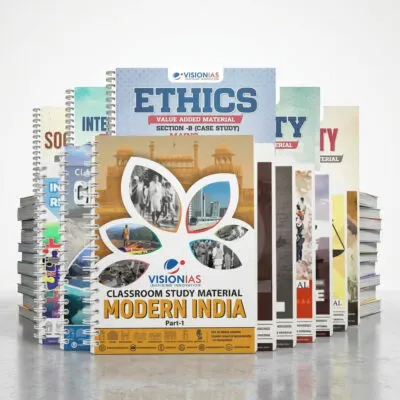
About Vajiram and Ravi Science and Technology Prelims Smasher Notes 2025-26
Vajiram and Ravi Science and Technology Prelims Smasher Notes 2025-26 is an original printed study material set from Vajiram and Ravi, covering Science and Technology. Available in English medium, this set is counted booklet by booklet before dispatch — no photocopies, no missing booklets.
Product Details
- Institute: Vajiram and Ravi
- Subject: Science and Technology
- Medium: English
- Pages: 102
- Format: High-Quality Printed Booklets
- Delivery: Pan-India delivery in 4–7 working days, free over ₹1,999
- Condition: New, original print — counted before dispatch
Why Buy from UPSC Store?
- ✓ Original Printed Notes — no photocopies, every booklet counted before it ships
- ✓ Fast Dispatch — ships within 24 hours from Delhi, arrives in 4–7 days pan-India
- ✓ Secure Packaging — bubble-wrapped and boxed to prevent damage in transit
- ✓ 180+ Orders Shipped — to 25 states across India
- ✓ WhatsApp Support — ask which set fits your optional and medium before ordering
Frequently Asked Questions
Original print — the same printed booklets the institute issues. Every set is counted booklet by booklet before dispatch.
Orders are dispatched within 24 hours from Delhi and delivered across India in 4–7 working days. Delivery is free over ₹1,999.
Returns are accepted only if the problem is from our side: wrong item, damaged or defective copy, or missing booklets or pages. Report it within 7 days of delivery and we arrange a free pickup and send a free replacement or a full refund. We do not accept change-of-mind returns, so please check the medium, edition and binding before ordering. WhatsApp us to start a return.