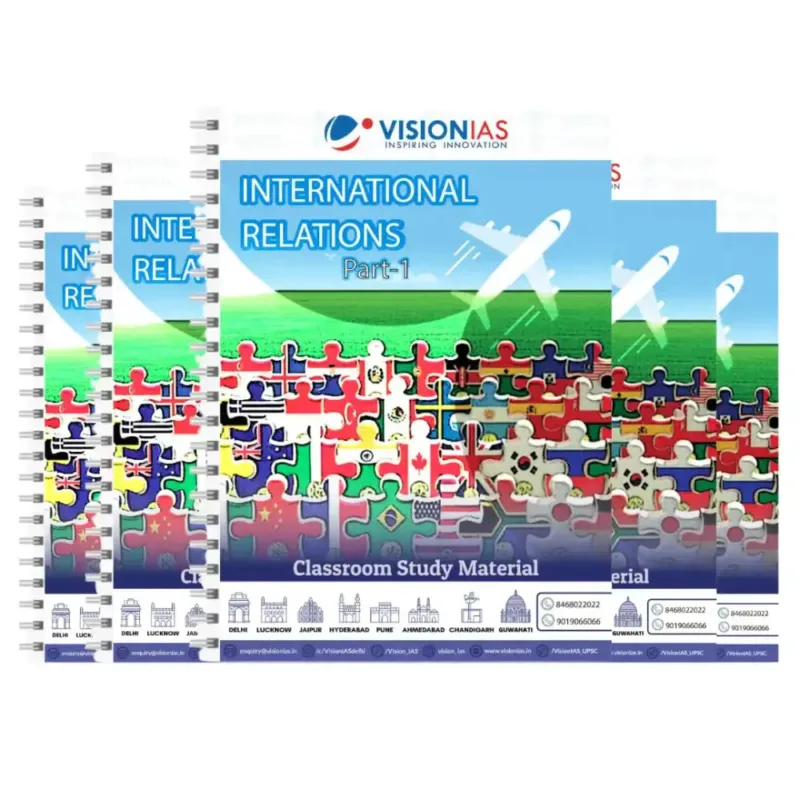

Vision IAS International Relations 2025-26

2 Booklets | English
Key Highlights:
πŸ“˜ 2 Booklets
πŸ“š International Relations
πŸŽ“ Vision IAS
🏷️ Printed
πŸ‡¬πŸ‡§ English Medium
β‚Ή688
πŸŒ€ spiral βœ“
πŸ“˜ book-binding βœ“
Only 24 sets left
Selling fast (57 sold this week)
5% OFF Use UPSC5% (COD Available)
10% OFF Use UPI10 (UPI Only)
Secure Payment
Fast Delivery
Safe Packaging

About Vision IAS IR Notes English

The Vision IAS IR Notes English is a printed UPSC study material set sold by UPSC Store β€” India’s trusted source for genuine, latest-batch civil services preparation books. This page covers full booklet details, syllabus coverage, pricing, shipping, and frequently asked questions. Useful for UPSC CSE, BPSC, UPPSC, MPPSC, RAS and other state PSC examinations.


Vision IAS International Relations Notes 2025-2026 Description

Vision IAS International Relations Notes Booklets 2025 – 2026 English Edition: The Definitive UPSC Mains & Prelims Resource

Related: Vision IAS notes Β· International Relations material

Product Overview

FeatureSpecification
Booklets Count5 Comprehensive Modules (Full Set)
LanguageEnglish
PublisherVision IAS Academy (Printed Edition)
ConditionBrand New (Latest 2025-2026 Batch)
FormatHigh-Quality Printed Booklets with Reinforced Binding
Paper Quality75 GSM White Maplitho Paper

Complete Booklet Catalog

The “Vision IAS International Relations Notes Booklets 2025 – 2026 English Edition” is curated into a systematic series of printed modules. This ensures that the massive syllabus of International Relations (IR) for the UPSC Civil Services Examination is segmented into manageable, logically ordered physical units. Below is the list of every individual booklet included in this premium set:

  • Booklet 1: India’s Foreign Policy & The Immediate Neighborhood – Focusing on the foundational principles of Indian diplomacy and bilateral relations with bordering nations.
  • Booklet 2: India and the Extended Neighborhood (South East Asia & West Asia) – Detailed coverage of the “Act East” policy and the strategically vital Middle East.
  • Booklet 3: Relations with Major Global Powers – In-depth analysis of India’s ties with the USA, Russia, China, Japan, and the European Union.
  • Booklet 4: International Organizations, Regional Groupings & Global Treaties – Comprehensive data on the UN, WTO, IMF, BRICS, SCO, QUAD, and G20.
  • Booklet 5: Emerging Global Issues & Geopolitical Trends – Coverage of 2025-2026 specific developments including maritime security, climate diplomacy, and global supply chain resilience.

Internal Content Architecture: A Deep Dive into Booklet 1

Booklet 1 serves as the bedrock of your International Relations preparation. From a physical layout perspective, the booklet opens with a high-resolution, multi-color table of contents that categorizes chapters into “The Evolution of India’s Foreign Policy” and “Bilateral Ties.” Each chapter within this booklet is printed using a double-column layout where necessary to facilitate faster reading. The text is rendered in a crisp 10-point sans-serif font that minimizes eye strain during long study sessions.

Internally, this booklet features a “Drishti/Vision Special” index that highlights “Focus Areas for 2025.” For example, the section on India-Pakistan relations doesn’t just list historical wars; it contains physically printed comparison tables of the Indus Waters Treaty and the status of the LOC. The “India-China” section includes detailed, high-contrast greyscale maps showing the LAC, the Galwan Valley, and the String of Pearls vs. the Necklace of Diamonds strategy. These maps are printed with precision, ensuring that even the smallest topographical labels are legible.

The Physicality of Study: 75 GSM Paper and Anti-Glare Ink

The “Vision IAS International Relations Notes Booklets 2025 – 2026” are not standard photocopies. They are printed on industrial-grade 75 GSM (Grams per Square Meter) paper. This specific weight was chosen because it offers the perfect balance between durability and portability. The paper is thick enough that when you use a highlighterβ€”whether it is a neon yellow or a deep blueβ€”the ink does not bleed through to the reverse side of the page. This is a critical physical attribute for UPSC aspirants who engage in heavy “active reading” and note-marking.

Furthermore, the ink used is a specialized anti-glare, matte-finish black ink. This ensures that even under the harsh white light of a study lamp, the pages do not reflect light back into the eyes of the reader. This “Eye-Care” printing technology is a staple of the 2025-2026 editions, aimed at reducing the physical fatigue associated with the 8-10 hour study days common in the competitive exam cycle. The margins are wide (approximately 1.5 inches), providing ample white space for students to add their own physical annotations or current affairs updates directly on the printed page.

Booklet 2 & 3: Strategic Depth and Visual Aids

Moving into the second and third booklets, the focus shifts to India’s “Extended Neighborhood” and “Global Power Dynamics.” Physically, these booklets are slightly thicker, reflecting the density of information regarding West Asia and the Indo-Pacific. A standout feature in Booklet 2 is the “Energy Security Map” of the Middle East, which is printed as a full-page infographic. This helps the student visualize the “International North-South Transport Corridor (INSTC)” and the “IMEC (India-Middle East-Europe Economic Corridor)” with absolute clarity.

In Booklet 3, which covers relations with the USA and Russia, the internal content is structured using “Strategic Comparison Boxes.” These are shaded grey boxes that physically separate historical context from contemporary “Critical and Emerging Technology (iCET)” initiatives. The layout uses bold sub-headers for “Defense Cooperation,” “Trade & Diaspora,” and “Space Collaboration.” This hierarchical structure allows the reader’s eye to navigate the page effectively, ensuring that the hierarchy of information is physically represented on the paper.

Booklet 4: The Institutional Framework and Flowcharts

Booklet 4 is arguably the most technical of the set. It covers the complex architecture of international organizations. To make this information digestible, Vision IAS has utilized extensive “Relational Flowcharts.” These diagrams physically map out the organs of the United Nations, the voting power structures of the IMF, and the dispute settlement mechanisms of the WTO. Unlike digital PDFs, these printed flowcharts are sized to the full width of the A4 page, ensuring that the connecting arrows and fine text within the boxes are sharp and distinct.

The “Regional Groupings” section of this booklet uses a “Modular Table” format. This allows the student to see the membership, headquarters, objectives, and India’s specific interest in groups like ASEAN, BIMSTEC, and the SCO all on a single page spread. This physical “single-glance” design is intentional, aiding in the spatial memory of the student during the high-pressure environment of the Mains exam.

Booklet 5: 2025-2026 Current Affairs Integration

The final booklet in the set is the “Live Update” module. This booklet is unique because its internal index is organized by “Contemporary Themes” rather than geography. Topics such as “Global South Leadership,” “Digital Public Infrastructure (DPI) Diplomacy,” and “Arctic Geopolitics” are given dedicated chapters. The content here is sourced from the latest 2025 diplomatic summits and international reports.

Physically, this booklet includes a “Glossary of Diplomatic Terms” at the end, which acts as a quick-reference physical dictionary. The back of the booklet also contains a section for “Previous Year Questions (Mains)” and “Model Answer Frameworks.” These are printed in a slightly smaller, italics font to distinguish them from the main study material, providing a clear visual cue that the reader has moved from “learning” to “application.”

Binding and Durability: The Reinforced Build

Each booklet in the “Vision IAS International Relations Notes 2025 – 2026” set features reinforced “Side-Staple” or “Perfect Binding” (depending on the specific batch thickness). This isn’t just a matter of aesthetics; it is a functional requirement. The binding is designed to allow the booklets to lie relatively flat on a desk, which is essential for students who like to keep the book open while typing or writing in a separate journal. The cover page is made of a 150 GSM laminated cardstock, which protects the internal 75 GSM pages from moisture, dust, and the general wear and tear of a year-long preparation cycle.

Internal “Vision Special” Features

Every booklet in this English edition contains several “Special Features” that are unique to the Vision IAS pedagogy. These are physically integrated into the text flow:

  • The “Way Forward” Boxes: At the end of every bilateral relation chapter, there is a physical box titled “Way Forward.” This provides a 3-4 point summary of future diplomatic strategies, printed in a distinct italicized font.
  • Pre-Mains Linkage: Symbols (like a small star or a ‘P/M’ icon) are printed next to certain paragraphs to indicate whether the information is more relevant for the Preliminary or the Mains examination.
  • Data Visualization: Instead of long paragraphs about trade deficits, the booklets use printed bar charts and line graphs (in greyscale) to show the trajectory of India’s trade with major partners over the last decade.
  • Chronology Timelines: Every major relationship (e.g., India-USA) begins with a vertical timeline on the left margin or a horizontal timeline across the page, providing a physical anchor for historical events.

Detailed Chapter-by-Chapter Content Analysis

To understand the depth of these booklets, one must look at the internal chapter structure. In the “India-Russia” chapter of Booklet 3, the content is not merely a list of summits. It begins with “The Cold War Legacy,” moves into the “Strategic Partnership Agreement of 2000,” and then dives deep into contemporary issues like “The S-400 Deal,” “Rouble-Rupee Trade Mechanism,” and the “Impact of the Ukraine Conflict on Bilateral Ties.” Each of these is a distinct sub-section with its own bold header, making the physical navigation of the booklet intuitive.

In the “India-Africa” section of Booklet 2, the notes cover the “India-Africa Forum Summit (IAFS)” frameworks, the “Duty-Free Tariff Preference (DFTP)” scheme, and India’s role in the African Union’s inclusion in the G20. The notes use bullet points meticulouslyβ€”ensuring that for a 15-mark question, a student has exactly 10-12 distinct points ready to be transcribed. This “Answer-Ready” physical formatting is what differentiates these Vision IAS booklets from standard textbooks.

The Mapping Section: A Visual Masterclass

International Relations is as much about geography as it is about politics. These 2025-2026 booklets include an “Integrated Map Series.” These are not separate inserts but are embedded directly into the relevant pages. For instance, when discussing the “South China Sea Dispute,” the booklet provides a detailed map showing the “Nine-Dash Line,” the “Paracel Islands,” and the “Spratly Islands.” The print quality ensures that the contour lines and maritime boundaries are sharp. This physical inclusion of maps eliminates the need for the student to constantly refer to an external atlas, making the study process more “self-contained.”

Quality Assurance and Authentication

Each set of “Vision IAS International Relations Notes” undergoes a physical quality check before shipment. The pages are checked for “ghosting” (where ink from the back shows on the front) and “misalignment.” Because these are the 2025-2026 editions, they feature the latest updated “Vision IAS” watermark on every page, which serves as a mark of authenticity and ensures the student is not using outdated material from previous years. The covers are color-coded (typically a shade of blue or grey for IR) to help students quickly identify the subject on a crowded bookshelf.

Frequently Asked Questions (FAQ)

1. Are these the latest notes for the 2025-2026 UPSC attempt?
Yes, this is the most current edition of the Vision IAS International Relations booklets. They have been specifically updated to include diplomatic events, summits, and treaty changes occurring up to late 2024 and early 2025, making them the primary resource for the 2025 and 2026 exam cycles.

2. How many total pages are included in the 2-booklet set?
The total page count across all five booklets is approximately 450-500 pages. The number varies slightly between print batches, but the internal content is exhaustive, covering every micro-topic of the UPSC GS Paper II syllabus.

3. What is the paper quality, and can I use highlighters?
The booklets are printed on premium 75 GSM white maplitho paper. This is significantly higher quality than standard newsprint or cheap photocopy paper. You can use standard highlighters and ink pens without worrying about bleed-through or page tearing.

4. Is the text font legible for long hours of study?
Absolutely. The notes use a professional 10-11 point font size with optimized line spacing (leading). This creates a “breathable” page layout that prevents the “wall of text” effect, allowing for easier scanning and retention.

5. Do these booklets include diagrams and maps?
Yes, visual learning is a core component of these notes. There are over 60+ high-quality greyscale maps, flowcharts, and comparison tables integrated directly into the text to explain complex geopolitical concepts like the “Indo-Pacific” or “Central Asian Pipelines.”

6. How is the binding of the booklets handled?
The booklets come with reinforced side-stapling and a heavy-duty spine tape or perfect binding. This ensures that the booklets do not fall apart even with frequent use and transport in a backpack.

7. Are these notes sufficient for both Prelims and Mains?
Yes. The content is structured to cover factual data (useful for Prelims) such as headquarters of organizations and names of treaties, as well as analytical perspectives (useful for Mains) such as the “Challenges in India-China relations” or “The relevance of NAM in a multipolar world.”

8. Is the language easy to understand for beginners?
The English used is formal yet accessible. It avoids unnecessary jargon while introducing the student to essential diplomatic terminology. Each complex term is usually followed by a brief contextual explanation within the text.

9. How do these booklets handle current affairs updates?
While these are static printed booklets, they are designed with “Update Margins.” There is enough white space on the sides for you to write in the latest news. Additionally, Booklet 5 is dedicated to the most recent trends as of the 2025-2026 printing cycle.

10. Does the set include previous year UPSC questions?
Yes, every major section concludes with a list of relevant questions asked in the UPSC Mains from 2013 to 2024. This allows you to immediately correlate what you have read with the type of questions asked by the commission.

11. Are these original printed copies or photocopies?
These are high-quality printed editions of the Vision IAS classroom study material. They feature crisp, dark ink and clean white paper, ensuring a much better reading experience than low-quality pirated photocopies.

12. What is the “Drishti/Vision Special” feature mentioned?
This refers to the “Value Addition” boxes scattered throughout the booklets. These include “Expert Quotes,” “International Reports,” and “Case Studies” (like the success of India’s ‘Vaccine Maitri’) which help you score the extra 1-2 marks in Mains answers.

Final Physical Verdict

The “Vision IAS International Relations Notes Booklets 2025 – 2026 English Edition” is more than just a set of papers; it is a meticulously engineered physical tool. From the 75 GSM paper thickness to the anti-glare ink and the answer-oriented layout, every aspect of these booklets is designed to optimize the physical act of studying. The logical progression from Booklet 1 to Booklet 5 ensures that a student moves from the basics of their immediate neighborhood to the complex nuances of global governance in a seamless, structured manner. This set is an indispensable asset for any serious UPSC aspirant aiming to master International Relations for the upcoming 2025-2026 examination cycle.

Frequently Asked Questions

What does the IR notes set cover?

It is a comprehensive English medium International Relations module set for UPSC Civil Services Mains and Prelims.

Are the booklets brand new?

Yes, all booklets are brand new from the latest 2025-2026 batch with reinforced binding.

What paper quality is used?

75 GSM white maplitho paper for clear, glare-free reading.

Is COD available?

Yes, COD is supported pan-India along with prepaid payment options.

How long does shipping take?

Orders typically reach within 3-5 business days across India.

Useful for state PSC?

Yes, the notes also support BPSC, UPPSC, MPPSC and other state PSC IR preparation.

Reference: Civil Services Examination

Customer Reviews 130

4.5
Based on 130 reviews
5β˜…
78
4β˜…
39
3β˜…
13
2β˜…
0
1β˜…
0
A
Ananya Mishra
25 Apr 2026
βœ“ Verified

This is exactly what every UPSC aspirant needs for International Relations.

V
Vikram Singh
24 Apr 2026
βœ“ Verified

Exactly what I needed for my UPSC prep. Quality booklets with detailed explanations.

H
Harsh Malhotra
13 Apr 2026
βœ“ Verified

Mza aaya padh ke, quality ekdum zyada hai.

R
Rohan Kapoor
09 Apr 2026
βœ“ Verified

Booklets mein proper flow hai aur topics logical order mein arrange hain.

R
Rahul Patel
04 Apr 2026
βœ“ Verified

Bohot sahi hai bhai, quality top-notch.

A
Arjun Singh
29 Mar 2026
βœ“ Verified

Content quality ekdum first-class hai. Bohot helpful for mains preparation.

P
Priya Sharma
23 Mar 2026
βœ“ Verified

Content is good but covers only basic IR topics. Would've preferred more case studies and current affairs analysis.

P
Priya Deshmukh
20 Mar 2026
βœ“ Verified

Perfect for IR preparation. Content is comprehensive aur organized bhi bahot accha hai.

πŸ›οΈ

Aspirants Also Bought

More from the same category

View All β†’

About Vision IAS International Relations 2025-26

Vision IAS International Relations 2025-26 is a highly recommended UPSC study material from Vision IAS, specially designed for International Relations preparation. Available in English medium, this material is crafted to match the exact requirements of the UPSC Civil Services Examination syllabus β€” covering both Prelims and Mains comprehensively.

Product Details

  • Institute: Vision IAS
  • Subject: International Relations
  • Medium: English
  • Format: Printed
  • Delivery: Pan-India delivery in 3–5 working days
  • Format: Original printed material, verified authentic

Why Buy from UPSC Store?

  • βœ… 100% Genuine Printed Material β€” Original printed notes, no photocopies or fake copies
  • βœ… Fast Delivery β€” Ships within 24 hours, arrives in 3–5 days pan-India
  • βœ… Secure Packaging β€” Bubble-wrapped and boxed to prevent damage in transit
  • βœ… Trusted by 10,000+ Aspirants β€” India's most reliable UPSC material marketplace
  • βœ… WhatsApp Support β€” Get expert guidance on material selection before ordering

Frequently Asked Questions

Is this product 100% original?

Yes, all products at UPSC Store are 100% genuine printed materials. We do not sell photocopies or fake copies.

How long does delivery take?

Orders are dispatched within 24 hours and delivered across India in 3–5 working days via reputed courier partners.

Can I return the product?

Yes, we accept returns within 7 days if the product is damaged or incorrect. Check our refund policy for details.

Which other study materials should I buy with this?

We recommend pairing this with current affairs notes and a UPSC test series for comprehensive preparation. Browse more in General Studies, International Relations, UPSC, Vision IAS.