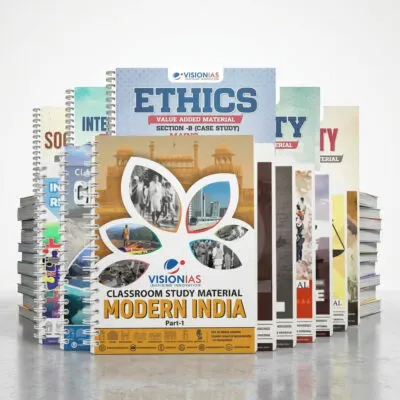

Vision IAS General Studies Notes 2025-26

46 Booklets | English Medium | UPSC Study Material

β‚Ή4,999
πŸŒ€ spiral βœ“
πŸ“˜ book-binding βœ“
Only 12 sets left
Selling fast (87 sold this week)
5% OFF Use UPSC5% (COD Available)
10% OFF Use UPI10 (UPI Only)
Secure Payment
Fast Delivery
Safe Packaging

About Vision IAS GS Notes 2025-26

The Vision IAS GS Notes 2025-26 is a printed UPSC study material set sold by UPSC Store β€” India’s trusted source for genuine, latest-batch civil services preparation books. This page covers full booklet details, syllabus coverage, pricing, shipping, and frequently asked questions. Useful for UPSC CSE, BPSC, UPPSC, MPPSC, RAS and other state PSC examinations.

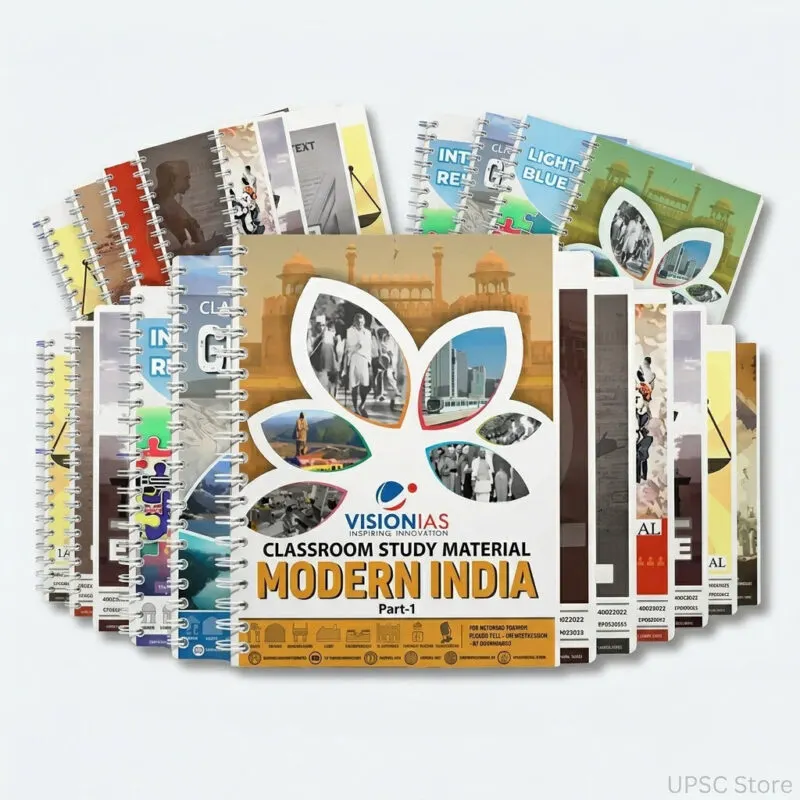
Vision IAS General Studies 2025-26 β€” 42 English Medium Printed Booklets for UPSC GS Paper I, II, III and IV

Related: Vision IAS notes Β· UPSC General Studies material

Product Overview

FeatureDetails
Booklets Count42 Individual Printed Booklets β€” Full UPSC GS Syllabus Coverage (Paper I, II, III and IV)
LanguageEnglish Medium
PublisherVision IAS (Classroom Study Material Series)
Edition2025-26 β€” Latest Genuine Batch
ConditionBrand New, Unmarked, Fresh Stock
FormatHigh-Quality Printed Booklets β€” Spiral or Book Binding
Paper Quality75 GSM Ultra-White β€” Highlighter Safe, Zero Bleed-Through
ShippingPan India Delivery in 3-5 Business Days β€” Tracked
Also Useful ForBPSC, UPPSC, MPPSC, RAS, MPSC and all State PSC examinations

Complete Booklet Catalog

This Vision IAS 2025-26 set delivers the full General Studies curriculum across 42 printed English medium booklets, covering every subject tested across UPSC Prelims and Mains GS Paper I, II, III and IV. Whether you are beginning your UPSC preparation from scratch or consolidating revision before the final exam, this complete set is structured to serve aspirants at every stage of the preparation cycle.

  • Booklet 1: Ancient History β€” Indus Valley Civilisation, Vedic Age, Mahajanapadas, Mauryan Empire, post-Mauryan kingdoms, Gupta period, early medieval India, major dynasties, socio-religious movements, trade networks, and archaeological sources aligned with UPSC GS Paper I syllabus.
  • Booklet 2: Medieval History β€” Delhi Sultanate, Vijayanagara Empire, Mughal administration, Bhakti and Sufi movements, regional kingdoms, Maratha rise, socio-economic structures, provincial administrations and cultural synthesis relevant to UPSC GS Paper I history questions.
  • Booklet 3: Modern Indian History Part 1 β€” Early European contacts, rise of British power, revenue systems, Revolt of 1857, social reform movements, rise of Indian nationalism, formation of Indian National Congress, moderates versus extremists, partition of Bengal.
  • Booklet 4: Modern Indian History Part 2 β€” Home Rule Movement, Gandhian era, Non-Cooperation, Civil Disobedience, Quit India, revolutionary movements, Indian National Army, communal politics and constitutional acts up to Independence β€” aligned to UPSC Mains GS Paper I.
  • Booklet 5: Modern Indian History Part 3 β€” Transfer of power, Partition of India, integration of princely states, framing of the Constitution, key personalities of Independence movement, legacy of colonial rule and its impact on post-Independence governance.
  • Booklet 6: Post-Independence Indian History β€” Nation-building challenges, Nehruvian policies, reorganisation of states, Green Revolution, Emergency period, economic liberalisation 1991, political developments, coalition era and India’s evolving democratic structure post-1947.
  • Booklet 7: Art and Culture β€” Architecture styles (Nagara, Vesara, Dravidian), painting traditions, classical dance forms, music systems, literature across languages, UNESCO heritage sites, folk arts, performing arts, festivals and intangible cultural heritage important for UPSC Prelims and Mains.
  • Booklet 8: World History Part 1 β€” Renaissance, Reformation, French Revolution, American Independence, Industrial Revolution, colonialism and imperialism, World War I, Russian Revolution, League of Nations, rise of fascism and Nazism, causes and consequences relevant to UPSC GS Paper I.
  • Booklet 9: World History Part 2 β€” World War II, Cold War, decolonisation, United Nations formation, Korean War, Vietnam, Cuban Missile Crisis, Non-Aligned Movement, collapse of USSR, post-Cold War world order and contemporary global power dynamics for UPSC Mains GS Paper I.
  • Booklet 10: Society Part 1 β€” Indian society features, diversity, social institutions, caste system, tribal communities, women in society, communalism, regionalism, secularism, demographic dividend, urbanisation trends β€” covering UPSC GS Paper I society segment thoroughly.
  • Booklet 11: Society Part 2 β€” Poverty, social exclusion, welfare schemes, education system challenges, health outcomes, gender issues, child rights, elderly care, disability, vulnerable sections, social capital and role of civil society in India’s development landscape.
  • Booklet 12: Geography Part 1 β€” Physical geography fundamentals: geomorphology, interior of the earth, earthquakes, volcanoes, rock types, landforms, weathering, erosion, fluvial and aeolian processes, karst topography β€” essential for UPSC GS Paper I physical geography section.
  • Booklet 13: Geography Part 2 β€” Climatology: atmosphere layers, insolation, heat budget, pressure belts, winds, monsoon systems, cyclones, ocean currents, tides, hydrological cycle, ENSO, Indian Ocean Dipole β€” frequently tested UPSC GS Paper I topics.
  • Booklet 14: Geography Part 3 β€” Indian geography: physiographic divisions, river systems, drainage patterns, soils, natural vegetation, forest types, wildlife, mineral resources, energy resources, agriculture patterns and their UPSC Mains GS Paper I relevance.
  • Booklet 15: Geography Part 4 β€” Economic geography: industries, transport networks, international trade routes, population geography, migration, urbanisation, human development index, globalisation impacts β€” topics tested in both UPSC Prelims and Mains GS Paper I.
  • Booklet 16: Geography Part 5 β€” Map-based geography, important locations, border disputes, straits and passes, islands, ocean ridges, sea routes, current affairs integration in geography β€” critical for UPSC Prelims map-based questions and Mains GS Paper I answers.
  • Booklet 17: Polity and Constitution Part 1 β€” Historical background of the Constitution, making of the Constitution, Preamble, fundamental rights, directive principles, fundamental duties, constitutional amendments β€” foundational UPSC GS Paper II polity content.
  • Booklet 18: Polity and Constitution Part 2 β€” Union executive: President, Vice President, Prime Minister, Council of Ministers, Cabinet, Parliament structure, legislative process, parliamentary privileges, anti-defection law β€” core UPSC GS Paper II governance topics.
  • Booklet 19: Polity and Constitution Part 3 β€” Judiciary: Supreme Court, High Courts, subordinate courts, judicial review, judicial activism, PIL, constitutional bodies, statutory bodies, independent regulators and their UPSC GS Paper II examination relevance.
  • Booklet 20: Polity and Constitution Part 4 β€” State government, federalism, centre-state relations, Inter-State Council, Finance Commission, special provisions for states, local self-government (Panchayati Raj and Urban Local Bodies), 73rd and 74th Amendments.
  • Booklet 21: Polity and Constitution Part 5 β€” Elections and electoral system, Election Commission, voting rights, political parties, coalition politics, electoral reforms, money in elections, Model Code of Conduct, RTI, CAG, UPSC and other constitutional bodies.
  • Booklet 22: Polity and Constitution Part 6 β€” Governance issues, e-governance, accountability mechanisms, civil services reforms, disaster management framework, social audit, citizens’ charter, transparency legislation and recent constitutional developments relevant for UPSC Mains GS Paper II.
  • Booklet 23: Governance β€” Good governance principles, government schemes, welfare delivery, public policy, accountability frameworks, role of NGOs and SHGs, cooperative federalism, NITI Aayog, role of technology in governance β€” UPSC GS Paper II governance segment.
  • Booklet 24: Social Justice β€” Welfare schemes for SC/ST/OBC, women empowerment policies, minority welfare, education and health missions, MGNREGS, food security, social security nets, poverty alleviation programmes β€” important for UPSC GS Paper II social justice answers.
  • Booklet 25: International Relations Part 1 β€” India’s foreign policy evolution, neighbourhood first policy, bilateral relations with major nations, India-China, India-Pakistan, India-USA, India-Russia relations, nuclear policy, multilateral forums and their UPSC GS Paper II significance.
  • Booklet 26: International Relations Part 2 β€” Regional groupings (SAARC, ASEAN, SCO, BRICS, G20, G7), international organisations (UN, WTO, IMF, World Bank), international law, maritime disputes, global governance challenges β€” frequently tested UPSC GS Paper II topics.
  • Booklet 27: Economics Part 1 β€” Basic economic concepts, national income accounting, GDP/GNP/NNP, planning in India, economic reforms 1991, liberalisation, privatisation, globalisation, sectoral composition, NITI Aayog versus Planning Commission for UPSC GS Paper III.
  • Booklet 28: Economics Part 2 β€” Agriculture: land reforms, green revolution, agricultural marketing, food security, PDS, MSP, crop insurance, irrigation, agricultural credit, allied sectors (fisheries, animal husbandry), e-NAM β€” UPSC GS Paper III agriculture section.
  • Booklet 29: Economics Part 3 β€” Industry and infrastructure: industrial policy, public sector, Make in India, startup ecosystem, SEZs, infrastructure financing, PPP model, logistics, transport, energy sector β€” tested in UPSC GS Paper III economy and infrastructure questions.
  • Booklet 30: Economics Part 4 β€” Money, banking and finance: RBI functions, monetary policy, credit policy, financial inclusion, banking sector reforms, NBFCs, capital markets, SEBI, insurance, pension reforms and their significance for UPSC Mains GS Paper III.
  • Booklet 31: Economics Part 5 β€” Fiscal policy, Union Budget, taxation (direct and indirect), GST, fiscal federalism, public debt, external sector (trade, BOP, exchange rates, FDI, FII), economic survey insights β€” critical UPSC GS Paper III economy content.
  • Booklet 32: Environment Part 1 β€” Biodiversity: ecosystem types, biomes, species diversity, conservation approaches (in-situ, ex-situ), protected areas, biodiversity hotspots, wetlands, IUCN categories, international conventions (CBD, CITES, Ramsar) for UPSC GS Paper III.
  • Booklet 33: Environment Part 2 β€” Climate change: greenhouse effect, global warming, IPCC, Paris Agreement, carbon credits, NDCs, climate finance, ocean acidification, Arctic and Antarctic significance, India’s climate commitments β€” UPSC GS Paper III environment.
  • Booklet 34: Environment Part 3 β€” Pollution types (air, water, soil, noise, plastic), environmental laws and regulations, EIA, NGT, forest rights, environmental governance, waste management, clean energy transition, sustainable development goals β€” UPSC GS Paper III environment topics.
  • Booklet 35: Science and Technology Part 1 β€” Space technology (ISRO missions, satellites, launch vehicles), nuclear technology, defence technology, missile systems, biotechnology basics, nanotechnology, robotics, artificial intelligence basics β€” UPSC GS Paper III science and technology.
  • Booklet 36: Science and Technology Part 2 β€” Information technology, cybersecurity, semiconductors, 5G, quantum computing, health technology, vaccine development, gene editing (CRISPR), recent scientific developments β€” important for UPSC GS Paper III technology questions.
  • Booklet 37: Security Part 1 β€” Internal security challenges: left-wing extremism, insurgency, border management, role of armed forces, paramilitary forces, intelligence agencies, critical infrastructure protection, organised crime β€” UPSC GS Paper III security segment.
  • Booklet 38: Security Part 2 β€” Terrorism, cyber threats, money laundering, human trafficking, drug trafficking, coastal security, disaster and security interface, recent security policies, major security legislation β€” key UPSC GS Paper III security content.
  • Booklet 39: Disaster Management β€” Disaster types (natural and man-made), disaster risk reduction, NDMA framework, SDRF/NDRF, Sendai Framework, international cooperation in disaster management, early warning systems, urban disaster resilience β€” UPSC GS Paper III disaster management.
  • Booklet 40: Ethics Part 1 and Part 2 β€” Foundations of ethics, moral philosophy, attitudes, values, integrity, civil service values, probity in governance, emotional intelligence, work culture, codes of ethics, codes of conduct β€” UPSC GS Paper IV ethics core content.
  • Booklet 41: Ethics Part 3 and Part 4 β€” Public/private institutions ethics, corporate governance, NGO ethics, international relations ethics, philosophical thinkers (Gandhi, Aristotle, Kant, Rawls), applied ethics, moral dilemmas β€” advanced UPSC GS Paper IV preparation.
  • Booklet 42: Ethics Case Studies Q&A and Essay β€” Solved and practice case studies for GS Paper IV with model answers, ethical frameworks application, plus essay writing techniques, topic-wise essay content, recent essay questions analysis and structure templates for UPSC Mains Essay paper.

In-Depth Content Breakdown: Booklet by Booklet

Booklets 1–3: Ancient, Medieval and Early Modern History

These three booklets form the bedrock of UPSC GS Paper I history preparation. Ancient History opens with pre-historic India and advances through the Indus Valley Civilisation, Vedic society, Buddhism, Jainism, the Mauryan Empire, Sangam period and Gupta Age. Every topic is mapped directly to the UPSC Mains syllabus, with cultural and socio-economic dimensions highlighted so that answers go beyond dates and names to analytical depth required by the exam. Archaeological evidence, epigraphy and literary sources are woven throughout the narrative.

Medieval History covers the Delhi Sultanate administrative system, Bhakti-Sufi synthesis, Vijayanagara’s regional importance, and the Mughal Empire’s political economy in a structure ideal for answer writing. The content avoids rote-based approaches and instead builds themes β€” governance, culture, economy, religion β€” that recur across UPSC questions. The Early Modern Indian History booklet bridges the medieval period to the colonial encounter, explaining how Maratha power, Sikh kingdom and regional powers shaped the arrival of Europeans in India. Timelines, maps and thematic summaries support rapid revision.

Booklets 4–6: Modern Indian History (Parts 2–3) and Post-Independence History

Modern Indian History Part 2 and Part 3 together cover the critical Gandhian mass movement era β€” Non-Cooperation, Civil Disobedience and Quit India β€” alongside the revolutionary strand of the independence movement. The Constitutional Acts of 1919 and 1935 are explained with their political consequences, setting the stage for Independence and Partition. These two booklets focus heavily on cause-and-effect relationships, which is exactly the analytical lens UPSC examiners reward in Mains GS Paper I answers. Key personalities are profiled with their ideological contributions contextualised.

Post-Independence Indian History is one of Vision IAS’s most updated booklets in the 2025-26 edition, covering nation-building from the Constituent Assembly through reorganisation of states, Nehruvian foreign and economic policy, the Emergency (1975–77), Operation Blue Star, liberalisation under Narasimha Rao and Manmohan Singh, and coalition-era political dynamics. This booklet is indispensable for aspirants who find post-1947 Indian history underrepresented in standard textbooks but heavily tested in UPSC Mains.

Booklet 7: Art and Culture

Art and Culture in Vision IAS GS notes covers the entire UPSC Mains GS Paper I cultural syllabus within a single booklet structured around temple architecture styles (Nagara, Dravida, Vesara), cave architecture, stupa construction, Indo-Islamic architecture and colonial-era architecture. Painting traditions range from Ajanta murals and Mughal miniatures to regional styles like Madhubani, Pattachitra and Warli. Classical dance (Bharatanatyam, Odissi, Kathak, Kuchipudi, Manipuri, Mohiniyattam, Sattriya) and music systems (Hindustani and Carnatic) are covered with their historical lineage and key exponents.

The booklet integrates UNESCO World Heritage Sites list and India’s UNESCO Intangible Cultural Heritage entries directly into the relevant topics, making it immediately useful for both Prelims fact-based questions and Mains descriptive answers. Folk art traditions, tribal crafts, major festivals and their cultural significance are mapped to specific regions across India. A visual-friendly layout with structured lists makes this booklet an efficient reference during the revision phase rather than only a primary study tool.

Booklets 8–9: World History (Parts 1 and 2)

World History Part 1 addresses the UPSC GS Paper I mandate for 18th–20th century global events with thematic clarity. The French Revolution is treated not merely as a political event but as a social transformation with global reverberations β€” connecting to the American Declaration of Independence, European revolutions of 1848, and the ideological seeds of nationalism that spread to Asia and Africa. The Industrial Revolution section maps its causes to British geography, capital availability and colonial markets, followed by its consequences for labour, urbanisation and imperialism.

World History Part 2 brings the 20th century to life β€” World War II causes and consequences, the Cold War as an ideological contest, decolonisation movements in Asia and Africa, the formation and evolution of the United Nations, and post-Cold War unipolar then multipolar order. The booklet connects historical patterns directly to contemporary UPSC International Relations questions, making it a bridge between the History and IR portions of the syllabus. Questions from PYQs (Previous Year Questions) patterns are discussed within the content structure to guide answer framing.

Booklets 10–11: Society (Parts 1 and 2)

The Society Part 46 Booklet aligns directly with the GS Paper I “Indian Society” segment and covers salient features of Indian society β€” unity in diversity, family, marriage, religion as a social institution, tribal societies, caste system, and the urban-rural divide. It also addresses social issues like communalism, regionalism and secularism with their constitutional and sociological dimensions. Each concept is illustrated with data points from census reports and government surveys, giving answers the statistical grounding UPSC examiners appreciate.

Society Part 2 shifts focus to welfare, poverty, health and gender. The booklet covers major government schemes β€” MGNREGS, PM-KISAN, Ayushman Bharat, National Education Policy 2020, POSHAN Abhiyan β€” alongside their policy intent, implementation challenges and social outcomes. Gender issues span the gender pay gap, women in workforce, domestic violence legislation, SHG movements and political representation. Vulnerable sections (children, elderly, disabled, minorities) are treated with their specific legislative protections and welfare frameworks. This structure directly supports GS Paper II Social Justice answer writing as well.

Booklets 12–16: Geography (Parts 1–5)

The five Geography booklets together cover the widest range of the UPSC GS Paper I geographical syllabus. Part 1 handles physical geography foundations β€” geomorphology, interior of the earth, plate tectonics, volcanism and seismicity, rock formation and types, weathering processes, fluvial, glacial, wind and coastal landforms. This booklet is frequently cited by successful UPSC candidates for its ability to simplify complex geomorphological processes into answer-ready explanations without sacrificing scientific accuracy.

Geography Parts 2 and 3 together address climatology and Indian physical geography. Monsoon dynamics, the Indian Ocean Dipole, ENSO effects on Indian rainfall, cyclone classification and track patterns, and ocean current systems are explained in Part 2. Part 3 dives into India β€” physiographic zones, Himalayan vs. Peninsular drainage, soil classification (laterite, alluvial, black cotton, red and yellow soils), vegetation types, and natural resources including coal, iron ore, petroleum and renewable energy. Accurate maps and tabular comparisons make these booklets visually effective for Prelims revision.

Geography Parts 4 and 5 cover economic geography and map-based content respectively. Part 4 includes industrial location theories applied to Indian industries, transport modes and their geographic constraints, port-led development, trade route significance and demographic geography including migration patterns and urbanisation. Part 5 focuses on location-based questions β€” important straits, passes, sea routes, hotspots, border geography and island territories. This booklet is directly targeted at the Prelims map-based question cluster and Mains GS Paper I place-in-news answers.

Booklets 17–22: Polity and Constitution (Parts 1–6)

Six dedicated Polity and Constitution booklets ensure that UPSC GS Paper II’s most heavily tested subject receives the depth it deserves. Part 1 lays the constitutional foundation β€” the historical evolution from Government of India Acts through Constituent Assembly debates to the adoption of the Constitution. Fundamental Rights are analysed article by article with landmark Supreme Court cases. Directive Principles and Fundamental Duties are contrasted, with their judicial evolution and recent constitutional amendments integrated into the narrative.

Parts 2 through 6 systematically cover the Union Executive, Parliament, Judiciary, Federal structure, Elections and Governance. Each booklet in this series follows the same structure: constitutional provision β†’ structural arrangement β†’ functional practice β†’ recent controversies β†’ model answer approach. Part 6 specifically addresses contemporary governance challenges including e-governance, accountability mechanisms, RTI, CAG audit reports, civil services reforms and recent legislative developments β€” topics that form the basis of Vision IAS’s celebrated Current Affairs integration approach.

Booklets 23–24: Governance and Social Justice

The Governance booklet goes beyond constitutional provisions to examine how government actually functions at the delivery level. It covers good governance frameworks, public policy analysis, citizens’ charter, social audit mechanisms, role of NGOs and civil society organisations, cooperative federalism in practice and NITI Aayog’s policy advisory role. E-governance initiatives β€” DigiLocker, Aadhaar, UMANG, GeM, PFMS β€” are covered with their impact on service delivery and transparency, reflecting the UPSC Mains GS Paper II shift toward applied governance questions.

Social Justice consolidates the welfare scheme universe that UPSC tests extensively in GS Paper II. The booklet organises schemes by beneficiary category β€” SC/ST welfare, women empowerment, child nutrition, minority welfare, senior citizens, persons with disabilities β€” and examines each scheme’s legislative basis, funding mechanism and implementation gaps. This thematic organisation is far more useful for answer writing than a random list of schemes, as UPSC questions increasingly ask aspirants to evaluate policy effectiveness rather than simply name schemes.

Booklets 25–26: International Relations (Parts 1 and 2)

International Relations Part 1 anchors India’s foreign policy within its historical evolution β€” from Nehruvian non-alignment to the strategic autonomy doctrine and neighbourhood first policy of the current era. Bilateral relationships with major powers are covered with their economic, strategic and civilisational dimensions. India-China relations include both the border dispute dimension and economic interdependence. India-USA strategic partnership, India-Russia defence ties and India’s role in the Indo-Pacific are examined with the analytical depth required for UPSC Mains GS Paper II ten-mark and fifteen-mark answers.

International Relations Part 2 maps the multilateral arena β€” India’s engagement with SAARC, BIMSTEC, SCO, BRICS, QUAD, G20 and UN bodies. International organisations like the IMF, World Bank, WTO, UNHCR and WHO are covered with their governance structures and India’s role. Global governance challenges β€” nuclear non-proliferation, climate finance, internet governance, refugee law β€” are analysed through India’s policy lens. This booklet is updated with developments through mid-2025, including recent summits, multilateral agreements and India’s foreign policy positions.

Booklets 27–31: Economics (Parts 1–5)

Economics Part 1 builds foundational understanding before advancing to policy. National income concepts, sectoral growth, India’s planning history and the shift from mixed economy to market-oriented approach are explained with data tables sourced from Economic Survey and RBI Annual Reports. The NITI Aayog’s role, three-year action agenda and strategy documents are contextualised in comparison with Planning Commission functions β€” a perennially tested UPSC distinction. Growth vs. development debates are covered with thinkers’ perspectives.

Economics Parts 2 through 5 cover the four functional domains of GS Paper III economics: agriculture and food security, industry and infrastructure, money and banking, and fiscal and external sectors. Agriculture Part 2 is particularly detailed β€” it covers land reforms trajectory, MSP mechanism, agricultural marketing reforms (APMC, e-NAM), PM-KISAN, crop insurance (PMFBY), water use efficiency and doubling farmers’ income framework. Industry Part 3 examines Make in India, PLI schemes, industrial corridors and the startup ecosystem. Parts 4 and 5 on banking-finance and fiscal-external sectors are updated with the latest Union Budget data, RBI policy moves and GST revenue trends through 2025.

Booklets 32–34: Environment (Parts 1–3)

Environment Part 1 on Biodiversity is among the most frequently cited Vision IAS booklets by successful UPSC candidates for its ability to condense a vast subject. Ecosystem types (forest, grassland, wetland, marine, freshwater, desert) are covered with their biodiversity characteristics and threats. The booklet explains IUCN Red List categories with Indian examples, biodiversity hotspots including the Western Ghats and Eastern Himalayas, and key international conventions β€” CBD, CITES, Ramsar, CMS, Bonn Convention β€” with India’s domestic implementation framework for each.

Environment Parts 2 and 3 address Climate Change and Pollution-Governance respectively β€” two of the highest-weightage environment topics in UPSC GS Paper III. Part 2 covers the IPCC assessment report findings, Paris Agreement architecture (NDCs, global stocktake, climate finance), India’s renewable energy targets, Mission LiFE and the green hydrogen policy. Part 3 on pollution covers the Air Quality Index system, National Clean Air Programme, river rejuvenation missions, plastic waste management rules, e-waste regulations, NGT jurisdiction and Environmental Impact Assessment notification updates through 2025.

Booklets 35–36: Science and Technology (Parts 1 and 2)

Science and Technology Part 1 covers space, defence and biotechnology β€” three of the most dynamic areas in UPSC GS Paper III. ISRO’s missions (Chandrayaan, Gaganyaan, Aditya-L1, PSLV/GSLV/LVM3 launch vehicles), India’s satellite constellation, remote sensing applications and the Space Policy 2023 are detailed. Nuclear technology covers India’s three-stage nuclear programme, civil nuclear agreements and the nuclear doctrine. Defence technology includes indigenisation milestones, DRDO achievements, hypersonic and cruise missile developments under the defence modernisation programme.

Science and Technology Part 2 is a forward-looking booklet addressing emerging technology domains β€” artificial intelligence and its governance challenges, 5G rollout and spectrum policy, quantum computing and quantum communication, semiconductor manufacturing in India, cybersecurity legislation and the Digital Personal Data Protection Act 2023, blockchain applications in governance, and CRISPR gene editing ethics and applications. This booklet is updated through 2025 to incorporate the latest technological developments that have entered the UPSC Current Affairs ecosystem, making it particularly valuable for aspirants preparing for the 2026 Mains examination.

Booklets 37–38: Security (Parts 1 and 2)

Security Part 1 addresses internal security architecture β€” the nature and geography of left-wing extremism in India, ongoing counterinsurgency operations, insurgency in the Northeast and its ethnic roots, border management with a focus on the Line of Control and Line of Actual Control, role of Central Armed Police Forces, intelligence network (IB, RAW, NSG), critical infrastructure protection and recent policy developments in the National Security framework. Content connects directly to UPSC Mains GS Paper III’s security segment and also to Essay Paper themes.

Security Part 2 covers the transnational dimensions of internal security β€” terrorism typology, dark web and cyberterrorism, money laundering through the PMLA framework, hawala networks, narco-terror nexus, human trafficking legislation and enforcement, coastal security post-26/11 reforms, and maritime security challenges in the Indian Ocean Region. Each topic is presented with the relevant legislation, institutional mechanism, implementation challenge and a model answer framework β€” the Vision IAS classroom approach that has produced consistent UPSC Mains toppers.

Booklet 39: Disaster Management

The Disaster Management booklet covers the full UPSC GS Paper III disaster management syllabus with a policy-and-implementation lens. Natural disasters (earthquakes, cyclones, floods, droughts, landslides, tsunamis, heatwaves) are covered with their causes, India-specific vulnerability zones and historical events. Man-made disasters include industrial accidents, nuclear incidents, chemical hazards and urban fires. The Sendai Framework for Disaster Risk Reduction 2015–2030 is covered in detail with India’s National Disaster Management Plan alignment and NDMA guidelines for each hazard type.

The booklet explains India’s institutional disaster management architecture β€” NDMA, NDRF, SDMA, SDRF, State Disaster Management Authorities and district-level mechanisms β€” with their respective roles in preparedness, response and recovery. Early warning systems for cyclones (IMD’s colour-coded alerts), flood forecasting (CWC), earthquake monitoring and drought Early Warning Indicators under the National Drought Management Policy are addressed. Community-based disaster risk reduction and role of local self-governments in resilience building round out this booklet’s content.

Booklets 40–41: Ethics (Parts 1–4)

Ethics Parts 1 and 2 form the foundational content for UPSC GS Paper IV, covering the philosophical roots of ethics (consequentialism, deontology, virtue ethics, contractarianism), Indian ethical traditions (Gandhian ethics, Buddhist ethics, Vedantic perspective), attitude formation and change, emotional intelligence in administration, values and integrity in public service, civil service values framework, and the distinction between codes of ethics and codes of conduct. Vision IAS structures this content with answer-ready frameworks rather than purely academic philosophy, which is what UPSC Mains GS Paper IV demands.

Ethics Parts 3 and 4 cover applied ethics domains β€” corporate governance and ethics, NGO accountability, media ethics, international ethics in diplomacy and conflict situations, ethical issues in emerging technologies (AI ethics, bioethics, environmental ethics), and the ethics of public administration in practice. Western thinkers (Aristotle, Kant, J.S. Mill, John Rawls) and Indian thinkers (Kautilya, Vivekananda, Ambedkar, Gandhi) are profiled with their key ethical positions and UPSC relevance. Moral dilemma frameworks and structured approaches to difficult ethical situations are explained with examples.

Booklet 42: Ethics Case Studies Q&A and Essay

The final booklet in the Vision IAS 2025-26 GS set addresses two critical UPSC Mains components: Ethics Case Studies and Essay writing. The Case Studies Q&A section provides solved examples across different ethical scenario types β€” conflict of interest, whistleblowing, civil servant versus political authority, resource allocation dilemmas, regulatory capture and personal integrity under pressure. Each solved case study demonstrates the Vision IAS structured approach: stakeholder analysis β†’ ethical dimensions identification β†’ possible courses of action β†’ recommended course with justification.

The Essay section is a bonus component covering essay writing strategy, structural templates for different essay types (value-based, social, international, philosophical), topic-wise content notes organised by essay themes, vocabulary and analytical expression guidance, and analysis of recent UPSC Mains Essay paper patterns. With the Essay paper now carrying 250 marks and requiring both breadth and depth, this booklet fills a critical gap that many aspirants struggle with when relying only on static subject material. This makes Booklet 42 one of the highest-value additions in the Vision IAS 2025-26 complete set.

Physical Construction and Quality Standards

Every booklet in this Vision IAS 2025-26 set is printed and bound to withstand daily intensive use throughout a UPSC preparation cycle that may span 12–18 months of active study and multiple revision rounds across all four GS papers.

Paper Quality: 75 GSM Anti-Glare White Paper

All 46 Booklets use 75 GSM ultra-white paper chosen specifically for high opacity β€” text and diagrams on one side do not shadow through to the reverse, eliminating the most common complaint about lower-grade study material. The anti-glare finish reduces eye strain during long study sessions of 6–8 hours, which is standard for serious UPSC aspirants. Both ballpoint pens and multiple highlighter colours (yellow, pink, green, blue) work cleanly on this paper surface without ink spreading or bleed-through, supporting colour-coded revision systems that UPSC toppers consistently recommend.

Printing Technology: High-Resolution Laser Printing

Vision IAS 2025-46 Booklets are produced using high-resolution laser printing technology that delivers sharp, consistently dense text at all font sizes, including footnotes and table cells. Diagrams, flowcharts, maps and infographics reproduce with the precision necessary for geographic and scientific content β€” coastlines, river systems, atmospheric diagrams and economic graphs remain readable without magnification. Laser toner is permanently fused to the paper surface, making the print smudge-proof and resistant to moisture from humid storage conditions common in Indian study environments. There is no fading with extended use.

Binding and Durability

Booklets in this set are available in spiral or book binding depending on printing batch. Spiral-bound booklets open completely flat on a study desk, allowing the aspirant to write margin notes, annotations and answer drafts alongside the printed content without the spine fighting back β€” particularly useful for Geography maps and Ethics case study practice. Book-bound booklets offer compact stacking for organised storage and shelf organisation. All covers are printed on 300 GSM thick card stock with a protective laminate finish that resists corner damage, moisture absorption and regular wear from daily handling across months of preparation.

Key Features and Study Design

These Vision IAS General Studies 2025-46 Booklets are structured specifically around the UPSC examination pattern β€” Prelims factual density, Mains analytical depth and interview conceptual clarity are all served within a single integrated set designed for end-to-end preparation.

  • Complete GS Coverage in One Set: All four GS papers β€” GS Paper I (History, Geography, Society, Art & Culture), GS Paper II (Polity, Governance, IR), GS Paper III (Economy, Environment, S&T, Security) and GS Paper IV (Ethics) β€” are fully covered across 46 Booklets, eliminating the need to buy multiple separate resources and ensuring systematic preparation without gaps.
  • UPSC Syllabus-Mapped Structure: Each booklet’s table of contents directly mirrors the UPSC Mains and Prelims syllabus phrasing, making it easy for aspirants to track coverage and identify completed vs. pending topics during their study schedule. No syllabus topic is left uncovered across the complete 46-booklet set.
  • Answer-Writing Oriented Content: Content is organised with UPSC answer frameworks in mind β€” introduction strategies, body structure points, case examples, data statistics and conclusion approaches are embedded within the subject matter rather than treated as a separate skill. This reflects the Vision IAS classroom teaching philosophy that produced hundreds of IAS selections.
  • Current Affairs Integration: The 2025-26 edition incorporates developments through mid-2025, including new government schemes, recent Supreme Court judgements, the latest Union Budget highlights, updated international relations developments, and new science and technology milestones β€” ensuring aspirants preparing for UPSC 2026 are not studying outdated material.
  • Visual Learning Aids: Maps, timelines, comparison tables, process flowcharts and summary boxes are integrated throughout all 46 Booklets. These visual elements serve the dual purpose of explaining complex relationships (like federal-centre financial transfers or global climate agreements) and acting as rapid revision anchors during the final weeks before the UPSC Mains examination.

Shipping, Packaging and Delivery

All 46 Booklets in the Vision IAS General Studies 2025-26 English medium set are individually shrink-wrapped in groups before being packed into a heavy-duty double-walled corrugated cardboard box with foam padding on all six sides. Edge protectors are applied at all corners to prevent the covers from bending during transit. The outer box is sealed with tamper-evident tape and labelled with a fragile sticker. This packaging method ensures that even in rough logistics handling across long-distance Indian interstate deliveries, every booklet arrives in the same brand-new, unmarked, flat-cover condition that it left the store in. If you buy this set as a gift for a fellow aspirant, it will arrive gift-ready without any additional wrapping required.

Orders are dispatched within 24 hours of payment confirmation from our Mukherjee Nagar, Delhi store β€” the heart of India’s UPSC preparation ecosystem. Pan India delivery is completed in 3-5 business days via tracked courier, and a tracking ID is shared on WhatsApp at +91 70045 49563 within 12 hours of dispatch. Deliveries reach all major cities (Delhi, Mumbai, Bengaluru, Chennai, Hyderabad, Kolkata, Patna, Lucknow, Jaipur, Bhopal, Bhubaneswar, Ranchi) as well as smaller towns and rural PIN codes across every Indian state. In the rare case of a missing, damaged or incorrect booklet, we replace it free of charge within 48 hours of your reporting it to us on WhatsApp. Buy with complete confidence β€” your order is fully protected.

Frequently Asked Questions (FAQ)

Q1: How many booklets are included in the Vision IAS General Studies 2025-26 English medium set?

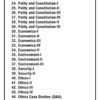
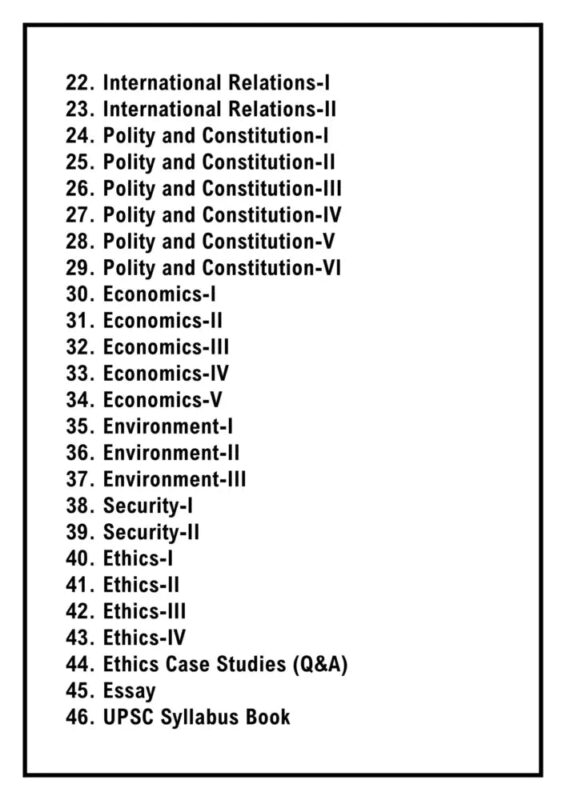
A: This set contains exactly 42 individual printed booklets covering the complete UPSC General Studies syllabus across GS Paper I, II, III and IV. The 46 Booklets span Ancient History, Medieval History, Modern Indian History (three parts), Post-Independence History, Art and Culture, World History, Society, Geography (five parts), Polity and Constitution (six parts), Governance, Social Justice, International Relations (two parts), Economics (five parts), Environment (three parts), Science and Technology (two parts), Security (two parts), Disaster Management, Ethics (four parts), Ethics Case Studies Q&A and Essay writing guidance.

Q2: What is the paper quality? Can I use a highlighter?

A: These booklets use 75 GSM ultra-white paper chosen for high opacity β€” multiple highlighter colors and gel pens work without bleed-through to the reverse side, ideal for color-coded revision. The anti-glare finish also reduces eye fatigue during extended daily study sessions typical of serious UPSC preparation routines. Both the front and reverse of every page can be annotated without any ink spreading, feathering or shadowing from one side to the other, making these booklets genuinely suited to active, annotated study rather than passive reading.

Q3: Is this Vision IAS study material available in English medium for the 2025-26 edition?

A: Yes β€” this product listing is specifically for the English medium 2025-26 edition of Vision IAS General Studies classroom study material. All 46 Booklets are printed in English. The content is authored and structured for English-medium UPSC aspirants who prefer the language of the Vision IAS Delhi classroom programme. If you need the Hindi medium version of Vision IAS GS material, please check our separate product listing for the Hindi medium set which is also available on this store.

Q4: Does the Vision IAS 46-booklet set cover all four GS papers for UPSC Mains?

A: Yes, this set provides full coverage of all four GS papers. GS Paper I (History, Geography, Art & Culture, Society, World History) is covered in booklets 1–16. GS Paper II (Polity, Governance, Social Justice, International Relations) is covered in booklets 17–26. GS Paper III (Economics, Environment, Science & Technology, Security, Disaster Management) is covered in booklets 27–39. GS Paper IV (Ethics and Case Studies) plus Essay is covered in booklets 40–42. UPSC Prelims is also addressed throughout as the content depth exceeds Prelims requirements.

Q5: Is Vision IAS study material enough for UPSC Prelims and Mains 2026 preparation?

A: Vision IAS General Studies notes form an excellent core study resource and cover the syllabus at the depth required for both UPSC Prelims and Mains 2026. For Prelims, you would benefit from supplementing with MCQ practice sets and the standard NCERT base. For Mains, the 46-booklet set can serve as your primary printed resource, ideally complemented by a current affairs magazine (Vision IAS monthly) and PYQ answer practice. Many UPSC toppers have cleared Mains using Vision IAS classroom material as their principal resource for all four GS papers.

Q6: How is Vision IAS study material different from Vajiram and Ravi notes?

A: Both Vision IAS and Vajiram & Ravi are premium UPSC preparation institutes with strong printed material traditions. Vision IAS notes are known for their clean structure, current affairs integration and answer-writing focus that mirrors the classroom experience of their Delhi centre. Vajiram & Ravi notes are known for their traditional detailed prose style popular with Hindi-belt aspirants. Vision IAS booklets in this 2025-26 set use structured tables, flowcharts and boxed summaries more extensively, which many aspirants find more effective for rapid revision in the final weeks before UPSC Mains.

Q7: Where can I buy original Vision IAS 2025-26 printed booklets online?

A: You can buy the original Vision IAS General Studies 2025-26 English medium printed booklets directly from this store β€” UPSC Store, Mukherjee Nagar, Delhi. We source directly from the institute’s publication cycle and stock only genuine, latest-batch booklets. You can also contact us on WhatsApp at +91 70045 49563 to confirm availability, verify the booklet list or ask about bulk order discounts for study groups. We ship pan India with tracking and deliver in 3-5 business days to all states and union territories.

Q8: Are Vision IAS 2025-46 Booklets updated with the latest UPSC syllabus and current affairs?

A: Yes β€” the 2025-26 edition incorporates current affairs and policy updates through mid-2025. This includes the latest Union Budget highlights, recent Supreme Court landmark judgements, updated India foreign policy positions, new government schemes launched in 2024-25, ISRO mission updates including Chandrayaan and Gaganyaan developments, the Digital Personal Data Protection Act 2023 implementation, and recent environmental policy changes. The 2025-26 edition is particularly relevant for aspirants targeting the UPSC CSE 2026 Mains examination who need material that reflects the contemporary policy environment.

Q9: Is this set useful for State PSC examinations like BPSC, UPPSC or MPPSC?

A: The Vision IAS General Studies 2025-26 printed set covers General Studies content that directly overlaps with the syllabus of all major State PSC examinations including BPSC (Bihar), UPPSC (Uttar Pradesh), MPPSC (Madhya Pradesh), RAS (Rajasthan), MPSC (Maharashtra) and other state-level civil services exams. History, Geography, Polity, Economics, Environment, Science and Technology, Ethics and Essay content from this set is directly applicable to state PSC Mains papers. State PSC aspirants can buy this set as a single-source GS resource without needing to buy separate state-specific material for most general topics.

Q10: What binding type do these Vision IAS booklets come in?

A: Vision IAS 2025-46 Booklets are available in spiral binding or book binding depending on the printing batch and availability. Spiral-bound booklets open flat on a desk β€” ideal for active annotation and writing practice alongside the text. Book-bound booklets are compact and stack neatly for organised shelf storage. The 300 GSM laminated cover ensures durability in both formats across months of daily use. At the time of your order, our WhatsApp team at +91 70045 49563 can confirm the current binding format available in fresh stock for the 2025-26 set before you buy.

Q11: What if I receive a damaged or missing booklet in my order?

A: We take packaging quality and order accuracy seriously. All 46 Booklets are counted, verified against the printed booklet list and packed under double-wall corrugated protection before dispatch. However, in the rare event that a booklet arrives damaged, is missing from the package, or an incorrect booklet is included, simply WhatsApp us at +91 70045 49563 with a photo of the received package within 48 hours of delivery. We will dispatch the replacement booklet at zero cost to you by the next business day. Every order is backed by our complete satisfaction guarantee β€” you can buy with full confidence.

Q12: How should I use the Vision IAS 46-booklet set in my UPSC preparation schedule?

A: A structured approach works best with this set. In the first reading phase (months 1–4), read each booklet subject-by-subject alongside NCERT books for foundational alignment, making light margin notes. In the second phase (months 5–8), do active revision with the booklets as your primary source β€” use the tables and flowcharts for quick recall and practice writing 150-word and 250-word answers from memory. In the third phase (final 3 months), use the booklets as rapid-reference material for current affairs integration and answer-writing practice with previous year UPSC question papers. Ethics booklets (40–42) and Essay guidance are best revisited closer to the Mains examination date.

Summary

SpecificationValue
Booklets42 Printed Booklets
LanguageEnglish Medium
Paper75 GSM Ultra-White
BindingSpiral or Book Binding
Delivery3-5 Business Days Pan India
Also Useful ForBPSC, UPPSC, MPPSC, RAS, MPSC and all State PSC examinations

Sold by UPSC Store, Mukherjee Nagar, Delhi β€” India’s most trusted neighbourhood for UPSC preparation resources. Buy the complete Vision IAS General Studies 2025-26 English medium set today and receive all 46 Booklets at your doorstep with pan India tracked delivery in 3-5 days.

Reference: Civil Services Examination

πŸ›οΈ

Aspirants Also Bought

More from the same category

View All β†’

About Vision IAS General Studies Notes 2025-26

Vision IAS General Studies Notes 2025-26 is a highly recommended UPSC study material. This material is crafted to match the exact requirements of the UPSC Civil Services Examination syllabus β€” covering both Prelims and Mains comprehensively.

Why Buy from UPSC Store?

  • βœ… 100% Genuine Printed Material β€” Original printed notes, no photocopies or fake copies
  • βœ… Fast Delivery β€” Ships within 24 hours, arrives in 3–5 days pan-India
  • βœ… Secure Packaging β€” Bubble-wrapped and boxed to prevent damage in transit
  • βœ… Trusted by 10,000+ Aspirants β€” India's most reliable UPSC material marketplace
  • βœ… WhatsApp Support β€” Get expert guidance on material selection before ordering

Frequently Asked Questions

Is this product 100% original?

Yes, all products at UPSC Store are 100% genuine printed materials. We do not sell photocopies or fake copies.

How long does delivery take?

Orders are dispatched within 24 hours and delivered across India in 3–5 working days via reputed courier partners.

Can I return the product?

Yes, we accept returns within 7 days if the product is damaged or incorrect. Check our refund policy for details.

Which other study materials should I buy with this?

We recommend pairing this with current affairs notes and a UPSC test series for comprehensive preparation. Browse more in General Studies, UPSC, Vision IAS.