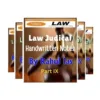




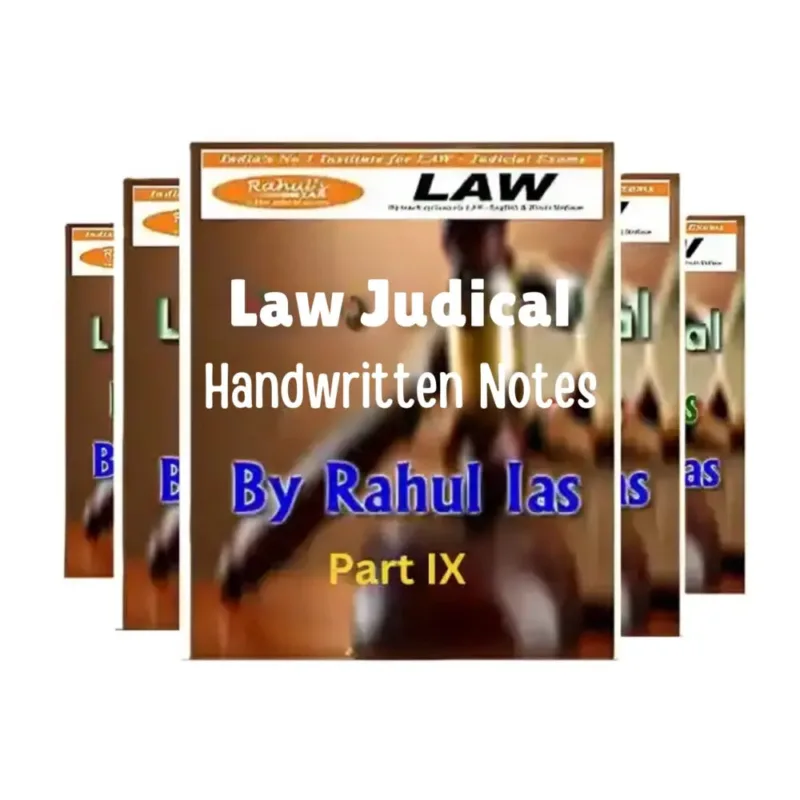
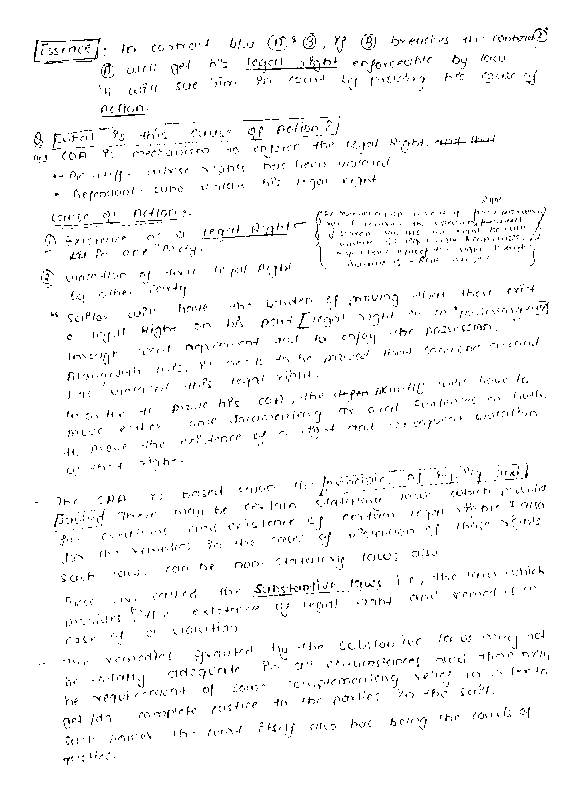


Rahul’s IAS Law & Judiciary Notes 2025-26
Rahul's IAS Law & Judiciary β UPSC Study Material
Related: Rahul's IAS Law notes Β· Law optional
Buy Rahul's IAS Law & Judiciary printed booklets for UPSC Civil Services Examination preparation. This page lists complete details about Rahul's IAS Law & Judiciary including booklet count, language, syllabus coverage, pricing, and shipping.
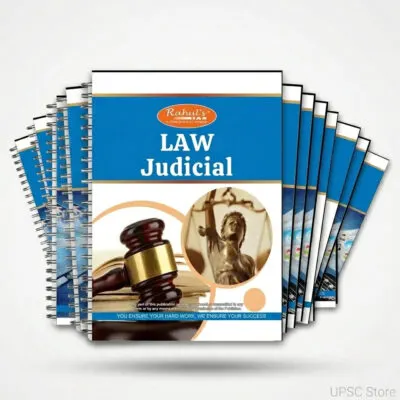
Rahul’s IAS Law & Judiciary Notes 2025-26 β 24 English Medium Printed Booklets for UPSC Law Optional
Product Overview
| Feature | Details |
|---|---|
| Booklets Count | 24 Individual Printed Booklets β Full UPSC Law Optional Syllabus Coverage (Paper I & Paper II) |
| Language | English Medium |
| Publisher | Rahul’s IAS (India’s No.1 Institute for Law & Judicial Exams) |
| Edition | 2025-26 β Latest Genuine Batch |
| Condition | Brand New, Unmarked, Fresh Stock |
| Format | High-Quality Printed Booklets β Spiral or Book Binding |
| Paper Quality | 75 GSM Ultra-White β Highlighter Safe, Zero Bleed-Through |
| Shipping | Pan India Delivery in 3-5 Business Days β Tracked |
| Also Useful For | BPSC, UPPSC, MPPSC, RAS, and All State PSC Judicial & Law Exams |
Complete Booklet Catalog
These 24 printed booklets by Rahul’s IAS cover the entire UPSC Law Optional syllabus across Paper I and Paper II, structured topic by topic for focused, high-scoring preparation. Designed for aspirants who want faculty-led, exam-oriented study material without the noise of generic textbooks.
- Booklet 1: Constitutional Law β Part I β Nature and sources of the Indian Constitution, Preamble, Union and its territory, Citizenship, Fundamental Rights under Articles 12β35, Doctrine of Eclipse and Severability, Constitutional amendments and limitations, judicial review of constitutional provisions, key landmark Supreme Court judgments.
- Booklet 2: Constitutional Law β Part II β Directive Principles of State Policy, Fundamental Duties, President and Governor powers, Council of Ministers, Parliament structure and legislative procedures, Money Bills, Parliamentary privileges, Anti-Defection Law under Schedule X, Centre-State legislative and executive relations, emergency provisions under Articles 352, 356, 360.
- Booklet 3: Constitutional Law β Part III β Judiciary: Supreme Court, High Courts, subordinate courts, independence of judiciary, judicial activism and restraint, PIL, writ jurisdiction under Articles 32 and 226, Doctrine of Basic Structure, judicial appointments post NJAC judgment, tribunals under Article 323A and 323B.
- Booklet 4: International Law β Part I β Nature, sources and subjects of International Law, relationship between international and municipal law, recognition of states and governments, state responsibility, law of treaties under Vienna Convention 1969, state succession, diplomatic and consular relations, privileges and immunities.
- Booklet 5: International Law β Part II β Law of the Sea under UNCLOS, territorial sea, EEZ, continental shelf, high seas, international dispute settlement, arbitration and judicial settlement, role of the ICJ, international humanitarian law, Geneva Conventions, refugee law, UNHCR, human rights in international law, UN Charter framework.
- Booklet 6: Law of Crimes β IPC Part I β General principles of criminal liability, actus reus and mens rea, strict liability, joint liability, abetment, criminal conspiracy under Section 120-A and 120-B, general exceptions under Chapter IV, right of private defence, offences against the state, sedition under Section 124-A, waging war.
- Booklet 7: Law of Crimes β IPC Part II β Offences relating to the human body: culpable homicide, murder, grievous hurt, wrongful restraint, kidnapping, abduction, rape and sexual offences post-2013 amendments, offences against property: theft, robbery, dacoity, cheating, criminal breach of trust, mischief, house-trespass, forgery, counterfeiting.
- Booklet 8: Law of Torts β Nature and definition of tort, general conditions of liability, Winfield vs Salmond debate, negligence: Donoghue v Stevenson, contributory negligence, res ipsa loquitur, strict liability: Rylands v Fletcher, absolute liability: MC Mehta case, nuisance, defamation, assault and battery, malicious prosecution, vicarious liability, sovereign immunity.
- Booklet 9: Law of Contracts β Part I β Formation of contract: offer, acceptance, consideration, capacity, free consent, void and voidable contracts, Doctrine of Privity, Doctrine of Frustration under Section 56 ICA, performance of contracts, discharge by agreement, breach, remedies including damages, specific performance, injunction, quantum meruit.
- Booklet 10: Law of Contracts β Part II β Special contracts: indemnity, guarantee, bailment and pledge, agency under the Indian Contract Act 1872, creation and termination of agency, irrevocable agency, sub-agent, rights and duties of agent and principal, ratification, implied agency, partnership under the Indian Partnership Act 1932, rights and duties of partners.
- Booklet 11: Specific Relief Act β Recovery of possession, specific performance of contracts, enforceability and non-enforceability clauses, who may obtain and against whom specific performance may be enforced, discretion of court, rectification and cancellation of instruments, declaratory decrees, injunctions: temporary, perpetual and mandatory, 2018 Amendment Act key changes.
- Booklet 12: Transfer of Property Act β General principles of transfer, rule against perpetuity, lis pendens, part performance under Section 53-A, sale of immovable property, mortgage types and rights of mortgagor and mortgagee, leases and licences, gift, exchange, actionable claims, vested and contingent interests, transfer for benefit of unborn persons.
- Booklet 13: Family Law β Hindu Law β Sources and schools of Hindu Law, concept of HUF and coparcenary, Mitakshara vs Dayabhaga, Hindu Marriage Act 1955: conditions, void and voidable marriages, matrimonial remedies, Hindu Succession Act 1956 with 2005 amendment, daughters as coparceners, Hindu Adoption and Maintenance Act, guardianship under Hindu Minority and Guardianship Act.
- Booklet 14: Family Law β Muslim Law β Sources of Muslim Law: Quran, Sunna, Ijma, Qiyas, schools of Muslim Law, marriage as civil contract: conditions, muta marriage, dower, dissolution of Muslim marriages: talaq forms, khula, mubarat, Dissolution of Muslim Marriages Act 1939, Muslim personal law and the Muslim Women (Protection of Rights on Divorce) Act, maintenance, paternity, legitimacy, guardianship.
- Booklet 15: Family Law β Christian & Parsi Law + Uniform Civil Code β Indian Christian Marriage Act 1872, Divorce Act 1869 as amended, matrimonial remedies for Christians, Parsi Marriage and Divorce Act 1936, Special Marriage Act 1954: inter-religious marriages, Foreign Marriage Act, Indian Succession Act 1925, UCC debate: constitutional basis under Article 44, comparative analysis, Goa civil code as model.
- Booklet 16: Civil Procedure Code β Part I β Structure of civil courts, res judicata under Section 11, res sub judice, jurisdiction: subject matter, pecuniary, territorial, suits by and against government, foreign judgments, institution of suit, plaint and written statement, rejection of plaint, discovery, inspection, admission, framing of issues, place of suing, interim orders.
- Booklet 17: Civil Procedure Code β Part II β Trial procedures, examination of witnesses, judgments and decrees, types of decrees, execution of decrees and orders, attachment and arrest in execution, appeals: first appeal, second appeal, Letters Patent Appeal, revision under Section 115, review under Section 114, inherent powers under Section 151, Order 47, suits of civil nature, representative suits, class action.
- Booklet 18: Criminal Procedure Code (CrPC / BNSS) β Structure of criminal courts, classification of offences, investigation, inquiry and trial distinction, FIR, arrest with and without warrant, bail provisions including anticipatory bail, charge framing, types of trials: warrant, summons and summary, compounding of offences, appeal and revision, Section 482 inherent powers, maintenance under Section 125, new BNSS provisions.
- Booklet 19: Law of Evidence β Relevancy of facts under Sections 5β55, admission and confessions, statements by persons who cannot be called as witnesses, res gestae, judgments as evidence, expert opinion, character evidence, oral and documentary evidence, primary and secondary evidence, public documents, presumptions of law and fact, estoppel, burden of proof, examination of witnesses, leading questions, privileged communications.
- Booklet 20: Administrative Law β Nature and scope of administrative law, Droit Administratif vs English system, delegated legislation: types, constitutionality, control mechanisms, administrative tribunals under Article 323A and 323B, natural justice principles: audi alteram partem, nemo judex, judicial control of administrative action, grounds of judicial review, writs, ombudsman, Lokpal and Lokayukta.
- Booklet 21: Company Law & Arbitration β Company as legal person: lifting of corporate veil, types of companies, memorandum and articles of association, prospectus, share capital, debentures, directors: powers, duties and liabilities, meetings, dividends, winding up, Insolvency and Bankruptcy Code 2016, Arbitration and Conciliation Act 1996 with 2015 and 2019 amendments, domestic and international commercial arbitration.
- Booklet 22: Public International Law β Advanced Topics β Air law and Chicago Convention, space law and Outer Space Treaty, environment and international law: Stockholm, Rio principles, UNFCCC, Kyoto, Paris Agreement, WTO and international trade law, TRIPS, countermeasures and sanctions in international law, extradition, asylum, statelessness, nationality under international law, protection of minorities.
- Booklet 23: Constitutional Law β Advanced Doctrines & Current Developments β Doctrine of proportionality, doctrine of legitimate expectation, right to privacy post-Puttaswamy, right to life expansions under Article 21, freedom of speech and reasonable restrictions, sedition law debate post S.G. Vombatkere, same-sex marriage judgment, reservation law evolution, 103rd Constitutional Amendment and EWS quota, recent constitutional benches and their outcomes.
- Booklet 24: UPSC Law Optional Previous Year Questions β Topic-Wise Analysis & Model Answers β Topic-wise sorted previous year questions from UPSC Mains Law Optional Paper I and Paper II covering last 15 years, examiner-expected answer structures, high-frequency topics analysis, model answer templates, time management strategy for 3-hour law optional paper, last-minute revision pointers, high-value one-liners for quick recollection.
In-Depth Content Breakdown: Booklet by Booklet
Booklet 1: Constitutional Law β Part I
Constitutional Law forms the spine of UPSC Law Optional Paper I and no topic commands more marks in this subject than the Indian Constitution. This booklet opens with the nature and sources of the Constitution, explaining why India chose a written constitution, and then moves systematically through the Preamble’s interpretive value, citizenship provisions under Articles 5β11, and the critically tested Fundamental Rights under Articles 12β35. Doctrines like Eclipse, Severability, and Waiver are explained with case law references essential for UPSC Mains answers.
What makes this Rahul’s IAS booklet stand out is its case-law integration at every step. Landmark judgments such as Maneka Gandhi v Union of India, Kesavananda Bharati, Golaknath, and AK Gopalan are not merely listed β they are analysed for the legal principle they establish and the UPSC question patterns they answer. Tables comparing pre- and post-judgment positions are included for quick revision. The booklet closes with a structured note on Article 368 and the power and limitations of constitutional amendments, a recurring theme in UPSC Law Optional.
Booklet 2: Constitutional Law β Part II
This booklet takes up where Part I leaves off β beginning with the Directive Principles of State Policy under Articles 36β51 and their relationship with Fundamental Rights, a debate that has generated some of the most important Supreme Court judgments in Indian legal history. The booklet covers Fundamental Duties under Article 51-A and their enforceability, then transitions to the executive structure: President, Vice-President, Governor, Council of Ministers, and the doctrine of collective and individual ministerial responsibility, all tested frequently in UPSC Law Optional.
Parliamentary law occupies the second half of this booklet, covering the structure, composition, and powers of the Lok Sabha and Rajya Sabha, legislative procedures for ordinary and money bills, joint sittings, parliamentary privileges under Articles 105 and 194, and the Anti-Defection Law under Schedule X as interpreted in Kihoto Hollohan v Zachillhu. Centre-State relations under Articles 245β263 are covered with flow diagrams that clarify which list prevails in a repugnancy situation β directly applicable to UPSC answer writing.
Booklet 3: Constitutional Law β Part III
The third constitutional law booklet focuses entirely on the judiciary β the institution most relevant to both UPSC Law Optional aspirants and those preparing for judicial services. It covers the constitution, jurisdiction, and powers of the Supreme Court, including original jurisdiction under Article 131, appellate jurisdiction, advisory jurisdiction under Article 143, and writ jurisdiction under Article 32. The High Court’s jurisdiction under Article 226 is compared with the Supreme Court’s writ powers, a distinction that UPSC examiners test regularly.
The booklet then explores the Doctrine of Basic Structure through a chronological analysis from Shankari Prasad to the NJAC judgment, explaining how each case added a new dimension to what is considered unamendable. Judicial activism, PIL, and the expanding scope of Article 21 are explained through a curated set of leading cases. Tribunals under Articles 323-A and 323-B, including their constitutional validity as tested in L Chandra Kumar, round off this booklet with material directly mapped to UPSC Law Optional previous year questions.
Booklet 4: International Law β Part I
International Law in UPSC Law Optional Paper II is tested with consistent emphasis on foundational concepts and treaty law. This booklet begins with the nature and basis of International Law β is it true law? β and covers the Austinian critique, Kelsenian theory, and the voluntarist school. The five sources under Article 38(1) of the ICJ Statute are analysed individually with examples. The booklet then addresses statehood criteria under the Montevideo Convention, recognition theories, the constitutive vs declaratory debate, and the consequences of non-recognition.
State responsibility occupies a critical portion of this booklet β covering the ILC Articles on Responsibility of States for Internationally Wrongful Acts, attribution rules, circumstances precluding wrongfulness, and countermeasures. The law of treaties section is based on the Vienna Convention on the Law of Treaties 1969, covering treaty formation, reservations, jus cogens, pacta sunt servanda, rebus sic stantibus, and treaty termination. This section is consistently tested in UPSC Law Optional and the booklet’s structured coverage makes it easy to produce answers that score full marks.
Booklet 5: International Law β Part II
Building on foundational international law, this booklet dives into specific regimes that form the second half of the International Law segment in UPSC Law Optional Paper II. UNCLOS is covered in detail β from the baseline to the continental shelf, EEZ, deep seabed mining under the International Seabed Authority, and freedom of the high seas. The booklet also covers international dispute settlement mechanisms: the ICJ, ITLOS, arbitration under Annex VII, and the WTO Dispute Settlement Body.
International humanitarian law is a high-value topic in recent UPSC Law Optional papers. This booklet covers the four Geneva Conventions and their Additional Protocols, the distinction between international and non-international armed conflicts, rules of engagement, treatment of POWs, and protection of civilians. The booklet also addresses refugee law under the 1951 Refugee Convention, the principle of non-refoulement, and the UNHCR’s mandate. Human rights enforcement at the international level, including the role of treaty bodies and the Human Rights Council, completes this booklet.
Booklet 6: Law of Crimes β IPC Part I
The Indian Penal Code 1860 β now being superseded by the Bharatiya Nyaya Sanhita 2023 β remains the primary reference for UPSC Law Optional and this booklet covers its general principles with precision. Actus reus and mens rea are explained through their common law development, followed by the Indian equivalents under the IPC. The general exceptions chapter is covered with illustrations: mistake of fact, judicial acts, necessity, consent, and private defence with its limits under Sections 96β106 are explained through landmark judgments.
Abetment, criminal conspiracy, and attempts are treated separately in this booklet with case-law analysis. The distinction between abetment by instigation, aid, and conspiracy is a frequently tested concept. The booklet covers offences against the state β sedition under Section 124-A, its constitutional validity post S.G. Vombatkere, waging war under Section 121, and terrorism-related provisions. A comparative table between the IPC and the new BNS 2023 provisions is included to ensure aspirants are updated for UPSC 2025-26.
Booklet 7: Law of Crimes β IPC Part II
This booklet covers offences against the human body and property β the two most tested chapters in the Law of Crimes segment of UPSC Law Optional. Culpable homicide vs murder under Sections 299 and 300 is explained through the five exceptions, the Virsa Singh test, and the Bachan Singh judgment. Grievous hurt, voluntarily causing hurt, and their illustrations are covered with the penal consequences. The 2013 Criminal Law Amendment Act’s changes to sexual offences, new definitions, and widened scope are incorporated throughout.
Property offences are covered systematically β from theft, extortion, robbery, and dacoity through cheating, criminal breach of trust, receiving stolen property, mischief, and criminal trespass. Each offence is broken down into its essential elements, backed by illustrative cases. Forgery and currency counterfeiting under Chapter XVIII are also covered. A section at the end compares IPC provisions with their BNS 2023 counterparts, giving aspirants the updated content they need for UPSC Law Optional 2025-26 answers.
Booklet 8: Law of Torts
Law of Torts occupies a dedicated portion of UPSC Law Optional Paper I and this booklet covers it from first principles through to advanced doctrines. The Winfield vs Salmond debate on the scope of tortious liability is the starting point, followed by the elements of a tort, general defences, and damages. Negligence is covered through the neighbour principle from Donoghue v Stevenson, duty of care, breach, and causation β including the but-for test, novus actus interveniens, and remoteness of damage under the Wagon Mound rule.
Strict liability under Rylands v Fletcher and its absolute liability evolution in MC Mehta v Union of India is a high-scoring topic that this booklet addresses with a direct comparison chart. Nuisance (public and private), defamation (libel and slander), malicious prosecution, false imprisonment, and trespass are covered with Indian cases. Vicarious liability β including master-servant relationship, scope of employment, and independent contractor distinction β and the state’s tortious liability close the booklet with reference to N Nagendra Rao and the constitutional position under Article 300.
Booklet 9: Law of Contracts β Part I
Contract Law under the Indian Contract Act 1872 is a cornerstone of UPSC Law Optional Paper I and this booklet builds a solid foundation. It begins with the essentials of a valid contract β offer, acceptance, consideration, capacity, and free consent β explaining each element with leading cases. The booklet covers the vitiating factors: coercion, undue influence, fraud, misrepresentation, and mistake, explaining both their definitions and their consequences on contractual validity.
The second half covers performance, discharge, and remedies. Discharge by performance, agreement, impossibility (Section 56 and the Doctrine of Frustration), breach, and lapse of time are covered with comparative case law from English and Indian courts. Remedies for breach β compensatory damages under Hadley v Baxendale, liquidated damages vs penalty under Section 74, specific performance, injunction, and quantum meruit β are explained with UPSC answer-writing templates. The booklet also addresses the Doctrine of Privity and its Indian modifications through legislative exceptions.
Booklet 10: Law of Contracts β Part II
Special contracts under the Indian Contract Act 1872 are the subject of this booklet β covering indemnity, guarantee, bailment, pledge, and agency. Each special contract is broken down into its definition, essential elements, rights and liabilities of parties, and termination. The distinction between a contract of guarantee and indemnity, and between continuing guarantee and specific guarantee, is a frequently tested concept in UPSC Law Optional. The booklet uses comparison tables to make these distinctions exam-ready.
Agency law β creation, types of authority (express, implied, apparent, and by ratification), duties and rights of agent and principal, personal liability of agent, and termination of agency β is covered extensively. Irrevocable agency and sub-agency are treated with specific case references. The Indian Partnership Act 1932 rounds off this booklet: formation, registration, rights and duties of partners, liability to third parties, dissolution, and the distinction between partnership and company are all covered with structured notes ideal for UPSC answer writing.
Booklet 11: Specific Relief Act
The Specific Relief Act 1963, substantially amended in 2018, is a dedicated topic in UPSC Law Optional Paper I and this booklet covers it with the depth the exam demands. Recovery of possession of immovable and movable property, specific performance of contracts β who may obtain and against whom it may be enforced, circumstances where courts cannot grant specific performance, and the discretionary nature of the remedy β are all covered with leading cases both pre- and post-2018 amendment.
The 2018 Specific Relief (Amendment) Act transformed the grant of specific performance from a discretionary remedy to one that is ordinarily available, and this booklet addresses that change directly with a before-and-after analysis. Rectification and cancellation of instruments, declaratory decrees and their limitations under Section 34, preventive relief through injunctions β temporary, perpetual, and mandatory β grounds for granting and refusing injunctions, and the interplay with Order 39 CPC are all covered with case law and UPSC-pattern answer structures.
Booklet 12: Transfer of Property Act
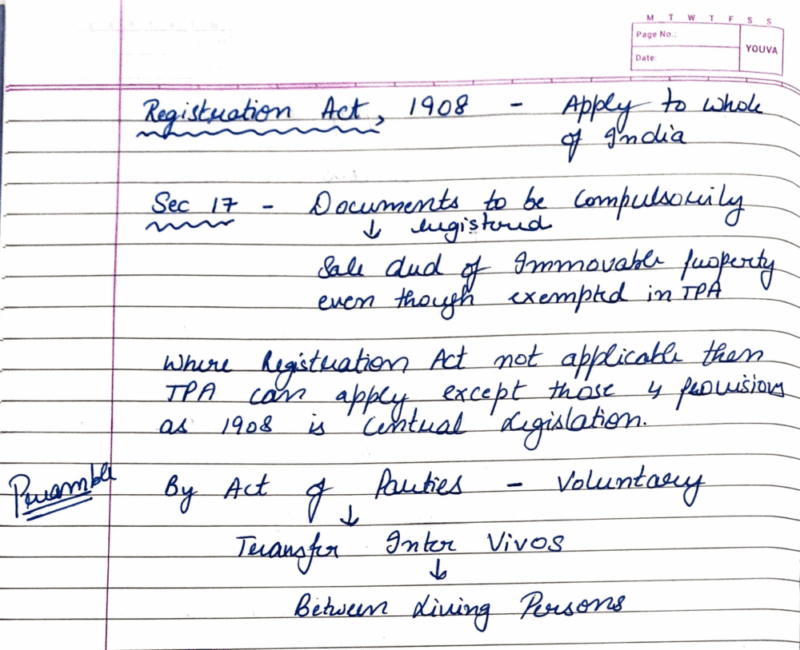
The Transfer of Property Act 1882 is a technical but high-scoring topic in UPSC Law Optional Paper I. This booklet begins with general principles: what constitutes a transfer, who can transfer, and the conditions subject to which transfers can be made, including the rule against perpetuity and the rules relating to accumulation. Lis pendens under Section 52, part performance under Section 53-A, and the doctrine of feeding the grant by estoppel are covered with landmark cases.
Specific transfers occupy the bulk of this booklet β sale (essential elements, rights and liabilities of buyer and seller before and after completion), mortgage (types: simple, usufructuary, English, equitable mortgage by deposit of title deeds, anomalous; rights of mortgagor including equity of redemption and clog on redemption; remedies of mortgagee), lease and licence distinction, gift (revocation), and exchange are all treated with illustrations and UPSC answer frameworks. Actionable claims and the transfer of interests round off this comprehensive booklet.
Booklet 13: Family Law β Hindu Law
Hindu Law is one of the most detail-intensive topics in UPSC Law Optional and this booklet covers both classical Hindu law principles and the modern codified law with equal depth. It begins with the sources of Hindu Law β Sruti, Smriti, commentaries, custom β and the two major schools: Mitakshara (with its five sub-schools) and Dayabhaga. The concept of the Hindu Undivided Family, coparcenary under Mitakshara, and joint family property are explained with the critical 2005 amendment to the Hindu Succession Act granting daughters coparcenary rights.
The Hindu Marriage Act 1955 β conditions for a valid Hindu marriage, void and voidable marriages, matrimonial reliefs (restitution of conjugal rights, judicial separation, divorce including fault theory and breakdown theory grounds) β are covered in full. Adoption under the Hindu Adoptions and Maintenance Act 1956, the conditions and effects of adoption, and maintenance obligations are also included. Guardianship under the Hindu Minority and Guardianship Act 1956 and the welfare of the minor as the paramount consideration close the booklet with case law support.
Booklet 14: Family Law β Muslim Law
Muslim Personal Law, as applied in India, is covered in this booklet with both the classical Sharia framework and contemporary judicial developments. The four sources of Muslim Law and the Sunni (Hanafi, Maliki, Shafi’i, Hanbali) and Shia schools are explained at the outset. Muslim marriage as a civil contract β conditions of validity, void and irregular marriages, dower (mahr) as an essential element, rights and obligations of spouses β forms the first major section.
Dissolution of Muslim marriages receives detailed treatment: talaq in its various forms (talaq-ul-sunnat vs talaq-ul-biddat), the Supreme Court’s judgment in Shayara Bano v Union of India declaring triple talaq unconstitutional, khula, mubarat, lian, and judicial divorce under the Dissolution of Muslim Marriages Act 1939 are all covered. The Shah Bano case, the Muslim Women (Protection of Rights on Divorce) Act 1986, and subsequent judicial developments on maintenance and alimony are analysed. Paternity, legitimacy, guardianship of minor children, and Muslim inheritance law close this booklet.
Booklet 15: Family Law β Christian & Parsi Law + Uniform Civil Code
This booklet covers the personal laws of Christians and Parsis under their respective statutes and concludes with the Uniform Civil Code debate β arguably one of the most topical issues in current UPSC Law Optional papers. The Indian Christian Marriage Act 1872, forms of solemnisation, and the Divorce Act 1869 as amended by the Indian Divorce (Amendment) Act 2001 are covered with the grounds for matrimonial relief available to Christians, including the significant changes made by the amendment act.
Parsi marriage under the Parsi Marriage and Divorce Act 1936 and the role of Panchayets are briefly but clearly covered. The Special Marriage Act 1954, which allows inter-religious civil marriages, is explained with its procedure and effects β including succession consequences under the Indian Succession Act 1925. The Uniform Civil Code section analyses Article 44 as a directive principle, the Goa Civil Code as India’s existing UCC model, the 21st Law Commission’s report, and the constitutional and political dimensions of UCC implementation β a guaranteed topic for UPSC Law Optional 2025-26.
Booklet 16: Civil Procedure Code β Part I
The Civil Procedure Code 1908 is a procedural law paper that rewards aspirants who understand its structure and key doctrines β and this booklet builds that understanding from the ground up. Jurisdiction β subject matter, pecuniary, territorial, and original vs appellate β is explained with the CPC provisions that govern each type. Res judicata under Section 11, its essential conditions, constructive res judicata, and res sub judice under Section 10 are covered with case law illustrations showing their application in UPSC hypothetical question patterns.
The institution of civil suits β plaint and written statement requirements, rejection of plaint under Order 7 Rule 11, appearance of parties, ex parte proceedings, and set-off and counter-claim β are covered with procedural flow charts. Discovery, inspection, admissions, framing of issues, and the examination and cross-examination of witnesses are included. Suits by and against the government, suits by minors and persons of unsound mind, representative suits, and interim orders including injunctions, attachment before judgment, and appointment of receiver round off this booklet.
Booklet 17: Civil Procedure Code β Part II
This continuation booklet covers the trial, post-trial, and appellate stages of civil procedure under the CPC 1908. The decree β preliminary and final, types of decrees β and the judgment are explained with the difference between judgment, decree, and order clarified for UPSC answer writing. Execution of decrees and orders under Sections 36β74 and Orders 21 covers arrest and detention, attachment of property, sale, delivery of property, and payment of money β all with procedural requirements.
Appeals are covered at three levels: first appeal under Section 96, second appeal on substantial questions of law under Section 100, and Letters Patent Appeal. Revision under Section 115 and review under Section 114 and Order 47 are distinguished from each other and from appeals β a distinction that UPSC examiners test directly. Inherent powers under Section 151, abatement of suits, transfer of suits under Section 25, restitution under Section 144, and representative suits under Order 1 Rule 8 complete this booklet with practice question alignment.
Booklet 18: Criminal Procedure Code (CrPC / BNSS)
Criminal procedure is covered in this booklet with full reference to both the CrPC 1973 and the new Bharatiya Nagarik Suraksha Sanhita 2023, which replaced it. The structure of criminal courts, their hierarchy, and the classification of offences into cognizable/non-cognizable and bailable/non-bailable are explained at the outset. FIR β its evidentiary value, mandatory registration under the Supreme Court’s ruling in Lalita Kumari, and the distinction from a complaint β bail, anticipatory bail, and default bail provisions are covered in detail.
Trial procedures β warrant trial, summons trial, and summary trial β are distinguished with flowcharts showing each stage from charge framing to judgment. The booklet covers compounding of offences under Section 320 CrPC, plea bargaining, juvenile justice interface, Section 482 CrPC (inherent powers of the High Court), and maintenance under Section 125. The new BNSS provisions β changes in investigation timelines, charge sheet filing, use of technology in trials, and victim rights strengthening β are integrated throughout to ensure UPSC 2025-26 relevance.
Booklet 19: Law of Evidence
The Indian Evidence Act 1872 β and its replacement, the Bharatiya Sakshya Adhiniyam 2023 β is the subject of this booklet. It begins with relevancy of facts under Sections 5β55, covering admission and confessions (the difference between the two, their evidentiary weight, and retracted confessions), statements by persons who cannot be called as witnesses under Section 32, res gestae, and the relevancy of judgments. Expert opinion under Section 45, its reliability, and its treatment by Indian courts are covered with current examples.
Documentary evidence β primary and secondary, public and private documents, certified copies, and the rules for proving documents β forms the second major segment. The booklet covers oral evidence rules including the best evidence rule, exclusion of oral by documentary evidence, and exceptions. Presumptions of law and fact under Sections 79β114, estoppel (equitable, promissory, and representation estoppel), burden of proof and onus of proof distinctions, examination of witnesses (examination-in-chief, cross-examination, re-examination), and privileged communications complete this booklet.
Booklet 20: Administrative Law
Administrative Law is a distinct subject in UPSC Law Optional Paper II and increasingly tested in recent years. This booklet starts with the nature and scope of administrative law, the Droit Administratif system in France vs the A.V. Dicey Rule of Law model, and why Dicey’s position has been modified to accommodate modern welfare state administration. Delegated legislation β its necessity, constitutional basis under Article 245 read with entries in the Schedules, and control mechanisms (parliamentary, judicial, and procedural) β are covered with leading cases including Delhi Laws Act and Hamdard Dawakhana.
Natural justice β the two cardinal rules of audi alteram partem and nemo judex in causa sua, their content, exceptions, and consequences of violation β are explained through an extensive case-law analysis from Ridge v Baldwin to Maneka Gandhi. Judicial review of administrative action β grounds including illegality, irrationality, and procedural impropriety from CCSU β and the application of these in India are covered. Writs as remedies, the Lokpal and Lokayukta Act 2013, Central Vigilance Commission, and the role of the CAG in administrative accountability close this booklet.
Booklet 21: Company Law & Arbitration
Company Law and Arbitration are covered together in this booklet, reflecting the UPSC Law Optional Paper II syllabus structure. The company as a separate legal person β the rule in Salomon v Salomon, exceptions (lifting of the corporate veil), and types of companies under the Companies Act 2013 β form the opening section. The memorandum and articles of association, doctrine of ultra vires, indoor management rule (Turquand’s rule), and the effects of misstatements in a prospectus are covered with Indian corporate cases.
Directors’ appointment, powers, duties, and liabilities under the Companies Act 2013 β including the prohibition on insider trading and related party transactions β are covered concisely. Winding up: voluntary, compulsory, and under the Insolvency and Bankruptcy Code 2016, are explained with the IBC’s CIRP process and its implications for creditors. The Arbitration and Conciliation Act 1996 (as amended in 2015 and 2019) β the distinction between domestic and international commercial arbitration, appointment of arbitrators, grounds for challenging an award, and enforcement of foreign awards under the New York Convention β round off this booklet.
Booklet 22: Public International Law β Advanced Topics
This advanced international law booklet covers specialized regimes that appear with increasing frequency in UPSC Law Optional Paper II. Air law begins with the Chicago Convention on International Civil Aviation 1944 β the five freedoms of the air, ICAO, and sovereignty over airspace. Space law covers the Outer Space Treaty 1967, the Moon Agreement, liability for damage caused by space objects, and emerging issues like private space exploration and debris governance that are relevant to current UPSC question trends.
International environmental law is covered through the Stockholm Declaration 1972, the Rio Declaration 1992, UNFCCC, the Kyoto Protocol, and the Paris Agreement 2015 β with critical analysis of the common but differentiated responsibilities principle. WTO law β the GATT framework, most-favoured-nation clause, national treatment, TRIPS, and the WTO Dispute Settlement Understanding β is covered with India-related disputes. Extradition law, asylum (territorial and diplomatic), statelessness under the 1954 and 1961 Conventions, and international protection of minorities complete this advanced booklet.
Booklet 23: Constitutional Law β Advanced Doctrines & Current Developments
This booklet is specifically designed for UPSC 2025-26 aspirants who need to be current with evolving constitutional law. It opens with the proportionality doctrine in Indian administrative and constitutional law β how it has replaced the Wednesbury unreasonableness standard in cases involving fundamental rights. Legitimate expectation as a ground of judicial review, its scope and limits in Indian law, and its relationship with promissory estoppel are covered with the most recent Supreme Court judgments.
The right to privacy after the Puttaswamy nine-judge bench, the right to life’s expansion under Article 21 through judgments on the right to livelihood, shelter, health, education, and environment, and the recent right to be forgotten are covered in detail. Sedition law’s constitutional status post-S.G. Vombatkere, same-sex marriage in Supriyo v Union of India, the EWS reservation under the 103rd Constitutional Amendment and its validation in Janhit Abhiyan v Union of India, and the ongoing debates around the electoral bonds judgment and Article 324 are integrated to make this the most current booklet in the set.
Booklet 24: UPSC Law Optional Previous Year Questions β Topic-Wise Analysis & Model Answers
This final booklet serves as the strategic bridge between content knowledge and UPSC answer writing performance. It compiles previous year UPSC Mains Law Optional questions from Paper I and Paper II β sorted topic-wise β covering the last 15 years of examinations. For each topic, the frequency of questions is analysed to help aspirants identify which areas warrant deeper preparation and which can be addressed with an overview answer. High-frequency topics such as Basic Structure, triple talaq, strict liability, specific performance, and state responsibility appear with multiple question variants.
Model answers are provided for a representative set of questions, following the UPSC examiner-expected structure: statutory provision, doctrine/principle, relevant case law, application to the question, and a balanced conclusion within a 200-250 word limit. The booklet includes time management strategies for the 3-hour Law Optional paper, advice on structuring 10-mark and 20-mark answers differently, a list of must-know Latin maxims and legal terms for law optional, and a final rapid-revision one-liner sheet covering all 22 Booklets’ key holdings and principles.
Physical Construction and Quality Standards
Rahul’s IAS Law & Judiciary Notes 2025-26 are produced to standards that match the demands of an aspirant spending months in intensive UPSC preparation β daily use, margin annotations, highlighting, and repeated revision are all accounted for in the physical build of these 22 Booklets.
Paper Quality: 75 GSM Anti-Glare White Paper
Every booklet in this set is printed on 75 GSM ultra-white, anti-glare paper chosen specifically for long law reading sessions. The high opacity of 75 GSM stock ensures that printed matter on the reverse side does not bleed through β critical when you are annotating dense case law notes on both sides. Multiple highlighter colors including yellow, green, pink, and orange work without smearing or bleed-through, enabling the color-coded revision system that most UPSC toppers recommend. The paper’s smooth surface also takes ballpoint, gel pen, and pencil annotations cleanly, preserving your margin notes across months of use.
Printing Technology: High-Resolution Laser Printing
All text, tables, flowcharts, and case-law summaries in these booklets are produced using high-resolution laser printing technology. Laser toner bonds permanently to the paper fibers β unlike inkjet printing which can smear with humidity β making these booklets safe for use across India’s diverse climatic conditions from coastal humidity to dry northern plains. Diagrams illustrating constitutional doctrines, flowcharts for CPC trial procedures, and comparison tables for IPC vs BNS provisions are all rendered with crisp clarity at 600 DPI, ensuring that even small text in footnotes and statutory sections is fully legible.
Binding and Durability
These booklets are available in either spiral binding or book binding β both chosen for durability through a full UPSC preparation cycle. Spiral binding allows each booklet to lie completely flat on the desk, making it easy to write notes alongside printed text without the book springing shut β a practical advantage when working through dense law topics. Book-bound editions have a 300 GSM laminated cover that protects the interior pages from daily handling, stacking, and transport in bags to coaching centres and libraries. Spine reinforcement ensures pages do not fall loose even after months of daily use.
Key Features and Study Design
These 22 Booklets are built around a single purpose: helping UPSC Law Optional aspirants produce structured, case-law backed, examiner-satisfying answers across all topics in both Paper I and Paper II of the law optional.
- Case Law Integration Throughout: Every doctrine, statutory provision, and legal principle is immediately followed by the relevant leading case β including the court, year, and principle established β so aspirants never need to separately memorise cases from a separate list. This mirroring of legal concept with judicial authority is how UPSC examiners expect law optional answers to be constructed.
- BNS / BNSS / BSA 2023 Updates Included: The new criminal law codes β Bharatiya Nyaya Sanhita, Bharatiya Nagarik Suraksha Sanhita, and Bharatiya Sakshya Adhiniyam β replace the IPC, CrPC, and Evidence Act. All relevant booklets in this 2025-26 set include comparative sections showing the changes, ensuring aspirants are prepared for UPSC’s updated question patterns.
- UPSC-Pattern Answer Templates: For high-frequency topics like specific performance, Basic Structure, res judicata, and state responsibility, the booklets include model answer templates that demonstrate the recommended structure β definition, statutory basis, case law, application, conclusion β within the word limits UPSC Mains demands.
- Comparative Tables and Flowcharts: Abstract legal distinctions β culpable homicide vs murder, sale vs exchange, guarantee vs indemnity, talaq types β are presented in structured comparison tables that are faster to revise than prose paragraphs. CPC trial procedure, criminal trial stages, and international law enforcement mechanisms are presented as flowcharts.
- Current Affairs Integration in Constitutional Law Booklets: The 2025-26 edition incorporates recent Supreme Court judgments on electoral bonds, reservation law, same-sex marriage, the right to privacy, and sedition β all likely to feature in UPSC Law Optional 2025-26 β directly within the relevant booklets rather than as a separate supplement, ensuring contextual understanding.
Shipping, Packaging and Delivery
All 22 Booklets are packed as a complete set before dispatch. Each booklet is individually shrink-wrapped to prevent moisture entry during transit. The full set is then placed in a corrugated cardboard box with foam edge protectors on all four corners to absorb impact during handling at logistics hubs. Additional bubble wrap is used around the exterior of the booklet stack to prevent shifting inside the box. The outer box is sealed with tamper-evident tape and clearly labelled as “Handle with Care β Educational Material.” Orders placed before 12 noon on business days are typically dispatched the same day from our Mukherjee Nagar, Delhi fulfilment centre.
Once dispatched, every order is assigned a tracking number that is sent via WhatsApp to the mobile number provided at checkout β typically within 4 hours of dispatch. Standard pan India delivery takes 3-5 business days, covering all pin codes including Tier 2 and Tier 3 cities, and most Northeast locations. If any booklet in the 22-booklet set is found missing or physically damaged upon opening, WhatsApp us at +91 70045 49563 with an unboxing photograph and the missing or damaged booklet will be replaced within 48 hours at zero additional cost. We stand fully behind the completeness and condition of every order.
Frequently Asked Questions (FAQ)
A: Rahul’s IAS is widely regarded as India’s No.1 institute for Law and Judicial Exams. The notes are faculty-curated, case-law rich, and mapped directly to the UPSC Law Optional syllabus for Paper I and Paper II. The 22-booklet structure ensures granular coverage β students who buy Rahul’s IAS printed notes consistently report structured preparation that translates to high marks in the 500-mark law optional, which can be a decisive scoring advantage in UPSC Mains final rankings.
A: This set includes exactly 24 individual printed booklets. The 22 Booklets together cover the complete UPSC Law Optional syllabus across Paper I (which includes Constitutional Law, Torts, Contracts, Transfer of Property, Family Laws, and the Specific Relief Act) and Paper II (which includes International Law, Administrative Law, Criminal Law, Evidence, and Company Law and Arbitration). The final booklet is dedicated to previous year questions and model answer strategy.
A: Yes. The product listed here is the English medium edition of Rahul’s IAS Law & Judiciary Notes for 2025-26. The cover also indicates availability in Hindi medium, but this particular listing is for English medium only. Aspirants who write UPSC Mains in English should buy this English medium set. If you need the Hindi medium version, contact us on WhatsApp at +91 70045 49563 to check availability and place an order.
A: The 22 Booklets cover Constitutional Law (22 Booklets), International Law (22 Booklets), Law of Crimes β IPC/BNS (22 Booklets), Law of Torts, Law of Contracts (22 Booklets), Specific Relief Act, Transfer of Property Act, Family Law β Hindu, Muslim, and Christian and Parsi law with UCC, Civil Procedure Code (22 Booklets), Criminal Procedure Code and BNSS, Evidence Act, Administrative Law, Company Law and Arbitration, Advanced Public International Law, current constitutional developments, and a previous year questions booklet with model answers.
A: Yes β Booklet 11 in this 22-booklet set is dedicated entirely to the Specific Relief Act 1963 as amended by the Specific Relief (Amendment) Act 2018. The booklet covers recovery of possession of immovable and movable property, specific performance (who may obtain, against whom enforced, and when courts cannot grant it), the 2018 amendment’s shift from discretionary to ordinarily available remedy, rectification and cancellation of instruments, declaratory decrees, and all forms of injunctions. It is one of the most UPSC-tested topics in Law Optional Paper I.
A: These booklets use 75 GSM ultra-white paper chosen for high opacity β multiple highlighter colors and gel pens work without bleed-through to the reverse side, ideal for color-coded revision. The anti-glare surface also reduces eye fatigue during long law reading sessions. Ballpoint pen, pencil, and marker annotations all work cleanly on this paper, making margin notes and case-law additions easy to write and retain across repeated revisions throughout your UPSC preparation.
A: Yes. The 2025-26 edition specifically incorporates the three new criminal law codes β Bharatiya Nyaya Sanhita (replacing IPC), Bharatiya Nagarik Suraksha Sanhita (replacing CrPC), and Bharatiya Sakshya Adhiniyam (replacing the Evidence Act) β within the relevant booklets with comparative sections against the old statutes. Constitutional law booklets are updated with recent Supreme Court judgments including electoral bonds, EWS reservation validation, right to privacy developments, and same-sex marriage rulings that are UPSC 2025-26 exam-relevant.
A: Most printed law optional notes in the market are either generic textbook summaries or PDF printouts without structured UPSC answer orientation. Rahul’s IAS notes are faculty-led, case-law integrated, and include UPSC-pattern answer templates for high-frequency topics β a combination that generic notes lack. The 22-booklet structure allows topic-specific revision without flipping through a single massive volume. The 2025-26 edition’s incorporation of new criminal law codes further separates it from older stock still circulating from other publishers.
A: You can buy Rahul’s IAS Law Optional Notes 2025-26 directly from this listing on our UPSC store. We are a Mukherjee Nagar, Delhi based store supplying genuine, current-batch printed notes β not reprints or photocopies. Each order is brand new, unmarked, and sealed before dispatch. To buy printed notes online with confidence, this store provides WhatsApp support at +91 70045 49563 and a replacement guarantee for any missing or damaged booklets upon delivery anywhere in India.
A: Yes. While these notes are structured for UPSC Law Optional, the substantive law they cover β Constitutional Law, IPC, CrPC, CPC, Evidence Act, Transfer of Property Act, Contracts, Torts, and Administrative Law β is directly relevant to BPSC, UPPSC, MPPSC, RAS, and most State PSC law papers and judicial service prelims and mains. The 2025-26 updated content including new criminal law codes is particularly valuable for state judicial service aspirants who are examining these statutory changes for the first time.
A: Delivery takes 3-5 business days pan India from the date of dispatch, with tracking provided via WhatsApp. For payment and COD availability specific to your pin code, WhatsApp us at +91 70045 49563 before placing your order and we will confirm the options available for your location. Orders from major cities including Delhi, Mumbai, Bengaluru, Chennai, Kolkata, Hyderabad, Pune, and Jaipur typically arrive within 3 business days. Northeast India and some remote pin codes may take up to 5-7 business days.
A: Absolutely. Law Optional accounts for 500 marks in UPSC Mains β equal to the entire General Studies portion across two papers. A difference of 30-40 marks in law optional, which is achievable through structured note-based preparation vs unguided self-study, can meaningfully change your final merit rank. Buying the complete 22-booklet set ensures no topic gap in either Paper I or Paper II, and the previous year question booklet (Booklet 24) alone adds a strategic layer that helps you direct your revision effort where the marks are actually available in the UPSC exam.
Summary
| Specification | Value |
|---|---|
| Booklets | 24 Printed Booklets |
| Language | English Medium |
| Paper | 75 GSM Ultra-White |
| Binding | Spiral or Book Binding |
| Delivery | 3-5 Business Days Pan India |
| Also Useful For | BPSC, UPPSC, MPPSC, RAS, and All State PSC Law and Judicial Exams |
Sourced and dispatched from our store in Mukherjee Nagar, Delhi β India’s hub for UPSC study material. Buy Rahul’s IAS Law & Judiciary Notes 2025-26 today and receive your complete 22-booklet set with pan India delivery in 3-5 days.
Reference: UPSC official syllabus
Customer Reviews 145
Organized aur informative. IAS ke liye essential product hai.
Reliable notes for IAS exam preparation. Content is upto date aur accurate.
Useful content for Law optional students. But mujhe laga ki coaching classes se better hota.
Notes are very detailed aur well-organized. Great investment for law optional!
22 booklets cover sab kuch comprehensively. Packing bhi mast tha, koi damage nahi hua.
Notes are okay for basics. But compared to other coaching materials, yeh thoda generic lag raha hai.
Best study material available, worth every rupee spent.
Notes properly structured hain. Mujhe bohot help mil raha padhai mein.
Aspirants Also Bought
More from the same category
About Rahul’s IAS Law & Judiciary Notes 2025-26
Rahul’s IAS Law & Judiciary Notes 2025-26 is a highly recommended UPSC study material from Rahulβs IAS, specially designed for Law & Judiciary preparation. Available in English medium, this material is crafted to match the exact requirements of the UPSC Civil Services Examination syllabus β covering both Prelims and Mains comprehensively.
Product Details
- Institute: Rahulβs IAS
- Subject: Law & Judiciary
- Medium: English
- Format: Printed
- Delivery: Pan-India delivery in 3β5 working days
- Format: Original printed material, verified authentic
Why Buy from UPSC Store?
- β 100% Genuine Printed Material β Original printed notes, no photocopies or fake copies
- β Fast Delivery β Ships within 24 hours, arrives in 3β5 days pan-India
- β Secure Packaging β Bubble-wrapped and boxed to prevent damage in transit
- β Trusted by 10,000+ Aspirants β India's most reliable UPSC material marketplace
- β WhatsApp Support β Get expert guidance on material selection before ordering
Frequently Asked Questions
Yes, all products at UPSC Store are 100% genuine printed materials. We do not sell photocopies or fake copies.
Orders are dispatched within 24 hours and delivered across India in 3β5 working days via reputed courier partners.
Yes, we accept returns within 7 days if the product is damaged or incorrect. Check our refund policy for details.
We recommend pairing this with current affairs notes and a UPSC test series for comprehensive preparation. Browse more in Law, Optional, UPSC.