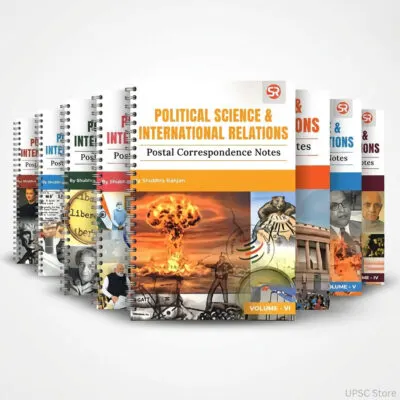

Piyush Chaubey PSIR Notes GS Score 2025-26

6 Booklets | English Medium | UPSC Study Material

Key Highlights:
πŸ“˜ 6 Booklets
πŸ“š PSIR
πŸŽ“ GS Score
🏷️ Printed
πŸ‡¬πŸ‡§ English Medium
β‚Ή1,345
πŸ“˜ book-binding βœ“
πŸŒ€ spiral βœ“
Only 28 sets left
Selling fast (70 sold this week)
5% OFF Use UPSC5% (COD Available)
10% OFF Use UPI10 (UPI Only)
Secure Payment
Fast Delivery
Safe Packaging

About Piyush Chaubey PSIR GS Score

The Piyush Chaubey PSIR GS Score is a printed UPSC study material set sold by UPSC Store β€” India’s trusted source for genuine, latest-batch civil services preparation books. This page covers full booklet details, syllabus coverage, pricing, shipping, and frequently asked questions. Useful for UPSC CSE, BPSC, UPPSC, MPPSC, RAS and other state PSC examinations.

Piyush Chaubey PSIR Notes GS Score 2025-26 β€” 10 English Medium Printed Booklets for UPSC Political Science & International Relations Optional

Related: GS Score notes Β· Political Science optional

Product Overview

FeatureDetails
Booklets Count10 Individual Printed Booklets β€” Full PSIR Optional Syllabus Coverage (Paper I & Paper II)
LanguageEnglish Medium
PublisherGS Score / IAS Score (Political Science Foundation Series by Dr. Piyush Kumar Chaubey)
Edition2025-26 β€” Latest Genuine Batch
ConditionBrand New, Unmarked, Fresh Stock
FormatHigh-Quality Printed Booklets β€” Spiral or Book Binding
Paper Quality75 GSM Ultra-White β€” Highlighter Safe, Zero Bleed-Through
ShippingPan India Delivery in 3-5 Business Days β€” Tracked
Also Useful ForBPSC, UPPSC, MPPSC, RAS and all State PSC optional examinations

Complete Booklet Catalog

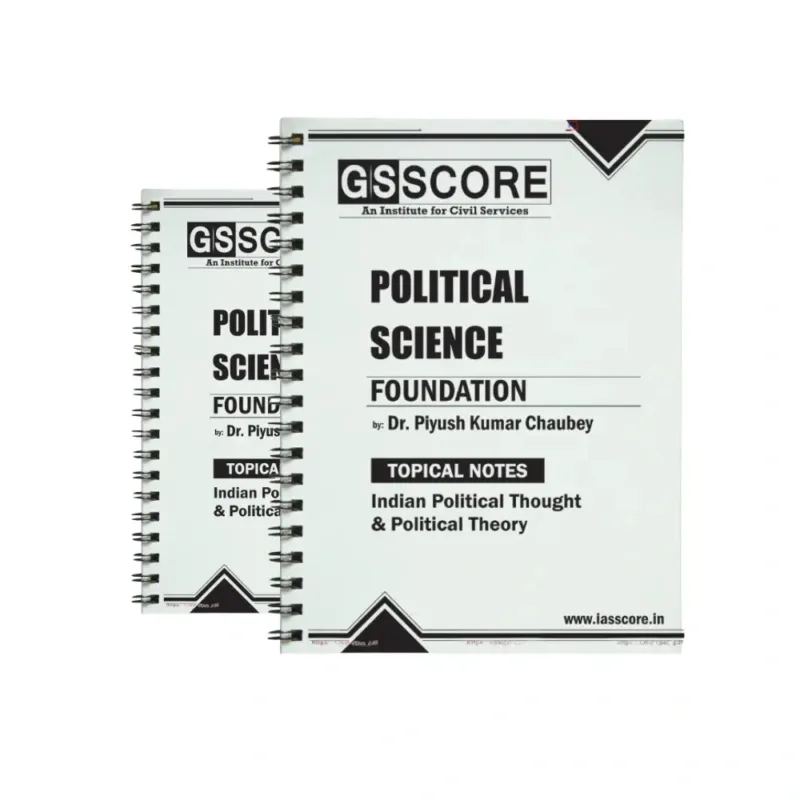
This 6-booklet set by Dr. Piyush Kumar Chaubey of GS Score covers the entire UPSC PSIR optional syllabus β€” from foundational political theory and Indian political thought to comparative politics, international relations theory, and India’s foreign policy. Designed as topical printed notes, this series is structured for aspirants who want well-organised, exam-ready material that directly maps to UPSC Mains Paper I and Paper II without wading through bulky textbooks.

  • Booklet 1: Political Theory β€” Core Concepts β€” Covers the foundational building blocks of Political Theory including the nature and scope of politics, concepts of power, authority, legitimacy, and sovereignty. Includes key thinkers from Plato and Aristotle to Machiavelli and Hobbes, with structured notes mapping each concept to UPSC Paper I Section A questions and analytical answer frameworks.
  • Booklet 2: Political Ideologies β€” Detailed treatment of major political ideologies including Liberalism, Neo-liberalism, Conservatism, Socialism, Marxism, Fascism, and Anarchism. Each ideology is presented with its historical emergence, core principles, key thinkers, and critical evaluation in the context of UPSC optional answer writing requirements.
  • Booklet 3: Indian Political Thought β€” Covers the UPSC syllabus on Indian Political Thought including Kautilya’s Arthashastra, Manu’s political ideas, Buddhist political philosophy, medieval Islamic political thought, and modern Indian thinkers such as Bankim Chandra, Vivekananda, Sri Aurobindo, Gandhi, Ambedkar, Nehru, Lohia, and JP Narayan.
  • Booklet 4: Western Political Thought β€” Covers classical and modern Western political thinkers: Plato, Aristotle, Machiavelli, Hobbes, Locke, Rousseau, J.S. Mill, Hegel, Marx, Gramsci, Arendt, Rawls, and Nozick. Includes critical analysis of each thinker’s contribution to political philosophy along with UPSC-pattern evaluation notes and connecting themes.
  • Booklet 5: State, Nation, and Political Institutions β€” In-depth notes on theories of the State, concepts of the Nation and Nationalism, federalism, constitutionalism, rule of law, civil society, and political institutions. Covers comparative constitutional frameworks and their relevance to UPSC questions on governance and political structures.
  • Booklet 6: Comparative Politics and Political Economy β€” Covers systems of government, comparative methodology, political development, dependency theory, world systems theory, democratisation, and political economy approaches including structuralism and institutionalism. Includes comparative analysis of democratic transitions relevant to UPSC Paper I Section B.
  • Booklet 7: International Relations Theory β€” Covers all major IR theories β€” Realism, Neo-realism, Liberalism, Neo-liberalism, Constructivism, Marxist approaches, Post-colonialism, and Feminism. Includes key theorists: Morgenthau, Waltz, Keohane, Wendt, and others. Structured for direct application in UPSC PSIR Paper II analytical questions.
  • Booklet 8: International Organisations and Global Governance β€” Detailed notes on the United Nations system (UNSC, UNGA, ICJ, ECOSOC), Bretton Woods institutions (IMF, World Bank, WTO), regional organisations (EU, ASEAN, AU, SAARC), and emerging global governance mechanisms including G20 and BRICS, with current affairs linkages for UPSC 2025-26.
  • Booklet 9: India’s Foreign Policy β€” Covers the evolution of India’s foreign policy from Nehruvian idealism to strategic autonomy, Non-Alignment Movement and its relevance today, India’s nuclear doctrine, Look East/Act East Policy, Neighbourhood First Policy, and India’s bilateral relationships with major powers including the USA, Russia, China, and the EU.
  • Booklet 10: Contemporary Global Issues and India’s Position β€” Notes on globalisation and its political consequences, terrorism and global security, climate change diplomacy, nuclear non-proliferation, cyber security, humanitarian intervention, Responsibility to Protect (R2P), and India’s stance on emerging global challenges β€” directly linked to recent UPSC question trends.

In-Depth Content Breakdown: Booklet by Booklet

Booklet 1: Political Theory β€” Core Concepts

Political Theory forms the backbone of UPSC PSIR Paper I Section A, and this booklet by Dr. Piyush Kumar Chaubey lays a rigorous foundation. It covers the nature and scope of political science, tracing its evolution from a normative discipline to a behavioural and post-behavioural science. Key concepts examined include power β€” its sources, types, and limitations; authority β€” traditional, charismatic, and legal-rational (Weber’s framework); legitimacy in democratic and non-democratic contexts; and sovereignty β€” its classical and pluralist critiques. The content is mapped directly to UPSC question patterns from the last decade.

What makes this booklet particularly useful is the structured presentation of each concept with definitions, theoretical debates, and contemporary relevance. Each section includes boxed summaries ideal for quick revision before the UPSC Mains exam. The booklet also features flowcharts connecting different political thinkers to their respective conceptual contributions, helping aspirants build an integrated understanding rather than studying thinkers in isolation. Answer-writing hints are embedded throughout, making this a practical preparation tool rather than a passive reading resource for PSIR optional.

Booklet 2: Political Ideologies

This booklet covers the full spectrum of political ideologies required for UPSC PSIR Paper I. Liberalism is treated from its classical origins through welfare liberalism to neo-liberalism, with thinkers from Locke and Mill to Hayek and Rawls. Conservatism is presented through Burke, Oakeshott, and neo-conservative variations. Socialism is covered across its Utopian, Marxist, Fabian, and Democratic Socialist strands. Fascism and its relationship to Nationalism receive analytical treatment especially relevant to questions on 20th-century political thought. Anarchism β€” from Bakunin to contemporary eco-anarchism β€” closes the ideological survey with critical UPSC-angle commentary.

Each ideology section follows a consistent format: historical emergence, core principles, key thinkers and their arguments, internal critiques, and contemporary relevance. This structured approach means aspirants can write balanced, multi-perspectival UPSC answers demonstrating the kind of analytical depth that scores well in the optional paper. Special tables comparing ideological positions on the State, freedom, equality, and property allow for quick comparative revision. The booklet explicitly cross-references Indian political thinkers who engaged with these ideologies, connecting Paper I theoretical content with Indian political thought questions.

Booklet 3: Indian Political Thought

Indian Political Thought is one of the most scoring yet often under-prepared areas of UPSC PSIR optional. This booklet provides structured topical notes on ancient, medieval, and modern Indian political thinkers. The ancient section covers Kautilya’s Arthashastra β€” saptanga theory, foreign policy maxims (mandala theory), and statecraft β€” Manu’s Dharmashastra, and Buddhist political philosophy centred on the Dhamma concept. The medieval section addresses Ziauddin Barani, Al-Biruni, and the political thought embedded in Mughal administrative theory, contextualising these within UPSC’s examination of pre-colonial political traditions.

The modern Indian political thought section is the most detailed, covering Bankim Chandra’s cultural nationalism, Vivekananda’s social philosophy, Sri Aurobindo’s integral humanism and nationalism, Gandhi’s political philosophy (Satyagraha, Swaraj, Trusteeship, Non-violence), Ambedkar’s critique of caste and his constitutional vision, Nehru’s democratic socialism and foreign policy thought, Ram Manohar Lohia’s socialist critique, and Jayaprakash Narayan’s concept of Total Revolution. Each thinker is presented with their key texts, central arguments, and UPSC-style critical evaluation notes, making this booklet essential for anyone preparing PSIR optional with GS Score material.

Booklet 4: Western Political Thought

Western Political Thought is a staple of UPSC PSIR Paper I questions, and this booklet covers thinkers across three major epochs. The classical section gives detailed treatment to Plato’s Theory of Justice and the Ideal State, and Aristotle’s classification of constitutions and concept of the polis. The early modern section covers Machiavelli’s separation of ethics and politics, Hobbes’s social contract and absolute sovereignty, Locke’s theory of rights and limited government, Rousseau’s general will, and Montesquieu’s separation of powers. Each thinker is contextualised within their historical moment to explain why UPSC examiners continue to ask about them.

The modern and contemporary section covers Hegel’s dialectic and the ethical state, Marx’s historical materialism and class struggle, Gramsci’s concept of hegemony, J.S. Mill on liberty and representative government, Hannah Arendt on totalitarianism and the public realm, John Rawls’s theory of justice and the veil of ignorance, and Nozick’s libertarian critique of redistribution. The booklet uses comparative tables to contrast thinkers on shared themes such as the State, freedom, and justice β€” a format directly useful for UPSC answers that ask candidates to compare two thinkers or assess a theoretical debate.

Booklet 5: State, Nation, and Political Institutions

This booklet addresses one of the most conceptually rich areas of PSIR Paper I β€” theories and structures of the State, Nation, and political institutions. Theories of the State covered include the liberal pluralist view, the Marxist instrumentalist and structuralist accounts, the Gramscian hegemony-based analysis, the feminist critique of the gendered State, and the neo-liberal minimal state. Nationalism is examined through primordialist, constructivist, and modernist frameworks, with case studies drawn from decolonisation movements relevant to UPSC questions on Asia and Africa. Federalism receives detailed treatment comparing Indian, American, and German models.

Constitutionalism, rule of law, separation of powers, and judicial review are covered with both theoretical grounding and comparative examples. Civil society β€” from Tocqueville’s associational democracy to Gramsci’s contested terrain β€” is a focus area given its frequent appearance in UPSC PSIR and GS Paper II questions. Political parties, electoral systems (proportional representation vs. first-past-the-post), pressure groups, and bureaucracy complete the institutional analysis. This booklet is particularly valuable for aspirants who also take GS Paper II, as the conceptual clarity gained here reinforces governance-related answers in the General Studies component.

Booklet 6: Comparative Politics and Political Economy

Comparative Politics is the methodological and substantive heart of PSIR Paper I Section B. This booklet opens with a clear treatment of comparative methodology β€” case studies, cross-national statistical analysis, area studies, and the most-similar and most-different systems designs. It then moves to political development theory, covering modernisation theory (Almond, Verba, Huntington), dependency theory (Frank, Cardoso), and world systems theory (Wallerstein) β€” all of which appear regularly in UPSC PSIR optional questions. Democratic theory is examined through procedural, substantive, and deliberative variants, with Dahl’s polyarchy as a central reference point.

The political economy section covers key debates between liberal institutionalism, structuralism, and Marxist political economy in the international context. The developmental state model, illustrated through East Asian examples, is contrasted with the Washington Consensus approach. Democratisation theory β€” including transition and consolidation phases, Huntington’s waves of democracy β€” is covered with contemporary examples from Latin America, Eastern Europe, and Asia. The booklet closes with notes on political culture and political socialisation, concepts that connect comparative politics to both UPSC PSIR optional answers and GS Paper I society questions.

Booklet 7: International Relations Theory

International Relations theory forms the conceptual architecture of PSIR Paper II, and this booklet provides the most structured treatment in the GS Score PSIR series. Classical Realism is covered through Thucydides, Machiavelli, and Morgenthau’s six principles of political realism. Neo-realism (Structural Realism) is explained through Waltz’s Theory of International Politics, including the distinction between offensive and defensive realism. Liberal Internationalism β€” from Kant’s perpetual peace to Woodrow Wilson’s Fourteen Points β€” leads into neo-liberal institutionalism (Keohane and Nye’s complex interdependence). Each theory is examined for its explanatory strengths and limitations with reference to real-world international events.

Constructivism (Wendt’s “Anarchy is what states make of it”) receives substantial treatment, as does the English School (Bull’s anarchical society, solidarism vs. pluralism). Marxist IR theory β€” world systems, dependency, uneven development β€” connects to the political economy booklet. Post-colonial IR theory and feminist IR perspectives are covered as critical approaches. Each theoretical framework includes a dedicated section on its application to South Asian and Indian foreign policy contexts, making this booklet directly useful for UPSC PSIR Paper II Section A questions on IR theory as well as the applied sections on contemporary world order and India’s foreign policy.

Booklet 8: International Organisations and Global Governance

International organisations are central to UPSC PSIR Paper II, and this booklet provides structured topical notes on the full landscape of multilateral institutions. The United Nations system receives the most detailed coverage β€” the UNSC’s permanent membership and veto power, reform debates, peacekeeping operations, and the General Assembly’s normative role. The ICJ’s jurisdiction and landmark cases, ECOSOC’s coordination role, and specialised agencies (UNESCO, WHO, ILO) are covered with reference to recent UPSC questions. The booklet also examines the tension between state sovereignty and UN intervention, a recurring PSIR optional exam theme.

The Bretton Woods institutions β€” IMF, World Bank, and WTO β€” are analysed as both governance mechanisms and sites of contestation between developed and developing nations. Regional organisations receive dedicated treatment: the European Union’s integration model, ASEAN’s non-interference principle, the African Union’s peace and security architecture, SAARC’s structural challenges, and SCO’s evolving role. BRICS and G20 are examined as emerging multi-polar governance forums with India’s leadership role highlighted. Current affairs integrations β€” India’s G20 Presidency themes, WTO dispute settlement reforms, UN Security Council reform β€” make this booklet particularly relevant for the 2025-26 UPSC cycle.

Booklet 9: India’s Foreign Policy

India’s foreign policy is one of the most frequently tested areas in UPSC PSIR Paper II, and this booklet by Dr. Piyush Kumar Chaubey traces its evolution with analytical depth. The Nehruvian phase covers the idealist foundations β€” Non-Alignment, anti-colonialism, Panchsheel, and the Bandung spirit β€” and their domestic legitimation. The post-Nehru period through the Indira Gandhi era is covered with the 1971 Bangladesh war and the Treaty of Peace, Friendship, and Cooperation with the USSR as turning points. The Rajiv Gandhi, Narasimha Rao, Vajpayee, and Manmohan Singh periods are traced to show the gradual shift toward pragmatic engagement and economic diplomacy.

The contemporary phase under India’s current strategic orientation receives detailed treatment: the Neighbourhood First Policy and its challenges with Pakistan, China, and smaller neighbours; Act East Policy and ASEAN engagement; the Indo-US strategic partnership and QUAD; India-Russia relations and strategic autonomy under multipolarity; India-China relations β€” border disputes, BRI critique, and Doklam/Galwan analysis; India’s nuclear doctrine (no first use, credible minimum deterrence); and India’s role in BRICS, SCO, and G20. Answer-writing frameworks for 10-mark and 15-mark UPSC PSIR questions on India’s foreign policy are embedded throughout this booklet.

Booklet 10: Contemporary Global Issues and India’s Position

The final booklet in the GS Score PSIR 2025-26 series by Dr. Piyush Kumar Chaubey addresses contemporary global issues that are increasingly prominent in UPSC PSIR Paper II questions and GS Paper II international relations sections. Globalisation is examined through its economic, political, cultural, and technological dimensions, with a critical analysis of its uneven effects on the Global South. Terrorism β€” state-sponsored, transnational, and cyber-enabled β€” is covered with the UN Global Counter-Terrorism Strategy and India’s policy response. Climate change diplomacy from Kyoto to Paris to COP-28/29 is detailed with India’s climate commitments and equity arguments in multilateral negotiations.

Nuclear non-proliferation β€” the NPT regime, CTBT, India’s position as a non-signatory, and the nuclear security summit process β€” is treated with the analytical rigour required for UPSC PSIR Paper II Section B questions. Cyber security as an emerging dimension of national security and IR is covered, including norms debates in the UN GGE process. Humanitarian intervention and the Responsibility to Protect doctrine are examined with critical case studies. The booklet closes with notes on refugee law (UNHCR, 1951 Convention), human rights regimes, and the politics of international criminal justice β€” all areas that UPSC PSIR examiners have drawn upon in recent question papers, making this an indispensable final booklet.

Physical Construction and Quality Standards

These GS Score PSIR printed notes are manufactured to the standards expected by serious UPSC optional aspirants who use their study material daily across 12-14 months of intensive preparation. Every production choice β€” paper, ink, binding β€” is optimised for the demanding conditions of UPSC optional study.

Paper Quality: 75 GSM Anti-Glare White Paper

Each booklet is printed on 75 GSM ultra-white paper selected specifically for high opacity and minimal eye fatigue during extended reading sessions. The surface texture is smooth enough for clear text reproduction while providing just enough grain for comfortable hand-writing of margin notes. Multiple highlighter colours β€” yellow, green, pink, and blue β€” can be applied without any bleed-through to the reverse side, enabling the colour-coded revision systems favoured by UPSC toppers. Under standard room lighting and study lamps, the anti-glare surface eliminates the reflection problems associated with coated glossy papers used in lower-quality prints.

Printing Technology: High-Resolution Laser Printing

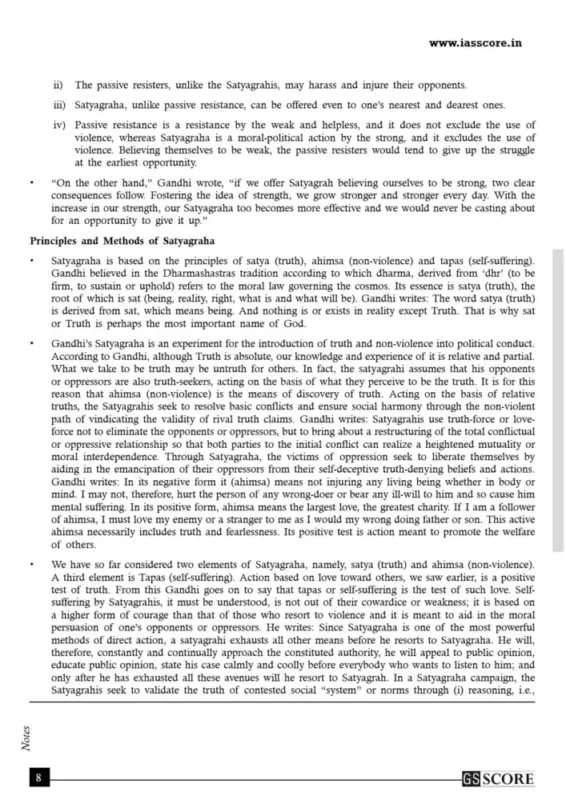
All ten booklets in this Piyush Chaubey GS Score PSIR series are produced using high-resolution laser printing technology at a minimum resolution of 1200 DPI. This ensures that every text character, table border, flowchart line, and map detail is reproduced with precise sharpness β€” critical for a subject like PSIR where theoretical diagrams, structural flowcharts showing IR theory relationships, and comparison tables form an integral part of the study material. Laser toner is permanently fused to the paper fibres, making the printed content fully smudge-proof and water-resistant under normal handling conditions across months of daily use.

Binding and Durability

The GS Score PSIR booklets are available in spiral binding or book binding depending on current stock. Spiral-bound booklets open completely flat on any study surface, allowing aspirants to write notes alongside the printed content without the book springing shut β€” a significant practical advantage during answer-writing practice sessions. The outer cover is produced on 300 GSM thick card stock, providing rigid protection against corner damage and spine wear during repeated bag-to-desk transit. Book-bound versions offer a compact form factor ideal for shelf storage and carry, with the same 300 GSM cover protection. Both formats deliver a full UPSC optional preparation cycle’s durability.

Key Features and Study Design

The GS Score PSIR 2025-26 notes by Dr. Piyush Kumar Chaubey are built around the specific demands of UPSC optional answer writing β€” analytical depth, conceptual clarity, and structured presentation that translates directly into marks on exam day.

  • Topical Organisation Mapped to UPSC Syllabus: Every booklet is organised by UPSC PSIR syllabus topics rather than by textbook chapter conventions. This means aspirants can immediately locate the notes relevant to any past UPSC question and can plan their study schedule around the official syllabus without cross-referencing multiple sources.
  • Answer-Writing Frameworks Embedded: Throughout the 6-booklet series, Dr. Piyush Kumar Chaubey has integrated answer-writing hints, model paragraph structures, and analytical frames for both 10-mark and 15-mark UPSC PSIR Mains questions. Aspirants studying independently without classroom coaching will find these frameworks particularly valuable for building exam-ready writing habits.
  • Thinker-to-Concept Cross-Referencing: Political thinkers are indexed across booklets so that a concept like “justice” can be traced from Plato through Rawls to Ambedkar, building the kind of cross-thematic analytical capacity that UPSC PSIR examiners reward. This cross-referencing system reduces the need for multiple separate revision notes.
  • Current Affairs Integration for 2025-26: The IR and India’s Foreign Policy booklets have been updated for the 2025-26 UPSC cycle with references to recent multilateral developments, India’s G20 Presidency outcomes, evolving India-China-Russia dynamics, and the latest shifts in global governance debates β€” ensuring the printed material stays relevant to UPSC Mains 2025 and 2026 question setters’ focus areas.
  • Self-Study Accessible Without Classroom Attendance: The GS Score PSIR printed notes are written as standalone study material. Dr. Piyush Kumar Chaubey’s topical notes include sufficient explanatory context that aspirants outside Delhi, or those unable to attend GS Score classroom sessions, can use the 6-booklet set as their primary PSIR optional study material without supplementing with coaching recordings.

Shipping, Packaging and Delivery

Every order of the Piyush Chaubey GS Score PSIR 2025-26 6-booklet set is packed using a four-layer protection protocol designed specifically for printed study material. All 6 Booklets are first wrapped individually in shrink-wrap film to protect covers from moisture and scuffing. The full set is then placed in a corrugated cardboard insert tray that prevents booklets from shifting during transit. Reinforced cardboard edge protectors are applied to all four corners before the complete package is sealed in a heavy-duty outer corrugated shipping box rated for the stacking pressures of courier and postal sorting facilities across India.

Orders are dispatched within 1-2 business days of confirmed payment and reach most major Indian cities and towns within 3-5 business days via fully tracked courier. A tracking ID is shared via email and WhatsApp immediately upon dispatch, allowing you to monitor your PSIR notes shipment in real time. For queries, order customisation, or bulk institutional orders, WhatsApp our team at +91 70045 49563. In the rare event of a damaged or missing booklet upon delivery, we replace the affected booklet within 48 hours of a reported complaint β€” no questions asked.

Frequently Asked Questions (FAQ)

Q1: Are Piyush Chaubey PSIR notes from GS Score good for UPSC optional?

A: Yes. Dr. Piyush Kumar Chaubey’s GS Score PSIR notes are widely used by UPSC optional aspirants for their topical organisation, conceptual clarity, and answer-writing frameworks. The 6-booklet set covers the full PSIR syllabus β€” both Paper I (Political Theory, Indian Political Thought, Western Political Thought, Comparative Politics) and Paper II (IR Theory, International Organisations, India’s Foreign Policy, Contemporary Global Issues) β€” making it a solid primary resource for UPSC PSIR optional preparation in the 2025-26 cycle.

Q2: How many booklets are included in GS Score PSIR notes 2025-26?

A: This product includes exactly 10 individual printed booklets covering the complete PSIR optional syllabus for UPSC. The 6 Booklets span Political Theory, Political Ideologies, Indian Political Thought, Western Political Thought, State and Nation, Comparative Politics and Political Economy, International Relations Theory, International Organisations, India’s Foreign Policy, and Contemporary Global Issues. All 6 Booklets are shipped together as one complete set in a single tracked delivery.

Q3: Is GS Score PSIR material available in English medium?

A: Yes. This specific product β€” the Piyush Chaubey GS Score PSIR Notes 2025-26 that you are currently viewing β€” is entirely in English medium. All 6 Booklets, including explanations, analytical notes, thinker summaries, answer-writing frameworks, tables, and flowcharts, are written and printed in English. This makes the set directly useful for aspirants writing their UPSC PSIR optional Mains answers in English, which is the medium in which most PSIR toppers attempt the optional paper.

Q4: What topics are covered in Piyush Chaubey PSIR notes?

A: The 6-booklet GS Score PSIR series covers: Political Theory (power, authority, legitimacy, sovereignty), Political Ideologies (Liberalism, Marxism, Conservatism, Socialism, Fascism), Indian Political Thought (Kautilya to Ambedkar, Gandhi, Nehru), Western Political Thought (Plato to Rawls and Nozick), Comparative Politics, International Relations Theory (Realism, Liberalism, Constructivism), International Organisations (UN, IMF, WTO, ASEAN, BRICS), India’s Foreign Policy (Nehruvian to current), and Contemporary Global Issues including terrorism, climate, and nuclear non-proliferation.

Q5: Are GS Score PSIR notes sufficient for UPSC Mains optional preparation?

A: The GS Score PSIR 6-booklet set provides a strong primary study base for UPSC PSIR optional. For most aspirants, supplementing with standard reference texts β€” such as O.P. Gauba for Political Theory, Bipan Chandra for Indian Political Thought, and Mohit Bhattacharya for Public Administration perspectives in IR β€” will strengthen the preparation. Previous year UPSC PSIR optional question papers should be practised alongside these notes for answer-writing skill development. Many successful PSIR optionalists have used GS Score material as their backbone study resource.

Q6: How is GS Score PSIR notes different from Vajiram or Vision IAS PSIR material?

A: GS Score PSIR notes by Dr. Piyush Kumar Chaubey are structured as topical notes with embedded answer-writing frameworks β€” a format that differs from Vajiram’s class-note style and Vision IAS’s GS-integrated approach. GS Score PSIR material gives greater depth to Indian Political Thought and International Relations Theory, with thinker-level cross-referencing that suits analytical UPSC optional answers. The choice between institutes ultimately depends on the aspirant’s learning style; many serious PSIR optional takers buy and compare multiple sets before settling on their primary material.

Q7: Can I use Piyush Chaubey notes without attending GS Score classes?

A: Yes. The GS Score PSIR printed notes are specifically written as standalone study material that can be used without attending classroom sessions or watching recorded lectures. Dr. Piyush Kumar Chaubey’s topical notes include conceptual explanations, thinker analyses, critical evaluations, and answer-writing guidance that make the printed booklets self-sufficient. Aspirants outside Delhi, in tier-2 cities, or those with full-time work commitments have successfully used these notes as their primary PSIR optional study material without any supplementary coaching input.

Q8: What is the price of GS Score PSIR 6 Booklets study material 2025-26?

A: The current price of the Piyush Chaubey GS Score PSIR Notes 2025-26 β€” 6 Booklets, English medium β€” is listed on this product page and includes all 10 printed booklets shipped together. The price shown includes standard pan India tracked delivery within 3-5 business days. For the most up-to-date pricing, any active discounts, or information about bulk orders for study groups or coaching centres, please check the product page directly or WhatsApp our store at +91 70045 49563.

Q9: What is the paper quality? Can I use a highlighter?

A: These booklets use 75 GSM ultra-white paper chosen for high opacity β€” multiple highlighter colors and gel pens work without bleed-through to the reverse side, ideal for color-coded revision. The paper also performs well with ballpoint and fine-liner pens, allowing aspirants to write margin notes, star-mark important thinker arguments, and annotate answer frameworks directly on the printed pages without the ink spreading or ghosting through to the opposite side during intensive daily use.

Q10: Is this the latest 2025-26 edition with updated content?

A: Yes. This is the genuine 2025-26 edition of the GS Score PSIR notes by Dr. Piyush Kumar Chaubey, sourced directly from fresh stock. The IR Theory, International Organisations, India’s Foreign Policy, and Contemporary Global Issues booklets have been updated to reflect developments relevant to the 2025-26 UPSC examination cycle, including India’s recent multilateral engagements, G20 outcomes, and shifts in global governance debates. All booklets dispatched are brand new, unmarked, and free from any previous owner annotations or damage.

Q11: Can these notes be used for State PSC optional exams?

A: Yes. The Piyush Chaubey GS Score PSIR 2025-26 notes are useful for state PSC optional examinations including BPSC, UPPSC, MPPSC, and RAS where Political Science is an optional subject. The conceptual grounding in political theory, Indian political thought, and comparative politics provided by these booklets aligns well with state PSC syllabi. Aspirants attempting political science optional at the state level will benefit from the same topical structure and analytical frameworks, though they should cross-check their specific state PSC syllabus for any additional topics not covered in the UPSC syllabus.

Q12: Where can I buy Piyush Chaubey PSIR notes online and how fast will I receive them?

A: You can buy Piyush Chaubey GS Score PSIR notes 2025-26 online directly from this product page β€” our UPSC Store ships pan India from our base in Mukherjee Nagar, Delhi. After confirmed payment, orders are dispatched within 1-2 business days and delivered within 3-5 business days across India via tracked courier. A tracking ID is shared immediately upon dispatch. For express delivery requirements or bulk orders, WhatsApp us directly at +91 70045 49563 and our team will arrange the fastest available shipping option for your location.

Summary

SpecificationValue
Booklets10 Printed Booklets β€” Full PSIR Optional Syllabus
LanguageEnglish Medium
FacultyDr. Piyush Kumar Chaubey
InstituteGS Score / IAS Score (iasscore.in)
Edition2025-26 β€” Latest Genuine Batch
Paper75 GSM Ultra-White
BindingSpiral or Book Binding
Delivery3-5 Business Days Pan India
Also Useful ForBPSC, UPPSC, MPPSC, RAS and all State PSC optional examinations

Dispatched from our UPSC Store in Mukherjee Nagar, Delhi β€” the heart of India’s UPSC preparation ecosystem. Buy Piyush Chaubey GS Score PSIR Notes 2025-26 online today and receive your complete 6-booklet set with pan India tracked delivery in 3-5 days.

Reference: UPSC official syllabus

Customer Reviews 245

4.5
Based on 245 reviews
5β˜…
146
4β˜…
73
3β˜…
26
2β˜…
0
1β˜…
0
P
Priya Deshmukh
24 Apr 2026
βœ“ Verified

Booklets bilkul organized hain aur content crystal clear. Highly recommended for serious aspirants.

M
Mohit Jain
23 Apr 2026
βœ“ Verified

Notes acche hain aur format bhi student-friendly hai.

A
Arjun Reddy
20 Apr 2026
βœ“ Verified

Quality mast hai

N
Nikhil Chopra
17 Apr 2026
βœ“ Verified

Piyush Chaubey sir ke notes mein sab kuch hai jo entrance exam ke liye required hai. Quality packaging bhi bohot acchi thi.

R
Rohan Patel
16 Apr 2026
βœ“ Verified

Content quality top notch.

R
Rajesh Sharma
13 Apr 2026
βœ“ Verified

Booklets bahut comprehensive hain, Piyush sir ke notes se concepts clear ho gaye. GS Score quality maintain ki hai bilkul.

K
Karan Malhotra
11 Apr 2026
βœ“ Verified

Padh raha hoon abhi, par abhi tak bohot helpful lag raha hai.

N
Neha Singh
08 Apr 2026
βœ“ Verified

Content concise yet comprehensive hai. Piyush sir ke approach samajh mein aata hai.

πŸ›οΈ

Aspirants Also Bought

More from the same category

View All β†’

About Piyush Chaubey PSIR Notes GS Score 2025-26

Piyush Chaubey PSIR Notes GS Score 2025-26 is a highly recommended UPSC study material from GS Score, specially designed for PSIR preparation. Available in English medium, this material is crafted to match the exact requirements of the UPSC Civil Services Examination syllabus β€” covering both Prelims and Mains comprehensively.

Product Details

  • Institute: GS Score
  • Subject: PSIR
  • Medium: English
  • Format: Printed
  • Delivery: Pan-India delivery in 3–5 working days
  • Format: Original printed material, verified authentic

Why Buy from UPSC Store?

  • βœ… 100% Genuine Printed Material β€” Original printed notes, no photocopies or fake copies
  • βœ… Fast Delivery β€” Ships within 24 hours, arrives in 3–5 days pan-India
  • βœ… Secure Packaging β€” Bubble-wrapped and boxed to prevent damage in transit
  • βœ… Trusted by 10,000+ Aspirants β€” India's most reliable UPSC material marketplace
  • βœ… WhatsApp Support β€” Get expert guidance on material selection before ordering

Frequently Asked Questions

Is this product 100% original?

Yes, all products at UPSC Store are 100% genuine printed materials. We do not sell photocopies or fake copies.

How long does delivery take?

Orders are dispatched within 24 hours and delivered across India in 3–5 working days via reputed courier partners.

Can I return the product?

Yes, we accept returns within 7 days if the product is damaged or incorrect. Check our refund policy for details.

Which other study materials should I buy with this?

We recommend pairing this with current affairs notes and a UPSC test series for comprehensive preparation. Browse more in Optional, Political Science, UPSC.