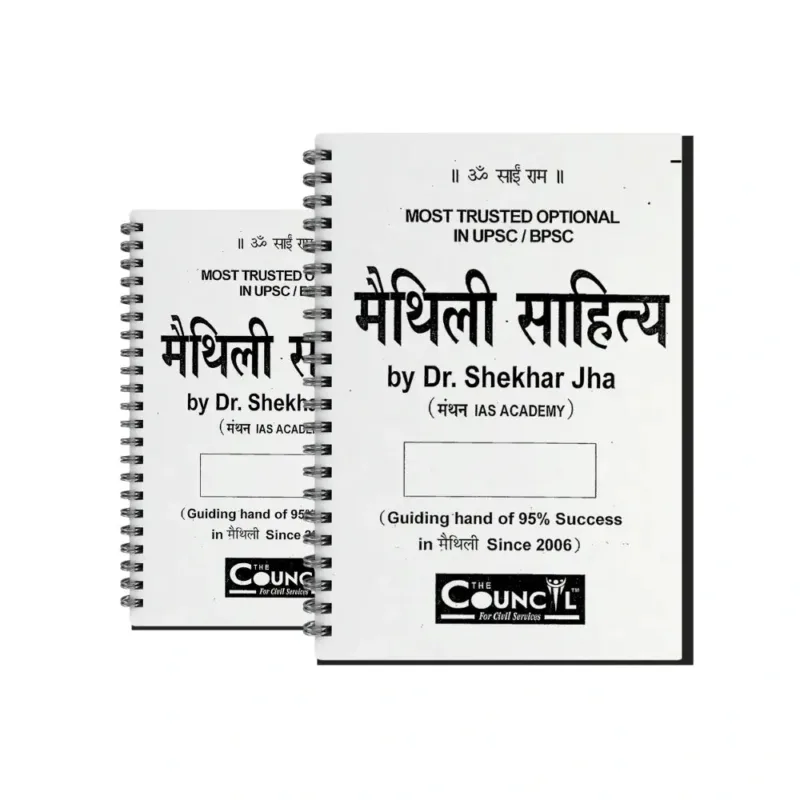
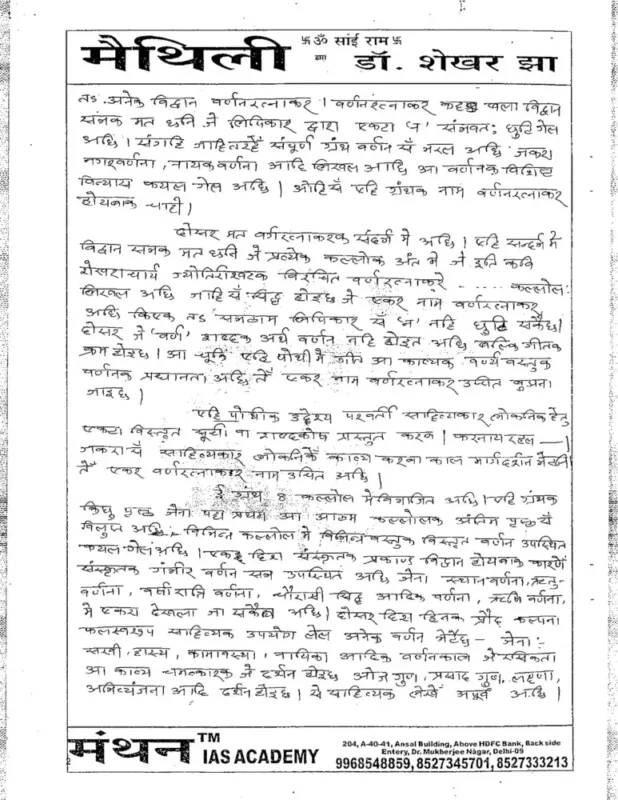
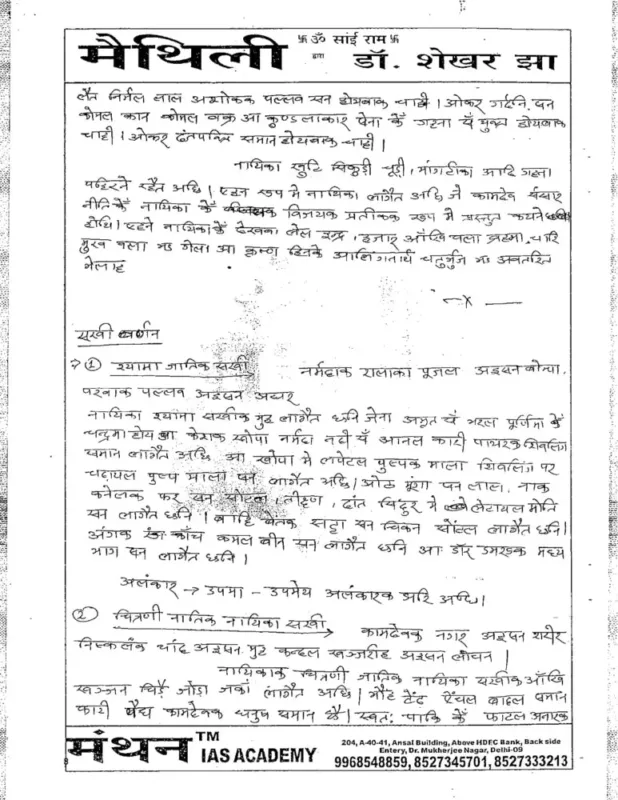


Maithili Sahitya Shekhar Jha Manthan IAS Academy Notes 2025-26
About Maithili Sahitya Manthan IAS Notes
The Maithili Sahitya Manthan IAS Notes is a printed UPSC study material set sold by UPSC Store — India’s trusted source for genuine, latest-batch civil services preparation books. This page covers full booklet details, syllabus coverage, pricing, shipping, and frequently asked questions. Useful for UPSC CSE, BPSC, UPPSC, MPPSC, RAS and other state PSC examinations.
Dr. Shekhar Jha Manthan IAS Academy Maithili Sahitya Notes 2025-26 — 8 Hindi Medium Printed Booklets for UPSC Optional Subject
Related: Maithili literature optional · Hindi medium UPSC
Product Overview
| Feature | Details |
|---|---|
| Booklets Count | 8 Individual Printed Booklets — Full UPSC Maithili Optional Syllabus Coverage (Paper I + Paper II) |
| Language | Hindi Medium (हिंदी माध्यम) — Explanations and Analysis in Hindi |
| Publisher | Manthan IAS Academy (Dr. Shekhar Jha Maithili Optional Series) |
| Edition | 2025-26 — Latest Genuine Batch |
| Condition | Brand New, Unmarked, Fresh Stock |
| Format | High-Quality Printed Booklets — Spiral or Book Binding |
| Paper Quality | 75 GSM Ultra-White — Highlighter Safe, Zero Bleed-Through |
| Shipping | Pan India Delivery in 3-5 Business Days — Tracked |
| Also Useful For | BPSC, UPPSC, MPPSC, RAS and all State PSC Examinations with Maithili Literature Paper |
Complete Booklet Catalog
These 8 printed booklets by Dr. Shekhar Jha of Manthan IAS Academy cover the complete UPSC Maithili optional syllabus across Paper I (भाषा एवं साहित्य का इतिहास) and Paper II (मैथिली साहित्य के प्रमुख ग्रंथ). Since 2006, Dr. Shekhar Jha has guided aspirants through the Maithili optional with an unmatched 95% success record, making this the most trusted printed material available for UPSC Mains preparation in Hindi medium.
- Booklet 1: मैथिली भाषा का उद्भव एवं विकास — Origin and historical development of the Maithili language; its classification within the Indo-Aryan family; dialectal variations such as standard Maithili, Bajjika, and Angika; geographical spread across Mithila region; script evolution from Tirhuta (Mithilakshar) to Devanagari; linguistic features including phonology, morphology, and syntax relevant to UPSC Paper I.
- Booklet 2: मैथिली साहित्य का इतिहास — आदिकाल एवं मध्यकाल — Detailed chronological study of Maithili literature from Aadikaal to Madhyakaal; major poets and their landmark works; Vidyapati Thakur’s pivotal role and literary contributions; Padavali tradition; Chandravali and other major poets; court poetry and social context; bhakti and shringar rasa in medieval Maithili verse; important questions from previous UPSC Mains papers.
- Booklet 3: आधुनिक मैथिली साहित्य — गद्य एवं पद्य — Development of modern Maithili prose and poetry from the 19th century onward; contributions of Chanda Jha, Harishchandra Jha, and other modernists; emergence of novel, short story, and drama forms; socio-cultural context of literary reform movements; influence of nationalism and Renaissance on Maithili writing; UPSC-focused analysis of significant texts and their literary value.
- Booklet 4: विद्यापति और उनकी रचनाएँ — In-depth study of Vidyapati Thakur — the central figure of Maithili literature; biographical background; thematic analysis of Padavali, Kirtilata, Purushpariksha, and Likhanabali; shringar and bhakti elements; Vidyapati’s influence on Bengali, Odia, and other regional literatures; language and style analysis; frequently asked UPSC Mains questions based on Vidyapati’s canon; critical perspectives from leading scholars.
- Booklet 5: मैथिली उपन्यास एवं कहानी साहित्य — Evolution of the Maithili novel and short story; major novelists including Baidyanath Mishra ‘Yatri’ (Nagarjuna) and their works; landmark short story collections; thematic concerns like social reform, agrarian life, caste dynamics, and women’s experience; narrative technique and literary devices; UPSC Paper II prescribed texts in prose fiction; model answers and essay-style analysis for Mains examination success.
- Booklet 6: मैथिली नाटक एवं निबंध साहित्य — Historical development of Maithili drama from traditional forms to modern theatre; major playwrights and their significant plays; thematic and structural analysis of important dramas; rise of Maithili essay writing; major essayists and their stylistic contributions; critical literary essays prescribed under UPSC syllabus; comparison with parallel developments in Hindi and other regional literary traditions; exam-oriented notes.
- Booklet 7: मैथिली साहित्य — प्रमुख ग्रंथों का विश्लेषण (Paper II) — Booklet-by-booklet analysis of all UPSC-prescribed texts under Maithili Paper II; character studies, plot summaries, thematic analysis, and critical evaluation of each prescribed work; relevant background of the author; literary devices and stylistic features highlighted; past UPSC Mains questions mapped to each text; model paragraph-length answers and key points for scoring maximum marks in Paper II.
- Booklet 8: उत्तर-लेखन कौशल, मॉडल प्रश्नोत्तर एवं पिछले वर्षों के प्रश्नपत्र — Dedicated answer-writing module for Maithili optional; Dr. Shekhar Jha’s time-tested answer-writing framework; 20+ model answers for 10-mark and 15-mark questions; previous years’ UPSC Mains question papers from 2015 to 2024; topic-wise question mapping; common examiner observations; revision strategy for final months before UPSC Mains; tips to score above 280 in Maithili optional paper.
In-Depth Content Breakdown: Booklet by Booklet
Booklet 1: मैथिली भाषा का उद्भव एवं विकास
Maithili’s linguistic history is a compulsory topic in UPSC Paper I, and this booklet gives aspirants a structured, exam-ready foundation. Starting from the Proto-Indo-Aryan roots and tracing the language’s gradual divergence into the distinctive Maithili dialect group, the content covers all the key linguistic milestones an examiner expects. The Tirhuta (Mithilakshar) script, its relationship with the Bengali script, and the eventual transition to Devanagari are explained clearly. Geographical distribution of Maithili across Bihar, Jharkhand, and Nepal is also mapped with context.
The booklet’s second half focuses on structural features of the language — phonology, morphology, syntax, and grammatical categories unique to Maithili. Dr. Shekhar Jha’s approach in this booklet is notably analytical rather than merely descriptive, giving aspirants the tools to write high-scoring answers that demonstrate linguistic awareness. Tables comparing Maithili with related languages like Bhojpuri and Bajjika are particularly helpful. The booklet also addresses the Sahitya Akademi recognition of Maithili in 1965 and its inclusion in the Eighth Schedule of the Indian Constitution, both commonly tested facts in UPSC Mains.
Booklet 2: मैथिली साहित्य का इतिहास — आदिकाल एवं मध्यकाल
This booklet covers the foundational literary history of Maithili from its earliest recorded texts through the Madhyakaal, which represents the richest period of classical Maithili writing. Aadikaal texts and their authorship, the emergence of court patronage under the Oinwar dynasty, and the flowering of Padavali poetry are all treated with the depth the UPSC optional paper demands. The booklet gives particular weight to the socio-religious context — the interplay between Shaivism, Vaishnavism, and Shakta traditions — that shaped the content and tone of medieval Maithili literature.
Vidyapati’s dominance over this era is treated in detail here, but the booklet also rescues from obscurity other significant medieval voices whose works appear in UPSC questions. The inclusion of timeline charts, poet-to-text mapping tables, and era-wise thematic summaries makes this booklet a revision powerhouse for the literary history section. Previous years’ UPSC questions from 2018 to 2024 have been mapped against specific content nodes in this booklet, allowing aspirants to immediately identify high-yield topics and prioritise their study time during the final revision phase.
Booklet 3: आधुनिक मैथिली साहित्य — गद्य एवं पद्य
The transition from classical to modern Maithili literature is a period of intense activity that UPSC examiners frequently probe. This booklet traces the 19th-century renaissance in Maithili writing, driven by print culture, social reform movements, and the influence of figures like Chanda Jha, who brought disciplined prose to the language. The development of Maithili journalism, literary societies, and the Mithila Mihir periodical are contextualised here as forces that shaped the modern literary imagination. The UPSC syllabus emphasis on prose forms makes this section particularly critical for Paper I scoring.
Modern poetry’s departure from Padavali conventions toward free verse and social consciousness is documented through detailed analysis of key poets and poetic movements. The booklet includes comparative notes on modern Maithili poetry vis-à-vis contemporary Hindi and Bengali poetry, enabling aspirants to write analytically rich answers. Short yet sharp author profiles — biographical context, major works, literary philosophy — are arranged for quick recall during the exam. The booklet concludes with a model essay on the defining characteristics of modern Maithili literature, demonstrating the answer-writing style Dr. Shekhar Jha recommends.
Booklet 4: विद्यापति और उनकी रचनाएँ
No subject in the entire UPSC Maithili optional carries as much weight as Vidyapati Thakur, and this dedicated booklet ensures aspirants have total command over every examinable dimension of his life and work. Starting with Vidyapati’s biography — his birth in Bisfi village, his royal patronage under Oinwar king Shiva Simha, and his extraordinary literary output — the booklet moves into detailed textual analysis of Padavali, Kirtilata, Purushpariksha, and Likhanabali. Each text receives thematic, structural, and stylistic analysis with specific examples drawn directly from the source.
The Padavali’s dual nature — simultaneously devotional and erotic — is one of the most frequently examined analytical challenges in UPSC Maithili optional, and Dr. Shekhar Jha handles it with exceptional clarity, giving aspirants precise language to articulate this complexity in their answers. The booklet also addresses Vidyapati’s influence beyond Maithili — on Vaishnava literature in Bengal (where he is revered as a bhakta-poet), on Odia Jagannath devotional poetry, and on later Hindi literature. A dedicated section on critical opinions about Vidyapati from major scholars ensures aspirants can engage with the evaluative questions that typically appear in the paper.
Booklet 5: मैथिली उपन्यास एवं कहानी साहित्य
Prose fiction in Maithili represents the most socially engaged dimension of the literary tradition, and this booklet documents its evolution from the earliest experimental novels through the mature works of the 20th century. Baidyanath Mishra ‘Yatri’ — known in Hindi circles as Nagarjuna — occupies a central place here, with detailed analysis of his Maithili novels that deal with agrarian life, caste oppression, and the lives of ordinary people in the Mithila heartland. The booklet shows how the Maithili novel absorbed the realist tradition while retaining distinctly regional cultural textures.
The short story (कहानी) receives equal attention, with coverage of major story collections, representative authors, and the thematic preoccupations that define the genre in Maithili. Women writers who contributed to Maithili fiction are highlighted — a dimension that UPSC examiners have increasingly focused on in recent years. For each major author, the booklet provides a concise but information-rich profile: birth-death years, major works, central themes, literary style, and place in the larger Maithili literary tradition. Model answers for UPSC-type questions on the novel and short story are interspersed throughout to reinforce exam application.
Booklet 6: मैथिली नाटक एवं निबंध साहित्य
Maithili drama has deep roots in folk performance traditions — Sama-Chakeva, Dhinan-Dhinan, and the tradition of community theatrical performance — which evolved under literary influence into a formal dramatic tradition. This booklet traces that arc from traditional performance to modern Maithili theatre, covering the major playwrights of the 20th century and the structural and thematic features of their best-known works. The UPSC syllabus specifically includes Maithili drama as a required area, and this booklet ensures complete coverage with critical analysis tools that help aspirants frame high-scoring answers.
The Maithili essay (nibandh) tradition — which flourished as a vehicle for social commentary, literary criticism, and cultural reflection — is treated with the seriousness it deserves in the second half of this booklet. Major essayists, their stylistic hallmarks, and the social contexts their essays addressed are all documented. A particularly valuable feature is the set of comparison tables that map the Maithili essay tradition against its counterparts in Hindi and Bangla, enabling aspirants to write comparative and evaluative answers that score high marks. The booklet ends with a curated set of model essay answers demonstrating Dr. Shekhar Jha’s recommended structure.
Booklet 7: मैथिली साहित्य — प्रमुख ग्रंथों का विश्लेषण (Paper II)
UPSC Paper II of the Maithili optional is built around close reading and critical analysis of prescribed texts — and this booklet is the dedicated resource for that entire paper. Every text prescribed in the official UPSC syllabus for Maithili Paper II is treated here with full critical apparatus: plot summary (where applicable), character analysis, thematic study, literary devices, the author’s historical and social context, and critical opinions from leading Maithili scholars. The booklet is structured so that aspirants can work through one text at a time, or use it as a quick-reference guide during final revision.
One of the most practical features of this booklet is the question-mapping system: previous UPSC Mains questions from 2013 to 2024 are tagged against the specific texts they examine. This allows aspirants to identify which texts have been most frequently questioned and to concentrate their reading accordingly. Model paragraph-length answers — written in the clear, analytical Hindi medium style that scores well in UPSC Maithili optional — are provided for each major text. Dr. Shekhar Jha’s insights into what UPSC evaluators look for in Paper II answers are embedded throughout, turning this booklet into both a content resource and an exam-strategy guide.
Booklet 8: उत्तर-लेखन कौशल, मॉडल प्रश्नोत्तर एवं पिछले वर्षों के प्रश्नपत्र
The final booklet in this set addresses the single most important skill that separates high scorers from average performers in the UPSC Maithili optional: answer writing. Dr. Shekhar Jha — whose students have achieved a 95% success rate in Maithili optional since 2006 — distils his answer-writing philosophy into a structured module that covers introduction framing, argument development, use of textual evidence, conclusion techniques, and time management within the three-hour exam window. Both 10-mark and 15-mark question formats are addressed separately, with format-specific guidance for each.
This booklet contains 20+ fully written model answers spanning the breadth of the UPSC Maithili syllabus — language, literary history, specific texts, and critical analysis. Each model answer is annotated to highlight what makes it effective: the use of specific examples, the deployment of critical vocabulary, the balance between description and analysis, and the use of Maithili terms and quotations to demonstrate subject-matter depth. The complete UPSC Maithili question papers from 2015 through 2024 are reproduced in full, allowing aspirants to practice under authentic exam conditions and self-assess using the model answers provided.
Physical Construction and Quality Standards
These 8 printed booklets are manufactured to withstand the intensive, long-duration study sessions that UPSC Maithili optional preparation demands — from first reading through multiple revision cycles right up to the morning before the exam.
Paper Quality: 75 GSM Anti-Glare White Paper
Each page uses 75 GSM ultra-white paper selected for its high opacity and surface density. Unlike cheaper 60 GSM paper commonly found in photocopy notes, this paper prevents ink from bleeding through to the reverse side — meaning your highlighter in five different colors and your gel pen annotations will remain clean and readable throughout months of use. The slightly matte, anti-glare surface reduces eye strain significantly during extended study sessions of four to six hours, which is the typical study block for UPSC optional subject preparation. Paper thickness also means pages don’t tear at the edges when booklets are opened repeatedly.
Printing Technology: High-Resolution Laser Printing
All text, tables, and literary timelines in these booklets are printed using high-resolution laser technology at 1200 DPI minimum. Laser printing bonds toner permanently to the paper surface, making the text completely smudge-proof even when pages are handled repeatedly with moist fingertips during intense study. Complex tables — such as poet-to-text mapping charts, era-wise literary chronologies, and answer-writing frameworks — are printed with crisp line clarity that makes them easy to read and annotate. The print quality remains consistent across all 20 Booklets in the set, ensuring a uniform reading experience throughout your Maithili optional preparation.
Binding and Durability
The booklets are available in either spiral binding or book binding depending on the specific booklet’s design requirements. Spiral-bound booklets open completely flat on a desk, which is ideal for writing notes and annotations alongside the printed content — a critical feature for the answer-writing practice booklet. Book-bound booklets use a strong perfect-bind spine with 300 GSM laminated covers that resist moisture, bending, and the general wear of being carried in a bag across coaching centres. The spine text on each booklet is clearly printed, making it easy to identify individual booklets when they are stacked or stored on a shelf.
Key Features and Study Design
These notes are purpose-built for UPSC Maithili optional aspirants preparing in Hindi medium — designed around how examiners actually set questions and how evaluators actually award marks in this specific 500-mark paper.
- Dr. Shekhar Jha’s 19-Year Track Record: Since 2006, Manthan IAS Academy under Dr. Shekhar Jha has guided Maithili optional aspirants with a documented 95% success rate — a figure that reflects not just teaching quality but a deep understanding of how the UPSC evaluates Maithili answers. When you buy these notes, you buy that institutional knowledge in printed form.
- Bilingual Content Strategy — Maithili Text with Hindi Explanation: The notes present Maithili literary passages, quotations, and technical terms in their original form while providing all explanations, analysis, and commentary in clear Hindi medium. This approach ensures aspirants can read and write Maithili textual references in their UPSC answers while understanding the critical framework entirely in their first language.
- UPSC Syllabus Mapping — Topic by Topic: Every section of the 20 Booklets is explicitly mapped to the official UPSC Maithili optional syllabus. Aspirants can immediately see which booklet and which section addresses which syllabus point, making study planning and gap identification fast and accurate throughout the preparation cycle.
- Previous Years’ Question Integration: UPSC Mains questions from 2013 to 2024 are integrated directly into the relevant content sections rather than collected at the end. This question-first approach keeps aspirants focused on examinable material and helps them test their understanding immediately after studying each topic — a proven technique for retention and recall under exam conditions.
- Dedicated Answer-Writing Module in Booklet 8: Unlike most optional notes sets that treat content and answer-writing as separate concerns, this set dedicates an entire booklet to answer-writing skill development. The 20+ model answers in Booklet 8 — aligned to real UPSC question formats — make this set a complete Maithili optional preparation system, not just a reference resource. This is the feature that most separates self-study aspirants who buy these notes from those who struggle without guidance.
Shipping, Packaging and Delivery
Every order of these 8 Maithili Sahitya printed booklets is packaged with the same care we give to our own study materials. Each booklet set is individually shrink-wrapped to keep all 20 Booklets together and protected from humidity during transit. The shrink-wrapped set is then placed inside a double-walled corrugated cardboard box with foam edge protectors at all four corners to absorb any impact during courier handling. A “Fragile — Books” sticker is applied to every parcel. The packaging is designed to survive the full 3-5 day transit journey without any booklet suffering bent covers, wet pages, or crushed spines.
Once dispatched, you will receive a tracking ID via WhatsApp and email within 24 hours of order confirmation. Delivery across pan India takes 3-5 business days from dispatch — metro cities typically receive orders in 2-3 days, and Tier-2 and Tier-3 cities within 4-5 days. If any booklet in your set arrives damaged or is found missing on delivery, contact us on WhatsApp at +91 70045 49563 and the replacement booklet will be dispatched within 48 hours at no extra cost. We handle all post-delivery queries personally — no automated responses, no delays.
Frequently Asked Questions (FAQ)
A: Yes — Manthan IAS Academy’s Maithili optional notes by Dr. Shekhar Jha are widely regarded as the most trusted resource for UPSC Maithili preparation. With a 95% success rate since 2006 and content that is explicitly mapped to the UPSC syllabus, these 20 Booklets represent the single most concentrated source of exam-relevant Maithili Sahitya knowledge available in printed Hindi medium form. Thousands of successful candidates have used this exact material to clear UPSC Mains.
A: This set contains exactly 8 individual printed booklets covering the complete UPSC Maithili optional syllabus. The 20 Booklets span Maithili language origin and development, literary history from Aadikaal through modern times, Vidyapati in depth, prose fiction, drama and essays, Paper II prescribed text analysis, and a dedicated answer-writing and previous-year questions module. All 20 Booklets are dispatched together in a single tracked parcel, and the complete set is what you buy online through our store.
A: Yes — Maithili is one of the relatively rare UPSC optional subjects where Hindi medium study material of genuinely high quality exists, primarily because of Dr. Shekhar Jha’s Manthan IAS Academy series. The 20 Booklets in this set present all explanations, analysis, critical commentary, and model answers in Hindi, while preserving original Maithili literary texts and quotations in their authentic form. This bilingual approach is ideal for aspirants whose primary medium is Hindi but who are taking Maithili as their optional subject.
A: The 20 Booklets cover: (1) Maithili language history and development; (2) Classical and medieval literary history including Vidyapati’s era; (3) Modern Maithili prose and poetry; (4) Detailed study of Vidyapati and his major works; (5) Maithili novel and short story; (6) Maithili drama and essay literature; (7) Analysis of all UPSC-prescribed Paper II texts; and (8) Answer-writing skills with 20+ model answers and previous year question papers from 2015-2024. Together they cover both UPSC Maithili Paper I and Paper II completely.
A: Yes — the edition you are buying is the genuine 2025-26 batch printed by Manthan IAS Academy, updated to reflect the current UPSC Maithili optional syllabus. Any changes in prescribed texts, updated critical perspectives, or new analytical frameworks relevant to the 2025-26 UPSC examination cycle have been incorporated. We ship only the latest genuine batch directly — we do not hold or sell older editions. The edition year is clearly printed on the cover of each booklet so you can verify it upon delivery.
A: Maithili is considered one of the more scoring literature optionals in UPSC Mains when prepared well. Literature optional subjects in general offer more predictable syllabi and consistent scoring compared to social science optionals. Maithili specifically has a smaller and well-defined candidate pool, and evaluators familiar with the subject reward precise textual knowledge and good answer structure. Dr. Shekhar Jha’s documented 95% success rate and the fact that many of his students have scored above 280 marks together confirm that Maithili, with the right preparation material, is highly rewarding.
A: The primary difference lies in faculty expertise, syllabus depth, and answer-writing orientation. Dr. Shekhar Jha of Manthan IAS Academy has 19+ years of exclusive focus on Maithili optional, which means the content here reflects deep understanding of what UPSC examiners actually want — not generic textbook reproduction. Many competing notes are broader but shallower. The Manthan IAS 20-booklet set is also distinctive in dedicating an entire booklet to answer-writing with model answers and previous-year question papers — a feature most competing materials lack entirely.
A: Yes — these 20 Booklets are specifically designed to be self-sufficient for aspirants who cannot attend classroom coaching. The content is structured for independent study with clear explanations in Hindi, model answers demonstrating correct answer-writing technique, previous-year question papers for practice, and UPSC syllabus mapping throughout. Many aspirants preparing from Tier-2 and Tier-3 cities or working professionals have successfully cleared UPSC Maithili optional using only these printed notes. Booklet 8’s answer-writing module essentially delivers the core benefit of coaching in printed form.
A: These booklets use 75 GSM ultra-white paper chosen for high opacity — multiple highlighter colors and gel pens work without bleed-through to the reverse side, ideal for color-coded revision. The matte anti-glare surface also reduces eye strain during long study sessions of four to six hours, which is typical during UPSC Maithili optional preparation. The paper is thick enough that pages don’t tear at corners or edges when opened and closed repeatedly over months of revision use.
A: Every set we dispatch is a genuine, brand-new, freshly printed 2025-26 edition from Manthan IAS Academy — not photocopies, not scanned PDFs printed locally, and not older batches repackaged. The paper quality, printing resolution, and binding are all at the original manufacturer’s standard. All 20 Booklets arrive unmarked and unread. We source directly and maintain fresh inventory specifically to ensure every buyer receives the same quality that classroom students at Manthan IAS Academy receive when they buy notes in person in Delhi.
A: After order confirmation, your parcel is typically dispatched within 24 hours on business days. Delivery across pan India takes 3-5 business days from dispatch date — metro cities such as Delhi, Mumbai, Kolkata, Patna, and Ranchi usually receive orders in 2-3 days. You will receive a tracking ID via WhatsApp at +91 70045 49563 and by email within 24 hours of dispatch, allowing you to monitor your parcel in real time. If any delivery issue arises, contact us on WhatsApp and we resolve it within the same business day.
A: Yes — while these 20 Booklets are primarily designed for UPSC Maithili optional preparation, the content is equally valuable for BPSC, UPPSC, MPPSC, RAS, and other state PSC examinations that include Maithili literature as an optional or language paper. The foundational language history, literary history, and textual analysis content in Booklets 1 through 7 is relevant across all competitive examinations that test Maithili Sahitya knowledge. The UPSC focus of Booklet 8 is specifically UPSC-oriented, but the model answer frameworks apply to state PSC answer writing as well.
Summary
| Specification | Value |
|---|---|
| Booklets | 8 Printed Booklets — Complete UPSC Maithili Optional Syllabus |
| Faculty | Dr. Shekhar Jha, Manthan IAS Academy |
| Language | Hindi Medium (हिंदी माध्यम) |
| Edition | 2025-26 — Latest Genuine Batch |
| Paper | 75 GSM Ultra-White, Anti-Glare, Highlighter Safe |
| Binding | Spiral or Book Binding with 300 GSM Cover |
| Printing | High-Resolution Laser Print — Smudge-Proof |
| Delivery | 3-5 Business Days Pan India — Tracked Parcel |
| Also Useful For | BPSC, UPPSC, MPPSC, RAS and all State PSC Examinations |
| Contact | WhatsApp +91 70045 49563 |
Sold by UPSC Store — Mukherjee Nagar, Delhi, the trusted source for genuine optional subject printed notes. Buy online today and receive your complete Set of 20 Maithili Sahitya booklets by Dr. Shekhar Jha, Manthan IAS Academy, at your doorstep with pan India delivery in 3-5 days.
Reference: Civil Services Examination
Customer Reviews 268
Some booklets are really good but kuch toh bilkul bakwas hain. Selective padho.
8 booklets bilkul complete package hain. Quality aur content dono excellent. Packaging bhi protective tha.
These notes cover every important topic for Maithili Sahitya. The structure is perfect for systematic revision and the Hindi medium makes it super accessible.
Ye material padhne ke baad Maithili literature poora clear ho gaya.
Bahut mast study material. Worth every penny spent.
Quality thoda normal hai aur content bhi standard roop se likha gaya hai. Average study material.
Shekhar Jha sir ke notes ek dum original aur exam-focused hain.
Maithili sahitya ke liye itna comprehensive material rarely milta hai. Definitely buying again for my friend.
Aspirants Also Bought
More from the same category
About Maithili Sahitya Shekhar Jha Manthan IAS Academy Notes 2025-26
Maithili Sahitya Shekhar Jha Manthan IAS Academy Notes 2025-26 is a highly recommended UPSC study material from Shekhar Jha, specially designed for Maithili Sahitya preparation. Available in Hindi medium, this material is crafted to match the exact requirements of the UPSC Civil Services Examination syllabus — covering both Prelims and Mains comprehensively.
Product Details
- Institute: Shekhar Jha
- Subject: Maithili Sahitya
- Medium: Hindi
- Format: Printed
- Delivery: Pan-India delivery in 3–5 working days
- Format: Original printed material, verified authentic
Why Buy from UPSC Store?
- ✅ 100% Genuine Printed Material — Original printed notes, no photocopies or fake copies
- ✅ Fast Delivery — Ships within 24 hours, arrives in 3–5 days pan-India
- ✅ Secure Packaging — Bubble-wrapped and boxed to prevent damage in transit
- ✅ Trusted by 10,000+ Aspirants — India's most reliable UPSC material marketplace
- ✅ WhatsApp Support — Get expert guidance on material selection before ordering
Frequently Asked Questions
Yes, all products at UPSC Store are 100% genuine printed materials. We do not sell photocopies or fake copies.
Orders are dispatched within 24 hours and delivered across India in 3–5 working days via reputed courier partners.
Yes, we accept returns within 7 days if the product is damaged or incorrect. Check our refund policy for details.
We recommend pairing this with current affairs notes and a UPSC test series for comprehensive preparation. Browse more in Maithili Sahitya, Optional, UPSC.