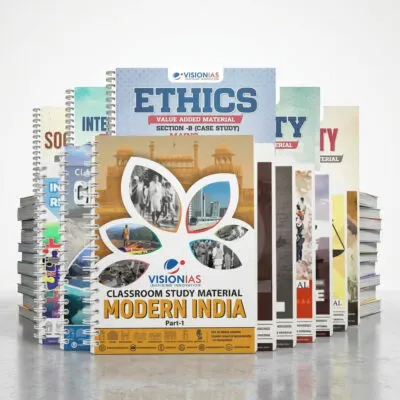



Vision IAS General Studies Hindi Notes 2026-27
About Vision IAS GS Hindi Notes
The Vision IAS GS Hindi Notes is a printed UPSC study material set sold by UPSC Store — India’s trusted source for genuine, latest-batch civil services preparation books. This page covers full booklet details, syllabus coverage, pricing, shipping, and frequently asked questions. Useful for UPSC CSE, BPSC, UPPSC, MPPSC, RAS and other state PSC examinations.
Vision IAS General Studies Hindi Notes 2026-27 — 54 Booklets Hindi Medium Printed Notes for UPSC GS Paper I II III IV
Related: Vision IAS Hindi bundle · General Studies notes
Product Overview
| Feature | Details |
|---|---|
| Booklets Count | 54 Individual Printed Booklets — Complete GS Paper I, II, III & IV Coverage |
| Language | Hindi Medium (हिंदी माध्यम) |
| Publisher | Vision IAS (Classroom Adhyayan Samagri Series) |
| Edition | 2026-27 — Latest Genuine Batch |
| Condition | Brand New, Unmarked, Fresh Stock |
| Format | High-Quality Printed Booklets — Spiral or Book Binding |
| Paper Quality | 75 GSM Ultra-White — Highlighter Safe, Zero Bleed-Through |
| Shipping | Pan India Delivery in 3-5 Business Days — Tracked |
| Also Useful For | BPSC Hindi Medium, UPPSC Hindi Medium, MPPSC, RAS, all State PSC Hindi Medium aspirants |
Complete Booklet Catalog
This 54-booklet set from Vision IAS covers the entire UPSC Civil Services Mains syllabus across all four General Studies papers in Hindi medium. Designed specifically for Hindi medium aspirants targeting UPSC CSE 2026-27, this set spans history, geography, polity, economy, environment, ethics, essay, science and technology, international relations, security, governance, social justice, and more.
- Booklet 1: Paryavaran (Bhag-1) — Ecology fundamentals, biodiversity hotspots, ecosystem services, climate change science, UNFCCC framework, Paris Agreement, carbon credits, environmental laws in India, National Action Plan on Climate Change, and UPSC GS Paper III environment-related topics with diagrammatic representations.
- Booklet 2: Paryavaran (Bhag-2) — Pollution types (air, water, soil, noise), solid waste management, e-waste policy, environmental impact assessment, coastal regulation zones, wetlands, mangroves, coral reefs, tigers and wildlife protection acts, and recent environmental current affairs relevant to UPSC Mains GS Paper III.
- Booklet 3: Bhartiya Samaj (Bhag-1) — Indian society structure, caste system, secularism, communalism, regionalism, role of women, SHGs, poverty, hunger, social movements, tribal issues, and urbanization trends as mapped to UPSC GS Paper I Mains syllabus with sociological analysis.
- Booklet 4: Bhartiya Samaj (Bhag-2) — Population dynamics, demographic dividend, family planning, health policy, education reforms, social empowerment schemes, minority rights, disability rights, child labor, human trafficking, and constitutional safeguards for marginalized communities under UPSC GS Paper I and II.
- Booklet 5: Neetishastra (Bhag-1) — Foundations of ethics, integrity in public life, moral philosophy (Western and Indian traditions), Gandhian ethics, emotional intelligence, attitude formation, aptitude for civil services, public and private morality, and UPSC GS Paper IV conceptual framework with definitions and examples.
- Booklet 6: Neetishastra (Bhag-2) — Probity in governance, code of conduct, citizen charter, accountability mechanisms, transparency, RTI application, whistle-blower protection, corporate governance, ethical dilemmas in public administration, and answer-writing strategies for UPSC GS Paper IV Ethics paper with structured model answers.
- Booklet 7: Bhugol (Bhag-1) — Physical geography, geomorphology, earthquake and volcanism, ocean currents, tides, monsoon mechanism, world climate types, biomes, soil types, Indian physiography, drainage systems, Himalayan rivers vs. peninsular rivers — all mapped to UPSC GS Paper I Mains geography syllabus.
- Booklet 8: Bhugol (Bhag-2) — Economic geography, agricultural types, industrial location theories, energy resources, transportation networks, urbanization, population distribution, migration patterns, India-specific geographical issues, natural disaster geography, and map-based questions relevant to UPSC GS Paper I.
- Booklet 9: Aadhunik Bharat ka Itihas (Bhag-1) — British conquest of India, Subsidiary Alliance, Doctrine of Lapse, economic exploitation under colonialism, early resistance movements, 1857 revolt causes and consequences, rise of Indian nationalism, Indian National Congress formation, moderate and extremist phases analyzed for UPSC GS Paper I History.
- Booklet 10: Aadhunik Bharat ka Itihas (Bhag-2) — Gandhian era, Non-Cooperation, Civil Disobedience, Quit India movements, revolutionary nationalists, subhash chandra bose and INA, partition of India, constitutional development from Morley-Minto to Government of India Act 1935, and transfer of power — UPSC GS Paper I modern history.
- Booklet 11: Rajvyavastha aur Samvidhan (Bhag-1) — Making of Indian Constitution, Preamble, Fundamental Rights, Directive Principles, Fundamental Duties, constitutional amendments, Parliament structure and functions, legislative process, President and Governor powers, and emergency provisions — core UPSC GS Paper II Polity content in Hindi.
- Booklet 12: Rajvyavastha aur Samvidhan (Bhag-2) — Judiciary (Supreme Court, High Courts, tribunals), federalism, centre-state relations, local self-government (73rd and 74th Amendments), constitutional bodies (UPSC, CAG, Election Commission), quasi-judicial bodies, and recent constitutional developments for UPSC GS Paper II Polity syllabus.
- Booklet 13: Nibandh (Bhag-1) — Essay writing framework, structure and strategy for UPSC Essay Paper, topic clusters (social, economic, philosophical, moral), sample essays on development vs. environment, women empowerment, democracy, nationalism, technology and society — with evaluation-ready Hindi medium essay models.
- Booklet 14: Nibandh (Bhag-2) — Advanced essay topics including India’s foreign policy, rural-urban divide, education system reforms, science and spirituality, ethics in public life, climate justice, India’s role in global order — with Hindi medium expression techniques and vocabulary enrichment for UPSC Essay paper scoring.
- Booklet 15: Antarrashtriya Sambandh (Bhag-1) — India’s foreign policy evolution, Panchsheel, Non-Alignment Movement, India-US relations, India-China border disputes, India-Pakistan issues, India-Russia strategic partnership, nuclear policy, SAARC, BIMSTEC, and bilateral agreements — for UPSC GS Paper II International Relations.
- Booklet 16: Antarrashtriya Sambandh (Bhag-2) — UN system and reforms, multilateral organizations (IMF, World Bank, WTO, WHO), India and global governance, G20, SCO, QUAD, ASEAN, Indo-Pacific strategy, global terrorism, climate diplomacy, refugee crisis, and recent geopolitical developments for UPSC GS Paper II.
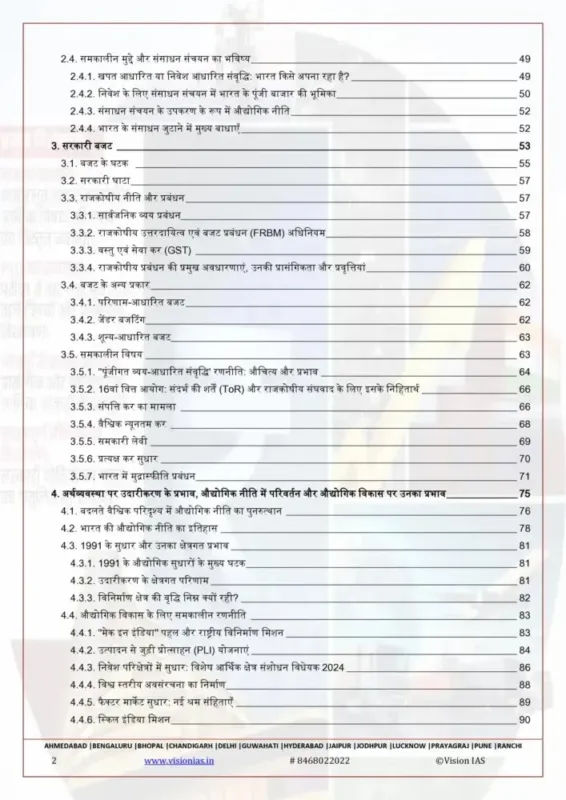
- Booklet 17: Arthshastra (Bhag-1) — Indian economy basics, national income concepts, economic planning, NITI Aayog, budget and fiscal policy, taxation system (direct and indirect), GST, monetary policy, RBI functions, inflation measurement, banking sector reforms — UPSC GS Paper III economy in Hindi medium with tables and data.
- Booklet 18: Arthshastra (Bhag-2) — Agriculture sector, food security, PDS, agricultural subsidies, land reforms, water management, industrial policy, MSMEs, infrastructure development, PPP model, FDI policy, balance of payments, current account deficit, external debt, and WTO issues for UPSC GS Paper III economy syllabus.
- Booklet 19: Arthshastra (Bhag-3) — Poverty and inequality measurement, human development index, social sector schemes (PM-KISAN, MGNREGS, Ayushman Bharat, PM Awas Yojana), financial inclusion, digital economy, startup ecosystem, make in India, skill development, employment generation — UPSC GS Paper III applied economics.
- Booklet 20: Vishwa Itihas (Bhag-1) — World history from Renaissance and Reformation to American Revolution, French Revolution, Industrial Revolution, rise of nationalism in Europe, unification of Germany and Italy, imperialism and colonialism — mapped directly to UPSC GS Paper I World History syllabus with timeline charts.
- Booklet 21: Vishwa Itihas (Bhag-2) — World Wars I and II, Russian Revolution, rise of fascism and Nazism, Cold War origins and phases, decolonization of Asia and Africa, Chinese Revolution, Korean War, Vietnam War, disintegration of Soviet Union, and post-Cold War world order for UPSC GS Paper I.
- Booklet 22: Kala evam Sanskriti (Bhag-1) — Indian art traditions, rock paintings, Indus Valley artifacts, Buddhist art (Stupa, Chaitya, Vihara), Gandhara and Mathura schools, Gupta period art, temple architecture styles (Nagara, Dravida, Vesara), cave paintings at Ajanta and Ellora — UPSC GS Paper I Art and Culture in Hindi.
- Booklet 23: Kala evam Sanskriti (Bhag-2) — Classical dance forms, folk dances, Hindustani and Carnatic music, instruments, Indian theatre traditions, puppetry, handicrafts, UNESCO Intangible Heritage listings, cultural policy of India, major literary traditions, and modern Indian artists relevant to UPSC Prelims and Mains GS Paper I.
- Booklet 24: Aapda Prabandhan — Disaster types (natural and man-made), disaster management cycle (prevention, mitigation, preparedness, response, recovery), NDMA, SDMA, NDRF, Sendai Framework, disaster risk reduction, early warning systems, India’s disaster history, climate change and disasters, and UPSC GS Paper III Disaster Management syllabus.
- Booklet 25: Suraksha (Bhag-1) — Internal security challenges, insurgency in Northeast India, left-wing extremism (Naxalism), Jammu & Kashmir conflict, border management, coastal security, role of paramilitary forces, intelligence agencies (IB, RAW), cyber security threats and India’s national cyber security policy for UPSC GS Paper III.
- Booklet 26: Suraksha (Bhag-2) — Terrorism and counter-terrorism measures, money laundering, FATF, organized crime, human trafficking, drug trafficking, radicalization, UAPA, anti-insurgency operations, border infrastructure, foreign funding of NGOs, and critical infrastructure protection — UPSC GS Paper III Security in Hindi medium.
- Booklet 27: Sushasan (Bhag-1) — Governance concepts, government vs. governance, new public management, e-governance, digital India initiatives, Aadhaar, DBT, JAM trinity, citizen services delivery, grievance redressal mechanisms, RTI Act implementation, and transparency in government — UPSC GS Paper II Governance syllabus in Hindi.
- Booklet 28: Sushasan (Bhag-2) — Role of civil services in democracy, ARC recommendations, administrative reforms, civil services reforms (lateral entry, performance appraisal), accountability frameworks, SLA, citizen charter, anti-corruption measures, Lokpal and Lokayukta, CVC, CBI reforms for UPSC GS Paper II Governance.
- Booklet 29: Vigyan aur Prodyogiki (Bhag-1) — Science and technology basics, space technology (ISRO missions, satellites, launch vehicles), nuclear technology (civil nuclear program, NPT, CTBT), defence technology, robotics, AI fundamentals, biotechnology, genome editing, CRISPR applications — UPSC GS Paper III Science and Technology in Hindi.
- Booklet 30: Vigyan aur Prodyogiki (Bhag-2) — Information technology, cyber security, blockchain, 5G technology, Internet of Things, quantum computing basics, nanotechnology, indigenous technology development, IPR issues, technology policy, science budget, and current technology developments relevant to UPSC Mains GS Paper III Science syllabus.
- Booklet 31: Samajik Nyay (Bhag-1) — Social justice framework, affirmative action, reservations policy, SC/ST welfare legislation, OBC issues (Mandal Commission), women’s rights and legal safeguards, POCSO, domestic violence act, maternity benefit, equal pay, Constitutional provisions for social equity — UPSC GS Paper II Social Justice.
- Booklet 32: Samajik Nyay (Bhag-2) — Health sector reforms, Ayushman Bharat, National Health Mission, nutritional security (POSHAN Abhiyan), education (NEP 2020, RTE Act), skill development (PM Kaushal Vikas Yojana), urban poverty, slum development, social security schemes, and welfare delivery reforms — UPSC GS Paper II.
- Booklet 33: Azadi ke Baad ka Bharat (Bhag-1) — Integration of princely states, Sardar Patel’s role, reorganization of states on linguistic basis, State Reorganization Commission, first general elections, Nehruvian economic model, planning commission and Five Year Plans, industrialization strategy — UPSC GS Paper I Post-Independence India.
- Booklet 34: Azadi ke Baad ka Bharat (Bhag-2) — Green Revolution and its impact, White Revolution, Emergency period (1975-77), Janata government, return of Congress, Rajiv Gandhi era (technology revolution, Punjab accord), economic crisis of 1991, liberalization reforms — UPSC GS Paper I Post-Independence India modern history syllabus.
- Booklet 35: Prachin Itihas (Bhag-1) — Prehistoric India, Indus Valley Civilization (sites, urban planning, trade, decline), Vedic period (Rigvedic and Later Vedic), Mahajanapadas, rise of Jainism and Buddhism, Nanda dynasty, Mauryan Empire (Chandragupta, Ashoka, Dhamma) — UPSC GS Paper I Ancient Indian History.
- Booklet 36: Prachin Itihas (Bhag-2) — Post-Mauryan period, Shungas, Satavahanas, Kushanas, Gupta Empire (Golden Age, art, literature, science), Harshavardhana, South Indian kingdoms (Pallavas, Chalukyas, Rashtrakutas), Sangam Age, ancient Indian trade with Rome and Southeast Asia — UPSC GS Paper I Ancient History.
- Booklet 37: Madhyakalin Itihas (Bhag-1) — Arab invasion, Rajput kingdoms, Ghaznavid and Ghorid invasions, Delhi Sultanate (Slave, Khilji, Tughlaq, Sayyid, Lodi dynasties), administrative and revenue systems, Bhakti and Sufi movements, regional kingdoms (Vijayanagara, Bahmani) — UPSC GS Paper I Medieval History in Hindi.
- Booklet 38: Madhyakalin Itihas (Bhag-2) — Mughal Empire (Babur to Aurangzeb), Mughal administration, art and architecture, Akbar’s policy of religious tolerance (Sulh-i-Kul), Maratha Empire, Shivaji, decline of Mughals, advent of European powers — Portuguese, Dutch, French, British — UPSC GS Paper I Medieval History syllabus.
- Booklet 39: Neeti 80 Case Adhyayan (Bhag-1) — First Set of 54 case studies for UPSC GS Paper IV Ethics covering ethical dilemmas in administration, whistle-blowing scenarios, conflict of interest situations, corruption and integrity tests, emotional intelligence application, civil servant conduct in crisis — with structured answer frameworks in Hindi medium.
- Booklet 40: Neeti 80 Case Adhyayan (Bhag-2) — Second Set of 54 case studies including interpersonal dilemmas, public-private role conflicts, family vs. duty scenarios, natural disaster response ethics, policy implementation challenges, stakeholder management situations, and administrative courage — complete 80-case study coverage for UPSC Paper IV Ethics.
- Booklets 41–54: UPSC Pathyakram evam Anushangik Samagri — Supplementary booklets covering UPSC syllabus mapping, previous year question analysis (GS I, II, III, IV), answer writing templates, current affairs integration guides, static-dynamic linkage charts, important government schemes list, quick revision capsules, and model answer booklets for all four GS papers in Hindi medium.
In-Depth Content Breakdown: Booklet by Booklet
Booklets 1–2: Paryavaran (Environment)
The two Paryavaran booklets cover the complete environment and ecology component of UPSC GS Paper III. Booklet 1 lays the conceptual foundation with ecosystem types, biodiversity measurement, species extinction drivers, IUCN categories, climate change science, greenhouse gases, IPCC reports, and international agreements from Kyoto Protocol to Paris Agreement. Every topic is tied directly to UPSC Mains answer-writing with flowcharts and comparison tables that help Hindi medium aspirants structure their responses effectively.
Booklet 2 shifts to applied environmental issues — pollution control boards, environmental laws (Environment Protection Act, Forest Conservation Act, Wildlife Protection Act), coastal regulation, wetland conservation, and critically endangered species. It also covers environmental governance bodies like CPCB, SPCB, NGT, and recent Supreme Court orders on environmental matters. The content is updated for 2026-27 UPSC Mains with recent policy developments integrated throughout, making it a reliable resource for both Prelims and Mains preparation.
Booklets 3–4: Bhartiya Samaj (Indian Society)
The Indian Society booklets address one of the most conceptually nuanced sections of UPSC GS Paper I. Booklet 3 covers the sociological framework — caste system evolution and constitutional treatment, secularism in Indian context, communalism and regionalism as challenges, role of women in social transformation, self-help groups, NGOs, and the dynamics of poverty. The content draws from NCERT sociology and Ignou MA materials adapted into crisp, UPSC-relevant Hindi medium notes with examples from contemporary India.
Booklet 4 focuses on demographic and developmental dimensions — population explosion, sex ratio, age pyramid, demographic dividend, migration drivers (push-pull), urbanization pressures, and smart cities mission. Health policy, POSHAN targets, RTE implementation, and empowerment schemes for SC/ST communities are covered with specific constitutional articles cited. This booklet helps aspirants link sociology with governance schemes, a connection frequently tested in UPSC Mains GS Paper I and GS Paper II simultaneously.
Booklets 5–6: Neetishastra (Ethics)
The Neetishastra booklets are among the most strategically important in this entire 54-booklet Vision IAS Hindi medium set. Booklet 5 systematically builds the theoretical foundation — Western ethics (Kant, Mill, Aristotle), Indian philosophical traditions (Vedanta, Jainism, Buddhism), Gandhian ethics and sarvodaya, emotional intelligence (Goleman’s model), attitude versus aptitude debate, and the qualities demanded of a civil servant. All concepts are explained in clear Hindi with definitions suitable for direct quotation in UPSC GS Paper IV answers.
Booklet 6 moves into applied ethics — probity in governance, the accountability ecosystem (RTI, CAG, CVC, Lokpal), codes of conduct for civil servants, ethical dimensions of the policy cycle, corporate social responsibility, and conscience versus rules dilemmas. Special attention is given to how to approach abstract Ethics questions in UPSC Mains — with answer templates, key terminology in Hindi, and evaluation parameters explained. Hindi medium candidates especially benefit from the precise Hindi translations of ethics terminology used here.
Booklets 7–8: Bhugol (Geography)
Geography contributes significantly to UPSC GS Paper I, and these two booklets ensure complete coverage. Booklet 7 covers physical geography with scientific rigor — rock cycle and geomorphology, internal and external forces shaping landforms, types of volcanoes and their global distribution, earthquake zones and seismicity scales, ocean floor topography, ocean currents (warm and cold with global impact), El Niño and La Niña, Indian monsoon mechanism (onset, withdrawal, variability), and the Köppen climate classification system with Indian examples.
Booklet 8 covers human and economic geography, which forms the applied portion of UPSC GS Paper I geography. Topics include agricultural systems (wet, dry, shifting), Green Revolution geography, mineral resource distribution in India, power sector geography (thermal, hydro, solar, wind), railway and highway network development, port development, census-based demographic patterns, and urban agglomeration issues. Diagrams and sketch maps are included to help Hindi medium aspirants answer map-based questions in UPSC Mains with greater accuracy.
Booklets 9–10: Aadhunik Bharat ka Itihas (Modern Indian History)
Modern Indian History is a high-yield section of UPSC GS Paper I, and these booklets from Vision IAS treat it with the depth it deserves. Booklet 9 starts from the East India Company’s commercial entry through to the consolidation of British rule — Plassey, Buxar, Mysore wars, Anglo-Maratha wars, Subsidiary Alliance mechanism, Doctrine of Lapse impacts, economic drain theory (Dadabhai Naoroji), de-industrialization of India, and the societal backdrop that gave rise to the 1857 revolt, analyzed as both a sepoy mutiny and a national uprising.
Booklet 10 carries the narrative from the formation of the Indian National Congress through the independence movement. The moderate-extremist divide, partition of Bengal (1905) as a turning point, Morley-Minto and Montagu-Chelmsford reforms, Gandhian mass movements (Champaran, Kheda, Non-Cooperation, Civil Disobedience, Quit India), parallel revolutionary streams (Bhagat Singh, Subhas Bose, INA), Cabinet Mission, Direct Action Day, and finally the Partition and Transfer of Power — all presented with UPSC answer-writing perspective in Hindi.
Booklets 11–12: Rajvyavastha aur Samvidhan (Polity and Constitution)
Polity is the backbone of UPSC GS Paper II, and Vision IAS dedicates two thorough booklets to it in the Hindi medium set. Booklet 11 covers constitutional foundations — Constituent Assembly debates, sources of the Constitution, Preamble interpretation (Kesavananda Bharati case), Fundamental Rights (Articles 12-35) with landmark judgments, Directive Principles and their enforceability, Fundamental Duties significance, the amendment process (Article 368), and Parliament’s structure (Rajya Sabha, Lok Sabha composition, sessions, and special powers). Key constitutional amendments with their significance are listed in tabular form.
Booklet 12 covers institutional governance — the judiciary’s structure and independence (judicial review, PIL, judicial activism vs. restraint), federalism debates (cooperative, competitive, asymmetric), Governor’s role and constitutional position, Panchayati Raj and Urban Local Bodies with their constitutional backing (Articles 243-243ZT), constitutional bodies (Election Commission, UPSC, CAG, Finance Commission, NHRC) and their powers. Recent Supreme Court judgments affecting polity and the 2026-27 UPSC Mains GS Paper II syllabus are integrated throughout with specific article references.
Booklets 13–14: Nibandh (Essay)
Essay is a standalone paper in UPSC Mains carrying 250 marks, and these two Hindi medium Nibandh booklets from Vision IAS address it strategically. Booklet 13 focuses on the architecture of a high-scoring essay — introduction styles (anecdote, quote, definition, contrast), thesis building, argument structuring, counter-argument integration, use of examples and data, and conclusion writing. Sample essays on development-environment conflict, feminism in Indian context, democracy and its distortions, and technology as both tool and threat are provided with evaluator commentary.
Booklet 14 contains advanced essay topics and material drawn from current affairs, philosophy, and ethics — India’s civilizational vision in the 21st century, the future of multilateralism, digital democracy challenges, rural-urban economic divide, education as social justice, and India’s soft power. The language in both booklets is crafted for Hindi medium UPSC aspirants who want to write essays that feel naturally eloquent in Hindi rather than translated from English. Vocabulary enrichment sections help build the Hindi essay idiom essential for UPSC mains scoring.
Booklets 15–16: Antarrashtriya Sambandh (International Relations)
International Relations is one of the most dynamic sections of UPSC GS Paper II, requiring constant updation. Booklet 15 provides the stable theoretical and historical base — India’s foreign policy doctrine from Nehruvian Non-Alignment to strategic autonomy, India’s neighborhood first policy, India-China boundary dispute (LAC, Galwan, Doklam), India-Pakistan (Kashmir, terrorism, water treaty), India-US relationship (civil nuclear deal, defence partnership, trade tensions), India-Russia (S-400, defence dependence, evolving dynamics), and India’s Act East Policy with ASEAN engagement.
Booklet 16 covers multilateral diplomacy and India’s global role — UN Security Council reform (India’s bid for permanent seat), India’s positions at WTO, IMF reforms, global health governance (WHO reform post-COVID), India and climate negotiations (UNFCCC COP, ISA, CDRI), India’s role in G20, SCO membership significance, BRICS relevance in multipolar world, QUAD and Indo-Pacific security architecture, and India’s diaspora diplomacy. Content is updated to cover geopolitical shifts relevant to UPSC 2026-27 aspirants.
Booklets 17–19: Arthshastra (Economy)
Economy in UPSC GS Paper III demands both conceptual clarity and current affairs integration. Booklet 17 builds the macro foundation — GDP, GNP, NDP measurement methods, base year changes, fiscal federalism, Union Budget structure, FRBM Act, fiscal deficit trends, revenue and capital accounts, GST structure and implementation challenges, RBI’s monetary policy framework, MPC and repo rate decisions, inflation targeting, and banking sector reforms post-IL&FS crisis. Data tables with recent figures help Hindi medium aspirants write data-backed answers.
Booklet 18 covers the real economy sectors — agriculture’s share in GDP vs. employment (structural imbalance), minimum support price politics, APMC reforms, contract farming, FCI and food grain management, irrigation challenges, water pricing, Make in India outcomes, PLI scheme sector-wise performance, infrastructure investment (NIP), PPP model evolution, FDI policy liberalization trends, current account and trade deficit analysis, and India’s export competitiveness. This booklet bridges UPSC GS Paper III with the economic survey and budget updates.
Booklet 19 focuses on inclusive growth and social sector economics — Amartya Sen’s capability approach applied to Indian policy, multidimensional poverty measurement, SECC data, direct benefit transfers (DBT) impact, Jan Dhan-Aadhaar-Mobile (JAM) architecture success and gaps, PM-KISAN implementation review, MGNREGS employment generation vs. budget allocation debates, financial inclusion metrics, UPI and digital payments growth, PM Mudra Yojana, and startup India performance data. This booklet is essential for UPSC GS Paper III social sector and inclusive growth questions.
Booklets 20–21: Vishwa Itihas (World History)
World History covers a distinct segment of UPSC GS Paper I from the 18th century onwards. Booklet 20 begins with the intellectual revolutions that reshaped global order — the Scientific Revolution’s impact on governance, Enlightenment political philosophy (Locke, Rousseau, Voltaire), the American Declaration of Independence and its principles, the French Revolution’s three phases (constitutional monarchy, radical republic, directory), Napoleonic wars and their pan-European consequences, the Congress of Vienna, and the Industrial Revolution’s economic and social transformation of Britain and Europe.
Booklet 21 covers the 20th century’s defining events — World War I (alliance system, new weapons, economic costs), Russian Revolution (February and October 1917, Bolshevism, Stalin’s consolidation), Great Depression and its global spread, rise of totalitarianism (Mussolini, Hitler, Hirohito), World War II (Holocaust, Pacific theater, atomic bombings), Cold War’s origins (Truman Doctrine, Marshall Plan, NATO vs. Warsaw Pact), proxy wars, decolonization waves, Non-Aligned Movement, and Soviet collapse — all contextually linked to UPSC GS Paper I syllabus requirements.
Booklets 22–23: Kala evam Sanskriti (Art and Culture)
Art and Culture tests are heavily Prelims-oriented but also appear in UPSC Mains GS Paper I. Booklet 22 covers visual arts — prehistoric cave paintings (Bhimbetka), Indus Valley seals and artifacts, Buddhist art evolution (early aniconic to iconic representation of Buddha), major Stupa sites (Sanchi, Amaravati, Nagarjunakonda), Greek-influenced Gandhara school vs. indigenous Mathura school, Gupta age sculptures as classical ideal, and temple architecture evolution from early structural temples to the mature Nagara (North) and Dravida (South) styles with key examples and architectural terminology explained in Hindi.
Booklet 23 covers performing arts — eight classical dance forms (Bharatnatyam, Kathak, Odissi, Manipuri, Kuchipudi, Mohiniyattam, Sattriya, Kathakali) with their regional origins, Hindustani vs. Carnatic music systems, tala and raga basics, classical instruments, Indian theatre forms (Yakshagana, Bhavai, Tamasha, Jatra), puppetry traditions, major literary languages and their classical status, and UNESCO Intangible Cultural Heritage list entries from India. The booklet is updated with recent cultural policy decisions relevant to UPSC 2026-27 cultural heritage questions.
Booklet 24: Aapda Prabandhan (Disaster Management)
Disaster Management is a focused topic within UPSC GS Paper III. This booklet covers the full spectrum — natural disaster types (earthquake, flood, cyclone, drought, landslide, tsunami, heat wave) with Indian vulnerability mapping, the Sendai Framework 2015-2030 and its four priority areas, India’s National Disaster Management Plan, role of NDMA and SDRF, response mechanisms during recent disasters (Uttarakhand floods, Odisha cyclones), early warning systems (IMD, INCOIS), community-based disaster preparedness, and integration of climate change adaptation into disaster risk reduction strategies.
The booklet uniquely connects disaster management with UPSC answer-writing by providing structured response templates for both 10-mark and 15-mark Mains questions. It includes case studies from India’s disaster response evolution — from reactive post-disaster relief to proactive risk reduction governance. The role of technology in disaster management (satellite imaging, GIS mapping, mobile alert systems), role of armed forces in disaster relief, international cooperation (CDRI, Coalition for Disaster Resilient Infrastructure), and legal framework for disaster management in India are all covered with current 2026-27 data.
Booklets 25–26: Suraksha (Internal Security)
Internal Security is a high-marks section of UPSC GS Paper III that requires both factual knowledge and analytical understanding. Booklet 25 covers the geography and history of India’s security challenges — Northeast insurgency (historical origins, AFSPA debate, peace accords), Left Wing Extremism (Red Corridor, Naxal ideology, socioeconomic roots, Operation Samadhan strategy), Jammu and Kashmir (Article 370 abrogation aftermath, cross-border terrorism mechanisms), border management infrastructure (border fencing, integrated check posts), coastal security framework post 26/11, and role of central armed police forces.
Booklet 26 covers emerging security dimensions — cybercrime and cyber warfare, India’s National Cyber Security Policy, critical infrastructure protection, social media as a security challenge, radicalization pathways and counter-radicalization programs, UAPA provisions and judicial scrutiny, money laundering (PMLA) and hawala networks, drug trafficking routes (Golden Crescent, Golden Triangle impact on India), human trafficking routes and legislation, and organized crime-political nexus. The booklet includes intelligence agency functions (IB, RAW, NTRO) and parliamentary oversight mechanisms.
Booklets 27–28: Sushasan (Governance)
Governance is central to UPSC GS Paper II and tested both conceptually and through current policy examples. Booklet 27 addresses the theoretical and digital dimensions of governance — governance vs. government distinction, New Public Management principles, e-governance evolution in India (from NIC to Digital India), Aadhaar’s role in service delivery transformation, Direct Benefit Transfer (DBT) outcomes, PM-JAY implementation, UMANG platform, DigiLocker, and grievance redressal platforms (CPGRAMS). The booklet includes critical analysis sections that help UPSC aspirants write balanced answers addressing both achievements and limitations.
Booklet 28 covers institutional governance reforms — civil services history and current reform debates (lateral entry, performance-linked pay, tenure security), Second ARC recommendations and implementation status, accountability architecture (Lokpal, CVC, CBI, vigilance commissions), RTI Act implementation and proposed amendments, State Public Service Commissions, and citizens’ charter implementation. Analysis of governance failures and their administrative causes is provided through case studies drawn from recent events, helping Hindi medium UPSC aspirants connect static concepts to dynamic examples in GS Paper II answers.
Booklets 29–30: Vigyan aur Prodyogiki (Science and Technology)
Science and Technology in UPSC GS Paper III requires staying current with India’s scientific developments. Booklet 29 covers space and nuclear technology in depth — ISRO’s launch vehicle evolution (PSLV, GSLV, LVM3), Chandrayaan and Gaganyaan missions, satellite applications (remote sensing, communication, navigation/NavIC), military space, nuclear energy in India (DAE, NPCIL, thorium fuel cycle), India’s nuclear doctrine (no-first-use, minimum credible deterrence), Nuclear Suppliers Group debate, and CTBT/NPT India’s position — all with UPSC-relevant analytical content in Hindi medium.
Booklet 30 covers emerging technologies that increasingly appear in UPSC questions — Artificial Intelligence (machine learning basics, AI ethics, India’s National AI Strategy), blockchain technology applications in governance, 5G rollout and its strategic implications, cybersecurity frameworks, quantum computing and its cryptography implications, nanotechnology applications in medicine and defence, biotechnology (vaccine technology post-COVID, genome sequencing in India, biosafety regulations), and India’s semiconductor policy. Each technology section includes policy dimensions that directly connect to UPSC GS Paper III questions.
Booklets 31–32: Samajik Nyay (Social Justice)
Social Justice is tested across UPSC GS Paper II and requires both constitutional knowledge and policy awareness. Booklet 31 covers the constitutional and legal framework for social equity — Articles 15, 16, 17 and untouchability abolition, SC/ST Prevention of Atrocities Act and its 2018 amendment, OBC reservation (Mandal Commission, 102nd and 103rd Constitutional Amendments, EWS reservation), women’s legal rights (Hindu Succession Act amendment, Maternity Benefit Act, POCSO, Criminal Law Amendment post Nirbhaya), LGBTQ rights post Section 377 judgment, and disability rights (Rights of Persons with Disabilities Act 2016).
Booklet 32 covers social sector service delivery — National Health Mission targets vs. achievements, Ayushman Bharat PM-JAY coverage and implementation gaps, mental health policy, POSHAN Abhiyan and malnutrition data, National Education Policy 2020 and its implementation roadmap, RTE Act challenges, Skill India outcomes vs. targets, MGNREGS wage levels and livelihood security role, urban social infrastructure (housing, sanitation, clean cooking fuel) through PM Awas Yojana and Ujjwala Yojana performance data — helping UPSC aspirants write data-supported social justice answers.
Booklets 33–34: Azadi ke Baad ka Bharat (Post-Independence India)
Post-Independence India is a recently added and rapidly growing section of UPSC GS Paper I. Booklet 33 covers the immediate post-1947 challenges — integration of 562 princely states (Operation Polo for Hyderabad, Junagarh, Kashmir accession, Patel’s role), the States Reorganization Commission and linguistic reorganization, first general elections of 1951-52 as a democratic achievement, Nehru’s economic vision (mixed economy, public sector temples, heavy industrialization), Planning Commission structure, and the foreign policy of non-alignment in Cold War context — all covered for UPSC Mains depth.
Booklet 34 carries the post-independence narrative through social and economic transformations — land reforms (Zamindari abolition, tenancy laws, ceiling legislation and limitations), Green Revolution geography and socioeconomic consequences, White Revolution (Operation Flood), Emergency (1975-77) constitutional crisis, Janata interregnum, Indira Gandhi’s return, Punjab crisis and Operation Blue Star, 1984 anti-Sikh riots, Rajiv Gandhi’s technology push, LTTE entanglement, economic crisis of 1991, Narasimha Rao-Manmohan Singh liberalization reforms — key turning points in India’s post-independence history for UPSC.
Booklets 35–36: Prachin Itihas (Ancient History)
Ancient History forms a significant segment of UPSC Prelims and GS Paper I Mains. Booklet 35 covers the earliest phases — Paleolithic, Mesolithic, and Neolithic tool cultures in India, Chalcolithic societies, Indus Valley Civilization’s urban sophistication (Harappa, Mohenjo-Daro, Dholavira grid planning, drainage systems, weight standardization, trade with Mesopotamia), Aryan debate and Vedic literature (four Vedas, Upanishads, Brahmanas), sixteen Mahajanapadas, rise of Magadha, Jain and Buddhist philosophical systems with UPSC-relevant doctrinal content, and the Mauryan imperial system.
Booklet 36 traces the Classical and post-Classical periods — post-Mauryan regional kingdoms, Satavahana art patronage, Kushana syncretism, Gupta Empire’s administration, land grants, decimal system, Aryabhata, Kalidasa, and the concept of a Golden Age in Indian historiography. The Harshavardhana period, Hiuen Tsang’s account, South Indian empires (Pallava shore temples, Chalukya Badami caves, Rashtrakuta literary patronage), Sangam literature and Tamil society, and Chola naval power are covered with sufficient depth for UPSC Mains GS Paper I Ancient History questions.
Booklets 37–38: Madhyakalin Itihas (Medieval History)
Medieval History covers a long and complex period in UPSC GS Paper I. Booklet 37 begins with early medieval India — Arab invasion of Sind (712 CE), Pratiharas, Rashtrakutas and Palas three-way conflict, Mahmud of Ghazni’s raids vs. Ghori’s conquest intent, Battle of Tarain and its consequences, Delhi Sultanate establishment through five dynasties (Slave dynasty’s Iltutmish and Razia Sultan, Khilji’s expansionism, Tughlaq administrative innovations including token currency and transfer of capital, Sayyids and Lodis), and the Bhakti and Sufi movements as social reform alongside political transformation.
Booklet 38 covers the Mughal period — Babur’s Fergana origin and Panipat victory (1526), Humayun’s exile and restoration (Sur Empire interregnum), Akbar’s administrative genius (Mansab system, Zabti revenue system, Sulh-i-Kul, Din-i-Ilahi debate), Jahangir’s patronage of painting, Shah Jahan’s architectural legacy, Aurangzeb’s Deccan policy and Jizya reimposition, Maratha rise under Shivaji (guerrilla warfare, Ashtapradhan, swarajya concept), Mughal decline factors (Jagirdari crisis, Deccan ulcer), and European trading companies’ entry — all for UPSC GS Paper I Medieval History.
Booklets 39–40: Neeti 80 Case Adhyayan (80 Ethics Case Studies)
With 80 case studies across two booklets, this is the most practically valuable component of this Vision IAS Hindi medium set for UPSC GS Paper IV preparation. Booklet 39 presents 40 carefully constructed administrative dilemmas — a District Collector discovering senior officer corruption during natural disaster relief, an IPS officer pressured by political leadership to file a false FIR, a civil servant discovering procurement fraud just before a major government scheme launch, a diplomat facing an ethical breach during international negotiations — each case followed by structured answer guidance in Hindi with evaluation criteria.
Booklet 40 presents the remaining 40 case studies covering personal and interpersonal ethics — a civil servant’s family pressure conflicting with official duty, whistleblower scenarios with personal risk calculation, community welfare vs. legal procedure dilemmas, ethical dimensions of emerging technology (AI surveillance, data privacy in governance), emotional intelligence in conflict resolution, and cross-cultural sensitivity challenges in a diverse posting. This 80-case study resource is arguably the most valuable ethics preparation tool for Hindi medium UPSC candidates, covering virtually every case study type examiners have tested since 2013.
Booklets 41–54: UPSC Pathyakram evam Anushangik Samagri (Supplementary Material)
The final 54 Booklets in this Vision IAS 54-booklet Hindi medium set serve as the connective tissue that transforms subject-wise study into integrated UPSC preparation. These include the complete UPSC syllabus annotated in Hindi with coverage mapping, previous year question (PYQ) compilations for GS Paper I through GS Paper IV with topicwise categorization, model answer templates demonstrating introduction-body-conclusion structure for UPSC Mains, and static-dynamic integration guides showing how to connect current affairs with standard syllabus topics.
Additional supplementary booklets include government scheme quick reference guides (updated to 2026-27), important committees and commissions list with their key recommendations, major Supreme Court judgments relevant to UPSC polity and rights questions, important international treaties and India’s positions, India data snapshots (population, economy, agriculture, energy), and quick revision capsules for the final months of UPSC Mains preparation. These booklets transform the set from a reading resource into a complete UPSC preparation system for Hindi medium aspirants targeting the 2026-27 Civil Services Examination.
Physical Construction and Quality Standards
Every booklet in this Vision IAS Hindi medium 54-booklet set is manufactured to withstand the rigors of daily UPSC study — repeated readings, extensive annotation, and months of active use without pages yellowing, tearing, or binding failure. The physical quality standards applied to this set match what serious UPSC aspirants expect from top classroom study material.
Paper Quality: 75 GSM Anti-Glare White Paper
Each booklet uses 75 GSM ultra-white paper chosen specifically for high opacity — text on one side does not shadow through to the reverse side regardless of whether you use multiple colors of highlighters or gel ink pens simultaneously. The anti-glare white surface reduces eye strain during extended study sessions that UPSC preparation demands, typically four to six hours of reading per day. Color-coded revision using yellow, green, pink, and blue highlighters works cleanly without any bleed-through, making these booklets ideal for the layered review strategy used by most UPSC toppers.
Printing Technology: High-Resolution Laser Printing
All 54 booklets are laser-printed at high resolution, ensuring that Hindi Devanagari text is rendered with the sharpness needed to distinguish between similar-looking characters that can be confused in low-quality prints. Flowcharts, comparison tables, and maps — which are prevalent throughout the Geography, Economy, and Science booklets — are printed with clean lines and uniform contrast. Laser toner is permanent and smudge-proof, so the text remains crisp even when pages are handled repeatedly with slightly damp fingers during summer study sessions. Diagrams that would appear blurry in photocopied notes are crystal clear here.
Binding and Durability
Booklets in this set come in either spiral binding or book binding depending on the booklet’s page count and content type. Spiral-bound booklets open completely flat — a critical feature when writing notes alongside printed content, or when placing a booklet beside an answer sheet during mock test practice. Book-bound booklets use reinforced spine gluing with a 300 GSM laminated cover that resists bending and edge wear during transport. All covers are laminated with matte finish, protecting them from moisture and friction. Whether you carry these in a bag to Mukherjee Nagar coaching or study at home, the physical integrity holds throughout your entire UPSC preparation cycle.
Key Features and Study Design
These Vision IAS Hindi medium notes are designed not just as reading material but as an active UPSC preparation system — each structural and content choice serves a specific purpose in helping Hindi medium aspirants prepare efficiently for GS Paper I, II, III, and IV.
- Complete GS Coverage Across 4 Papers: All 54 booklets together address the full UPSC Civil Services Mains syllabus across GS Paper I, II, III, and IV — History, Geography, Polity, Economy, Ethics, Environment, Science, and more — so Hindi medium aspirants do not need to source multiple books from different publishers.
- Hindi Medium Optimized Language: Content is written in standard modern Hindi (Khari Boli) accessible to aspirants from any Hindi-speaking state, avoiding overly Sanskritized or colloquial registers. Key English UPSC terms are retained with Hindi transliteration and definition alongside, supporting smooth answer-writing in Hindi medium UPSC Mains.
- 80 Ethics Case Studies Included: The dedicated two-booklet Set of 54 case studies for UPSC GS Paper IV is a standout feature — covering virtually every administrative dilemma type tested in UPSC Mains since 2013. Structured answer frameworks are provided in Hindi, a resource extremely rare in Hindi medium UPSC study material.
- Current Affairs Integration Ready: Supplementary booklets include static-dynamic linkage charts that explicitly show Hindi medium aspirants how to connect current events with standard syllabus topics — a skill that separates high-scoring UPSC Mains answers from average ones. Updated to include developments through 2026-27 exam cycle.
- Answer-Writing Architecture: Throughout the subject booklets, margin notes and boxed sections identify high-probability UPSC Mains questions, suggest introduction styles, provide data points suitable for inclusion in answers, and flag topics where balanced opinions (both supportive and critical) should be prepared — transforming passive notes into active UPSC answer preparation tools.
Shipping, Packaging and Delivery
All 54 booklets are individually shrink-wrapped in sets before being packed into a heavy-duty double-walled corrugated cardboard box designed specifically for bulk booklet shipments. Rigid cardboard corner edge protectors prevent cover damage during transit, and air-cushion bubble wrap lines the interior to absorb impact from courier handling. The outer box is sealed with tamper-evident security tape and labeled with the tracking barcode. This packaging protocol ensures that booklets arrive in the same brand-new, unmarked condition they left our Mukherjee Nagar warehouse — no bent corners, no moisture damage, no displaced spirals.
Orders are dispatched within 24 hours of payment confirmation and delivered anywhere in India within 3-5 business days via tracked courier services. A tracking ID is sent to your registered mobile number and email upon dispatch. If you have not received your order within 6 business days, or if any booklet is found missing or damaged upon delivery, contact us on WhatsApp at +91 70045 49563 — missing booklets are replaced within 48 hours at zero additional cost. We serve UPSC aspirants across Delhi, Allahabad, Patna, Bhopal, Jaipur, and every corner of India with the same service quality.
Frequently Asked Questions (FAQ)
A: This set includes 54 individual printed booklets covering the complete UPSC Civil Services Mains syllabus across GS Paper I, II, III, and IV. Subjects covered include History (Ancient, Medieval, Modern, World, Post-Independence), Geography, Polity, Economy, Environment, Ethics, Essay, International Relations, Science and Technology, Governance, Social Justice, Security, Disaster Management, Art and Culture, and 80 case studies for GS Paper IV — all in Hindi medium.
A: Vision IAS Hindi medium notes cover all four GS papers with sufficient depth for UPSC Mains. For most static topics, this 54-booklet set provides complete preparation. However, for current affairs (which accounts for approximately 30-40% of UPSC Mains questions), aspirants should supplement with a monthly current affairs magazine and newspaper reading. The supplementary booklets in this set include static-dynamic linkage guides that show exactly how to connect current events to syllabus topics, making the integration manageable for Hindi medium aspirants.
A: The price of this complete 54-booklet Vision IAS General Studies Hindi Notes 2026-27 set is listed on the product page and reflects the genuine classroom study material with full physical quality (75 GSM paper, laser printing, proper binding). This is significantly more cost-effective than buying individual subject booklets separately, and includes the 80 Ethics case studies and supplementary material that would otherwise cost extra. Check the current price on the product page as it may vary with promotions.
A: The product you are buying here is the complete physical printed set — 54 genuine printed booklets on 75 GSM ultra-white paper with proper binding. This is not a PDF download, not a photocopy, and not a scanned printout. These are the actual Vision IAS classroom study material booklets, brand new and unmarked. Physical printed notes are preferred by most UPSC toppers over PDFs for active reading, annotation, and long-duration study sessions without screen fatigue.
A: Yes. The 54 booklets in this set provide full coverage of all four UPSC Mains General Studies papers — GS Paper I (History, Geography, Indian Society, Art and Culture), GS Paper II (Polity, Governance, International Relations, Social Justice), GS Paper III (Economy, Environment, Science and Technology, Internal Security, Disaster Management), and GS Paper IV (Ethics, Integrity, Aptitude including 80 case studies). The supplementary booklets additionally cover the Essay paper with Nibandh preparation material.
A: Both Vision IAS and Drishti IAS produce widely used Hindi medium UPSC study material. Vision IAS notes are known for their structured answer-writing orientation, multi-perspective analysis sections, and tight syllabus mapping. The 80-case study booklets for GS Paper IV Ethics included in this Vision IAS set are a distinguishing feature. Content language in Vision IAS Hindi notes uses standard modern Hindi suited for answer-writing, while maintaining analytical depth. Buy this set if you prefer a structured, answer-focused preparation approach for UPSC Mains GS papers.
A: Yes. This is the 2026-27 edition, which is the latest batch of Vision IAS classroom study material available. Content across all 54 booklets has been updated to include recent Supreme Court judgments, government scheme data, economic indicators, science and technology developments, geopolitical changes, and current affairs integration relevant to the UPSC Civil Services Examination 2026-27 cycle. The edition year (2026-27) guarantees you are buying the most current version rather than an outdated previous year batch.
A: Yes. This 54-booklet set includes dedicated Nibandh (Essay) booklets — covering essay structure strategy, sample essays across philosophical, social, economic, and governance themes in Hindi medium — and two complete Neetishastra (Ethics) booklets covering GS Paper IV theory. Additionally, a separate two-booklet set provides 80 fully worked case studies (Neeti Case Adhyayan) covering all major ethical dilemma categories tested in UPSC GS Paper IV since the ethics paper was introduced. This is among the most complete Ethics preparation packages available in Hindi medium.
A: These booklets use 75 GSM ultra-white paper chosen for high opacity — multiple highlighter colors and gel pens work without bleed-through to the reverse side, ideal for color-coded revision.
A: This product listing is for the complete 54-booklet set as a single purchase. If you need only specific subject booklets (e.g., only Arthshastra or only Neetishastra case studies), please contact us on WhatsApp at +91 70045 49563 and we will advise on individual booklet availability. However, buying the complete set offers significantly better value per booklet and ensures you have integrated supplementary material that complements the subject-wise booklets during your UPSC preparation.
A: Yes. While these booklets are primarily designed for UPSC Civil Services Mains preparation, the content is equally valuable for BPSC (Bihar Public Service Commission), UPPSC (Uttar Pradesh Public Service Commission), MPPSC (Madhya Pradesh PSC), RAS (Rajasthan Administrative Service), and other State PSC examinations conducted in Hindi medium. State PSC GS syllabuses overlap significantly with UPSC GS Paper I through IV content, making this 54-booklet Vision IAS Hindi medium set a cost-efficient preparation resource for multiple exams simultaneously.
A: After your order is dispatched (within 24 hours of payment), a tracking ID is sent to your registered mobile number via SMS and email. You can use this tracking ID on the courier company’s website to monitor real-time delivery status. Expected delivery across India is 3-5 business days from dispatch. If you face any delivery issue, have not received tracking information, or want to confirm your order status, WhatsApp us at +91 70045 49563 — we respond within a few hours on all working days.
Summary
| Specification | Value |
|---|---|
| Booklets | 54 Printed Booklets |
| Language | Hindi Medium (हिंदी माध्यम) |
| Paper | 75 GSM Ultra-White |
| Binding | Spiral or Book Binding |
| Delivery | 3-5 Business Days Pan India |
| Also Useful For | BPSC Hindi Medium, UPPSC Hindi Medium, MPPSC, RAS, all State PSC Hindi Medium aspirants |
Sold from our store in Mukherjee Nagar, Delhi — India’s most trusted address for UPSC printed study material. Order now and receive your complete 54-booklet Vision IAS Hindi medium GS Notes set anywhere in India within 3-5 days.
Reference: Civil Services Examination
Customer Reviews 60
Notes theek taak se likhe hue hain par kuch chapters zyada detailed nahi hain. Paisa thoda zyada lag raha.
Material quality accha hai lekin delivery mein late ho gaya. Content otherwise decent hai.
Notes ka quality bahut acha hai aur content comprehensive bhi hai, lekin packaging thoda normal tha.
Packing acchi thi aur sab booklets condition mein aaye.
Notes bohot comprehensive hain bhaiya.
Sab topics cover ho gaye aur explanations bhi detailed hain. Zyada paise ki value mil gayi.
Padhne layak material bilkul hai aur Vision IAS ka naam hai toh quality guarantee hai, par price thoda zyada ho sakta tha.
Notes quality bilkul theek hai aur mera revision mein bohot help ho raha, only thing paper quality thoda improve ho sakti thi.
Aspirants Also Bought
More from the same category
About Vision IAS General Studies Hindi Notes 2026-27
Vision IAS General Studies Hindi Notes 2026-27 is a highly recommended UPSC study material from Vision IAS, specially designed for General Studies preparation. Available in Hindi medium, this material is crafted to match the exact requirements of the UPSC Civil Services Examination syllabus — covering both Prelims and Mains comprehensively.
Product Details
- Institute: Vision IAS
- Subject: General Studies
- Medium: Hindi
- Format: Printed
- Delivery: Pan-India delivery in 3–5 working days
- Format: Original printed material, verified authentic
Why Buy from UPSC Store?
- ✅ 100% Genuine Printed Material — Original printed notes, no photocopies or fake copies
- ✅ Fast Delivery — Ships within 24 hours, arrives in 3–5 days pan-India
- ✅ Secure Packaging — Bubble-wrapped and boxed to prevent damage in transit
- ✅ Trusted by 10,000+ Aspirants — India's most reliable UPSC material marketplace
- ✅ WhatsApp Support — Get expert guidance on material selection before ordering
Frequently Asked Questions
Yes, all products at UPSC Store are 100% genuine printed materials. We do not sell photocopies or fake copies.
Orders are dispatched within 24 hours and delivered across India in 3–5 working days via reputed courier partners.
Yes, we accept returns within 7 days if the product is damaged or incorrect. Check our refund policy for details.
We recommend pairing this with current affairs notes and a UPSC test series for comprehensive preparation. Browse more in BPSC, General Studies, UPPSC, UPSC, Vision IAS.