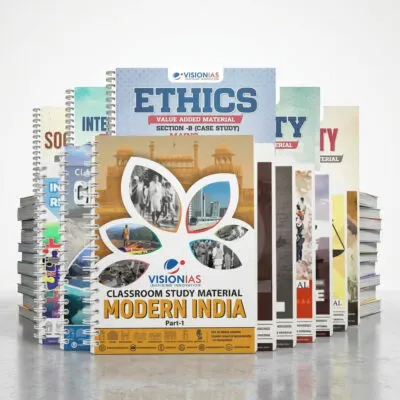
Vision IAS Art and Culture Notes 2025-26
About Vision IAS Art and Culture
The Vision IAS Art and Culture is a printed UPSC study material set sold by UPSC Store β India’s trusted source for genuine, latest-batch civil services preparation books. This page covers full booklet details, syllabus coverage, pricing, shipping, and frequently asked questions. Useful for UPSC CSE, BPSC, UPPSC, MPPSC, RAS and other state PSC examinations.
Vision IAS Art and Culture Notes 2025-26 β 8 Printed Booklets for UPSC GS Paper I
Related: Vision IAS notes Β· Art and Culture notes
Buy Vision IAS Art and Culture printed notes online β the complete 2025-26 set of 8 booklets covering every major art form, architectural style, and cultural heritage topic tested on UPSC Prelims and Mains. This is the most detailed GS Paper I resource from Vision IAS’s premium collection, now available in printed English medium format with high-quality 75 GSM paper suitable for highlighter marking and long study sessions.
Product Overview
| Feature | Details |
|---|---|
| Booklets Count | 8 Individual Printed Booklets β Complete Art and Culture Coverage (Ancient, Medieval, Modern, Classical Arts, Architecture, Sculpture, Painting, Cultural Heritage) |
| Language | English Medium |
| Publisher | Vision IAS (GS Notes Series) |
| Edition | 2025-26 β Latest Genuine Batch |
| Condition | Brand New, Unmarked, Fresh Stock |
| Format | High-Quality Printed Booklets β Spiral or Book Binding |
| Paper Quality | 75 GSM Ultra-White β Highlighter Safe, Zero Bleed-Through |
| Shipping | Pan India Delivery in 3-5 Business Days β Tracked |
| Also Useful For | BPSC, UPPSC, MPPSC, RAS, KPSC, JPSC, OPSC, and all State PSC exams |
Complete Booklet Catalog
This 8-booklet series provides comprehensive coverage of Art and Culture for UPSC GS Paper I, designed by Vision IAS’s subject specialists to align perfectly with the civil services examination pattern. Each booklet isolates a major theme within Indian art and cultural heritage, allowing aspirants to study systematically and retain information through focused, thematic revision sessions.
- Booklet 1: Ancient Indian Art Forms β Vedic and Classical period sculptures, temple art traditions, rock-cut architecture, Mauryan and Gupta-era stone carving innovations, yaksha and yogi iconography, regional art schools of ancient India, Buddhist and Hindu sculptural symbolism, and visual documentation of architectural transitions from timber to stone construction.
- Booklet 2: Medieval Temple Architecture β Nagara and Dravida architectural orders, shikhara and gopuram structural designs with measurement and height specifications, Odishan temple complexes, Khajuraho temple layout and sculptural content, regional temple building techniques, stone masonry evolution, decorative elements and their religious significance, and temple town planning principles.
- Booklet 3: Classical Indian Dance Forms β Odissi, Bharatanatyam, Kathakali, Kathak, Kuchipudi, and Manipuri dance traditions with origins, key movements, mudra systems, and UPSC-tested facts. Historical development, guru-shishya parampara, and contemporary performances. Musical instruments used, costume styles, and cultural contexts of each dance form across different regions of India.
- Booklet 4: Mughal and Indo-Islamic Architecture β Mughal period architectural features including domes, arches, jali work, and inlay techniques. Taj Mahal, Red Fort, Jama Masjid structures and historical context. Indo-Islamic synthesis in Indian architecture, garden design principles, calligraphy, and decorative arts. Akbar to Aurangzeb period architectural patronage and evolution of style.
- Booklet 5: Painting and Miniature Arts β Mughal miniature painting schools, Rajasthani and Pahari painting traditions, Bengal Renaissance painting movement, Company School, and contemporary Indian art. Techniques, materials, pigments, subject matter, historical progression, artist-patron relationships, and how these art forms feature in UPSC prelims and mains questions with visual identification strategies.
- Booklet 6: Indian Textiles, Crafts, and Heritage β Traditional handlooms including Banarasi silk, Pochampalli, Pashmina, and Chanderi. Pottery traditions, wood carving, metalwork, and stone carving across regions. Craft heritage sites, UNESCO intangible cultural heritage recognition, tribal crafts, and contemporary craft preservation. Regional variations and cultural significance tied to UPSC GS Paper I syllabus requirements.
- Booklet 7: Indian Music Systems and Instruments β Hindustani and Carnatic classical music, raag classification, taal systems, and notation methods. Major musical instruments: sitar, sarangi, veena, mridangam, and tabla with structural descriptions. Legendary musicians and their contributions, music school traditions, and how Indian music traditions answer UPSC questions on cultural heritage and classical arts.
- Booklet 8: Cultural Heritage, Festivals, and Rituals β Major Indian festivals across religions and regions, rituals and their cultural-historical significance, oral traditions and folk practices, UNESCO World Heritage cultural sites in India, intangible cultural heritage preservation, and contemporary challenges to cultural conservation. Integration of archaeological findings with living cultural practices for comprehensive UPSC preparation.
In-Depth Content Breakdown: Booklet by Booklet
Booklet 1: Ancient Indian Art Forms
This foundational booklet traces the evolution of Indian artistic expression from the Vedic period through the Classical era, covering sculpture traditions that define India’s cultural identity. Vision IAS includes detailed analysis of the Indus Valley Civilization’s terracotta figurines, the emergence of stone sculpture under the Mauryans, and the sophisticated iconography developed during the Gupta period. Each sculpture typeβyaksha, yogi, standing Buddhaβis examined for its stylistic features, geographical origin, and the religious or philosophical values it represents. This booklet equips UPSC aspirants with the ability to identify and contextualize ancient artworks by their period, material, and cultural significance, directly addressing GS Paper I requirements for understanding India’s civilizational heritage.
The booklet uses visual descriptive techniques instead of relying solely on images: architectural elements are described with precise terminology (corbel arches, pillar designs, carving depth), enabling aspirants to visualize and recall these features during exams. Regional art schoolsβGandharan, Mathura, Sarnathβare differentiated by their distinctive features and historical circumstances. The content integrates archaeological evidence with art historical analysis, making it suitable for both Prelims fact-based questions and Mains essay-type questions on Indian civilization’s artistic contributions to world culture. Special attention is given to the yaksha tradition and how it represents pre-Buddhist indigenous art forms surviving within later Buddhist contexts.
Booklet 2: Medieval Temple Architecture
Booklet 2 provides exhaustive coverage of medieval Hindu temple architecture, the most heavily tested art and culture topic on UPSC. Vision IAS presents the Nagara and Dravida architectural orders as coherent systems with specific structural logic: the shikhara (northern temple tower) is described with its characteristic curved profile, re-entrant angles, and the mathematical principles governing its tapering shape. The gopuram (southern temple tower) is analyzed for its pyramidal structure, multiple tiers, and decorative elaboration. Measurements, proportional relationships, and regional variationsβOdishan temples with their distinctive curvilinear shikhara, Hoysala temples with intricate stone carvingsβare documented with the precision required for UPSC answer writing. This booklet covers the Khajuraho temple complex in detail, explaining the sculptural program, architectural innovations, and historical context under the Chandella dynasty.
The architectural analysis extends to materials (sandstone vs. granite), construction techniques (ashlar masonry, post-and-lintel systems), and decorative motifs (jaladhari, kalasa finials, mandapa structures). Each temple discussedβBrihadeswara, Meenakshi, Jagannath, Konark Sun Templeβserves as a case study for understanding regional temple building principles and patronage patterns. For aspirants preparing for UPSC Mains, this booklet provides the detailed knowledge needed for architecture-specific questions and general questions about medieval Hindu society’s values as expressed through temple construction. The visual descriptions enable aspirants to write detailed architectural descriptions without relying on photographs during the exam.
Booklet 3: Classical Indian Dance Forms
This booklet covers the eight classical dance forms recognized by the Indian Ministry of Culture: Bharatanatyam, Kathak, Kathakali, Kuchipudi, Odissi, Manipuri, Mohiniyattam, and Sattriya. Each dance form is presented with its geographical origin, historical development, key movements (hastas/mudras), musical accompaniment, costume and makeup traditions, and major exponents. Vision IAS distinguishes between the dance forms by their characteristic features: Bharatanatyam’s aramandi (bent-knee stance) and the tattoo-like kolam patterns of costume, Kathak’s rapid footwork and spinning movements, Kathakali’s stylized makeup and hand positions representing mythological characters. The booklet includes the natya shastra’s role in codifying dance traditions and how classical dances represent different regional religious practicesβBharatanatyam’s temple origins, Kathak’s evolution in Mughal courts, Kathakali’s connection to Kerala’s Hindu traditions.
For UPSC preparation, this section directly addresses GS Paper I questions about India’s performing arts heritage and regional cultural diversity. The mudra (hand gesture) systems are explained as a sophisticated non-verbal communication method integral to Indian aesthetics. Historical information covers the devadasi system’s role in preserving Bharatanatyam, the court patronage supporting Kathak development, and contemporary challenges to traditional dance preservation. The booklet lists major classical dancers of the 20th-21st centuries, questions frequently asked in UPSC about cultural icons. Modern adaptations and fusion forms are discussed within the context of cultural evolution, preparing aspirants for questions about how classical arts remain relevant in contemporary India.
Booklet 4: Mughal and Indo-Islamic Architecture
Booklet 4 examines the architectural synthesis created during the Mughal period, when Islamic building traditions merged with Indian design elements to create a distinctive Indo-Islamic style. The booklet begins with the Tughlaq and Lodi period foundations, then systematically covers each Mughal emperor’s architectural patronage: Akbar’s Fatehpur Sikri with its red sandstone construction and palace complexes, Jahangir’s contributions, and Shah Jahan’s peak achievements represented by the Taj Mahal. Architectural elements are precisely definedβthe dome construction methods, the use of jali (latticed screens) for privacy and ventilation, arch types (pointed arches, domes replacing corbels), marble inlay work with semi-precious stones, and calligraphic inscriptions. The Taj Mahal receives detailed analysis of its symmetry, proportional harmonies, garden layout (Mughal char bagh design), and the building’s mathematical precision, directly answering UPSC questions about this monument’s significance.
Beyond famous monuments, this booklet covers Red Fort’s palaces, mosques, and defensive structures, Jama Masjid’s scale and courtyard design, and lesser-known but equally important buildings like Humayun’s Tomb and Safdarjung’s Tomb. The evolution of architectural style across the Mughal period is tracedβfrom Akbar’s eclecticism to Aurangzeb’s increasingly austere Islamic adherenceβproviding context for understanding Mughal cultural policies and their expression in architecture. Regional variations of Indo-Islamic architecture are noted: Gujarat’s mosque traditions, Bengal’s terracotta ornamentation, and Kashmir’s wooden architecture showing Persian influence. The integration of Indian artisans’ techniques with Persian architectural principles is emphasized, making this essential reading for questions about Indo-Islamic cultural synthesis and the historical conditions enabling architectural innovation.
Booklet 5: Painting and Miniature Arts
This booklet provides comprehensive coverage of Indian painting traditions from Mughal court art to contemporary Indian painting, with special emphasis on miniature painting schools. Vision IAS details the Mughal miniature painting technique: the paper preparation, pigment sources, brush types, and multi-artist production system where specialized artisans contributed different elements (backgrounds, figures, details). Major Mughal court painters and their distinctive styles are documentedβBasawan, Dasavant, and their innovations under Akbar’s patronage. Regional painting schoolsβRajasthani courts (Marwar, Mewar, Kishangarh), Pahari painting in Himachal Pradesh, and Deccan sultanate paintingsβare differentiated by subject matter, color palettes, and stylistic conventions. Rajasthani painting’s vibrant colors, geometric simplicity, and devotional themes contrast with Pahari painting’s landscape integration and romantic poetry-inspired compositions.
The Company School is covered as a critical transitional art form where Indian artists adopted European perspective and realistic representation while maintaining Indian subjects, representing colonial cultural exchange. The Bengal School and the Indian Renaissance are presented as movements of cultural revivalism through art, with artists like Raja Ravi Varma, Abanindranath Tagore, and the Calcutta School developing a self-consciously “Indian” modern art in response to colonialism. Contemporary Indian artists and art movements prepare aspirants for questions about cultural identity, artistic expression, and modernity. Technical aspectsβmaterials, pigments, paper types, preservation challengesβconnect to broader UPSC themes of heritage conservation. This booklet emphasizes visual identification strategies: how to distinguish painting schools by their compositional patterns, color schemes, and subject matter without seeing high-resolution images.
Booklet 6: Indian Textiles, Crafts, and Heritage
Booklet 6 is dedicated to India’s craft heritageβtraditional handlooms and craft industries that represent centuries of technical sophistication and cultural identity. Vision IAS provides detailed coverage of major textile traditions: Banarasi silk with its distinctive brocade technique using gold and silver threads, Pochampalli’s ikat dyeing method creating resist patterns, Chanderi’s cotton-silk blend and gossamer lightness, and Pashmina’s fine wool sourcing from Kashmir. Each textile’s production process, distinctive visual characteristics, geographical origin, and cultural significance are explained. Pottery traditions across regions (Khurja blue pottery, Jaipur blue pottery), wood carving schools (Kashmir walnut carving, Odisha wooden artifacts), metalwork traditions (Bidriware from Hyderabad, bell metal from Jandiala), and stone carving (Agra stone inlay, Jaipur marble work) are systematically covered with references to artisan communities and traditional production methods.
The booklet addresses UNESCO recognition of intangible cultural heritage, listing Indian craft traditions granted this international status and explaining why traditional crafts require preservation efforts in the face of industrialization and globalization. Tribal craftsβWarli painting from Maharashtra, Santhal tribal art, Nagaland’s weaving traditionsβare presented as living cultural expressions with deep historical roots. Contemporary challenges to craft heritage, such as competition from machine-made goods, declining apprenticeship systems, and economic pressures on artisan communities, are discussed in the context of UPSC’s emphasis on developmental and cultural issues. For UPSC preparation, this booklet equips aspirants with knowledge of India’s soft power through crafts, cultural tourism potential, and policy initiatives supporting traditional craftspeople, making it essential for both GS Paper I (cultural heritage) and GS Paper II (governance and development) questions.
Booklet 7: Indian Music Systems and Instruments
Booklet 7 explores India’s two major classical music systemsβHindustani (North Indian) and Carnatic (South Indian)βalong with folk music traditions, providing the foundational knowledge for UPSC questions about Indian performing arts. The Hindustani system’s raag structure is explained: how raags are defined by characteristic melodic patterns (aroha-avaroha), allowed and forbidden notes, emotional flavor (rasa), and time of day for performance. Major raagsβBhairav, Yaman, Raga Malharβare described with their recognizable features and how expert musicians improvise within raag constraints. The taal (rhythmic cycle) system is detailed: how taals like Tintal, Rupak, and Jhaptal structure rhythmic patterns, with specific beat counts and accents. Hindustani notation systems (Bilaswami notation, modern staff notation adaptations) are compared with Carnatic svarita notation, addressing technical differences for classical music specialists.
Indian musical instruments are comprehensively catalogued with structural descriptions enabling visual identification: the sitar’s sympathetic strings, frets, and resonance chamber design; the sarangi’s bowing technique and unique sound production; the veena’s prominence in South Indian classical music and its physical structure; the tabla’s two-drum system with different tonal qualities; and the mridangam’s role in Carnatic music accompaniment. Hindustani classical instruments (sarod, sarangi, bansuri) are distinguished from Carnatic instruments (veena, mridangam, ghatam), addressing the regional differences in musical traditions. The booklet covers legendary musicians and their contributionsβTansen under Akbar, Pandit Ravi Shankar’s global influence, Hariprasad Chaurasia’s bamboo flute innovationsβand how music reflects India’s regional diversity and spiritual traditions. For aspirants preparing for UPSC, this booklet provides knowledge of India’s musical heritage’s significance in world culture and contemporary challenges facing classical music preservation.
Booklet 8: Cultural Heritage, Festivals, and Rituals
This final booklet synthesizes cultural heritage knowledge by examining festivals, rituals, and oral traditions that constitute India’s living cultural practices. Vision IAS details major Indian festivals across religious and regional categories: Hindu festivals (Diwali, Holi, Navratri) with their mythological narratives and regional variations; Muslim festivals (Eid-ul-Fitr, Eid-ul-Adha, Muharram) and their observance patterns; Christian festivals (Christmas, Easter); and Sikh festivals (Guru Nanak Jayanti, Baisakhi). Each festival is analyzed for its religious significance, historical origins, regional customization, and social functions in binding communities. Ritualsβlife cycle rituals like marriage ceremonies, death rites, and seasonal rituals tied to agricultureβare explained as vehicles of cultural transmission and identity maintenance. The booklet covers oral traditions: epic recitations (Ramayana, Mahabharata storytelling traditions), folk ballads, and how these narratives preserve historical memory and cultural values across generations.
UNESCO World Heritage cultural sites in India are comprehensively listed with their cultural significance: Agra Fort, Fatehpur Sikri, Hampi, Khajuraho temples, Varanasi’s sacred geography, and dozens more. The booklet explains selection criteria for UNESCO recognition and what “intangible cultural heritage” designation means for traditional practices like Koodiyattam (Sanskrit theatre), Chhau dance, and Mudiyettu (ritual performance). Contemporary challenges to cultural heritage preservationβurbanization pressures on traditional art spaces, climate change threats to heritage sites, commercialization of rituals, and linguistic erosion of oral traditionsβare presented with specific UPSC-relevant examples. Government initiatives for heritage preservation, including the National Mission for Manuscripts, Intangible Cultural Heritage programme, and cultural tourism development are covered. This booklet directly addresses UPSC’s emphasis on understanding India’s cultural continuity and adaptability, preparing aspirants for sophisticated questions linking culture, development, and governance.
Physical Construction and Quality Standards
Vision IAS’s Art and Culture booklets are manufactured to the highest standards for UPSC aspirants who will study these materials for 6-12 months during their preparation journey. Each booklet undergoes quality control to ensure binding integrity, paper uniformity, and printing precision. The manufacturing process is optimized for long-term use in demanding study environments: tight spiral bindings that open completely flat for comfortable note-taking, reinforced covers protecting booklets in backpacks during commutes, and acid-free paper preventing yellowing during extended storage. These booklets are designed to be study companions, not display pieces, built to withstand highlighter marking, marginal annotations, and repeated page-turning over many months of revision cycles.
Paper Quality: 75 GSM Anti-Glare White Paper
The 75 GSM (grams per square meter) ultra-white paper selected for Vision IAS Art and Culture booklets is specifically engineered for intensive UPSC study. The higher GSM weight ensures opacityβmulti-colored highlighters applied to one side do not bleed through to the reverse page, eliminating the frustration of damaged content or visibility interference. Anti-glare finish reduces eye strain during marathon study sessions spanning 4-6 hours daily, a critical consideration for aspirants studying for months. The paper’s brightness rating (ISO 104 ultra-white standard) creates optimal contrast with laser-printed text, making content reading less fatiguing than photocopied or lower-quality materials. The paper accepts all standard highlighter colors (yellow, pink, green, orange) and gel pens without feathering, enabling effective color-coded study systems. Eraser compatibility is excellentβpencil annotations can be cleanly removed if study strategy changesβand the paper’s surface is smooth enough for quick note-writing but textured enough to prevent ink smudging. This paper quality is directly comparable to premium academic journals, elevating the learning experience beyond typical budget study materials.
Printing Technology: High-Resolution Laser Printing
Vision IAS uses industrial-grade laser printing technology to reproduce booklet content with precision that handwriting or photocopying cannot achieve. Laser printing guarantees consistent ink saturation across all 8 booklets in this seriesβevery architectural diagram appears equally crisp, every flowchart showing relationships between Indian art forms maintains clarity. The resolution (1200 DPI minimum) ensures that small text, numbered lists, and intricate tables reproduce without pixelation or bleeding. Maps and architectural drawingsβcritical for Art and Culture studyβare rendered with sufficient detail for aspirants to extract specific information (temple dimensions, artistic regional boundaries, painting school characteristics) without image enhancement. The toner used in laser printing is permanent and smudge-proof: dry highlighter passes over printed text without disrupting the underlying content. Compared to ballpoint pen-written study materials or faded photocopied notes that deteriorate with use, laser-printed content remains pristine throughout months of study. The printing color consistency means that repeated study sessions reinforce the same visual patterns, aiding memory consolidation through visual recognitionβcritical for art and architecture topics requiring spatial reasoning.
Binding and Durability
Vision IAS offers two binding options for the Art and Culture 8-booklet series, accommodating different study preferences and use cases. Spiral binding allows each booklet to open completely flat (180 degrees), eliminating the binding crease that typically prevents writing in center margins. Aspirants studying at desks can lay the booklet flat, place it beside their answer sheets while practicing questions, and write comprehensive answers without the booklet closing. The spiral metal binding is reinforced with 300 GSM cardstock front and back covers that protect inner pages from dog-earing, coffee spills, and wear from backpack transportation. Spiral-bound booklets are ideal for aspirants planning to annotate extensively and add supplementary information from lectures or current affairs updates. Book binding (perfect binding or cloth binding) offers a more compact, portable formatβthese booklets can fit into smaller backpack pockets and resemble traditional textbooks, suitable for studying during commutes or in coaching institute libraries. Book-bound covers are wrapped in matte laminate providing water resistance (accidental liquid spills do not immediately damage content). The binding strength is tested to withstand opening and closing cycles exceeding 500 repetitionsβtypical for a booklet studied over 6 months with daily review sessions. Corner reinforcements and stitching patterns are designed to prevent page separation even with intensive daily use.
Key Features and Study Design
Vision IAS has designed these 8 Art and Culture booklets specifically for UPSC aspirants targeting high scores in GS Paper I. The thematic organization, content density, and study aids embedded throughout distinguish this from general art history books or online notes, making these booklets a purpose-built UPSC resource.
- Thematic Booklet Isolation: Each of the 8 booklets isolates a distinct cultural theme (ancient sculpture, medieval architecture, classical dance, etc.), enabling focused study sessions lasting 45-90 minutes with clear revision endpoints. Aspirants can complete one booklet’s revision in a single day, creating natural study cycles. This structure accommodates coaching institute class schedules where Art and Culture is taught thematically, allowing immediate reinforcement of lecture content.
- UPSC Syllabus Alignment: Content is organized exactly following the UPSC Civil Services syllabus structure for GS Paper I (“Indian Heritage and Culture”), ensuring no gaps in knowledge. Each major topic point explicitly coveredβArchitecture, Sculpture, Painting, Literature, Music, Dance, Craftsβhas dedicated booklet sections. Cross-references between booklets (e.g., how Mughal architecture influenced later regional styles) help aspirants understand interconnections tested in sophisticated UPSC questions requiring synthesis across art forms.
- Architectural Identification Through Description: Rather than relying solely on visual images, booklets employ detailed written descriptions of architectural features enabling aspirants to visualize and identify temples, monuments, and buildings by reading their characteristics. Descriptions include specific measurements (gopuram heights, shikhara angles), distinctive decorative elements (jali patterns, carving depth), and regional signatures. This approach directly prepares aspirants for UPSC Mains questions where they must describe monuments in answer essays without accessing images during the exam.
- Timeline Integration and Historical Context: Art and culture topics are never presented in isolation but within their historical contextsβhow Mauryan patronage shaped sculptural traditions, how Mughal emperors’ religious policies influenced architecture, how colonialism transformed Indian painting. This contextual knowledge directly addresses UPSC’s emphasis on understanding India’s civilizational narrative and is essential for questions linking cultural expression to political, social, and economic conditions.
- Regional Diversity Mapping: Each art form (temples, dance, textiles, music) is mapped across India’s regions, showing how variations emerged based on geographic, climatic, and cultural factors. This geographic approach enables aspirants to answer questions about regional cultural distinctiveness and diversityβa recurring UPSC theme. State-specific heritage lists help aspirants prepare for questions about State PSC exams covering local cultural heritage alongside national syllabus.
Shipping, Packaging and Delivery
Vision IAS Art and Culture booklets are packaged using professional-grade materials protecting the product through India’s diverse transportation infrastructure. Each booklet set is shrink-wrapped with 3-mil polyethylene film providing moisture barrier and compression protection. Booklets are inserted into corrugated kraft boxes sized specifically for 8 booklets, preventing internal movement during transit. Interior packaging includes kraft paper padding and, for orders traveling longer distances, additional protective corner guards. The box exterior is sealed with water-resistant kraft tape on all seams. Addressing labels are affixed using permanent adhesive resisting rain and humidity. This packaging standard exceeds typical book shipping requirements, ensuring booklets arrive in identical condition to their original printingβcovers unmarked, spines unbent, paper surfaces pristine and ready for aspirant annotation and highlighting.
Delivery is managed through India Post and major courier networks (BlueDart, Fedex, Delhivery) with tracking IDs provided to every customer at order placement. Pan-India delivery covers all 28 states and 8 union territories with guaranteed delivery within 3-5 business days for metro cities and 5-7 business days for remote areas. Real-time tracking updates are sent via email and WhatsApp (+91 70045 49563) at dispatch, in-transit, and delivery stages. If any booklet arrives damaged during shipping, replacement dispatches within 48 hours at zero additional costβVision IAS maintains stock specifically for replacement purposes, respecting that every aspirant’s study timeline cannot accommodate extended delays. For pre-scheduled dispatches (bulk orders for coaching institutes), custom packaging with institute branding is available. Delivery addresses can be changed up to 24 hours before dispatch, accommodating aspirants whose coaching center or residential address changes during preparation.
Frequently Asked Questions (FAQ)
A: Vision IAS Art and Culture notes are specifically designed for UPSC GS Paper I by subject specialists familiar with the exam’s pattern, difficulty level, and knowledge expectations. These 8 booklets provide the depth needed for both Prelims objective questions (requiring specific facts: temple names, artist dates, architectural terminology) and Mains descriptive answers (requiring contextual understanding of how art reflects broader civilizational values). Vision IAS’s coaching background ensures content aligns with current UPSC question trends and syllabus evolution. Combined with standard reference books like Nitin Singhania (for additional breadth), Vision IAS notes provide specialized depth most aspirants need for 85+ scores in Art and Culture.
A: The complete Vision IAS Art and Culture 2025-26 set spans approximately 800-900 total pages across 8 booklets, with each booklet typically containing 100-120 pages depending on thematic density. Booklets covering broader themes (Ancient Art Forms, Medieval Architecture) tend toward higher page counts, while specialized areas (classical instruments) may be more compact. The page count represents comprehensive coverage without unnecessary repetitionβevery page contains essential UPSC-relevant information. This volume is manageable within a 3-4 month focused study period, with aspirants covering one booklet per week during intensive preparation phases.
A: The 8-booklet series includes comprehensive coverage of: Ancient Indian Art Forms (sculpture, iconography, regional schools), Medieval Temple Architecture (Nagara/Dravida orders, major temples, construction techniques), Classical Indian Dance Forms (all 8 recognized classical dances with movements and history), Mughal and Indo-Islamic Architecture (monuments, design elements, periods), Painting and Miniature Arts (Mughal, Rajasthani, Pahari, Bengal School, contemporary), Indian Textiles and Crafts (traditional handlooms, pottery, metalwork, jewelry), Indian Music Systems and Instruments (Hindustani, Carnatic, raag, taal, instruments), and Cultural Heritage with Festivals and Rituals. Each booklet integrates timelines, regional variations, and UPSC-tested facts within thematic organization enabling focused study.
A: Vision IAS notes excel in providing depth and specialization for GS Paper I’s Art and Culture component compared to general GS notes from other institutes. Vision IAS’s dedicated 8-booklet focus on art and culture (versus 1-2 booklets in comprehensive GS series) allows thorough coverage of architectural details, regional traditions, and historical contexts. Competitor options like Vajiram and Ravi offer similarly quality Art and Culture notes with slight variations in structure and depthβchoice depends on personal learning preferences. Many aspirants use Vision IAS as primary source with Nitin Singhania’s specialized art history book for additional breadth. The question is not “best” but rather “best fit for your study style”βVision IAS excels for systematic, thematic learners who prefer booklet-based materials over online platforms.
A: Absolutely. Vision IAS Art and Culture booklets are explicitly designed for dual-purpose preparation, with content serving both Prelims and Mains needs. Prelims questions test factual knowledge: temple names, artist identification, architectural feature recognitionβall covered in Vision IAS notes with precision. Mains questions require deeper understanding of cultural evolution, historical context, and synthesis across themesβVision IAS provides this contextual knowledge alongside factual details. The booklets include essay-writing relevant information (how to discuss temple architecture’s reflection of social values) alongside factual reference material (specific temple dimensions). Aspirants typically use these booklets for foundational Prelims study (months 1-4 of preparation) and then return during Mains preparation (months 7-10) to deepen essay-writing knowledge.
A: Pricing for Vision IAS Art and Culture 8-booklet printed set is competitively positioned within the premium UPSC study materials market, typically ranging from Rs. 1,200-1,600 depending on binding choice (spiral vs. book binding). Current 2025-26 edition pricing reflects manufacturing costs (75 GSM paper, laser printing, professional binding) and is occasionally subject to bulk discounts or promotional offers for coaching institute orders. Purchase on our store website or WhatsApp +91 70045 49563 confirms current pricing, applicable discounts, and free delivery eligibility. Comparing cost-per-booklet (approximately Rs. 150-200 per booklet), Vision IAS notes represent competitive value relative to online courses or hiring private tutors for art and culture coaching.
A: The 2025-26 edition incorporates all UPSC syllabus updates and recent examination patterns through mid-2025. Vision IAS updates content based on: recent UPSC Prelims and Mains questions indicating new topic emphasis, addition of new UNESCO World Heritage sites recognized between 2024-2025, contemporary developments in cultural heritage preservation (government schemes, conservation projects), and emerging art forms gaining cultural recognition. While foundational art history (ancient temples, classical dances) remains stable, contemporary sections addressing modern cultural issues and latest archaeological discoveries are refreshed each edition. Aspirants using 2025-26 edition benefit from the most current UPSC-relevant Art and Culture knowledge available in printed format, though aspirants should supplement with current affairs updates for very recent cultural heritage announcements (past 3 months).
A: Vision IAS Art and Culture printed booklets are exclusively available for purchase through our UPSC Store website (www.upscstore.com), not for digital downloadβthese are printed study materials optimized for physical annotation and long-term page-turning use rather than PDF reading. Ordering process: visit store website β navigate to “Vision IAS” section β select “Art and Culture Notes 2025-26” β choose binding preference (Spiral or Book) β add to cart β proceed to checkout with delivery address and payment method (credit card, debit card, UPI, net banking accepted). Alternatively, WhatsApp your order details to +91 70045 49563 (provide name, delivery address, phone number) and receive payment confirmation link via message. Orders are dispatched within 24-48 hours and tracked real-time, with expected delivery in 3-5 days pan-India. Digital/PDF versions are not available as Vision IAS maintains quality standards and intellectual property protection on printed formats.
A: Vision IAS Art and Culture booklets use premium 75 GSM ultra-white paper specifically selected for intensive UPSC study use with highlighters and gel pens. This paper weight ensures zero bleed-throughβyellow, pink, green, and orange highlighters applied to one page do not damage content on the reverse side. The anti-glare finish reduces eye strain during extended study sessions (4+ hours daily), a significant advantage for aspirants studying these booklets for months. The paper accepts pencil annotations cleanly (erasable if study strategy changes) and withstands months of page-turning without tearing at bindings. Compared to cheaper 60 GSM paper commonly used in photocopied notes, the 75 GSM standard is professional-grade, equivalent to academic journals and premium textbooks, justifying the investment for aspirants treating Art and Culture preparation seriously.
A: Vision IAS Art and Culture booklets are highly beneficial for State PSC exams, especially BPSC, UPPSC, MPPSC, and RAS which include GS papers covering Art, Culture, and Heritage topics. These state exams often test deeper knowledge of regional cultural heritageβfor example, BPSC emphasizes Bihar’s historical monuments and art traditions, UPPSC focuses on Uttar Pradesh’s temple architecture, RAS covers Rajasthan’s forts and palaces extensively. Vision IAS booklets cover regional variations across all Indian art forms and heritage sites, enabling state PSC aspirants to extract region-specific knowledge while studying national-level content. The architecture, sculpture, and cultural heritage sections are particularly valuable for state exams emphasizing regional history. Aspirants preparing for both UPSC and State PSC examinations should pair Vision IAS notes with state-specific cultural heritage resources for comprehensive preparation.
A: Vision IAS printed Art and Culture booklets offer distinct advantages over online platforms: physical booklets eliminate screen fatigue from 6+ hours daily computer screen exposure, enable distraction-free study without notifications interrupting concentration, support tangible annotation and color-coded highlighting systems, and provide offline accessibility (crucial during internet disruptions or while traveling to coaching institutes). Online platforms offer flexibility, searchability, and multimedia (videos, interactive diagrams) but often lack the focused, portable study companion quality of printed notes. The optimal strategy combines Vision IAS printed booklets as primary study material with selective online supplementation (YouTube lectures for visual temple tours, documentary clips for dance forms) rather than replacing printed notes with purely online study.
A: Vision IAS Art and Culture booklets are covered by a quality assurance guarantee: if any booklet arrives with manufacturing defects (binding failures, printing errors, page damage), it is replaced free of cost within 48 hours of notification. If individual booklets are missing from the shipment, complete sets are dispatched immediately as replacement stock. Satisfaction with content quality is expected based on Vision IAS’s established reputation for UPSC materialsβthese are not trial products but specialized study resources for serious aspirants. Return requests due to content dissatisfaction are handled case-by-case; however, once opened and annotated, booklets typically cannot be returned (similar to textbook purchasing policies). Pre-purchase consultations via WhatsApp +91 70045 49563 allow aspirants to verify product suitability before ordering, preventing mismatched expectations.
Summary
| Specification | Value |
|---|---|
| Booklets | 8 Printed Booklets (Ancient Art, Medieval Architecture, Classical Dance, Mughal Architecture, Painting, Crafts, Music, Heritage/Festivals) |
| Language | English Medium |
| Paper Quality | 75 GSM Ultra-White, Anti-Glare, Highlighter Safe |
| Binding Options | Spiral (opens flat) or Book Binding (compact portable) |
| Total Pages | 800-900 pages across 8 booklets |
| Printing | High-Resolution Laser Printing (1200 DPI), Crisp Diagrams, Permanent Toner |
| Delivery | 3-5 Business Days Pan India (Tracked) |
| Exam Coverage | UPSC GS Paper I (Art, Architecture, Sculpture, Music, Dance, Crafts, Heritage) β Prelims & Mains |
| Also Useful For | BPSC, UPPSC, MPPSC, RAS, KPSC, JPSC, OPSC, all State PSC Art & Culture Sections |
Vision IAS Art and Culture Notes 2025-26 available exclusively at UPSC Store, Mukherjee Nagar, Delhi. Buy printed notes online for comprehensive GS Paper I preparation. Pan India delivery 3-5 days.
Reference: Civil Services Examination
Customer Reviews 404
Bahut detailed aur easy to understand. All 8 booklets mein proper coverage hai.
Bilkul sahi quality.
8 booklets mein sab kuch comprehensive hai. Mast product.
8 booklets mein sab kuch cover hai. Bahut helpful for revision bhi.
Notes mein depth aur clarity dono hain. Exam ke liye perfect preparation tool.
In-depth coverage, comprehensive examples aur proper conceptual clarity provide karti hain.
Mujhe ye set bilkul sahi laga, confidence badh gaya padh-padh ke.
Ye set leke bilkul sahi decide kiya, concepts clear ho gaye easily.
Aspirants Also Bought
More from the same category
About Vision IAS Art and Culture Notes 2025-26
Vision IAS Art and Culture Notes 2025-26 is a highly recommended UPSC study material from Vision IAS, specially designed for Art & Culture preparation. Available in English medium, this material is crafted to match the exact requirements of the UPSC Civil Services Examination syllabus β covering both Prelims and Mains comprehensively.
Product Details
- Institute: Vision IAS
- Subject: Art & Culture
- Medium: English
- Format: Printed
- Delivery: Pan-India delivery in 3β5 working days
- Format: Original printed material, verified authentic
Why Buy from UPSC Store?
- β 100% Genuine Printed Material β Original printed notes, no photocopies or fake copies
- β Fast Delivery β Ships within 24 hours, arrives in 3β5 days pan-India
- β Secure Packaging β Bubble-wrapped and boxed to prevent damage in transit
- β Trusted by 10,000+ Aspirants β India's most reliable UPSC material marketplace
- β WhatsApp Support β Get expert guidance on material selection before ordering
Frequently Asked Questions
Yes, all products at UPSC Store are 100% genuine printed materials. We do not sell photocopies or fake copies.
Orders are dispatched within 24 hours and delivered across India in 3β5 working days via reputed courier partners.
Yes, we accept returns within 7 days if the product is damaged or incorrect. Check our refund policy for details.
We recommend pairing this with current affairs notes and a UPSC test series for comprehensive preparation. Browse more in Art & Culture, General Studies, UPSC, Vision IAS.