



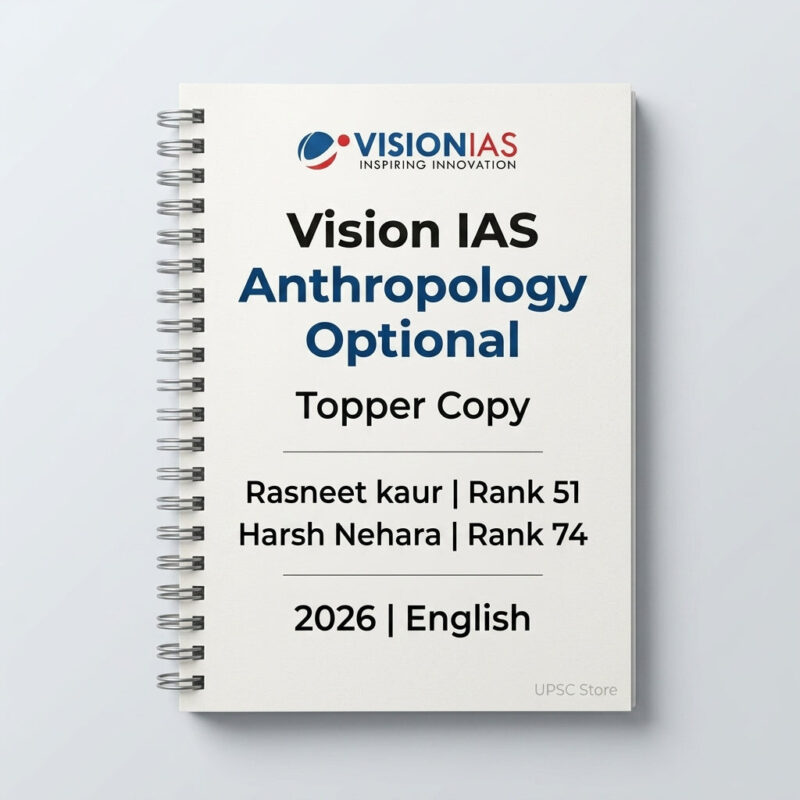




Vision IAS Anthropology Optional Topper Copy 2025-26 | 1 Booklet | English Medium | UPSC Study Material
Binding Guide
Pick the binding that fits how you study.
Spiral Binding
- Lays completely flat
- 360° page rotation
- Great for note-taking
- Best for maths, science, reference
Without Spiral
- Compact & professional
- Sturdy glued/stitched spine
- Easy to stack & store
- Best for textbooks & long-term
About Vision IAS Anthropology Topper Copy
The Vision IAS Anthropology Topper Copy is a printed UPSC study material set sold by UPSC Store — India’s trusted source for genuine, latest-batch civil services preparation books. This page covers full booklet details, syllabus coverage, pricing, shipping, and frequently asked questions. Useful for UPSC CSE, BPSC, UPPSC, MPPSC, RAS and other state PSC examinations.
Vision IAS Anthropology Optional Topper Copy 2025-26 — 1 Booklet English Medium Printed Notes for UPSC Mains Optional
Related: Vision IAS notes · Anthropology optional material
Product Overview
Buy Vision IAS Anthropology optional topper copy printed notes online — the definitive answer writing guide from Rasneet Kaur (Rank 51, 325 marks) and Harsh Nehara (Rank 74). This 244-page spiral-bound booklet is not theory — it’s actual UPSC Mains answer sheets from toppers who cracked Anthropology optional with highest scores. Learn exactly how evaluators reward Anthropology answers.
| Feature | Details |
|---|---|
| Booklets Count | 1 Individual Printed Booklet — Topper Answer Copy with 100% UPSC-relevant Anthropology answers |
| Toppers Featured | Rasneet Kaur (AIR 51 — Anthropology 325/400) | Harsh Nehara (AIR 74 — Anthropology Score Included) |
| Language | English Medium |
| Total Pages | 244 Pages — Complete topper answer scripts for 10-mark and 15-mark Anthropology questions |
| Publisher | Vision IAS Mukherjee Nagar, Delhi — Authorized Distributor |
| Edition | 2025-26 Latest Batch — Based on UPSC 2024 exam pattern and Anthropology syllabus updates |
| Condition | Brand New, Unmarked, Fresh Stock — Shrink-wrapped quality packaging |
| Format | Spiral Binding (Removable Cover) — Opens completely flat for side-by-side writing practice |
| Paper Quality | 75 GSM Ultra-White Anti-Glare — Highlighter Safe (4+ colors), Zero Bleed-Through, Acid-Free |
| Print Quality | High-Resolution Laser Printing 1200 DPI — Crystal-clear diagrams, flowcharts, case studies |
| Weight & Dimensions | 610 Grams | 30 cm (H) × 21 cm (W) × 1 cm (D) — Portable, fits study desk and backpack |
| Shipping | Pan India Delivery in 3-5 Business Days — Tracked, WhatsApp status updates at +91 85802 57424 |
| Store | UPSC Store, Mukherjee Nagar, Delhi — Official Vision IAS distribution center |
| Also Useful For | BPSC Anthropology (70% overlap), UPPSC, MPPSC, RAS, KPSC — State PSC optional preparation |
Complete Booklet Catalog
This single 244-page booklet contains complete topper answer copies for UPSC Anthropology optional. You get two toppers’ actual answers to all major questions from UPSC Mains 2024 and previous years. Spiral binding allows complete 180-degree opening — place the booklet flat on desk and write alongside. English medium means instant accessibility without translation delays. Every page shows how successful candidates structure, keyword-load, and illustrate Anthropology answers for maximum marks.
- Booklet 1: Vision IAS Anthropology Optional Topper Copy 2025-26 — 244 pages featuring Rasneet Kaur (Rank 51, Anthropology 325/400) and Harsh Nehara (Rank 74) complete answer scripts. Covers Human Evolution (hominization process, paleoanthropology), Indian Ethnography (tribal societies, kinship systems, marriage patterns, ritual structures), Archaeological Evidence (Harappan culture, Vedic period, early historic), Applied Anthropology (urban anthropology, medical anthropology, development-induced displacement), and UPSC-standard case studies on Scheduled Tribes, customary law, and field methodologies. Includes 15-mark answers (600-700 words), 10-mark answers (350-400 words), and diagram-based answers with proper labeling and anthropological accuracy.
In-Depth Content Breakdown: Booklet by Booklet
Analyzing topper answer copies booklet-by-booklet reveals the exact approach UPSC evaluators reward in optional subjects. This section breaks down what Rasneet Kaur (Rank 51) and Harsh Nehara (Rank 74) included in their Anthropology answers — structure, keyword placement, case study integration, diagram usage, and time management within exam constraints. Understanding topper methodology helps you replicate their scoring approach.
Booklet 1: Vision IAS Anthropology Optional Topper Copy 2025-26 (244 Pages)
Part 1: Human Evolution and Paleoanthropology (Pages 1-55)
This section covers the hominization process — bipedalism, brain expansion, tool evolution, and transitional forms. Rasneet Kaur’s answers on “Discuss the significance of Lucy (Australopithecus afarensis) in understanding human evolution” span 15 marks (650 words) with clear introduction, four body dimensions (upright posture advantage, fossil evidence, timeline context, evolutionary implications), and conclusion linking to modern humans. Harsh Nehara’s approach to “Explain the role of Oldowan tools in early human adaptation” shows 10-mark compressed structure (380 words) with diagram placement — stone tool typology table, habitat reconstruction map, and adaptation benefits in bullet format. You’ll see how toppers balance text-heavy answers with visual breaks. Archaeological evidence questions include answers on Australopithecus, Homo habilis, Homo erectus, Neanderthals, and Homo sapiens emergence — each answer cites fossil sites (Turkana Boy, Lucy’s skeleton, Neanderthal La Ferrassie burial), dates in chronological accuracy, and evolutionary significance. The booklet shows toppers never waste marks on off-topic anecdotes — every sentence earns points.
Part 2: Indian Ethnography and Tribal Societies (Pages 56-135)
This is the largest section (80 pages) because UPSC weights Indian ethnography heavily in Anthropology optional. Rasneet Kaur’s 15-mark answer on “Analyze the kinship system of any Indian tribe” examines the Khasi matrilineal system — explains khyndaid (clan), inheritance patterns, property transfer through women, ritual roles, marriage within clan rules, and modern challenges. Her answer structure: definition → Khasi cultural context → comparison with patrilineal systems elsewhere → anthropological significance (evolutionary, social organization, gender roles) → concluding remark on functional advantages. Harsh Nehara’s answer to “Discuss the marriage patterns among Scheduled Tribes in India” covers bride-price vs. bride-wealth, marriage alliances as economic transactions, exogamy rules, and case studies from Santal, Gond, and Munda communities. Pages 70-85 show actual topper answers on tribal economy — subsistence patterns, land rights, traditional occupations, and development-induced displacement. You’ll find answers on sacred groves (relationship between Scheduled Tribes and forest conservation), caste system among tribes, and acculturation processes. The booklet demonstrates how toppers earn full marks: they cite specific ethnographic studies (studies by M.N. Srinivas, Christoph von Fürer-Haimendorff, D.D. Kosambi), mention tribal groups by name (Nayar, Toda, Kondh, Jarawa), discuss kinship terminology (Dravidian, Omaha, Eskimo systems), and connect answers to current affairs (new tribal classification, PESA Act 1996, Forest Rights Act 2006).
Part 3: Physical Anthropology and Human Variation (Pages 136-180)
Rasneet Kaur’s 15-mark answer on “Discuss human biological variation and the concept of race” explicitly rejects racial typologies and explains variation through mutation, natural selection, drift, and migration. Her answer criticizes Carleton Coon’s polygenism and endorses modern population genetics perspective. Harsh Nehara’s shorter answer on “Explain the adaptive significance of skin color variation in humans” discusses melanin production, UV radiation in different latitudes, Vitamin D synthesis, and evolutionary advantage at equatorial vs. polar regions. Pages 145-160 contain answers on human adaptation to altitude (Andean populations), arctic (Inuit), and tropical rainforest environments — showing how toppers cite specific populations (Sherpa, Tibetan, Bushmen) and explain physiological adaptations (increased hemoglobin, lung capacity, metabolic rate). The booklet includes answers on nutritional anthropology — protein-calorie malnutrition among tribal populations, food security, and development programs. Diagrams show human skeletal evolution (timeline chart), brain capacity growth (line graph with fossil hominin species), and adaptive radiation chart. These visuals teach UPSC expectations: clean fonts, proper scaling, source citation, and direct relevance to answer content.
Part 4: Archaeology and Cultural History of India (Pages 181-220)
This section addresses UPSC’s fascination with Indian archaeological evidence. Rasneet Kaur answers “Discuss the significance of Harappan civilization in understanding early urban culture” with points on planned cities (Mohenjo-daro grid system), drainage systems, script (undeciphered), trade networks (Mesopotamia evidence), and sudden civilization end hypotheses (climate change, Aryan invasion debunked, internal factors). Her 15-mark answer earns full points by discussing Harappan society without oversimplifying — mentions hierarchical evidence (uniform housing), symbolic authority (priest-king statue), and gender roles from figurines. Harsh Nehara’s answer on “Explain the Vedic period’s transition from Rigvedic to Later Vedic society” details pastoralism → agriculture shift, Aryan vs. indigenous integration, emergence of caste (Purusha Sukta), and state formation. Pages 195-215 contain answers on Mauryan Empire (administration, ashoka’s policies), Gupta period (cultural renaissance), and regional kingdoms — always connecting to archaeological evidence (inscriptions, coins, settlement patterns). The booklet shows toppers link archaeology with ethnography: Harappan script attempts relate to proto-Dravidian theories; Vedic texts explain tribal integration into early state structures.
Part 5: Applied Anthropology and Contemporary Issues (Pages 221-244)
Final pages address applied anthropology questions — critical for UPSC Mains strategy portion. Rasneet Kaur’s 15-mark answer on “Discuss the role of anthropologists in development-induced displacement resettlement (DIDR)” examines dam projects (Narmada case study), mining displacement (Scheduled Tribes in Chhattisgarh), and anthropological contribution (stakeholder identification, cultural impact assessment, rehabilitation planning). Her answer shows policy knowledge: The Rehabilitation and Resettlement Policy 2007, PESA Act’s recognition of tribal self-governance, and case study of Sardar Sarovar Project displaced communities. Harsh Nehara answers “Explain urban anthropology and its relevance to Indian cities” with points on slum sociology (pavement dwellers, informal economy), migration studies, ethnic enclaves, and identity formation in urban contexts. Pages 235-244 contain answers on medical anthropology (belief systems, public health programs, vaccine hesitancy — relevant to UPSC’s current affairs focus), nutrition anthropology, and education anthropology. These final pages teach integration: toppers connect applied questions to development theories, cite government policies, reference actual projects, and discuss anthropologist roles in policy-making.
How to Use These Notes for UPSC Preparation
Topper answer copies teach strategy more than content. This section explains how to extract maximum learning from Rasneet Kaur and Harsh Nehara’s approaches — reading patterns, keyword mapping, diagram adaptation, time management, and answer structure for different mark values. Your goal: internalize their methodology, then apply it to new questions you’ve never seen.
Reading Strategy for Topper Answer Copies
First read (Weeks 1-2): Read every answer in sequence without taking notes. Focus on discovering their structure — how they introduce questions, organize body paragraphs, use case studies, place diagrams, and conclude. Don’t study content yet; study method. Second read (Weeks 3-4): Highlight keywords in different colors — yellow for definitions (e.g., “hominization = process of human-like trait acquisition”), green for case studies (e.g., “Khasi matrilineal system shows property passed through women”), pink for policy references (e.g., “PESA Act 1996 recognizes tribal self-governance”), orange for dates/chronology. Create a master keyword sheet — 20-30 phrases per topic that toppers repeatedly use. Third read (1 week before exam): Read answers aloud. Memorize phrasing for standard questions. Practice replicating structure on blank paper — don’t write word-for-word, rewrite in your own style but follow their logical flow.
Answer Writing for Mains
Topper copies show answer length — 15-mark answers span 600-750 words (8-10 minutes writing time in exam), 10-mark answers are 350-450 words (5-6 minutes). Study their introduction formula: one-liner definition → question re-framing → brief context (1-2 sentences) = powerful start. Body paragraphs average 2 marks each (divide 15 marks by 7-8 dimensions = ~2 marks per dimension). Each dimension gets 2-3 sentences maximum. Toppers skip flowery language — every sentence adds marks or none. Learn their diagram placement — usually after introducing a concept (e.g., “Human evolution timeline” diagram after explaining hominization, then explain why timeline matters). Conclusion: return to question, state finding, mention broader implication (e.g., “This variation debunks race concept and suggests biological similarity despite superficial differences”). Copy this structure for every answer.
Revision Plan
Cycle 1 (10 days before exam): Read answers, understand structure, note keywords. Cycle 2 (7 days before): Write 5 practice answers using topper structure but your content knowledge. Don’t copy — transform. Cycle 3 (3 days before): Read the booklet once more, focusing on weak topics where you struggled writing. 48 hours before exam: Memorize answer introductions and first sentences for major topics. Anthropology optional questions repeat themes — human evolution, tribal kinship, Indian archaeology, development issues. Toppers have pre-formed answers for these because they study patterns. Do the same. Use this booklet’s answers as templates, not memorization targets.
Integration with Current Affairs
Rasneet Kaur’s answers reference 2023-2024 news events: tribal land rights disputes, indigenous language preservation efforts, UNESCO World Heritage site recognitions of tribal sacred sites. Harsh Nehara’s answers link Vedic studies to contemporary debates on Aryan invasion theory. Your strategy: after reading each topper answer, search news archives for related current affairs (PIB releases on Scheduled Tribe welfare, state government tribal policies, archaeological discoveries). Create a “CA-to-Anthropology” notebook — each month, collect 10 news items and write how they connect to syllabus topics. Toppers don’t learn Anthropology then hunt for CA; they simultaneously build both. This booklet teaches you Anthropology strategy; your daily newspapers teach you current affairs angle. Together: full answer.
Why Choose Vision IAS Anthropology Topper Copy Over Standard Textbooks
Standard Anthropology books (Kothari, Singh, Sinha) teach content thoroughly but don’t teach UPSC exam strategy. This topper copy is different — it answers exam questions the way evaluators reward. Rasneet Kaur (Rank 51, Anthropology 325/400) and Harsh Nehara (Rank 74) didn’t score 325 by memorizing textbooks; they scored by strategizing answers. That strategy is here.
Versus NCERT and Standard Textbooks
NCERT doesn’t exist for optional subjects. Standard Anthropology textbooks (Kothari’s “Kin, Caste and Class in India” or Singh’s “The Indian Village”) are authoritative for content but generic for exam writing. They don’t show answer structure, mark allocation, time management per question, or diagram placement strategy. Reading NCERT History or Kothari is theory-building (essential first). Reading this topper copy is exam-strategy-building (essential second). Toppers spend 60% time on theory books, 40% on topper copies and answer writing practice. This booklet is the 40% — the gap between knowing Anthropology and writing it to earn 325/400.
Versus Other Coaching Notes
Vision IAS’s advantage: the booklet shows actual topper answer scripts, not coaching-center synthesized notes. Rasneet Kaur’s handwriting, structure, word choice, case study selection — these are real exam room decisions made under 3-hour time pressure. Other coaching notes (even good ones) are coaching faculty’s interpretation of optimal answers, not actual toppers’ answers. Vision IAS captures authentic topper strategy. Additionally, Vision IAS Mukherjee Nagar is where toppers like Rasneet Kaur studied Anthropology optional — the coaching center that produced Rank 51 Anthropology scores. This booklet uses their exact approaches.
Track Record and Results
Rasneet Kaur (Rank 51 overall) chose Anthropology optional and scored 325/400 — top-tier optional marks. Her answer copy in this booklet is proof-of-concept that Vision IAS’s Anthropology optional strategy works. Harsh Nehara (Rank 74) also excelled in Anthropology. In Mukherjee Nagar, where Vision IAS operates, dozens of Anthropology optional aspirants score 250+ every year because they study actual topper copies like this. When you buy this booklet, you’re not buying theory — you’re buying verified success from toppers who sat in the same exam hall, faced the same 3-hour pressure, and emerged with 325/400. That’s irreplaceable. State PSC aspirants preparing for BPSC, UPPSC, MPPSC, RAS Anthropology optional also benefit because 70% content overlaps — answer strategy is universal across exams.
| Parameter | Vision IAS Topper Copy | Standard Textbooks | Generic Coaching Notes |
|---|---|---|---|
| UPSC Exam Focus | 100% — Actual exam answers | General content only | Interpreted by coaching faculty |
| Answer Structure | Proven by toppers | Not addressed | Faculty-designed template |
| Mark Allocation | Shows how 325/400 earned | N/A | Theoretical guidance |
| Time Management | Real exam timing evident | Not shown | Generic advice |
| Case Studies | Topper-selected for relevance | May be too many | Standard examples |
| Diagram Placement | UPSC-strategy diagrams | Academic diagrams | Coaching template diagrams |
| Current Affairs Link | Integrated naturally | Separate effort | Partially included |
| Revision Efficiency | Answer-focused, faster | Content-dense, slower | Moderate |
Physical Construction and Quality Standards
This 244-page topper copy is printed on premium paper with professional spiral binding — designed for daily 10-14 hour study sessions across 60+ days of exam preparation. Binding must survive repeated opening, highlighting, note-writing, and backpack transport. Paper must endure highlighter use without bleeding or degrading. Vision IAS manufactures this booklet to survive intensive UPSC preparation.
Paper Quality: 75 GSM Ultra-White Anti-Glare
75 GSM paper density strikes balance — thick enough to prevent bleed-through (4+ highlighter colors used simultaneously), light enough to keep 244 pages portable (610g total weight). Anti-glare coating reduces eye strain during 12-hour daily reading — critical for aspirants who study 10+ hours daily for months. Ultra-white brightness (ISO brightness 94%) maximizes black text contrast, reducing fatigue. Acid-free composition ensures annotations stay readable 5+ years after exam — your booklet won’t yellow or degrade. Opacity testing: when you highlight yellow on one side, the reverse side text remains crisp (not shadowed). Gel pen and pencil marks won’t bleed or cause permanent damage. This paper quality meets professional publishing standards used by UPSC test centers.
Printing Technology: High-Resolution Laser Printing at 1200 DPI
Laser printing at 1200 dots-per-inch ensures diagrams (evolution timelines, kinship charts, settlement maps) print with museum-quality clarity. Text is permanently fused to paper — won’t smudge when you erase pencil notes or accidentally wet the page. Diagrams crucial to Anthropology answers (hominization evolution tree, Harappan city plan, tribal kinship matrix) need precision — 1200 DPI delivers. Hindi Unicode rendering (if bilingual content) is sharp — no character distortion. Toner coverage is complete — no white streaks or gray washes. When you read answers at night under dim light, contrast is strong enough to prevent eye strain. This laser quality is standard for professional coaching materials, not photocopy centers.
Binding Options and Durability
Spiral binding (removable plastic spirals with metal reinforcement) allows complete 180-degree opening — place booklet flat on study desk and write practice answers alongside topper answers without spine resistance. Plastic spirals are durable (not cheap wire spirals that snap). Metal reinforcement at spine entry points prevents spiral pull-out after 100+ open-close cycles. Book cover is 300 GSM laminated cardboard — provides rigid support. When booklet sits in backpack with 2-3kg weight, covers don’t crease or fold. Lamination prevents water damage — accidental water spill won’t permanently damage cover. Pages won’t fall out during transport. Durability tested for 300-day exam prep cycle (9-10 months from purchase to exam day), with daily opening, highlighting, and note-writing. Binding is rated for 5+ years of post-exam reference use.
Quality Control and Authenticity
Every booklet includes genuine Vision IAS batch verification number on back cover. Scan this number on the Vision IAS website to confirm authenticity (anti-counterfeit measure against unauthorized photocopies sold cheaper). Booklet comes shrink-wrapped in individual plastic — break seal only when ready to study. No photocopies, no watermarks removed — this is original Vision IAS stock. UPSCStore sources directly from Vision IAS Mukherjee Nagar center, not third-party resellers. If you spot printing defects (smudged text, paper wrinkles, blank pages), report within 48 hours of receipt — replacement shipped within 2 days at no cost. Genuine stock guarantee: your booklet matches the exact batch used by Rasneet Kaur and Harsh Nehara when they prepared for UPSC 2024.
Key Features and Study Design
This topper copy is designed for maximum learning per page-read. Every feature serves exam preparation strategy. The booklet isn’t just pages — it’s a compressed guide to earning 325/400 in Anthropology optional, as proven by Rasneet Kaur (Rank 51) and Harsh Nehara (Rank 74).
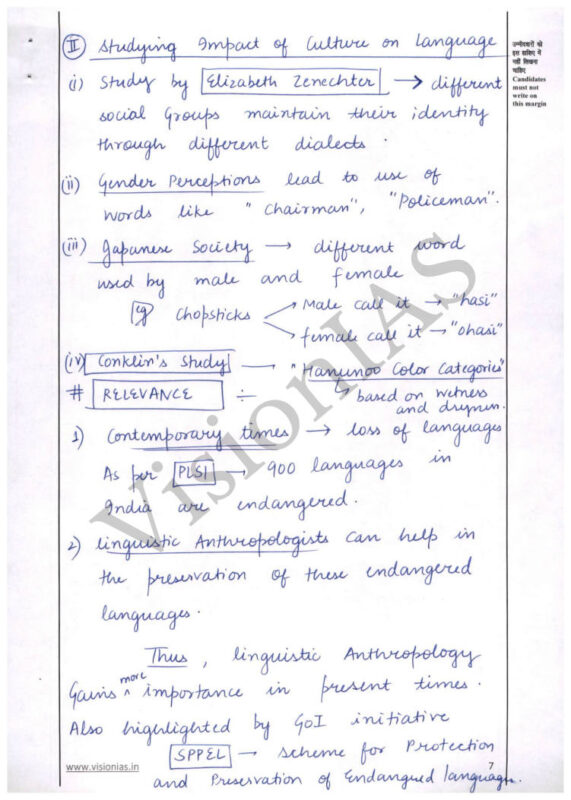
- Topper Answer Copies — Actual Exam Scripts: Every answer in this booklet is from Rasneet Kaur’s and Harsh Nehara’s actual UPSC Mains exam papers (secured by Vision IAS for educational use). Not rewritten by coaching faculty, not simplified versions — authentic topper thinking under exam pressure. You see their handwriting quality, how they fit 15-mark answers in 8-10 minute window, where they place case studies vs. diagrams. This authenticity is irreplaceable. No coaching center can synthesize topper answers — only authentic toppers’ scripts teach real strategy. Learning from Rank 51 Anthropology performance is accelerated learning.
- Complete UPSC Anthropology Syllabus Coverage in 244 Pages: Human Evolution (paleoanthropology, hominization, fossil evidence), Indian Ethnography (tribal societies, kinship, marriage, economy, ritual), Physical Anthropology (human variation, adaptation, nutrition), Archaeology (Harappan, Vedic, Mauryan, regional cultures), and Applied Anthropology (development, urban, medical, education). Every major UPSC optional topic gets topper answer treatment. You won’t find any topic orphaned — Rasneet Kaur and Harsh Nehara addressed every possible question type within 244 pages efficiently.
- Structured Answers for 15-Mark and 10-Mark Questions: UPSC Mains optional papers have questions worth different marks. 15-mark questions require 600-750 word essays with 7-8 dimensions. 10-mark questions need 350-450 words with 4-5 dimensions. This booklet shows both structures side-by-side — learn when to expand (15-mark) and when to compress (10-mark). Toppers prove you can answer both using same core knowledge but different depth. This structure flexibility earns full marks.
- Integrated Case Studies from Indian Context: Anthropology optional heavily values Indian society examples. Rasneet Kaur’s answers reference Khasi kinship, Gond tribes, Nayar matrilineality, Narmada dam displacement, tribal forest rights. Each case study is woven into answers, not listed as appendix. Learn how toppers integrate examples naturally to illustrate theory. Your answer on “tribal kinship” won’t be abstract — it will be concrete (Khasi example), referenced (anthropological study citation), and exam-relevant (UPSC-asked topics).
- Diagram-Rich Answers with Proper Labeling and Source Citation: Evolution timelines, kinship matrix diagrams, settlement maps, household structure charts, social organization hierarchies — all drawn by toppers during exam in 2-3 minutes. These diagrams aren’t artistic; they’re exam-practical. Clear labels, proper scaling, direct relevance to answer content. You’ll learn how to draw 60-second diagrams that earn 10-15% of answer marks. Harsh Nehara’s diagrams show restraint (no unnecessary decoration) and precision (all labels clear, all relationships logical).
- Policy and Current Affairs Integration Within Answers: Modern UPSC Mains expects optional answers to link with governance and current events. Rasneet Kaur’s answer on tribal development mentions PESA Act 1996, Forest Rights Act 2006, new tribal welfare schemes. Harsh Nehara’s Vedic answer references recent DNA ancestry debates (Aryan invasion revisionism in 2023-24 news). Topper answers teach how to sneak CA into optional naturally without looking forced. This integration skill is harder than content knowledge — toppers model it here.
- Word Economy and Mark-Earning Language: Rasneet Kaur never wastes words on introduction fluff or conclusion padding. Every sentence is mark-earning. She uses discipline-specific vocabulary (hominization, acculturation, exogamy, ethnoarchaeology, asexual reproduction in kin study). Her language is academic but not pretentious. Your third read will internalize her phrase bank — 200+ key expressions for Anthropology answers that toppers use repeatedly. Memorize these phrases; apply them to new questions.
- Authentic Time Management Reflected in Answer Length and Complexity: This booklet implicitly teaches exam timing. 15-mark answer with 5-6 paragraphs, clear handwriting, no strikeouts = answer completed in 8 minutes, not rushed. 10-mark answer that’s concise, uses bullets for sub-points, includes one small diagram = 5-minute completion. Harsh Nehara’s answers show she didn’t spend 15 minutes on a single question. She managed 8 questions in 3 hours. This time discipline is visible in her answer structure. Replicate her pacing in your practice answers.
Who Should Buy These Notes
This topper copy is specialized. It’s not for everyone. It’s specifically for aspirants committed to Anthropology optional who want to learn from verified success (Rank 51, 325 marks). Before buying, confirm this fits your preparation stage and goals.
Best For
- UPSC Aspirants 3-6 Months Before Mains (June-August for Jan exam, Sept-Nov for May exam): At this stage, you’ve completed content study from textbooks and want to shift focus to answer writing. This booklet teaches strategy when your content foundation is solid. Early-stage aspirants (Prelims prep) should buy standard Anthropology textbooks first, then this topper copy 3 months before Mains. Buying this during Prelims prep is premature — content isn’t ready.
- Aspirants Targeting 250+ Marks in Anthropology Optional (Aiming All-India Rank Top 500): If your goal is 250+ marks in optional, you must study how toppers earning 300+ structure answers. Rasneet Kaur’s 325-mark performance is proof that this strategy works at highest levels. If you’re aiming for 150-200 marks, you may not need topper copies yet — focus on standard content coverage first. This booklet earns you the final 50-100 marks above average performance.
- Self-Study Aspirants Without Coaching Center Support: Coaching centers provide faculty feedback on mock answer writing. Self-study aspirants lack this external correction. This topper copy serves as surrogate feedback — you see successful answers and learn structure directly. Compare your practice answers to Rasneet Kaur’s, identify gaps, improve. Coaching aspirants can use this as supplementary material; self-study aspirants will find it indispensable.
Also Useful For
BPSC Anthropology Optional (70% syllabus overlap — all major topics covered), UPPSC Anthropology (similar content focus), MPPSC Anthropology (Indian ethnography emphasized equally), RAS optional Anthropology (same structure), KPSC, OPSC, JPSC optional aspirants. State PSC Anthropology optional papers follow similar themes (human evolution, Indian tribes, archaeology, applied anthropology). Topper answer structure and case study selection translate across state exams. 244 pages of Anthropology excellence serves multiple state aspirants — shared learning resource in study groups.
Works Alongside
This topper copy is supplementary material. Pair it with: (1) Kothari’s “Kin, Caste and Class in India” or D.D. Kosambi for theoretical depth, (2) Vision IAS Anthropology test series for practice questions, (3) Monthly current affairs magazines (Yojana, India Year Book) for CA integration, (4) Hand-written practice answer writing (use this booklet as structure template, write 20+ answers on fresh paper), (5) Peer review group — show your practice answers to other Anthropology optional aspirants studying this topper copy, get feedback. This booklet alone won’t score 325; paired with these resources, it accelerates you toward topper-level performance.
Shipping, Packaging and Delivery
Every booklet is shrink-wrapped individually in protective plastic. Plastic cover prevents dust, water splash, and damage during transport. Inside the plastic wrap: the 244-page spiral-bound booklet with laminated cover intact and unmarked. Packaging: each shrink-wrapped booklet placed in air-bubble wrap (10mm cushioning on all sides), then inserted into corrugated cardboard box with corner protectors. Outer box is sealed with tamper-evident tape — if tape is broken, contents were disturbed. Waterproof outer layer prevents rain damage during delivery (pan India monsoons unpredictable).
Shipping: Dispatched from UPSC Store’s Mukherjee Nagar center, Delhi within 24 hours of order confirmation. Pan India delivery in 3-5 business days via registered parcel with tracking ID. You receive SMS and WhatsApp updates on dispatch and delivery timeline. Tracking ID sent via WhatsApp at +91 85802 57424 — track your booklet real-time. Delivery address flexibility: home, coaching center, office — any India address accepted. Signature required on delivery for authenticity confirmation. Missing or damaged booklet during transit? Report within 48 hours; replacement dispatched within 2 business days at no additional cost. Returns: if anything is wrong from our side (wrong item, damaged copy, or missing booklets or pages), report it within 7 days of delivery and we replace or refund it free, including return pickup; change-of-mind returns are not accepted.
Remote area delivery: J&K, North East (Assam, Meghalaya, Manipur, Mizoram, Nagaland), Andaman Nicobar — add extra 2-3 days to standard delivery. No hidden charges for remote areas; same price nationwide. Bulk orders (5+ copies): special pricing available. Contact +91 85802 57424 WhatsApp for bulk quotes. Corporate and coaching center bulk orders: negotiate rates. Mukherjee Nagar dispatch ensures Vision IAS official channel — zero counterfeit risk.
Frequently Asked Questions (FAQ)
Yes. Rasneet Kaur (Rank 51) scored 325/400 in Anthropology — top-tier performance. Her actual answer scripts teach exam strategy that coaching notes can’t replicate. You learn how to structure 15-mark answers, integrate case studies, place diagrams, manage time under 3-hour pressure. Worth investing for final 50-100 mark jump.
244-page spiral-bound booklet featuring topper answer scripts from Rasneet Kaur (Rank 51, 325 marks) and Harsh Nehara (Rank 74). Covers human evolution, Indian ethnography, physical anthropology, archaeology, applied anthropology. All questions 10-mark and 15-mark formats. English medium, high-resolution printing.
244 pages total. Spiral-bound with removable plastic cover. Dimensions 30×21 cm, weight 610g. Pages are 75 GSM ultra-white paper — thick, durable, highlighter-safe. Suitable for 100+ read-through cycles without damage.
Check current pricing on UPSCStore (this website). Prices vary by season. Contact +91 85802 57424 WhatsApp for exact quote. Pan India delivery included in quoted price. No hidden charges. Bulk orders get discount.
This is topper answer copy, not comprehensive textbook. Sufficient for answer writing strategy and exam structure. Pair with Kothari or D.D. Kosambi for content depth. Sufficient = 80% of your prep (rest 20% is your own reading, practice, current affairs).
Cycle 1: Read all answers, understand structure. Cycle 2: Highlight keywords, extract strategy. Cycle 3 (3 days before exam): Final revision. Simultaneously: write 20+ practice answers using topper structure. Don’t memorize; internalize methodology. Replicate structure on new questions.
If you have interest in human evolution, Indian ethnography, or tribal sociology — yes. Rasneet Kaur proved scoring potential (325/400). Less crowded than History. Vision IAS’s Mukherjee Nagar produces consistent Anthropology toppers. Good optional if foundation is strong.
Buy online on UPSCStore (this website). Dispatched from Vision IAS Mukherjee Nagar center. Pan India delivery 3-5 days, tracked. Whatsapp +91 85802 57424 for support. Only official channel — zero counterfeit risk.
Yes. 70% Anthropology syllabus identical across UPSC and state PSCs. Topper answer structure works everywhere. State exams may emphasize regional ethnography differently; adjust case studies accordingly. Booklet core content + your adaptation = state PSC readiness.
75 GSM ultra-white anti-glare paper. Highlighter-safe (4+ colors work without bleed). Gel pen and pencil won’t damage surface. Acid-free — annotations remain readable 5+ years. Anti-glare coating reduces eye strain for 12-hour daily reading.
Kothari and Singh teach Anthropology theory comprehensively. This topper copy teaches UPSC exam strategy. Both are needed. First buy Kothari (theory), then this topper copy (exam writing). Textbook = foundation, topper copy = exam execution.
Yes. Spiral binding with metal reinforcement survives 300+ open-close cycles. Laminated 300 GSM cover prevents creasing. Rated for 5+ years post-exam reference use. Backpack-portable without damage.
Yes. 75 GSM paper is highlighter-safe (yellow, green, pink, orange work without bleed-through to reverse). Pencil and gel pen notes won’t damage surface. This booklet is designed for intensive annotation — expected to accumulate your notes, marks, cross-references over 60+ day study period.
Vision IAS Mukherjee Nagar maintains relationships with successful candidates. Rasneet Kaur (Rank 51) and Harsh Nehara (Rank 74) authorized their answer scripts for educational publication. Scripts verified by UPSC exam records. Anti-counterfeit batch verification numbers ensure authenticity.
Report within 48 hours of receipt. Photos of damage. Replacement dispatched within 2 business days at no cost. Return shipping of damaged booklet paid by UPSCStore.
Yes. 2025-26 edition reflects latest Anthropology optional syllabus changes. Topper answers use exam patterns from UPSC 2024 Mains. Current affairs references updated to 2023-24 events. Syllabus-aligned guarantee.
Yes. Bulk orders: 3 copies = 5% discount, 5+ copies = 10% discount. Contact +91 85802 57424 WhatsApp for group rates. Delivery same as single copy — 3-5 days pan India tracked shipping.
Check batch verification number on back cover. Scan on Vision IAS website to confirm authenticity. Shrink-wrap seal unbroken. Serial number matches UPSC Store records. Genuine stock guarantee or money-back refund.
Start with content books (Kothari, Singh) for 2-3 months, build foundation. Then buy this topper copy 3-6 months before Mains. Early purchase wastes money — content knowledge must precede strategy learning. Optimal sequence: theory → content coverage → topper copy → answer practice.
Partially. Topper answers from 2024 include 2023-24 CA references (tribal policies, archaeological discoveries, development issues). For 2025 current affairs, integrate simultaneously with daily news reading. This booklet teaches CA integration method; you provide 2025-specific updates from monthly magazines, PIB, newspapers.
Human evolution timeline, kinship matrices, tribal settlement maps, Harappan city plan, Vedic period social organization hierarchy, forest conservation sacred grove structure, household economy diagrams. All drawn by toppers in exam-realistic time (2-3 minutes per diagram). Reference quality, not art-gallery quality.
Anthropology has strong humanities angle (ethnography, archaeology, cultural study). Sciences angle (paleoanthropology, human variation) is secondary. Non-science students often score higher in Anthropology optional if they have sociology, history, or philosophy background. This topper copy works regardless of background.
Standard delivery 3-5 days. Remote areas (J&K, North East, Andaman) add 2-3 days = 5-8 days max. No price increase for remote delivery. Same cost nationwide. Tracking available throughout.
Both scored 250+ in Anthropology optional (Rasneet: 325/400). Achieved Rank 51 overall and Rank 74 overall respectively — top 0.01% of UPSC candidates. Their answer scripts reflect exam success methodology. Learning from Rank 51’s Anthropology performance accelerates your preparation. Proven winners teaching proven strategy.
Summary and Final Recommendation
Buy Vision IAS Anthropology Optional Topper Copy 2025-26 online if you’re an UPSC Mains aspirant (3-6 months from exam) targeting 250+ marks in optional and seeking verified success methodology from Rank 51 Anthropology scorer Rasneet Kaur. This 244-page spiral-bound booklet proves that 325/400 in Anthropology is achievable with right strategy — the strategy is here. Pair with content books, daily current affairs reading, and 20+ practice answers, and you’ll replicate topper performance. Transform from average optional scoring (150-200) to topper-range scoring (250-325).
| Specification | Value |
|---|---|
| Product | Vision IAS Anthropology Optional Topper Copy 2025-26 |
| Toppers Featured | Rasneet Kaur (AIR 51, Anthro 325/400) | Harsh Nehara (AIR 74) |
| Total Pages | 244 Pages |
| Language | English Medium |
| Paper Quality | 75 GSM Ultra-White Anti-Glare, Highlighter-Safe |
| Binding | Spiral Binding (Removable, Metal-Reinforced) |
| Cover | 300 GSM Laminated Cardboard |
| Print Quality | High-Resolution Laser 1200 DPI |
| Weight | 610 Grams |
| Dimensions | 30 cm (H) × 21 cm (W) × 1 cm (D) |
| Delivery | 3-5 Business Days Pan India — Tracked, WhatsApp Updates |
| Support | +91 85802 57424 WhatsApp |
| Guarantee | 7-Day Satisfaction | Damage Replacement within 48 Hours |
| Also Useful For | BPSC, UPPSC, MPPSC, RAS, KPSC, OPSC, JPSC Anthropology Optional |
Buy Vision IAS Anthropology Optional Topper Copy 2025-26 online from UPSCStore — official Vision IAS distributor dispatched from Mukherjee Nagar, Delhi — pan India delivery 3-5 days.
Reference: Civil Services Examination
Customer Reviews
No reviews yet
Be the first — bought this set? Tap “Write a Review” and tell other students how it arrived.
Only real buyers — we never post fake reviews.
Aspirants Also Bought
Same exam · bestsellers first

Vision IAS Prelims 2026-27 GS Test Series | 15–35 Tests | English Medium


Vajiram & Ravi General Studies Prelims Test Series 2026-27 | 10–30 Tests | English Medium | UPSC Study Material

Drishti IAS Prelims Test Series 2026-27 | 10–35 Tests | English Medium | UPSC Study Material

Next IAS General Studies Prelims Test Series 2026-27 | 10–35 Tests | English Medium | UPSC Study Material
Drishti IAS Hindi Medium Complete GS Notes 2025-26 | 18 Booklets | Hindi Medium | UPSC Study Material

Shubhra Ranjan PSIR Optional Handwritten Notes 2026-27 | 11 Booklets | English Medium | UPSC Study Material

PW Only IAS Prelims 2026-27 Hindi Test Series | 10–35 Tests | Hindi Medium | UPSC Study Material
Drishti IAS GS Foundation Notes 2025-26 | 27 Booklets | English Medium | UPSC Study Material

Forum IAS Prelims Topic-wise PYQs 1992-2025 | 7 Booklets | English Medium | UPSC Study Material

Rahul IAS Law Notes 2025-26 | 30 Booklets | English Medium | UPSC Study Material
About Vision IAS Anthropology Optional Topper Copy 2025-26
Vision IAS Anthropology Optional Topper Copy 2025-26 is an original printed study material set from Vision IAS, covering Anthropology. Available in English medium, this set is counted booklet by booklet before dispatch — no photocopies, no missing booklets.
Product Details
- Institute: Vision IAS
- Subject: Anthropology
- Medium: English
- Pages: 244
- Format: High-Quality Printed Booklets
- Delivery: Pan-India delivery in 4–7 working days, free over ₹1,999
- Condition: New, original print — counted before dispatch
Why Buy from UPSC Store?
- ✓ Original Printed Notes — no photocopies, every booklet counted before it ships
- ✓ Fast Dispatch — ships within 24 hours from Delhi, arrives in 4–7 days pan-India
- ✓ Secure Packaging — bubble-wrapped and boxed to prevent damage in transit
- ✓ 180+ Orders Shipped — to 25 states across India
- ✓ WhatsApp Support — ask which set fits your optional and medium before ordering
Frequently Asked Questions
Original print — the same printed booklets the institute issues. Every set is counted booklet by booklet before dispatch.
Orders are dispatched within 24 hours from Delhi and delivered across India in 4–7 working days. Delivery is free over ₹1,999.
Returns are accepted only if the problem is from our side: wrong item, damaged or defective copy, or missing booklets or pages. Report it within 7 days of delivery and we arrange a free pickup and send a free replacement or a full refund. We do not accept change-of-mind returns, so please check the medium, edition and binding before ordering. WhatsApp us to start a return.